
If you treat supplier selection like shopping, you will pay for it in production. Clothing manufacturer vetting is the discipline that stops “good sample, bad bulk,” unrealistic lead times, and hidden subcontracting before they become costly surprises.
This guide is built for brand owners, sourcing managers, merchandisers, and ops leads who need a repeatable way to evaluate a factory using evidence, not opinions. Done properly, clothing manufacturer vetting can reduce supplier risk, improve quote accuracy, and lower the likelihood of avoidable production and delivery problems.
By the end, you will have a structured workflow, a supplier scoring model, an evidence pack checklist, and a production readiness gate you can reuse for every new supplier. This is clothing manufacturer vetting as an operating system, not a one-time event.
Quick Answer: Clothing Manufacturer Vetting Framework
Pre-screen → Proof → Pilot → Control → Approve.
Pre-screen removes poor-fit suppliers early. Proof validates documents and systems. Pilot confirms execution under pressure. Control locks approvals and readiness. Approval happens only after all pass/fail gates are cleared.
For the broader manufacturer selection process, read our complete guide to choosing a clothing manufacturer before moving deeper into supplier qualification.
Table of Contents
Clothing Manufacturer Vetting and Due Diligence in Apparel Sourcing: What It Really Means
Clothing manufacturer vetting means verifying what a supplier can repeatedly deliver, using proof. Due diligence means validating claims with records, not promises. In apparel, a factory is not “good” because they can make one sample. They are good when they can deliver the same outcome across sizes, colors, trims, timelines, and volumes. For a broader responsible-sourcing framework, the OECD Due Diligence Guidance for Responsible Supply Chains in the Garment and Footwear Sector explains how companies can identify, prevent, mitigate, and address risks throughout garment and footwear supply chains.
This guide focuses specifically on manufacturer evaluation and proof: manufacturing due diligence, supplier qualification, audit documentation, capability assessment, sample evaluation, and supplier risk assessment. RFQ preparation and supplier onboarding are covered separately because they begin after a supplier has passed the initial qualification process.
A key principle: sampling is not due diligence by itself. Clothing manufacturer vetting proves the system behind the sample, not just the appearance of one unit.
Vetting proves these 5 things:
- Product scope fit (they already make what you sell)
- Capability and capacity realism (machines, people, planning discipline)
- Quality system maturity (control points, inspection records, CAPA closure)
- Compliance and subcontracting controls (who actually makes the goods)
- Execution discipline (approvals, timelines, communication standards)
Clothing Manufacturer Vetting vs Audit vs Onboarding: Use the Correct Terms
Clothing manufacturer vetting is your decision step: qualify or reject before serious spend. An audit is a structured assessment against a defined standard. Onboarding is the operating setup after you choose the supplier, where you align RFQ details, approvals, PP steps, and production controls.
The timeline should be clean. Vetting happens before you invest heavily. Auditing can happen before or during the relationship depending on policy. Onboarding begins after you decide to proceed and before bulk starts, so the control system is installed early.
Clothing Manufacturer Vetting Is a Variability Control System (Not a Tour)
A factory visit can impress you and still hide risk. Clothing manufacturer vetting is about controlling variability: operator differences, fabric instability, inconsistent trims, unmanaged capacity, and weak approvals. Variability is what turns a stable sample into unstable bulk.
This is why supplier risk assessment matters. It converts “I feel confident” into “I have evidence.” When variability is unmanaged, the factory’s output shifts by week, line, and operator, and every shift costs time and rework.
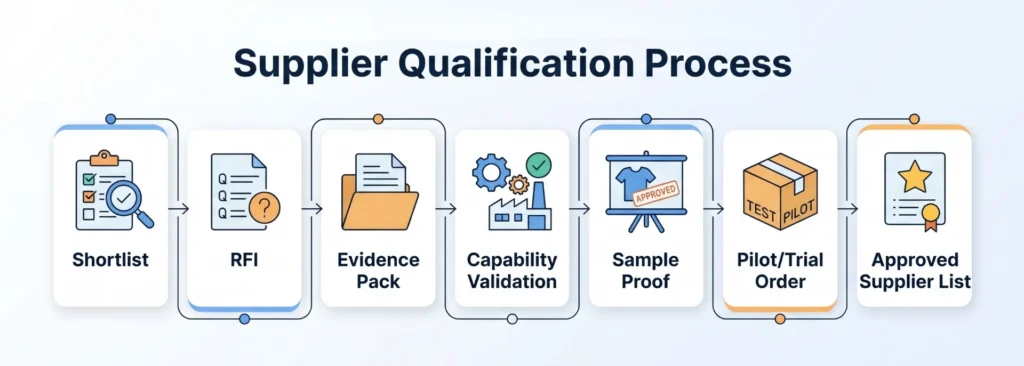
Clothing Manufacturer Vetting Workflow: The Supplier Qualification Process Step-by-Step
The supplier qualification process should be sequential. Clothing manufacturer vetting works best when you eliminate bad fits early, demand proof before samples, and approve only after your pass/fail gates are cleared.
Use this workflow:
- Pre-screen (fit and capacity reality check)
- Evidence pack (audit documentation and proof standards)
- Manufacturing capability assessment (machines, methods, people)
- Quality system validation (control points and records)
- Compliance and subcontracting controls (risk containment)
- Sampling as proof (sample evaluation criteria that test the system)
If you skip the proof stage, you waste sampling budget. If you skip scoring and gates, you inherit risk into bulk. clothing manufacturer vetting is not one activity, it is a pipeline that builds confidence in stages.
For buyers who want to move from supplier vetting into production preparation, the next step is building a structured RFQ, quote comparison, and onboarding process. You can continue with our detailed guide on RFQ and onboarding system to understand how to turn a qualified supplier into a production-ready partner.
Step 1: Pre-Screen a Custom Apparel Supplier (Fit, Scope, Capacity Reality)
Start by filtering for fit. A custom apparel supplier that does not routinely produce your product category will create costly learning curves. Your first objective is to confirm they already execute similar fabrics, constructions, and finishing methods at your expected quality level.
Capacity reality matters as much as skill. Many suppliers will accept orders beyond stable capacity and then solve it with delays, compressed QC, or subcontracting. Ask for monthly capacity by product category, how they book lines, and what happens in peak season.
Use pre-screening to test communication discipline as well. If response quality is vague, slow, or inconsistent now, it will be worse in bulk. This step is part of clothing manufacturer vetting because it eliminates poor fits before deeper due diligence.
Pre-screen questions that eliminate poor fits fast:
- What styles do you produce weekly (not “can you do,” but “do you do”)?
- What is your monthly capacity by category and production line type?
- What is your standard lead time for development sample, PP sample, and bulk?
- How does MOQ change by fabric type and process (print, embroidery, wash)?
- What testing do you run in-house vs outsource, and can you show recent reports?
- What is your approval loop time, and who owns approvals internally?
- What processes are subcontracted, and what controls exist?
Step 2: Evidence Pack Request (Audit Documentation That Proves the System)
Audit documentation is the core of manufacturing due diligence checklist execution. Marketing PDFs do not count. You need real records: dated logs, SOPs, inspection reports, testing reports, CAPA records, and traceable evidence that the system exists and is used.
Your evidence pack should cover five proof categories: legal identity, quality system proof, capacity proof, compliance proof, and testing proof. The goal is to confirm operational maturity before you spend heavily on development.
This stage is where clothing manufacturer vetting becomes evidence-based, and a structured capacity and QC checklist helps you verify whether the supplier’s records reflect a real operating system or only a sales presentation. A supplier that cannot produce clean records is signaling informal operations and high variability.
Evidence Pack Checklist
| Document / Proof Item | Why it matters | Red flag | Verification method |
| Business registration + factory address proof | Confirms legal entity and location | Mismatch across documents | Cross-check invoices, shipping docs |
| Org chart + key contacts | Clarifies accountability | “One person does everything” | Confirm QA + planning ownership |
| SOPs for key processes | Shows control discipline | No SOPs or outdated templates | Request revision dates + training logs |
| QC logs (inline/endline/final) | Proof of control points | No logs or generic logs | Request recent masked samples |
| CAPA records | Proves problem closure | “We fix on the floor” | Ask for closure evidence and dates |
| Testing reports | Proves technical validation | No recent reports | Verify lab name, date, standard |
| Machine list + maintenance logs | Validates capability and uptime | No maintenance history | Request last month’s plan |
| Compliance certificates / audits | ESG gate | Expired or unverifiable | Verify auditor, scope, date |
| Subcontractor disclosure | Controls hidden production | Refusal or vague answers | Request process map + oversight method |
| Production plan sample | Proves planning maturity | “We plan after PO” | Ask for line loading example |
When a supplier provides an accredited management-system certificate, buyers can use IAF CertSearch to verify the certified organization, site, certification scope, issuing body, and current certification status rather than relying only on a PDF copy.
A supplier does not need perfect documents, but the records should be current, traceable, and consistent across functions. If the evidence pack is incomplete, outdated, or contradictory, pause the process before moving into samples or pilot planning.
Step 3: Manufacturing Capability Assessment (Machines, Methods, People)
Manufacturing capability assessment is not a tour. It is a structured verification that the supplier can execute your product with stable methods and measurable controls. Machines matter, but methods and technical leadership matter more.
Assess capability across the full flow: fabric inspection, cutting control, sewing methods, finishing discipline, and packing accuracy. Identify bottlenecks that will hit lead time under pressure, such as specialized machines, limited skilled operators, or weak cutting accuracy.
This is where clothing manufacturer vetting separates “they can do it” from “they can do it reliably.” Ask for proof of similar product execution and connect evidence back to records and outputs.
Capability Assessment Scorecard
| Process area | Required capability | Proof to request | Score (1-5) |
| Fabric inspection | Roll inspection and defect grading | Inspection logs | |
| Cutting | Lay planning and bundling control | Lay plan + SOP | |
| Sewing | Right machine types + skill depth | Machine list + line layout | |
| Printing/Embroidery | Process control and rework discipline | QC logs + approvals | |
| Washing (if used) | Shrinkage and consistency control | Wash reports + SOP | |
| Finishing | Measurement and appearance control | Check logs | |
| Packing | Label/barcode/carton accuracy | Packing SOP + sample | |
| Planning | Line loading + capacity booking | Plan sample | |
| QA ownership | Escalation and CAPA discipline | CAPA examples |
Step 4: Quality System Validation (Control Points, Inspection Discipline, Records)
Quality is not an inspection moment. It is a system of control points supported by records. Weak or inconsistent records are a strong warning sign that production controls may not be applied consistently, even when the sample looks acceptable. This systems-based approach aligns with the concept of a quality management system, where quality depends on defined processes, responsibilities, procedures, and continual control rather than final inspection alone.
Validate inspection stages (inline, endline, final), defect classification discipline, measurement tolerance control, testing alignment, and CAPA closure. If they cannot show consistent logs, you cannot assume consistency in bulk.
This is where clothing manufacturer vetting becomes protection against “silent drift.” When pressure increases, factories with weak systems lose control first.
Non-negotiable QC records to ask for:
- Inline inspection logs (defects, counts, corrective action)
- Endline workmanship and measurement checks
- Final inspection report and AQL sampling evidence
- Rework and repair tracking
- CAPA logs with closure proof
- Testing reports tied to product risk
Where final inspection uses AQL-based sampling, ISO 2859-1:2026 provides the international framework for acceptance sampling by attributes and AQL-indexed lot inspection.
Quality Control System Checks
| Control stage | What is checked | Output record | Red flag |
| Inline | Critical ops, seam quality, trims | Inline QC log | No defect trend tracking |
| Endline | Measurements, workmanship, appearance | Endline report | No tolerance discipline |
| Final | AQL sampling, packing accuracy | Final report | “100% checked” with no records |
| Testing | Shrinkage, fastness, strength | Lab report | No standard references |
| CAPA | Root cause and prevention | CAPA log | No closure timelines |
Step 5: Compliance + Subcontracting Controls (The Hidden Failure Mode)
Compliance is not a certificate. It is control over who makes your goods and under what conditions. One of the most serious hidden risks is uncontrolled subcontracting, where production moves to unknown units to meet deadlines.
Ask for the compliance audit scope and for subcontracting disclosure rules. A factory can be compliant on paper and still outsource high-risk processes without buyer visibility if controls are weak. For Bangladesh sourcing, the Better Work Bangladesh programme is also a useful reference for workplace standards, factory participation, management improvement, and compliance-related risk.
This is a supplier risk assessment priority. clothing manufacturer vetting must include subcontracting governance, because subcontracting failures are often discovered only after quality or delivery collapses.
Subcontracting red flags:
- Absolute denial with no process map
- Refusal to disclose subcontractors for print, embroidery, wash
- No buyer approval gate for subcontracting
- No traceability between batches and process locations
Allowed subcontracting control rules (buyer-side):
- Only defined processes can be subcontracted with pre-approval
- Subcontractor must be disclosed and documented
- Incoming and outgoing QC must be recorded
- Production must be traceable to orders and batches
Step 6: Sample Evaluation Criteria (Use Sampling as Proof, Not Decoration)
Sample evaluation criteria must test the supplier’s system, not just aesthetics. Treat sampling as a controlled experiment, and use a clear questions to ask before sampling checklist to test whether the supplier can follow the tech pack, manage revisions, hold tolerances, and deliver on time while maintaining documentation discipline.
Split sampling checks into technical proof, communication proof, and commercialization proof. Technical proof checks construction, measurements, shrinkage, and appearance. Communication proof checks revision handling and clarity. Commercialization proof checks whether lead time and MOQ logic remain stable when changes occur.
This is part of clothing manufacturer vetting because the sample should validate control behavior under realistic pressure.
Sample Evaluation Criteria
| Criteria | How to test | Pass standard | Common fail reason |
| Measurement accuracy | Measure against spec | Within tolerance | Pattern control weakness |
| Construction quality | Stress points + seam consistency | No critical defects | Operator variability |
| Fabric behavior | Wash test, shrinkage check | Within limits | Wrong fabric or unstable process |
| Color control | Shade matching + consistency | Acceptable delta | Weak dye/print control |
| Trims + labels | Verify against BOM | 100% match | Approval gaps |
| Communication | Revision loop speed | Fast and clear | Vague, slow responses |
| Documentation | Change tracking | Traceable | No change log discipline |
| Timeline realism | Planned vs actual | Stable | Overpromising |
A good sample is not only a visual approval. It is proof that the supplier can control measurements, materials, revisions, and timing under real development conditions.
Need Help Evaluating a Supplier Shortlist?
Bring your supplier shortlist, product requirements, or existing factory information. RYZEAL SOURCING can help you identify capability gaps, quality risks, and the safest next step before you commit to sampling or bulk production.
Supplier Risk Assessment for Clothing Manufacturer Vetting (Make the Decision Measurable)
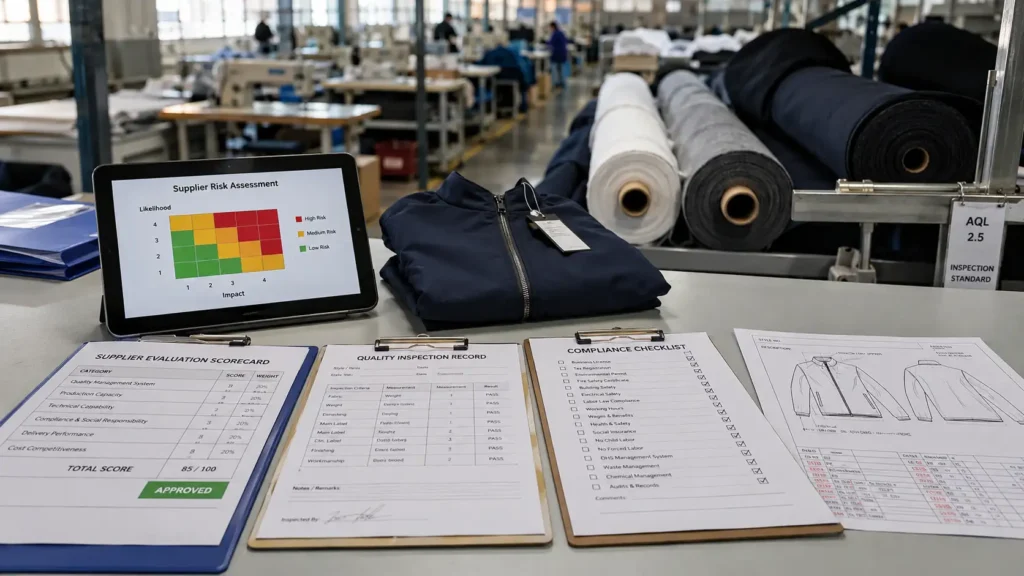
Supplier risk assessment converts impressions into measurable decision logic. Under clothing manufacturer vetting, the point is not to find “perfect.” The point is to identify controllable risk and eliminate suppliers with hidden or unmanaged risk.
Score risk across operational stability, quality system maturity, compliance integrity, capacity reliability, and timeline predictability. Then weight those risks based on your product type. A simple knit tee and a complex technical outerwear style do not carry the same failure modes.
Use scoring to make decisions defensible internally. When stakeholders disagree, the scorecard forces the debate back to evidence. That is exactly what clothing manufacturer vetting is meant to do.
Supplier Risk Assessment Matrix
| Risk area | Indicator | Evidence | Likelihood (1-5) | Impact (1-5) | Mitigation |
| Operational | Weak planning | No line plan, vague lead times | Require plan before PO | ||
| Quality | Weak records | Missing QC logs, no CAPA | Require QC proof + pilot | ||
| Compliance | Subcontracting opacity | No disclosure | Add approval gate + traceability | ||
| Technical | No testing proof | No recent lab reports | Require test plan + reports | ||
| Capacity | Overloaded lines | Unrealistic delivery promises | Confirm line booking | ||
| Communication | Slow approvals | Delayed responses | Set SLA + escalation path |
Weighted Supplier Evaluation Scorecard
| Category | Weight (%) | Score (1-5) | Notes |
| Product scope fit | 15 | ||
| Manufacturing capability assessment | 20 | ||
| Quality system maturity | 20 | ||
| Compliance + subcontracting control | 15 | ||
| Planning + lead time reliability | 15 | ||
| Documentation + responsiveness | 15 |
Pass/Fail Gates: When to Reject a Supplier Even if the Price Looks Great
A structured manufacturer due-diligence process needs clear pass/fail gates. If the supplier fails a gate, the answer is “no,” regardless of pricing. Gates prevent false positives and stop you from negotiating with risk.
Use evidence-based gates only. A gate is not an opinion. It is a proof requirement that must be satisfied before you move forward.
This strengthens clothing manufacturer vetting because it formalizes decisions and reduces emotion-driven exceptions.
Auto-disqualifiers (examples):
- Refuses to provide basic audit documentation
- Cannot show recent QC logs or testing reports
- Hides subcontracting or refuses disclosure
- No accountable QA ownership or CAPA discipline
- Repeatedly misses basic communication timelines during vetting
- Cannot define realistic capacity or lead time logic
- Cannot tie proof to real orders or styles
Quote Behavior Risk Signals (Pricing Is a Symptom)
Quote behavior reveals maturity. If a supplier quotes without asking clarifying questions, they are often guessing. Guessing becomes cost escalation, delays, and disputes later.
Look for quote structure: assumptions, BOM clarity, lead time breakdown, MOQ logic, testing assumptions, and approval timeline references. A good quote shows a thinking process, not just a number.
This is part of clothing manufacturer vetting because pricing credibility is a risk signal, not a commercial win by itself.
Quote red flags:
- Quote delivered with zero technical questions
- No BOM assumptions or fabric testing assumptions
- Lead time stated as one number with no breakdown
- MOQ “flexible” with no logic or thresholds
- No mention of approvals or sampling timeline gates
A structured RFQ can expose many of these risks early by forcing the supplier to confirm assumptions, inclusions, timelines, and accurate RFQ requirements before pricing is accepted.
Approved Supplier List (ASL): Lock Clothing Manufacturer Vetting Into a System
An approved supplier list (ASL) turns one-off supplier decisions into a controlled system. clothing manufacturer vetting without an ASL forces your team to repeat mistakes, lose institutional memory, and reopen risk every season.
An ASL is not a contact list. It stores supplier scope, capability limits, compliance status, risk score, evidence status, and performance history. This is how you protect continuity when people change roles, vendors rotate, or product complexity grows.
The governance rule is simple: only suppliers who pass your workflow and gates can enter the ASL. This makes clothing manufacturer vetting scalable across categories and collections.
Approved Supplier List Fields
Use this table to record each approved supplier’s scope, capacity limits, quality status, compliance status, risk score, and notes.
| Supplier | Product scope | Capacity notes | Lead times | QC system status | Compliance status | Risk score | Notes |
Audit Documentation Standards That Make an ASL Defensible
Audit documentation standards should be strict. If approved suppliers have incomplete or outdated evidence, the ASL can create false confidence.
Require documentation to be dated, versioned, traceable, and connected to real production. Store it centrally with clear naming and access discipline so it is usable during disputes or requalification.
This keeps the supplier vetting process reliable over time.
Supplier Performance Scorecard (What You Monitor After Approval)
Approval is not permanent. You need a supplier performance scorecard to confirm execution remains stable. Track performance signals that match your risk profile: on-time delivery, defects, rework, responsiveness, and CAPA closure.
When monitored consistently, performance data becomes an early-warning system. That is how clothing manufacturer vetting stays alive after the first order.
Ongoing Supplier Scorecard KPIs
| KPI | Definition | Buyer Target | Notes |
| On-time delivery | Shipment meets promised date | ||
| Defect rate | Defects per inspection sample | ||
| Rework rate | % units requiring repair | ||
| Response time | Reply time on approvals/issues | ||
| CAPA closure | % CAPA closed on time |
A supplier’s performance should also be reviewed against the broader manufacturer selection framework used during initial qualification, so declining performance can trigger re-evaluation before the next order.
Production Readiness Checklist (The Final Gate After Clothing Manufacturer Vetting)
A supplier can be “approved” and still not be “safe to bulk.” Safe to bulk means specifications, approvals, materials, and control plans are locked. This is what operational due diligence looks like before bulk production begins.
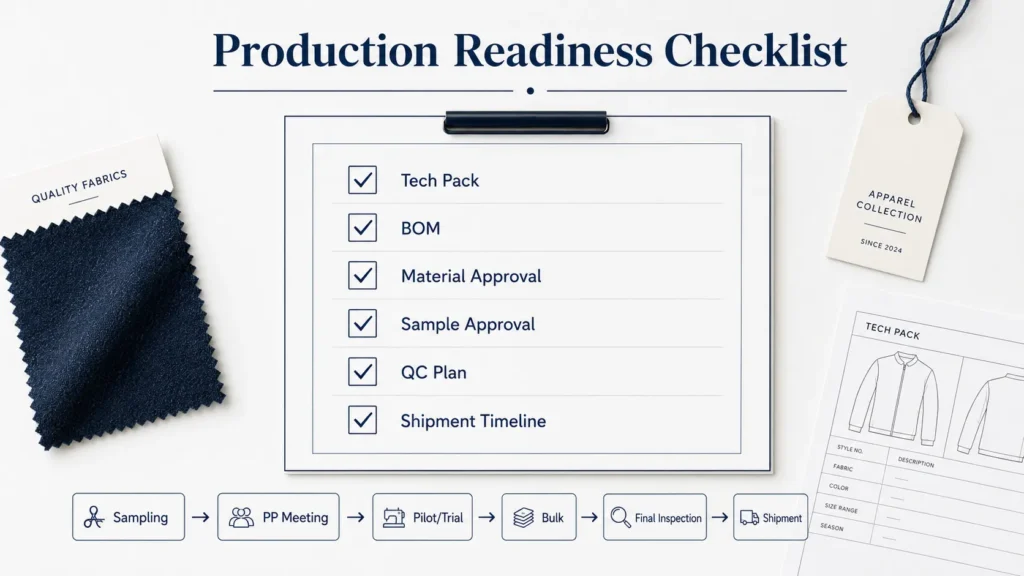
The production readiness checklist is your final gate. It ensures you do not start bulk with missing approvals, unclear BOM changes, unbooked capacity, or undefined testing plans. It also enforces ownership: who is responsible for each lock.
This is where clothing manufacturer vetting becomes bulk protection, not just supplier selection.
Production Readiness Checklist
| Area | Must be locked | Owner | Evidence | Status |
| Spec pack | Final measurements + tolerances | Buyer | Approved tech pack | |
| BOM | Fabric + trims + packaging | Buyer/Factory | Final BOM | |
| Material approval | Lab dips/shade/handfeel | Buyer | Approval record | |
| Sample approvals | PP/size set/color set | Buyer | Signed approvals | |
| Testing plan | Tests + standards + frequency | QA | Plan + lab booking | |
| QC plan | Inline/endline/final + AQL | QA/Factory | SOP + forms | |
| Capacity booking | Line allocation confirmed | Factory | Line plan evidence | |
| Subcontracting controls | Approved list + rules | Both | Disclosure + control plan | |
| Packing + labeling | Barcode/label/carton rules | Buyer | Packing approval |
Sampling → PP meeting → Pilot/Trial → Bulk → Final Inspection → Shipment
A documented PP meeting checklist for garments helps confirm that the approved sample, measurements, materials, artwork, testing requirements, packing instructions, and QC responsibilities are locked before bulk production begins.
A clear apparel approval workflow also prevents outdated lab dips, strike-offs, size sets, PP samples, or other approvals from being used as the production reference.
Common Failure Patterns in Clothing Manufacturer Vetting (And How Buyers Prevent Them)
Most failures are governance failures. The product did not “randomly go wrong.” The operating system was incomplete. clothing manufacturer vetting prevents the predictable failures by installing proof requirements early.
Failure pattern one is documentation drift: specs and BOM change but approvals are not tracked, and production runs on outdated information. Failure pattern two is weak approval discipline: decisions are made verbally but never locked, so operators follow assumptions.
Failure pattern three is capacity pressure: the supplier accepts orders beyond stable capacity and solves it by compressing QC or shifting production. Failure pattern four is uncontrolled subcontracting under deadline stress. Strong clothing manufacturer vetting identifies these patterns before you commit.
Anonymized case patterns:
- Issue: Bulk measurement failures → Missed control: tolerance sign-off and size set discipline → Prevention: lock size set approvals and measurement SOP before bulk.
- Issue: Shade inconsistency across components → Missed control: no component-level material approval gate → Prevention: lab dip approvals per component and documented release.
Ready to Move From Vetting to Production?
If your supplier has passed the initial checks, send your product requirements to RYZEAL SOURCING so the RFQ, costing, sampling, approvals, and production route can be reviewed before bulk starts.
FAQs About Clothing Manufacturer Vetting
What is the fastest way to start a supplier risk assessment for a new supplier?
Start with pre-screen questions, then request an evidence pack. Use a simple matrix to score operational stability, quality records, compliance controls, and timeline reliability, which is the core of clothing manufacturer vetting.
What audit documentation should I request first?
Ask for recent QC logs (inline/endline/final), testing reports, key SOPs, and CAPA examples. If these are missing or vague, treat it as a system maturity risk.
How do I run a manufacturing capability assessment without visiting the factory?
Request machine lists, line layout, maintenance logs, production plans, and order-linked photos or video proof. Cross-check consistency across documents, dates, and outputs.
What sample evaluation criteria matter most before bulk?
Measurement accuracy, construction consistency, fabric behavior (shrinkage), color control, and revision responsiveness. The sample should prove control behavior, not just appearance.
When should I add a supplier to an approved supplier list?
Only after they pass your supplier qualification process, clear pass/fail gates, and show evidence-based readiness for your product scope and control requirements.
What does a production readiness checklist prevent in real production?
It prevents bulk starting with missing approvals, unclear BOM changes, unbooked capacity, and undefined QC or testing plans. Those gaps drive delays, rework, and disputes.
Connect with RYZEAL SOURCING