
Sampling is where many sourcing projects start, but it should not be where clarity starts. If you skip the right questions, you get predictable outcomes: wrong MOQ assumptions, lead time surprises, mismatched fabric in bulk, and compliance issues discovered too late. This guide is a practical set of questions to ask a clothing manufacturer before you spend money or time on samples.
The goal is not to interrogate suppliers. The goal is to force alignment and proof early, so your sample becomes a controlled test, not an expensive guessing game. These questions to ask a clothing manufacturer are designed to lock down MOQ, lead time, testing expectations, and compliance transparency before the first sample is approved.
Use this as a checklist in your first supplier call or email thread. Ask the questions, request proof, record answers, and score risk based on what they can show, not what they say.
Before using this question bank, make sure the supplier has already passed your basic screening. For the broader process of checking capability, evidence, risk, and supplier readiness, see our Manufacturer Vetting and Due Diligence: How to Evaluate a Clothing Manufacturer guide.
Quick Answer: the 4 categories you must confirm before sampling
Direct answer: The most important questions to ask a clothing manufacturer before sampling fall into four buckets: MOQ logic, lead time reality, testing discipline, and compliance transparency.
Compliance: What documentation exists, what is the scope, and is subcontracting controlled?
MOQ: What minimums apply by fabric, color, size, and process, and why?
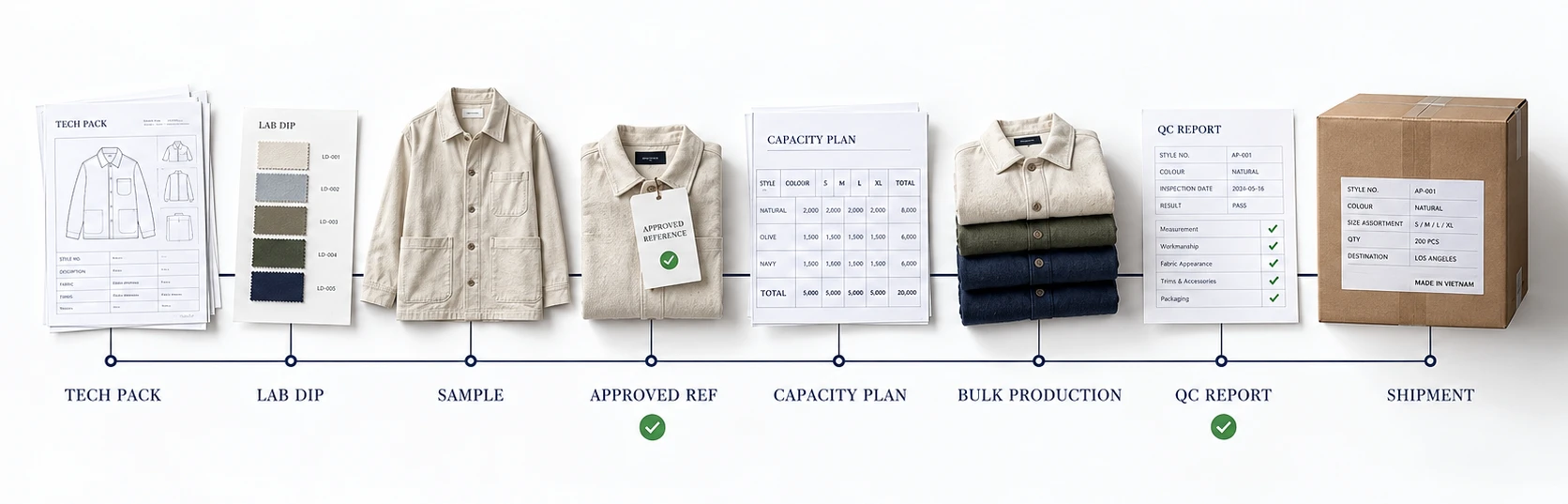
Lead time: What is the real critical path from tech pack to shipment?
Testing: What tests will be run, when, and what reports will be provided?
Table of Contents
Questions to Ask a Clothing Manufacturer Before Sampling (Master Table)
Direct Answer
This master table consolidates the highest-impact questions to ask a clothing manufacturer so you can avoid sampling delays, quote confusion, and bulk failures caused by missing assumptions.
Use the table like a scorecard. Answers that include proof (records, reports, timelines, named owners) score high. Vague answers score low. If they resist proof, treat it as risk.
Master Question Table
| Question | Why it matters | Proof to request | Acceptable answer | Red flag |
| What is MOQ per style, per color, and per size split? | MOQ is rarely “one number” | MOQ breakdown by component | Clear MOQ drivers explained | “MOQ is flexible” with no logic |
| What minimum color quantity (MCQ) applies to each fabric and color? | Color minimums often control cost | Mill MOQ/MCQ proof | MCQ stated with supplier logic | No mention of MCQ |
| What is sample lead time by stage? | Lead time must be staged | Sample timeline breakdown | Stages with realistic buffers | One-number promise |
| What is bulk lead time by stage? | Bulk risk is planning risk | Critical path + capacity booking method | Staged lead time + booking clarity | “We will manage” |
| What tests are required for this fabric? | Prevents performance disputes | Test plan + report examples | Required tests, timing, responsibility, and reporting method are defined | “We don’t test” |
| Will the sample fabric represent the planned bulk fabric? | Prevents sample-bulk mismatch | Fabric sourcing confirmation | Sample material source and any differences are disclosed, with a defined bulk-fabric approval and testing plan. | Development fabric differs materially from bulk expectations with no validation plan. |
| What compliance docs do you have and what is the scope? | “Certificate” without scope is noise | Audit report summary + validity | Facility + scope transparency | Refusal or vagueness |
| Do you subcontract any processes? | Hidden subcontracting = high risk | Subcontracting policy + approved list | Controlled and disclosed | “Sometimes” without details |
MOQ Questions to Ask a Clothing Manufacturer (Minimums That Control Cost)
Direct Answer
MOQ is usually shaped by fabric, trims, processing, production setup, and supplier minimums rather than by one arbitrary factory number. The right pre-sampling questions clarify which minimums are fixed, which can be adjusted, and what commercial trade-offs apply at lower quantities.
MOQ problems usually come from hidden drivers: mill minimums, dye lot minimums, trim purchase minimums, print/embroidery set-up, and washing/finishing constraints. If you only ask “what’s your MOQ,” you will get an answer that is incomplete.
MOQ question bank (use as-is)
These are the most practical questions to ask a clothing manufacturer about MOQ:
- What is MOQ per style and per color?
- What is MCQ (minimum color quantity) for dyed fabric?
- Is MOQ different for greige fabric vs dyed fabric?
- Is MOQ different for solid vs heather vs yarn-dyed vs printed fabric?
- What is MOQ for each process: screen print, DTG, embroidery, heat transfer, washing, garment dye?
- What is MOQ for trims: zippers, snaps, elastics, drawcords, labels, hangtags?
- If we split sizes heavily (more smalls, fewer larges), does it affect MOQ or cost?
- Can you combine multiple styles in one fabric order to reach MOQ?
- If MOQ is “flexible,” what is the pricing impact at each tier?
- What happens if we reorder the same style later: do minimums reduce?
What is negotiable vs non-negotiable
Some of the least flexible MOQ drivers come from upstream supply, including mill minimums, dye-lot quantities, trim-supplier minimums, and process setup requirements. More flexible areas can include how styles are bundled, how colors are planned, and whether a higher unit cost is acceptable at lower quantities.
This is where questions to ask a clothing manufacturer must go beyond the factory and into the upstream supply chain logic.
MOQ Clarifier Table
| MOQ driver | What it controls | Proof you request | Risk if unclear |
| Mill fabric MOQ | Total fabric availability | Mill MOQ confirmation | Wrong cost estimate |
| Dye lot MCQ | Color feasibility | Dye house MCQ logic | Color split becomes expensive |
| Print/embroidery setup | Minimum run size | Setup cost breakdown | Hidden cost later |
| Trim supplier MOQ | Label/zipper minimum | Trim quotes | Delays or forced substitutions |
| Wash/finish MOQ | Process feasibility | Wash unit MOQ | Finish changes late |
The key takeaway for buyers is to ask what is driving the MOQ before negotiating the number itself.
The MOQ questions that expose “low-MOQ marketing”
Low-MOQ offers can be legitimate, but they often depend on specific conditions such as stock fabric, limited colors, simplified trims, higher unit costs, or restricted processes. Clarify those conditions before treating a low MOQ as directly comparable with a standard bulk offer.
- If MOQ is low, what changes: price, lead time, fabric source, or quality risk?
- Are you quoting with stock fabric for sampling but custom fabric for bulk?
- Does low MOQ mean limited color options or restricted size splits?
- Are trims substituted at low MOQ without approval?
- Is the MOQ only for sewing, while fabric MOQ is higher?
Lead Time Questions to Ask a Clothing Manufacturer (Sample vs Bulk, Real Critical Path)
Direct Answer
Lead time must be broken into stages. The right questions to ask a clothing manufacturer confirm a real critical path and expose overbooked suppliers before you waste weeks.
A reliable supplier can explain lead time as a chain of dependencies: fabric sourcing, lab dips/strike-offs, trims, pattern development, sample rounds, approvals, capacity booking, production, finishing, packing, inspection, shipment.
Sample lead time: what stages must be defined
Ask for the timeline with dates, not guesses. Your questions to ask a clothing manufacturer should cover:
- How many sample rounds do you expect for this complexity?
- What is the lead time for pattern development and first prototype?
- What is the typical revision cycle time, and what buyer-feedback turnaround does that timeline assume?
- What is the lead time impact if we change fabric or trims after first sample?
Bulk lead time: where suppliers hide risk
Bulk lead time fails when capacity is not booked and approvals drift. These questions to ask a clothing manufacturer reveal whether planning is real:
- When do you lock production capacity: after sample approval, after PP approval, or after PO?
- Can you provide capacity-booking evidence or an anonymized line-loading view for the relevant production period?
- What happens in peak season: does lead time expand, or do you subcontract?
- What is your overtime policy and how does it impact quality control?
Lead Time Breakdown Table
| Stage | Typical dependency | What you request | Acceptable answer | Red flag |
| Fabric sourcing/dyeing | Mill + dye house | Sourcing plan + MCQ | Staged timeline + proof | “Fabric is quick” |
| Trims sourcing | Supplier minimums | Trim quote + lead time | Defined suppliers | “No issue” |
| Sample development | Pattern + sewing | Sample timeline | Clear stages | One-number promise |
| Approvals | Buyer response | Approval map | Defined gates | No approval system |
| Capacity booking | Planning | Line booking proof | Booking rule explained | No planning artifacts |
| Production | Line output | Output expectation | Realistic throughput | “We will manage” |
| Finishing/packing | SOP | Packing plan | Defined standard | Vague or missing |
Questions that reveal whether the factory is overbooked
Use these questions to ask a clothing manufacturer to detect overload:
- What is your current order load by category this month?
- What is your maximum stable capacity (not peak)?
- Can you show current WIP on the line you would allocate to us?
- How do you prioritize orders when delays occur?
- What triggers subcontracting in your system?
- Who owns production planning and reporting?
- What is your weekly output reporting format?
- What is your change-control rule when specs shift mid-stream?
Once the timeline and supplier assumptions are clear, those requirements should be transferred into a structured RFQ and onboarding system so pricing, approvals, responsibilities, and production expectations remain consistent.
Fabric and Garment Testing Questions Before Sampling
Direct Answer
Testing protects you from performance disputes and sample-to-bulk mismatch. The best questions to ask a clothing manufacturer include a testing plan with clear reports, timing, and responsibility.
For example, ISO 6330 defines standardized domestic washing and drying procedures used for textile testing, which can form part of dimensional-stability and performance evaluation.
Testing responsibilities should be agreed before sampling and bulk approval. The required test plan depends on the fabric, garment construction, performance claims, buyer requirements, and destination market. Clarify what must be tested, who arranges it, when testing happens, which method or standard applies, and how results will be reported.
Fabric tests you should confirm
Use these questions to ask a clothing manufacturer as your baseline:
- Which fabric tests will be run before bulk fabric approval?
- Who pays for testing, and when does testing happen in the timeline?
- Which lab do you use, and can you provide recent report examples?
- What shrinkage test method and acceptance criteria will apply to this fabric and garment?
- Which colorfastness tests and acceptance criteria apply to this product and target market?
- Do you test pilling and abrasion where relevant?
- For stretch fabrics, do you test stretch recovery?
Trim and process testing (where failures hide)
If your garment uses zippers, snaps, elastics, prints, embroidery, washing, or special finishes, testing risk increases. Ask:
- How do you validate zipper/snap durability and finish stability?
- How do you validate print/embroidery wash durability?
- If washing is applied, how do you control shade, shrinkage, and handfeel change?
Prevent the “sample fabric trap”
A common failure pattern: the sample is made with a convenient fabric, then bulk fabric behaves differently. These questions to ask a clothing manufacturer stop that:
- Will the sample fabric come from the same mill/supplier planned for bulk?
- If not, what is the difference, and how will bulk behavior be validated?
- Will we run lab dips and bulk fabric approval before PP or before bulk cutting?
- What is the policy on shade bands and batch variation?
Testing Request Table
| Test / validation | Why it matters | When to run | Proof | Red flag |
| Shrinkage test | Size stability | Before bulk approval | Report | No agreed test method or acceptance criteria |
| Colorfastness | Color durability | Pre-bulk | Lab report | No defined testing or reporting plan where required |
| Pilling/abrasion | Wear durability | Pre-bulk if needed | Report | Requirement dismissed without considering fabric and end use |
| Stretch recovery | Fit retention | Pre-bulk for stretch | Report | No stretch spec |
| Print durability | Wash performance | Pre-bulk | Strike-off + test | No strike-off system |
| Trim strength | Function integrity | Pre-bulk | Spec + result | “Supplier guarantees” only |
What apparel testing looks like in practice
Testing can cover fabric performance, dimensional stability, colorfastness, trims, construction, and other product-specific requirements. This overview from Intertek Bangladesh shows how professional softlines testing supports apparel quality and performance verification.
Lab dip and strike-off approval questions (color and print control)
These are high-value questions to ask a clothing manufacturer:
- For custom-dyed colors, will lab dips be submitted for approval, and how is the approval cycle managed?
- What is your approval turnaround expectation?
- How do you manage shade variation across batches?
- For prints, do you provide strike-offs, and do you test wash durability?
- What happens if a lab dip is rejected: timeline impact and cost impact?
Sample types and what each sample should prove (size set, PP sample)
Sampling is not one sample. Ask:
- What sample types do you provide (proto, fit, size set, pre-production (PP), and top-of-production (TOP), where required)?
- What does each sample validate: fit, construction, materials, approvals, packing?
- What are your acceptance criteria for PP approval?
These testing questions should complement, not replace, supplier capability checks. Use our Clothing Manufacturer Vetting Checklist: Capacity, Quality Systems, Communication, Red Flags to verify whether the supplier has the systems to support the answers they provide.
Compliance Questions to Ask a Clothing Manufacturer (Documents, Scope, Subcontracting)
Direct Answer
Compliance is control plus transparency. The right questions to ask a clothing manufacturer confirm what documentation exists, what it covers, and whether subcontracting is managed.
Compliance is frequently treated as a checkbox. That’s a mistake. Compliance should be evaluated by scope, facility coverage, validity, and evidence of corrective-action follow-up – not by the presence of a certificate or audit name alone. You need to know which facility is covered, what processes are included, and how corrective actions are handled.
For social-compliance audits, buyers should also understand what the audit actually represents. For example, SMETA is an audit methodology used to assess areas such as labour standards, health and safety, environmental performance, and business ethics; Sedex specifically notes that SMETA is not a certification or a general stamp of approval.
Compliance question bank (use as-is)
These are essential questions to ask a clothing manufacturer:
- What compliance audits do you have, and what is the audit date and scope?
- Which facility addresses are covered by the audit?
- Are dormitories included if applicable?
- Where disclosure is permitted, can you provide a summary of material findings and evidence that required corrective actions have been closed?
- Can you share a summary page or audit letter with validity details?
- Do you subcontract any processes (printing, embroidery, washing, dyeing)?
- If yes, what is the approved subcontractor list and buyer approval gate?
- How do you ensure traceability when subcontracting occurs?
- What is your policy for unauthorized subcontracting?
- Who owns compliance internally?
Compliance Evidence Table
| Evidence | What it proves | What to check | Red flag |
| Audit report summary | Audit existence | Date, scope, facility | Refusal to share any proof |
| Corrective action closure | System response | Closure evidence | “We fixed” with no record |
| Subcontracting policy | Process control | Approval gate | “We outsource sometimes” |
| Facility list | Coverage | Addresses match reality | Mismatched addresses |
| Worker policy summary | Baseline compliance | Signed policies | No documented policies |
The depth of compliance verification should match the destination market, buyer requirements, product category, and sourcing commitments. For products entering the European Union, buyers should also review applicable REACH obligations and restrictions, including requirements that may apply to substances present in clothing and other textile articles. Where compliance or responsible-sourcing claims are important, documentary scope and subcontracting transparency should be confirmed before production.
Not Sure Whether the Supplier Is Ready for Sampling?
Before paying for development, verify that the supplier’s capacity, quality system, communication, and risk controls support the answers they have given you.
Sample checklist of requirements (what you must send to get an accurate sample)
Direct Answer
A sample is only as accurate as the input package. A complete sample checklist of requirements prevents wrong samples, wrong quotes, and approval chaos.
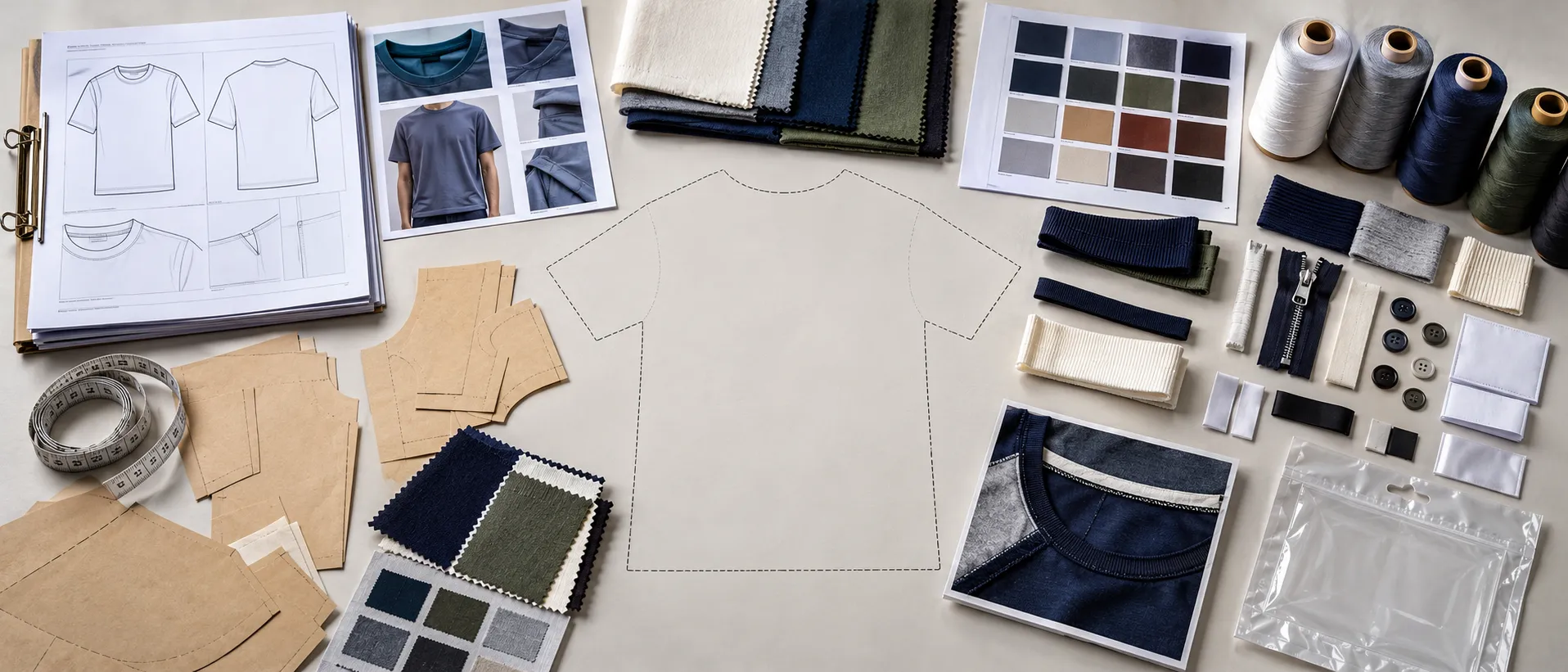
Use this sample checklist of requirements before you request a prototype:
- Tech pack with measurements and tolerances
- BOM with fabric, trims, labels, packaging
- Artwork files and placement details
- Construction notes and stitch requirements
- Fabric specs (composition, GSM, finish)
- Target color references (Pantone reference, approved swatch, or other agreed physical/digital standard)
- Label content rules and care label standards
- Packing instructions (polybag, hangtag, carton marks)
- Sample types needed (fit, size set, PP) and acceptance criteria
- Timeline expectations and feedback loop rules
Sample Input Checklist Table
| Item | Minimum detail | Why it matters | Common failure |
| Tech pack | Measurements + tolerances | Controls fit | Vague measurements |
| BOM | All components listed | Controls cost | Missing trims |
| Fabric spec | GSM, finish, composition | Controls behavior | Wrong handfeel/shrinkage |
| Artwork | Vector + placement | Controls print | Low-res files |
| Color refs | Pantone/swatches | Controls shade | “Similar color” |
| Packing spec | Polybag/carton rules | Controls shipment | Packing decided late |
This section supports your questions to ask a clothing manufacturer because the supplier cannot answer accurately without accurate inputs.
Decision gates after these questions (proceed, pause, or reject)
Direct Answer
After you ask the right questions, you should decide fast. Use gates to avoid sunk-cost sampling with the wrong supplier.
Proceed if:
- MOQ logic is clear and supported by upstream proof.
- Lead time is staged, realistic, and supported by planning discipline.
- Testing plan is clear with report ownership.
- Compliance scope is transparent and subcontracting is controlled.
Pause if:
- Answers are reasonable but proof is incomplete.
- Lead time depends on materials not yet confirmed.
- Testing requirements are unclear but fixable with a defined plan.
Reject if:
- MOQ is vague or “flexible” with no logic.
- Lead time is promised as one number with no stage breakdown.
- The supplier refuses to define or coordinate testing that is required for the product or order.
- Compliance proof is vague or subcontracting is not controlled.
- The supplier repeatedly misses agreed response or escalation timelines after expectations have been clarified.
Decision Rule Table
| Signal | Decision | Next action |
| Clear answers + proof | Proceed | Request sample + lock approvals map |
| Answers clear, proof partial | Pause | Require missing documents before sampling |
| Vague answers or refusal | Reject | Move to next supplier |
Passing the pre-sampling decision gate does not mean the style is ready for bulk production. Before sewing begins, use a production readiness checklist to confirm line setup, approved references, control points, pilot requirements, and escalation rules.
FAQs
What are the most important questions to ask a clothing manufacturer before sampling?
Start with MOQ logic, lead time by stage, testing responsibilities, and compliance scope including subcontracting controls. These four areas address several common sources of sampling delays, commercial surprises, and later production risk.
What is the difference between MOQ and MCQ?
MOQ is the minimum quantity a supplier accepts for an order, style, fabric program, or other defined scope. MCQ is the minimum quantity required for a specific color, often influenced by mill or dyeing constraints.
How do I avoid sample-to-bulk fabric mismatch?
Confirm whether sample fabric matches bulk sourcing. Require a plan for bulk fabric approval, testing reports, and shade band control before PP or bulk cutting.
Which testing reports matter most for basic apparel?
Shrinkage and relevant colorfastness tests are common starting points for many apparel products, but the required test package depends on fabric, construction, end use, buyer standards, and destination-market requirements.
What compliance documents should I request first?
At minimum, audit date and scope, facility coverage, and corrective action closure evidence. If subcontracting is used, require policy and disclosure rules.
When should I walk away before sampling?
When answers are vague, proof is refused, lead times are unrealistic, testing is not taken seriously, or subcontracting controls are unclear. Those risks don’t improve after sampling.
Final Takeaway: Clarity Before Sampling Saves Time Later
The purpose of these questions is not to make supplier communication difficult. It is to remove assumptions before money, materials, and development time are committed.
Before sampling starts, buyers should understand the real MOQ structure, the critical-path timeline, the required testing plan, the compliance scope, and any subcontracting rules. Clear answers supported by evidence give the sample a defined purpose: proving that the product and supplier can move toward controlled bulk production.
If important answers remain vague, resolve them before approving the next stage. A sample can prove that one garment can be made; it cannot correct an unclear commercial or production system by itself.
Preparing to Start Sample Development?
If you have a tech pack, product reference, target MOQ, fabric idea, or delivery requirement, RYZEAL SOURCING can help review the production route and identify the key questions that should be resolved before sampling begins.
Connect with RYZEAL SOURCING