
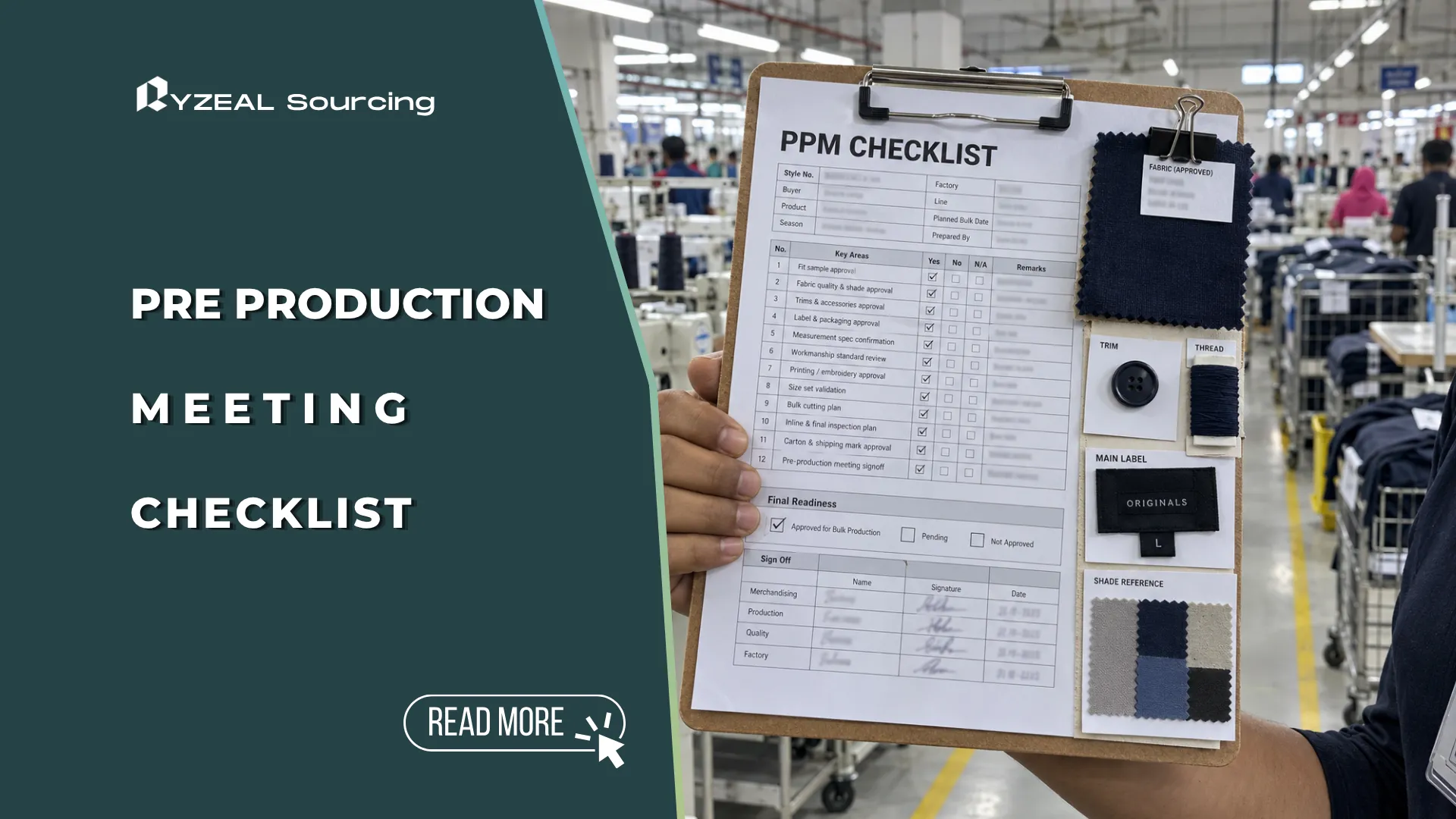
Many bulk-production problems begin before the sewing line, when important specifications, approvals, material decisions, quality controls, or production responsibilities are still open. Sampling may look acceptable, costing may be approved, and the PO may already be issued, but unresolved decisions can still create rework, delays, and disputes once production starts.
A pre production meeting (PPM) is an important readiness gate used to reduce that risk. It brings the buyer, supplier, and relevant production teams together to confirm the current specification, BOM, materials, approvals, quality plan, production schedule, responsibilities, and open risks. This pre production meeting checklist provides a repeatable system for deciding whether the order is ready for bulk production.
The PPM sits inside the wider RFQ and onboarding system that moves a vetted supplier from quotation to controlled bulk production. Before reaching this stage, the supplier should already have passed manufacturer vetting and due diligence, and the product scope should have been clarified through a structured process for how to write an RFQ that manufacturers can quote and execute accurately.
Quick Answer: pre production meeting checklist in 12 gates
A pre production meeting checklist is a set of gates that must be locked before bulk cutting. If a gate is not locked, bulk start is risk, not progress.
The 12 gates:
- PO + spec lock
- BOM lock
- Fabric approval + test status
- Lab dip approval + shade band rules
- Artwork placement + print/emb method lock
- Measurement tolerance lock (critical POMs)
- Sample approval process status (size set/PP)
- Packaging and labeling lock
- Quality standards + inline QC plan
- Production scheduling + capacity booking proof
- Risk review + mitigation owners
- Change-control rules + escalation ladder
| Gate | What Must Be Confirmed | Typical Owner | Evidence | Risk if Missing |
|---|---|---|---|---|
| PO + specification | Style, quantity, delivery, current tech pack | Buyer / merchandising | PO + approved spec | Wrong scope |
| BOM | Fabric, trims, labels, packaging | Merchandising | Final BOM + approvals | Substitution or cost change |
| Fabric | Source, test status, bulk readiness | Fabric / QA | Approval + test status | Fabric failure |
| Color | Approved color standard and bulk-lot rule | Buyer / QA | Lab dip / shade reference | Shade variation |
| Branding | Placement, size, process | Buyer / technical | Artwork map + approval | Incorrect logo execution |
| Measurement | Critical POMs and tolerances | Technical / QA | Measurement chart | Fit inconsistency |
| Samples | PP approval and remaining conditions | Buyer / technical | Approval record | Bulk mismatch |
| Packaging | Labels, folding, polybag, carton | Buyer / logistics | Packing approval | Packing or labeling error |
| Quality plan | Defect criteria and inline checkpoints | QA | QC plan | Late defect detection |
| Production plan | Facility, line, timing, capacity | Production / partner | Production plan | Schedule risk |
| Risk review | Key risks, owners, actions | Buyer + supplier | Risk register | Unmanaged issue |
| Change control | Approval authority and escalation | Buyer + supplier | Change-control record | Uncontrolled revisions |
Table of Contents
What is a pre production meeting (PPM) and why it’s the bulk-start gate?
Direct Answer
A pre production meeting is a structured readiness review held before bulk production begins. Its purpose is to confirm that the current product specification, approved references, materials, production controls, responsibilities, and known risks are aligned before the order moves into bulk execution.
A PPM is not a status meeting. It is a decision meeting. The output is not “we discussed it.” The output is locked scope, assigned owners, evidence attached, and open actions with deadlines.
Bulk start is expensive to reverse. Cutting wrong fabric, sewing wrong placement, or producing the wrong measurement tolerance means you either rework, scrap, or ship late. A pre production meeting checklist prevents those outcomes by forcing final agreement at the right time, before the factory commits capacity and before materials flow into cutting.
A useful PPM should define which items are mandatory release conditions and what evidence is required for each one. Typical evidence includes approvals, material-test status, packaging confirmation, the QC plan, production schedule, and records of any approved exceptions.
When production is coordinated through a manufacturing and sourcing partner, the same PPM structure can be used across the selected manufacturing facility while one buyer-facing team coordinates approvals, production readiness, quality follow-up, reporting, and escalation.
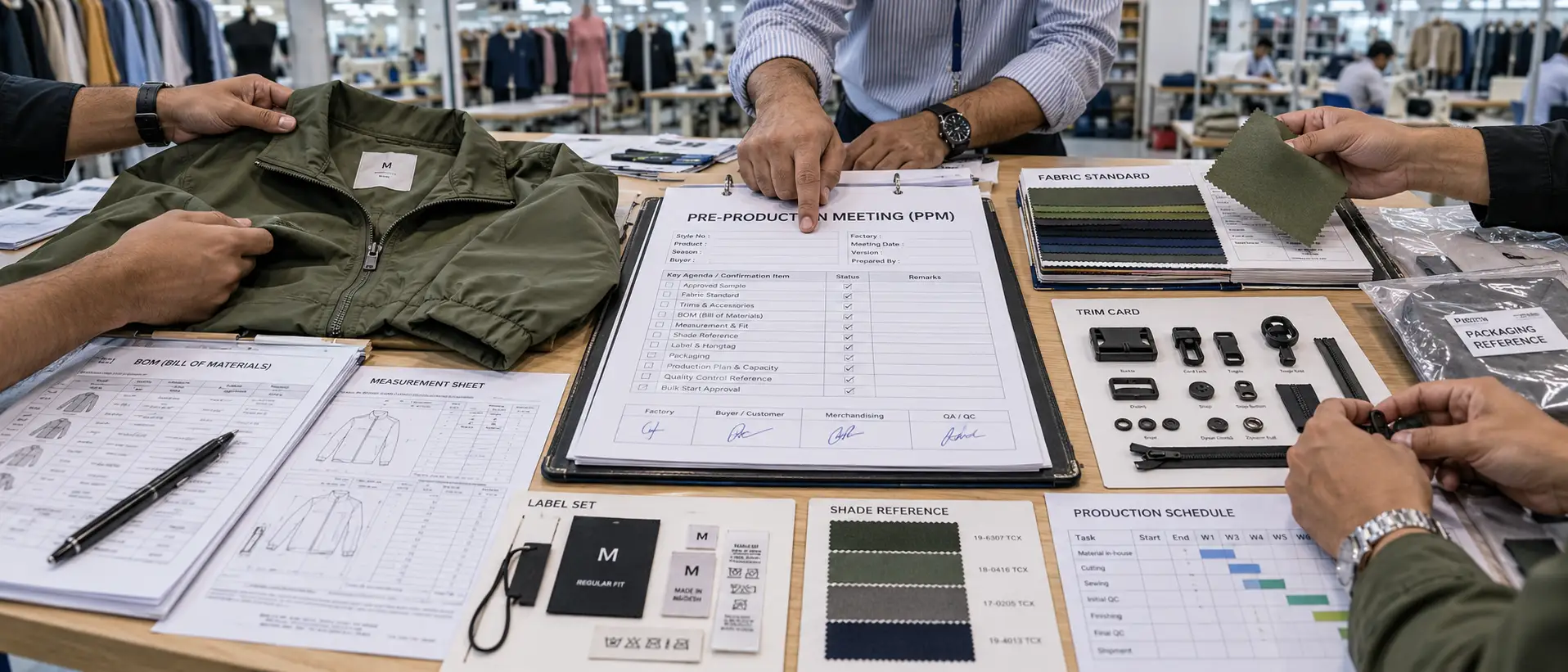
Pre production meeting checklist in 12 gates (one-page control system)
Direct Answer
Use this pre production meeting checklist as a control system. Every gate is either “locked” with evidence or “open” with a named owner and deadline. If a gate is open, bulk does not start.
Gate 1: PO + spec lock
- Confirm the PO references the correct style, quantity, and delivery window.
- Confirm the latest tech pack version is attached and approved.
- Confirm any change requests have been recorded and accepted.
Proof to attach: PO pack + final tech pack version + change log.
Gate 2: BOM lock
- Confirm fabric, trims, labels, and packaging are finalized.
- Confirm equivalents allowed vs not allowed.
- Confirm any supplier substitutions are approved in writing.
Proof to attach: locked BOM + trim approvals + packaging spec.
Gate 3: Fabric approval + test status
- Confirm lab dip or other approved color standard is complete where applicable.
- Define how bulk dye lots will be reviewed and segregated.
- Confirm the acceptable shade-variation rule.
- If bulk lots are already available, review the shade band or bulk shade references.
- Define the action required if a bulk lot falls outside the agreed range.
Proof to attach: approved color reference + bulk shade-control rule + shade band or lot references when available.
Gate 4: Color approval + bulk shade-control rules
- Confirm lab dip approval is complete.
- Confirm shade band rules for bulk lots and what range is acceptable.
- Confirm what happens if shade drifts (stop/go rule).
Proof to attach: lab dip cards/photos + shade band reference + decision rule.
Gate 5: Artwork placement + method lock
- Confirm artwork placement reference points, size, and alignment.
- Confirm print/embroidery method is locked.
- Confirm strike-off or embroidery sample approval evidence is available.
Proof to attach: placement map + strike-off/emb sample + approval record.
Gate 6: Measurement tolerance lock (critical POMs)
- Confirm which points of measure are “critical.”
- Confirm measurement tolerance by size and point.
- Confirm how measurement will be taken (method consistency).
Proof to attach: measurement chart + tolerance rules + measurement method note.
Gate 7: Sample approval status and production-reference rules
- Confirm size-set and PP sample approval status where required.
- Confirm that PP comments and required corrections are closed or clearly documented.
- Define whether a top-of-production (TOP) sample will be required after bulk starts.
- Define who reviews the TOP sample, when it is taken, and what happens if it does not match the approved production standard.
Proof to attach: sample approval log + PP comments closure + TOP requirement, if applicable.
Gate 8: Packaging and labeling lock
- Confirm labels match compliance requirements and brand rules.
- Confirm polybag spec, barcode placement, carton marks, and assort method.
- Confirm packing method and final evidence requirement.
Proof to attach: packing spec + label artwork approvals + carton mark artwork.
Care-label requirements also depend on the buyer and destination market. Where symbol-based care labeling is used, ISO 3758:2023 defines a system of textile-care symbols covering washing, bleaching, drying, ironing, and professional care.
Gate 9: Quality standards + inline QC plan
- Confirm quality standards expectations (defect classification + acceptance rule).
- Confirm inline QC plan and checkpoints.
- Confirm rework responsibility and escalation path.
Proof to attach: QC plan + checkpoint map + defect guideline.
Gate 10: Production scheduling + capacity booking proof
- Confirm planned start date is realistic based on material readiness and approvals.
- Confirm line plan and capacity allocation.
- Confirm critical path dependencies.
Proof to attach: production schedule snapshot + capacity booking note.
Gate 11: Risk review + mitigation owners
- Confirm top risks and mitigation actions.
- Assign owners and deadlines.
- Confirm trigger thresholds and escalation.
Proof to attach: risk register table + action list.
Gate 12: Change-control rules + escalation ladder
- Define what triggers re-quote, re-approval, and timeline reset.
- Define who can approve changes.
- Define escalation ladder and response SLA.
Proof to attach: change-control rules + owner map + SLA rules.
A pre production meeting checklist works best when each gate has a clear status, owner, evidence requirement, and release decision. Any open item that can materially affect bulk execution should be closed, formally accepted with conditions, or treated as a reason to delay the affected production stage.
Need Production Readiness Support Before Bulk?
RYZEAL SOURCING coordinates sampling, approvals, production planning, quality follow-up, compliance support, and bulk production through vetted manufacturing partners, helping buyers keep the development-to-production handoff connected through one team.
Approvals gate: sample approval process + approval checklist that stops rework
Direct Answer
Approvals are production dependencies. If a critical sample, material, color, artwork, or packaging approval is still unresolved, the activities that depend on it may need to remain on hold. The PPM should document each approval, its owner, required evidence, and impact on production.
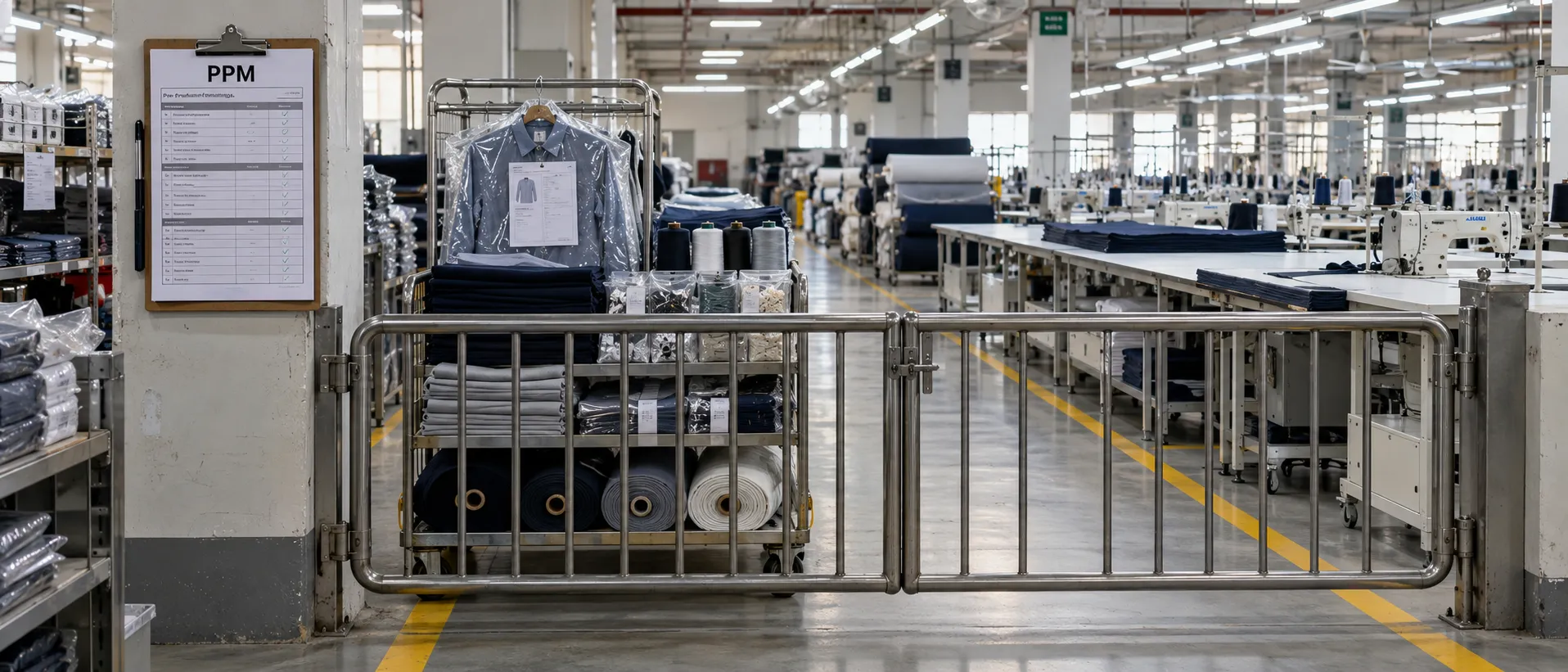
What must be approved before bulk starts (minimum)
- Final tech pack version confirmation
- Fabric direction approval
- Lab dip approval (if dyed)
- Artwork placement approval
- PP sample approval (or defined conditional approval rules)
If you are running printed or embroidered products, strike-offs or embroidery approvals must be tied to placement references, not only mockups.
What “approval” means in production terms
Approval is not a message saying “looks good.” Approval is:
- evidence attached (photo, report, sample reference)
- version locked (which file/version was approved)
- conditions recorded (what must still be fixed)
- ownership clear (who approved)
This is why an approval checklist belongs inside a pre production meeting checklist, it is a bulk-start dependency system.
| Approval | Evidence Required | Owner | Response Target | Gate Impact |
|---|---|---|---|---|
| Fabric | Approved reference / report | Buyer / technical | Agreed by project | May block cutting |
| Lab dip | Approved color reference | Buyer / color approver | Agreed by project | May block bulk dyeing |
| Print strike-off | Approved strike-off | Buyer / artwork approver | Agreed by project | May block printing |
| Embroidery | Approved embroidery sample | Buyer / artwork approver | Agreed by project | May block embroidery |
| Size set | Measurements + comments | Technical | Agreed by project | May block PP approval |
| PP sample | Approved sample + closure comments | Buyer / technical / QA | Agreed by project | May block bulk release |
| Packing | Labels, folding, carton approval | Buyer / logistics | Agreed by project | May block packing |
How the approved sample connects development to bulk
Before mass production begins, the production team needs a clear reference connecting the approved design, pattern, materials, trims, construction, and manufacturing requirements. This factory walkthrough shows how development and the pre-production sample fit into that handoff.
For the PPM, the important question is whether the approved product information has been transferred clearly enough for the production and quality teams to execute bulk consistently.
.
Rework prevention rules (simple but strict)
- No bulk start if PP sample is not approved (unless buyer issues written conditional approval).
- No method changes after approval (print method, trim grade, packaging grade) without change control.
- No “verbal approvals” for critical items. If it isn’t recorded, it isn’t approved.
Color gate: lab dip approval, shade bands, and bulk fabric risk
Direct Answer
Lab dip approval establishes the intended color direction before bulk dyeing, but it does not guarantee that every bulk lot will match automatically. The PPM should therefore confirm both the approved color reference and the controls used to review bulk shade variation.
What lab dip approval must cover
- confirm target shade and acceptable range
- confirm lighting conditions for viewing (or at least consistent evaluation rule)
- confirm what happens if shade is out-of-range
Shade band rules (bulk reality)
Bulk fabric is often produced in lots. Even if the lab dip is correct, bulk lots can drift. Shade bands define the acceptable range and how lots are managed.
PPM decisions to lock:
- Are mixed lots allowed in one order?
- If allowed, how are lots separated by size/color bundles?
- What is the acceptance rule for shade variation?
Evidence to collect
- approved lab dip cards/photos
- shade band reference (if used)
- bulk fabric inspection evidence (such as reports or internal checks)
Stop/go decision rule
If shade drift risks brand rejection, define:
- stop production at cutting stage until resolved
- re-dye or re-source decision owner
- timeline impact acknowledgment

Branding gate: artwork placement lock + print/embroidery execution proof
Direct Answer
Branding is where “approved design” still fails in production because placement and method execution were not locked.
Artwork placement decisions to lock
- placement reference point, such as center front from Highest Point of Shoulder (HPS), placket, or seam
- placement size and tolerance (e.g., ±0.5 cm or buyer-defined)
- orientation (parallel to hem, parallel to placket)
- multi-size rules (same placement across sizes or scaled)
Method lock decisions
- print method: screen, heat transfer, DTG (as applicable)
- embroidery type and backing/stabilizer expectations
- washing/finishing that can impact print/emb durability
Proof required
- strike-off evidence for prints
- embroidery sample evidence for embroidery
- placement map with measurable reference points
Common failure mode: “we approved a mockup.” Mockups do not control placement execution. A pre production meeting checklist must lock placement mapping.
Artwork Placement Check
- Final artwork file and version confirmed
- Print or embroidery method confirmed
- Placement reference point defined
- Placement dimensions defined
- Placement tolerance defined where required
- Size-scaling rule confirmed
- Strike-off or embroidery sample approved where applicable
- Approval owner recorded
- Approved evidence stored with the production file
Fit and measurement gate: measurement tolerance that protects bulk
Direct Answer
Measurement tolerance defines the permitted deviation from the target measurement. The PPM should confirm the applicable tolerances and measuring method before bulk so the buyer, factory, and QC team evaluate garments against the same reference.
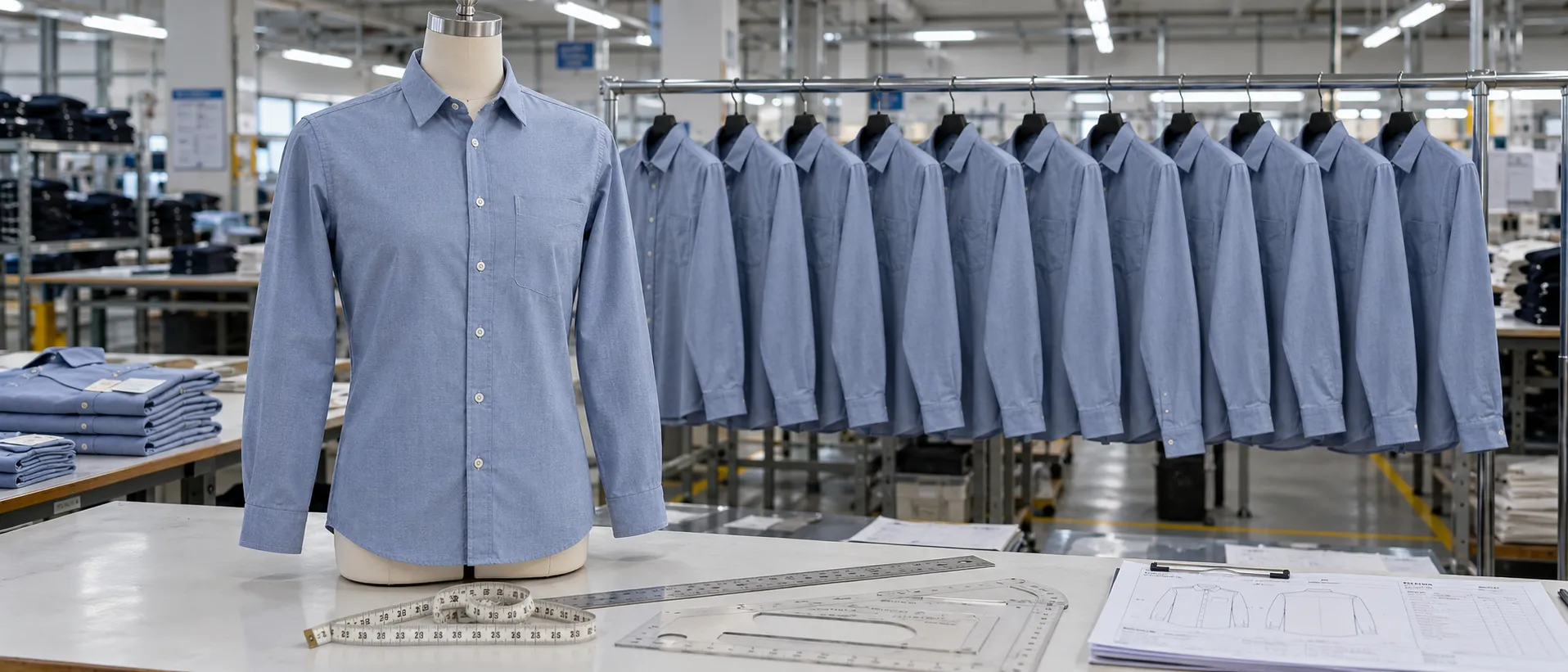
What to lock: critical points of measure (POMs)
Not every POM carries equal risk. Critical POMs typically include:
- chest width
- body length
- sleeve length
- shoulder width
- inseam/outseam (bottoms)
- waist/hip (bottoms)
Define which POMs are critical and the decision rule if a critical POM fails.
Measurement tolerance rules
- measurement tolerance by POM and size
- whether tolerance is symmetric (+/-) or one-sided
- whether tolerance bands differ by size or category
Measurement method consistency (how you measure)
Many disputes are measurement-method disputes. PPM must lock:
- whether garment is measured flat or on body form
- whether garment is measured pre-wash or post-wash
- how tension/stretch is applied during measurement
Decision rules if tolerance fails
- minor deviation: rework or adjust process
- critical deviation: stop-line or hold shipment until corrective action closes
- repeated deviation: escalate to root cause analysis and reset process
| Point of Measure | Target | Tolerance | Measuring Method | Decision Rule |
|---|---|---|---|---|
| Chest | Buyer spec | Buyer-defined | Garment flat, agreed reference points | Review if outside tolerance |
| Body length | Buyer spec | Buyer-defined | HPS to hem or specified method | Review if outside tolerance |
| Sleeve length | Buyer spec | Buyer-defined | Defined start/end points | Review if outside tolerance |
| Shoulder | Buyer spec | Buyer-defined | Seam to seam | Review if outside tolerance |
| Waist / hip | Buyer spec | Buyer-defined | Flat or circumference as specified | Review if outside tolerance |
| Inseam / outseam | Buyer spec | Buyer-defined | Defined seam points | Review if outside tolerance |
A pre production meeting checklist should therefore confirm both the measurement tolerance and the measuring method used to judge bulk garments.
Quality gate: quality standards + inline QC plan before bulk starts
Direct Answer
Inline QC provides earlier visibility into production problems than relying only on final inspection. Defined checkpoints during cutting, sewing, finishing, and packing can help identify recurring issues while corrective action is still possible.
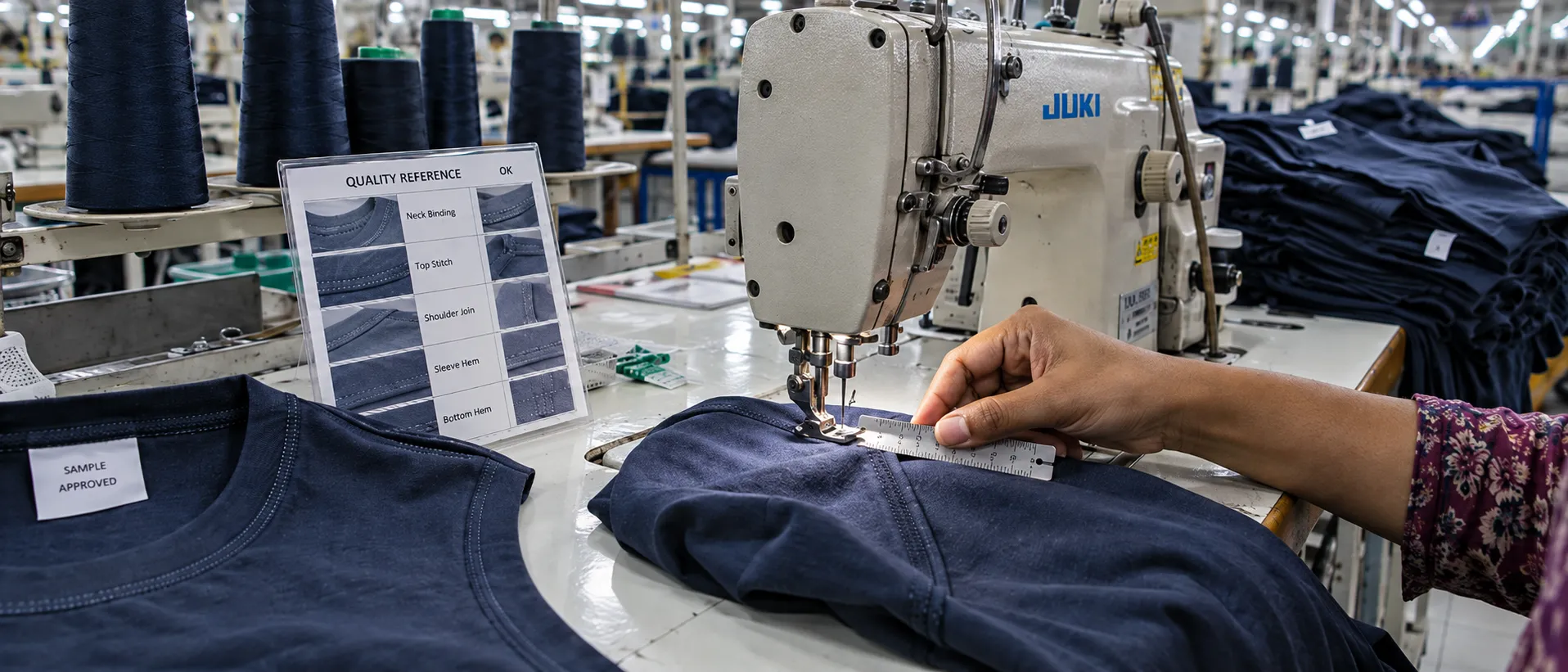
Quality standards to lock
Even if you don’t publish an entire quality manual inside a PPM, you must lock:
- defect classification approach (critical/major/minor)
- acceptance rule (buyer-defined acceptance criteria)
- rework responsibility and reporting discipline
If the buyer uses AQL-based lot acceptance for final inspection, that should be defined separately from inline process control. ISO 2859-1:2026 provides acceptance-sampling schemes indexed by Acceptance Quality Limit for lot-by-lot inspection.
Inline QC (what it is and why it matters)
Inline QC means checking work during production stages rather than only at the end. It catches issues when they are still cheap to fix:
- cutting issues (pattern alignment, fabric defects)
- sewing issues (stitch quality, seam allowance, puckering)
- finishing issues (measurement drift, trims, cleanliness)
Inline QC checkpoint map (minimum)
- cutting: fabric shade/defect checks + panel pairing rules
- sewing: first-output checks + defined in-process inspection frequency
- finishing/packing: measurement checks + labeling and packing checks
| Process Stage | Checkpoint | Examples to Watch | Evidence | Owner |
|---|---|---|---|---|
| Fabric / cutting | Fabric, shade, marker, panel checks | Shade mixing, fabric defects, incorrect cutting | Inspection record / photos | Cutting QA |
| Sewing start | First-output verification | Construction, seam, measurement, placement | First-output report | Line QA |
| Sewing in-process | Defined periodic checks | Stitch defects, seam issues, measurement drift | Inline QC report | Line QA |
| Finishing | Appearance and measurement | Trims, stains, pressing, measurements | Finishing inspection | Finishing QA |
| Packing | Label and packing verification | Wrong label, barcode, assortment, carton marks | Packing audit | Packing QA |
The PPM should therefore confirm where inline checks will occur, who owns them, what evidence will be recorded, and how recurring defects will be escalated.
How the quality plan continues after the PPM
The PPM defines the controls before production starts, but those controls still need to operate on the factory floor. Inline inspection, measurement verification, finishing checks, defect reporting, and final inspection provide different layers of production evidence.
The exact inspection system depends on the buyer and order, but the PPM should make the required checkpoints and responsibilities clear before bulk begins.
Planning gate: production scheduling + capacity booking proof
Direct Answer
Production scheduling should reflect the dependencies that determine when each production stage can realistically begin. Material readiness, approvals, capacity allocation, process sequence, and critical-path activities all affect the final schedule.
What to lock in production scheduling
- planned production start and end dates
- line plan and capacity allocation
- output assumptions and buffers
- critical path dependencies
Proof to request
- line plan snapshot
- capacity booking confirmation (even informal but recorded)
- critical path view (what must happen first)
What changes schedules (and how to control it)
- material delays (fabric/trims)
- approval delays (lab dips, PP sample)
- rework or defect spikes
- unexpected capacity shifts
The PPM should define: what happens when a dependency slips. Without this, production scheduling becomes reactive.

Risk review gate: risk register you must build in the PPM
Direct Answer
Risk review identifies foreseeable production, material, quality, compliance, capacity, and logistics issues before they become harder to correct. The PPM should record the most relevant risks, actions, owners, deadlines, and escalation triggers for the order.
Minimum risk categories to review
- materials (fabric shade, shrinkage, trims delays)
- approvals (lab dip, PP, artwork placement)
- workmanship (stitch quality, measurement tolerance drift)
- capacity (line availability, peak load)
- compliance (subcontracting, documentation, labeling)
- logistics (packing readiness, shipment documentation readiness)
Production risk review is only one part of wider supply-chain risk management. The OECD garment and footwear guidance recommends ongoing risk-based due diligence to identify, prevent, mitigate, and account for risks across operations and business relationships.
Risk register rules
- list top risks (5–10 is enough)
- assign probability and impact
- assign mitigation action with owner and deadline
- define trigger thresholds (what signals the risk is “real now”)
| Risk | Probability | Impact | Mitigation / Action | Owner | Deadline |
|---|---|---|---|---|---|
| Fabric shade variation | Low / Med / High | Low / Med / High | Review bulk lots and segregation rules | QA / fabric | Date |
| Trim delay | Low / Med / High | Low / Med / High | Confirm delivery and backup action | Merchandising | Date |
| PP comment not closed | Low / Med / High | Low / Med / High | Close before affected bulk stage | Technical | Date |
| Measurement drift | Low / Med / High | Low / Med / High | First-output and inline measurement checks | QA | Date |
| Capacity change | Low / Med / High | Low / Med / High | Confirm allocation and escalation route | Production | Date |
| Packing delay | Low / Med / High | Low / Med / High | Finalize artwork and packing materials early | Merchandising | Date |
A pre production meeting checklist becomes powerful when it includes a risk register that is actually used weekly.
PPM minutes template: what to record so bulk doesn’t drift
Direct Answer
PPM minutes create a controlled record of the decisions, open actions, owners, evidence, and release conditions agreed before production begins. They reduce reliance on memory, scattered messages, or verbal instructions.
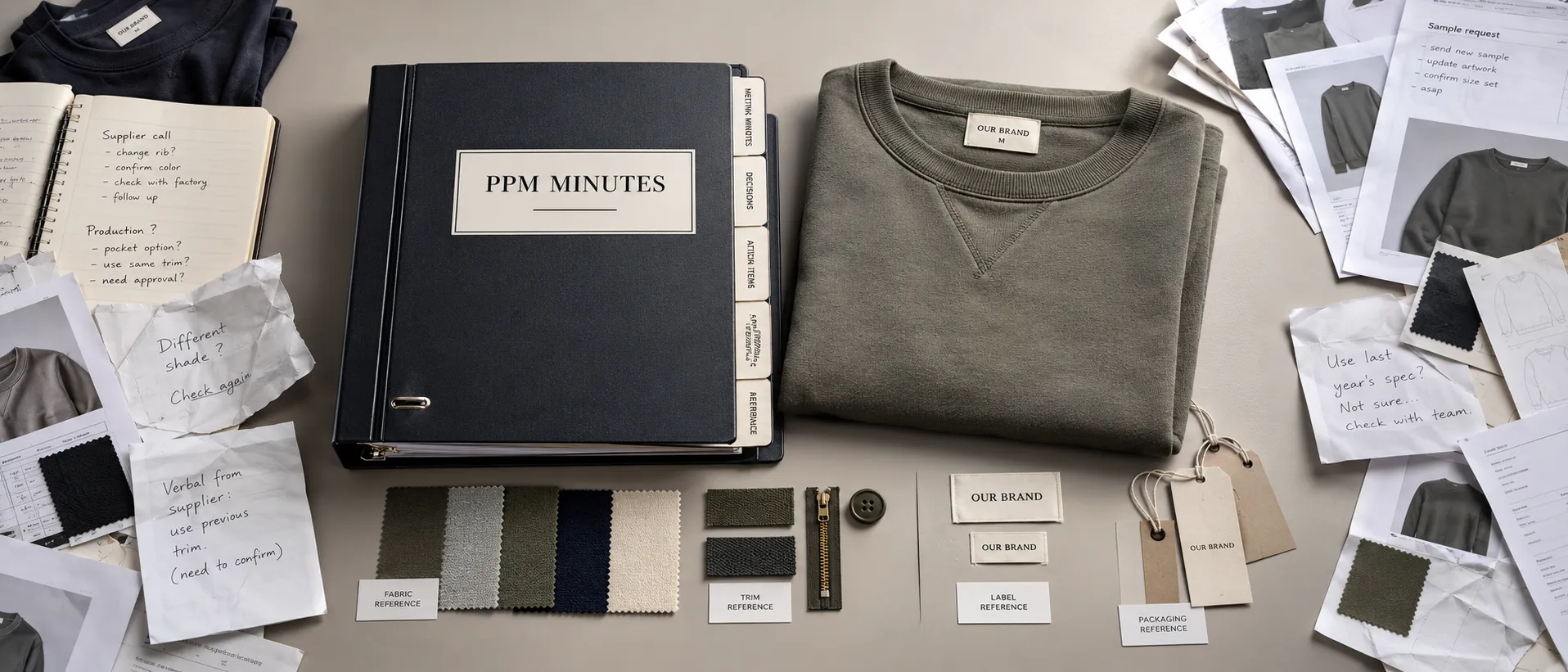
Your PPM minutes should record:
- attendees and decision owners
- locked decisions (spec, BOM, color, artwork placement, QC, schedule)
- open actions (owner + deadline + evidence required)
- evidence links (single source of truth folder)
PPM Minutes Template
Meeting date:
Style / PO reference:
Factory / production facility:
Current tech pack version:
PP sample reference:
Attendees and roles:
Confirmed decisions:
- –
- –
- –
Open actions:
Owner | Action | Deadline | Evidence Required |
|---|---|---|---|
Key risks and mitigation:
- –
- –
- –
Approved exceptions or conditions:
- –
- –
- –
Bulk-start decision:
Go / Conditional Go / Hold
Release authority:
Name / role:
Next review date, if required:
This is a required section in a pre production meeting checklist because it prevents “we agreed verbally” disputes.
Common PPM red flags (what “not locked” looks like)
Direct Answer
These signals indicate that the order may not yet be ready for an unconditional bulk release.
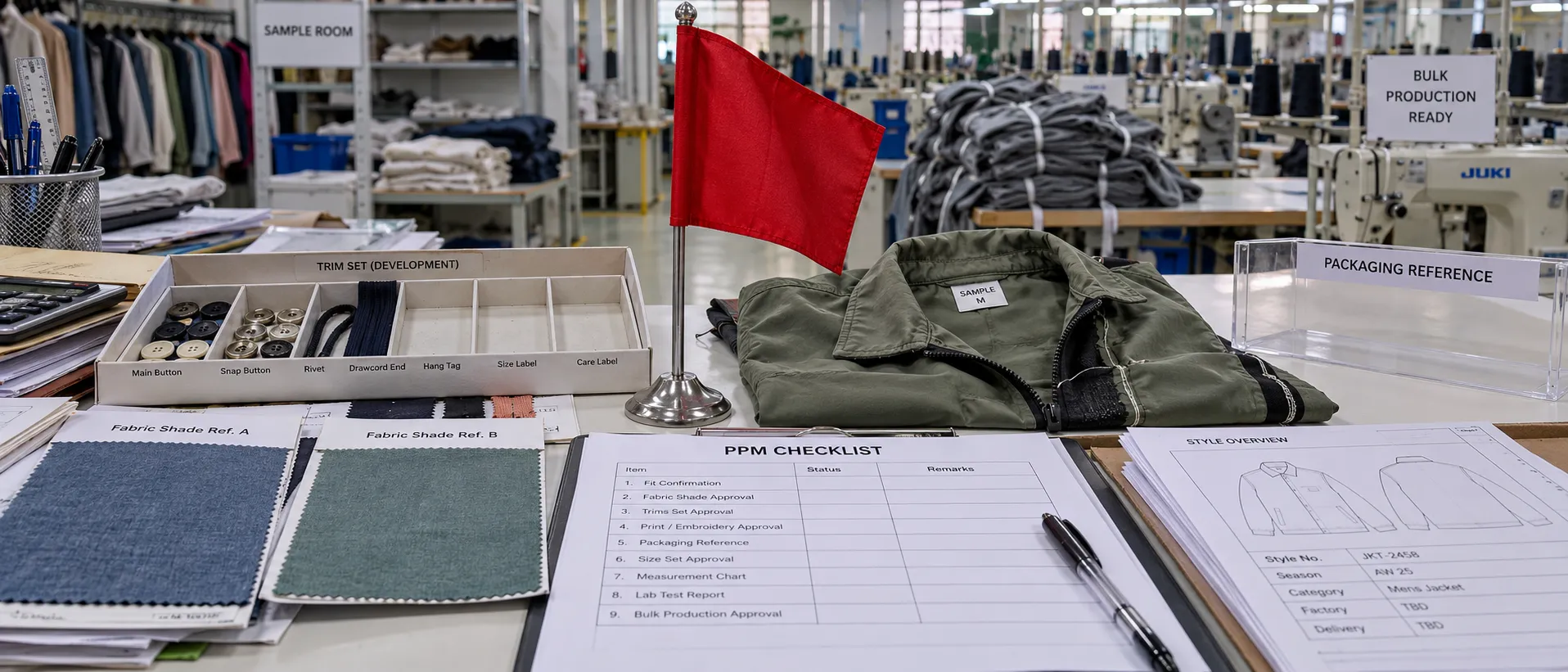
Red Flags:
- PP sample not approved but bulk is being pushed
- Lab dip approval is “pending” but fabric is already in cutting
- Artwork placement confirmed verbally but no placement map exists
- Measurement tolerance not defined for critical POMs
- No inline QC plan, only final inspection expectation
- Production scheduling is one date, not a staged plan
- No risk review, no owners, no escalation ladder
- Packaging and labeling are “standard” with no approvals
When a red flag affects a critical production dependency, the PPM should record whether the affected stage is held, conditionally released, or allowed to proceed with a documented mitigation plan and named approval authority.
FAQs
What is a pre production meeting?
A pre production meeting is the alignment gate before bulk starts where specs, materials, approvals, QC plan, production scheduling, and risk ownership are locked with evidence.
What is a pre production meeting checklist used for?
A pre production meeting checklist is used to prevent bulk starting with open decisions. It ensures every critical item is locked with proof and ownership before cutting begins.
What is the sample approval process timing relative to PPM?
PPM should occur only after key approvals are complete or clearly staged. PP sample approval is typically a bulk-start dependency unless the buyer issues written conditional approval.
When does lab dip approval need to be completed?
For custom-dyed fabric, lab dip approval is normally completed before bulk dyeing is released. Bulk shade lots should then be reviewed against the approved color reference, with shade-control and lot-segregation rules defined before the affected fabric moves into cutting.
How do I lock artwork placement properly?
Use measurable reference points, define placement size and tolerance, confirm method execution proof (strike-off/emb sample), and record approvals with evidence.
What’s the difference between measurement tolerance and measure tolerance?
They refer to the same concept: the allowed deviation from target measurements. The key is defining tolerance by POM and locking measurement method consistency.
What is inline QC?
Inline QC is quality checking during production stages (cutting, sewing, finishing) rather than only at the end. It detects defects early when correction is still cheap.
What production scheduling proof should I request?
At minimum: a line plan snapshot, capacity allocation note, and a staged timeline that shows dependencies on materials and approvals.
Summary: bulk should start only after gates are locked
A pre production meeting checklist turns the handoff from development to bulk production into a controlled release process. Confirm the critical gates, attach the available evidence, assign owners, document open conditions, and make a clear go, conditional-go, or hold decision for the affected production stages. This gives the buyer, manufacturing team, and quality team a shared reference before bulk execution begins.
.
Still Resolving Requirements Before the PPM?
If MOQ, lead time, testing, compliance, fabric assumptions, or sample requirements are still unclear, resolve those questions before treating the order as ready for final pre-production release.
Connect with RYZEAL SOURCING