
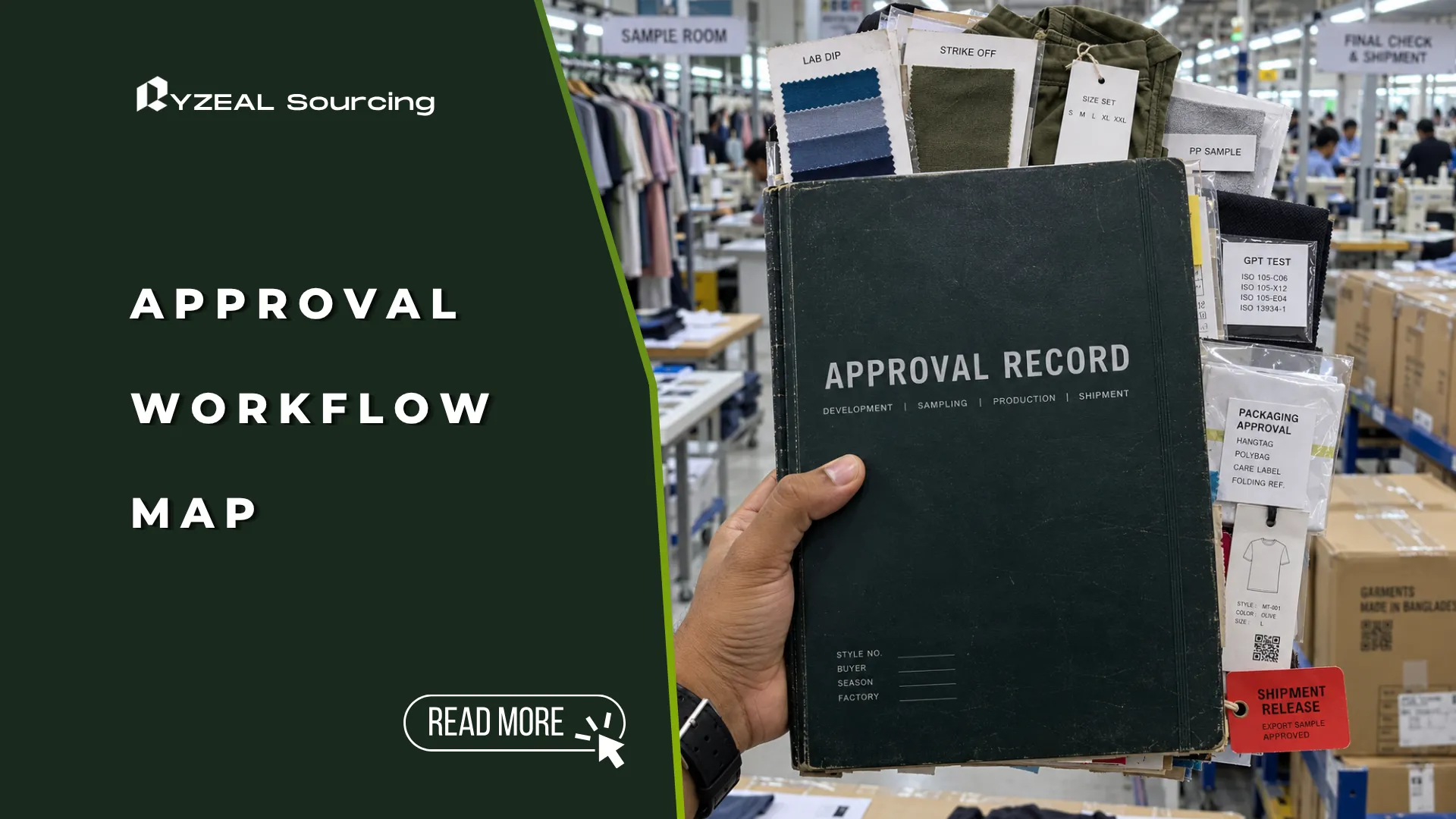
Apparel production timelines can be disrupted when critical approvals are delayed, poorly documented, or assigned to unclear decision owners. Even when manufacturing capacity is available, unresolved color, artwork, fit, sample, testing, or packaging decisions can delay dependent activities. A structured approval workflow helps buyers, manufacturers, and sourcing partners manage these decisions before they affect bulk production or shipment.
This guide presents a practical approval workflow map covering lab dips, print strike-offs, size sets, pre-production (PP) samples, garment testing (GPT), packaging approval, and shipment release. For each approval category, you will see the decisions required, acceptable evidence, responsible parties, and the production activities affected.
This guide builds on the wider RFQ and onboarding system that coordinates supplier setup, purchase orders, approvals, and production readiness. Before applying it, buyers should understand manufacturer vetting and due diligence and how to write an RFQ with clear technical and commercial requirements. The approved documents and samples should then be reviewed through the pre production meeting checklist before bulk production begins.
Quick Answer: the 6-stage approval workflow (with gate rules)
An apparel approval workflow defines the decision owner, required evidence, agreed response time, and production impact of each approval. Critical requirements must be completed before the activities they control can proceed. Other activities may continue in parallel when the remaining risks and responsibilities are documented.
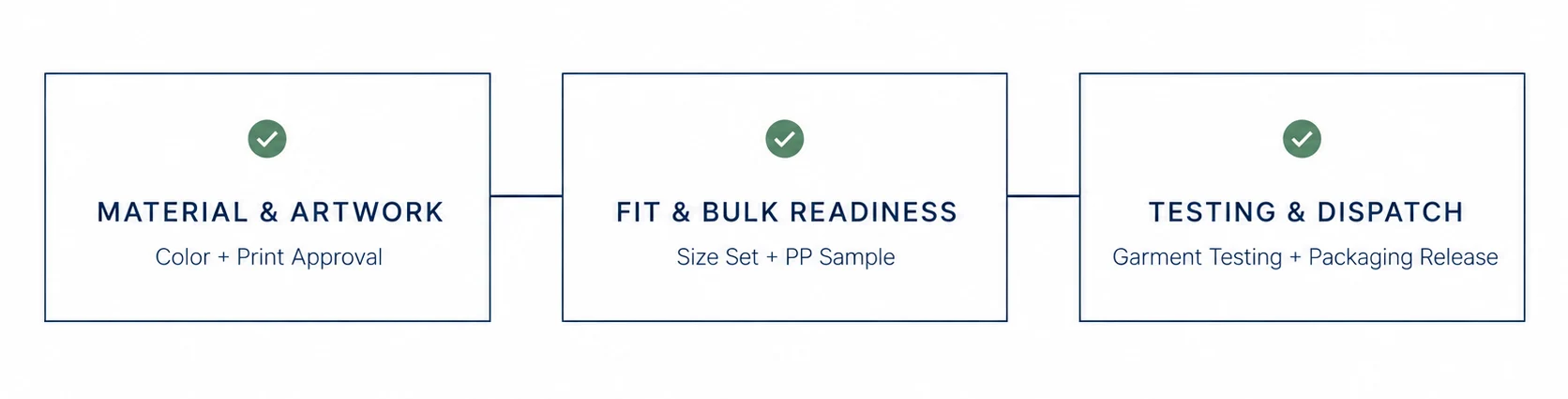
The 6 stages:
- Color approval (lab dips, where applicable)
- Print and embroidery approval (strike-offs and embroidery samples)
- Fit and grading confirmation (size set)
- Pre-production sample approval (PP sample)
- Garment performance or package testing (GPT, where required)
- Packaging approval and shipment release
| Approval | Typical Owner | Evidence | Response Target | Blocks What? | Rework Trigger |
|---|---|---|---|---|---|
| Lab dip | Buyer / color approver | Approved color reference | Agreed per project | Custom bulk dyeing | Color rejection or changed standard |
| Print / embroidery | Buyer / artwork approver | Strike-off or embroidery approval | Agreed per project | Affected decoration process | Method, artwork, or substrate change |
| Size set | Technical / buyer | Size measurements and comments | Agreed per project | Relevant grading or bulk release | Critical POM or fit failure |
| PP sample | Buyer / technical / QA | Approved sample and comment closure | Agreed per project | Affected bulk production | Unapproved material or construction change |
| GPT / testing | QA / buyer | Required test reports | Based on testing plan | Defined production or shipment gate | Failed or invalidated test |
| Packaging / shipment | Buyer / QA / logistics | Packing, inspection, and release records | Agreed per project | Packing or dispatch | Label, packing, inspection, or document issue |
Table of Contents
What an Approval Workflow Is and How It Affects Lead Time
Direct Answer
An approval workflow is the system that connects product decisions to the manufacturing activities they authorize. Because many approvals are production dependencies, delays can affect material sourcing, printing, cutting, sewing, packing, or shipment. The workflow should identify exactly which activities depend on each approval.
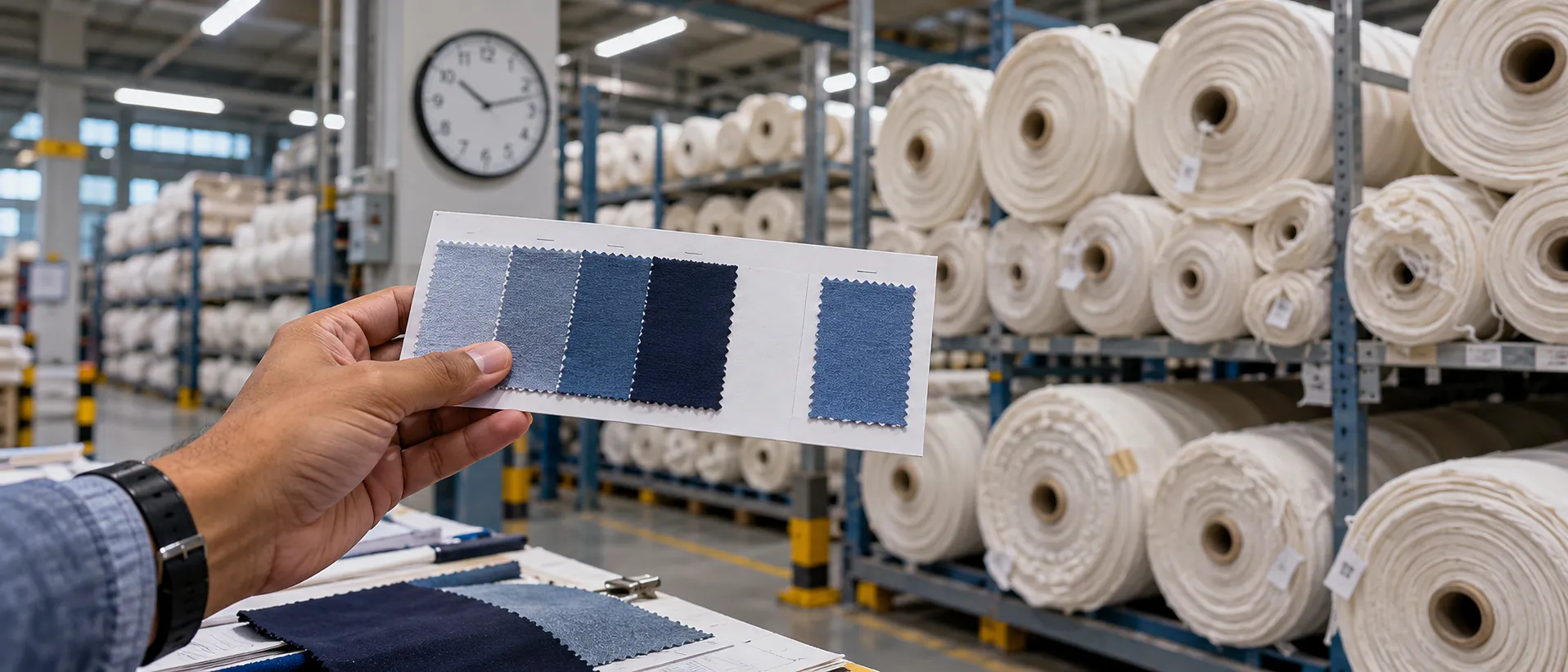
A real approval process workflow answers five questions:
- What needs approval (exact item and version)?
- Who approves (decision owner)?
- What evidence counts (sample/report/photo/version)?
- How fast decisions must happen (SLA)?
- What is blocked if approval is late (bulk release, cutting, shipment, etc.)?
If any of these are vague, approval drift begins. Approval drift means:
- factory starts on assumptions to keep lines running
- buyer discovers issues late and requests changes
- changes trigger rework, delays, or re-approvals
- shipment is held when packaging or testing is incomplete
The approval timeline is an important part of the production critical path. A practical approval workflow connects each decision to an owner, documented evidence, agreed response targets, the activities affected, and the action required when an approval is delayed or rejected.
When apparel production is coordinated through a network of specialized manufacturing partners, one shared approval system can also give the buyer-facing team a consistent method for tracking decisions, evidence, deadlines, and escalation across the selected facilities.
The Apparel Approval Workflow: What Each Gate Controls
Direct Answer
Use this approval workflow map to identify which approvals apply to the order, the evidence required, and the manufacturing activities affected. A critical approval may block its dependent process, while unrelated activities can sometimes continue under a documented production plan.
Stage summary (what blocks what)
- Lab dip approval may block bulk dyeing when custom color approval is required.
- Print strike-off or embroidery sample approval controls the affected decoration process.
- Size set approval confirms grading and measurement requirements before the relevant bulk-production stage.
- PP sample approval establishes the agreed production reference before bulk release, subject to documented conditions.
- GPT or other required garment testing can affect bulk or shipment release according to the buyer’s testing plan.
- Packaging approval controls packing execution and contributes to the final shipment-release decision.
Gate 1: Lab Dip and Color Approval
Direct Answer
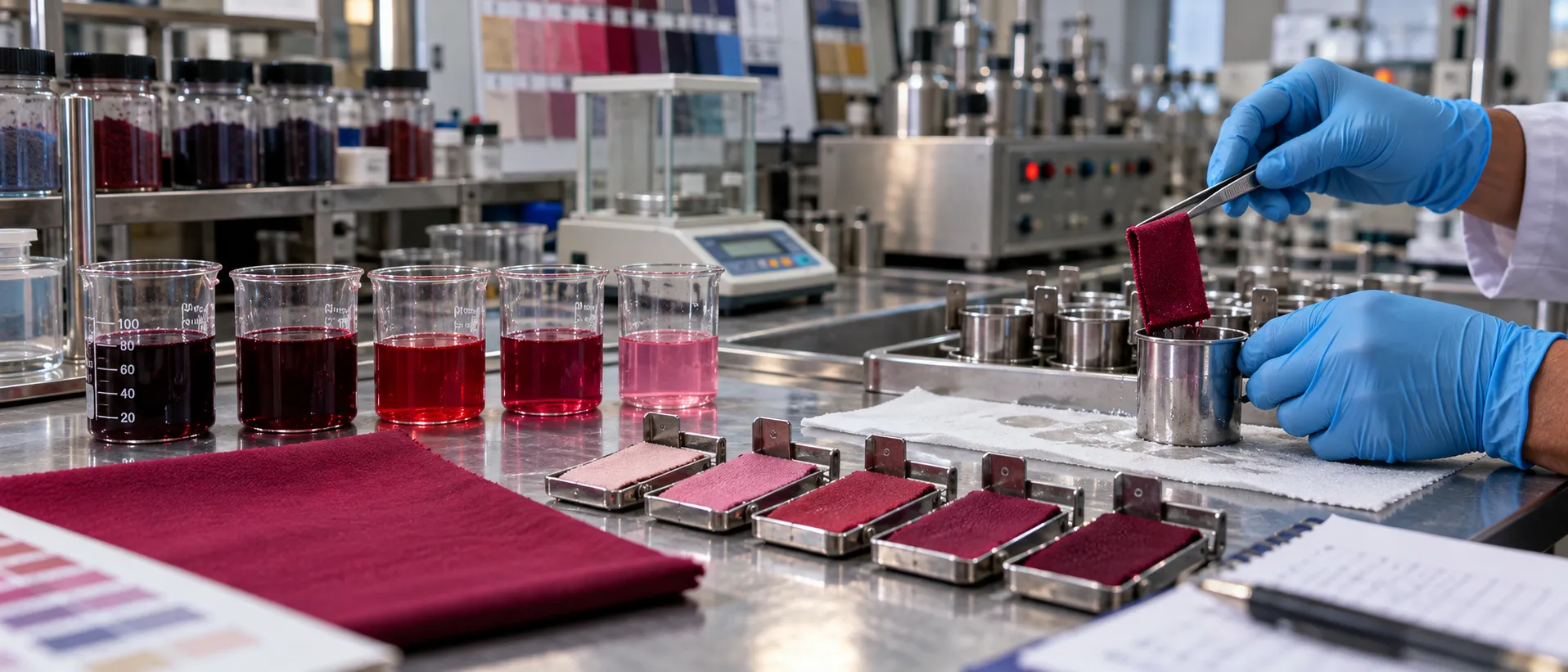
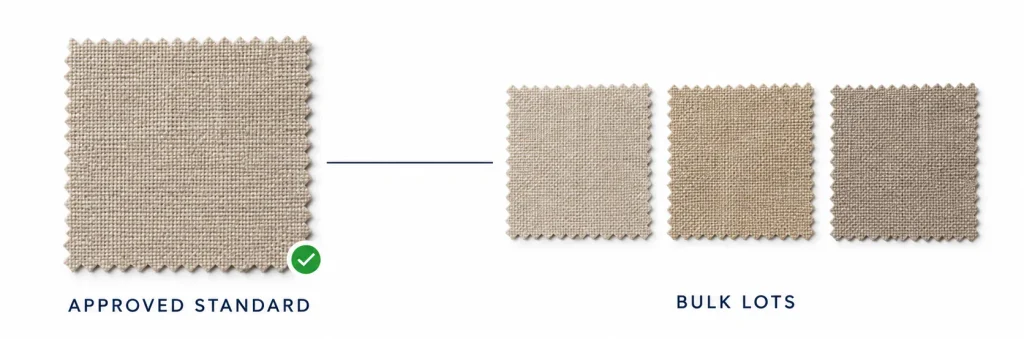
The lab dip process establishes an approved color reference for custom-dyed fabric before bulk dyeing. It helps reduce shade-mismatch risk, but bulk fabric still needs shade evaluation and lot-control procedures because an approved lab dip does not guarantee identical results across every bulk dye lot.
What lab dip approval must lock
- Target shade reference (Pantone or physical swatch reference)
- Viewing conditions rule (at least consistent evaluation, not random lighting)
- Agreed color tolerance and bulk shade-review procedure, with shade bands established when actual bulk lots become available
- Stop/go rule if bulk shade drifts
Textile color should be evaluated under agreed lighting conditions. X-Rite explains that fabric color appearance can change depending on the light source, viewing angle, and material, making consistent evaluation conditions important when comparing approved references and production samples.
Evidence that counts
- Approved lab dip card(s) with approval date
- Photo evidence under agreed lighting (if your system uses photos)
- Shade band or bulk-lot references when available
- Bulk lot control decision (how lots are handled)
What lab dip approval blocks
- Bulk dyeing for custom dyed fabric
- Cutting for critical brand colors where shade is non-negotiable
Rework triggers
- Shade outside acceptable band
- Supplier changes dye lot or mill without disclosure
- Buyer changes shade reference after approval (requires re-approval)
| Evidence Required | Typical Owner | Response Target | Bulk Impact |
|---|---|---|---|
| Approved lab dip or color standard | Buyer / color approver | Agreed by project | Controls custom bulk dyeing |
| Fabric identity and reference | Fabric team / supplier | Agreed by project | Confirms intended substrate |
| Bulk shade review | QA / fabric team | Before affected cutting stage | Controls lot acceptance |
| Shade variation decision | Buyer / QA | Agreed by project | Determines hold, segregation, or corrective action |
| Approval record | Merchandising | Upon decision | Provides traceable production reference |
How Lab Dips Are Developed Before Bulk Dyeing
Before approving a custom fabric color, a dye house may prepare small dye trials, compare the results against the target shade, and adjust the formulation. This dye-house walkthrough shows the practical development process behind a lab dip.
The final color approval should be linked to the correct fabric reference, approved submission, decision date, and procedure for reviewing bulk dye lots.
Gate 2: Print Strike-Off and Embroidery Approval
Direct Answer
A print strike-off is a trial print used to evaluate how artwork reproduces on the intended fabric or substrate. It helps confirm print color, scale, detail, and execution quality. Garment placement should also be checked against an approved placement reference, while embroidery requires its own sample or swatch approval where applicable.
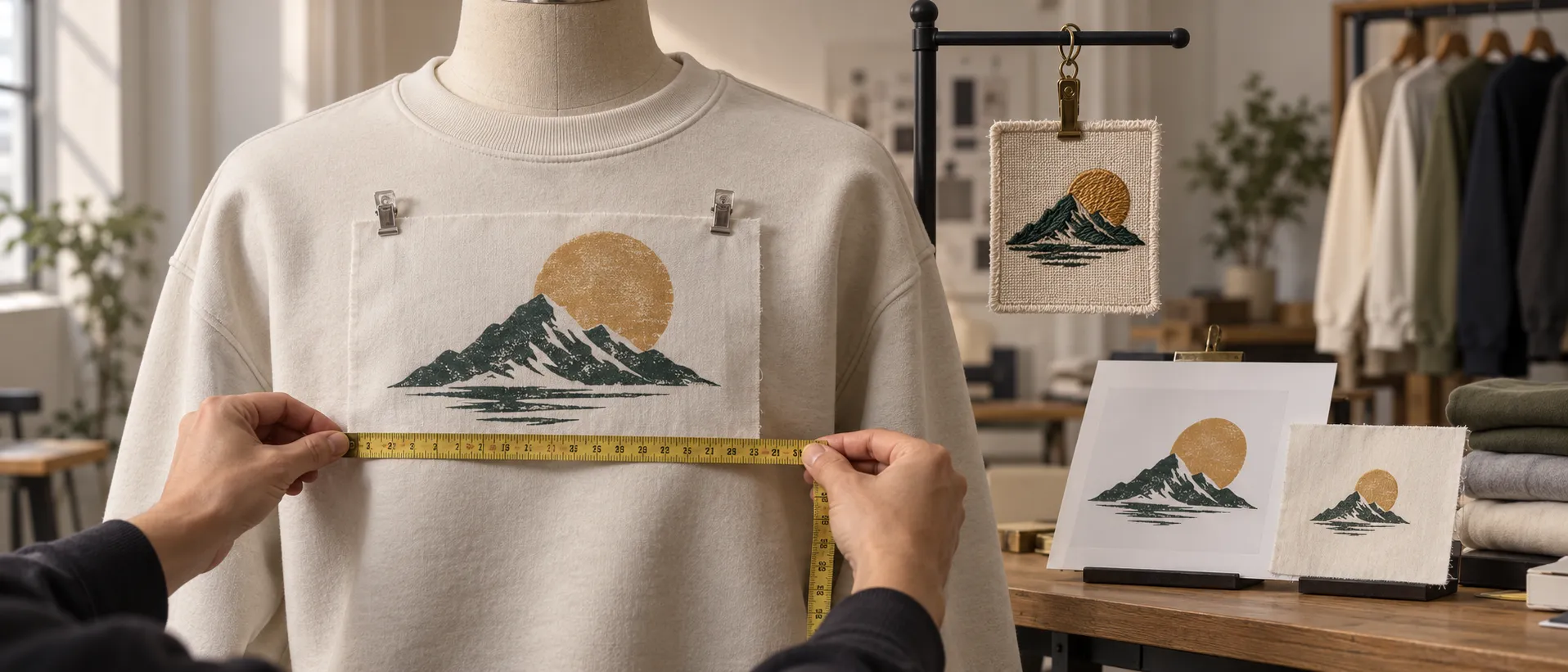
What a strike off must prove
- Color accuracy (ink/transfer result on fabric)
- Print sharpness and details
- Size/scale accuracy
- Placement reference points (how it will be positioned on garment)
- Durability expectations (if wash tests are required)
Evidence that counts
- Strike off sample on the correct fabric and finish
- Photo evidence with measurement scale (optional but useful)
- Placement map with reference points
- Approval record (owner + date + version)
What strike off approval blocks
- Bulk print execution
- Cutting (if placement requires panel alignment)
- A change in the approved print method that requires technical review and re-approval before the affected process continues
Rework triggers
- Method changed after approval
- Fabric base changed after approval (print behavior changes)
- Placement reference points not defined, leading to inconsistent execution
Print and Embroidery Approval Checklist
- Final artwork file and version confirmed
- Intended fabric or substrate identified
- Print or embroidery method confirmed
- Artwork color, scale, and detail reviewed
- Placement reference and dimensions confirmed
- Strike-off or embroidery sample approved
- Durability testing requirements defined, if applicable
- Approval owner and date recorded
- Re-approval decision required for changes to critical artwork, materials, or production methods
Gate 3: Size Set, Grading, and Measurement Approval
Direct Answer
A size set sample helps evaluate how grading, fit, measurements, and construction translate across the required size range. It can identify size-specific issues before bulk production, especially when approval of a single base size does not adequately represent the complete order.
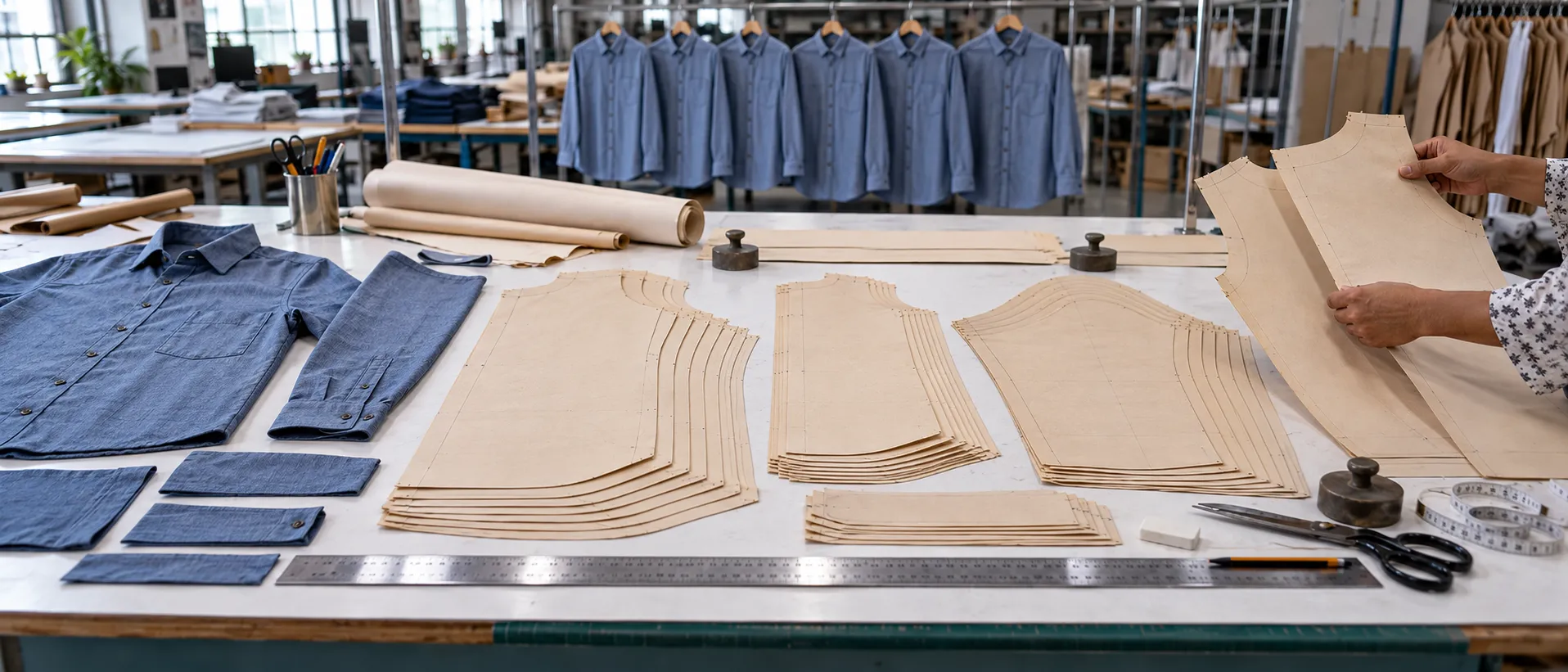
What a size set sample proves
- Grading consistency across sizes
- Critical points of measure stay within tolerance
- Pattern and construction scale correctly across sizes
- Fit issues are not hidden by only sampling one size
What must be locked at this gate
- Measurement tolerance by critical POM
- How garments are measured (method consistency)
- Pass/fail rules if tolerance is exceeded
- Any “size-specific” construction changes (if applicable)
Evidence that counts
- Size set measurement sheet
- Photos or measurement evidence if your system uses it
- Written decision: pass, conditional pass, or fail
What it blocks
- Bulk release on multi-size orders where grading risk is high
- Finalizing the PP sample standard without confirmed grading stability
| Size | Critical Point of Measure | Target | Tolerance | Decision Rule |
|---|---|---|---|---|
| XS | Buyer-defined POM | Approved size specification | Buyer-defined | Review deviations |
| S | Buyer-defined POM | Approved size specification | Buyer-defined | Review deviations |
| M | Buyer-defined POM | Approved size specification | Buyer-defined | Review deviations |
| L | Buyer-defined POM | Approved size specification | Buyer-defined | Review deviations |
| XL | Buyer-defined POM | Approved size specification | Buyer-defined | Review deviations |
Gate 4: Pre-Production Sample Approval
Direct Answer
A pre-production (PP) sample is a production-intent garment used to confirm the approved materials, construction, fit, measurements, branding, and workmanship before bulk manufacturing. Once accepted, it becomes an important reference for the production and quality teams alongside the approved technical documents.
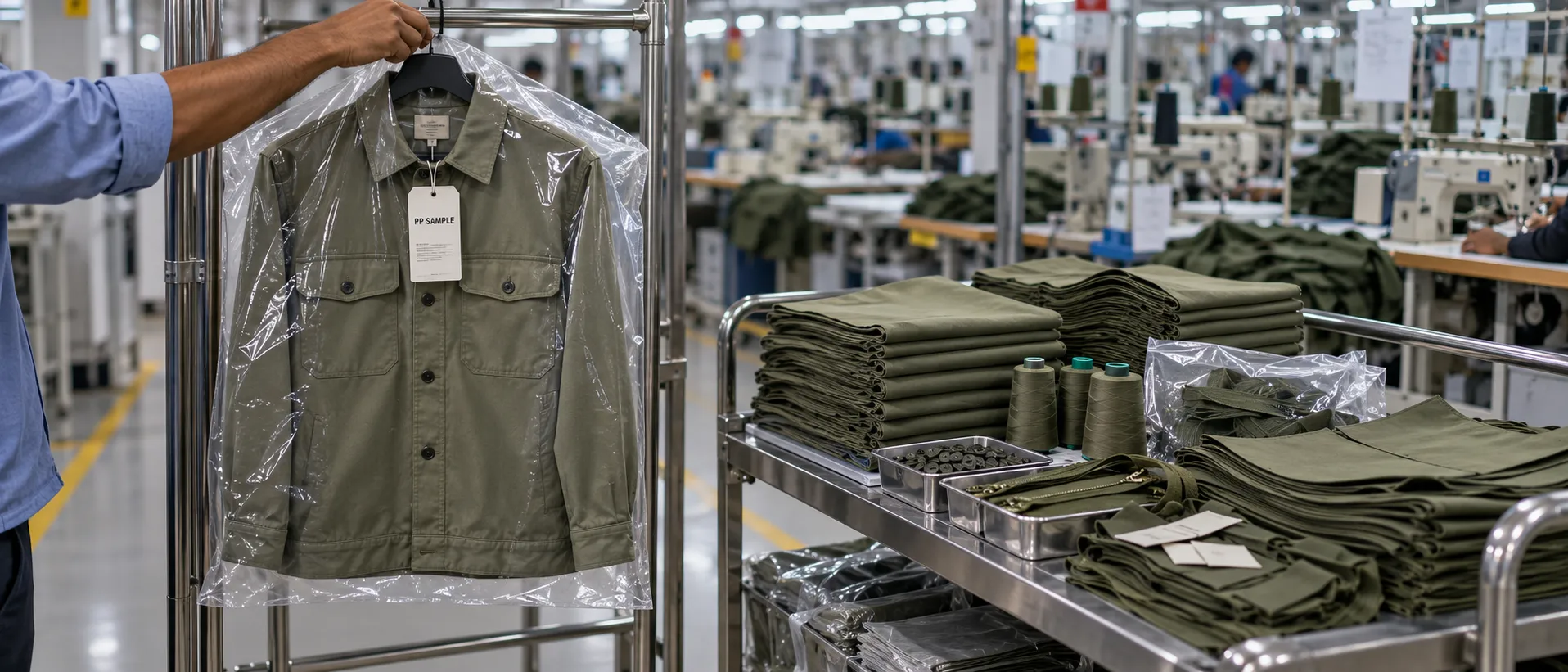
A PP sample may be developed in a sample room, but the buyer should confirm how closely its materials, trims, construction methods, equipment requirements, and finishing processes represent the intended bulk-production conditions. Differences or substitutions should be disclosed and controlled before the affected bulk process begins.
What must match the PP sample
- Fabric and trims (or formally approved equivalents)
- Construction and workmanship standards
- Artwork placement and method execution (print/emb)
- Measurement tolerance compliance
- Packaging readiness assumptions (labels and placements)
Conditional approval vs final approval (rules)
Conditional approval is acceptable only when conditions are explicit:
- what must be fixed
- who owns the fix
- by what date
- what evidence proves closure
- whether any affected bulk activity may proceed before closure, and who is authorized to approve that decision
What PP approval blocks
- Bulk release for the affected processes until mandatory approval conditions are closed or an authorized conditional release is documented
- Shipment release if PP issues impact compliance or labeling
Rework triggers
- Any change in fabric, trims, wash, print method, or measurement spec after PP approval
- Any unresolved PP comments that later reappear in bulk
| Approval Item | Required Evidence | Typical Owner | Response Target | Gate Impact |
|---|---|---|---|---|
| Fabric and trims | Approved BOM and material references | Merchandising / buyer | Agreed by project | Material readiness |
| Construction | Sample and technical comments | Technical / QA | Agreed by project | Bulk construction |
| Measurements | Approved measurement report | Technical / buyer | Agreed by project | Fit and size control |
| Branding | Approved print or embroidery reference | Buyer / artwork team | Agreed by project | Decoration release |
| Open PP comments | Corrective-action closure record | Merchandising / QA | Before affected bulk release | Conditional approval |
| Final PP decision | Approved sample reference and authorization | Buyer / designated approver | Agreed by project | Bulk-production release |
Need Better Control From Samples to Bulk Production?
RYZEAL SOURCING helps apparel buyers coordinate product development, sampling, factory matching, approvals, production follow-up, quality control, and shipment readiness through a vetted network of specialized manufacturing partners.
Gate 5: Garment Testing and Approval
Direct Answer
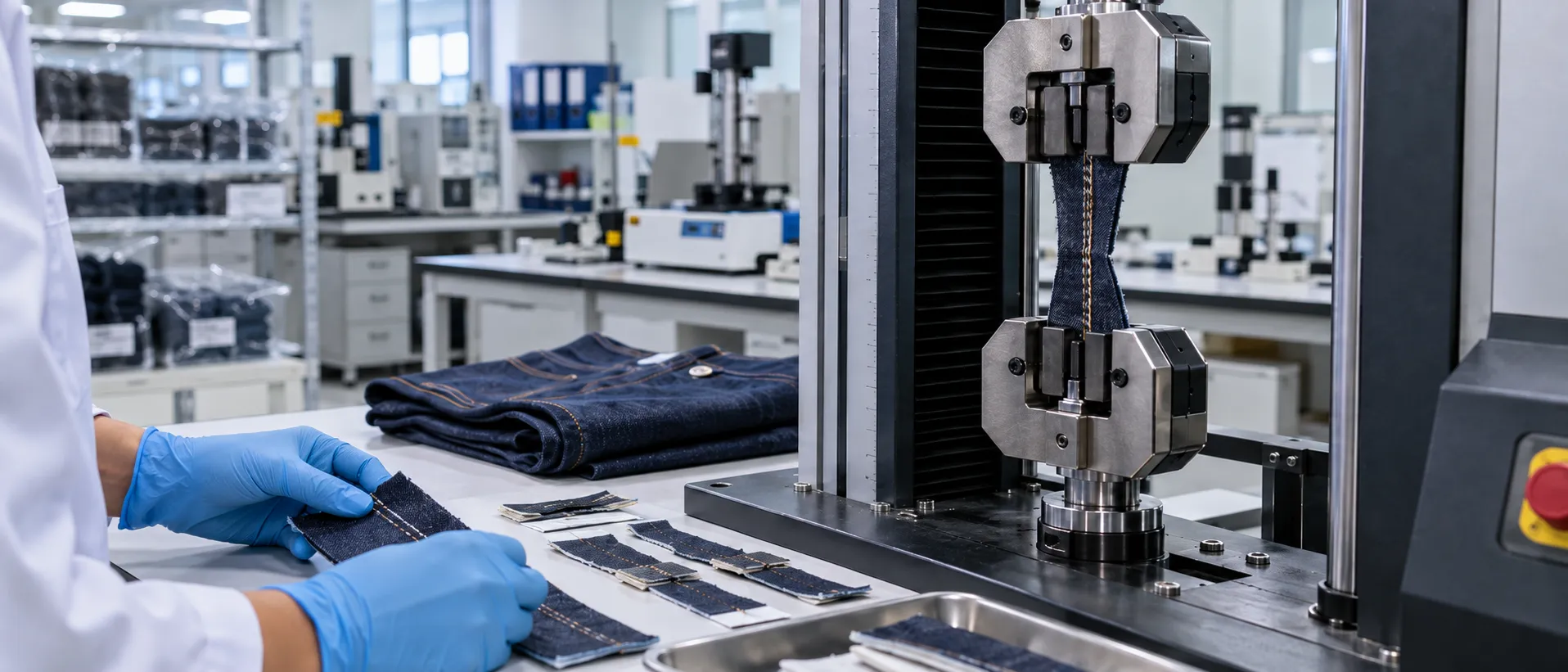
GPT commonly refers to Garment Performance Test or Garment Package Test in apparel buyer workflows, although the terminology varies. It involves a defined testing program that may cover physical, chemical, dimensional, or other product performance requirements. The buyer’s test matrix should specify which tests apply, when samples are submitted, and which production or shipment decisions depend on the results.
What to lock at this stage
- Which tests apply (buyer-defined matrix)
- When samples are taken and which development or production stage they represent
- Which standards apply (market/brand standard)
- What happens if a test fails (hold/rework/retest rule)
Evidence that counts
- Test request record (what was submitted, when)
- Test report(s) showing pass/fail
- Corrective action record if failures occurred
- Retest confirmation if required
What GPT blocks
- The production or shipment activity identified in the buyer’s testing plan
- Bulk release where required tests must pass before manufacturing begins
- Shipment release where mandatory final results remain outstanding or unacceptable
Rework triggers
- Failed test results
- Changes to materials/process that invalidate prior tests
| Test | Applicable Standard | Sample Timing | Failure Action |
|---|---|---|---|
| Dimensional stability | Buyer-specified ISO / AATCC method | Defined by testing plan | Review shrinkage or growth |
| Colorfastness | Applicable test method | Development or bulk, as required | Investigate color performance |
| Pilling resistance | Buyer-specified method | According to product requirements | Review fabric and finishing |
| Seam performance | Applicable physical test | Based on product construction | Review seam and material performance |
| Restricted substances | Applicable market or buyer requirement | As required | Hold affected release pending resolution |
| Other performance claims | Relevant test method | Defined by buyer | Correct or validate performance |
The testing matrix should reflect the garment’s materials, construction, intended use, and destination market. Intertek’s textile testing services include dimensional stability, colorfastness, strength, abrasion, pilling resistance, and chemical evaluations, demonstrating why testing requirements should be defined for each product.
How Textile Testing Supports Garment Approval
Visual sample approval does not establish every aspect of garment performance. Depending on the product, laboratory testing may be needed to evaluate dimensional stability, colorfastness, physical strength, chemical requirements, or other specified properties.
This Intertek Bangladesh video introduces the role of testing and inspection in evaluating apparel and related textile products.
The approval tracker should identify the required tests, submitted sample references, applicable standards, report status, decision owner, and any production or shipment release affected by the results. A test result should be evaluated against the buyer’s agreed acceptance criteria, not treated as an automatic approval without review.
Gate 6: Packaging Approval and Shipment Release
Direct Answer
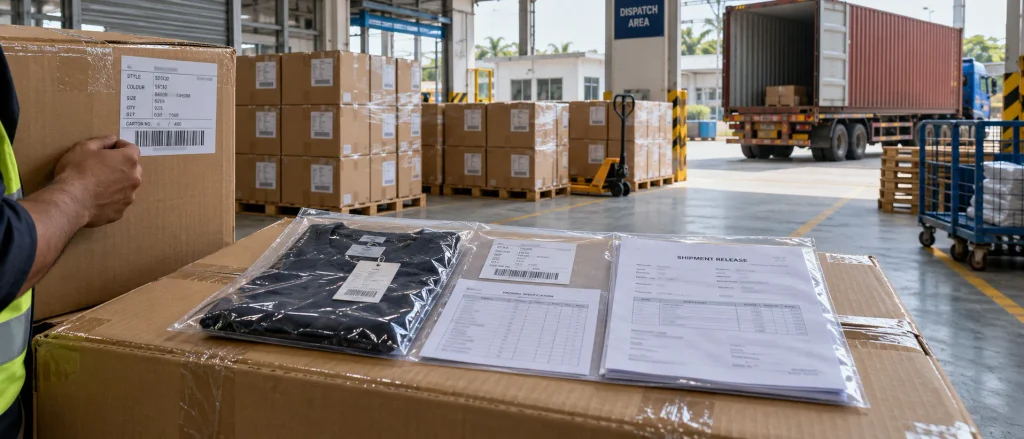
Packaging approval confirms that labels, barcodes, polybags, carton marks, packing methods, and related requirements match the buyer’s approved specifications. Incorrect packaging can cause relabeling, scanning problems, dispatch delays, or customer non-conformance. Applicable packaging requirements should therefore be verified before shipment release.
What packaging approval must lock
- Polybag spec (thickness, closure, warnings if applicable)
- Barcode and sticker placement
- Care label content and placement
- Carton marks content and layout
- Assort method (ratio packing rules)
- Carton size/strength rules
Care-label instructions should be appropriate for the garment and destination market. Where textile-care symbols are used, ISO 3758:2023 provides a standardized system covering washing, bleaching, drying, ironing, and professional textile care. Market-specific legal labeling requirements should be checked separately.
Evidence that counts
- Approved packaging spec
- Approved label artworks
- Packing photos from first packed cartons
- Carton mark sample photo
- Packing checklist sign-off
Bulk release vs shipment release (define clearly)
- Bulk release: authorization to begin the relevant bulk-production activities after required specifications, materials, samples, technical approvals, and production-readiness conditions have been reviewed.
- Shipment release: authorization to dispatch finished goods after the applicable final inspection, required testing, packaging verification, documentation checks, and buyer or authorized-party release requirements have been satisfied.
Shipment evidence pack (minimum)
- Final inspection evidence (internal or third-party)
- Packaging approval confirmation and packing photos
- Approval log (lab dip, strike off, PP, etc.)
- Test reports where required
- Shipment documents readiness confirmation (if your process includes it)
| Item | Required Evidence | Typical Owner | Release Gate |
|---|---|---|---|
| Final inspection | Accepted inspection report | QA / buyer | Shipment acceptance |
| Garment testing | Required accepted test reports | QA / technical | Testing clearance |
| Packaging | Approved packing specification and verification | Buyer / packing QA | Packing release |
| Labels and barcodes | Approved references and checks | Buyer / logistics | Labeling clearance |
| Carton marks | Approved carton-mark reference | Logistics / packing | Dispatch preparation |
| Approval status | Closed or formally accepted approval record | Merchandising | Final authorization |
| Shipping documents | Required documents and readiness confirmation | Commercial / logistics | Shipment processing |
| Shipment authorization | Named approver’s release decision | Buyer / authorized party | Dispatch approval |
Shipment Evidence Pack Checklist
- Final inspection report and acceptance decision
- Required garment and material test reports
- Approved PP sample reference
- Current technical specification and BOM
- Applicable color, print, embroidery, and size approvals
- Approved packing and labeling references
- Carton marks and packing details
- Corrective-action closure evidence, where required
- Required shipment documentation and commercial release status
- Final shipment authorization
Approval Timeline: Response Targets, Escalation, and Change Control
Direct Answer
An approval timeline should define when submissions are expected, how long reviews may take, who makes each decision, and what happens when a response is delayed. Agreed response targets help the production team plan dependent activities and resolve issues before they affect important milestones.
Setting Practical Approval Response Targets
- Lab dips: agree on a review target that allows proper color evaluation.
- Strike-offs: define a response target based on artwork complexity and approval requirements.
- Size set: allow time for measurement and grading review across the required sizes.
- PP sample: establish a target that accounts for fit, construction, materials, and technical comments.
- Packaging: define the review target before packing materials or processes are released.
- Testing: confirm laboratory turnaround and reporting dates in advance.
Escalation triggers (simple and effective)
- Any approval pending beyond SLA → escalation to decision owner
- Any change request that impacts cost/timeline → change-control review
- Repeated defects after approval: investigate the root cause and determine whether affected activities require a hold or corrective action.
Version control rules (non-negotiable)
Approvals must reference:
- version number of tech pack/artwork/BOM
- date of approval
- evidence link
When a change affects an approved requirement, the team should determine whether the affected item needs re-approval. Version control helps ensure that the buyer, supplier, production team, and QC team use the same current reference.
| Approval | Agreed Response Target | Escalation Trigger | Owner |
|---|---|---|---|
| Lab dip | Set by project | Target missed or color issue unresolved | Color approver |
| Strike-off / embroidery | Set by project | Artwork or method decision delayed | Artwork approver |
| Size set | Set by project | Fit or grading comments unresolved | Technical team |
| PP sample | Set by project | Bulk release affected | Buyer / technical |
| GPT / testing | Based on lab schedule | Test failure or report delay | QA / testing coordinator |
| Packaging | Set by project | Packing or shipment milestone affected | Buyer / logistics |
Common approval workflow failure modes (red flags that force a hold)
Direct Answer
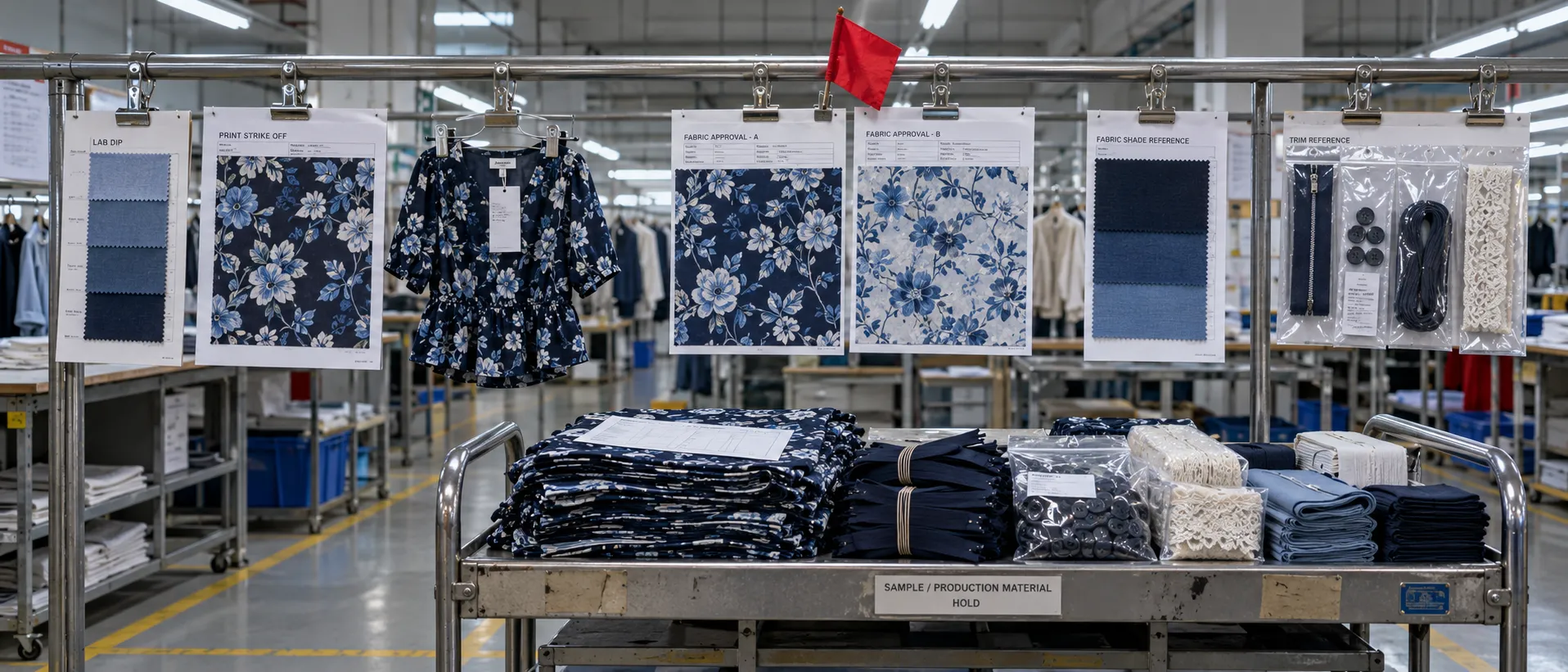
These warning signals indicate that approval ownership, documentation, release decisions, or change control may not be functioning effectively. The affected requirements should be reviewed before production continues on an uncertain basis.
Red flags:
- “Verbal approval” with no evidence or version reference
- Bulk printing is planned without the required strike-off or print approval
- PP sample approved without checking important material, construction, or process differences from the planned bulk method
- Lab dip approved but bulk lot changes without disclosure
- Packaging treated as “standard” with no packaging approval process
- Testing (GPT) scheduled too late, creating shipment hold risk
- Bulk release granted without documenting outstanding conditions, authorized exceptions, and the activities permitted to proceed
When a red flag affects a critical approval requirement, hold the relevant production or shipment activity until the issue is resolved or an authorized conditional release is documented with appropriate safeguards.
FAQs
What does approval workflow mean in garment production?
An apparel approval workflow defines how color, artwork, fit, samples, testing, packaging, and related production decisions are reviewed and authorized. It records the approval owner, required evidence, response target, and manufacturing activities affected by each decision.
What is the difference between an approval workflow and an approval timeline?
Approval process workflow is the sequence and gate rules. Approval timeline is the timing and SLAs assigned to each approval so the workflow does not drift.
What is the lab dip approval process timing?
For custom-dyed fabric, lab dip approval is normally completed before bulk dyeing is released. Actual bulk dye lots should then be reviewed against the approved color reference, with agreed shade-control and segregation rules before the affected fabric moves into cutting.
What is strike off approval?
Strike off approval is confirming print execution on the correct fabric base at the correct size and placement logic, with recorded evidence and version control.
What is a size set sample used for?
A size set sample checks grading and measurement tolerance across sizes so fit and workmanship are stable beyond a single sample size.
What is a PP sample in garment manufacturing?
A PP sample is a production-intent garment approved as a reference for bulk manufacturing. It should represent the agreed materials, construction, measurements, fit, and branding execution, with any approved substitutions or outstanding conditions documented.
What does GPT mean in this approval workflow map?
GPT commonly refers to Garment Performance Test or Garment Package Test in apparel buyer workflows. It describes testing against specified physical, chemical, or performance requirements. The applicable tests, sample timing, and release decisions depend on the buyer’s testing program.
What is the packaging approval process and why does it matter?
Packaging approval process locks polybag spec, labels, barcode placement, carton marks, and packing method. It prevents shipment holds, customs issues, and brand non-conformance.
Summary: Keep Approvals Aligned With Production
A reliable apparel production schedule depends on clear specifications, timely approvals, and documented release decisions. A structured approval workflow helps buyers and manufacturing teams identify which activities can proceed, which need additional evidence, and which should remain on hold. Assign decision owners, maintain approval records, establish response targets, and apply consistent control principles from product development through shipment.
Are Your Requirements Clear Before Sampling?
Before development approvals begin, clarify MOQ, lead time, testing, compliance, fabric assumptions, and subcontracting expectations. These early decisions help reduce avoidable changes later in the approval workflow.
Connect with RYZEAL SOURCING