
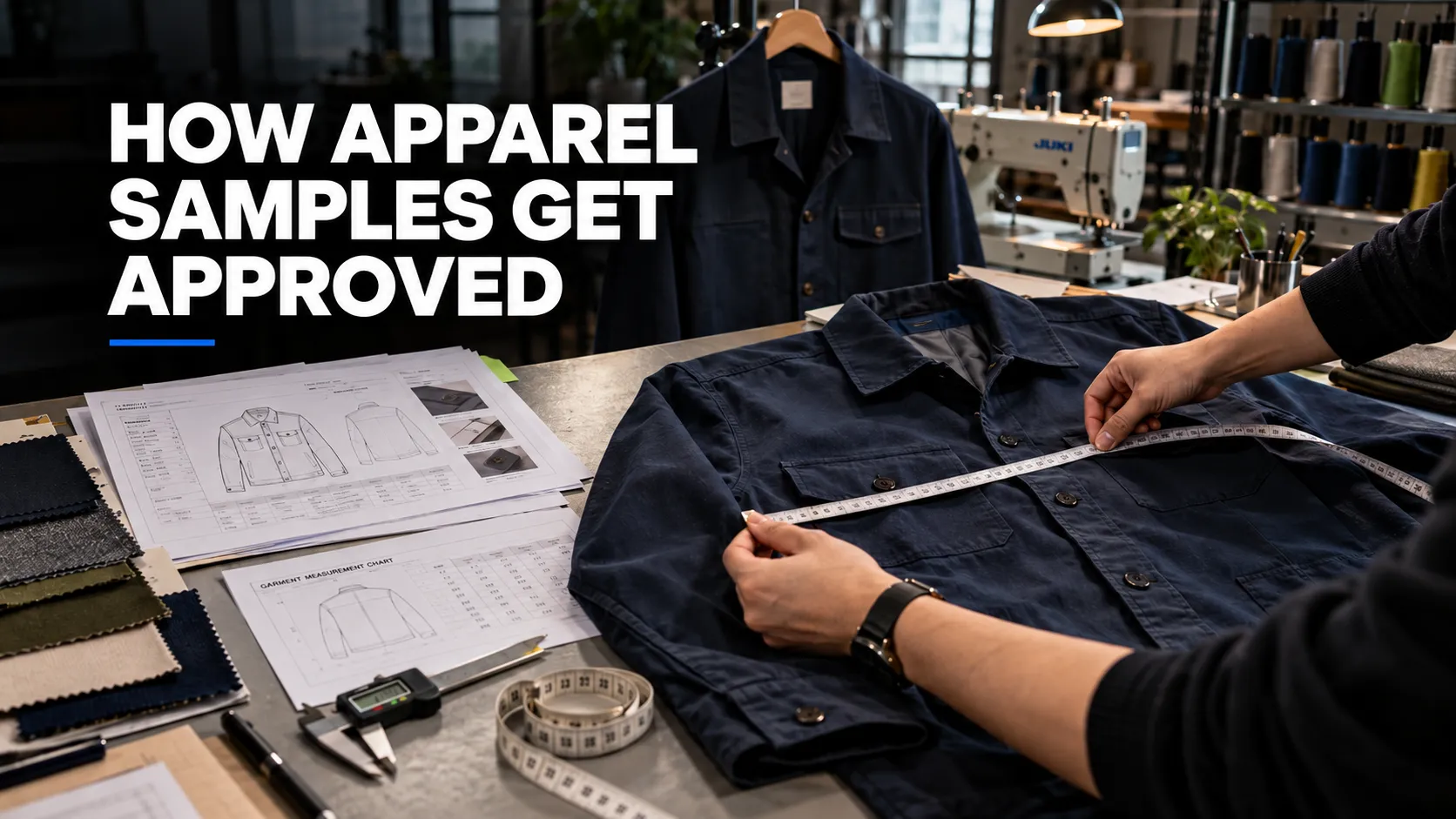
Apparel product development connects a clothing design with the technical specifications, materials, samples, and approvals needed for manufacturing. For brand owners, product developers, sourcing teams, and startups, a structured development process helps improve quotation accuracy, reduce avoidable sampling revisions, and prepare a product for bulk production.
An approved sample is more than a garment that looks right. It provides an agreed physical reference for fit, measurements, construction, workmanship, and other applicable details. Together with the approved tech pack, BOM, testing requirements, and approval records, it helps manufacturers and buyers establish a consistent standard for production.
This guide focuses on four important controls in apparel product development: technical specifications, Bill of Materials (BOM), measurement tolerances, and sample approvals. Understanding how these elements work together helps buyers make informed decisions, coordinate manufacturing partners, and identify development risks before they affect production.
The following sections explain the practical steps involved in developing apparel with a clothing manufacturer, from preparing technical documents and evaluating materials to reviewing samples and recording approvals.
Before development begins, buyers should establish that their selected manufacturing partner has suitable technical capabilities, communication processes, and production resources. Once those foundations are in place, clear specifications and documented approval checkpoints help guide the product from concept toward manufacturing readiness.
Table of Contents
What “apparel product development” means when you work with a clothing manufacturer
Apparel product development is the structured process of turning a design concept into specifications, materials, patterns, samples, and approved references that a manufacturer can use for production. Its purpose is to confirm product requirements and manufacturing feasibility before the relevant bulk-production activities begin. Development decisions may continue where necessary, but changes should be documented and controlled.
The distinction is practical: development establishes the approved product standard, while production works to reproduce that standard at scale. Development checks fit, construction, materials, workmanship, and applicable performance requirements. During bulk manufacturing, those approved references guide production monitoring, quality checks, and corrective actions. Clear handover between the two stages helps reduce avoidable changes and inconsistencies.
Clear responsibilities are essential. The brand defines product intent, target customer, fit expectations, quality requirements, and commercial priorities. The selected manufacturing facility evaluates technical feasibility, pattern execution, machinery, construction methods, and production capability. Where a manufacturing and sourcing partner coordinates the program, its team can manage communication, specifications, sampling follow-up, and approval tracking between the buyer and production facility.
Development delays can result from incomplete specifications, sourcing constraints, limited sampling capacity, technical problems, or slow approvals. Missing BOM details, unclear tolerances, and inconsistent instructions can create additional clarification and sample rounds. Effective apparel product development addresses both documentation quality and the manufacturing partner’s ability to execute the requirements.
Key Apparel Product Development Terms
| Term | What it means | Why it matters |
| Apparel product development | The controlled phase where design intent becomes an executable, repeatable standard | Reduces sampling loops and protects bulk quality |
| Development to production | The handoff from proving to repeating | Prevents decision-making during bulk |
| Approved sample | The agreed reference standard for bulk execution | Becomes the benchmark for QC and disputes |
| Tech pack | The instruction set that defines how to build the garment | The factory can only execute what you define |
| BOM (Bill of Materials) | All fabrics, trims, labels, packaging items required | Controls cost, availability, and consistency |
| Measurement tolerance | Allowed variation from target measurements | Prevents fit disputes and rejection risk |
| Sample gate | A checkpoint with pass/fail criteria | Controls when you move forward and why |
Apparel product development process overview (the stages and outputs)
A clean apparel product development process is a series of outputs, not a series of meetings. Each stage should produce an artifact that reduces uncertainty and proves something specific. When the artifacts are missing or inconsistent, development becomes a loop of opinions and WhatsApp screenshots, which rarely scales beyond one style.
The typical sequence starts with design intent and ends with approval control. Design intent becomes a sketch and construction notes. That becomes a tech pack with measurable specs. Specs become a BOM with exact materials and trims. That package drives sample-making, where each sample type proves a set of risks (fit, workmanship, shrinkage, placement, and packaging). Then approvals are logged, closed, and frozen into an “approved sample” standard.
This is why a development workflow must be designed like an execution pipeline. The pipeline is only as strong as its weakest document. If your BOM is incomplete, costing and procurement fail. If your measurement tolerance is unrealistic, fit disputes follow. If artwork placement lacks coordinates, print failures multiply. If sample feedback isn’t consolidated, the factory builds conflicting revisions.
A practical development system defines what must be confirmed at each stage, which evidence supports approval, who is responsible for open decisions, and when unresolved issues should be escalated. This helps buyers and manufacturers move from design clarification to production readiness without losing control of important changes.
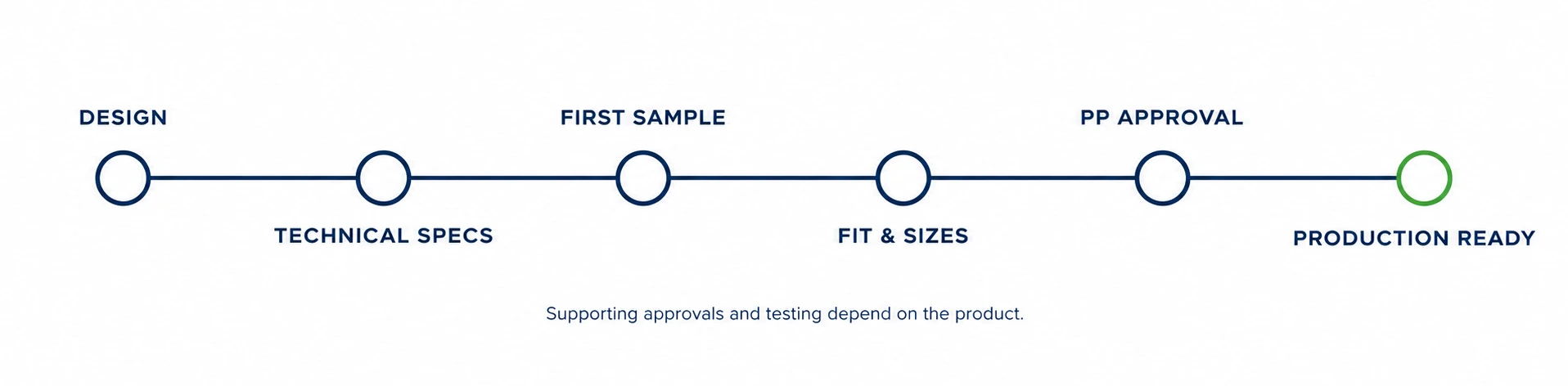
The apparel product development process (tech pack to approved sample) as a controllable system
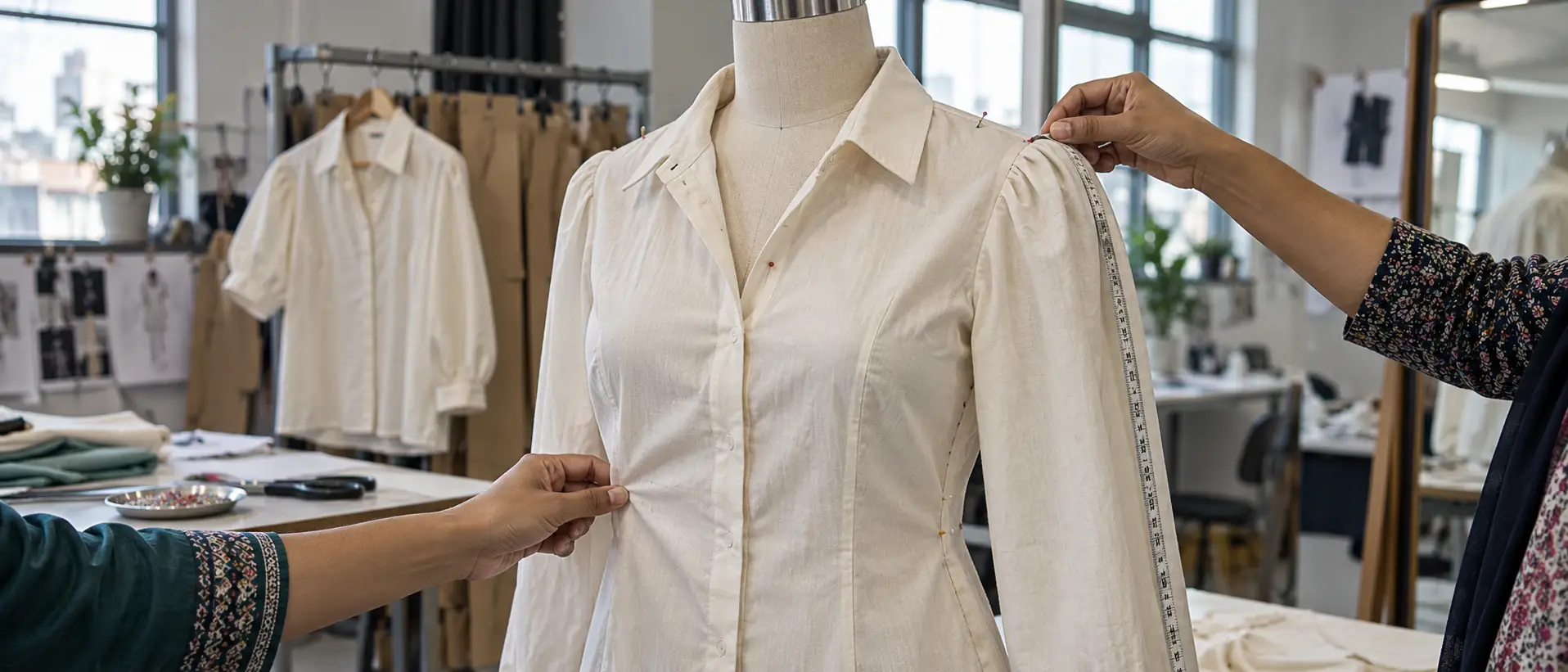
To run apparel product development like a system, you need control points. A control point is a stage where you lock a decision, record evidence, and define pass/fail criteria before moving forward. Without control points, development becomes “continuous change,” and continuous change is the fastest way to create endless sample rounds.
Every development gate should answer three questions: What requirements were provided? What did the manufacturing partner deliver? Does the result meet the agreed acceptance criteria? When criteria or approval records are unclear, teams may interpret requirements differently, overlook unresolved issues, or repeat corrections during later sample rounds.
Treat each stage as a documented control point. The tech pack defines construction and measurements, the BOM records materials and trims, and the tolerance plan establishes permitted variation. Sample approvals confirm whether defined requirements have been met. When a stage fails, review the cause, update the relevant specifications or process, and determine what must be corrected or tested again.
This is why apparel product development process control is not paperwork for its own sake. It is risk management. The cost of “one more sample” is not only sample cost, it is time, missed selling windows, and wrong procurement decisions. In a disciplined workflow, the output of each gate reduces uncertainty so the next gate can move faster.
The goal is to establish an approved sample with traceable supporting records, including the applicable tech pack, BOM version, approved comments, and accepted specifications. This provides a stronger reference for production handover and quality checks, although consistent bulk execution still depends on manufacturing capability and process control.
Apparel Development Gate Checklist: Required Evidence and Decisions
| Development Gate | Required Input | Expected Output | Approval / Release Criteria |
|---|---|---|---|
| 1. Tech Pack Readiness | Design brief, technical drawings, construction notes | Reviewed tech pack and clarification log | Requirements for the current development stage are clear; open questions are documented |
| 2. BOM Readiness | Material, trim, label, and packaging specifications | Reviewed BOM with sourcing and availability status | Critical cost and sourcing requirements confirmed; alternatives identified for approval |
| 3. Measurement Control | POM list, base-size targets, measuring methods | Measurement chart and relevant grading plan | Fit targets, tolerances, and measuring methods approved at the applicable stage |
| 4. Prototype / Fit Review | Tech pack, preliminary BOM, pattern instructions | Prototype or fit sample with review comments | Construction and fit evaluated; necessary corrections documented |
| 5. Size Set Validation | Approved base fit and grading instructions | Size-set samples and measurement report | Required sizes evaluated against approved measurements and grading rules |
| 6. PP Sample Approval | Production-representative materials, final specifications, approval references | Approved PP sample and supporting records | Applicable workmanship, materials, artwork, labeling, and packaging requirements verified |
| 7. Bulk Readiness | Approved documents, sample records, unresolved-item log | Go / Conditional Go / Hold decision | Authorized release recorded; critical open items resolved or controlled before affected activities begin |
Development timeline (what drives speed and what kills it)
Speed in product development is decided by the critical path, not by how fast a factory can sew a sample. The critical path is the chain of dependencies that cannot be parallelized. If you delay tech pack clarity, everything downstream delays. If you delay BOM confirmation, costing and sourcing delay. If you delay tolerance approval, fit disputes delay. Timeline discipline starts by identifying which approvals must happen before the next stage can start.
What drives speed is decision discipline. One owner for approvals. One consolidated comment log. One version naming system. One response-time SLA for both sides. When brands send fragmented feedback across multiple people, timelines expand because the factory must reconcile contradictions or choose one and hope. When factories respond with unclear status updates, brands wait, then escalate late, then rush decisions, which creates rework loops.
What kills speed is uncontrolled iteration. Every time you change fabric, you restart shrink and drape behavior assumptions. Every time you change a trim, you restart sourcing lead times. Every time you “small tweak” measurements without reviewing tolerance logic, you create new fit risk. Rework loops happen when feedback is not tied to root cause. If a sleeve twists, you must identify whether the root cause is grain, pattern, sewing method, or fabric torque, not just request “fix it.”
A practical SLA concept: define response windows. Example: factory status update every 48 hours during sampling; buyer feedback within 24-48 hours after receiving sample photos/measurement sheet. These are not formal contracts, but they force rhythm. Development without rhythm turns into idle time disguised as “waiting for sample.”
Product Development Timeline: Dependencies and Risk Factors
| Development Stage | Timeline Depends On | Primary Responsibility | Main Risk |
|---|---|---|---|
| Tech Pack Preparation | Design clarity, technical complexity, available specifications | Brand / Product Development | Missing or conflicting information |
| BOM Confirmation | Material selection, supplier availability, MOQ requirements | Sourcing / Manufacturer | Material delays or cost changes |
| Pattern & First Sample | Pattern complexity, material readiness, sampling capacity | Manufacturing Partner | Incorrect construction or interpretation |
| Fit & Measurement Review | Sample evaluation, fitting schedule, feedback turnaround | Brand / Technical Team | Unclear or delayed corrections |
| Sample Revisions | Number and complexity of required changes | Manufacturing Partner | Repeated defects or unresolved root causes |
| Size Set Development | Grading requirements, size range, base fit approval | Technical Team / Manufacturer | Size inconsistency or grading errors |
| PP Sample Development | Final materials, artwork, labeling, production references | Manufacturing Partner | Incomplete specifications or approvals |
| Final Approval & Release | Approval evidence, testing results, unresolved issues | Authorized Approval Owner | Delayed or unauthorized production release |
Actual development durations depend on garment complexity, material sourcing, sampling capacity, testing, and approval turnaround. Some activities may overlap where technical dependencies allow.
Tech pack execution: how to send specs that manufacturers can actually build
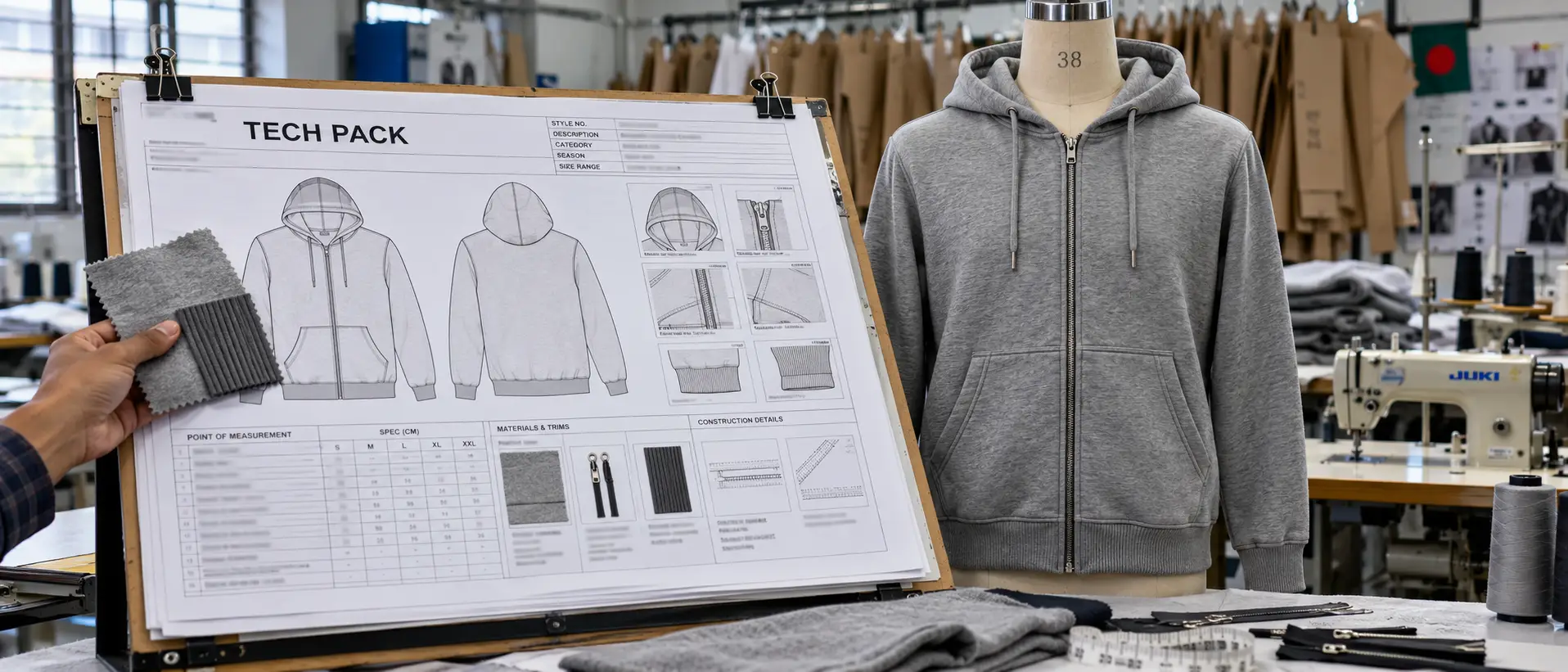
A tech pack is the primary technical reference connecting garment design with manufacturing requirements. During apparel product development, it helps pattern makers, sampling teams, merchandisers, and production personnel interpret construction details, measurements, materials, and finishing expectations. A complete, controlled tech pack reduces ambiguity and provides a consistent reference for costing, sampling, and subsequent approvals.
At minimum, a buildable tech pack must include clear sketches (front, back, and key details), construction notes, stitch types, seam allowances where critical, and a consistent spec format. It must also include points of measure (POM), measurement tolerances, a size reference (or grading plan), and a Bill of Materials. Add artwork placement pages with coordinates, print sizes, and method constraints. These items sit together because garment specifications are interconnected: if you change fabric or shrink assumptions, measurements, tolerances, and placement outcomes change too.
Incomplete specifications can delay costing, pattern development, material sourcing, and sample preparation. When construction details or material requirements are unclear, manufacturers may request clarification or propose technical options. These decisions should be reviewed and documented before they affect the sample or production standard. Early clarification helps reduce avoidable revisions.
Before sending a tech pack, identify the specifications a manufacturer would otherwise need to clarify. Important examples include fabric type and GSM, expected shrinkage, stitching requirements, seam allowances, labels, pocketing, trims, and packaging. Clearly documented requirements can reduce avoidable clarification and rework, while sample validation remains necessary to confirm the final construction.
A complete tech pack brings these specifications into a controlled reference. Buyers should confirm which details are required for preliminary costing, which are needed for sampling, and which must be finalized before bulk production.
Garment specifications and POM (points of measure) that reduce fit disputes
Fit problems can involve incorrect measurements, pattern balance, garment shape, fabric behavior, or comfort during movement. A Points of Measure (POM) chart provides measurable evidence for evaluating dimensions, but it should be used alongside physical fit assessment. Each POM should include its target, measuring method, and agreed tolerance so buyers and manufacturers can review dimensional differences consistently.
Strong garment specifications use two layers. The first layer is the numeric spec, target measurements for a reference size and a grading plan if relevant. The second layer is the measuring method, because two people can measure the same garment differently and create false defects. Define the garment state (laid flat, relaxed, stretched, buttoned, zipped), define the tool (tape vs ruler), and define the anchor points (HPS, CB, side seam, underarm). This removes interpretation and prevents rework driven by inconsistent measuring.
Measurement tolerances should be defined for the relevant POMs rather than relying on one general allowance for every dimension. Fit-critical measurements may require different limits depending on garment function, construction, and fabric behavior. Label positioning and topstitch alignment should be addressed separately through approved placement or workmanship tolerances.
Your POM table should also carry a risk note. Risk clarifies why a POM matters: customer comfort, return rates, visual silhouette, or compliance. When you attach risk to measurement tolerance, approvals become faster because stakeholders stop debating taste and start aligning to outcomes. If you want a manufacturer to execute consistently, your POM package must be complete enough that another factory could build the same garment using the same measurement language.
Example: Basic T-Shirt POM and Measurement Tolerances
| Point of Measure (POM) | Target | Tolerance | How to Measure | Risk if Missed |
|---|---|---|---|---|
| Chest Width | 52 cm | ±1.0 cm | Lay flat; measure 2.5 cm below the armhole | Incorrect chest fit |
| Body Length | 70 cm | ±1.0 cm | Measure from Highest Point of Shoulder (HPS) to bottom hem | Incorrect garment length |
| Shoulder Width | 45 cm | ±0.5 cm | Measure shoulder point to shoulder point | Shoulder fit variation |
| Sleeve Length | 22 cm | ±0.5 cm | Measure from shoulder seam to sleeve edge | Incorrect sleeve length |
| Bottom Width | 51 cm | ±1.0 cm | Lay flat; measure straight across the bottom opening | Hem fit inconsistency |
Illustrative example for a basic short-sleeve T-shirt. These targets, tolerances, and measuring points are not universal standards. Actual requirements must follow the approved style specification.
Measurement tolerance strategy (how to set tolerances that factories can hold)
Measurement tolerance is not a number you pick randomly. It is a capability agreement between fabric behavior, sewing method, and production reality. In apparel product development, tolerances must reflect shrink allowance, stretch recovery, and how seams behave under normal production pressure. If you demand ultra-tight tolerances on unstable fabrics, you force the factory into rework and sorting, and you still will not achieve consistency because the material itself moves.
Start with fabric behavior. Knit fabrics can relax and recover depending on finishing, heat, and handling. Wovens can skew, shrink, or torque depending on grain and wash. If the garment will be washed, tested, or garment dyed, your spec must account for expected shrink or growth. Build shrink allowance into the pattern and spec logic, then set measurement tolerance based on what remains variable after wash stabilization. This is how you avoid rejecting garments that behave normally.
Include grading instructions that reflect the approved base-size fit and intended size range. Identify critical POMs according to garment function and buyer requirements, then agree on tolerances that are realistic for the material and production process. Critical measurements need appropriate controls, but they do not automatically require the tightest possible numerical tolerance.
Finally, match tolerance to process risk. If the seam construction is complex, tolerance should include operator variability. If the style includes multiple panels or binding, the risk of cumulative error rises. During apparel product development, your best strategy is to create a tiered tolerance policy that is easy to apply, easy to inspect, and consistent across styles.
How to Evaluate Measurement Tolerances
| Control Area | What to Evaluate | Why It Matters | Tolerance Decision |
|---|---|---|---|
| Fit-Critical Measurements | Chest, waist, hip, rise, and garment length as applicable | Influences fit, comfort, and silhouette | Set according to approved fit and fabric behavior |
| Functional Openings | Neck, waist, cuff, and sleeve openings | Affects wearability, movement, and function | Assess construction, stretch, and intended use |
| Main Garment Dimensions | Body width, hem width, sleeve length, and balance | Influences appearance and size consistency | Evaluate material stability and production capability |
| Construction Details | Panel alignment, seam positions, and joining accuracy | Affects workmanship and garment shape | Define construction-specific acceptance limits |
| Decorative Placement | Artwork, labels, and visible topstitch positions | Influences branding and visual consistency | Follow approved placement and appearance requirements |
Artwork placement specs (how to prevent placement arguments later)
Artwork placement issues are expensive because they are obvious to the customer and hard to fix after production starts. Most placement disputes are caused by missing coordinates. If you write “center front logo,” you have not specified center relative to what, at what distance from what, and with what size constraints. A factory will place artwork based on their internal norms. If your brand’s visual standard is different, you will start negotiating after the print is already done.
During apparel product development, artwork placement should be treated like measurement. Define X and Y coordinates, define reference points (HPS, neckline seam, center front line, side seam), and define distances from seams. Also define maximum print size boundaries and how placement changes by size. If artwork remains fixed across sizes, say so. If it scales, define the scaling logic. This is where brand consistency is either protected or lost.
Print method constraints must be written into the placement spec. Screen print needs certain clearances, embroidery needs backing and stitch density limits, heat transfer needs flat zones and heat tolerance, and puff or high-density prints change handfeel and drape. If you do not define method constraints, the factory may choose a method that fits their line but not your expectation. Placement should also consider seams, pockets, and rib areas that distort prints.
Mini-checklist: Artwork placement spec must include
- Placement reference: center front, left chest, sleeve, back yoke, etc
- X/Y coordinates: distance from HPS or neckline, distance from center line
- Artwork size: width and height, plus maximum allowed size
- Method: screen print, embroidery, transfer, puff, silicone, etc
- Clearance rules: minimum distance from seams, ribs, pockets, zippers
- Size behavior: fixed, scaled, or size-dependent placement
BOM in garment industry: how to stop cost surprises and material errors
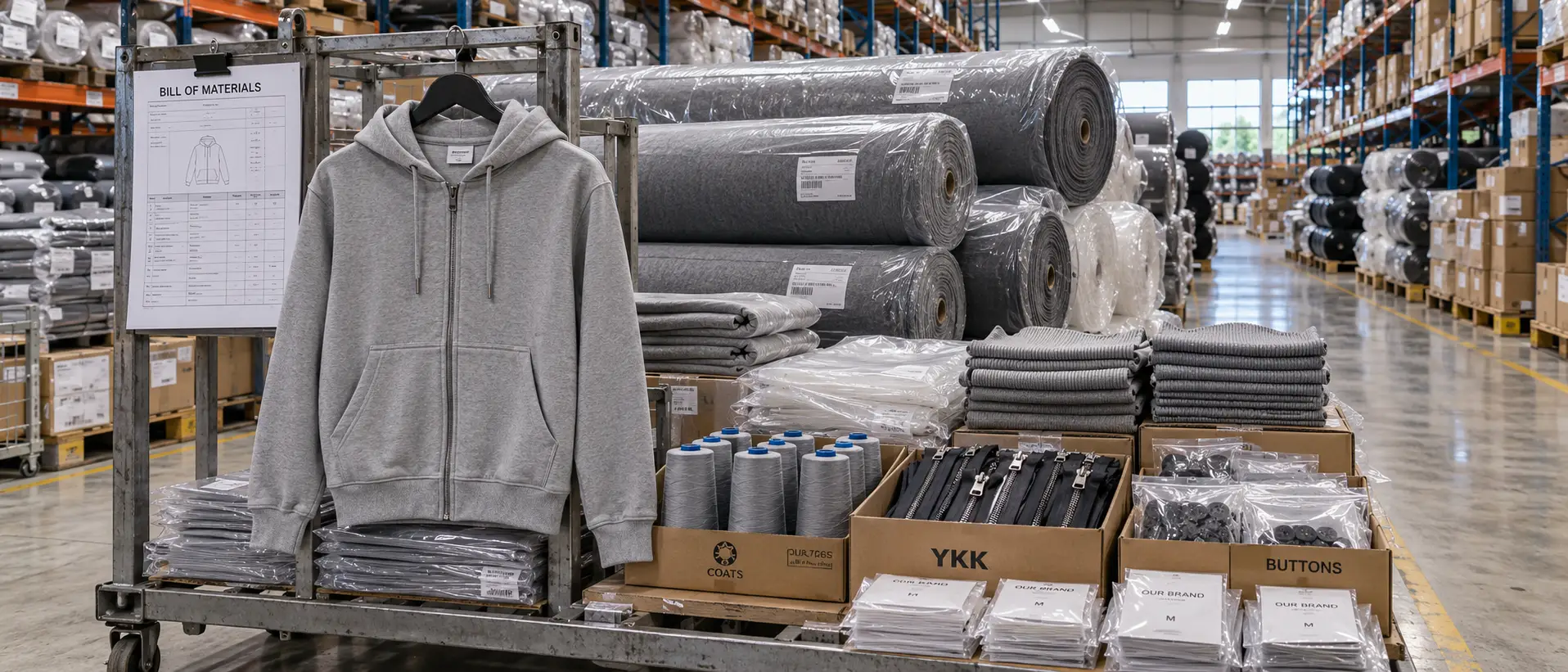
The Bill of Materials (BOM) connects product specifications with material sourcing and costing. During apparel product development, it records the fabrics, trims, labels, packaging, and relevant process requirements for each style. An incomplete BOM can create quotation assumptions, clarification requests, sourcing changes, or inconsistencies between approved samples and bulk materials.
BOM structure must be practical. Separate it into fabrics, trims, labels, packaging, and any special process items (wash, print, embroidery, appliqué). For each line item, define the technical spec: composition, GSM, width, color reference, supplier code if nominated, and any compliance requirement that matters to you. If you want the same outcome across seasons, your BOM must also track approved equivalents and what is not allowed to change.
Material consumption influences garment costing and purchasing decisions. Fabric requirements depend on pattern dimensions, marker efficiency, size ratios, shrinkage allowances, and cutting waste. Trim and packaging quantities depend on the approved construction and packing specifications. Documenting the relevant consumption assumptions helps buyers compare quotations and identify potential costing differences before order confirmation.
MOQ and MCQ implications belong inside the BOM discussion because availability is a production risk. A “small” trim like a zipper puller, drawcord tip, or custom hangtag can have a higher MOQ than the fabric. That can force you into substitutions or long lead times. Use the BOM to surface these constraints early so you can decide what to customize and what to standardize before sampling locks the brand look.
In garment manufacturing, BOM stands for Bill of Materials. It records the materials, trims, labels, packaging components, and applicable sourcing requirements for a garment. A controlled BOM also identifies approved alternatives and changes that require further authorization.
Example Bill of Materials for a Printed T-Shirt
| Category | Item | Specification | Color | Supplier / Source | Consumption | Notes |
|---|---|---|---|---|---|---|
| Fabric | Main Body Fabric | 95% cotton, 5% elastane, 200 GSM single jersey | Black | Approved fabric supplier | Per approved marker and consumption calculation | Confirm width, shrinkage, and shade |
| Fabric | Neck Rib | 2×2 rib, 260 GSM; approved composition | Matching Black | Approved fabric supplier | Per approved pattern consumption | Confirm shade matching and recovery |
| Trim | Sewing Thread | 100% polyester; ticket size and thread type per seam specification | Black | Approved trim supplier | Per approved sewing consumption | Match stitching and durability requirements |
| Label | Main Label | Woven label, 35 × 20 mm | Black / White | Nominated or approved supplier | 1 pc / garment | Approved artwork and back-neck placement |
| Label | Care Label | Satin label; approved care, fiber, and origin information | White / Black | Approved label supplier | 1 pc / garment | Confirm destination-market requirements |
| Packaging | Polybag | Clear polybag; approved dimensions and thickness | Clear | Approved packaging supplier | 1 pc / garment | Confirm folding and any required warnings |
| Packaging | Hangtag | 350 GSM card, double-sided print, approved string | Brand Artwork | Nominated or approved supplier | 1 pc / garment | Confirm artwork and MOQ |
| Process | Screen Printing | Single-color screen print with approved artwork and method | White | Approved print provider | 1 placement / garment | Confirm strike-off, placement, and durability |
This BOM is an illustrative example for a basic printed T-shirt. Actual fabric consumption, material specifications, sourcing arrangements, labeling, and process requirements must be confirmed for the individual order.
Garment sampling process: the sample types and what each must prove
The garment sampling process helps buyers and manufacturers evaluate a design before committing to the relevant stages of bulk production. Different samples may assess construction feasibility, fit, measurements, material behavior, artwork placement, and workmanship. Clearly defined review criteria help teams distinguish acceptable results from issues requiring correction or further testing.
A structured garment sampling process separates early development from later validation. Initial samples help identify construction, fit, and material issues, while subsequent rounds confirm corrections and updated requirements. When multiple specifications change together, the manufacturing team should document those changes and evaluate their combined effects before approving the revised sample.
Each sample stage should have a defined purpose. A prototype helps evaluate design and construction feasibility. Fit samples assess measurements, balance, and wearability. Size sets help verify grading across the required sizes. A pre-production (PP) sample establishes the agreed production reference, while garment performance testing (GPT), where required, evaluates specific material or garment performance criteria. The applicable stages depend on the product and buyer requirements.
To reduce avoidable sample rounds, agree on the evidence required for each submission. This may include measurement sheets, construction photographs, test results, and revision records, depending on the sample’s purpose. Buyers should consolidate feedback into a clear comment log, while the manufacturing team should confirm the corrections and updated specifications before the next review.
.
Garment Sample Types and Their Validation Requirements
| Sample / Validation Type | Main Purpose | What to Verify | Common Issues | Recommended Buyer Action |
|---|---|---|---|---|
| Prototype / Development Sample | Evaluate design and construction feasibility | Garment shape, key construction details, preliminary materials | Incorrect construction, missing details, impractical design elements | Clarify specifications and document necessary changes |
| Fit Sample | Evaluate base-size fit, balance, and comfort | Key POMs, silhouette, movement, pattern balance | Incorrect measurements, poor fit, twisted seams | Consolidate fit comments and update patterns or specifications |
| Size Set Sample | Validate grading across the required size range | Size progression, measurements, fit consistency | Incorrect grading, inconsistent measurements, size-specific fit issues | Review grading rules and approve required corrections |
| Pre-Production (PP) Sample | Establish the agreed production reference | Approved materials, workmanship, construction, artwork, labels, applicable packaging | Incorrect trims, artwork placement, stitching, or unresolved approvals | Review evidence and approve, request correction, or document release conditions |
| Garment Performance Testing (GPT) | Verify applicable performance requirements | Shrinkage, colorfastness, pilling, seam strength, or other specified tests | Failed test results, material instability, unmet performance criteria | Investigate failures, agree corrective actions, and retest where required |
Not every program requires every sample type. Testing and material approvals may run alongside relevant development stages rather than following a fixed sequence. Sample requirements should reflect product complexity, buyer specifications, and applicable testing obligations.
Pre production sample meaning (PP sample) and “approved sample” rules
A pre-production sample (PP sample) is a garment prepared to represent the agreed specifications before the relevant bulk manufacturing stage begins. It should reflect approved materials, construction, measurements, artwork, trims, and applicable labeling or packaging requirements. Any temporary substitutions or outstanding approvals must be identified and resolved according to the agreed release conditions.
A PP sample may be prepared under conditions that differ from normal bulk production. Manufacturers should therefore confirm that the approved construction, materials, machinery requirements, and workmanship standards can be transferred to the selected production line. The PP sample establishes a reference, while line setup, first-output checks, and ongoing quality controls help verify execution during bulk manufacturing.
This is where the “sealed sample” concept matters. An approved sample must be frozen as a reference, documented, and stored so both sides can compare future output against it. That means you lock the final tech pack version, lock the BOM, lock tolerances, and lock artwork placement. The sealed sample is not a trophy. It is a control tool that supports QC decisions and reduces disputes when something goes wrong in bulk.
Treat PP approval as part of the wider sample approval process. Review measurements, workmanship, materials, trims, artwork, and applicable packaging requirements against the approved references. If an item remains unresolved, document the issue, responsible person, required evidence, and affected production stage. Critical requirements should not be bypassed without authorized, documented release conditions.
Sample approval is also connected to production readiness. Our pre production meeting checklist explains how manufacturers and sourcing teams review specifications, material availability, production planning, and outstanding risks before releasing the relevant bulk activities.
Garment Performance Testing: Requirements, Timing, and Validation
Garment performance testing (GPT) helps verify that materials and finished garments meet specified performance requirements. Depending on the product and buyer program, testing may cover dimensional stability, colorfastness, pilling, seam strength, stretch recovery, or print durability. The required tests, methods, acceptance limits, and timing should be defined according to the applicable product, market, and buyer requirements.
Define scope before testing. Decide which standards matter: shrinkage range, colorfastness to wash and rub, pilling resistance, seam strength, and print durability. Then decide the required documentation: test reports, test methods, sample identification, and traceability to the exact BOM and production parameters. If the sample is not traceable, the test result is not actionable.
Not every style requires the same testing program. Existing material test evidence may support development decisions where it remains applicable, but changes to fabrics, finishes, construction, or suppliers can require additional validation. Testing should be scheduled early enough to identify problems before the manufacturing activities or shipment decisions that depend on the results.
For example, ISO 5077 describes a method for determining dimensional changes in textile materials and garments after specified washing and drying procedures. The applicable test method and acceptance limits should be confirmed for each program.
Sample approval process: how to approve faster without losing control
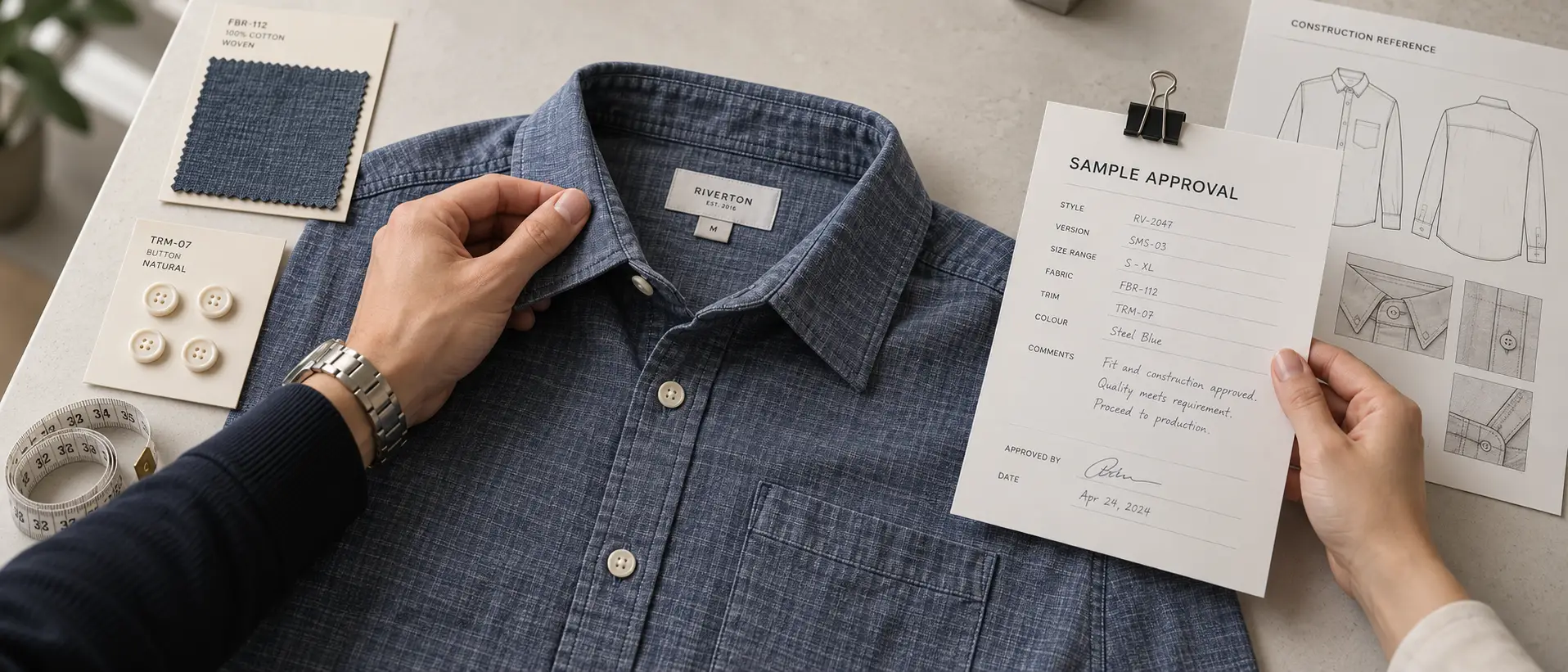
A structured sample approval process defines what needs to be reviewed, who can approve it, and which evidence supports the decision. Early samples may focus on construction and fit, while later stages can include materials, artwork, labeling, packaging, and applicable testing. Matching approval requirements to each stage helps reduce unnecessary reviews without overlooking important specifications.
Start with approval gates. Gate 1 is fit and measurement: does it meet POM targets within tolerance, and does it wear correctly on the intended body type. Gate 2 is workmanship: seams, stitch density, reinforcement, cleanliness, and repeatability. Gate 3 is artwork: placement, size, method constraints, and durability expectations. Gate 4 is packaging: labels, folding, polybag, barcode, hangtag, and carton expectations. Each gate needs evidence, not opinions.
Comment discipline is the multiplier. One owner must consolidate all comments and push a single log to the factory. That log must reference the tech pack page, POM name, or photo location. The factory must respond with one version plan: what will be fixed now, what is deferred, and what needs buyer confirmation. This is basic version control. Without it, you get two people approving different standards, and the factory builds the wrong one.
The broader approval process also includes decisions affecting materials, artwork, size sets, testing, and shipment. Our apparel approval workflow map explains how these checkpoints can be coordinated with clear responsibilities and documented evidence.
In apparel product development, speed is created by clear acceptance criteria and controlled feedback loops. Require the factory to send measurement sheets, detailed photos, and a change log with each submission. Require your side to respond within a defined window. You do not need more meetings. You need tighter operational rhythm.
.
Sample Approval Checklist: Requirements and Evidence
| Area | Pass criteria | Evidence | Owner |
| Fit | Silhouette matches intent, mobility acceptable | Fit photos, fit notes | Product owner |
| Measurement | All critical POMs within tolerance | Measurement sheet | Tech designer |
| Workmanship | Seams and stitches meet standard | Close-up photos, workmanship checklist | QC lead |
| Artwork | Placement and size per spec, method confirmed | Placement photos, strike-off proof if needed | Brand / design |
| Trims and labels | Correct BOM items, placement correct | Trim photos, label photos | Merchandising |
| Packaging | Folding, polybag, tag, barcode correct | Packaging photos, packing list | Operations |
How many sample rounds to plan (and how to stop endless loops)
Plan sample rounds based on complexity, not optimism. A basic knit with stable fabric and simple trims can be controlled in fewer rounds. A multi-panel style, new fabric, complex print placement, or special wash needs more rounds because more variables can fail. Build a realistic plan upfront and communicate it to the manufacturer so timelines are not built on fantasy.
Your planning assumptions should include: whether the pattern is new or existing, whether fabric is nominated or sourced, whether artwork is complex, and whether testing is required. If you do not define assumptions, you cannot manage expectations. This is how projects drift. In a controlled development timeline, each round has a defined goal, and you do not start the next round until the previous round’s goal is either achieved or formally revised.
Set realistic sample-round targets based on product complexity, material readiness, and technical risk. Define escalation triggers when the same defect repeats, corrections fail to resolve the underlying issue, or approval dates are repeatedly missed. Additional sample rounds should address documented problems rather than repeat the same unsuccessful approach.
Round planning is not about being strict. It is about preventing endless loops where nobody owns decisions. Define who can approve changes, who can change specs, and who signs off on final. That is how you stop sampling from eating the calendar.
Example Sample-Round Planning Model
| Development Stage | Goal | Required Inputs | Target Turnaround | Exit Criteria |
|---|---|---|---|---|
| Initial Prototype | Assess design feasibility and basic construction | Draft tech pack, preliminary BOM, design references | Agreed at project start | Key construction requirements reviewed; necessary changes documented |
| Fit Development | Confirm base-size fit and measurement requirements | Prototype feedback, updated pattern, POM chart | Based on required corrections | Fit approved or remaining corrections clearly defined |
| Size Set Validation | Verify grading and measurements across sizes | Approved base fit, grading instructions, size specifications | Based on size range and complexity | Required sizes meet agreed acceptance criteria |
| PP Sample Approval | Confirm production-representative specifications | Finalized applicable materials, construction, artwork, and approval references | Based on material and approval readiness | Sample approved or corrective actions and release conditions recorded |
| Performance Testing, If Required | Validate specified garment performance | Approved test scope, traceable material or garment samples | According to agreed testing schedule | Required results accepted or corrective actions completed |
This is a planning framework, not a mandatory five-round sampling sequence. Some stages may be combined, repeated, or omitted depending on the product and buyer requirements. Testing may also take place alongside other development activities.
Product development services your clothing manufacturer should provide (and what to verify)
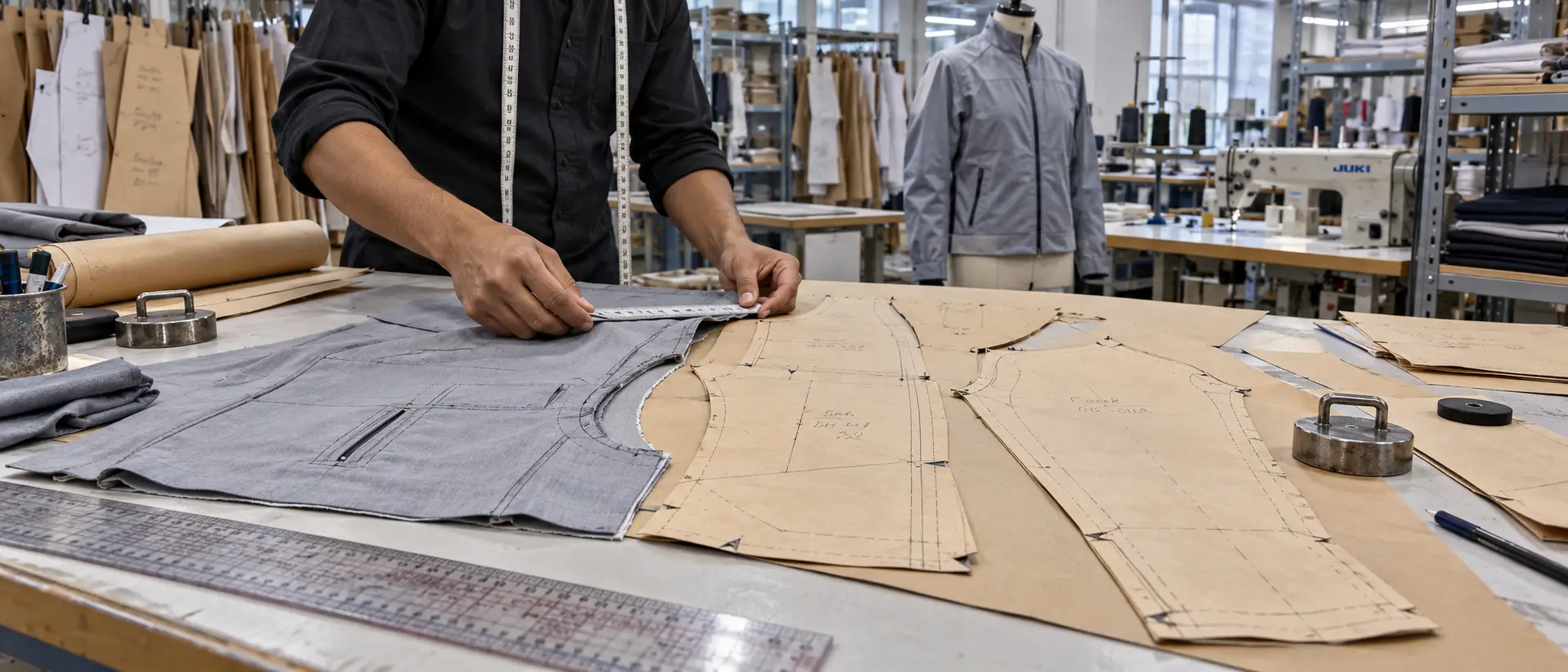
Development capabilities vary between apparel manufacturers. Some facilities offer extensive pattern, sampling, sourcing, and technical support, while others focus primarily on executing approved specifications. During apparel product development, buyers should confirm which capabilities are available directly, which are coordinated through specialist partners, and who is responsible for each activity.
Pattern support is the foundation. The factory should have pattern technicians who can interpret your tech pack, propose manufacturable adjustments, and explain trade-offs. Sourcing support is next: can they propose fabric and trims that match your spec, confirm MOQ, and manage lead time. Testing coordination matters when performance is a risk: can they arrange tests, track reports, and tie results back to the exact BOM and sample version.
Sampling capacity, technical support, and workmanship controls influence development quality and timing. Buyers should confirm how samples are produced, reviewed, and corrected, including whether the selected manufacturing facility uses internal resources or approved specialist support. Sampling performance provides useful evidence, but bulk production capability must also be evaluated through capacity, process controls, and production-readiness checks.
Capability verification should focus on relevant evidence rather than general assurances. Buyers can request sample measurement sheets, revision logs, construction photographs, production-process references, applicable test reports, and realistic sampling schedules. The exact evidence should reflect the product and the responsibilities of the selected manufacturing partner.
How to Verify Apparel Development Capabilities
| Service | Proof | Risk if missing |
| Pattern and fit support | Pattern notes, fit analysis comments | Endless fit rounds, wrong corrections |
| Sourcing support | Supplier options, MOQ confirmation | Cost surprises, delays, substitutions |
| Sample room capability | Sample lead time history, capacity confirmation | Timeline failure, inconsistent samples |
| Workmanship standards | Internal QC checklist, workmanship photos | Quality variance across samples and bulk |
| Testing coordination | Test reports with traceability | Performance failures discovered too late |
| Documentation discipline | Version logs, measurement sheets | Disputes, repeated errors, no accountability |
At RYZEAL SOURCING, apparel development is coordinated through a vetted network of specialized manufacturing partners in Bangladesh. The RYZEAL team helps buyers review technical requirements, coordinate materials and samples, manage approvals, and communicate with the selected manufacturing facility.
Need Support With Apparel Product Development?
RYZEAL SOURCING helps brands coordinate product development, material sourcing, sampling, and apparel production through vetted manufacturing partners in Bangladesh.
Clothing manufacturers for startups: from development to production without blowing budget and timelines
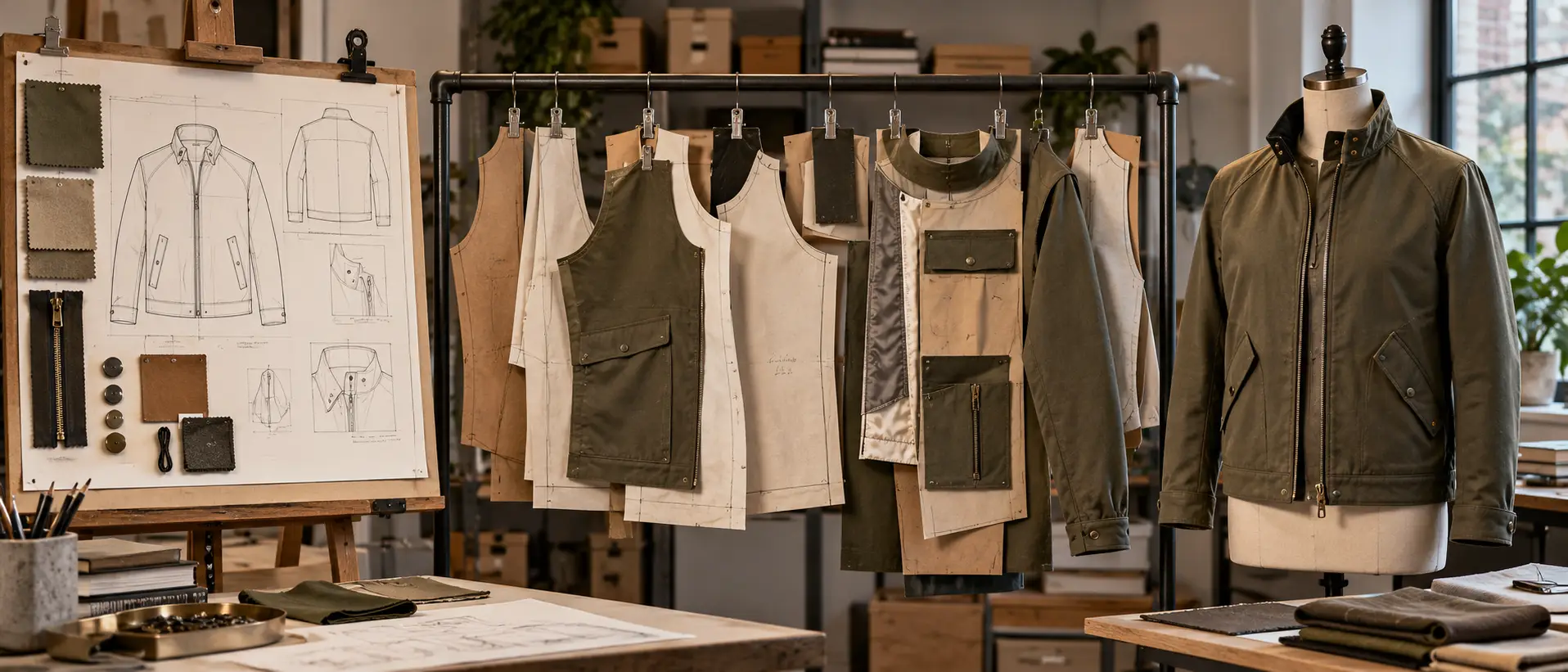
Startups often face development challenges when budgets are limited, specifications are evolving, and multiple customization decisions remain open. A practical approach is to prioritize essential product features, establish clear approval ownership, and simplify optional variations where possible. Using suitable existing materials or standard trims can help control costs without compromising the product’s defining requirements.
Sampling costs can be managed when you choose smart levers. Use existing factory blocks where acceptable. Standardize trims where the customer does not care. Use a small number of sizes early to prove fit, then expand to size sets once the base size is stable. In product development steps, the goal is to validate the product quickly, not to perfect every detail before you know the market wants it.
MOQ and lead time are also development variables. If your BOM includes a custom zipper, custom hangtag, and custom packaging from day one, you will hit MOQ and MCQ walls that force substitutions and delays. Decide what must be branded now and what can be standardized temporarily. This is part of development to production: every customization decision has a cost and timeline consequence.
When development problems occur, investigate the cause before making further changes. Repeated fit issues may require pattern or measurement review. Failed fabric tests may require material, finishing, or process corrections. If the target cost becomes unrealistic, assess which design or sourcing changes are technically and commercially acceptable. Controlled decisions help protect both the product and development budget.
Most important: set a single approval owner. Startups often have multiple stakeholders giving conflicting feedback. That creates slow approvals and more sample rounds. One voice, one log, one decision. That is how you protect budget and keep momentum.
Startup Apparel Development Readiness Checklist
| Item | Minimum acceptable | Why |
| Tech pack quality | Clear sketches + POM + tolerances + BOM draft | Reduces factory guessing and rework |
| Fabric strategy | Fabrics suitable for the product | Limits variables, speeds approvals |
| Trim strategy | Standard trims unless branding demands custom | Avoids MOQ/MCQ delays |
| Sample plan | Defined round goals + review checkpoints | Prevents endless loops |
| Budget control | Sampling budget and change control rule | Stops scope creep |
| Decision ownership | One approval owner | Eliminates conflicting feedback |
| Timeline rhythm | Response-time targets for both sides | Prevents idle time |
Common failure patterns in apparel product development (and how to prevent them)
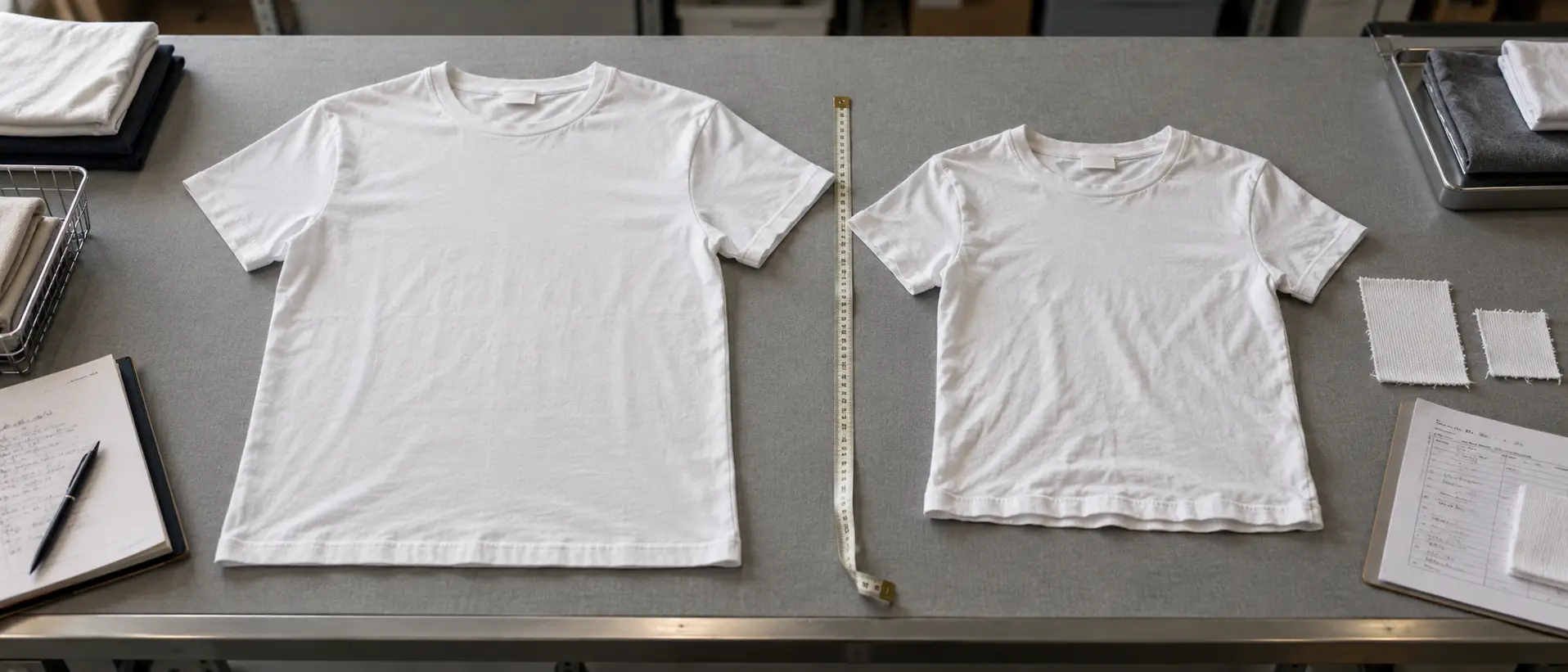
Failure patterns repeat across brands because the root causes repeat. The first is vague tech packs. If garment specifications are incomplete, the factory fills gaps with assumptions, and your next sample becomes a correction exercise instead of a validation exercise. The second is missing BOM fields. If trims, labels, packaging, or process notes are unclear, costing and procurement drift, and the sample does not represent bulk reality.
Unrealistic tolerances are another common failure. Teams set tight tolerances because they want quality, but they ignore fabric behavior, shrink, and process variance. That creates inconsistent pass or fail decisions and drags out approvals. Another pattern is uncontrolled artwork placement. If you do not specify coordinates, methods, and size behavior, you will argue about placement after prints are already done. Those reworks are expensive and time-consuming.
Approval fragmentation is a major operational failure. Multiple stakeholders give feedback in different formats. The factory receives mixed signals, builds contradictory changes, and sends back a sample that fails in new ways. This is a development workflow problem, not a factory problem. The fix is comment discipline: one owner, one consolidated log, one version naming system, and one approval gate list.
A practical prevention system combines documented specifications, clear approval responsibilities, and traceable evidence. Measurement, workmanship, artwork, and packaging requirements should be reviewed at the appropriate development stages. Unresolved critical specifications must be addressed before the manufacturing activities they affect are released, while other work may continue under an agreed and documented plan.
Common Apparel Development Problems and Corrective Actions
| Failure | Root cause | Early warning | Fix |
| Endless fit rounds | POM unclear or measurement method inconsistent | Different people measure differently | Define POM method, lock tolerances |
| Cost increases after sampling | BOM incomplete or assumptions hidden | “TBD” items and missing packaging | Complete BOM, confirm MOQ/MCQ early |
| Artwork placement disputes | No coordinates or size behavior defined | Factory asks “confirm placement” late | Add placement page with X/Y rules |
| Workmanship variance | No workmanship standard or process control | Samples look different each round | Define workmanship checklist, SOP proof |
| Timeline slips | Slow feedback and no rhythm | Long silent gaps in email threads | Define response SLA, weekly checkpoint |
| Wrong bulk output | Approved sample not sealed or version unclear | Factory uses older version | Seal sample, archive final tech pack and BOM |
Frequently Asked Questions About Apparel Product Development
What is an approved sample in apparel product development?
An approved sample is a documented physical reference for agreed product characteristics. Together with the approved tech pack, BOM, and relevant approval records, it helps guide manufacturing and quality comparisons.
What goes in a tech pack for a clothing manufacturer?
A tech pack typically includes technical drawings, construction details, measurements, tolerances, BOM, artwork, labeling, and revision control. Specific requirements depend on the garment and development stage.
What is BOM in garment industry and why does it matter?
BOM means Bill of Materials. It controls cost, availability, and consistency by listing every fabric, trim, label, and packaging item with exact specs.
What tolerance is acceptable for garment measurements?
It depends on fabric behavior and POM criticality. Critical openings and fit points usually need tighter tolerance than low-impact points like label offsets.
How many sample rounds are normal in a garment sampling process?
Simple styles can be controlled in fewer rounds, complex styles need more. The key is to set round goals and revision limits so rounds do not become endless loops.
What is the difference between a fit sample and a PP sample?
A fit sample helps evaluate garment shape, measurements, and wearability. A PP sample represents agreed production specifications, including applicable materials, construction, artwork, and labeling requirements.
What does “sealed sample” mean in sample approval process?
It is the approved reference sample that is labeled, stored, and used for QC comparisons. It prevents disputes by defining what “correct” looks like.
When is garment performance testing required?
Testing is required when specified by the buyer, applicable regulations, or product performance requirements. The scope and timing depend on the garment, materials, and manufacturing program.
How do I reduce sampling rounds in apparel product development?
Define pass or fail criteria for each sample stage, consolidate comments under one owner, and control versioning. Change one variable at a time and document outcomes.
What product development services should a manufacturer provide?
Pattern support, sample room capacity, sourcing support, testing coordination, workmanship standards, and documentation discipline. Verify with evidence, not claims.
Why do manufacturers request clarification during product development?
Manufacturers request clarification when specifications, materials, measurements, or approval requirements are incomplete. Resolving these questions helps avoid incorrect interpretation and unnecessary rework.
How do startups manage development to production without overspending?
Use an MVP approach: simplify designs, limit fabrics and trims, plan sample rounds, and enforce decision ownership. Control scope before chasing perfection.
Final Takeaway: From Product Concept to Manufacturing Readiness
Successful apparel product development depends on clear technical specifications, suitable materials, practical sampling, and documented approvals. Each stage should help buyers and manufacturing partners identify problems early, confirm requirements, and prepare for production.
A well-managed development process does not eliminate every manufacturing risk. It establishes the technical references, responsibilities, and approval records needed to make informed decisions and support consistent production.
Ready to Start Apparel Sampling?
Share your clothing design, reference garment, or tech pack with RYZEAL SOURCING to discuss sampling requirements and development options through our vetted manufacturing partners in Bangladesh.
Connect with RYZEAL SOURCING