
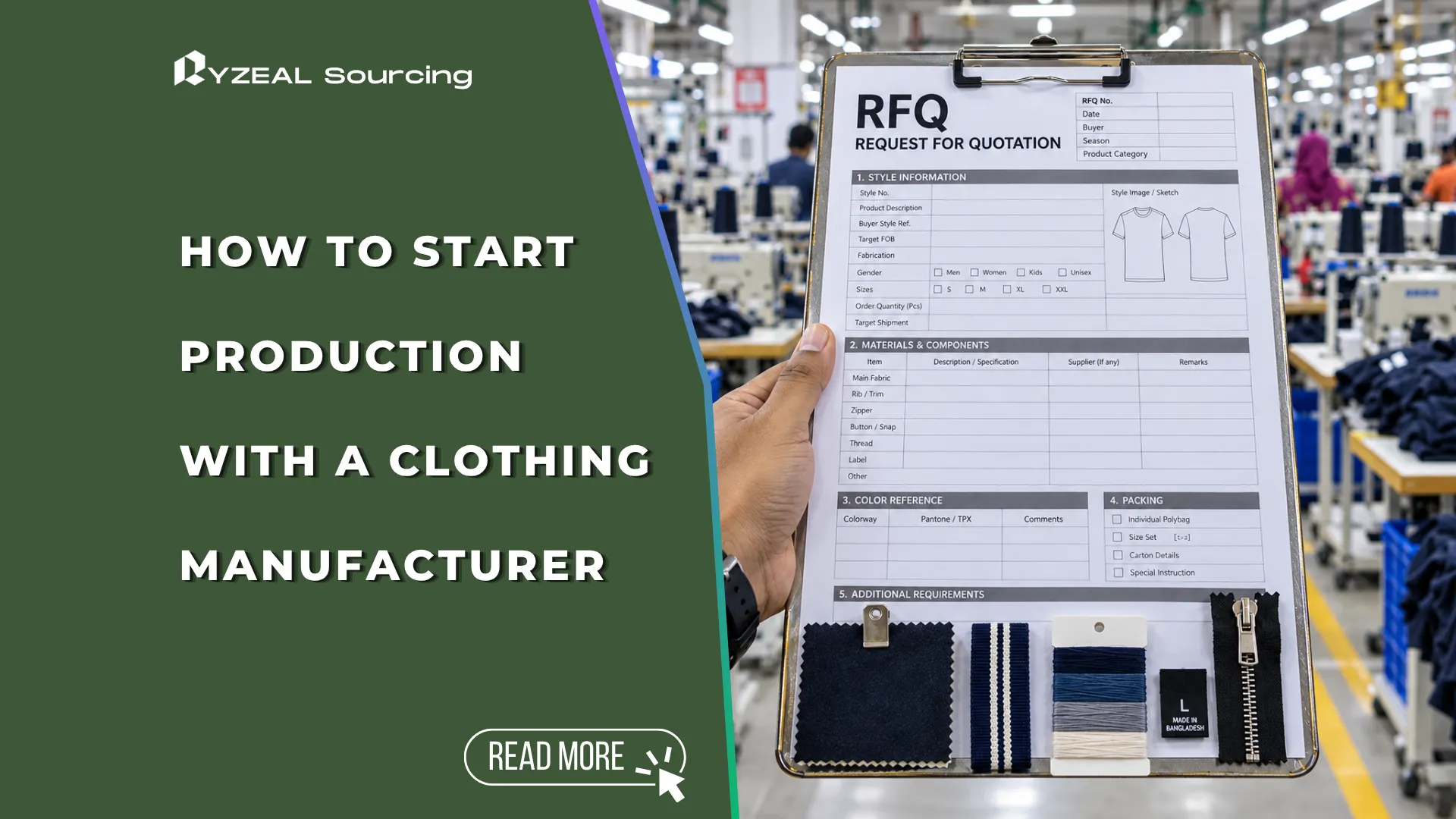
Many bulk-production problems begin before the sewing line, when a supplier is selected but execution starts with unclear scope, vague assumptions, or unmanaged approvals. A disciplined RFQ clothing manufacturer onboarding system reduces that risk by locking inputs, responsibilities, timelines, and proof requirements before production begins.
This hub is the operating playbook for moving from “shortlisted supplier” to “safe-to-start bulk.” It is designed to eliminate quote confusion, approval drift, PO disputes, and timeline collapse by turning RFQ and onboarding into a control framework.
If you are still selecting suppliers, start with our complete guide to how to find a clothing manufacturer in Bangladesh. Before moving into RFQ and onboarding, the shortlisted supplier should also pass a structured clothing manufacturer vetting and due diligence process so capability, evidence, quality systems, and sourcing risks are checked first.
Quick Answer: the 7-step system that prevents production drift
A reliable apparel RFQ and manufacturer onboarding system follows a practical sequence with defined control gates:
- Prerequisites (supplier passed vetting)
- RFQ pack (spec + BOM + requirements)
- Quote normalization (apples-to-apples comparison)
- Approval plan (who approves what, when, and with what evidence)
- Supplier onboarding process (documents + system setup + controls)
- PO workflow + PO approval workflow (commit spend only after scope is locked)
- Pre-production kickoff + communication SLA (agreed response-time and escalation targets) + order management tracker
For faster execution, avoid skipping control gates. Some activities can run in parallel when appropriate, but prerequisites, approvals, and release decisions should remain explicit.
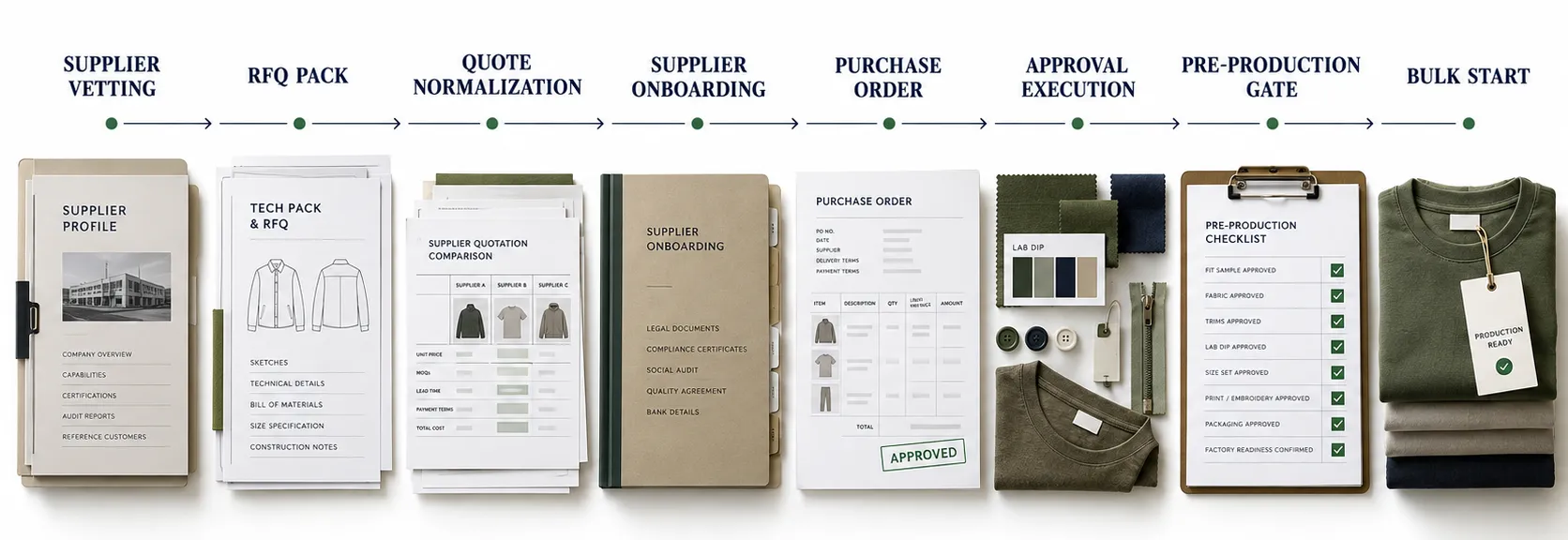
Table of Contents
System Overview: from RFQ to production kickoff (what you are building)
Direct Answer
The RFQ clothing manufacturer system is not paperwork. It is a control stack that creates predictable execution across cost, timeline, and quality.
A clean system has three layers:
Layer 1: Input control (what the supplier is quoting)
- One version of the tech pack and BOM
- Clear requirements for testing, compliance, packaging, and labeling
- Defined sample types and approval gates
- Defined quantities by color and size split
Layer 2: Decision control (how you select and commit)
- Quote normalization sheet that exposes assumptions
- Defined negotiation boundaries (what you can trade, what you cannot)
- Spend control via PO approval workflow
- Clear “accept/reject/clarify” rules
Layer 3: Execution control (how work moves on the factory side)
- Onboarding checklist that locks owners and reporting
- Approval workflow map that defines evidence and response time
- Pre-production gate that locks materials and QC plan
- Order management tracker that creates early warning signals
For buyers working through a manufacturing and sourcing partner, the same control system can be applied across multiple specialized factories while one buyer-facing team coordinates requirements, approvals, quality follow-up, production reporting, and escalation.
The point is simple: a disciplined apparel RFQ and onboarding process reduces uncontrolled interpretation before production starts. When specifications, assumptions, or responsibilities remain open to interpretation, delays, rework, and commercial disputes become more likely.
Minimum deliverables you should have after implementing this hub
- RFQ pack (locked, versioned, shareable)
- Normalized quote comparison sheet (assumptions visible)
- Onboarding checklist completed (roles + documents)
- PO package locked (spec + BOM + requirements attached)
- Approval tracker running (lab dips, strike-offs, PP, TOP, packing)
- Communication SLA agreed (response times + escalation)
- Order management tracker running (weekly visibility)
RFQ meaning in apparel: what it is and when it works
Direct Answer
RFQ means Request for Quotation. In apparel, an RFQ only works if your scope is defined enough that suppliers can quote the same thing.
A buyer asking for “price for hoodie” is not running an RFQ. An RFQ is a structured request that forces suppliers to quote against defined specifications and requirements. If your input is vague, suppliers fill gaps with assumptions. Those assumptions later become arguments.
As a general procurement reference, UNDP describes a Request for Quotation as a written request that asks a vendor for a price quotation against a clearly described requirement. Apparel RFQs usually need additional technical detail because fabric, trims, construction, testing, packaging, and approval assumptions can materially change the quotation.
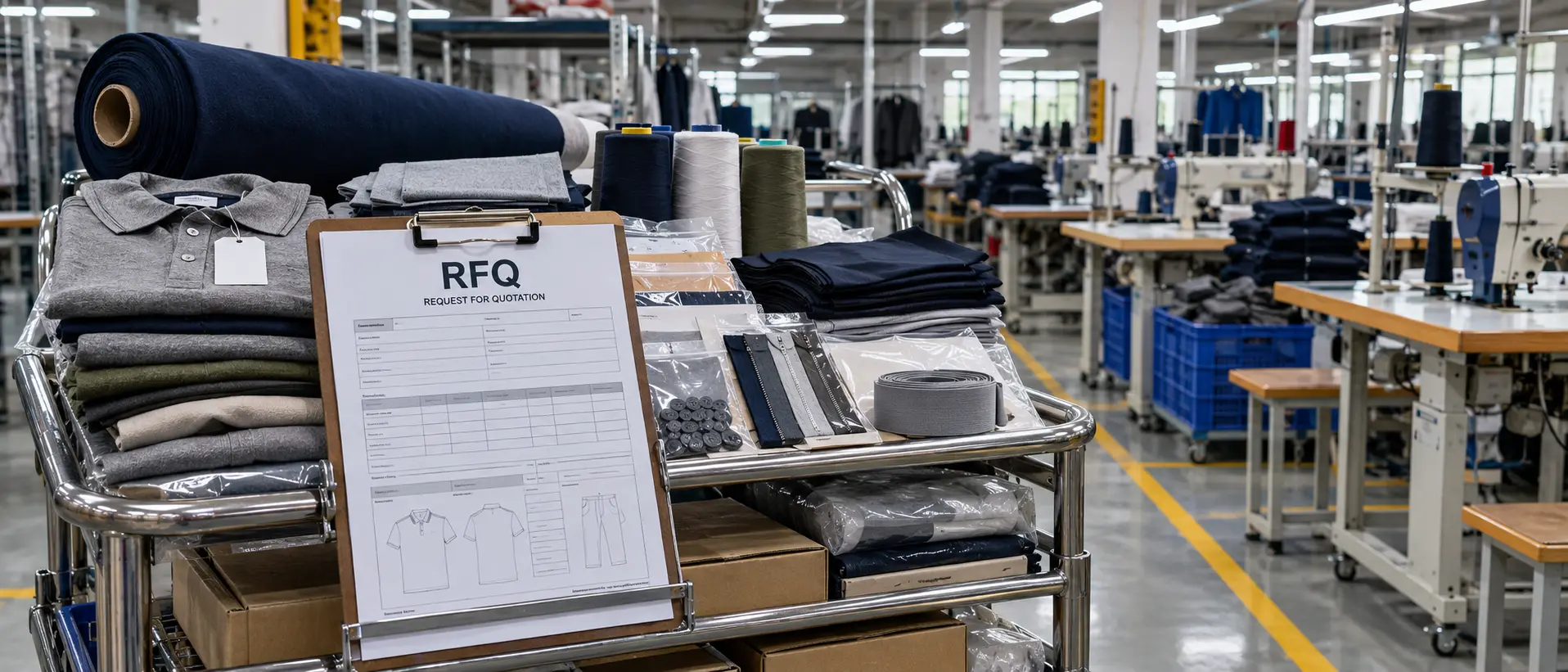
Use an RFQ clothing manufacturer approach when:
- You have a usable tech pack (even if not perfect)
- You can define fabric direction (composition, GSM, structure, finish)
- You can define trims and packaging expectations
- You want comparable quotes across multiple suppliers
- You need suppliers to commit to lead time stages, not a single number
Avoid formal RFQs when:
- You have no spec direction and you are still ideating product
- Your target is only “rough estimate” for early planning
- You cannot define testing/compliance requirements yet
Even then, you can run a “pre-RFQ estimate request,” but you must label it correctly so you do not treat estimate numbers as commitments.
RFQ Template for a Clothing Manufacturer: what your pack must include
Direct Answer
The RFQ clothing manufacturer pack must remove ambiguity. The best RFQ template does not chase detail for its own sake; it targets the details that drive cost, lead time, and quality risk.
The minimum RFQ pack (non-negotiables)
Attach or specify these every time:
- Tech pack: measurements, tolerances, construction notes
- BOM: fabric, trims, labels, packaging
- Artwork files: vector format + placement + size
- Order quantities: total, per color, per size split
- Testing requirements: what must be tested and what reports you require
- Compliance requirements: audit documentation expectations and subcontracting rules
- Packaging: polybag spec, carton spec, labels, barcodes, carton marks
- Delivery window: target dates, Incoterms, destination
- Sample requirements: sample types, quantities, acceptance criteria
If packaging or testing requirements are missing, suppliers may quote using their standard assumptions or a lower-cost baseline. Those assumptions may differ from the buyer’s actual product, market, or brand requirements and can create re-quoting or approval problems later.
RFQ Template Field Checklist (buyer-ready)
Use this checklist to build a request for quotation form that works.
Product definition
- Product category and style name
- Target gender/age range (if relevant)
- Intended season and target market (affects compliance and labeling)
Fabrication
- Composition, GSM, fabric structure (single jersey, rib, fleece, twill)
- Finish requirements (brushed, enzyme wash, anti-pilling, moisture wicking)
- Color method (piece dyed, yarn dyed, melange) and color references
Construction
- Stitch types and seam requirements (e.g., coverstitch, flatlock if needed)
- Key workmanship expectations (symmetry, topstitch width, bartack positions)
- Measurement tolerances by point of measure
Trims and accessories
- Zippers, snaps, drawcord, elastic specs
- Labels: main label, care label, size label
- Hangtags and packaging accessories
Branding
- Print type and location, embroidery type and backing
- Artwork files and placement specs
- Mockups if available
Quality and testing
- Required tests (shrinkage, colorfastness, pilling, stretch recovery if needed)
- Required report format and lab preference (if you have one)
- Inspection standard expectations (internal or third party)
Compliance
- Required audit documentation or policy declarations
- Subcontracting disclosure requirement (must be pre-approved)
- Restricted substance requirements if applicable
Logistics
- Target ship window and delivery terms
- Packing method (flat/assort), carton size rules
- Carton marks and barcode/label requirements
When delivery terms are included in the RFQ, identify the applicable Incoterms rule and the named place or port clearly. Incoterms help define important delivery responsibilities, costs, and risk allocation between buyer and seller, but they do not replace the full commercial contract.
“Assumption killers” (add these lines to every RFQ)
These five questions address several common sources of later quotation changes, delays, and commercial disputes:
- What does your quote include and exclude (testing, packing, trims, labels)?
- Are you quoting stock fabric or custom fabric? What are MOQ/MCQ implications?
- Is printing/embroidery/washing in-house or subcontracted? If subcontracted, how is it controlled?
- What is the lead time breakdown by stage (sample, approvals, bulk, finishing)?
- What changes if quantity or color split changes?
A strong RFQ clothing manufacturer habit is to force suppliers to answer these in writing, not verbally.
| RFQ Field | Why It Matters | Supplier Response to Request | Risk if Missing |
|---|---|---|---|
| Product and style definition | Establishes what is being quoted | Confirm style interpretation and capability | Different suppliers may quote different products |
| Fabric specification | Major cost and performance driver | Source, composition, GSM, construction, finish | Incorrect fabric basis or later re-quote |
| Quantity and color split | Drives MOQ, MCQ, efficiency, and costing | MOQ/MCQ and quantity assumptions | Price may not remain valid |
| Trims and accessories | Affects cost, lead time, and minimums | Exact or proposed trim sources | Unapproved substitution |
| Branding and artwork | Defines processes and setup requirements | Print, embroidery, placement, setup assumptions | Artwork cost or process omitted |
| Testing and compliance | Defines validation scope | Tests, reports, facility evidence, responsibility | Testing or compliance cost excluded |
| Packaging and logistics | Affects packing cost and shipment preparation | Packing method, carton assumptions, Incoterm | Incomplete landed-cost comparison |
| Sampling requirement | Defines development workload | Sample types, fees, timing, revision assumptions | Unexpected development cost |
| Lead-time stages | Shows the critical path | Material, sampling, approval, bulk, finishing stages | Unrealistic one-number lead time |
| Commercial terms | Defines quotation conditions | Price validity, payment terms, exclusions | Commercial assumptions remain hidden |
.
What a structured RFQ looks like in practice
The exact RFQ format varies by company and product, but the core principle is consistent: suppliers need a clearly defined requirement, quantities, commercial fields, delivery expectations, and enough technical information to prepare a meaningful quotation. This short procurement overview shows how an RFQ document can be structured.
For apparel, extend that basic procurement structure with garment-specific fields such as fabric, GSM, BOM, artwork, color split, testing, packaging, sample requirements, and approval expectations.
Quote Normalization: how to compare quotations without selecting the wrong supplier
Direct Answer
Quote comparison fails when suppliers price different assumptions. Your job is to normalize the quote, not negotiate blindly.
An RFQ clothing manufacturer process produces multiple quotes. But multiple quotes are useless unless they are comparable. To normalize, you force every supplier into the same cost structure.
The quote normalization categories
- Fabric: price basis, yield assumptions, MOQ/MCQ exposure, stock vs custom
- Trims: grade level, supplier source, minimums, substitutions allowed or not
- CM (cut-make): operations included, complexity drivers, efficiency assumptions (if shared)
- Testing: included vs excluded, lab, frequency, report format
- Packaging: polybag spec, carton spec, labeling, barcodes, carton marks
- Lead time: staged timeline, buffers, peak season behavior
- Payment terms: deposit, balance, LC capability if relevant
- Validity: how long price is valid and what triggers repricing
Red-flag behaviors in the quotation process
- They do not ask clarifying questions but send a price immediately
- They provide a lead time as a single number with no stage breakdown
- They say “standard packing” without confirming your packing spec
- They avoid discussing testing or compliance requirements
- They push for early commitment before assumptions are clarified
Quote Normalization Table (buyer-ready)
| Cost Element | Supplier A | Supplier B | Supplier C | Assumption Differences | Action Required |
|---|---|---|---|---|---|
| Fabric | Source, GSM, finish, yield, stock/custom | Normalize fabric basis | |||
| Trims | Grade, source, MOQ, substitutions | Confirm exact trim basis | |||
| CM / making | Construction and operations included | Clarify scope | |||
| Printing / embroidery / wash | Process, setup, subcontracting | Confirm process and supplier | |||
| Testing | Included tests, lab, frequency | Align testing scope | |||
| Packaging | Polybag, labels, carton, marks | Align packing specification | |||
| Lead time | Material, approval and production assumptions | Build comparable staged timeline | |||
| Payment terms | Deposit, balance, credit or LC terms | Compare commercial impact | |||
| Delivery term | Incoterm and named place | Normalize logistics basis | |||
| Price validity | Validity period and re-price triggers | Confirm quote validity |
Clarification question set (use as your quote gate)
Use these questions before you shortlist:
- Confirm fabric source and whether color is custom dyed or stock
- Confirm whether trims match your BOM exactly
- Confirm whether testing is included and which tests they assume
- Confirm packaging assumptions line by line
- Confirm staged lead time with approval gates
- Confirm subcontracting rules and disclosure policy
If a supplier cannot clarify important assumptions, treat the quotation as incomplete and higher risk rather than directly comparable. This is where a disciplined apparel RFQ process protects the buyer from making a decision on mismatched information.
Supplier Onboarding Process: turning a shortlisted supplier into a controlled execution partner
Direct Answer
Supplier onboarding is where you lock roles, documents, reporting cadence, and control rules before bulk starts. Without it, your RFQ becomes theory.
An apparel RFQ process must eventually translate into an operational setup. Supplier onboarding is the bridge between an agreed quotation and controlled execution. It reduces “we thought you meant…” conversations by confirming responsibilities, documents, approval rules, reporting methods, and production controls before bulk begins.
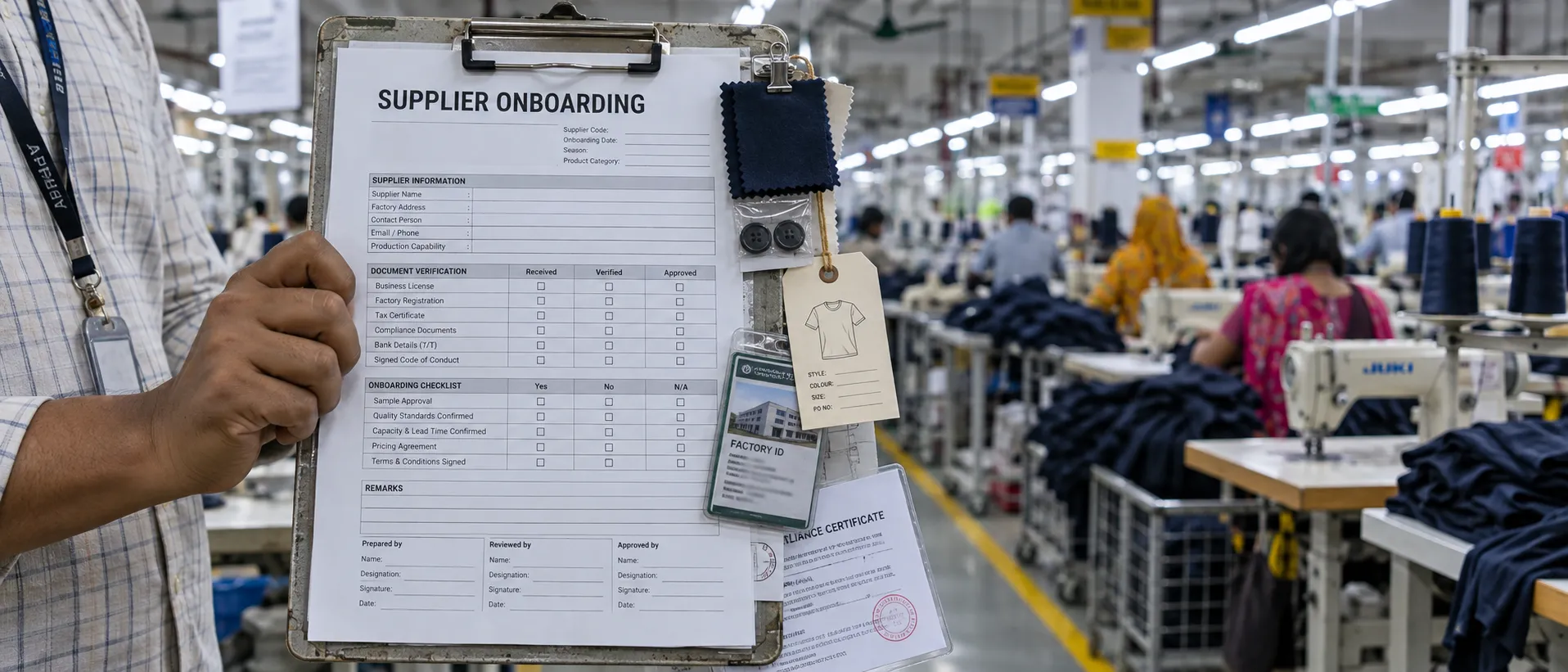
Onboarding deliverables (what must be completed)
Business and compliance setup
- Company profile, addresses, banking details
- Compliance documents or declarations relevant to your market
- Subcontracting disclosure agreement
For garment supply chains, subcontracting control should go beyond a simple disclosure statement. OECD guidance recommends transparency around subcontracting and, where subcontracting is permitted, due diligence and prequalification controls for the subcontractors involved.
Operational setup
- Named owners: merchandising, QA, production planning, sampling
- Reporting cadence: weekly output, WIP, risks, approvals status
- Communication channel rules: what is official, where approvals live
- Change control rules: what triggers re-quote or timeline reset
Technical setup
- Locked tech pack version and BOM version
- Materials approval plan (fabric, trims, colors)
- Testing plan and responsibilities
- Inspection and shipment release rule
Supplier Onboarding Checklist (apparel-specific)
| Onboarding Item | Owner | Due Date | Evidence | Pass / Fail Gate |
|---|---|---|---|---|
| Final scope and quotation assumptions | Buyer + supplier | Agreed date | Confirmed quotation / scope record | All major assumptions resolved |
| Company and banking verification | Commercial / finance | Agreed date | Verified company and banking information | Details confirmed |
| Technical file control | Merchandising / technical | Agreed date | Current tech pack and BOM versions | One approved version in use |
| Sample and approval plan | Merchandising | Agreed date | Sample schedule and approval map | Owners and gates defined |
| Material approval plan | Supplier + buyer | Agreed date | Fabric, trim, color approval tracker | Critical materials controlled |
| Testing plan | QA / technical | Agreed date | Test scope, responsibility, timing | Required testing defined |
| Compliance and subcontracting | Compliance / sourcing | Agreed date | Scope evidence and disclosure rules | Production route understood |
| QC and inspection plan | QA | Agreed date | Style-specific QC / inspection plan | Control points agreed |
| Communication and reporting | Merchandising | Agreed date | Reporting template and escalation map | Cadence confirmed |
| Shipment release rule | Buyer + QA | Before production | Release requirements | Evidence requirement agreed |
Minimum checklist items:
- Confirm scope and quote assumptions in writing
- Confirm sample plan and timeline
- Confirm approvals map and response SLAs
- Confirm QC checkpoints and inspection method
- Confirm subcontracting rules and disclosure
- Confirm shipment release rule (what evidence is required)
A mature apparel RFQ and onboarding system treats onboarding as a production-readiness gate. Buyers should define which onboarding requirements must be complete before bulk production is authorized.
Supplier Not Fully Vetted Yet?
Onboarding should begin only after the supplier has passed the appropriate capability, quality-system, communication, and risk checks. Use the vetting checklist before committing the supplier to the production workflow.
PO Workflow and PO Approval Workflow: commit spend only after scope is locked
Direct Answer
The purchase order workflow is a spend-control gate. The PO approval workflow prevents you from buying ambiguity.
A typical PO workflow:
- PO request (internal)
- Review (scope, attachments, pricing assumptions)
- Approval (finance + operations)
- PO issuance to supplier
- Supplier acknowledgement (written confirmation of scope and dates)
Your apparel RFQ process should require the PO to reference the agreed technical and commercial scope. Supporting attachments help ensure that the supplier and buyer are working from the same specifications, quantities, approvals, and delivery requirements.
PO attachment pack (minimum)
- Locked tech pack and BOM
- Quote normalization summary and final agreed cost
- Approvals map and sample plan
- Testing plan and responsibilities
- Packaging specs and carton marks
- Delivery terms and staged lead time
| PO Reference / Attachment | Why It Matters | Typical Owner | Gate |
|---|---|---|---|
| Final agreed quotation | Confirms commercial basis | Buyer / commercial | Price and assumptions approved |
| Current tech pack | Defines product construction and measurements | Technical / merchandising | Correct version attached |
| Final BOM | Defines materials and trims | Merchandising | Material scope confirmed |
| Quantity and size breakdown | Defines order volume | Buyer / merchandising | Final quantities approved |
| Sample / approval plan | Defines development and release gates | Merchandising | Approval route agreed |
| Testing plan | Defines validation responsibility | QA / technical | Required tests confirmed |
| Packaging specification | Defines packing and labeling | Buyer / merchandising | Packing scope agreed |
| Delivery terms | Defines shipment basis | Commercial / logistics | Incoterm and named place confirmed |
| Staged timeline | Sets execution expectations | Merchandising / production | Key dates acknowledged |
Issuing a PO without clear references to the agreed technical and commercial scope creates avoidable dispute risk. The PO should reference the current specification, quantity, price, delivery terms, and relevant attachments so both parties are working from the same approved information. Whether the PO and its attachments form the complete legal contract depends on the parties’ commercial and legal arrangement.
How the PO approval step fits into procurement
The internal approval structure varies by company, but the basic purpose is to ensure that commercial commitments are reviewed before a supplier receives the final order. This video provides a broader procurement view of how a requisition moves into an approved purchase order.
For apparel production, the PO should also connect back to the approved technical scope, BOM, quantity breakdown, testing, packaging, delivery terms, and production timeline.
Approval Workflow: the schedule is made of approvals (not promises)
Direct Answer
Approvals are critical-path dependencies in apparel production. When color, print, fit, pre-production, testing, or packing approvals move late, the activities that depend on them may also move late.
At minimum, document approvals for:
- Lab dip (color)
- Strike-off for print, or embroidery swatch/sample where applicable
- Size set (grading confirmation)
- PP sample (pre-production gate)
- Top-of-production (TOP) sample, where required
- Packing and labeling approvals
A controlled RFQ clothing manufacturer system assigns:
- Owner: who approves
- Evidence: what proof is required
- SLA: response time expectation
- Escalation: what happens when delayed
- Gate impact: what cannot proceed until approved
Approval Tracker Template (minimum fields)
| Approval | Owner | Evidence Required | Target Response Time | Escalation Trigger | Gate Impact |
|---|---|---|---|---|---|
| Lab dip | Buyer / color approver | Lab-dip card or agreed reference | Agreed by project | Response target missed or repeated rejection | May block bulk dyeing |
| Print strike-off | Buyer / artwork approver | Strike-off on agreed fabric base | Agreed by project | Color, scale, or quality unresolved | May block bulk printing |
| Embroidery approval | Buyer / artwork approver | Embroidery swatch or sample | Agreed by project | Thread, density, placement unresolved | May block embroidery |
| Size set | Technical / buyer | Measurements and fit comments | Agreed by project | Grading or fit unresolved | May block PP approval |
| PP sample | Buyer / technical / QA | Approved pre-production sample and comments | Agreed by project | Critical material or construction issue open | May block bulk start |
| TOP sample | Buyer / QA, where required | Production sample / measurement evidence | Agreed by project | Production differs from approved standard | Escalation during bulk |
| Packing approval | Buyer / logistics | Packing sample, labels, carton details | Agreed by project | Packaging requirement unresolved | May block shipment readiness |
Operational rules that prevent approval drift
- No approval decision without evidence attached
- No “verbal approvals” for critical gates
- Every approval has a date, version, and owner name
- IIf the agreed response target is missed, trigger the defined escalation process
.
Pre Production Process: the “safe-to-start bulk” gate before cutting
Direct Answer
Pre-production is the stage where the final product definition, approved materials, quality controls, responsibilities, and execution plan are checked before bulk starts. Beginning cutting or production with important requirements still open creates avoidable risk.
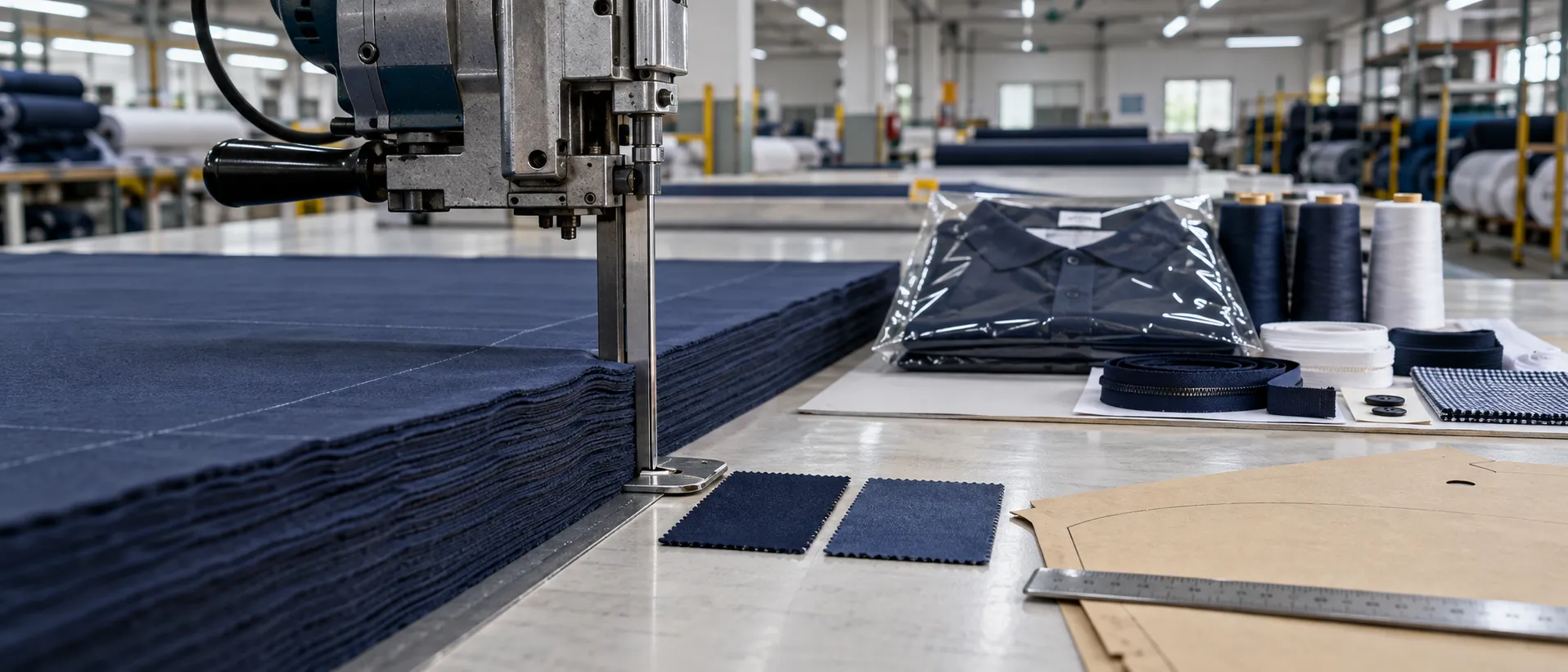
Pre production must lock:
- Final tech pack and measurement tolerances
- BOM and trims approvals
- Fabric approval status and shade rules
- QC plan and control points
- Testing plan timing and responsibilities
- Production plan (line allocation, output expectations)
- Risk register (top risks and mitigation plan)
A strong apparel RFQ and onboarding system treats pre-production readiness as a release decision, not only as a status meeting. The buyer and production team should know which requirements must be closed before bulk cutting or sewing is authorized.
Production Kickoff Checklist (PP gate)
| Category | Must Be Locked | Evidence | Owner | Pass / Fail |
|---|---|---|---|---|
| Product specification | Current tech pack and measurements | Approved version | Buyer / technical | Current version confirmed |
| Materials | Fabric and trims | Approval records / BOM | Merchandising | Critical materials approved |
| Color and artwork | Lab dips, print, embroidery where applicable | Signed or documented approvals | Buyer / merchandising | Required approvals closed |
| Sample standard | PP sample or agreed production reference | Approved sample and comments | Buyer / QA | Reference approved |
| Testing | Scope, timing, responsibility | Test plan / available reports | QA / technical | Required tests scheduled or passed |
| Quality control | Style-specific checkpoints | QC plan / inspection criteria | QA | Control plan agreed |
| Production planning | Facility, line, timing, output plan | Production schedule | Factory / partner | Plan confirmed |
| Packaging | Folding, polybag, labels, carton requirements | Packing approval | Buyer / logistics | Packing scope approved |
| Open risks | Remaining issues and mitigation | Risk register / action list | Named owners | No unresolved stop issue |
Common reasons buyers fail PP gates
- Materials not fully approved but production is rushed
- QC plan is generic and not style-specific
- Shade band rules not defined for multi-lot fabric
- Change control rules not agreed, so revisions derail timelines
.
Manufacturing Communication Systems: SLAs and escalation that protect lead time
Direct Answer
Communication is a control mechanism, not a courtesy. Response time is a KPI because approvals and issue resolution run on response time.
Define your communication workflow:
- Cadence: weekly minimum, more frequent during critical gates
- Format: one tracker, one folder, one versioning rule
- SLA: response times by topic
- Escalation ladder: who gets looped in when issues stall
- Evidence discipline: every update includes proof, not only text
A disciplined apparel onboarding system also evaluates communication performance. If a supplier repeatedly misses agreed update cycles, provides weak evidence, or fails to escalate issues during onboarding, treat that behavior as a warning sign before bulk increases the coordination pressure.
Communication SLA Table (buyer-ready)
| Topic | Cadence | Response-Time Target | Required Evidence | Escalation Trigger |
|---|---|---|---|---|
| Routine merchandising update | Agreed weekly cadence | Agreed by project | Updated tracker | Update missed |
| Approval request | As approval becomes ready | Agreed approval target | Sample/photo/report/version | Target missed and next stage affected |
| Material delay | Immediately when risk is known | Priority response | Supplier / mill status and revised plan | Delivery milestone at risk |
| Quality issue | As soon as material issue is identified | Priority response | Photos, defect data, containment action | Issue not contained |
| Production progress | Weekly or more frequently at critical stages | Agreed by project | Output vs plan / WIP | Material variance from plan |
| Shipment risk | Immediate | Priority response | Inspection, packing, booking or document status | Planned ship date at risk |
Minimum update template (what every update must include)
- Current status (what changed since last update)
- Output vs plan (if in production)
- Approvals pending (with owner and deadline)
- Risks (what can derail the schedule)
- Next actions (who owns what by when)
- Evidence (photos, reports, tracker screenshots)
Apparel Order Management: the early warning system from start to shipment
Direct Answer
Apparel order management is visibility plus early warning. Without it, you find problems late when options are expensive.
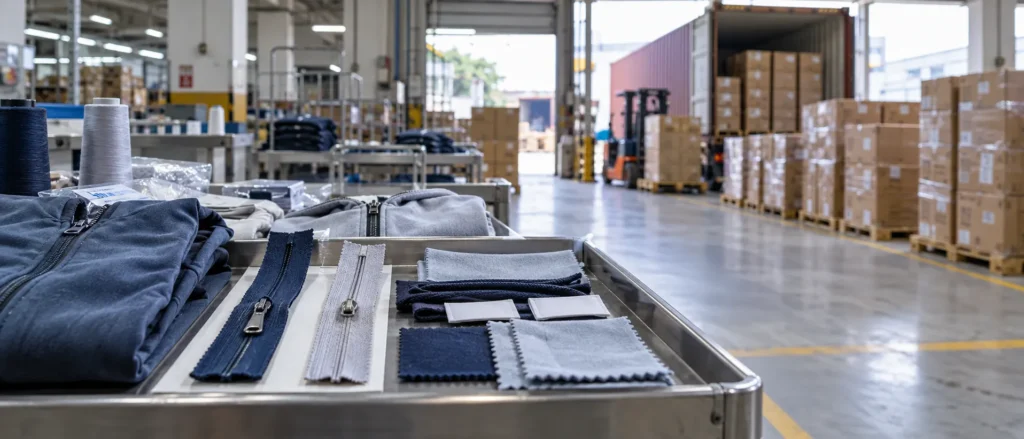
Minimum tracker fields:
- Style, color, size breakdown
- Material status (fabric, trims, packaging)
- Approval status (lab dip, strike-off, PP, TOP, packing)
- Production status (cut/sew/finish/pack)
- Output vs plan (weekly)
- Defects and rework status
- Open risks and mitigation status
- Shipment readiness and final evidence pack status
A complete system also defines shipment release rules: what proof must exist before shipment is authorized (final inspection evidence, packing confirmation, approvals log complete).
This is where the RFQ clothing manufacturer onboarding system becomes operational reality: you maintain control until shipment release, not only until the PO is issued.
Have an Apparel RFQ or Tech Pack Ready?
Share your product type, quantity, fabric, colors, construction details, branding, packaging, destination, and available technical files with RYZEAL SOURCING. Our team can review the requirement and coordinate the next quotation, sampling, and production-planning steps through the appropriate manufacturing route.
FAQs
RFQ meaning: is it the same as request for quotation?
Yes. RFQ means Request for Quotation. In apparel, the key is whether you included enough specification detail to make supplier quotes comparable.
What should be in an RFQ template for apparel production?
Tech pack, BOM, artwork, color references, testing requirements, compliance requirements, packing specs, delivery terms, and staged lead time assumptions.
What is supplier onboarding and why is it critical?
Supplier onboarding is the setup phase that locks owners, documents, reporting cadence, approval workflow, and change control before bulk begins. Without onboarding, production runs on assumptions.
What does a purchase order approval workflow prevent?
It prevents committing spend before scope is locked. A PO should only be approved when the attachment pack is complete and aligned to the final RFQ and quote assumptions.
Why is approval workflow the biggest lead-time lever?
Because approvals are dependencies. If lab dips, strike-offs, PP samples, TOP samples, or packing approvals drift, production cannot proceed safely or predictably.
What is the fastest way to implement this system without new software?
Standardize templates first: RFQ pack checklist, quote normalization sheet, onboarding checklist, approval tracker, communication SLA, and order management tracker. Tools can come later.
If sampling requirements are not yet fully defined, review our questions to ask a clothing manufacturer before sampling to clarify MOQ, lead time, testing, compliance, and approval expectations before the onboarding process advances.
Connect with RYZEAL SOURCING
 English
  Chinese
  French
  Dutch
Dutch  Japanese