
If you want predictable bulk outcomes, you need a proof-based screening process, not a “nice factory” impression. This clothing manufacturer vetting checklist is designed to help you verify four things fast: capacity reality, quality system discipline, communication control, and red-flag risk.
A supplier can look strong on paper and still fail in bulk because their planning is weak, their QA is informal, their response time is slow, or their subcontracting is uncontrolled. This clothing manufacturer vetting checklist forces evidence: documents, records, timestamps, photos, reports, and named owners.
Use this clothing manufacturer vetting checklist before you spend on sampling. Sampling proves a product can be made once. Vetting proves the supplier can repeat it at scale, on schedule, with controlled variation.
For the broader process behind this checklist – from manufacturer selection and sampling to pricing and production control – see our complete guide to choosing a clothing manufacturer in Bangladesh.
Table of Contents
How to use this clothing manufacturer vetting checklist (fast workflow)
Direct Answer
Run the clothing manufacturer vetting checklist in five passes:
Pre-screen → Evidence pack → Capability call → Factory validation → Decision + onboarding gates
Step 1: Pre-screen in 30 minutes (fit + feasibility)
- Confirm product category match (knit, woven, denim, outerwear) and similar styles produced recently.
- Confirm basic MOQ feasibility (fabric and trims often set the real MOQ, not sewing).
- Confirm export experience, target markets, and standard Incoterms used.
Step 2: Request an evidence pack (don’t debate, verify)
- Ask for documents + proof samples (see tables below).
- If they refuse, delay, or send generic templates, treat it as a signal.
Step 3: Capability validation call (technical + operational)
- Validate machine list relevance to your construction.
- Validate factory production planning method (capacity booking, line allocation, peak loading).
- Validate quality checkpoints, including inline, end-line, and final inspection, plus AQL-based final sampling where applicable and corrective-action discipline.
Step 4: Factory validation (onsite visit or live video walkthrough)
- Confirm actual lines running, WIP control, and process flow.
- Confirm QA records exist for current orders (not “we do QA,” but “here are the logs”).
Step 5: Decide using gates + score (not vibes)
- Apply pass/fail gates first.
- Use weighted scoring second.
For the broader framework behind these checks, see our Manufacturer Vetting and Due Diligence: How to Evaluate a Clothing Manufacturer guide.
Capacity reality check (can they actually execute your timeline)
Direct Answer
Capacity is not headcount. Capacity is the supplier’s ability to run your product category with stable output inside your delivery window, supported by factory production planning and line discipline.
Product-category fit and line specialization
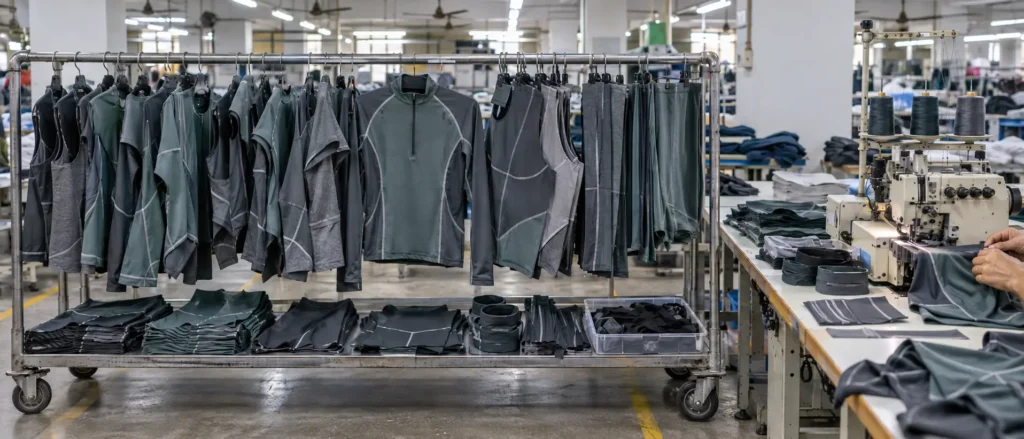
Use this part of the clothing manufacturer vetting checklist to avoid the most common trap: a factory says “yes” to everything, then struggles because your construction isn’t their daily bread.
Verify:
- Similar styles currently in production (same construction complexity, same fabric family).
- Correct line type: flatlock/activewear vs basic knit; seam sealing vs standard outerwear; etc.
- Critical operations capability (buttonhole, zipper attachment, bar-tack, bonding, wash).
Good signal:
- They show comparable styles with recent production photos or videos and, where appropriate, verifiable production or shipment evidence with confidential buyer details redacted.
Risk signal:
- Only showroom samples, no current line evidence, or “we can do anything.”
Factory production planning (proof, not promises)
This section ties directly to factory production planning and delivery credibility.
Ask for:
- Line loading snapshot (weekly plan view) for the next 4-8 weeks.
- Capacity booking method (how they reserve space after approvals).
- Bottleneck operations map (where WIP piles up).
Good signal:
- They can explain constraints and propose realistic sequencing.
Risk signal:
- They promise lead times without showing any planning framework.
Lead time, MOQ, and peak season logic
A strong clothing manufacturer vetting checklist includes reality checks:
- Lead time broken into: fabric sourcing/dyeing, trims, sampling rounds, approvals, cutting, sewing, finishing, packing, inspection, shipment.
- MOQ explained by components (fabric dye lot, trim minimums, print/embroidery set-up costs).
- Peak-season adjustment (what changes during high-load periods).
Table: Capacity & planning checklist (use this to score suppliers)
| Area | What to ask | Proof to request | Pass criteria | Red flag |
| Category fit | “Show last 3 similar styles shipped” | Production photos, spec highlights, recent comparable-style evidence | Comparable construction + fabric | Only generic samples |
| Line capability | “Which line will run this?” | Line video + operation list | Correct machines + operators | “Any line is fine” |
| Planning system | “How do you plan weekly output?” | Weekly plan snapshot | Clear line loading logic | No planning artifacts |
| Capacity booking | “When do you lock capacity?” | SOP / internal workflow | Booking after approvals | “We’ll manage” |
| Peak season | “What changes in peak?” | Lead time matrix | Transparent + conservative | Same lead time always |
This clothing manufacturer vetting checklist section should eliminate suppliers who sell optimism instead of capacity.
Quality systems and apparel quality assurance (proof of control)
Direct Answer
Reliable apparel quality assurance depends on a repeatable quality management system with defined checkpoints, records, ownership, and corrective action – not simply on a supplier saying they “care about quality.”
What a real apparel quality management system looks like
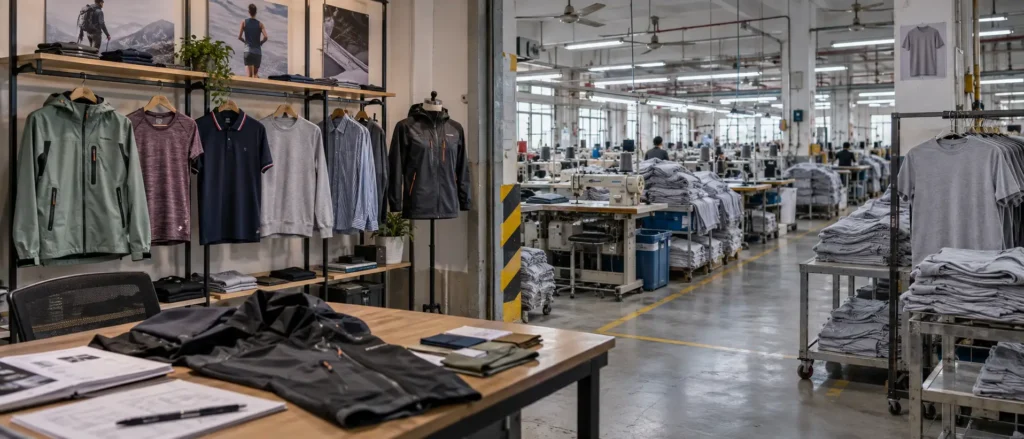
In this clothing manufacturer vetting checklist, you’re looking for system signals:
- Written SOPs (cutting, sewing, finishing, packing, inspections).
- Training discipline (operator training logs or skill matrix).
- Traceability (batch/lot tracking for fabric and trims where relevant).
Good signal:
- They show living documents and records from current production.
Risk signal:
- They describe quality verbally but can’t show controlled artifacts.
Inline, end-line, and final inspection discipline
You do not need a complicated system. You need one that is documented, repeatable, and visible in current production records:
- Inline checkpoints at critical operations.
- End-line checks for workmanship and measurement discipline.
- Final inspection method, including AQL-based sampling where applicable.
If your business needs AQL-based shipment approval, this clothing manufacturer vetting checklist should confirm they can produce inspection records consistently, not just “pass an inspection once.”
Testing plan: fabric, trims, and performance risk
Where product performance or buyer requirements create testing risk, the test plan should be defined before bulk production:
- Fabric tests relevant to the style (shrinkage, colorfastness, pilling, spirality, stretch recovery).
- Trim tests where applicable (zipper pull strength, snap durability, elastic recovery).
- Wash test discipline for styles with prints/embroidery/finishes.
Table: Apparel quality assurance evidence pack
| Control area | What you verify | Proof to request | Why it matters |
| QC structure | Who owns QA and escalation | Org chart + names | Prevents “no owner” failures |
| Inline QC | Checkpoints + defect handling | Inline logs, defect photos | Stops repeat defects early |
| Final QC | Final audit approach | Final inspection reports, sampling plan or AQL record where applicable | Prevents shipment surprises |
| Corrective action | How issues are closed | CAPA examples + closure evidence | Proves learning + control |
| Testing discipline | What they test + when | Lab reports or test plan | Prevents performance claims failures |
This clothing manufacturer vetting checklist is intentionally evidence-heavy because “quality” is a claim until proven operationally.
Preparing to Contact a Manufacturer?
Vetting tells you whether a supplier is worth taking seriously. The next step is to ask the right questions before sampling so MOQ, lead time, testing, compliance, and approval expectations are clear before development begins.
Communication control and supply chain response time (how to prevent chaos)
Direct Answer
The fastest way to avoid delays is to lock a communication system that protects decisions, approvals, and response time. Your supply chain response time is a measurable KPI, not a hope.
Define who owns decisions (and who can approve)
Your clothing manufacturer vetting checklist must confirm role clarity:
- Merchandiser / account owner
- QA owner
- Production planning owner
- Sampling coordinator
If approvals are scattered, timelines die.
Set a response-time SLA (and escalation path)
Before onboarding, buyer and supplier should agree on practical response targets. For example:
- Quotation clarifications: within 24-48 hours
- Sampling updates: every 2-3 days
- Bulk status: weekly output + risks
- Critical issues: same-day escalation
This connects directly to supply chain response time. If they can’t respond, they can’t control.
Approval discipline (the real schedule)
Approval drift is a common source of avoidable production delay:
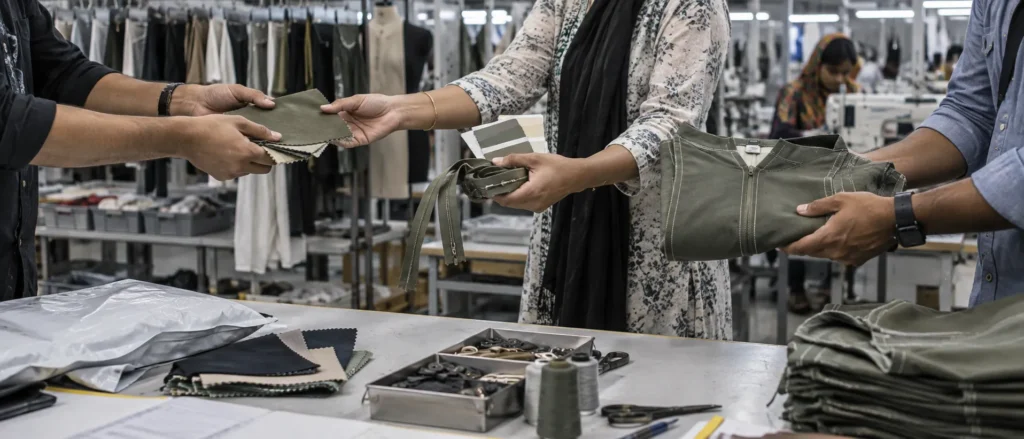
- Lab dip, trims, artwork strike-off, size set, PP sample, packing, carton marks.
- Every approval needs: owner, date, evidence, decision.
Table: Example Communication cadence & SLA
| Topic | Example cadence | Target response time | Evidence format | Escalation trigger |
| Sampling timeline | 2-3x/week | 24-48h | Tracker + photos | Missed sample date |
| Bulk production | Weekly | 48h | Output + WIP photos | Output slip |
| QA issues | As needed | Same day | Defect report + plan | Repeat defect |
| Approvals | Per gate | 24-48h | Approval log | Approval pending > 3 days |
Before sampling begins, buyers should also confirm MOQ, lead time, testing, compliance, and approval expectations. See our Questions to Ask a Clothing Manufacturer Before Sampling: MOQ, Lead Time, Testing, Compliance guide.
This clothing manufacturer vetting checklist section is what keeps the relationship operational, not emotional.
Red flags that should stop the process (before you waste weeks)
Direct Answer
Red flags are patterns that predict bulk failure. The clothing manufacturer vetting checklist should include deal-killers that override price and enthusiasm.
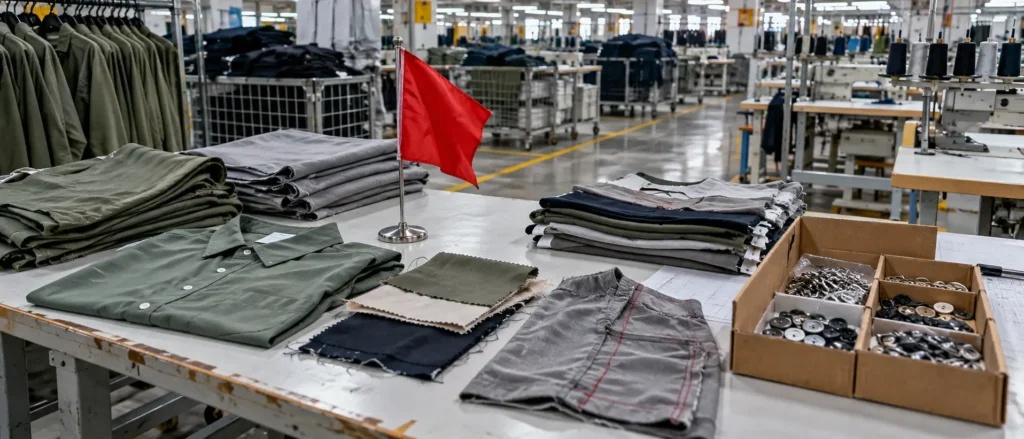
Commercial red flags
- Unrealistically low price with vague inclusions/exclusions.
- Instant “yes” to every requirement without questions.
- Refusal to share breakdown assumptions (fabric, trims, CM, testing, packing).
- Pressure for substantial or non-refundable payment before basic company and capability verification is complete.
Technical and quality red flags
- No evidence of inline or final QC records.
- No defined process for required testing, or refusal to coordinate tests that were agreed as part of the order.
- Samples look good but construction is inconsistent, or measurement control is weak.
- No defined process for defect containment and corrective action.
Compliance and subcontracting red flags
- Unclear subcontracting policy or “we outsource sometimes” without controls.
- Refusal to provide relevant, current compliance or audit evidence where such documentation is required for the order.
- Inconsistent answers on where processes happen (washing, printing, embroidery).
Table: Red flags and deal breakers
| Red flag | Why it matters | How to verify | What to do next |
| Vague quote scope | Hidden cost + quality risk | Normalization sheet | Reject or re-quote |
| No QC records | No control system | Ask for current logs | Stop process |
| Unreal lead time | Planning failure | Ask line loading proof | Stop or downgrade |
| Subcontracting unclear | Compliance + quality risk | Ask SOP + supplier list | Stop unless controlled |
| Slow response time | Timeline risk | Track response behavior | Replace supplier |
This is the fastest part of the clothing manufacturer vetting checklist because it prevents sunk-cost traps.
Scoring model (make the decision measurable)
Direct Answer
Use a two-layer decision system: pass/fail gates first, then weighted scoring. The clothing manufacturer vetting checklist is only useful if it leads to a decision.

Pass/fail gates (non-negotiables)
Fail the supplier immediately if:
- They can’t show category-relevant production evidence.
- They refuse evidence pack items.
- They can’t define owners for QA and planning.
- Their response time is consistently slow.
- Subcontracting is uncontrolled.
Weighted scorecard (compare suppliers fairly)
Score each category from 1–5, then convert the score against its assigned weight. Use: (Score ÷ 5) × Weight. The maximum total score is 100.
Table: Vetting scorecard template
| Category | Weight | Score (1-5) | Weighted score | What “5” looks like |
| Capacity & planning | 30 | Real plan proof + realistic lead time | ||
| Apparel quality assurance | 30 | Records + checkpoints + corrective action | ||
| Communication discipline | 20 | Named owners + SLA + clean approvals | ||
| Compliance + subcontracting control | 20 | Clear scope + controlled partners |
For the broader evaluation framework behind this scorecard, see our Manufacturer Vetting and Due Diligence: How to Evaluate a Clothing Manufacturer guide.
Use this clothing manufacturer vetting checklist to compare suppliers on consistent evidence rather than impressions alone.
Vendor onboarding checklist (move from “approved” to “safe to bulk”)
Direct Answer
Passing vetting does not mean a supplier is ready for bulk production. Vendor onboarding converts an approved supplier into a controlled execution partner by locking scope, approvals, documents, responsibilities, and escalation rules.
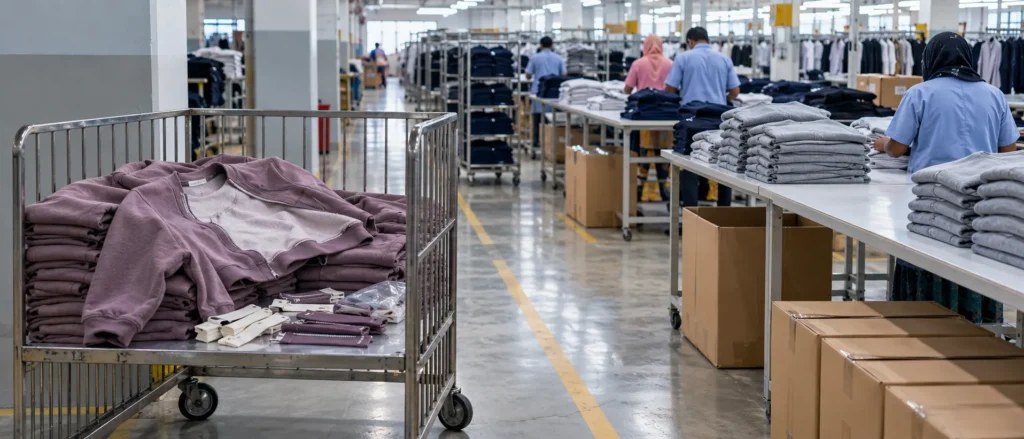
Minimum onboarding deliverables:
- Confirm scope: inclusions, exclusions, and assumptions (quote normalization).
- Confirm approvals map: who approves what and by when.
- Confirm production readiness checklist items: PP meeting agenda, control plan, test plan, packing standards.
- Confirm risk controls: subcontractor list (if any), escalation contacts, change control rules.
This is where vendor onboarding checklist discipline prevents “we thought you meant…” disputes.
Once a supplier passes vetting, the next step is to turn the decision into a controlled order setup. Our RFQ and Onboarding System: How to Start Production With a Clothing Manufacturer explains how requirements, approvals, responsibilities, and production inputs should be organized before bulk begins.
Your clothing manufacturer vetting checklist is complete only when onboarding gates protect bulk.
Need Support Managing the Manufacturing Process?
Supplier vetting is only the beginning. RYZEAL SOURCING supports buyers with factory sourcing, product development, sampling, production follow-up, quality control, compliance coordination, and shipment support through a vetted manufacturing network.
FAQs
How many suppliers should I run through a clothing manufacturer vetting checklist?
There is no fixed number. Start with enough suppliers to compare capability and evidence, then narrow the list to two or three serious candidates for deeper validation. The goal is not to collect the largest supplier list; it is to create a small, comparable shortlist.
What is the difference between a factory audit and this clothing manufacturer vetting checklist?
An audit is usually compliance- or standard-driven. This checklist is outcome-driven: it validates capacity, quality control, and execution reliability for your specific product.
Can a great sample still lead to bad bulk?
Yes. Sampling proves that a product can be made successfully once. Bulk production tests whether the supplier can repeat that approved result across more materials, machines, operators, and production volume while maintaining measurements, workmanship, color, and delivery control.
What is the most overlooked KPI during vetting?
Supply chain response time. Slow replies create delayed approvals, missed corrections, and timeline drift.
What should I ask if a supplier claims a strong quality management system in the apparel industry?
Ask for actual records: inline logs, final reports, corrective action closures, and a current test plan. Systems must be visible.
When should I stop the process even if pricing looks good?
When red flags show uncontrolled variability: no records, vague scope, unrealistic lead times, or unclear subcontracting.
FINAL NOTE
Use this clothing manufacturer vetting checklist as a repeatable decision system. Run comparable suppliers through the same gates, request equivalent evidence, and score them using the same method. The goal is not to find a factory that looks impressive – it is to identify a supplier whose capacity, quality system, communication, and controls can support repeatable bulk production.
Connect with RYZEAL SOURCING
 English
  Chinese
  French
  Dutch
Dutch  Japanese