
Many inaccurate or difficult-to-compare quotations begin with an unclear RFQ. When product details, BOM items, packaging requirements, testing expectations, or commercial assumptions are missing, suppliers have to make assumptions to prepare a price. Those assumptions can later lead to re-quotes, delays, or disagreements. This guide shows how to write an RFQ to a clothing manufacturer so quotations are based on a clearer and more comparable scope.
The goal is not to create the longest possible document. It is to define the commercial and technical scope clearly enough for suppliers to understand what they are pricing. A structured RFQ can reduce clarification loops and help buyers compare quotations using more consistent assumptions.
This RFQ guide is one part of the wider RFQ and onboarding system used to move a shortlisted supplier toward controlled production. If supplier capability has not yet been verified, first review how to vet a clothing manufacturer before relying on its quotation.
Quick Answer: How to Write an RFQ With the Minimum Information Manufacturers Need
If you want accurate quotes, how to write an RFQ comes down to one rule: lock the scope before you request price.
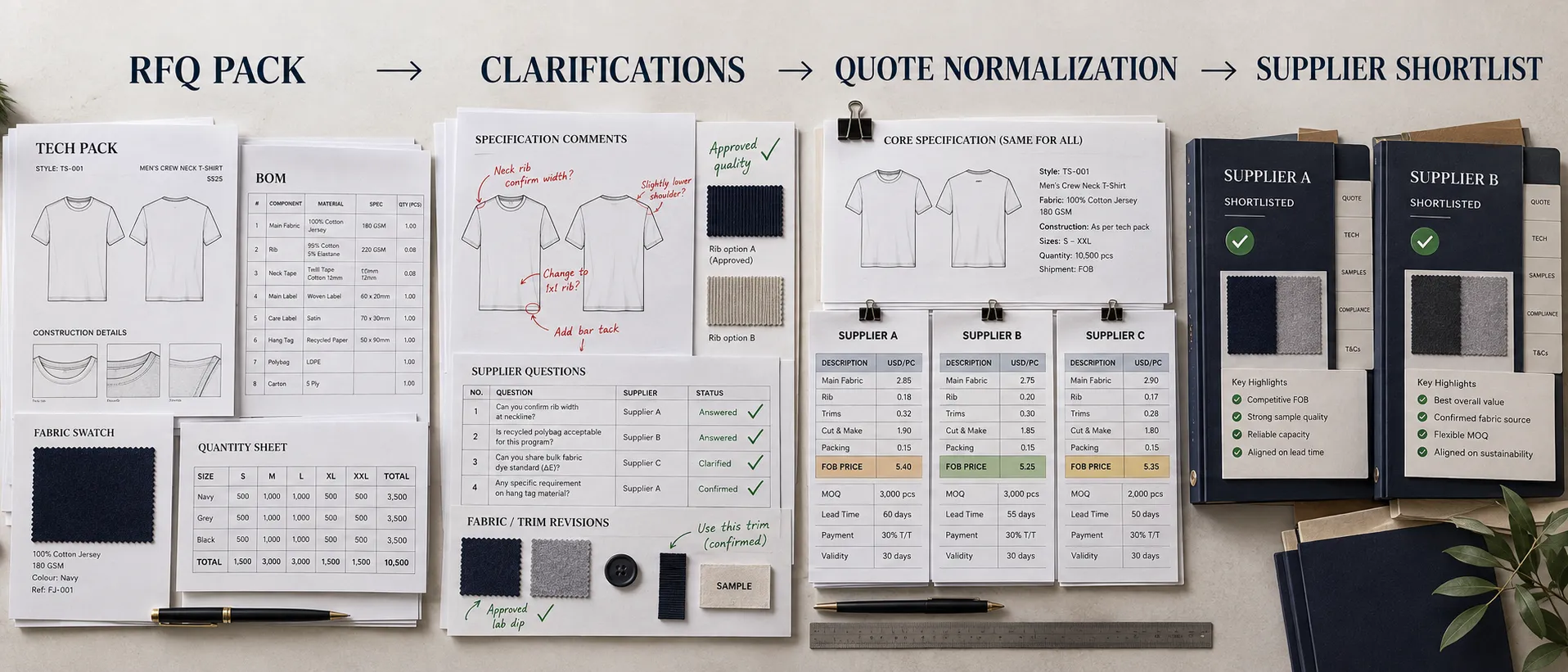
Minimum RFQ pack:
- Tech pack (measurements, tolerances, construction notes)
- BOM (fabric, trims, labels, packaging)
- Fabric spec sheet (composition, GSM, structure, finish)
- Artwork files + placement sizes
- Quantity by color and size split
- Pricing breakdown requirements (what cost lines must be shown)
- Production timeline request (staged lead time)
- Inspection and AQL requirements, where applicable
- Compliance requirements + subcontracting disclosure rule
If important cost-driving information is missing, suppliers may only be able to provide provisional pricing or quotations based on their own stated assumptions.
Table of Contents
RFQ meaning in apparel (request for quotation in plain English)
Direct answer:
RFQ means Request for Quotation. It is a structured request for suppliers to provide pricing and commercial terms against a defined requirement. In apparel sourcing, the RFQ usually needs enough technical detail for different manufacturers to understand and price the same product scope.
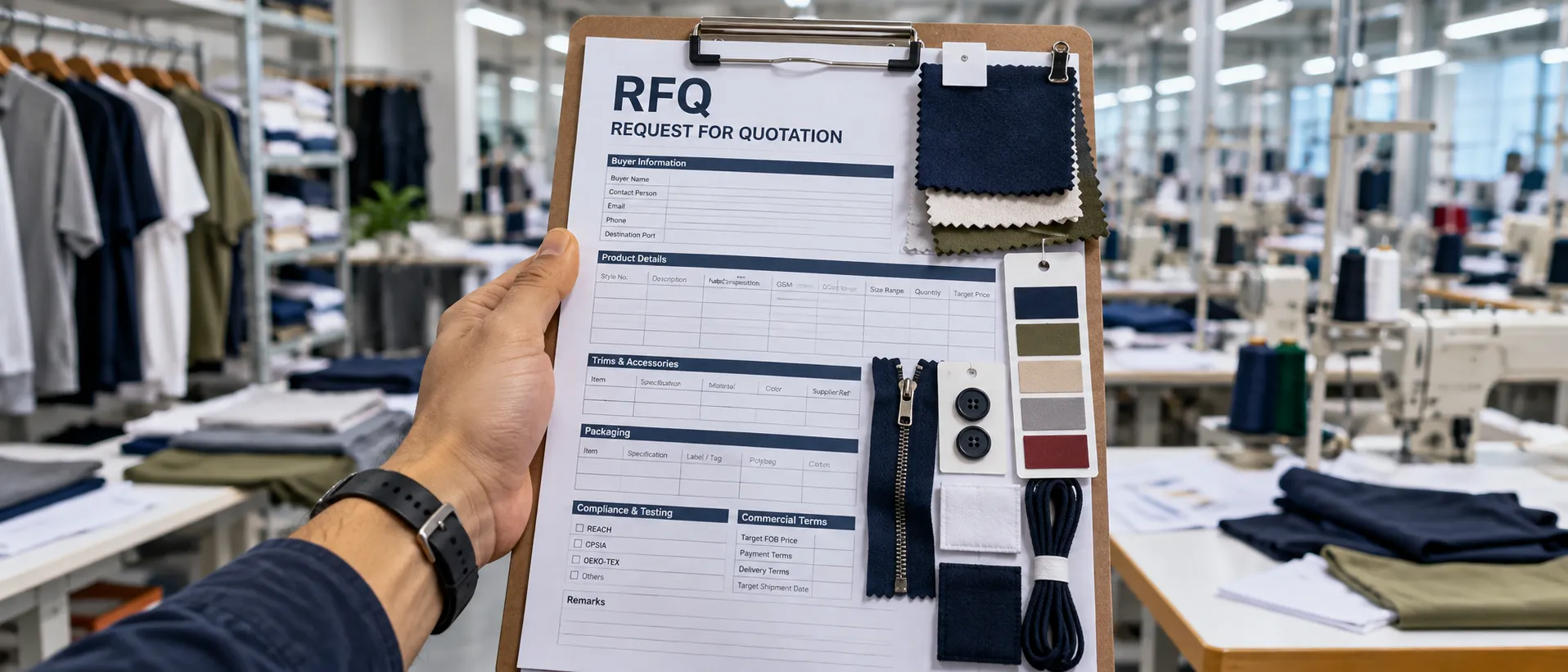
As a general procurement reference, UNDP describes an RFQ as a written request sent to a vendor for a price quotation against a clearly described requirement. Apparel RFQs usually need additional product-specific detail because fabric, construction, trims, branding, testing, packaging, and quantities can materially affect the quotation.
Many buyers ask “what is request for quotation?” because they are used to informal price requests. An RFQ is different: it asks suppliers to quote against a documented specification rather than relying mainly on their own interpretation. If you want to learn how to write an RFQ that works, treat the RFQ as the first control gate in your production workflow.
RFQ vs RFP vs PO (simple view)
- RFQ: requests pricing and commercial terms against a defined requirement
- RFP: requests a broader proposed solution where the approach or scope may require evaluation
- PO: communicates an order against agreed commercial and technical terms; its contractual effect depends on the buyer-supplier agreement
How to write an RFQ (step-by-step workflow that prevents assumptions)
Direct Answer
A practical way to write an RFQ consistently is to follow the same 5-step workflow each time. Repeatability helps reduce missing information and makes supplier responses easier to compare.
Step 1: Lock the product definition (no guessing)
Before you ask for price, lock what you are pricing:
- Style description and target use
- Fabric direction (composition, GSM, structure, finish)
- Construction expectations (seams, stitch type, key operations)
- Branding (print/embroidery type, placement, size)
- Packaging method (polybag/carton rules)
If you cannot lock every detail yet, define the main cost-driving requirements first and clearly identify which items remain provisional.
Step 2: Build the RFQ pack (attachments beat paragraphs)
Factories quote faster and more accurately when information is structured. Your RFQ should be a pack, not a long email.
Minimum attachments:
- Tech pack
- BOM
- Fabric spec sheet
- Artwork files
- Packaging spec
- Testing and compliance requirements
This is a core part of how to write an RFQ that gets accurate quotes: attachments reduce interpretation.
Why the technical pack matters before quotation
A manufacturer can only price the product that has been communicated. A strong tech pack gives the RFQ a technical reference for measurements, BOM items, colorways, construction, labels, tolerances, and other details that may affect costing and development.
The RFQ does not need every development decision to be final, but any provisional item should be identified clearly so the supplier can state the assumption used in the quotation.
Step 3: Request a pricing breakdown so quotes are comparable
If you request only a unit price, important assumptions may remain invisible inside the quotation. Define the cost lines and inclusions you want suppliers to show so different quotations can be compared on a more consistent basis.
Step 4: Request a staged production timeline (not one number)
A single lead-time number provides limited planning visibility. Ask for both sample and bulk timelines broken into the main stages and approval dependencies that can affect the final delivery date.
Step 5: Submit, clarify, and version-control
Your RFQ process must include:
- A clear deadline for quote submission
- One clarification loop with a tracker
- Version control: RFQ v1, v2, and what changed
RFQ template (request for quotation form fields a clothing manufacturer needs)
Direct Answer
An RFQ template is the fastest path to accuracy. If you’re serious about how to write an RFQ, standardize the fields so every supplier responds to the same structure.
Below is the RFQ template field logic. You can implement it in a spreadsheet, Google Doc, or form. The format matters less than the completeness.
Section A: Product definition fields (must-have)
- Product category and style name
- Season/use case (affects fabric finish and compliance)
- Fit type (regular, oversized, slim)
- Size range and grading method (if available)
- Quantity by color and size split (not only total quantity)
Section B: Fabric spec sheet fields (must-have)
- Fabric type/structure (single jersey, fleece, twill, rib, etc.)
- Composition (e.g., 100% cotton, cotton-poly blend)
- GSM or weight range
- Finish requirements (enzyme wash, brushed, anti-pilling, etc.)
- Color method (piece dyed, yarn dyed, pigment dyed)
- Color references (Pantone or physical swatch guidance)
Section C: RFQ BOM fields (must-have)
- Fabric consumption assumptions (if you have them)
- Trims: zipper, buttons, snaps, drawcord, elastic, thread type
- Labels: main label, care label, size label
- Hangtag and accessories
- Packaging: polybag, sticker, barcode, tissue, silica gel (if needed)
- Carton: size rules, strength requirements, carton marks
Section D: Branding/artwork fields (must-have)
- Print type (screen, DTG, heat transfer) and placement
- Embroidery type and placement
- Artwork file format (vector preferred) and size in cm/inches
- Mockup reference (optional)
Section E: Quality + compliance requirements (must-have)
- Inspection method and AQL requirements, where applicable
- Testing requirements (shrinkage, colorfastness, pilling, stretch recovery if needed)
- Compliance requirements (audit documentation expectations, restricted substances requirement if relevant)
- Subcontracting disclosure requirement (must be pre-approved)
Section F: Logistics and commercial fields (must-have)
- Applicable Incoterms rule and named place or port, where relevant
- Destination country/city (affects shipping and labeling)
- Target ship window
- Payment terms expectation
- Quote validity period
When using Incoterms in an RFQ, specify both the rule and the named place or port. ICC explains that Incoterms clarify the tasks, costs, and risks associated with delivery between seller and buyer.
| RFQ Field | Why It Matters | Common Mistake | Supplier Response / Proof |
|---|---|---|---|
| Style and product definition | Establishes what is being quoted | Vague style description | Capability confirmation and style interpretation |
| Fabric specification | Major cost and performance driver | Only saying “cotton” or “fleece” | Proposed source, composition, GSM, structure, finish |
| Quantity and color split | Affects MOQ, MCQ, efficiency and price | Giving total quantity only | MOQ/MCQ and quantity assumptions |
| BOM and trims | Defines accessory scope | Labels, zippers or packing items omitted | Proposed sources, specifications and minimums |
| Artwork and branding | Defines process and setup requirements | Mockup supplied without technical dimensions | Process, placement, size and setup assumptions |
| Packaging | Affects cost and shipment preparation | “Standard packing” left undefined | Polybag, labels, carton and packing assumptions |
| Testing | Affects cost and timeline | Testing discussed after quotation | Tests included, responsibility and reporting method |
| Compliance | Confirms production-scope requirements | Audit/facility requirements added later | Facility and documentation response |
| Lead-time stages | Supports realistic planning | One total lead-time number | Material, sampling, approval and bulk timeline |
| Delivery terms | Defines logistics basis | Incoterm without named place | Incoterm, named place and exclusions |
| Quote validity | Shows when pricing may change | No validity period | Validity period and re-quote triggers |
For more comparable quotations, define which RFQ fields suppliers must answer and which items may remain provisional at the current development stage.
Already Have a Tech Pack or RFQ?
Share your product specification, target quantity, fabric requirements, colors, branding, packaging, destination, and available technical files with RYZEAL SOURCING for quotation review and manufacturing-route planning.
RFQ BOM and BOM requirements (how to stop trim and packaging surprises)
Direct Answer
The BOM is one of the main inputs behind quotation accuracy because it defines the materials, trims, labels, packaging, and other components included in the product. For a detailed RFQ, include a complete or clearly identified provisional BOM so suppliers know what should be priced.
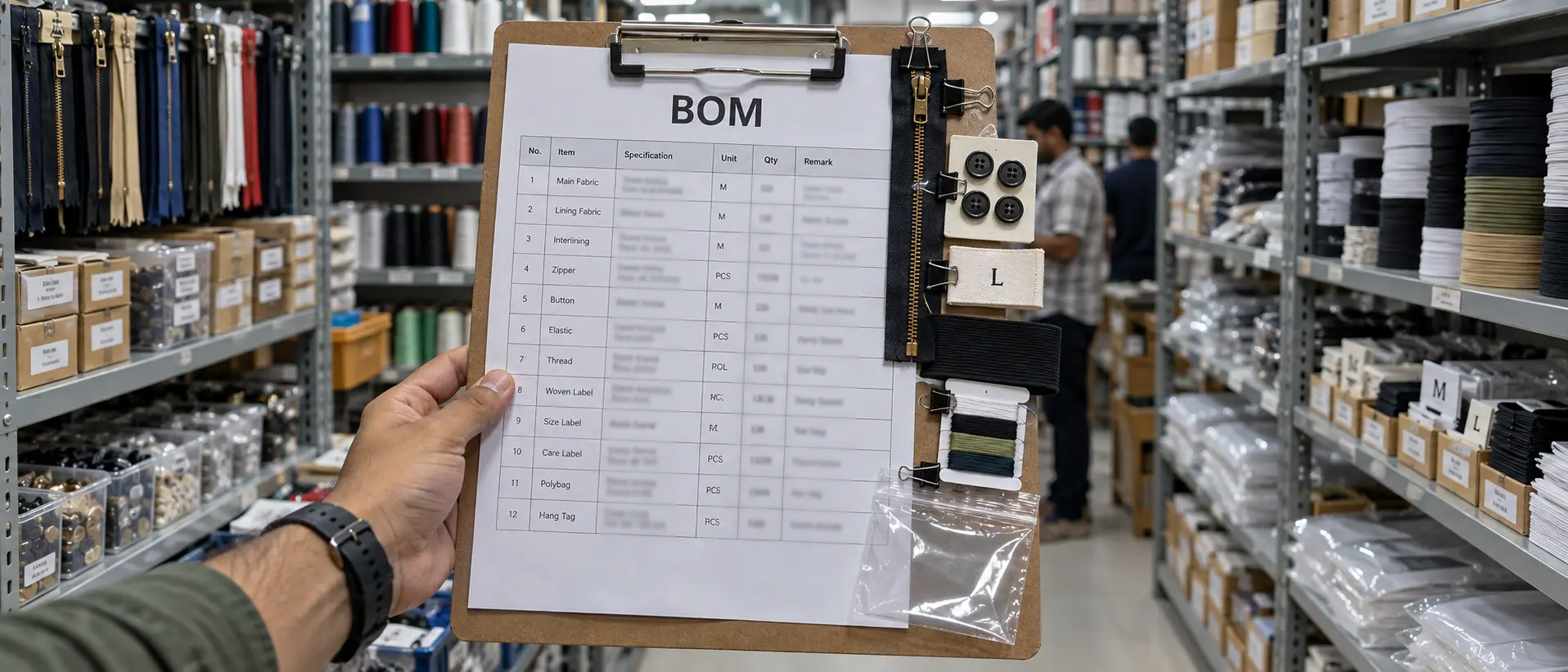
BOM essentials (what buyers often miss)
Trims
- Zipper type, length, finish color
- Snap/button material and finish
- Drawcord type, diameter, tip type
- Elastic width and stretch requirement
- Thread type (if it matters for performance)
Labels
- Main label material and technique (woven/printed)
- Care label requirements
- Size label format
- Placement rules if any
Packaging
- Polybag thickness, closure type, warning text rules (if applicable)
- Sticker/barcode rules
- Tissue or insert requirements
- Carton size and strength assumptions
- Carton marks content
“Equivalents allowed” vs “equivalents not allowed”
When exact trim specifications are not defined, suppliers may quote available or equivalent alternatives. Your RFQ should therefore clarify:
- Which items are fixed spec (no equivalent)
- Which items can be equivalent (with your approval)
This is a big lever in how to write an RFQ for accurate quotes: substitutions change cost, lead time, and quality risk.
BOM change control (what triggers re-quote)
Include a simple rule:
- Changes to fabric, wash, print method, trims, or packaging may require re-quoting when they affect cost or process.
- Changes to quantity or color split should trigger a quotation review when they affect MOQ, MCQ, efficiency, or supplier minimums.
BOM Completeness Check
- Main fabric and secondary fabrics identified
- Rib, lining, pocketing, or reinforcement material included where applicable
- Zippers, buttons, snaps, elastic, drawcords, thread, and other trims listed
- Main label, care label, size label, and branding accessories included
- Print, embroidery, wash, or finishing processes identified
- Polybag, sticker, barcode, tissue, inserts, and carton requirements included
- Any supplier-proposed equivalent must be identified before quotation approval
Re-Quote Review Triggers
- Fabric specification or source changes
- GSM, composition, wash, or finish changes
- Print or embroidery method changes
- Trim specification changes
- Packaging specification changes
- Quantity or color split changes that affect MOQ or efficiency
- Testing or compliance scope changes
- Delivery term or destination changes that affect quoted cost
Fabric spec sheet (what to include so the quote matches the real fabric)
Direct Answer
Fabric is often one of the largest cost drivers in an apparel quotation, so unclear fabric specifications can create significant differences between supplier prices. The RFQ should define the fabric closely enough that manufacturers are quoting against a comparable material expectation.
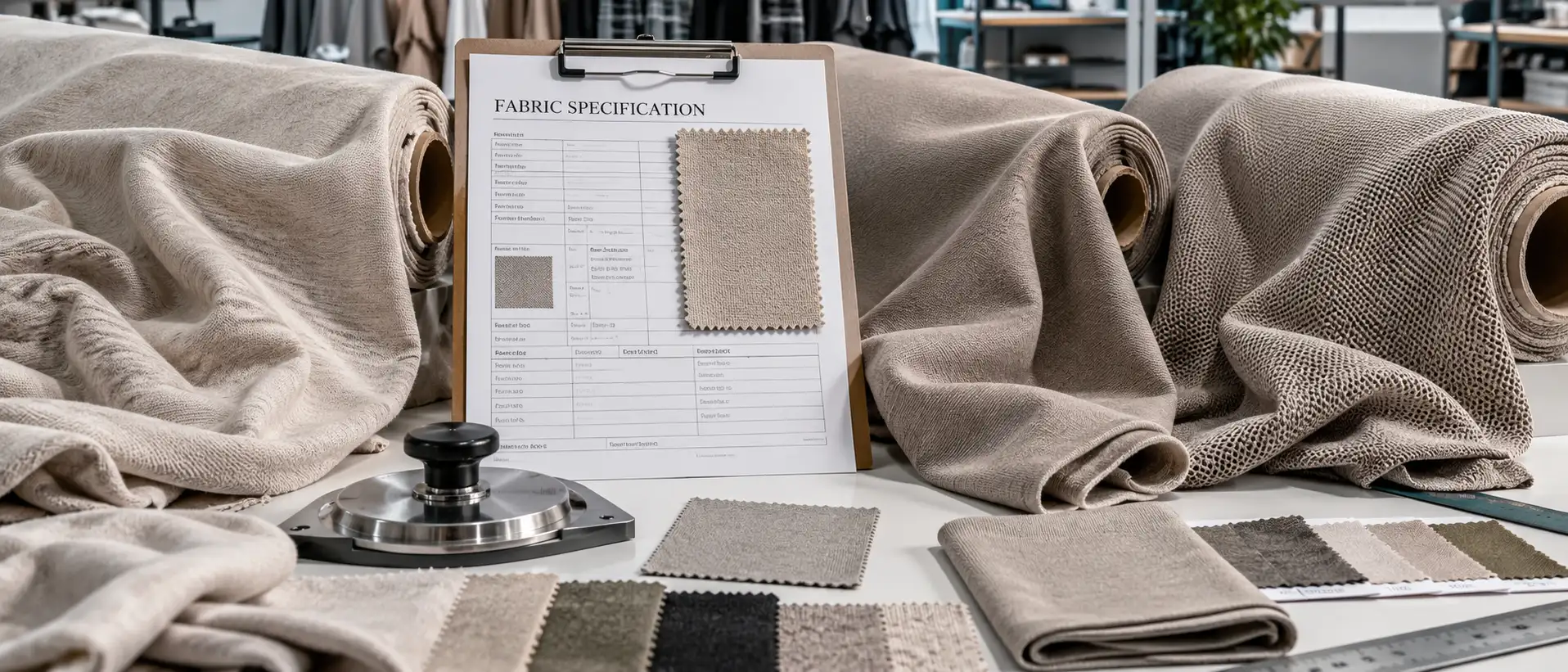
Minimum fabric spec sheet fields:
- Fabric structure (single jersey / fleece / rib / twill / poplin)
- Composition (percentages)
- GSM/weight range
- Finish requirements (enzyme wash, brushed, anti-pilling, wicking)
- Handfeel target (soft, crisp, compact, drapey)
- Shrinkage expectation (if you have one)
- Color method + color reference
The sample fabric vs bulk fabric trap
A common failure pattern:
- Sample is made with readily available fabric
- Bulk is sourced from a different mill or finish
- Bulk behavior changes (shrinkage, pilling, shade)
To prevent this, include these RFQ questions:
- Will sample fabric come from the same source planned for bulk?
- If not, what is the difference and how will bulk be validated?
- What testing will be done before bulk fabric approval?
This is central to how to write an RFQ that produces accurate quotes and stable production outcomes.
Fabric Spec Mini-Template
- Fabric structure:
- Composition:
- Target GSM or acceptable range:
- Width requirement, if relevant:
- Finish:
- Handfeel target:
- Stretch requirement, if applicable:
- Color method:
- Color reference:
- Shrinkage requirement or test criteria, if defined:
- Performance requirement, if applicable:
- Sample fabric source:
- Planned bulk fabric source, if known:
Must-Confirm Questions
- Is the quotation based on stock fabric or custom-developed fabric?
- What mill or fabric source is assumed?
- What fabric MOQ and color minimum apply?
- Will sampling use the same fabric source planned for bulk?
- If not, what differences should the buyer expect?
- What bulk fabric approval or testing will be required before production?
Pricing breakdown requirements (how to make quotes comparable)
Direct Answer
A pricing breakdown makes it easier to understand why supplier quotations differ. When suppliers disclose the main cost assumptions and inclusions, buyers can compare quotations on a more consistent basis instead of relying only on the final unit price.
Required pricing breakdown lines
Ask suppliers to quote using these line items:
- Fabric cost (basis and assumptions)
- Trims cost (BOM-level, or grouped by trim category)
- CM / sewing cost (cut-make)
- Print/embroidery cost (per placement)
- Washing/finishing cost (if applicable)
- Packaging cost (polybag, labels, carton)
- Testing cost (included or separate)
- Any development/sample cost (if relevant)
Key assumptions suppliers should state in writing
To get accurate quotes, require suppliers to state:
- Fabric source assumption (stock vs custom)
- MOQ/MCQ exposure (if any)
- Wastage/yield assumption (even if approximate)
- Subcontracting assumption for processes
- Lead time assumptions and peak-season risk
- Quote validity period and re-quote triggers
Quote normalization rules (simple and effective)
Your internal rule should be:
- If assumptions are missing, the quote is incomplete.
- If packaging or testing is excluded, request a revised comparable scope or use a clearly identified verified allowance before comparing totals.
- If lead time is not staged, request revision before shortlist.
This is the practical side of how to write an RFQ: you improve comparability by making assumptions and exclusions visible.
| Cost Line | Supplier | Assumption / Basis | Included / Excluded | Clarification / Notes |
|---|---|---|---|---|
| Fabric | Source, GSM, composition, finish | |||
| Trims | BOM basis and supplier minimums | |||
| CM / making | Construction and operations | |||
| Print / embroidery | Process, placement, setup | |||
| Wash / finishing | Process and treatment | |||
| Packaging | Polybag, labels, carton | |||
| Testing | Tests, frequency, lab | |||
| Development / samples | Sample types and fees | |||
| Delivery basis | Incoterm and named place | |||
| Quote validity | Validity and re-price triggers |
Decision rules (reject/clarify/shortlist)
- Do not shortlist yet: important assumptions remain unresolved or the supplier will not clarify the quoted scope
- Clarify: the quotation is broadly usable but one or more material categories need confirmation
- Shortlist: the quotation is clear, assumptions are visible, key questions are answered, and the supplier response supports comparison
Production timeline request (how to ask for a real lead time, not a guess)
Direct Answer
Lead time should be broken into the stages and dependencies that affect delivery. A staged production timeline gives buyers more useful planning information than one total lead-time number.
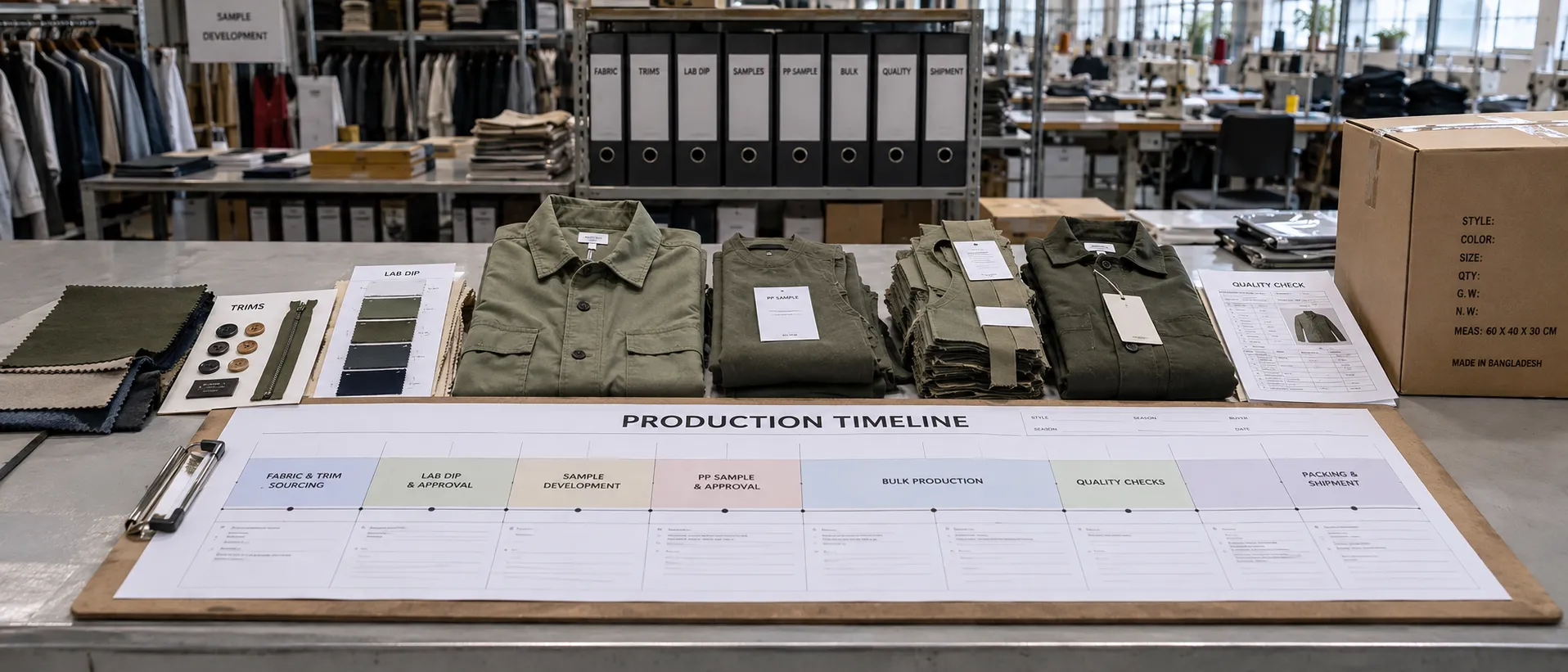
What to ask for (staged timeline)
Request:
- Sample lead time stages (pattern, materials, proto, revision cycle)
- Approval gates (lab dip/strike off if relevant, size set, PP)
- Bulk lead time stages (material lead time, cutting, sewing, finishing, packing)
- Inspection and shipment window
What proof to request (so timeline is real)
- Capacity booking logic (when they lock capacity)
- Critical path dependencies (what must be approved before next step)
- Peak season behavior (what changes and why)
Buyer-caused delay (approval SLA)
Your RFQ should state:
- Buyer will respond to approvals within X hours/days
- Supplier must flag dependencies immediately
- Timeline recalculates if approval SLA is missed
This reduces ambiguity and supports accurate quotes. It also shows the supplier you understand execution, which improves response quality to your RFQ.

Inspection, AQL, and Compliance Requirements to State Upfront
Direct Answer
If relevant quality and compliance expectations are not stated at RFQ stage, suppliers may quote against different assumptions, creating re-quoting or alignment problems later. A disciplined RFQ brings these requirements forward so they can be considered before supplier comparison.
AQL and inspection expectations (simple buyer language)
AQL refers to an acceptance-sampling approach used to make lot acceptance decisions from a defined inspection sample. Your RFQ does not need to reproduce the sampling standard, but it should state the buyer’s intended inspection approach where this has already been defined.
For reference, ISO 2859-1:2026 defines AQL-indexed sampling schemes for inspection by attributes. The exact inspection level, AQL values, defect classification, and buyer acceptance rules should still be agreed for the specific order or buyer program.
- State the buyer-defined inspection method and AQL values if already established
- Define or reference the buyer’s critical, major, and minor defect classifications
- State what happens if the inspection result does not meet the agreed acceptance criteria
If you already have a target AQL, state it. If not, state that your AQL will be defined at onboarding and must be accepted before bulk.
Inspection Expectations to Define
- Inspection method or referenced standard:
- Inspection level, if applicable:
- Critical defect limit:
- Major defect AQL:
- Minor defect AQL:
- Measurement inspection requirement:
- Packing inspection requirement:
- Rework / corrective-action rule:
- Re-inspection requirement after failure:
- Final shipment-release authority:
How inspection controls connect to apparel production
AQL is only one part of a broader garment quality-control system. Inline checks, measurement control, final inspection, defect classification, corrective action, and shipment-release requirements also affect how the buyer’s quality expectations are implemented.
Your RFQ only needs to state the inspection requirements relevant to the order. The detailed QC plan can then be finalized during onboarding and pre-production.
Compliance requirements (what to include)
State:
- Required audit documentation or policy declarations
- Facility scope transparency (which site produces your order)
- Subcontracting disclosure rule (must be pre-approved)
- Any restricted substance requirements relevant to your market (if applicable)
Even when detailed compliance verification happens during onboarding, relevant requirements should be disclosed during RFQ so suppliers can confirm whether the proposed production facility and commercial scope can support them.
| Compliance Item | What to Clarify at RFQ Stage | Evidence / Confirmation |
|---|---|---|
| Production facility | Which facility is proposed for the order | Facility identity and location |
| Buyer-required audit | Required audit program, if applicable | Audit type, scope and validity |
| Corrective actions | Whether material open findings affect eligibility | Closure status where disclosure is permitted |
| Subcontracting | Whether any process may be subcontracted | Proposed process and approval requirement |
| Restricted substances | Market or buyer-specific requirement | Supplier acknowledgement / test plan |
| Material certification | Required only where applicable | Scope and transaction evidence where required |
| Testing responsibility | Buyer, supplier or third-party responsibility | Agreed testing plan |
| Document validity | Whether evidence will remain valid through the order | Validity / renewal confirmation |
Submission and follow-up (RFQ email, clarifications, and version control)
Direct Answer
Submitting an RFQ is not “send and wait.” The clarification loop determines quote accuracy. Knowing how to write an RFQ includes knowing how to manage clarifications without chaos.

Submission rules (simple)
- One email thread per supplier
- One shared RFQ pack (versioned)
- Quote deadline stated clearly
- Clarification deadline stated clearly
- Quote format requirement attached (pricing breakdown + timeline)
RFQ Email Template
Subject: RFQ – [Product / Style Name] – [Target Quantity]
Dear [Supplier Name],
Please find attached our RFQ pack for [product/style].
The pack includes the current product specification, BOM, fabric requirements, artwork or branding information, quantity breakdown, packaging requirements, testing/compliance expectations, and target delivery window.
Please review the complete scope and return:
- Your quotation using the requested pricing format
- MOQ and MCQ assumptions
- Proposed fabric and trim sources
- Sample and bulk lead-time breakdown
- Inclusions and exclusions
- Quote validity
- Any questions or assumptions requiring clarification
Quotation deadline: [Date]
Clarification deadline: [Date]
Please identify any deviation from the requested specification before submitting the final quotation.
Best regards,
[Name / Company]
Clarification management (what to do when suppliers ask questions)
Good suppliers will ask clarifying questions. Your system should:
- Answer in one place (tracker or single document)
- Update RFQ version if the scope changes
- Notify all suppliers of the update to maintain fairness
Version control rules
- RFQ v1 is baseline
- RFQ v2 means scope changed (record what changed)
- No scope changes after shortlist unless you accept re-quote
This prevents “moving target quoting,” which is a major reason accurate quotes fail.
| Question / Clarification | Supplier | Final Answer | Scope / Cost Impact | RFQ Version | Status |
|---|---|---|---|---|---|
| Open / Closed |
Common RFQ mistakes that create inaccurate quotes (and how to fix them)
Direct Answer
Many quotation problems come from recurring RFQ gaps such as incomplete materials, vague fabric specifications, missing packaging requirements, or unclear commercial assumptions. A consistent RFQ checklist can catch many of these issues before supplier comparison begins.
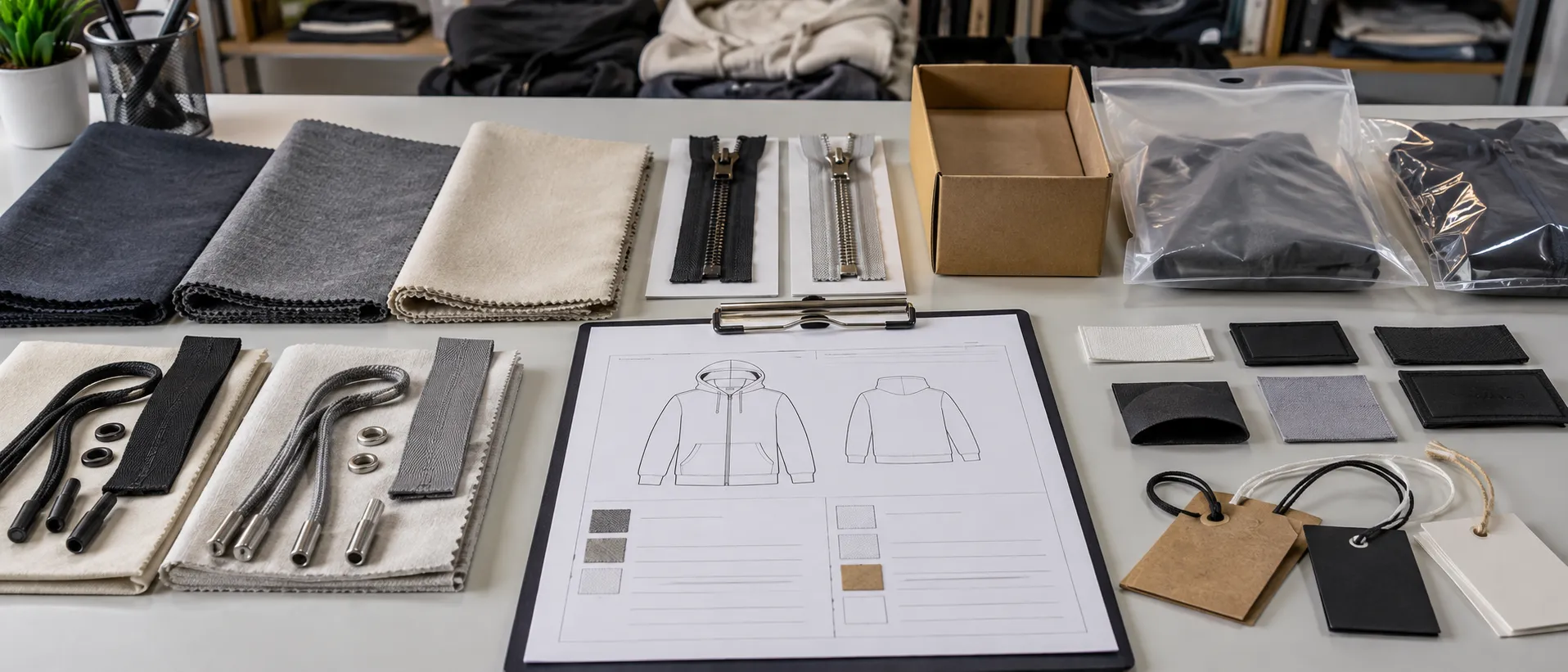
Mistake 1: No BOM or incomplete BOM
Outcome: missing trim and packaging costs, substitutions later.
Fix: RFQ BOM must include trims, labels, and packaging, or quote is incomplete.
Mistake 2: Fabric described in generic terms
Outcome: suppliers quote different fabrics with different behavior.
Fix: include fabric spec sheet with structure, composition, GSM, finish.
Mistake 3: No packaging requirements
Outcome: “standard packing” assumptions and later disputes.
Fix: define polybag, barcode, carton marks in RFQ.
Mistake 4: No pricing breakdown requirement
Outcome: unit price hides exclusions.
Fix: require pricing breakdown and written assumptions.
Mistake 5: Lead time asked as one number
Outcome: timeline collapses under approvals and materials.
Fix: request production timeline broken into stages and dependencies.
Mistake 6: Compliance requirements not stated
Outcome: suppliers quote a scope they cannot support.
Fix: declare compliance requirements and subcontracting rules upfront.
Supplier behavior red flags during RFQ
- An immediate quote on a complex or incomplete RFQ without clarifying material assumptions
- Refusal to provide pricing breakdown
- Vague lead time with no staging
- Avoidance of testing/compliance topics
- Pressure to commit before clarifications close
Corrective action checklist
- Tighten scope, update RFQ version, resend to shortlisted suppliers only.
- Require revised quote using your quote format.
- Remove suppliers who cannot comply with basic quote discipline.
Not Ready to Request a Final Quote Yet?
If MOQ, lead time, testing, compliance, fabric assumptions, or sample expectations are still unclear, resolve those questions before treating supplier pricing as final.
FAQs
How to write an RFQ if I don’t have a perfect tech pack?
Start with cost-driving fields: fabric spec, basic measurements, BOM essentials, artwork placement, packaging requirements, and testing/compliance expectations. Label missing areas clearly and expect a provisional quote until final specs are locked.
RFQ meaning: what is request for quotation used for?
A request for quotation is used to get pricing and terms against a defined scope so you can compare suppliers and plan production with fewer assumptions.
What should be in an RFQ template for apparel?
Tech pack, BOM, fabric spec sheet, artwork files, quantity split, pricing breakdown requirements, production timeline request, AQL/inspection expectations, compliance requirements, and packaging specs.
What is RFQ BOM and why is it important?
RFQ BOM is the bill of materials included at RFQ stage. It prevents trim, label, and packaging surprises that cause re-quotes and substitutions.
How do I request a pricing breakdown from factories?
Specify the required cost lines (fabric, trims, CM, print/emb, wash, packing, testing) and require suppliers to state inclusions/exclusions and assumptions in writing.
How do I ask for a real production timeline?
Ask for a staged production timeline with dependencies (samples, approvals, materials, bulk stages) and require a critical path explanation, not a single lead time number.
Where do AQL and inspection requirements fit into an RFQ?
If AQL-based inspection will apply, state that expectation during the RFQ stage and identify any buyer-defined inspection requirements already available. The detailed inspection level, AQL values, defect classifications, and release rules can then be confirmed during onboarding and pre-production.
What compliance requirements should be stated at RFQ stage?
At minimum: audit documentation expectations, facility scope transparency, subcontracting disclosure requirement, and any market-specific restricted substance expectations.
Summary: accurate quotes come from controlled scope
IIf you want accurate quotes, how to write an RFQ is not about writing more. It is about controlling scope through the tech pack, BOM, fabric specification, packaging, compliance requirements, timeline, and pricing breakdown. When suppliers quote against the same scope, you can compare prices and assumptions more fairly, identify commercial risks, and make a better-informed shortlist.
Before sending a final RFQ, make sure the commercial and development assumptions are clear by reviewing the questions to ask a clothing manufacturer before sampling. If your sourcing setup involves multiple factories or an intermediary partner, also understand how the single manufacturing partner model changes RFQ ownership, quote normalization, and production coordination.
Connect with RYZEAL SOURCING
 English
  Chinese
  French
  Dutch
Dutch  Japanese