
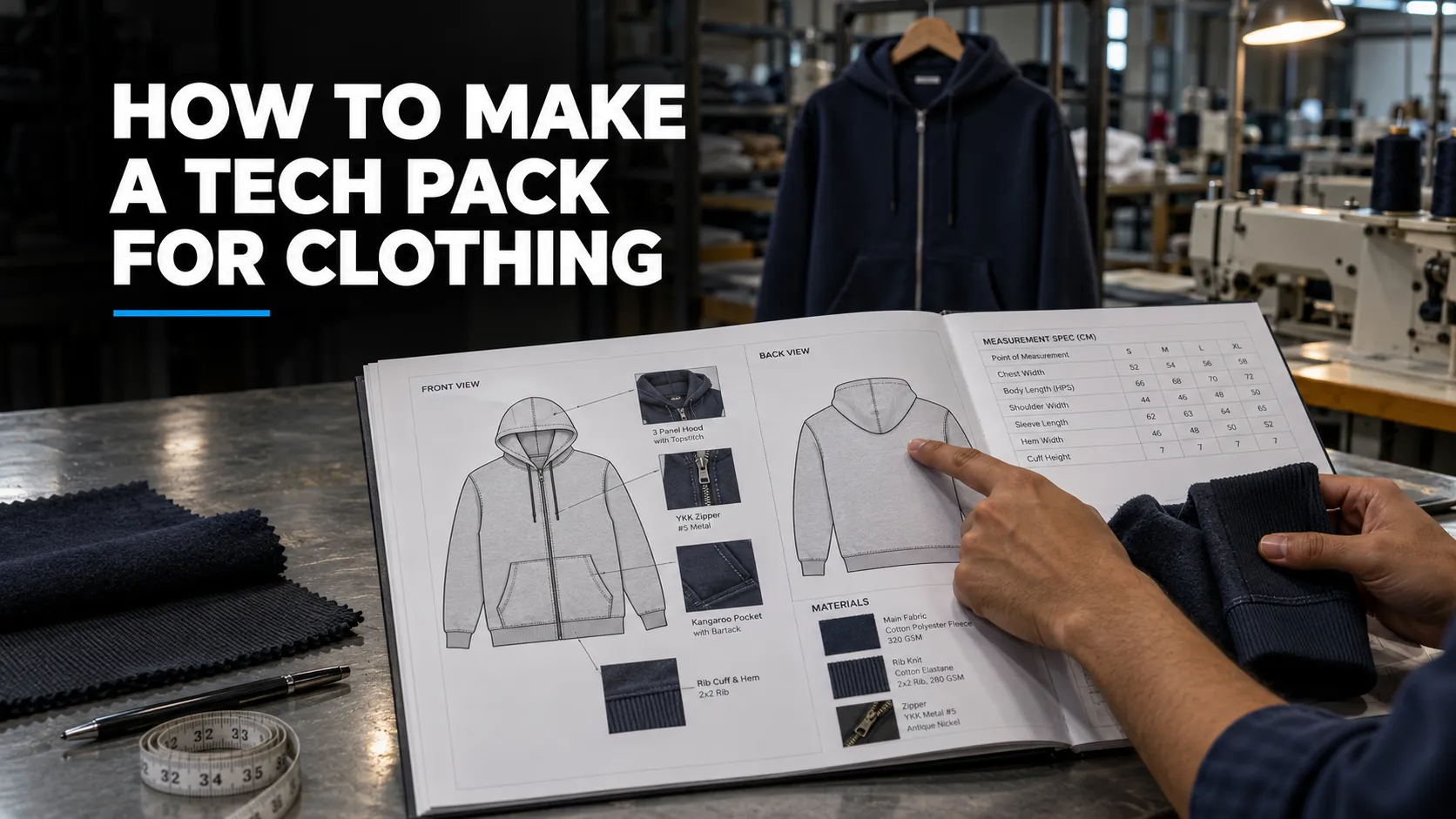
Learning how to make a tech pack is one of the most important steps in turning a clothing design into a garment that a manufacturer can accurately interpret, develop, and produce.
A tech pack connects your design idea with the technical information needed for costing, pattern development, sampling, material sourcing, and production. When important details are missing, buyers and manufacturers may spend additional time clarifying specifications, correcting samples, or revising quotations.
Whether you are launching a private-label clothing brand, developing a new collection, or coordinating multiple styles with manufacturing partners, a well-prepared tech pack helps you communicate your expectations clearly.
This guide explains how to build a clothing tech pack page by page, organize measurements and materials, document construction requirements, manage revisions, and prepare specifications that manufacturers can use at different development stages.
A tech pack also belongs to a broader development system. Understanding the apparel product development process helps buyers connect technical specifications with sampling, approvals, and manufacturing readiness.
Table of Contents
What Is a Tech Pack for Clothing?
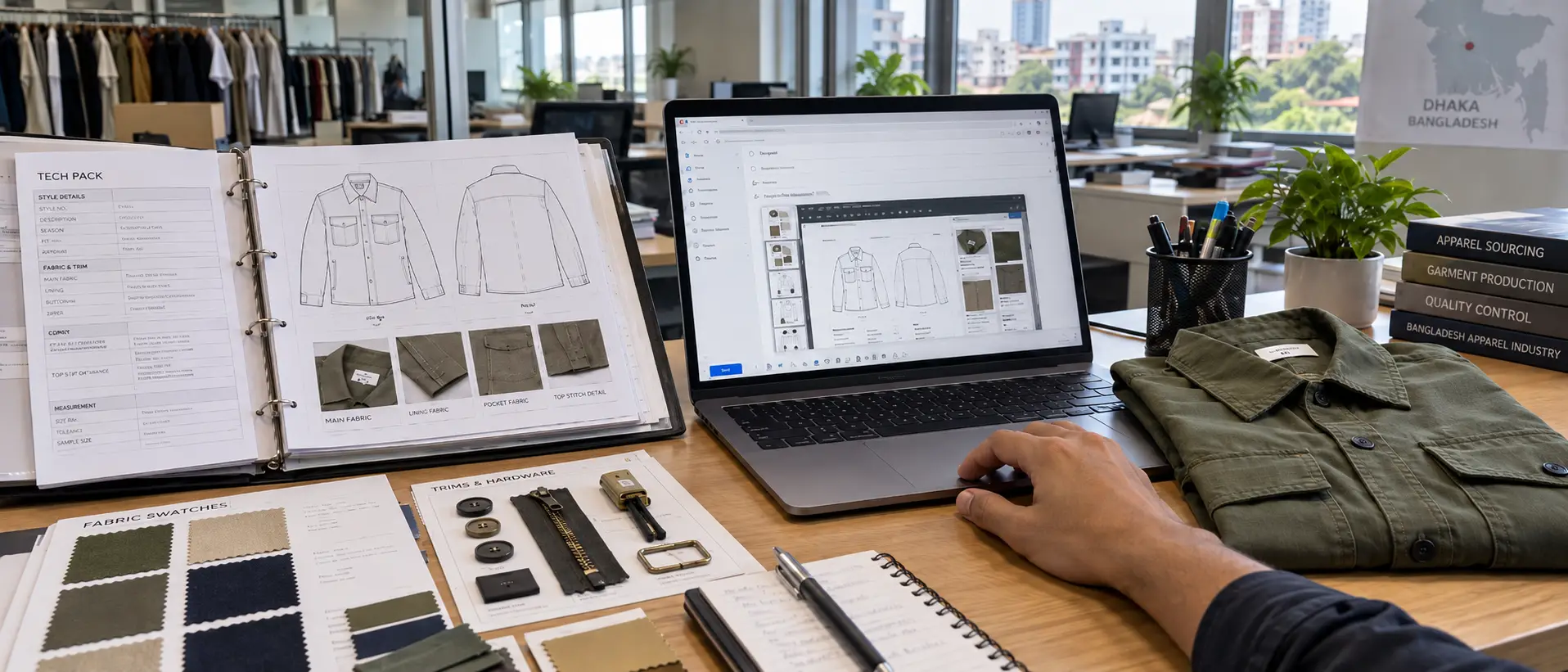
A clothing tech pack, or technical package, is a collection of documents that communicates how a garment should be constructed, measured, finished, and evaluated.
It translates design intent into manufacturing specifications that product developers, pattern makers, sample technicians, merchandisers, and production teams can follow.
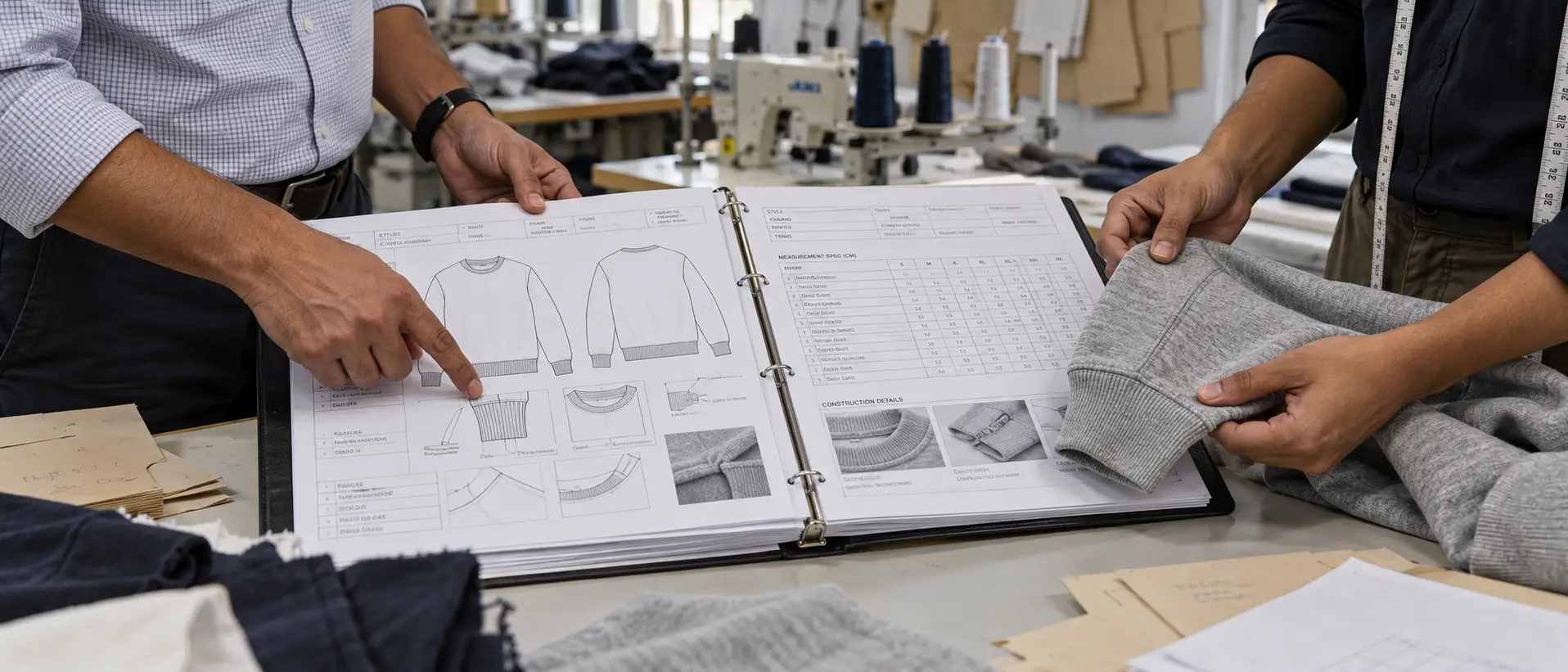
A typical apparel tech pack contains:
- Style identification and version details
- Technical flat sketches
- Construction and stitching instructions
- Fabric and trim specifications
- Points of Measure (POM) and measurement tolerances
- Size range and grading instructions
- Artwork and embellishment specifications
- Labels and packaging requirements
- Revision history and approval records
The amount of detail required depends on the garment, its complexity, and the development stage.
For example, a basic T-shirt may require relatively straightforward construction instructions, while a technical jacket with multiple panels, closures, functional pockets, and specialized materials may need considerably more documentation.
The objective is not to produce the longest possible document. It is to provide the information necessary for the manufacturer to understand and execute the product requirements.
Tech Pack vs. Spec Sheet: What Is the Difference?
The terms tech pack and spec sheet are sometimes used interchangeably, but they can describe different levels of documentation.
A spec sheet usually focuses on particular product specifications, such as measurements, fabric details, or construction requirements.
A tech pack brings these specifications together into a coordinated technical reference, often including drawings, BOM, artwork, grading, packaging, and revision records.
For preliminary costing, a manufacturer may be able to provide an indicative quotation using a sketch, basic material details, estimated quantities, and selected measurements.
However, any information that remains unconfirmed should be identified as a quotation assumption.
Sampling usually requires more detailed instructions. A revised colorway of an established garment may need fewer new documents than a completely new design, but its technical references must still be controlled.
The important distinction is not the document’s name. It is whether the information is sufficient for the decision or manufacturing activity being requested.
What Should a Complete Apparel Tech Pack Include?
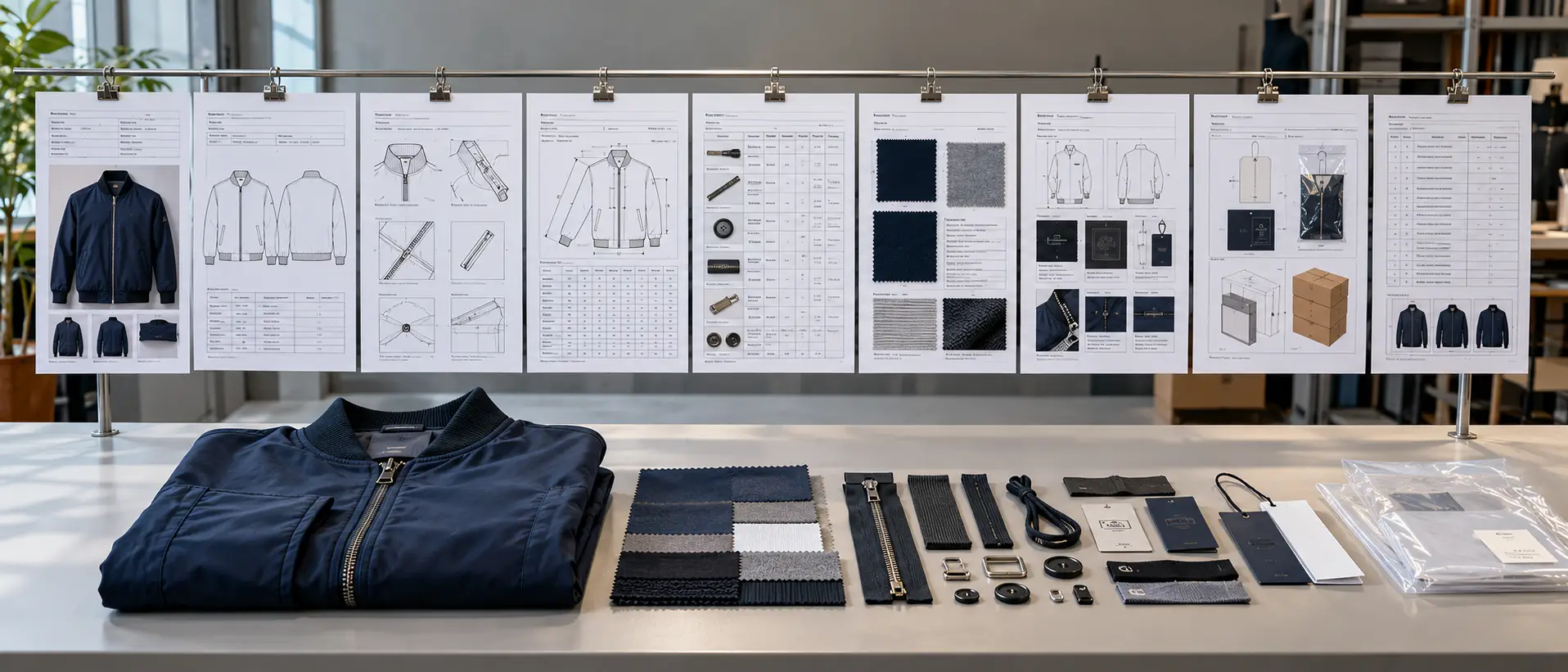
A structured tech pack organizes information into identifiable sections so the manufacturer can find the relevant details without searching through unrelated files or messages.
Although companies use different templates, most apparel programs benefit from a consistent set of technical pages.
Tech Pack Pages Checklist
| Tech Pack Section | Essential Information | Why It Matters | Main Responsibility |
|---|---|---|---|
| Cover Page | Style code, name, date, version, size range | Identifies the correct style and document version | Brand / Development |
| Technical Flats | Front, back, and relevant detail views | Communicates design and construction features | Design / Technical |
| Construction Details | Seams, stitches, finishing, reinforcement | Defines intended manufacturing methods | Technical / Manufacturer |
| Measurement Chart | POM, target measurements, measuring methods, tolerances | Supports dimensional and fit evaluation | Technical Team |
| Bill of Materials | Fabrics, trims, labels, sourcing references | Supports costing and material control | Sourcing / Development |
| Colorways & Artwork | Color references, artwork size, placement, method | Supports color and decoration consistency | Design / Brand |
| Labeling & Packaging | Label specifications, folding, packing requirements | Establishes finishing and presentation requirements | Brand / Merchandising |
| Grading Information | Base size, size range, grade rules | Guides development across required sizes | Pattern / Technical |
| Revision & Approval Log | Changes, dates, responsible parties, approval status | Prevents conflicting versions and decisions | Development Coordinator |
Depending on the product, some information may be combined into one page, while complex styles may require several pages for a single technical subject.
1. Cover Page and Style Identification
The cover page helps everyone involved identify the correct garment and technical document.
Include:
- Brand or buyer name
- Style name and unique style code
- Product category and season, if applicable
- Base size and intended size range
- Document preparation or revision date
- Current version number
- Contact or responsible department
The style code should remain consistent across sample requests, costing records, BOM documents, and approval correspondence.
A simple naming format is:
BRAND_STYLECODE_V03_YYYY-MM-DD.pdf
The exact naming convention is less important than using it consistently.
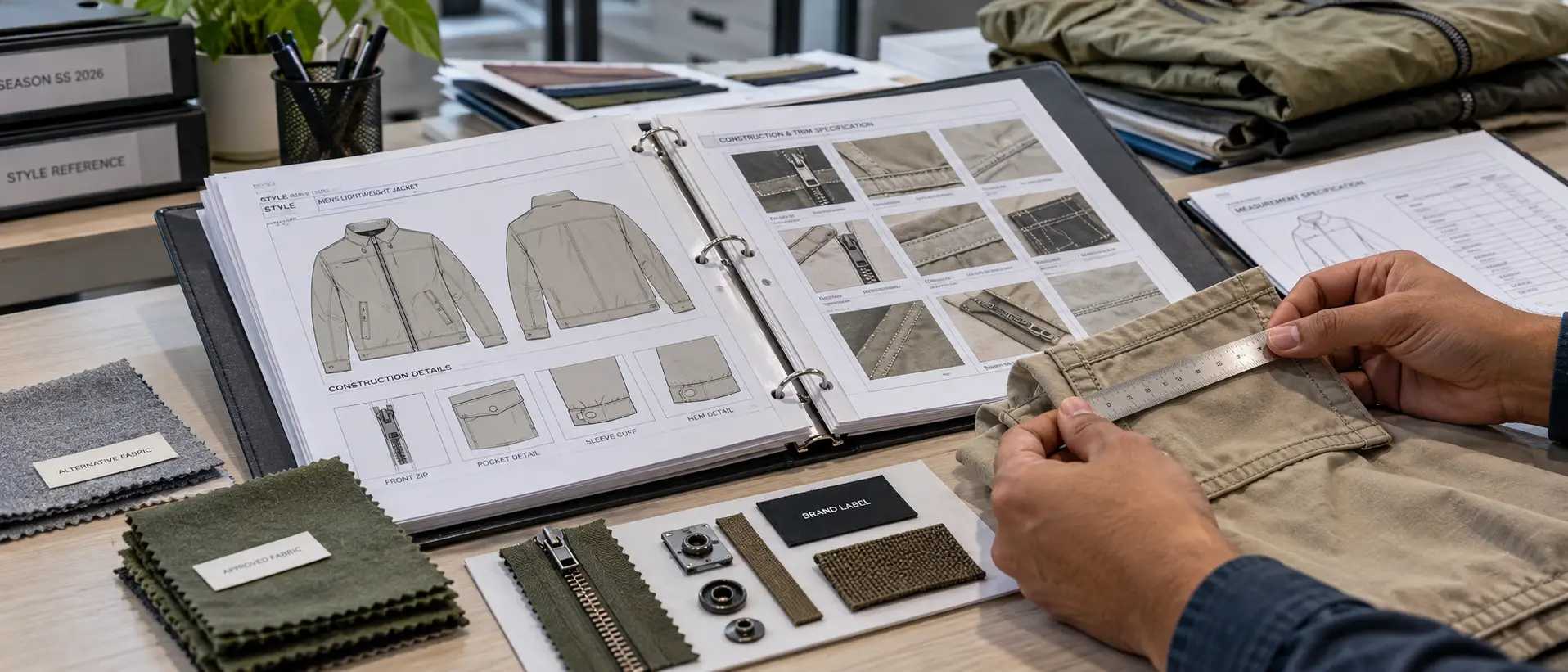
2. Technical Flat Sketches
Technical flats show garment construction and design details without the distractions of fashion illustrations or styled photography.
Include front and back views, with additional close-up views where necessary.
Depending on the garment, the drawings should identify:
- Neckline and collar construction
- Sleeve shape and cuff details
- Pocket types and placement
- Seams and panel divisions
- Closures, zippers, and buttons
- Waistbands, drawcords, and hems
- Decorative features and embellishments
Use callouts to connect specific design features with written construction instructions.
If a physical reference sample is available, photographs can support the drawings, but they should not replace measurements and technical specifications.
3. Construction Notes and Manufacturing Instructions
Construction notes explain how the garment should be assembled.
Two garments may look similar externally but use different sewing methods, seam allowances, reinforcement, or finishing techniques. These differences can affect appearance, durability, comfort, production feasibility, and cost.
Specify the construction details that matter to the product, such as:
- Seam type: Overlock, lockstitch, flatlock, or another approved method
- Stitch type: Appropriate stitch formation for the fabric and construction
- Stitch density: Stitches per inch (SPI), where controlled
- Seam allowance: Required allowance at relevant joining points
- Reinforcement: Bartacks, backtacking, or other strengthening methods
- Finishing: Hem construction, edge binding, seam covering, and special finishing
For example, an activewear garment may require stretch-compatible seams and stitching that withstand movement, while a tailored woven garment may require different construction standards.
Not every technical choice needs to be predetermined by the brand. A manufacturer may recommend a suitable method based on machinery, fabric behavior, and construction feasibility.
When such decisions affect the approved design or quality standard, they should be reviewed and recorded.
Garment Specifications That Prevent Misinterpretation
Clear garment specifications help manufacturers understand which details are fixed, which can be proposed, and which require approval.
A common source of development problems is incomplete information that leaves different teams working from different assumptions.
For instance, a tech pack might specify a 200 GSM cotton jersey fabric without defining its structure, finishing requirements, color standard, or expected dimensional stability. These missing details can affect sourcing, costing, and fit development.
Before sending the document, review the details that could influence manufacturing outcomes.
Specifications Worth Confirming
- Fabric: Composition, construction, GSM, usable width, color, and relevant performance requirements
- Seams: Construction method, seam allowance, and reinforcement where needed
- Stitching: Stitch type, SPI, and visible stitching requirements
- Trims: Type, dimensions, color, material, and applicable performance expectations
- Labels: Artwork, dimensions, content, material, and placement
- Artwork: Application technique, placement references, dimensions, and approved appearance
- Packaging: Folding, individual packing, hangtags, barcode positioning, and carton requirements
- Measurements: POM definitions, target values, measurement methods, and tolerances
If a detail has not been finalized, identify it as open rather than presenting an unapproved assumption as a confirmed specification.
A useful tech pack should also state which substitutions or technical changes require buyer authorization.
Tech Pack Measurements: POM, Tolerances, and Grading
The measurement section is one of the most important components of a clothing tech pack because it provides measurable targets for fit development and garment inspection.
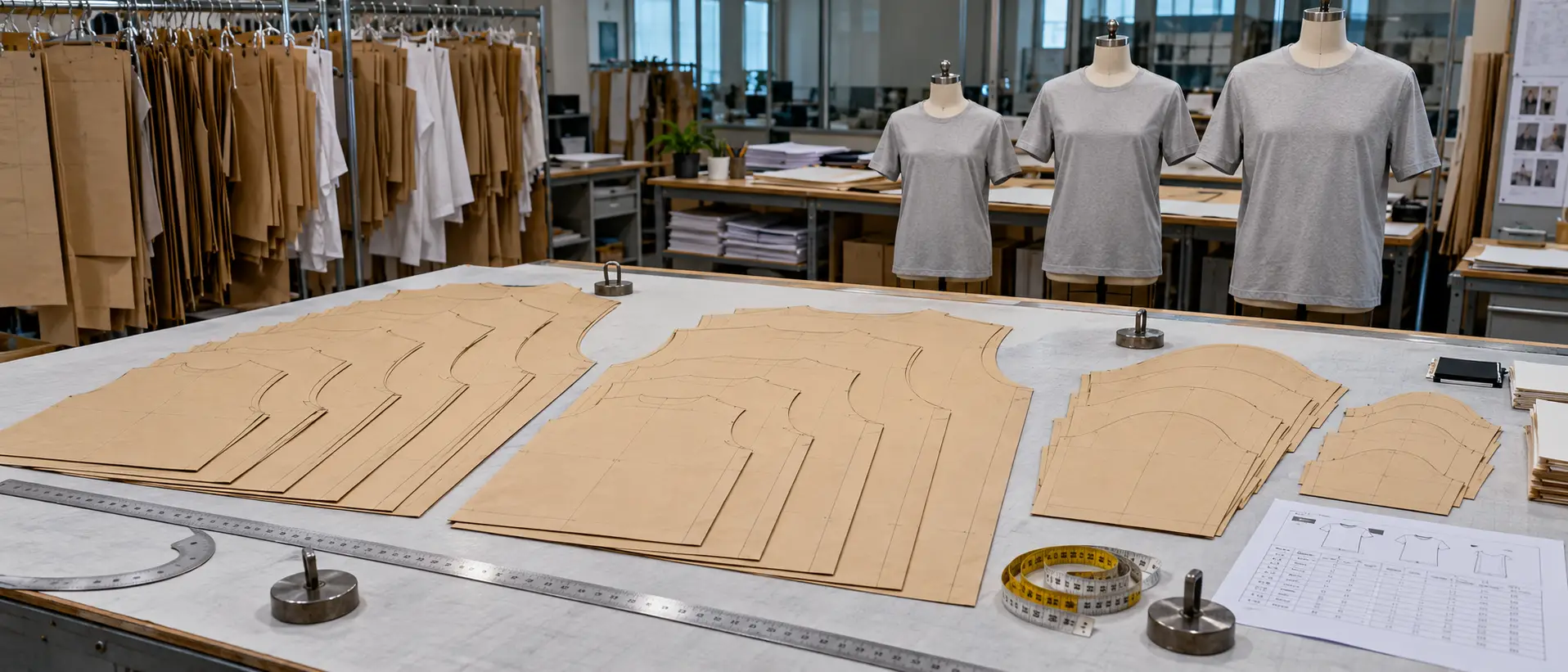
A Point of Measure (POM) identifies a specific garment dimension and explains how that dimension must be measured.
A reliable measurement chart includes four essential elements:
- The measurement point and its definition
- The target measurement
- The agreed measurement tolerance
- The method and garment condition used for measuring
A garment may meet its numeric measurements while still having fit or balance issues. Measurement checks should therefore support, rather than replace, physical fitting and pattern evaluation.
Example POM and Tolerance Chart
The following is an illustrative measurement chart for a basic short-sleeve T-shirt.
| Point of Measure | Target | Tolerance | How to Measure |
|---|---|---|---|
| Chest Width | 52 cm | ±1.0 cm | Measure flat across the chest, 2.5 cm below the armhole |
| Body Length | 70 cm | ±1.0 cm | Measure from Highest Point of Shoulder (HPS) to bottom hem |
| Shoulder Width | 45 cm | ±0.5 cm | Measure between defined shoulder points |
| Sleeve Length | 22 cm | ±0.5 cm | Measure from shoulder seam to sleeve edge |
| Bottom Width | 51 cm | ±1.0 cm | Measure straight across the bottom opening, laid flat |
These measurements and tolerances are examples only. Actual values must be established for the specific garment, fabric, intended fit, and buyer requirements.
How to Define Measurement Methods
A measurement method should explain more than where to place a tape.
For each relevant POM, define whether the garment is:
- Laid flat and relaxed
- Buttoned or zipped
- Measured before or after a specified wash
- Measured without stretching or under a defined extension
- Aligned using specified reference points
Terms such as HPS (Highest Point of Shoulder) and CB (Center Back) should be defined consistently where used.
Clear measuring instructions reduce differences between measurement results obtained by buyer technicians, sampling teams, and quality inspectors.
For a practical explanation of garment measurement specifications, the following tutorial demonstrates how Points of Measure (POM), measurement instructions, and graded specifications can be organized in a clothing tech pack. It provides a useful visual reference for understanding how measurement documentation is prepared.
How to Set Practical Measurement Tolerances
A measurement tolerance defines the permitted deviation from an approved target.
For example, if a chest width target is 52 cm with a tolerance of ±1 cm, the acceptable range for that specified measurement is 51 to 53 cm.
However, the same tolerance should not automatically be used for every POM.
Tolerances depend on the garment’s intended fit, fabric properties, construction, production capability, and buyer requirements.
Functional openings and critical fit measurements may need different limits from less sensitive dimensions. The appropriate values should be agreed rather than selected arbitrarily.
Fabric shrinkage and dimensional stability also influence measurement planning. Where wash performance is relevant, testing and pattern development should account for the required dimensional-change criteria.
For example, ISO 5077 describes a method for determining dimensional changes in textiles after specified washing and drying procedures. It does not itself establish a universal acceptable shrinkage percentage.
.
Include Grading Instructions for Multiple Sizes
Grading describes how garment patterns and measurements change between sizes.
Once the base-size fit is evaluated and approved, technical teams can finalize grade rules for the intended size range.
The tech pack should identify the base size, target dimensions for the required sizes, and any construction details that change by size.
For complex or unusual fit requirements, a size-set sample may be necessary to confirm that the grading approach produces acceptable results across the required sizes.
BOM in a Tech Pack: Fabrics, Trims, and Material Control
The Bill of Materials (BOM) identifies the materials, components, and relevant processes required to manufacture the garment.
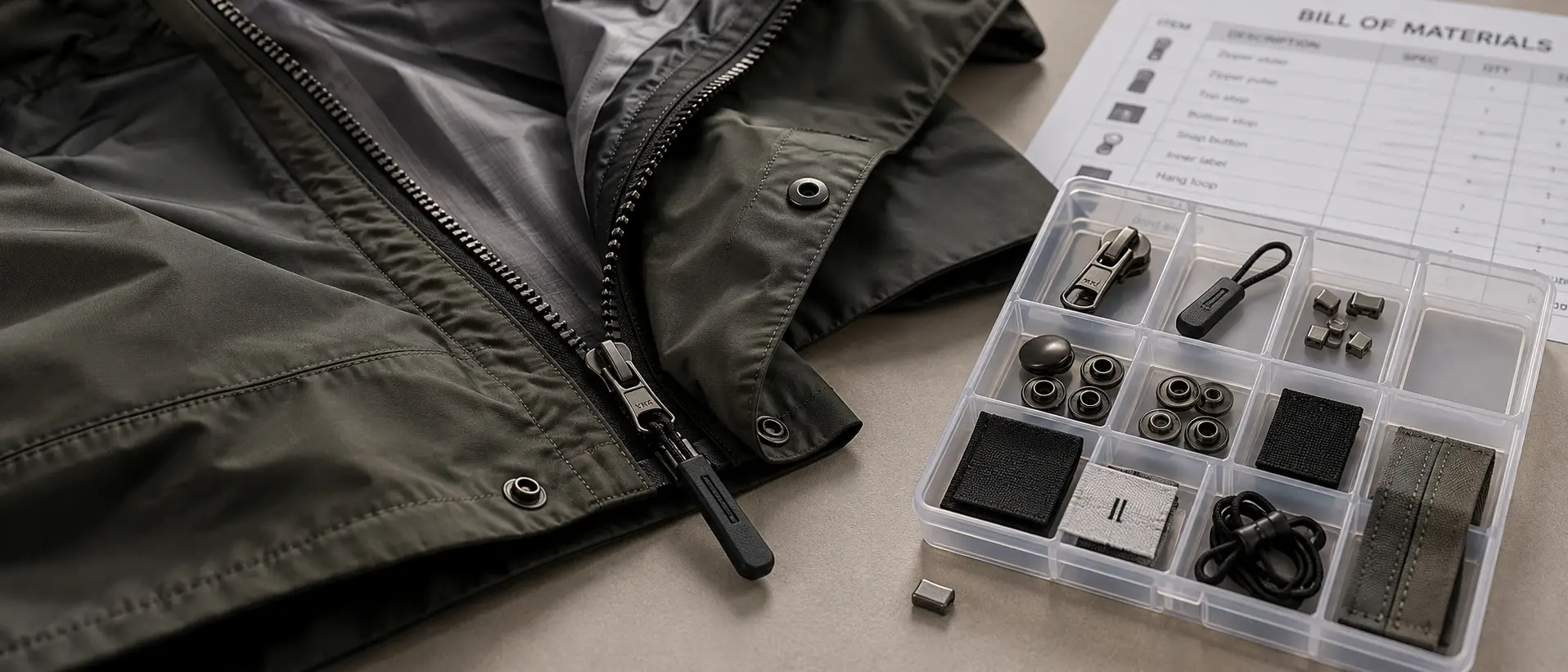
It connects technical development with sourcing, quotation, material approval, and production planning. An effective BOM should include more than the main fabric.
Depending on the garment, it may cover:
- Main and secondary fabrics
- Rib, lining, interlining, and pocketing
- Sewing threads
- Buttons, zippers, elastics, and drawcords
- Labels, patches, and heat transfers
- Hangtags and packaging materials
- Printing, embroidery, washing, or special finishing processes
Information to Include for Each BOM Item
For relevant items, record:
- Material or component name
- Technical specification
- Composition, GSM, width, or dimensions as applicable
- Color reference and colorway
- Nominated or proposed supplier
- Consumption or quantity basis
- Required test or compliance characteristics
- Approved alternatives, if permitted
- Approval status and revision information
Material consumption influences garment costing. Fabric requirements can change according to pattern dimensions, size ratios, usable fabric width, marker efficiency, shrinkage allowances, and cutting waste.
The initial BOM may use provisional consumption estimates for quotation, with updated values confirmed as development progresses.
Nominated Materials vs. Manufacturer-Sourced Materials
A nominated material is one for which the buyer specifies a particular supplier, product reference, or approved source.
A manufacturer-sourced material allows the production partner to propose a component that meets the defined technical and commercial requirements.
Both approaches can work, but the sourcing responsibility should be clear.
Buyers should also establish which substitutions require approval, especially when a change could affect fit, appearance, durability, certification claims, or cost.
MOQ and MCQ Considerations
Minimum Order Quantity (MOQ) and Minimum Color Quantity (MCQ) can influence material sourcing and commercial feasibility.
Custom labels, special zippers, distinctive trims, and packaging components may have minimum quantities that differ from the garment order quantity.
Confirming these conditions during development helps buyers decide which elements need full customization and where approved standard alternatives might be acceptable.
.
Artwork Placement, Labels, and Packaging Specifications
Artwork, labeling, and packaging are sometimes treated as secondary development details, but they can influence garment appearance, commercial requirements, and production readiness.
These instructions should be prepared early enough to support the relevant sourcing and sampling decisions.
Artwork Placement Specifications
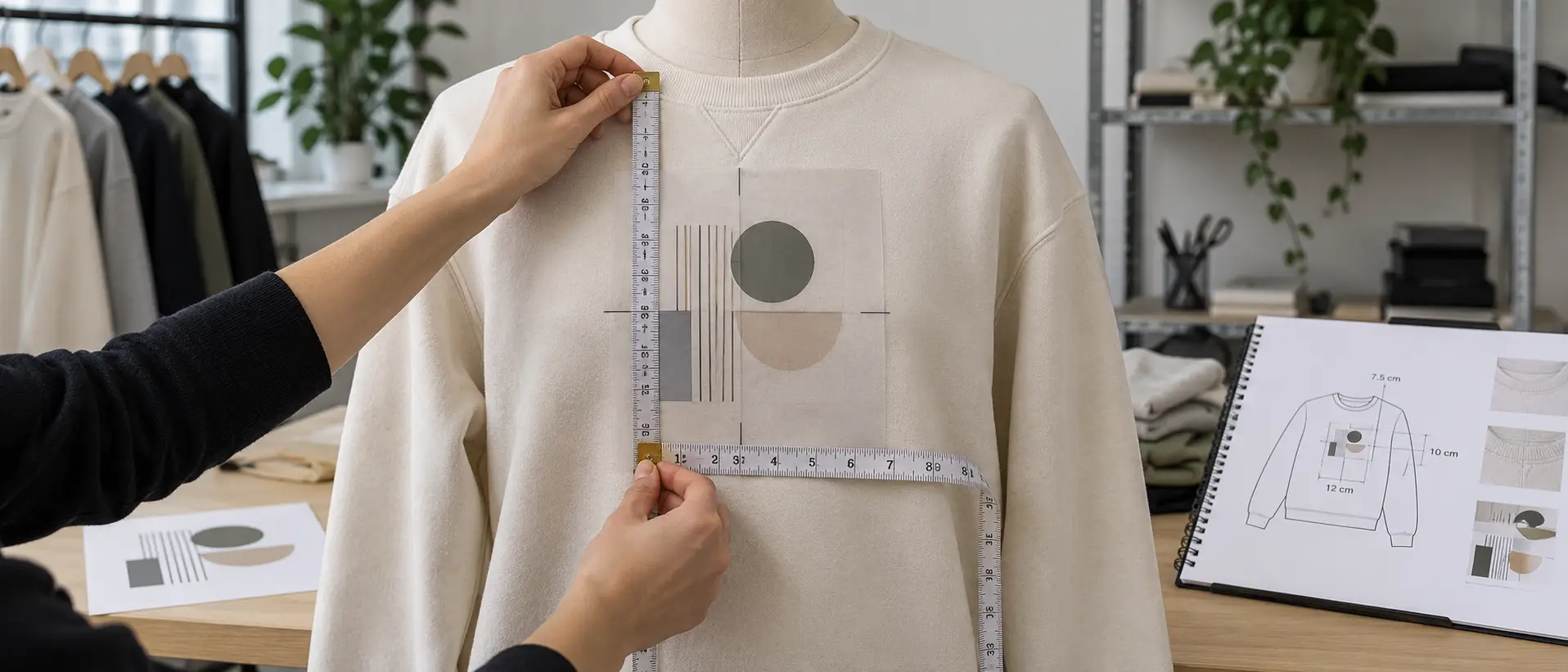
Artwork placement instructions should identify the exact position and dimensions of prints, embroidery, appliqué, transfers, or other decoration.
Writing only “center front logo” may not provide sufficient information for consistent placement.
A complete artwork specification should cover:
- Reference position: Center front, left chest, sleeve, back, or another defined location
- Coordinates: Horizontal and vertical distances from established reference points
- Artwork dimensions: Width, height, and relevant design limits
- Application method: Screen printing, embroidery, heat transfer, silicone print, or another approved method
- Clearance: Required distances from seams, pockets, zippers, and other components
- Size behavior: Fixed dimensions, graded placement, or size-dependent artwork
- Approval reference: Approved artwork file, strike-off, sample, or applicable photograph
Manufacturing methods also influence the technical requirements.
Embroidery may need attention to backing, stitch density, and fabric distortion. Heat transfers require suitable material and application conditions. Specialized prints can affect garment appearance, hand feel, and stretch.
The application method and placement should therefore be confirmed together rather than treated as independent decisions.
Labeling Requirements
Labels can include brand identification, size, fiber composition, care information, country of origin, and other relevant declarations.
The exact requirements depend on the destination market, product type, and applicable rules.
A labeling page should identify the approved wording or artwork, label material, dimensions, position, and attachment method.
For garments intended for the United States, the FTC Care Labeling Rule addresses care instructions for covered textile apparel and related responsibilities of manufacturers and importers. Other markets may have different requirements.
Packaging Instructions
Packaging requirements may include:
- Folding method
- Individual bag type and dimensions
- Hangtag placement
- Barcode or sticker location
- Size and color identification
- Assortment and packing ratios
- Carton specifications and markings
Not every packaging detail must be finalized for an early prototype, but any requirement affecting material procurement or the intended sample approval should be confirmed at the appropriate stage.
How to Make a Tech Pack for Clothing: Step by Step
A repeatable workflow makes preparing technical documentation easier, especially when managing multiple styles or working with several manufacturing partners.
The steps below provide a practical sequence. Certain activities, such as material sourcing and measurement development, may overlap.

Step 1: Prepare the Design Brief
Start with the product concept, intended customer, fit, style reference, material direction, target market, and commercial expectations.
Identify any design features that must not change.
Step 2: Create Technical Flats
Prepare front and back technical drawings, adding detail views for important construction features.
Use callouts for seams, pockets, closures, panels, and other relevant design elements.
Step 3: Document Construction Requirements
Define the intended sewing methods, finishing details, reinforcements, and any special operations.
Where the best construction method is not yet confirmed, request technical evaluation instead of specifying an unverified solution.
Step 4: Build the Measurement Chart
Identify the base size and required POMs.
Add target measurements, measuring methods, provisional or approved tolerances, and relevant fit references.
Step 5: Prepare the BOM and Colorway Information
List the fabrics, trims, labels, and components needed for the garment.
Record color references, sourcing responsibilities, approved alternatives, and availability constraints.
Step 6: Add Artwork, Labeling, and Packaging Requirements
Specify decoration methods, dimensions, placement, labels, and the packaging details relevant to the current development stage.
Keep artwork files and approvals connected to the correct style and version.
Step 7: Define Size Range and Grading Requirements
Confirm the base size and intended size range.
Document available grading rules and identify information that will be finalized after base-size fit approval.
Step 8: Review the Tech Pack for Completeness
Check for missing dimensions, unclear instructions, conflicting material references, and unresolved decisions.
Confirm whether the current version is intended for quotation, sampling, or production handover.
Step 9: Assign a Version and Send the Controlled File
Export or share the approved working document in the agreed format.
Use a consistent file name, record the revision date, and identify the responsible contact for technical questions.
Step 10: Review Manufacturer Questions and Update the Pack
Collect technical questions, proposed changes, and clarifications in one coordinated record.
Update the affected pages when decisions are approved, then circulate the correct revision.
To see how these technical documents come together, the following step-by-step tutorial demonstrates the preparation of a clothing tech pack using a hoodie as an example. It walks through technical sketches, construction notes, fit references, labels, measurement specifications, and material information.
Quote-Ready, Sample-Ready, and Bulk-Ready Tech Packs
One of the most useful distinctions in product development is knowing how much information must be confirmed before each manufacturing decision.
A tech pack that supports an initial price estimate may not contain all the information necessary to produce a representative garment sample.
Likewise, a pack suitable for early sampling may require further updates before bulk production.
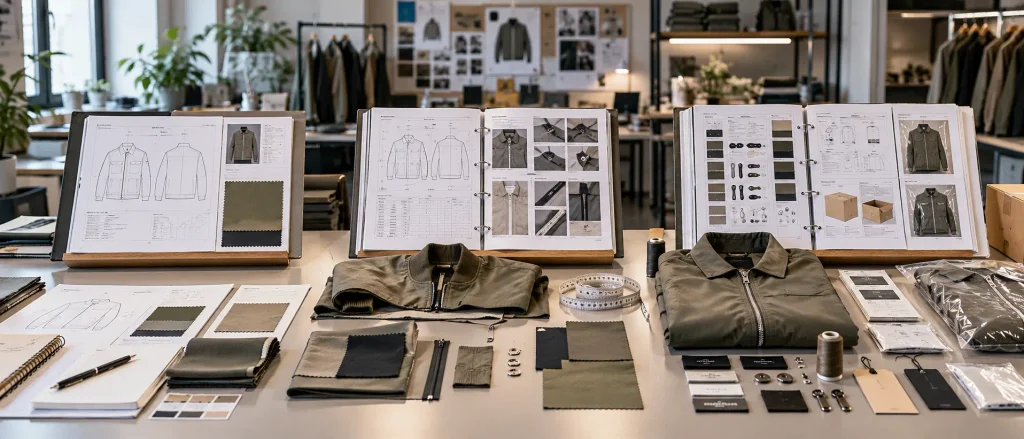
Tech Pack Readiness Checklist
| Requirement | Quote-Ready | Sample-Ready | Bulk-Ready |
|---|---|---|---|
| Style Identification | Required | Required | Final and controlled |
| Technical Drawings | Sufficient for pricing | Clear construction references | Approved references |
| Fabric Specifications | Cost-driving details identified | Suitable development materials defined | Approved materials and relevant specifications |
| Construction Notes | Main operations identifiable | Required sewing details available | Final approved construction |
| Measurement Chart | Key dimensions or stated assumptions | Relevant POMs and measuring methods | Approved specifications, sizes, and tolerances |
| BOM | Main components and cost assumptions | Materials needed for the sample identified | Complete approved BOM |
| Artwork | Method and cost-driving information | Development artwork and placement instructions | Final artwork and approval references |
| Labels & Packaging | Cost assumptions where relevant | Requirements for the sample stage | Final applicable specifications |
| Revision Control | Version identified | Changes recorded | Approved revision released |
This table is a general planning guide, not a universal document requirement. The exact readiness criteria depend on garment complexity, buyer expectations, and the activity being authorized.
What Does Quote-Ready Mean?
A quote-ready pack provides enough information for the manufacturer to understand the product, estimate material consumption, evaluate operations, and identify major cost drivers.
Where important details are provisional, the quotation should state its assumptions and conditions.
Buyers can strengthen the quotation process by combining the tech pack with a structured RFQ.
Our guide to writing an RFQ to a clothing manufacturer explains how to organize technical specifications, material details, quantities, commercial expectations, and supplier questions into a clearer quotation request.
What Does Sample-Ready Mean?
A sample-ready pack includes sufficient approved or provisional instructions for the specific sample being requested.
A first prototype may legitimately use development materials or provisional measurements. A pre-production sample generally requires more complete and production-representative references.
The purpose and limitations of the sample should therefore be agreed before development begins.
What Does Bulk-Ready Mean?
A bulk-ready technical package reflects the applicable approved specifications, materials, construction, measurements, artwork, labeling, and packaging requirements.
It should also identify relevant sample approvals, testing requirements, authorized changes, and unresolved conditions affecting production release.
The tech pack supports manufacturing readiness, but does not replace production planning, operator instructions, line setup, or quality-control procedures.
A practical tech pack checklist for quotation and sampling helps development teams identify essential information, separate provisional details from approved specifications, and confirm readiness before submitting files to a manufacturing partner.
Prepare Your Tech Pack for Quotation and Sampling
Have a clothing design or technical specification ready for review? Share your product information with RYZEAL SOURCING to discuss technical requirements, costing considerations, and the next development steps.
How to Build a Reusable Apparel Tech Pack Template
An apparel tech pack template helps brands maintain consistent documentation across multiple styles.
Instead of rebuilding the same pages for every garment, a reusable template provides a standard structure for technical specifications, material information, measurements, and approvals.
The template should be flexible enough to accommodate different products.
For example, a simple T-shirt does not need the same construction pages as a lined jacket, and a denim garment with a special wash may require additional finishing references.

Organize the Template Around Manufacturing Requirements
A useful template should contain:
- Standard cover and style-identification fields
- Technical sketch pages
- Construction callout sections
- POM and tolerance charts
- BOM and colorway tables
- Artwork and labeling sections
- Packaging instructions
- Grading references
- Revision and approval records
Optional pages can be added when a product requires special washes, functional testing, embroidery, multiple fabric layers, or complex construction.
Spreadsheet, PDF, or PLM: Which Format Should You Use?
The best format depends on the number of styles, team structure, and revision-control requirements.
Spreadsheets are useful for smaller teams that need structured measurement charts, BOM fields, and collaborative editing.
PDF documents are useful for sharing controlled versions with manufacturing partners because layout and page references remain consistent. However, a PDF still needs a clear revision and distribution process.
Product Lifecycle Management (PLM) systems can support larger development programs with many styles, multiple teams, and integrated approvals or materials information.
There is no universal requirement to use a particular software system. The priority is maintaining accurate, accessible, and controlled specifications.
Tech Pack Approval and Version Control
A technically complete pack can still create problems if different teams work from different revisions.
For example, the buyer’s product team might approve a revised measurement while the manufacturer continues preparing a sample from an earlier chart.
Version control helps prevent such conflicts.
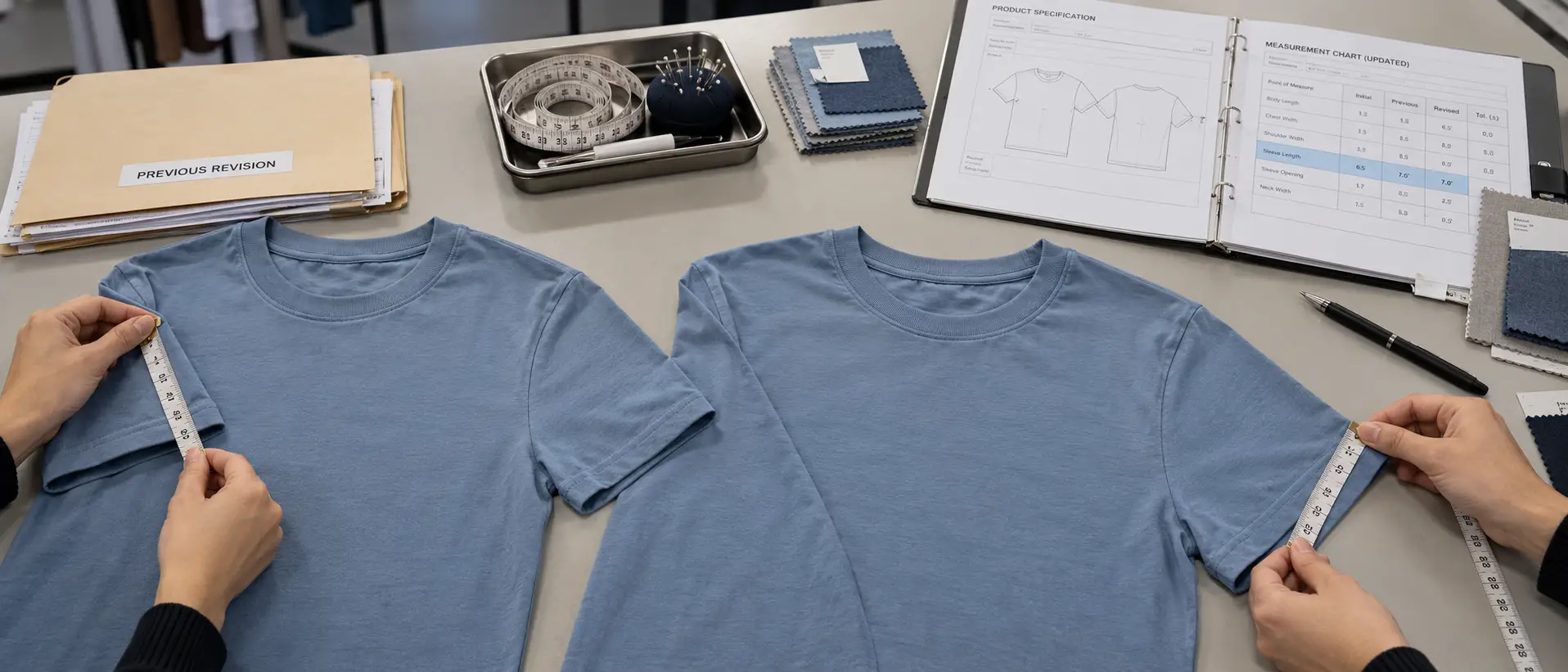
Establish a Clear Revision System
Use one consistent approach for document names and revision history.
A useful change log records:
- Style code
- Current revision
- Revision date
- Affected page or specification
- Description of the change
- Reason for the change
- Responsible reviewer
- Approval status
An example entry might be:
Version V03: Sleeve length updated from 23 cm to 22 cm following the approved base-size fit review.
The revised measurement should also appear in the relevant POM chart.
The change log explains the decision, while the updated technical page communicates the current instruction.
Keep Sample Feedback Connected to the Tech Pack
Sample comments should reference the correct technical page, measurement point, or construction detail.
A practical review record can use the following status categories:
- Approved: Meets the relevant acceptance criteria
- Revision Required: A correction is needed
- Clarification Required: Additional information or a decision is necessary
- Not Applicable: The requirement does not apply to this sample stage
After decisions are confirmed, update the relevant tech pack pages and distribute the correct revision.
The objective is not to make changes impossible. It is to make approved changes traceable.
The same control principle applies to fabric colors, artwork, size sets, pre-production samples, and other development approvals. Our apparel approval workflow map explains how these checkpoints fit into a coordinated approval system.
Common Tech Pack Mistakes and How to Avoid Them
Even experienced teams can encounter problems when technical information is incomplete or inconsistent.
The most important corrections are usually straightforward once the cause is identified.
1. Missing or Unclear Measurement Instructions
A measurement chart may contain target numbers without explaining the correct measuring method.
How to prevent it: Define POM locations, garment condition, reference points, and applicable tolerances.
2. Incomplete Construction Details
A sketch may show the garment’s appearance without identifying important stitching, seam, or finishing requirements.
How to prevent it: Add construction callouts and review manufacturability with the technical team.
3. Incomplete Bill of Materials
Missing trims, labels, printing details, or packaging components can affect sourcing and quotations.
How to prevent it: Review the full BOM and identify provisional items, approved alternatives, and sourcing responsibilities.
4. Unclear Artwork Placement
Instructions such as “small logo on chest” may not establish the intended dimensions or positioning.
How to prevent it: Use measurable reference points, approved artwork dimensions, and applicable placement rules.
5. No Revision History
Changes distributed through separate email or messaging conversations can leave different teams using conflicting information.
How to prevent it: Maintain a current master file, a change log, and clear approval responsibility.
6. Using Early Development Specifications for Bulk Production
A prototype may use provisional fabrics, approximate trims, or incomplete packaging details.
How to prevent it: Confirm production-representative specifications and required approvals before the relevant bulk manufacturing activities begin.
7. Making Multiple Changes Without Tracking Their Effects
Simultaneous adjustments to fabric, fit, construction, and decoration can make it difficult to identify which change affected the result.
How to prevent it: Record every meaningful change and assess related specifications together. When practical, test changes separately to identify their effects.
Tech Packs for Private-Label Clothing Brands and Startups

Startups and private-label businesses may not have large technical development teams, but they still need clear manufacturing instructions.
The most effective approach is to organize essential information first, then expand the technical documentation as the product progresses.
For an initial feasibility discussion, this may include:
- A clear design sketch or reference garment
- Intended fabric and approximate weight
- Base-size measurements and fit expectations
- Important construction details
- Branding and artwork requirements
- Estimated quantity and intended size range
- Open decisions requiring manufacturer feedback
This information can support preliminary development discussions without pretending that every detail has already been finalized.
As the style progresses, complete the technical requirements needed for fit samples, material approvals, size validation, and production handover.
Adjust the Tech Pack to the Garment’s Complexity
A fashion-forward garment with special washes, embellishments, or complicated panels may need additional references for appearance and finishing.
A basic garment produced repeatedly may place greater emphasis on consistent dimensions, approved materials, construction methods, and controlled changes.
Both require suitable documentation. The difference is which technical risks need the greatest attention.
Coordinate Responsibilities Clearly
A startup may prepare its designs internally while relying on a manufacturing partner for technical evaluation, pattern development, material recommendations, and sampling.
The responsibilities should be agreed at the start.
At RYZEAL SOURCING, apparel development can be coordinated through a vetted network of specialized garment manufacturing partners in Bangladesh. This allows buyers to work with a coordinated team while suitable technical and manufacturing capabilities are matched to the product requirements.
Sending Your Tech Pack to a Clothing Manufacturer
Preparing the document is only part of the process. The receiving manufacturer must also understand its intended purpose, current revision, and outstanding decisions.
Before sending the file, confirm that the submission identifies:
- The correct style and tech pack version
- Whether the request is for quotation, sampling, or production development
- The relevant files and supporting references
- Expected quantities and colorways, where available
- Target market and applicable product requirements
- Required response or approval responsibilities
- Any provisional specifications that still need confirmation
Avoid scattering essential technical decisions across unrelated conversations.
If several documents support the same style, use clear file names and identify which revision controls the current request.
Before sampling, buyers should also clarify technical capabilities, material availability, MOQ, development responsibilities, and approval arrangements. Our guide to the questions to ask a clothing manufacturer before sampling explains the important discussions to have before work begins.
Connecting Tech Packs With Sampling and Approval
The tech pack provides an important technical reference, but the development process continues through physical samples, measurement reviews, material approvals, and documented decisions.
A sample that meets the current specifications may still reveal a fit or construction issue requiring an approved change.
That is why tech pack management and sampling management should work together.
A structured sample management and approval process helps buyers organize sample objectives, review comments, development revisions, and final approval decisions without losing track of the agreed product standard.
Ready to Turn Your Tech Pack Into a Clothing Sample?
Share your tech pack, garment sketches, or product references with RYZEAL SOURCING to discuss sampling feasibility, technical requirements, and development through suitable manufacturing partners in Bangladesh.
Frequently Asked Questions About Clothing Tech Packs
What is a tech pack for clothing?
A clothing tech pack is a controlled set of technical documents that describes the garment’s design, construction, measurements, materials, artwork, and other relevant manufacturing requirements. It provides a shared reference for costing, sampling, approvals, and production.
How do I make a tech pack for clothing?
Start with a design brief and technical drawings. Add construction notes, measurements, tolerances, material specifications, artwork, labels, packaging, and revision details as required. Review the information for completeness before submitting it to the manufacturer.
Can I create a tech pack without professional design software?
Yes. A tech pack can be prepared using spreadsheets, document software, technical drawing applications, or PLM systems. The tools should support clear drawings, structured specifications, and version control.
What is the difference between a tech pack and a spec sheet?
A spec sheet generally describes particular garment specifications, such as measurements or materials. A tech pack combines the relevant specifications, drawings, construction instructions, and approval records into a broader technical reference.
What should a tech pack measurement chart include?
It should identify the relevant Points of Measure, target dimensions, measurement methods, applicable tolerances, base size, and size specifications or grading information where required.
What is a BOM in a clothing tech pack?
BOM stands for Bill of Materials. It identifies the fabrics, trims, labels, packaging, and relevant components required for the garment, along with specifications, quantities, sourcing information, and approval status where applicable.
Do I need a complete tech pack before requesting a quotation?
Not always. A manufacturer may provide an indicative quotation using preliminary information, provided important assumptions are identified. More complete specifications generally support more reliable costing and fewer subsequent clarifications.
Can manufacturers help prepare a tech pack?
Some manufacturers and sourcing partners provide technical development support, including construction advice, pattern review, material recommendations, and documentation assistance. Buyers should confirm the available services and responsibility for approving specifications.
How do tech packs reduce sampling revisions?
Tech packs provide clear requirements against which samples can be reviewed. This helps identify deviations and document corrections. They can reduce avoidable misunderstandings, although physical sample development and technical evaluation may still require several rounds.
When should a tech pack be updated?
Update the tech pack whenever an approved change affects construction, measurements, materials, artwork, labeling, packaging, or another relevant technical requirement. Record the revision and confirm that affected teams are working from the correct version.
Final Takeaway: A Tech Pack Is a Working Manufacturing Reference
Learning how to make a tech pack is not simply about assembling drawings and measurement charts. It is about communicating product requirements in a form that manufacturing teams can interpret, review, and use consistently.
A strong tech pack connects design, construction, materials, measurements, artwork, and approval records within one controlled technical framework.
As the garment progresses through development, the document should evolve with approved decisions. Clear specifications help reduce ambiguity, while effective sampling, coordination, and production controls remain necessary to achieve the intended result.
For clothing brands and sourcing teams, the practical objective is simple: prepare the information manufacturers need, confirm decisions at the appropriate stages, and keep everyone working toward the same approved product standard.
Connect with RYZEAL SOURCING