
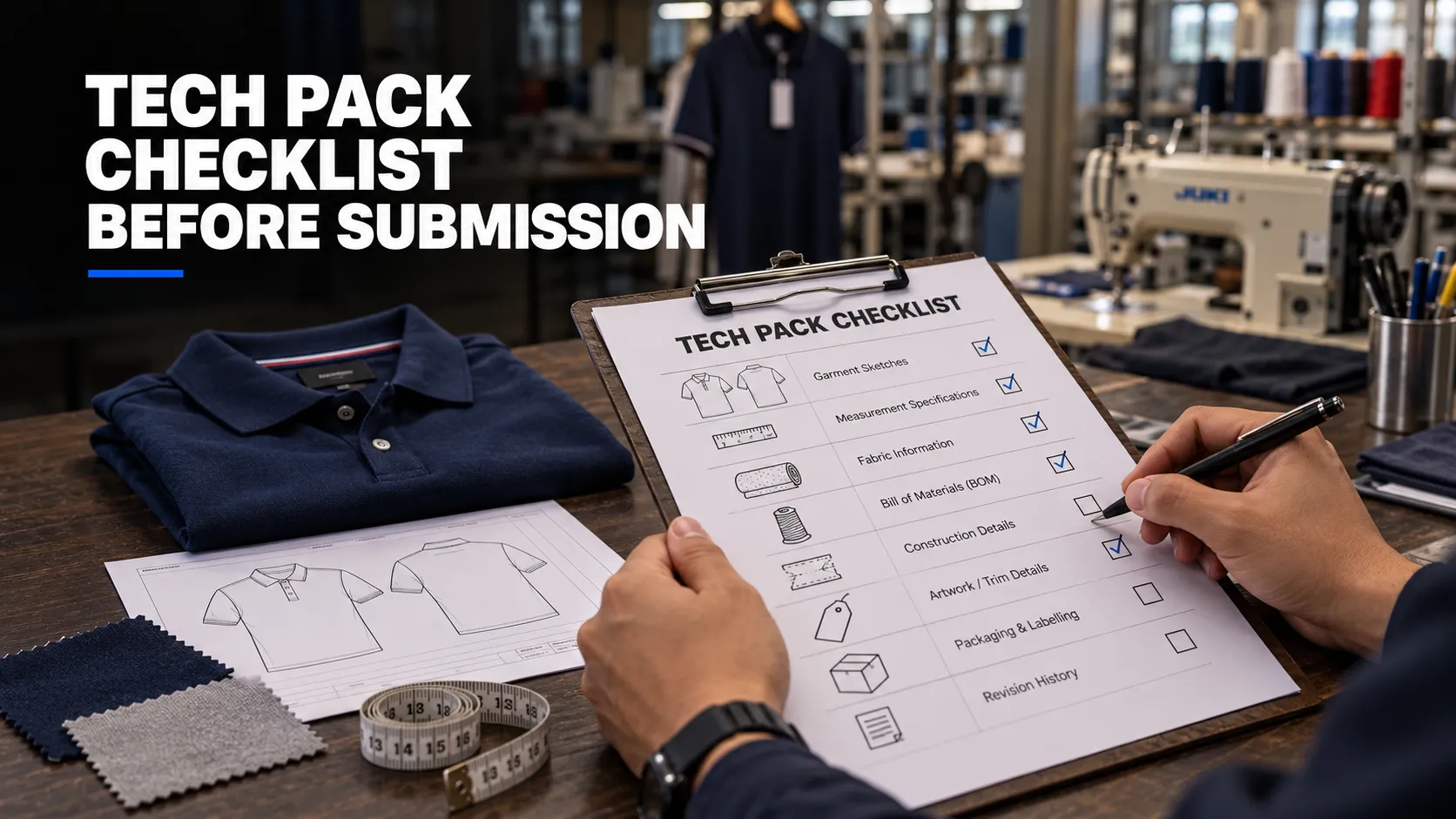
A tech pack checklist helps clothing brands prepare the information manufacturers need before requesting a quotation or developing a garment sample.
A manufacturer may be able to estimate a garment’s price using preliminary specifications, but sample development often requires more detailed instructions. Missing measurements, unclear construction details, incomplete material information, or conflicting artwork references can lead to additional questions, revised quotations, and avoidable sampling corrections.
For startup founders, designers, product developers, and sourcing teams, the practical challenge is knowing what must be included now and what can be finalized later.
This guide provides two separate checklists: one for preparing a quote-ready tech pack and another for preparing a sample-ready technical package. It also covers measurements, BOM requirements, artwork, packaging, version control, and common submission mistakes.
If you are still preparing your technical documentation, our guide on how to make a tech pack for clothing explains how to build the essential pages step by step.
These checklists also fit into the broader apparel product development workflow, which connects specifications with material sourcing, sampling, approvals, and production readiness.
Table of Contents
What Makes a Tech Pack Complete for a Clothing Manufacturer?
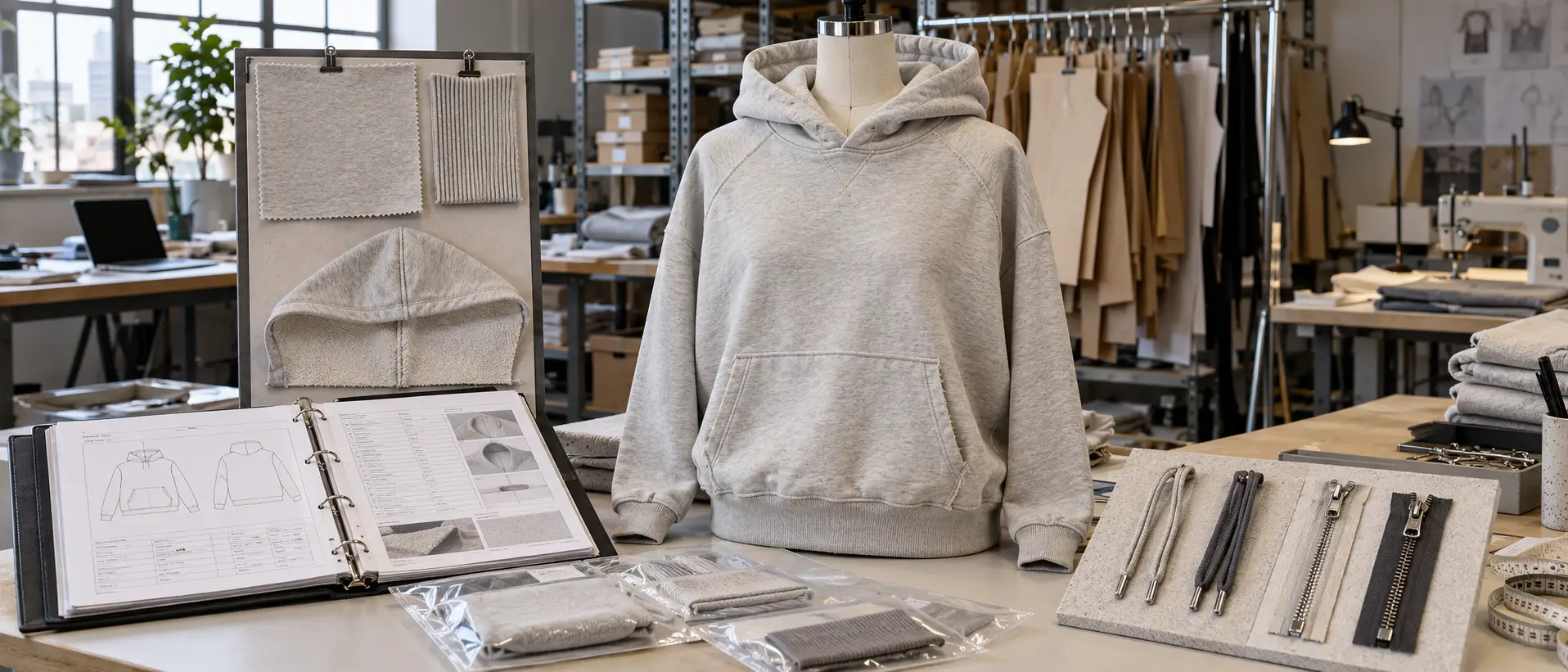
A complete tech pack is not necessarily one in which every specification has been finalized. It is one that contains enough reliable information for the manufacturing activity being requested, with unresolved requirements clearly identified.
For example, a preliminary quotation may use an estimated fabric consumption, subject to confirmation after pattern development. A fit sample may use a provisional material while the final fabric is being sourced.
These conditions are manageable when both parties understand which details are confirmed, which are estimated, and which require approval.
Three Levels of Tech Pack Readiness
1. Quote-Ready
The manufacturer has enough technical and commercial information to estimate material costs, production operations, special processes, and order requirements. Important costing assumptions are documented.
2. Sample-Ready
The manufacturer has suitable construction, measurement, material, and artwork instructions for the specific sample being developed. Provisional details and the purpose of the sample are clearly identified.
3. Production-Ready
The relevant technical specifications, materials, construction methods, measurements, artwork, labels, packaging, and approval references have been finalized or otherwise formally authorized for the applicable production stage.
The main purpose of a tech pack checklist is to verify the information appropriate to each stage, rather than applying the same requirements to every development activity.
Can You Use an Incomplete Tech Pack?
Yes, for certain preliminary activities.
A manufacturer may assess feasibility or provide an indicative quotation using a design sketch, reference sample, initial measurements, material direction, and estimated order quantity.
However, the buyer should not treat this preliminary information as a fully approved production specification.
A useful practice is to identify each outstanding detail as:
- Confirmed: Approved or sufficiently defined for the current activity.
- Provisional: Available for development or estimation but subject to confirmation.
- Open: Requires further information, technical evaluation, or a buyer decision.
- Not Applicable: Not relevant to the garment or current development stage.
This makes incomplete information visible without preventing necessary early discussions.
Quote-Ready Tech Pack Checklist: What Manufacturers Need for Pricing
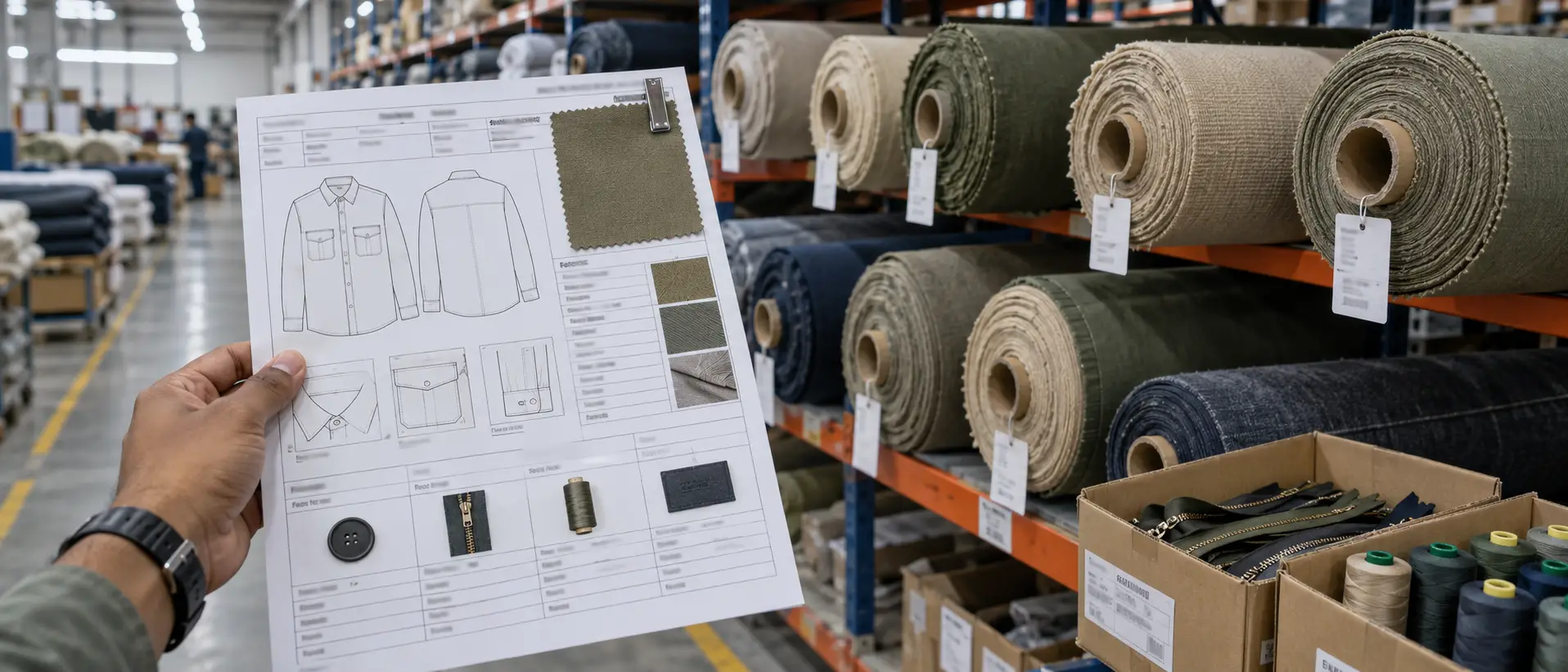
Before requesting a manufacturing quotation, review the technical and commercial details that can influence garment cost.
A manufacturer generally needs to understand the garment’s design, construction complexity, material requirements, order quantity, and any special operations.
The more accurately these requirements are communicated, the easier it becomes to compare quotations based on similar assumptions.
Quote-Ready Checklist
| Checklist Item | Information to Provide | Why It Matters | If Missing or Unclear |
|---|---|---|---|
| Technical Flats | Front, back, and relevant detail drawings | Helps identify garment components and construction complexity | Additional drawings or clarification may be needed |
| Construction Summary | Main seam types, finishing, closures, and special operations | Supports operation planning and sewing cost estimates | The quotation may exclude or assume certain operations |
| Main Fabric | Composition, construction, GSM, width, and finishing direction | Influences material cost and consumption | Fabric pricing may be provisional |
| BOM Essentials | Major fabrics, trims, labels, and components | Identifies cost-driving materials | Material costs may require revision |
| Colorways | Number of colors and applicable color references | Affects sourcing, dyeing, printing, and minimum quantities | Color-related costs may remain uncertain |
| Base Measurements | Base size and important garment dimensions | Supports preliminary pattern and consumption assessment | Fit or pattern complexity may need clarification |
| Order Quantity | Estimated units, size range, and color breakdown | Influences production efficiency and sourcing conditions | Unit pricing and MOQ feasibility may be difficult to assess |
| Special Processes | Printing, embroidery, washing, coating, or other finishes | Identifies additional operations and suppliers | Specialized processing costs may be omitted |
| Packaging | Expected packing format and any cost-driving requirements | Supports a more complete landed or ex-factory cost basis | Packaging assumptions may differ |
| Commercial Requirements | Delivery destination, requested pricing basis, and target schedule | Helps establish quotation scope and feasibility | Quotes may not be directly comparable |
A quotation may still be possible when some information is missing. The important point is to ensure the supplier identifies the assumptions used to calculate the offered price.
Material Specifications That Affect Costing
A general description such as “cotton fabric” provides limited information for reliable costing.
Where available, specify:
- Fiber composition and fabric construction
- Fabric weight in GSM
- Usable width or width requirement
- Finishing, washing, and performance expectations
- Colorways and shade references
- Required sourcing or testing conditions
Material choices can influence fabric consumption, processing costs, minimum quantities, and manufacturing feasibility.
If the fabric is not finalized, state the proposed specification and request quotation conditions for alternatives.
BOM Information Manufacturers Need Before Quoting
The Bill of Materials (BOM) lists the fabrics, trims, labels, and other relevant components required for the garment.
A quote-ready BOM should identify major cost-driving items, including:
- Main and secondary fabrics
- Rib, lining, pocketing, or interlining where applicable
- Sewing threads
- Zippers, buttons, snaps, and drawcords
- Branding labels and hangtags
- Print, embroidery, or other decoration requirements
- Packaging components that influence price
Also identify whether materials are buyer-nominated or proposed for sourcing by the manufacturer.
A nominated component may require a specific supplier or reference. A manufacturer-sourced component allows the supplier to propose a suitable option against the stated requirements.
Both sourcing approaches should be reflected in the quotation.
MOQ and MCQ Checks
Minimum Order Quantity (MOQ) and Minimum Color Quantity (MCQ) can affect the commercial feasibility of a garment order.
Custom trims, special fabric colors, woven labels, branded hardware, and packaging materials may have minimum purchase requirements independent of the garment quantity.
If exact minimums are not known, identify the items requiring supplier confirmation.
For buyers managing several styles, a more detailed BOM tech pack structure can help organize material specifications, sourcing responsibilities, consumption estimates, and approval records before committing to costs.
A detailed BOM tech pack structure helps buyers document fabric and trim requirements, sourcing responsibilities, cost assumptions, and material approvals in a consistent format.
Why a Tech Pack Alone Is Not Always Enough for Quotation
The tech pack explains the product, but a manufacturing quotation also depends on commercial information.
A Request for Quotation (RFQ) should identify the requested quantity, delivery conditions, pricing basis, and other relevant expectations.
For a structured approach, our guide to writing an RFQ to a clothing manufacturer explains how to organize these requirements so suppliers can prepare more comparable quotations.
The following tutorial demonstrates how a clothing tech pack can be organized into colorway, construction, artwork, branding, measurement, and BOM pages. It provides a useful visual reference for checking whether the documents needed for costing and subsequent sampling have been included.
Ready to Request a Clothing Manufacturing Quote?
Share your garment specifications, estimated quantities, material requirements, and available technical documents with RYZEAL SOURCING to discuss quotation feasibility through suitable manufacturing partners.
Sample-Ready Tech Pack Checklist: What the Sampling Team Needs
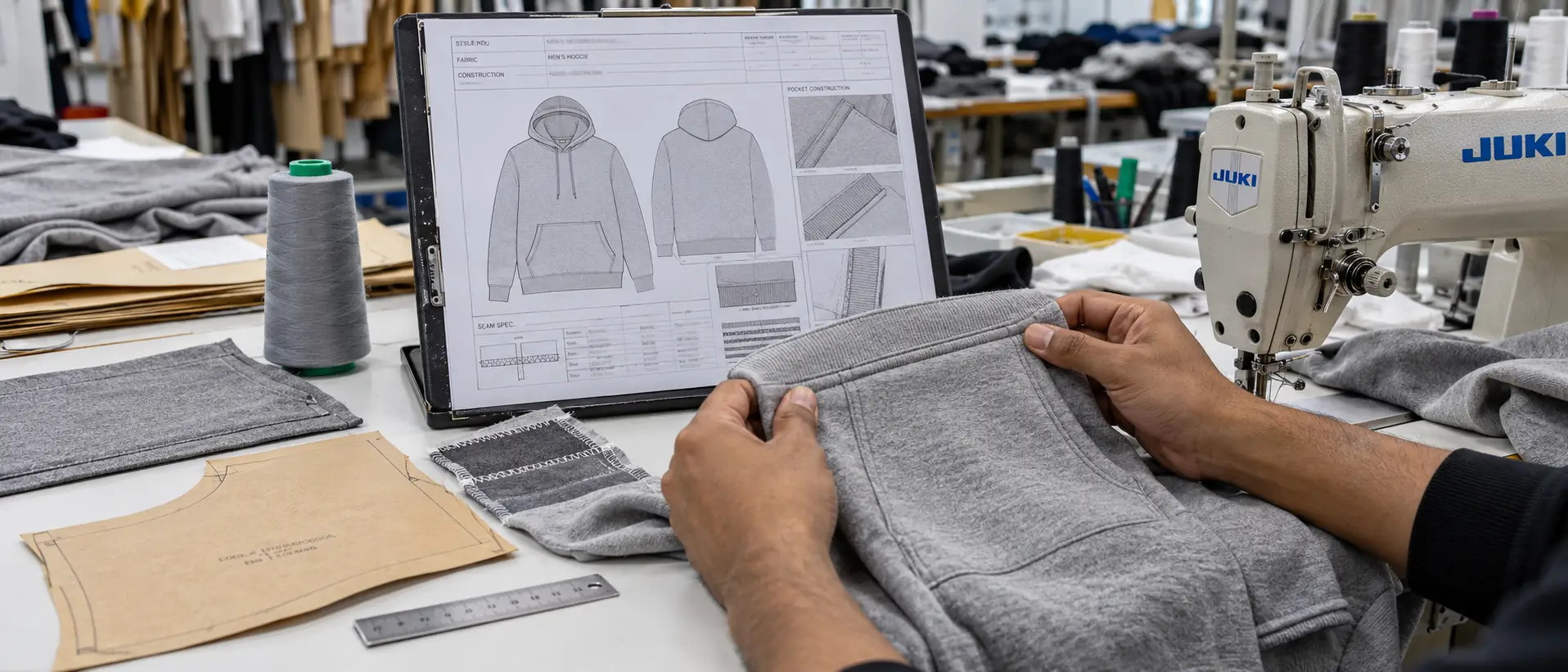
Once a garment moves from preliminary costing into physical development, the technical information must support the particular sample being requested.
A first prototype, fit sample, development sample, size-set sample, and pre-production sample can serve different purposes.
For example, a prototype may help evaluate construction feasibility or overall shape. A fit sample places greater emphasis on measurements, proportions, and wearability. A pre-production sample usually requires more complete, production-representative specifications.
The sample-ready tech pack checklist should therefore reflect the intended sample stage.
Essential Sample-Ready Checklist
Before requesting a sample, check the following:
- Style identification: The correct style code, garment description, base size, and document version are included.
- Technical drawings: Front, back, and necessary detail views clearly describe the design.
- Construction requirements: Important seams, stitches, finishing details, closures, and reinforcements are defined.
- Measurement chart: Relevant Points of Measure (POM), targets, and measuring methods are documented.
- Tolerances: Applicable measurement tolerances are defined or clearly marked for technical agreement.
- Material specifications: Fabrics and trims intended for the sample are identified, including approved or provisional substitutes.
- Artwork and embellishments: Required methods, dimensions, colors, and placement instructions are provided.
- Labels and branding: Relevant label artwork, dimensions, and positioning are specified for the sample stage.
- Size information: Base size and intended size range are identified; grading status is clear.
- Packaging requirements: Any packaging features being evaluated in the sample are documented.
- Sample objective: The buyer and manufacturer agree on what the sample is expected to demonstrate.
- Revision control: The current technical package and previous approved decisions are identifiable.
Not every item needs final production approval before the first sample. However, missing information that could affect the intended evaluation should be resolved or recorded before development proceeds.
Why Sample Objectives Matter
Consider a hoodie being developed for a new clothing collection.
A first sample may be intended to evaluate body shape, hood construction, sleeve proportions, and pocket placement.
If its final fabric or custom drawcord is unavailable, an agreed substitute may be used for that stage. The sample can still provide useful information, provided the limitations are understood.
However, the same sample should not automatically be treated as approval of final fabric behavior, decoration quality, or production trims.
This distinction helps prevent early development decisions from being interpreted as final production approvals.
A structured sample gates and approval process helps buyers define what each sample must prove, how comments should be recorded, and which specifications must be confirmed before advancing to the next development stage.
Tech Pack Measurement Checklist: POM, Tolerances, and Size Charts
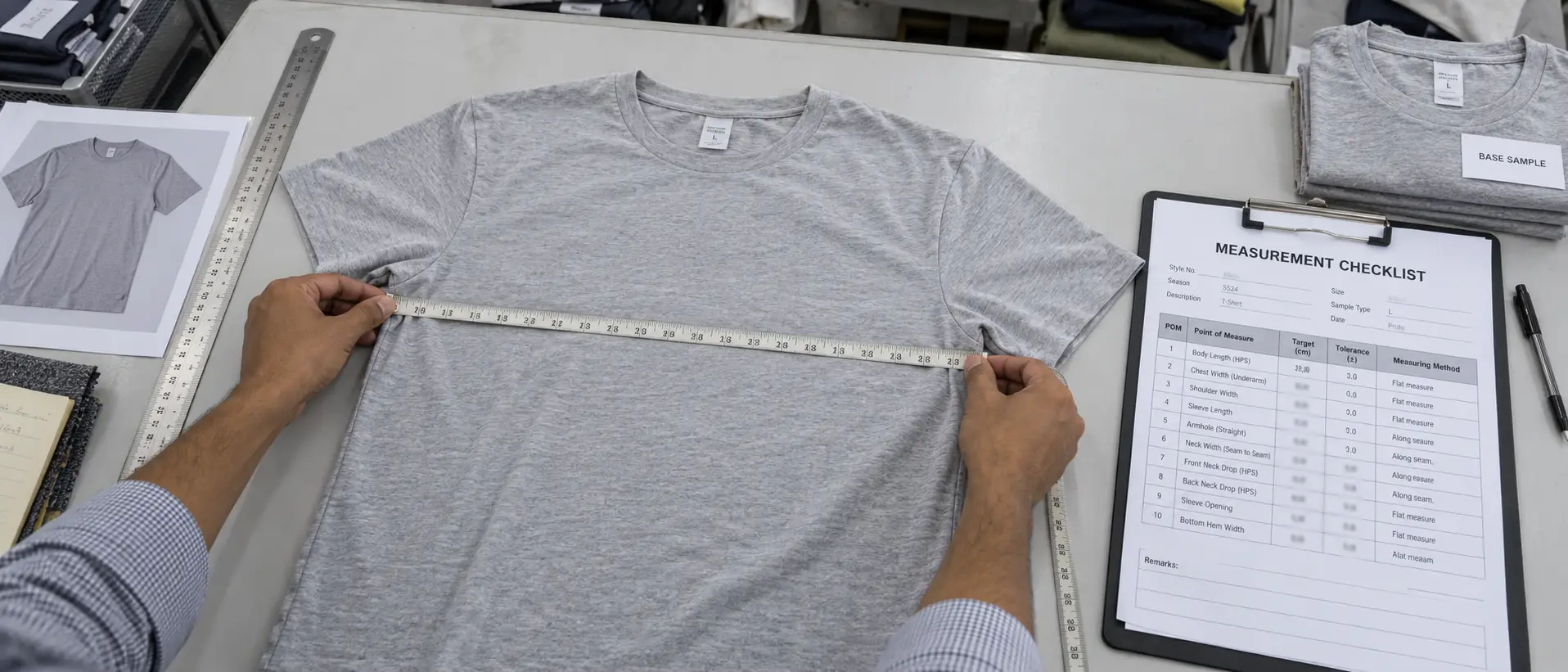
Measurement specifications provide a measurable reference for evaluating garment dimensions during development.
Without clear measurement instructions, two teams may obtain different results from the same garment.
A proper measurement chart should identify:
- POM name: The exact garment dimension being evaluated.
- Target measurement: The intended finished garment measurement.
- Tolerance: The permitted deviation from the target.
- How-to-measure method: The reference points and measuring procedure.
- Garment condition: Whether the garment is laid flat, relaxed, fastened, stretched, or measured after a specified process.
- Base size: The size to which the measurement specification applies.
Example Garment Measurement Chart
The following illustrative chart uses a basic short-sleeve T-shirt in a single base size.
| Point of Measure | Target | Tolerance | How to Measure | Main Risk if Incorrect |
|---|---|---|---|---|
| Chest Width | 52.0 cm | ±1.0 cm | Measure flat across the chest, 2.5 cm below the armhole | Body fit |
| Body Length | 70.0 cm | ±1.0 cm | Measure from Highest Point of Shoulder (HPS) to the bottom hem | Garment proportion |
| Shoulder Width | 45.0 cm | ±0.5 cm | Measure between defined shoulder points | Shoulder fit |
| Sleeve Length | 22.0 cm | ±0.5 cm | Measure from the shoulder seam to the sleeve hem | Sleeve proportion |
| Bottom Opening | 51.0 cm | ±1.0 cm | Measure straight across the bottom opening, laid flat | Hem fit and silhouette |
All values are illustrative. Actual measurements, tolerances, and measuring methods must be established for the particular garment, fabric, fit requirements, and buyer specifications.
How to Avoid Measurement Disputes
A measurement called “chest width” is incomplete unless the measurement location and method are clear.
The tech pack should state whether the dimension is a flat half-width or full circumference, where the tape should be positioned, and whether the garment must be relaxed or stretched.
The sample review should record the actual measured result against the approved target and tolerance.
For example, if the chest-width target is 52 cm with an agreed tolerance of ±1 cm, a measurement of 53.5 cm falls outside that specified range.
The technical team can then investigate whether the difference comes from the pattern, sewing, fabric behavior, finishing, or the measuring method.
This creates a specific corrective action rather than an unclear comment such as “fit is slightly wrong.”
The following tutorial provides a closer look at creating Points of Measure, defining tolerances, preparing a how-to-measure guide, and using those references in a graded specification sheet. It is particularly useful for understanding how sample reviewers and manufacturers can evaluate dimensions consistently.
When Do You Need a Full Size Chart?
A base-size measurement chart may be sufficient for an early fit-development sample, provided the intended size range is already known.
Once the base fit is confirmed, grading rules can be developed and evaluated across the required sizes.
A tech pack should distinguish between:
- Base-size specifications: Measurements for the primary development size.
- Garment size chart: Target garment dimensions across the required size range.
- Grading rules: The specified dimensional changes between sizes.
- Consumer size guide: Body measurements or fit guidance provided to customers.
These documents are related but do not serve identical purposes.
If grading has not been finalized, state that clearly. Avoid presenting estimated size measurements as approved specifications.
A detailed tech pack measurement chart and tolerances guide helps product teams define accurate Points of Measure, establish suitable dimensional limits, and investigate fit discrepancies during sampling.
Artwork, Embroidery, and Labeling Checklist
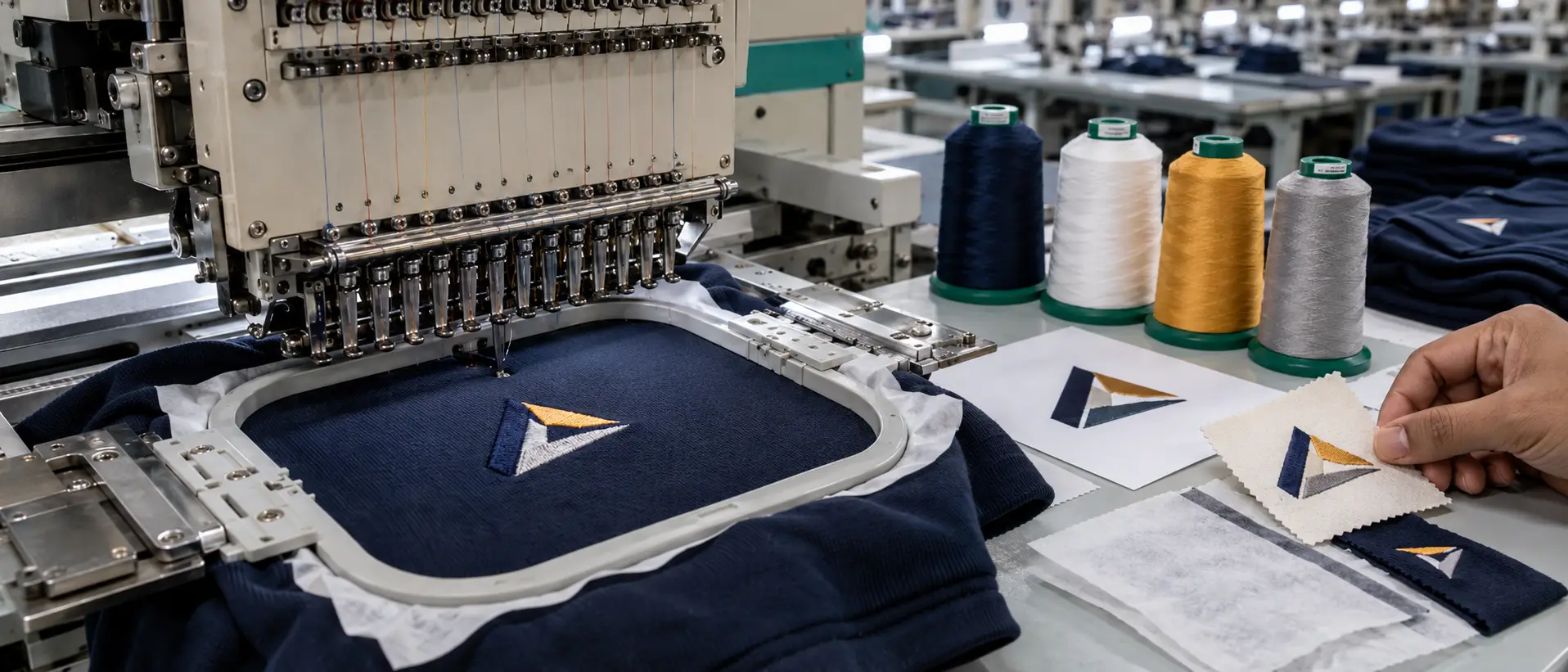
Prints, embroidery, labels, and other branding features introduce additional specifications that can affect both development quality and manufacturing cost.
These requirements should be documented wherever they are relevant to the garment.
Artwork Placement Checklist
For printing, heat transfers, appliqué, and similar decoration methods, check:
- Approved artwork file or design reference is included.
- Artwork width and height are specified.
- Placement is defined using measurable reference points.
- Horizontal and vertical positioning requirements are clear.
- Application method and color requirements are identified.
- Placement changes between sizes are explained where applicable.
- Relevant clearances from seams, pockets, or closures are defined.
- The required artwork approval or sample reference is identified.
A statement such as “logo on left chest” may not provide enough information to reproduce the intended placement consistently.
For example, artwork placement can be defined using distances from the center front and an agreed neckline or shoulder reference point.
The reference points themselves must be clearly identified.
Embroidery Tech Pack Checklist
An embroidery design requires additional technical consideration because the appearance depends on the stitch pattern, embroidery method, fabric, backing, and machine settings.
Include the following information where applicable:
- Embroidery artwork and approved visual reference
- Placement coordinates
- Finished embroidery width and height
- Thread color references
- Required or proposed stitch type
- Stitch density or stitch-count information, if available and relevant
- Suitable backing or stabilizer requirements
- Accepted digitized file format or digitizing responsibility
- Minimum detail or lettering limitations
- Approval requirements for embroidery samples
Not every embroidery specification must be predetermined by the buyer.
The embroidery supplier may recommend stitch settings, backing materials, and digitizing adjustments based on the artwork and garment fabric.
However, changes that affect the approved appearance, positioning, durability, or cost should be reviewed before final approval.
Should Embroidery Be Tested on the Actual Fabric?
Where feasible, embroidery approval should use the intended production fabric or a representative material with sufficiently similar properties.
Fabric stretch, thickness, surface texture, and stability can influence stitching performance and the final appearance.
An embroidery sample prepared on an unrelated substitute material may not fully demonstrate how the design will perform on the final garment.
Labeling Checklist
For relevant product labels, verify:
- Brand and size label artwork
- Label dimensions and material
- Fiber composition and care information
- Country-of-origin or other market-required declarations
- Placement and attachment method
- Approved wording and language requirements
Labeling requirements vary by destination market and product category.
For example, the United States has specific care-labeling obligations for covered textile apparel. The FTC guidance on complying with the Care Labeling Rule explains the responsibilities and conditions relevant to care instructions.
Buyers should confirm the actual labeling requirements for their target markets rather than assuming that one standard applies worldwide.
Packaging Tech Pack Checklist: What Must Be Specified?
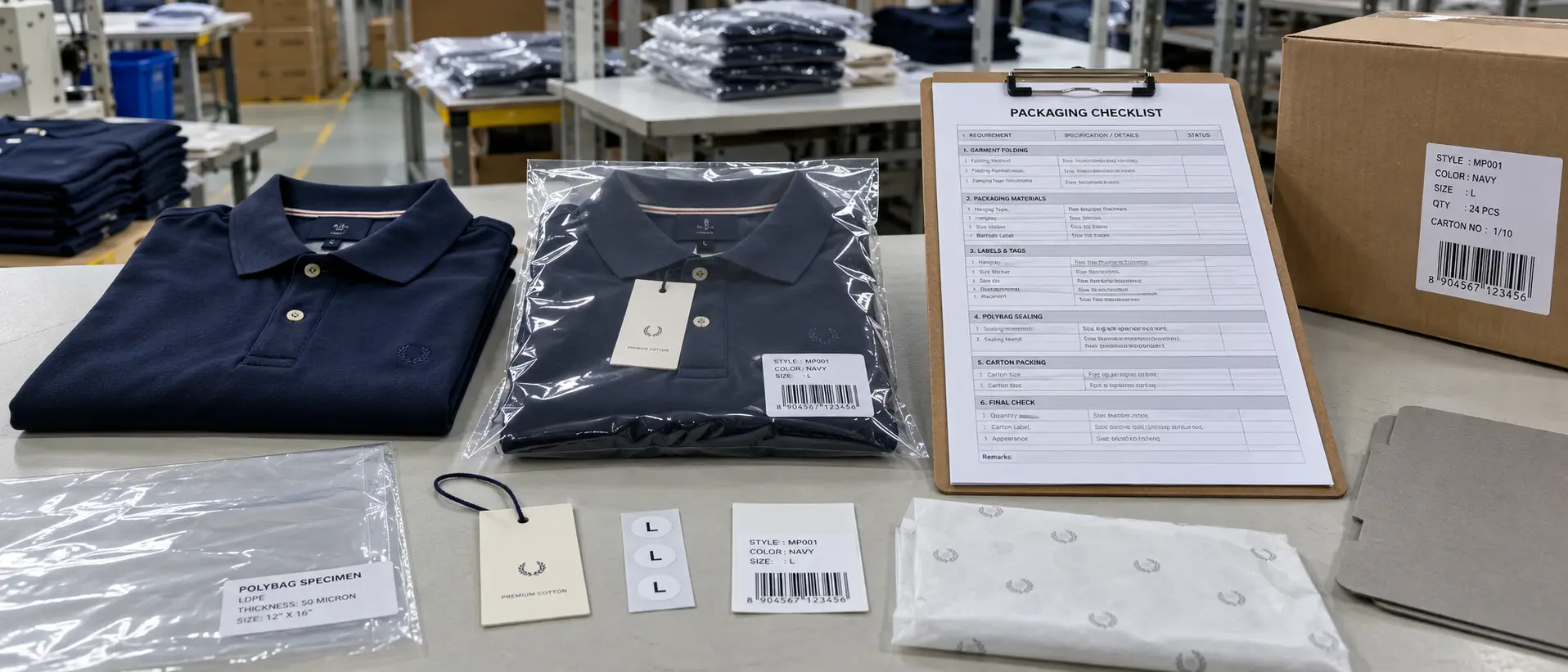
Packaging requirements can influence material costing, product protection, retail presentation, and shipment preparation.
A complete production package may include folding instructions, individual packaging, hangtags, barcodes, size identification, carton markings, and other buyer-specific details.
However, not every packaging component needs approval during an early fit sample.
The timing should reflect the sample objective and the buyer’s commercial requirements.
Packaging Requirements Checklist
| Packaging Element | What to Specify | Possible Approval Evidence | Risk if Unclear |
|---|---|---|---|
| Folding | Folding sequence, garment orientation, dimensions where relevant | Approved photograph or physical reference | Inconsistent presentation |
| Individual Packaging | Bag type, size, material, sealing method | Material specification or packed sample | Incorrect protection or packing |
| Barcode & Stickers | Data, format, position, and readability requirements | Approved label proof or scan check | Scanning or identification errors |
| Hangtags | Artwork, size, attachment method, location | Approved tag sample or photograph | Branding inconsistency |
| Required Warnings | Applicable wording, language, and placement | Approved artwork or compliance review | Market-specific compliance issues |
| Carton Packing | Assortment ratio, quantities, carton specifications, markings | Approved packing instructions | Incorrect shipment preparation |
| Premium Packaging | Tissue, inserts, presentation requirements | Packed sample or visual approval | Presentation mismatch |
When Should Packaging Be Approved?
The appropriate timing depends on what the sample is intended to validate.
A fit sample may not require final polybag and carton specifications. A pre-production sample or packing trial may need to demonstrate the approved folding method, labeling, packaging materials, and relevant carton configuration.
For retailer or marketplace orders, barcode and packaging requirements should be reviewed early enough to avoid late-stage sourcing or packing changes.
Where photographic evidence is appropriate, the buyer can request clear images of folded garments, labels, bag seals, and barcode locations.
For complex packaging requirements, a physical packed sample may provide a better approval reference than photographs alone.
Apparel Private Label Tech Packs: Minimum Requirements for Startups
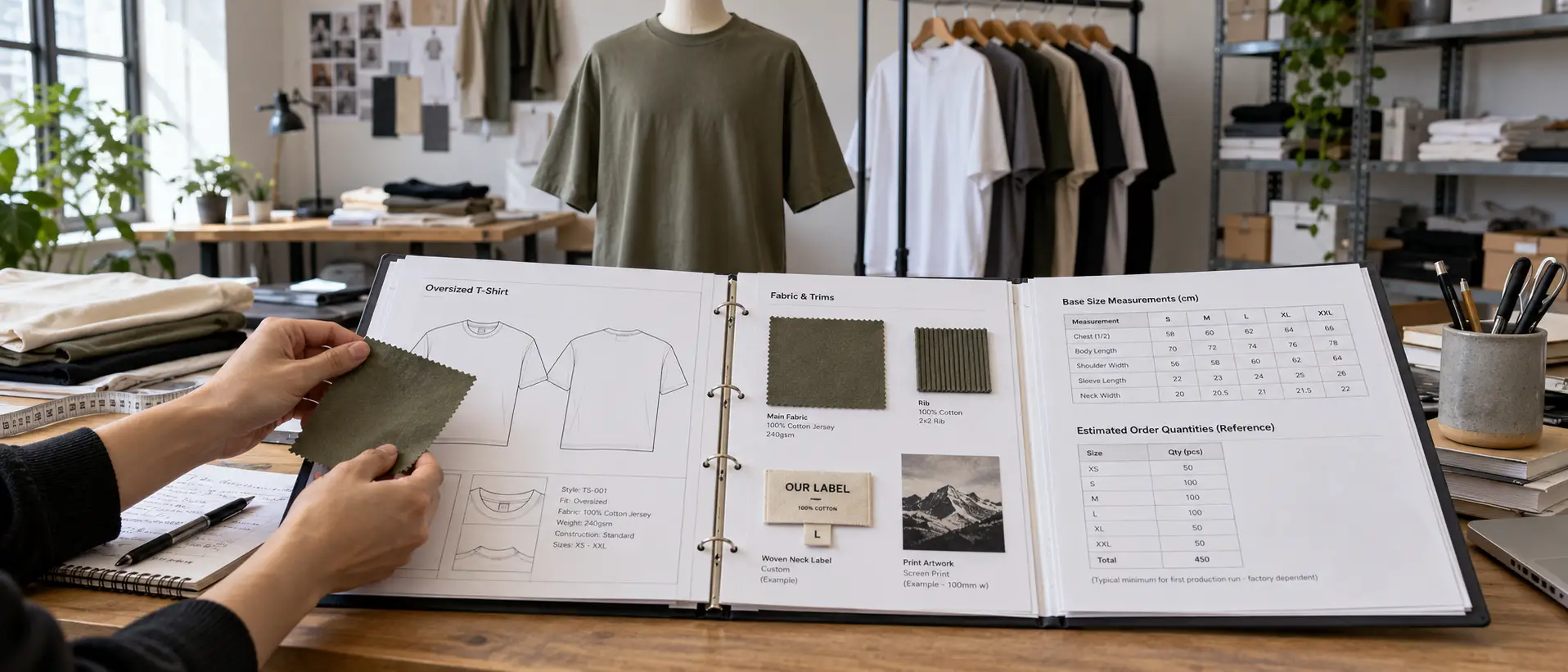
Private-label clothing brands often need to balance limited development resources with the technical requirements of garment manufacturing.
A smaller team does not necessarily need a complicated documentation system, but it does need a reliable process for recording important decisions.
What Should a Startup Prepare First?
For early quotation and feasibility discussions, prioritize:
- A clearly identified garment design.
- Technical sketches or suitable reference images.
- Intended fabric and major trim specifications.
- Base-size measurements and fit expectations.
- Key construction requirements.
- Branding and artwork details where applicable.
- Expected quantities, colorways, and size range.
- Available commercial and delivery information.
For sample development, expand these details to support the specific sample objective.
A reusable checklist is often more helpful than a complicated template containing dozens of fields that do not apply to the product.
What Can Be Finalized Later?
Depending on the garment and development stage, the following may remain provisional during early feasibility assessment:
- Complete grading rules
- Final fabric supplier
- Certain trim or accessory references
- Additional colorways
- Retail packaging variations
- Production-specific finishing details
These decisions should remain visible in the development record.
Before the relevant production activities begin, the necessary specifications and approvals must be completed or otherwise formally authorized.
Final Pre-Send Tech Pack Checklist
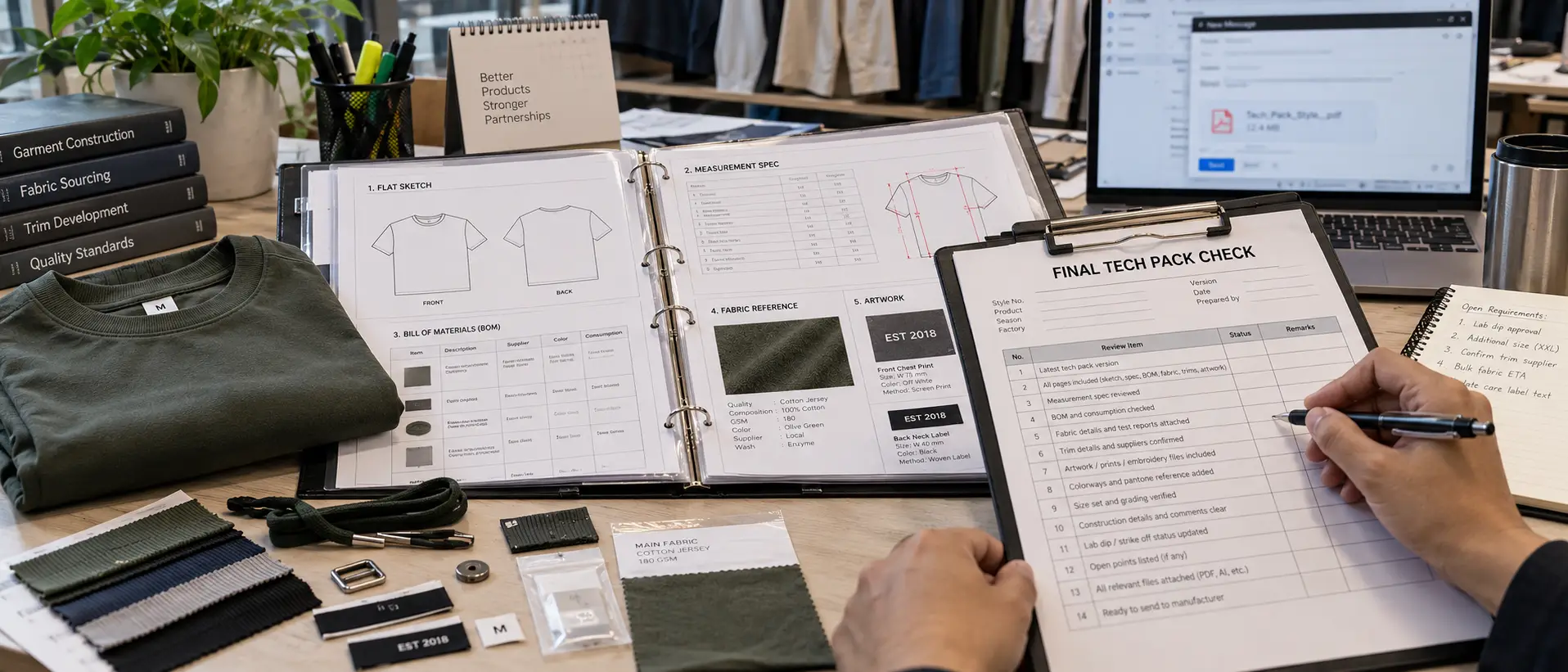
Before emailing your technical package or submitting it through a sourcing platform, perform one final review.
This is the stage where documentation accuracy and communication control come together.
Technical File Check
- The correct style code appears on the technical documents.
- All relevant technical drawings are included.
- Required measurements and material details are present.
- Construction notes match the intended design.
- Artwork and labeling references are identifiable.
- Open or provisional specifications are clearly indicated.
- The document matches the intended quotation or sampling stage.
Version Control Check
- The file name identifies the style and revision.
- Revision details are recorded.
- Updated specifications replace outdated instructions.
- Supporting files use consistent style references.
- The responsible person for technical clarifications is identified.
A possible file-naming format is:
BRAND_STYLECODE_V03_YYYY-MM-DD.pdf
The exact format can differ, but it should remain consistent across development records.
Submission Package Check
- The purpose of the submission is stated.
- Relevant tech pack, BOM, and artwork files are included.
- The requested quantity and size range are identified.
- Important commercial expectations are communicated.
- Questions requiring manufacturer input are listed.
- The recipient knows which version is current.
- The expected response or next development action is clear.
Manage Factory Questions in One Record
A structured clarification log can contain:
| Field | Information |
|---|---|
| Style Reference | The relevant garment and version |
| Question | The technical or commercial issue |
| Responsible Party | Who must provide the answer |
| Decision | Confirmed answer or agreed action |
| Status | Open, under review, or closed |
| Tech Pack Update | Whether the decision changes the specifications |
Not every conversation requires a new document revision.
However, a decision that changes the approved technical requirements should be reflected in the controlled specification record.
This keeps the current manufacturing instructions aligned with the latest confirmed decisions.
Common Tech Pack Problems and How to Correct Them
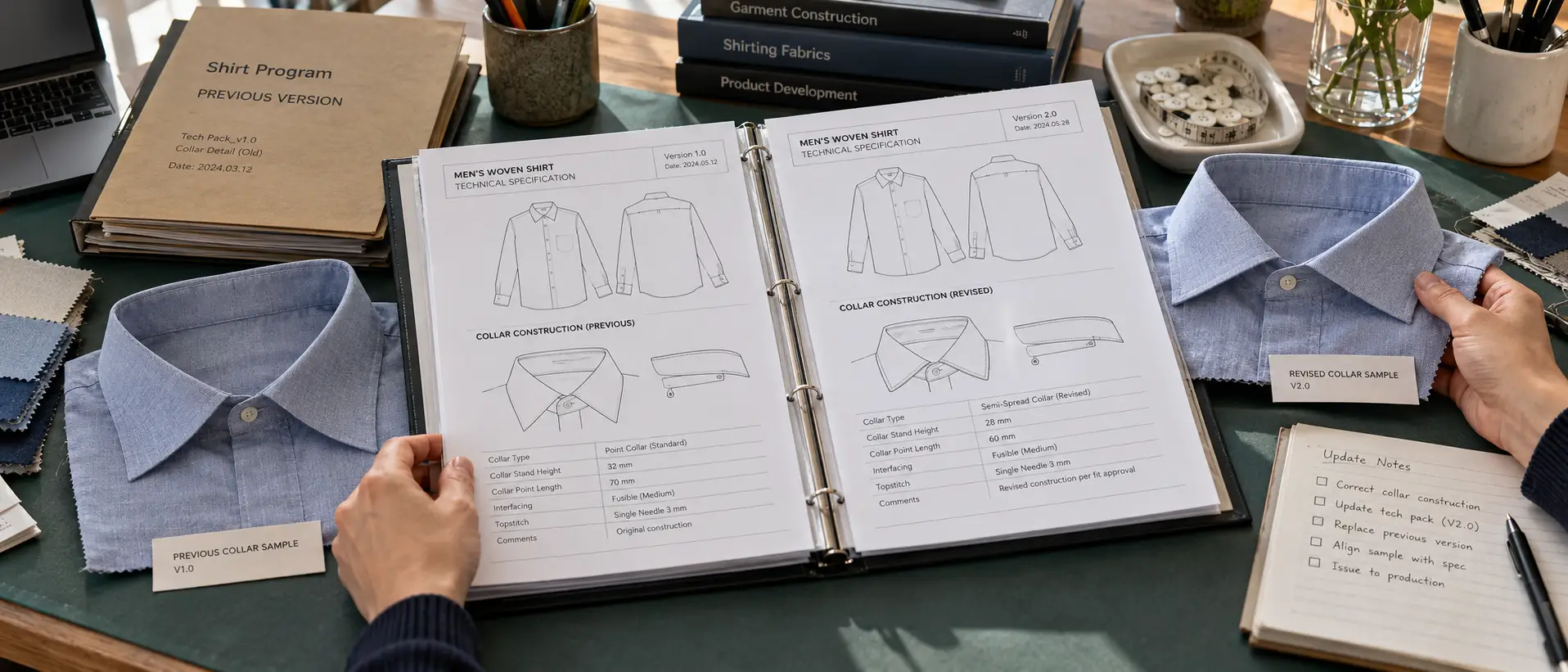
Many quotation and sampling problems can be traced to a manageable number of documentation gaps.
The purpose of reviewing these issues is not to assign blame to the buyer or manufacturer, but to identify the most useful corrective action.
Common Problems and Corrections
| Problem | Likely Documentation Gap | Practical Correction |
|---|---|---|
| Quotation changes after clarification | Material, trim, quantity, or process assumptions were incomplete | Update the relevant requirements and obtain a revised quotation |
| Sample appearance differs from design | Construction details or artwork placement were unclear | Add technical callouts and measurable references |
| Measurement disagreement | POM definitions, measuring methods, or tolerances were missing | Confirm measuring conditions and update the measurement chart |
| Incorrect material used | BOM reference or substitution approval was unclear | Identify approved materials and substitution rules |
| Packaging does not match requirements | Packing instructions were incomplete or not approved | Confirm packing details and approval references |
| Teams use different specifications | Revision control or document distribution was inconsistent | Reissue the controlled version and communicate changes |
How to Correct an Unclear Technical Requirement
A practical correction sequence is:
- Identify the exact specification or result causing concern.
- Compare the latest tech pack with the sample, quotation, or material reference.
- Clarify the intended requirement with the responsible technical team.
- Record any approved change in the relevant document.
- Confirm the revision and reassess the affected result.
For example, if an embroidery logo appears distorted, the issue may involve the artwork, embroidery settings, backing, fabric stability, or application method.
Rather than changing several unrelated specifications without a record, review the likely causes and confirm the proposed correction.
The same principle applies to measurements, trims, printing, and construction details.
How a Tech Pack Checklist Supports Sample Approval
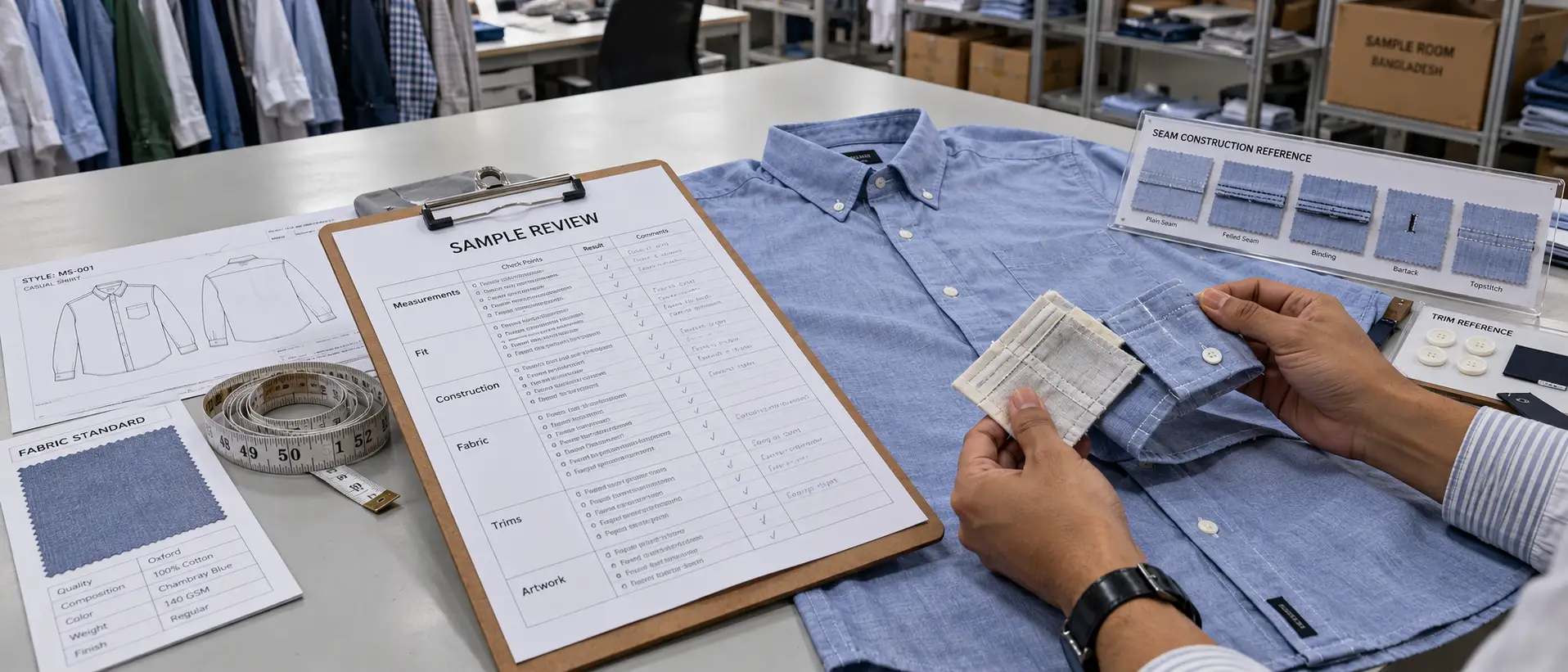
A checklist helps establish whether sufficient information is available to begin development.
Once a sample has been produced, the next task is evaluating the result against the applicable requirements.
Sample reviews may include:
- Measurements and fit
- Construction and workmanship
- Fabric and material references
- Artwork appearance and placement
- Labels and trims
- Applicable testing results
- Packaging requirements for the relevant sample stage
These checks should be connected to the appropriate technical specifications and approval records.
A sample that looks satisfactory may still require corrections to measurements, materials, or construction before later development stages.
Likewise, a measurement result that falls within tolerance does not automatically demonstrate acceptable overall garment fit.
Clear sample review responsibilities, documented comments, and controlled revisions help establish the standard needed for subsequent manufacturing decisions.
Before beginning sampling with a new partner, buyers should also discuss technical capabilities, MOQ expectations, sample responsibilities, and approval arrangements. Our guide to questions to ask a clothing manufacturer before sampling covers these practical supplier discussions.
At RYZEAL SOURCING, garment development and sampling can be coordinated through a network of vetted, specialized manufacturing partners in Bangladesh. The appropriate development approach depends on the garment category, available specifications, and the capabilities required for the project.
Is Your Tech Pack Ready for Clothing Sampling?
Share your garment tech pack, sketches, measurements, or product references with RYZEAL SOURCING to discuss technical requirements and sample development through suitable manufacturing partners in Bangladesh.
Frequently Asked Questions About Tech Pack Checklists
What should be included in a clothing tech pack checklist?
A tech pack checklist should cover style identification, technical drawings, construction instructions, measurements, fabric and trim specifications, artwork, labels, packaging requirements where relevant, and revision control. The required level of detail depends on whether the pack is intended for quotation, sampling, or production.
What does a manufacturer need to provide an accurate quotation?
Manufacturers generally need a clear garment description, technical drawings or references, key construction details, material specifications, major trims, order quantities, size range, colorways, and special process requirements. Commercial terms and unresolved assumptions should also be identified.
What is the difference between a quote-ready and sample-ready tech pack?
A quote-ready pack contains enough information to estimate garment costs and identify commercial assumptions. A sample-ready pack provides the construction, measurement, material, and other technical instructions necessary for the particular sample being developed.
What is a sample tech pack for a garment?
A sample tech pack is the technical documentation used to develop and evaluate a garment sample. It may contain provisional information during early development, but it should clearly identify what the sample is intended to demonstrate.
What should a tech pack measurement chart contain?
It should contain POM names, target measurements, measuring methods, applicable tolerances, base-size identification, and relevant garment conditions. Size specifications or grading instructions should be included when required.
What is a BOM in a garment tech pack?
A Bill of Materials is a structured list of the fabrics, trims, labels, packaging components, and other relevant items needed for the garment. It supports material sourcing, costing, approvals, and production planning.
What should an embroidery tech pack include?
It should identify the approved artwork, embroidery dimensions, placement coordinates, thread colors, and relevant execution requirements. Backing, stitch density, digitized files, and technical limitations should be agreed where applicable.
Do private-label clothing brands need a full size chart before the first sample?
Not necessarily. Early fit development can begin using a base-size measurement chart and a clearly stated intended size range. Full grading and size-set specifications can be finalized at the appropriate development stage.
When should a tech pack checklist be used?
Use it before important development decisions, particularly quotation requests, sampling submissions, revisions, and production handover. Recheck affected sections whenever technical requirements change.
Can a clothing manufacturer help complete missing tech pack details?
Many manufacturers and sourcing partners can provide technical recommendations, material options, pattern-development support, or sampling guidance. The availability of these services varies, and the responsibility for approving final specifications should be agreed between the buyer and manufacturing partner.
Final Takeaway: Check Before You Quote, Confirm Before You Sample
A reliable tech pack checklist helps buyers distinguish between the information necessary for preliminary costing and the more detailed specifications needed for garment sampling.
Quote-ready documentation should communicate the main product and commercial requirements clearly enough for the manufacturer to prepare a meaningful quotation with identified assumptions.
Sample-ready documentation should provide the technical references necessary to evaluate the intended sample, including measurements, construction details, materials, artwork, and relevant approval conditions.
Neither checklist eliminates every development question or sampling revision. Instead, both help buyers and manufacturers identify unresolved requirements earlier, communicate decisions consistently, and reduce avoidable misunderstandings.
For apparel brands, product developers, and sourcing teams, the objective is straightforward: submit the right information for the right development stage, confirm open decisions, and maintain one controlled technical reference as the garment progresses toward production.
Connect with RYZEAL SOURCING