

GSM Meaning in Fabric refers to the mass of a textile measured in grams per square meter (g/m²). It is one of the most common measurements used by apparel manufacturers, textile suppliers, and clothing brands to describe fabric weight.
For example, a 200 GSM fabric has a mass of 200 grams per square meter, while a 300 GSM fabric has a mass of 300 grams over the same area. The second fabric is heavier per unit area, but that does not automatically make it stronger, softer, more comfortable, or higher quality.
Fabric GSM helps buyers compare materials, estimate consumption, evaluate garment weight, and communicate requirements to manufacturers. However, yarn characteristics, fiber composition, knit or woven construction, and finishing processes can create substantial differences between fabrics with similar GSM.
A heavyweight T-shirt may offer the structured appearance required for a streetwear collection, while a lighter jersey may provide the flexibility and comfort desired for everyday wear. Neither option is universally better because the correct choice depends on the product’s intended use.
This fabric weight guide explains GSM measurements, garment weight ranges, unit conversions, cost implications, and the practical methods used to verify fabric weight before manufacturing. It also shows how buyers can document GSM requirements and manage acceptable variation between sample development and bulk production.
For a broader understanding of material selection, our fabric selection guide for clothing manufacturing explains how weight, fiber composition, construction, and performance influence fabric suitability.
Table of Contents
What Does GSM Mean in Fabric?
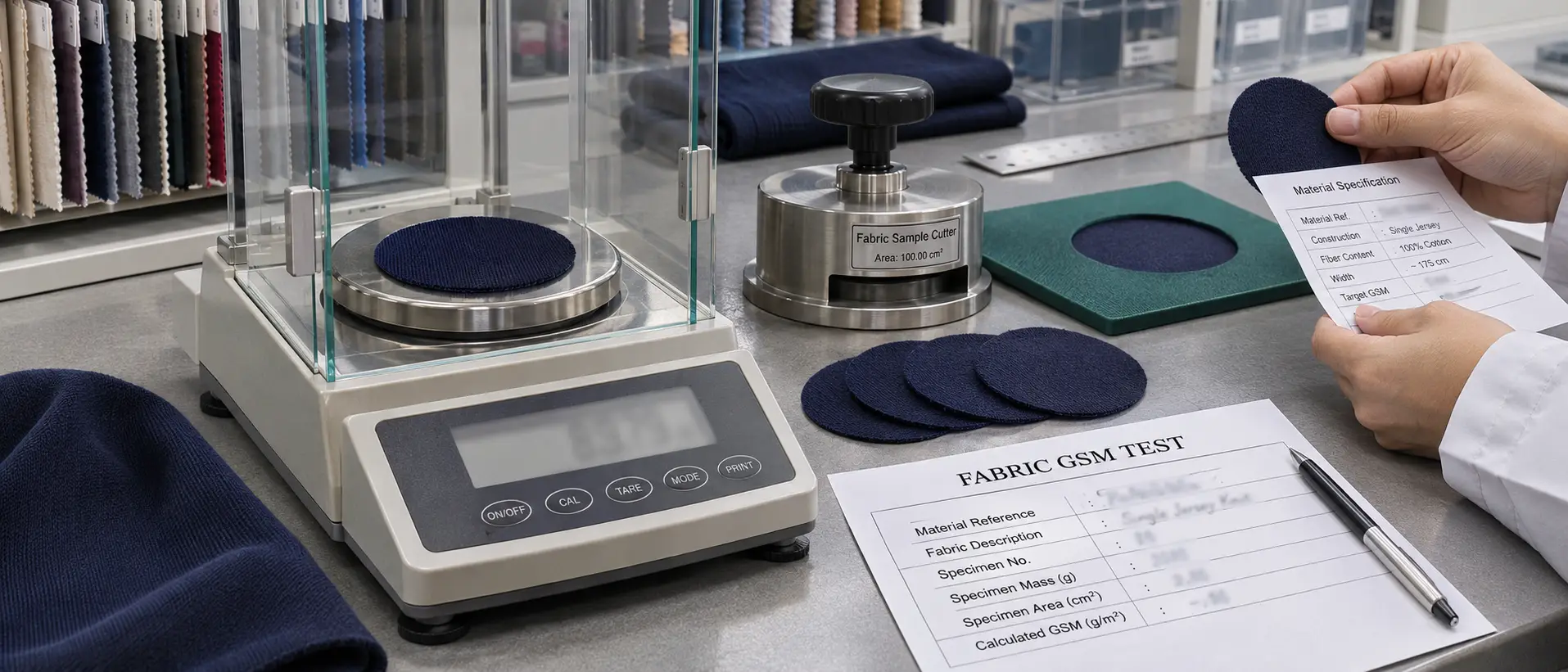
GSM stands for grams per square meter, a measurement of the mass of fabric occupying one square meter of area.
In technical terms, it describes mass per unit area, sometimes called areal density.
This means fabric weight can be compared independently of the dimensions of a finished garment. A small T-shirt and an oversized T-shirt made from the same fabric can have identical GSM specifications even though their total weights differ.
GSM in Fabric Means Mass per Unit Area
The expressions gsm in fabric means, meaning of gsm in fabric, and gsm meaning fabric all relate to the same question: what does the GSM number actually measure?
The answer is the textile’s mass relative to its area, not the total weight of the finished clothing product.
Consider three hypothetical fabrics:
- 150 GSM: 150 grams per square meter.
- 200 GSM: 200 grams per square meter.
- 300 GSM: 300 grams per square meter.
If equal areas of these fabrics are measured under comparable conditions, the 300 GSM material has twice the mass per unit area of the 150 GSM material.
However, their thickness, texture, elasticity, and performance may differ for reasons unrelated to mass alone.
Why Manufacturers Use Fabric GSM
Fabric Weight Comparison: GSM provides a numerical baseline for comparing candidate materials. It is most useful when comparing fabrics with similar construction and finishing.
Material Costing: GSM helps estimate the mass of fabric associated with a particular area. Combined with fabric price and consumption, it can support preliminary garment costing.
Production Specifications: GSM is recorded in the material specification so mills, manufacturers, and buyers can evaluate the intended fabric weight against agreed limits.
Bulk Quality Verification: Material weight can be checked during development and relevant production stages to identify unacceptable variation.
The phrase gsm fabric explained is therefore about more than understanding a number. For apparel buyers, GSM becomes useful when it is connected with actual material specifications and the garment’s intended characteristics.
GSM vs. Fabric Thickness, Opacity, and Drape
GSM is an important physical measurement, but it does not independently describe the entire fabric.
The distinction matters because two fabrics with the same weight can produce noticeably different garments.

Fabric Thickness vs. GSM
Fabric thickness vs gsm compares two different textile properties. GSM measures mass per unit area, while thickness measures the distance between the fabric surfaces under specified conditions.
A loosely constructed or heavily raised textile can be relatively thick without having an exceptionally high GSM. Another material may be compact and relatively thin despite having similar or greater mass per unit area.
Fiber properties, yarn construction, knitting or weaving density, and finishing all influence the result.
ASTM International’s standard test method for thickness of textile materials, ASTM D1777, describes thickness measurement and explains why the pressure applied during testing matters. This reinforces why thickness should not be assumed from GSM alone.
Opacity vs. GSM
Opacity vs gsm is particularly relevant for white T-shirts, leggings, and other garments where transparency can affect product acceptability.
A heavier fabric may provide greater coverage within certain comparable constructions, but higher GSM does not guarantee opacity.
Yarn properties, stitch density, color, fabric structure, and the degree of extension during wear also matter.
For example, a tightly constructed 200 GSM jersey may provide better coverage than a more open 220 GSM fabric. The actual result should be assessed using representative samples under relevant lighting and wearing conditions.
How GSM Affects Drape and Handfeel
Drape describes how fabric falls or hangs under its own weight and interacts with the garment’s shape.
Increasing the mass of an otherwise comparable fabric can change its drape, but stiffness, thickness, yarn structure, and finishing also affect the result.
A brushed 300 GSM textile may feel softer or bulkier than a compact material of the same weight. Similarly, softening or stabilization processes can change the way fabric handles without producing an equivalent change in GSM.
Video: Fabric Drapability, Stiffness, and Air Permeability
The following English-language textile education lesson, Fabric Testing: Air Permeability, is provided by the English and Foreign Languages University, Hyderabad, and indexed by the National Digital Library of India. It discusses fabric air permeability, stiffness, and drapability, helping explain why these textile characteristics need separate evaluation rather than being inferred from fabric weight alone.
Buyer Takeaway: Treat GSM as a useful starting measurement, not a complete product-quality assessment. Confirm the selected fabric’s construction, finish, handfeel, drape, and relevant performance before approval.
Fabric GSM by Clothing Category: Practical Weight Ranges

Choosing the right gsm for fabric depends on the garment category, intended fit, climate, and desired appearance. There is no single GSM range that guarantees suitable results across every clothing product.
The following gsm fabric weight chart provides illustrative lightweight, midweight, and heavyweight ranges for common apparel categories.
GSM Fabric Weight Chart by Product
| Garment Category | Lightweight | Midweight | Heavyweight |
|---|---|---|---|
| T-Shirts | 140-180 GSM | 180-220 GSM | 220-300+ GSM |
| Piqué Polo Shirts | 170-200 GSM | 200-240 GSM | 240-280+ GSM |
| Hoodies | 260-340 GSM | 340-480 GSM | 480-650+ GSM |
| Fleece Tops | 200-300 GSM | 300-380 GSM | 380-500+ GSM |
| Joggers | 260-340 GSM | 340-420 GSM | 420-550+ GSM |
| Leggings | 180-220 GSM | 220-280 GSM | 280-320+ GSM |
| Woven Shirts | 90-130 GSM | 130-170 GSM | 170-220+ GSM |
| Denim | 200-300 GSM | 300-400 GSM | 400-550+ GSM |
These ranges are broad product-development examples, not mandatory manufacturing specifications. Actual materials may fall outside them, and terms such as lightweight and heavyweight are relative to the fabric category. Denim is also commonly specified in oz/yd².
The lightweight fabric gsm classification for a woven shirt is different from the equivalent classification for a hoodie. Buyers should therefore interpret each range within its product category.
T-Shirt GSM: Choosing Between 200 and 300 GSM
T shirt gsm affects the garment’s weight, perceived substance, and potential drape. However, the gsm for t shirts should be selected together with the intended fit, construction, climate, and customer expectations.
200 GSM T-Shirt: A 200 gsm t shirt is commonly considered a substantial everyday jersey without necessarily entering the very heavyweight category. It can suit casualwear, regular-fit basics, and many premium T-shirt collections, depending on the fabric’s construction and finishing.
300 GSM T-Shirt: A 300 gsm t shirt is a heavyweight option often associated with structured streetwear or oversized silhouettes. It contains more fabric mass per unit area and may feel substantially heavier than a comparable 200 GSM jersey, but its comfort and durability still require evaluation.
For brands developing a gsm cotton t shirt, yarn characteristics, surface finishing, dimensional stability, and garment proportions should be reviewed alongside fabric weight.
A heavyweight material can be appropriate for a structured silhouette, while a lighter jersey may better suit a product intended for warm-weather everyday wear.
Hoodie GSM: What Is the Best Weight?
The best gsm for hoodies depends on whether the product is intended for lightweight layering, year-round casualwear, winter clothing, or substantial streetwear.
Common buyer searches include gsm hoodie, high gsm hoodie, and high quality gsm for hoodies. These phrases express interest in garment weight but do not define a complete hoodie specification.
400 GSM Hoodie: A 400 gsm hoodie may provide a substantial feel while remaining suitable for many casualwear and streetwear products. The actual result depends on the fabric structure, brushing, fiber composition, and garment design.
500 GSM Hoodie: A 500 gsm hoodie is generally a heavyweight direction that may support a more substantial silhouette. It can also increase the finished garment’s mass and affect material consumption and handling.
600 GSM Hoodie: A 600 gsm hoodie represents a very heavyweight fabric direction. Buyers should evaluate comfort, construction, drying behavior, sewing requirements, and manufacturing practicality before approval.
1000 GSM Hoodie: Claims involving a 1000 gsm hoodie require particular clarification. Buyers should verify whether the figure genuinely represents fabric mass per square meter or refers to total garment weight, multiple layers, or another measurement.
A heavier hoodie is not automatically better. The intended wearing conditions and actual material performance should determine the final choice.
Fleece GSM: Comparing 200 and 340 GSM
GSM fleece values need to be interpreted together with the textile’s construction and finishing, especially the treatment of the reverse surface.
200 GSM Fleece: A 200 gsm fleece may be suitable for lightweight layering or selected transitional-weather products, depending on the material. The term fleece should be clarified because it can describe different raised-surface textile constructions.
340 GSM Fleece: A 340 gsm fleece can provide greater mass per unit area and may suit sweatshirts, hoodies, or joggers requiring a more substantial feel. Its pilling resistance, dimensional stability, and surface appearance still depend on yarn and finishing.
A properly engineered 340 GSM material may perform better for a particular garment than a heavier alternative. Increasing GSM does not automatically improve durability or comfort.
Is 250 GSM Fabric Heavy?
The question is 250 gsm fabric heavy cannot be answered without knowing the product and textile construction.
For a single-jersey T-shirt, 250 GSM is generally toward the heavyweight side of common everyday jersey ranges. For some leggings or structured stretch knits, it may fall within a more typical range, while a 250 GSM woven shirting fabric may feel comparatively substantial.
The same distinction applies to heavy gsm fabric and midweight fabric gsm. These are useful comparative descriptions, but their interpretation depends on the actual material.
What Is the GSM of Cotton Fabric?
The gsm of cotton fabric is not determined by cotton content alone. Cotton fabrics can be lightweight, medium-weight, or heavyweight depending on yarn, construction, and finishing.
Searches such as gsm cotton often relate to cotton T-shirts, shirting, sweatshirts, or denim, but each category may require a different weight.
A lightweight cotton poplin and a heavyweight cotton jersey may both contain 100% cotton while having very different GSM values, textures, and applications.
Threads magazine’s guide to fabric weights and their practical applications explains how weight classifications vary across textile types and why fabric weight is most useful when compared with construction and handfeel.
GSM to Oz Conversion: How to Convert Fabric Weight Correctly
Textile suppliers commonly use GSM, while fabric weight is also frequently expressed in ounces per square yard (oz/yd²), especially for denim and certain US apparel markets.
Accurate conversion matters when suppliers use different units for the same material requirement.
GSM to Oz Conversion Formula
GSM to oz/yd²: oz/yd² = GSM / 33.906
Oz to GSM Conversion: GSM = oz/yd² × 33.906

For example, converting 200 GSM to ounces per square yard:
200 / 33.906 = 5.90 oz/yd²
Converting 12 oz/yd² to GSM:
12 × 33.906 = 406.87 GSM
The two values describe the same type of physical measurement, expressed in different units.
Fabric GSM to Oz Conversion Chart
| GSM | oz/yd² (Approx.) |
|---|---|
| 160 | 4.7 |
| 180 | 5.3 |
| 200 | 5.9 |
| 220 | 6.5 |
| 250 | 7.4 |
| 300 | 8.8 |
| 350 | 10.3 |
| 400 | 11.8 |
| 500 | 14.7 |
| 600 | 17.7 |
This fabric gsm to oz conversion chart can be used as a quick reference during supplier discussions.
When discussing gsm to oz fabric requirements, always confirm that the supplier means ounces per square yard, not ounces per linear yard or ounces for an entire garment.
GSM vs. Oz per Square Yard
Both units measure fabric mass per area.
However, gsm vs oz per square yard is different from comparing total garment weights because the latter also depends on garment dimensions and components.
ISO’s standard for determining mass per unit length and mass per unit area of woven fabrics, ISO 3801, addresses these measurement concepts for woven textiles. It also helps clarify why fabric mass per running length and fabric mass per area should not be confused.
How to Calculate GSM of Fabric and Check Fabric Weight
Knowing how to calculate gsm of fabric helps buyers verify material weight instead of relying solely on a supplier’s stated specification.
The calculation requires two measurements: the mass of a fabric specimen and its accurately measured area.
GSM Measurement of Fabric: Basic Formula

GSM Formula:
GSM = (Sample Weight in Grams / Sample Area in cm²) × 10,000
For example, if a 400 cm² specimen weighs 8 grams:
Calculation:
(8 / 400) × 10,000 = 200 GSM
This formula works for any accurately measured sample area expressed in square centimeters.
GSM Cutter Method
A common method uses a circular sample cutter that produces a specimen measuring exactly 100 cm².
Because 100 cm² equals 1/100 of a square meter, the calculation becomes simpler.
GSM Formula for a 100 cm² Sample:
GSM = Sample Weight (g) × 100
For example, if a sample weighs 2.00 grams:
Calculation:
2.00 × 100 = 200 GSM
This multiplication factor is correct only when the specimen area is 100 cm².
How to Check the GSM of Fabric Step by Step
- Prepare the Sample: Select representative material and follow the required conditioning and preparation procedure. Avoid unsuitable areas, creases, or unintended tension.
- Cut the Specimen: Use a suitable cutter or accurate template to obtain the required area.
- Weigh the Material: Measure the specimen using an appropriately precise balance.
- Calculate GSM: Apply the formula corresponding to the actual sample area.
- Repeat and Record: Measure the number of specimens required by the applicable procedure and document the individual results and average.
- Compare With Requirements: Evaluate the results against the buyer-approved GSM range and relevant test conditions.
For example, three illustrative 100 cm² samples may weigh 1.98 g, 2.01 g, and 2.00 g. Their average mass is approximately 1.997 g, corresponding to an average of 199.7 GSM.
Three measurements are used here for illustration, not as a universal sampling requirement.
Can Fabric GSM Be Checked Without a Cutter?
A fabric specimen can be measured and weighed without a circular GSM cutter, provided its area is known accurately.
For example, a carefully prepared 20 cm × 20 cm specimen covers 400 cm². The general GSM formula can then be applied using its measured mass.
However, inaccurate cutting, stretching, moisture variation, and insufficient scale precision can affect the result.
The method may be useful for preliminary checks, but formal acceptance testing should follow the buyer’s required procedure.
What Is a GSM Scale for Fabric?
The phrase gsm scale for fabric commonly refers to a balance or weighing system used with prepared textile specimens.
The scale measures mass, while GSM is calculated using the specimen’s area. Some equipment can display GSM directly when the correct sample area is configured.
ASTM International’s standard test methods for measuring fabric mass per unit area, ASTM D3776/D3776M, describe several recognized measurement approaches, including full pieces, full-width specimens, and smaller material samples. The appropriate method and specimen condition should be selected for the intended verification.
When Should Buyers Verify GSM?
Development Stage: Check whether the proposed fabric meets the intended weight requirement before proceeding with relevant product approvals.
Pre-Production Stage: Confirm weight where necessary using production-representative fabric and the agreed testing conditions.
Bulk Material Stage: Conduct relevant lot checks when required by the buyer’s control plan or where material variation presents a significant risk.
A change in mill, construction, finishing, or other material characteristics may justify further evaluation, but a complete retesting program is not automatically required for every change.
Prepare Your Fabric Specifications for Quotation and Sampling
Understand the technical information needed before clothing manufacturing, including fabric composition, GSM, construction, measurements, order quantities, and design requirements. Review RYZEAL SOURCING’s specification preparation guidelines to support more accurate quotations and sample development.
How GSM Changes Garment Cost, Consumption, and Cutting Yield

GSM cost considerations begin with the relationship between fabric mass, material area, and price.
A higher-GSM material contains more mass per square meter, but its final cost also depends on fiber prices, yarn characteristics, construction, finishing, sourcing, and usable yield.
Fabric Weight and Material Consumption
Consider two hypothetical fabrics used for a garment requiring 1.0 m² of net fabric area.
Assume both cost $5.00 per kilogram and have an additional material allowance of 10%.
| Cost Factor | Fabric A | Fabric B |
|---|---|---|
| GSM | 200 | 300 |
| Net Fabric Area | 1.0 m² | 1.0 m² |
| Fabric Mass Before Allowance | 0.20 kg | 0.30 kg |
| Additional Allowance | 10% | 10% |
| Estimated Chargeable Fabric Mass | 0.22 kg | 0.33 kg |
| Price per Kilogram | $5.00 | $5.00 |
| Estimated Fabric Cost | $1.10 | $1.65 |
Fabric Mass Formula: Fabric Mass (kg) = (GSM × Fabric Area in m²) / 1,000
Fabric Cost Formula: Estimated Cost = Fabric Mass (kg) × (1 + Additional Allowance Rate) × Price per kg
In this simplified example, the higher-GSM fabric increases estimated material cost by 50%.
However, this result assumes the same net area, material price per kilogram, and additional allowance. Real production may involve different cutting efficiency, usable width, prices, or processing costs.
Cutting Yield vs. GSM
Cutting yield vs gsm requires separate consideration because material weight does not directly determine how efficiently pattern pieces fit into a fabric width.
Marker utilization depends on garment patterns, size ratios, fabric width, grain requirements, and cutting restrictions.
Heavier materials may also affect lay height, handling, or cutting conditions, but these effects vary by fabric construction and equipment.
Freight and Finished Garment Weight
Increasing fabric GSM may increase the mass of otherwise comparable garments, which can affect packing and transportation.
However, the final garment weight also includes ribs, pockets, linings, zippers, labels, and other components.
For accurate costing, the buyer should evaluate the full garment construction rather than estimating shipping weight from GSM alone.
GSM and Durability: Does Heavier Fabric Last Longer?
GSM Meaning in Fabric should not be confused with a durability rating.
Higher fabric mass may contribute to a more substantial feel within comparable constructions, but it does not automatically provide better abrasion resistance, shape retention, or overall service life.
Why Equal-GSM Fabrics Can Perform Differently
Two 250 GSM fabrics may behave differently because of their fiber properties, yarn construction, stitching or weaving density, and finishing processes.
One material may develop unacceptable pilling after repeated wear, while another retains a more consistent surface.
Similarly, a heavy jersey can experience significant dimensional change if its construction and finishing do not provide suitable stability.

Durability Tests Beyond GSM
When durability matters, buyers should identify relevant performance requirements.
These may include pilling resistance, abrasion resistance, dimensional stability, seam behavior, and recovery after stretching.
Intertek’s textile testing services for apparel materials describe evaluations covering textile performance and related quality requirements. Such testing provides evidence about material behavior that fabric weight alone cannot establish.
The appropriate testing requirements should reflect the product’s intended use rather than assuming every fabric needs the same test package.
Our guide to fabric testing for shrinkage, pilling, colorfastness, and spirality will explain how buyers verify these properties and interpret relevant test results.
How to Write GSM Requirements Into Fabric Specifications
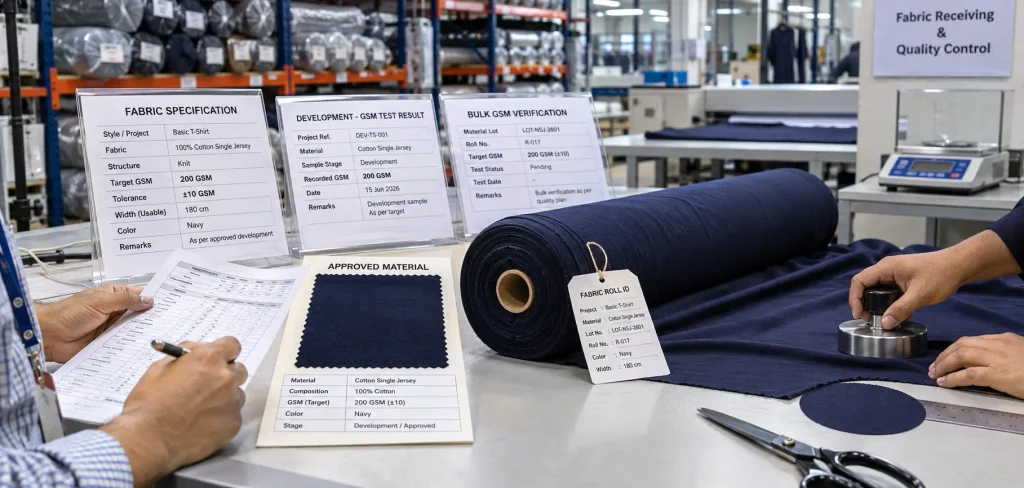
The fabric weight gsm requirement should be documented as a measurable material property rather than a general description such as “heavy cotton” or “premium fleece.”
A reliable specification identifies the target, permitted variation, measurement method, and applicable verification stage.
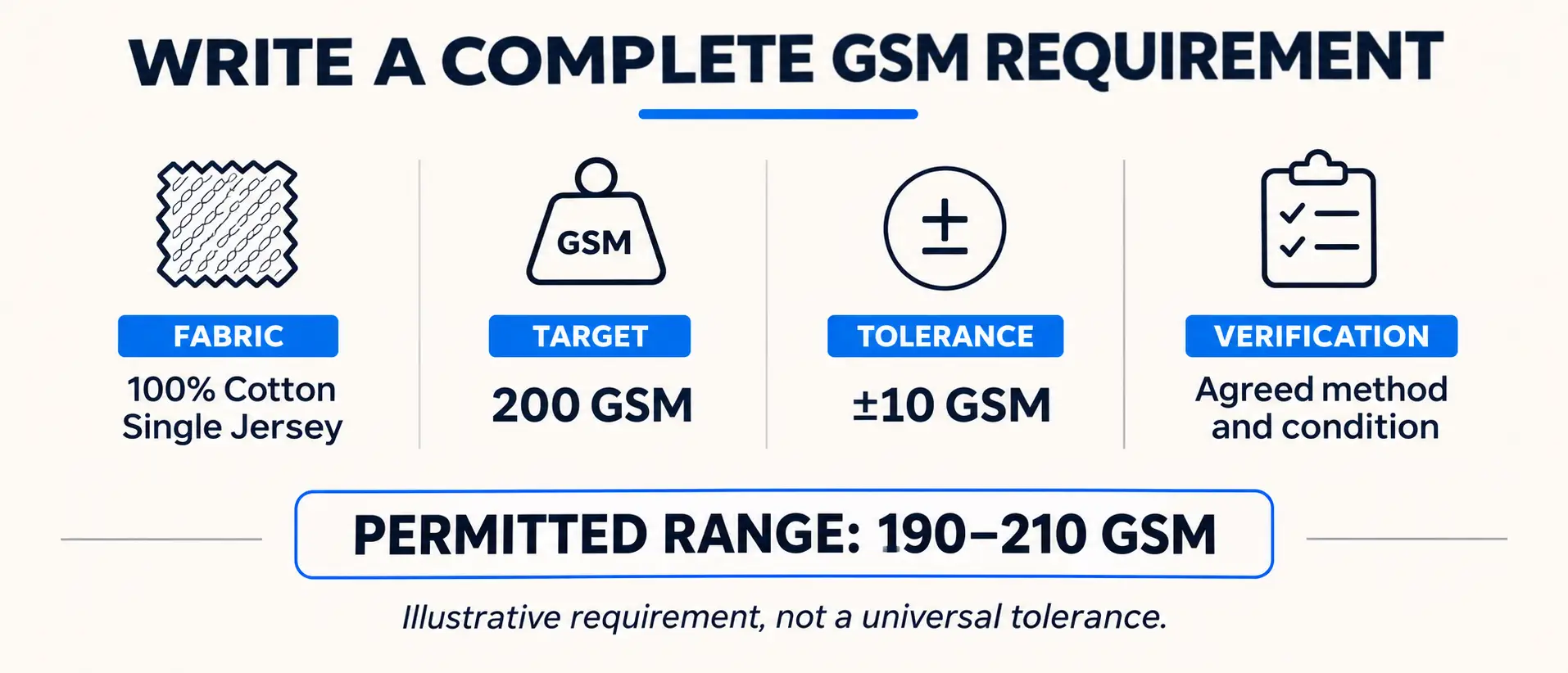
Example Fabric GSM Specification
Fabric: 100% Cotton Single Jersey
Target GSM: 200 GSM
Permitted Variation: ±10 GSM
Acceptable Range: 190-210 GSM
Measurement: Approved mass-per-unit-area procedure on fabric in the specified condition
Verification: Development and relevant bulk checks according to the agreed quality plan
The values are illustrative. Buyers and suppliers should agree on appropriate limits for the actual material.
Why Construction and Finishing Must Also Be Defined
A manufacturer may produce two fabrics with the same target GSM but different yarn characteristics or finishing.
Therefore, a complete material description should identify relevant construction, composition, finishing, and performance requirements alongside weight.
Our guide to fabric specifications and GSM tolerance requirements explains how to document these fields in a complete specification sheet for quotation, sampling, and manufacturing approval.
Our supporting guide to types of fabric construction and their effects on weight and drape explains why knit, woven, and other textile structures behave differently despite similar GSM measurements.
Frequently Asked Questions About GSM Meaning in Fabric
1. What does GSM mean in fabric in simple words?
GSM means grams per square meter. It tells buyers how much one square meter of fabric weighs and provides a consistent unit for comparing material mass per area.
2. Is higher GSM always better quality?
No. Higher GSM means greater mass per unit area, but textile quality also depends on composition, yarn, construction, finishing, and performance. A lighter, well-engineered fabric may be more suitable than a heavier alternative.
3. What is a good T-shirt GSM for everyday wear?
Many everyday T-shirts use fabrics around 160-220 GSM, although suitable materials may fall outside this range. The best choice depends on the intended fit, feel, construction, and wearing conditions.
4. Is a 300 GSM T-shirt too heavy for hot weather?
A 300 GSM T-shirt may feel substantially heavier than a comparable 180-200 GSM jersey. Its suitability for hot weather depends on construction, fit, airflow, and wearer preference.
5. What is the best GSM for hoodies?
There is no single best hoodie GSM. Material weight should be selected according to the intended silhouette, climate, comfort, construction, and finishing.
6. Why do two fabrics with identical GSM feel different?
Yarn characteristics, fiber composition, textile construction, and finishing can produce different thicknesses, textures, and drape. GSM measures mass per area, not these properties individually.
7. How to check T-shirt GSM at home or in a factory?
When considering how to check t shirt gsm, cut a specimen of accurately known area, weigh it using a precise scale, and calculate the mass per square meter. Formal acceptance checks should follow the applicable method and sampling requirements.
8. How do I convert GSM to ounces per square yard?
Divide GSM by approximately 33.906 to obtain oz/yd². To convert oz/yd² to GSM, multiply by 33.906.
9. Is 250 GSM fabric heavy for knitted and woven materials?
A 250 GSM single jersey may be considered heavyweight for certain T-shirts, while a 250 GSM woven fabric can have a substantially different structure and feel. Compare the material within its construction and product category.
10. When should buyers recheck GSM during bulk production?
GSM may need reverification when production conditions or material characteristics change significantly, or when the quality plan requires bulk material checks. Verification frequency should reflect buyer requirements and production risk.
Final Takeaway: Use GSM to Compare Fabric, Not Judge Quality Alone
Understanding GSM Meaning in Fabric helps clothing brands make more informed decisions about material weight, garment feel, consumption, and manufacturing specifications.
GSM is most useful when combined with fabric construction, composition, finishing, physical samples, and relevant quality verification.
For apparel buyers, the practical approach is to select a suitable weight range, evaluate actual materials, agree on acceptable variation, and confirm the requirements before the relevant bulk production activities begin.
RYZEAL SOURCING supports fabric sourcing and apparel manufacturing coordination through a network of specialized independent manufacturing partners in Bangladesh, helping brands align material requirements with suitable garment development and production arrangements.
Ready to Manufacture Clothing With the Right Fabric GSM?
Share your garment type, target fabric GSM, composition, construction, estimated quantity, and customization requirements with RYZEAL SOURCING. Our merchandising and sourcing team can review your requirements and coordinate appropriate manufacturing options through our partner network in Bangladesh.
The right fabric weight is not necessarily the highest GSM. It is the weight that supports the garment’s intended appearance, comfort, performance, and commercial requirements.
Connect with RYZEAL SOURCING