

Fabric selection is one of the most important decisions in clothing manufacturing because the material affects how a garment looks, feels, fits, performs, and behaves during production and everyday use.
Choosing the right fabric involves more than finding an attractive texture or selecting a familiar fiber such as cotton or polyester. Apparel brands must evaluate fabric weight (GSM), fiber composition, knit or woven construction, dimensional stability, colorfastness, durability, finishing, and sourcing feasibility.
A fabric that looks excellent in a showroom may behave differently after washing, cutting, sewing, or repeated wear. Two fabrics with identical fiber compositions can also produce noticeably different garments because of their yarn characteristics, construction, finishing processes, and performance properties.
For clothing brands, product developers, merchandisers, sourcing professionals, and quality assurance teams, effective fabric selection means matching the material to the garment’s intended use and establishing specifications that manufacturers can reproduce consistently.
Fabric decisions also influence garment costing, fabric consumption, manufacturing lead times, testing requirements, and the likelihood of costly revisions between sample development and bulk production.
This fabric selection guide explains how to choose fabrics for clothing manufacturing by evaluating four essential factors:
This fabric selection guide explains how to choose fabrics for clothing manufacturing by evaluating four essential factors:
- GSM: The fabric’s mass per unit area and its relationship with garment weight and handling.
- Composition: The fibers and blends that influence material properties.
- Construction: How yarns or fibers are assembled into the fabric.
- Performance: How the finished material behaves under specified conditions.
It also covers fabric quality parameters, shrinkage, colorfastness, pilling, fabric testing, supplier selection, manufacturing costs, and the technical specifications buyers should approve before bulk production.
Table of Contents
What Is Fabric Selection in Clothing Manufacturing?
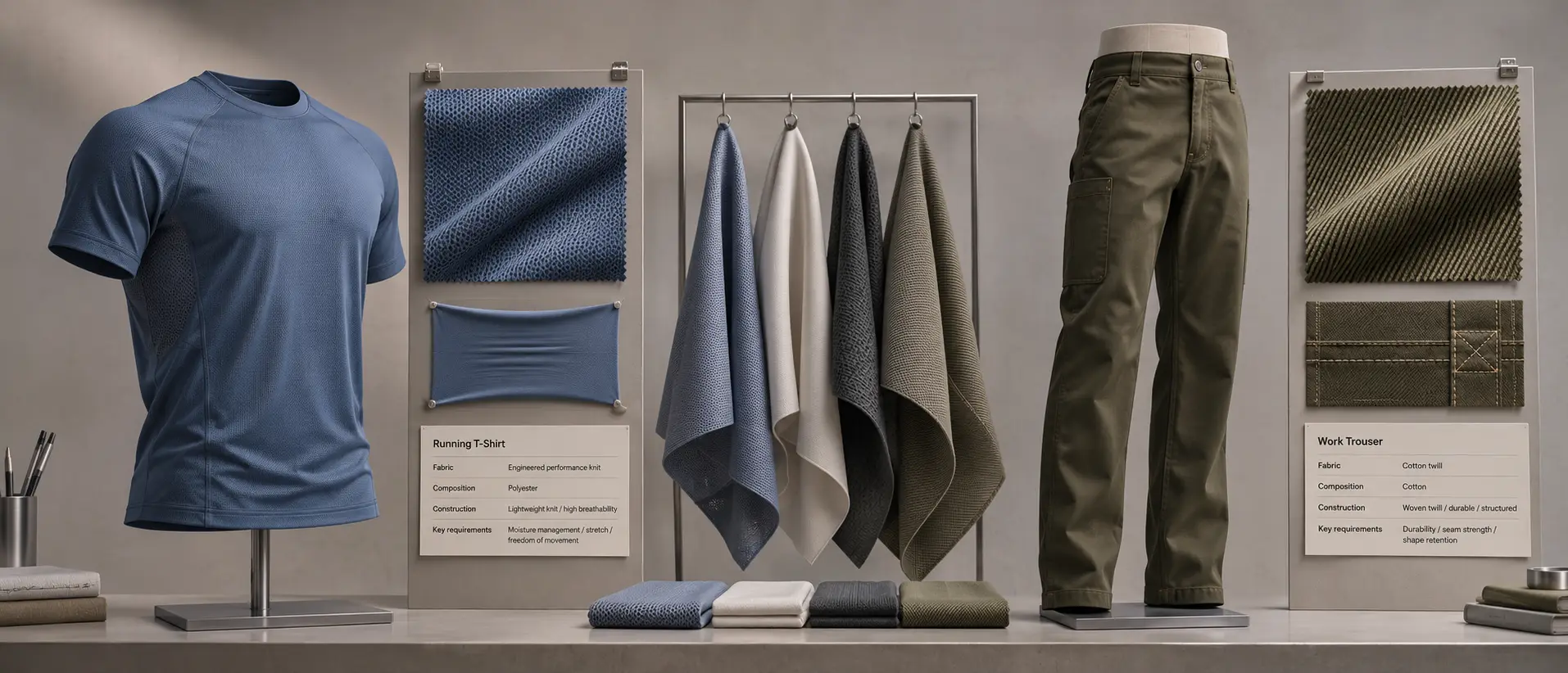
Fabric selection is the process of identifying, comparing, testing, and approving textile materials that meet a garment’s design, functional, quality, commercial, and manufacturing requirements.
It connects the clothing design with the materials and production processes needed to manufacture the intended product.
For example, a brand developing a lightweight running T-shirt may prioritize moisture management, comfort, stretch, and drying behavior. A manufacturer producing structured work trousers may need different characteristics, including abrasion resistance, dimensional stability, seam performance, and shape retention.
Both products require suitable fabrics, but their selection criteria are not interchangeable.
Why Fabric Selection Matters for Apparel Brands
A poor fabric decision can affect several stages of production.
Product Fit and Appearance: Fabric stretch, recovery, drape, thickness, and dimensional stability influence how a garment fits and maintains its intended shape.
Manufacturing Efficiency: Fabric width, construction stability, surface characteristics, and handling behavior affect cutting, sewing, finishing, and inspection.
Product Performance: The intended use may require specific strength, abrasion resistance, dimensional stability, comfort, or colorfastness properties.
Garment Costing: Fabric price alone does not determine garment material cost. Consumption, usable width, wastage, processing, and quality losses also matter.
Bulk Consistency: The material used during sampling should represent the approved production requirements. Uncontrolled changes in yarn, mill, construction, or finishing can affect the finished garment.
Fabric Selection vs. Fabric Sourcing
Although closely related, these activities have different functions.
Fabric selection determines the material specifications and performance requirements suitable for the garment.
Fabric sourcing identifies manufacturers or suppliers capable of providing material that meets those requirements under the agreed quantity, quality, price, and delivery conditions.
Selecting a suitable fabric without confirming its availability can create problems when the buyer moves from development to bulk production.
Similarly, choosing the lowest available fabric quote without verifying the material can result in unexpected differences in garment performance.
A successful sourcing program must connect both decisions.
The Fabric Selection Process at a Glance
A practical process follows seven steps:
- Define the garment’s intended use and performance expectations.
- Identify appropriate fabric construction families.
- Compare suitable fiber compositions and blends.
- Establish fabric weight, width, finishing, and appearance requirements.
- Evaluate samples and conduct relevant testing.
- Compare supplier capability, costs, and lead times.
- Document the approved fabric specification and production controls.
This framework provides a foundation for selecting materials without treating one characteristic, such as GSM or fiber composition, as the sole indicator of quality.
Fabric Selection Guide: Four Decisions Buyers Must Make Before Sampling
Before requesting fabric swatches or approaching textile mills, buyers should identify the garment requirements that will influence material selection.
The four most important decisions involve end use, construction, composition, and performance.
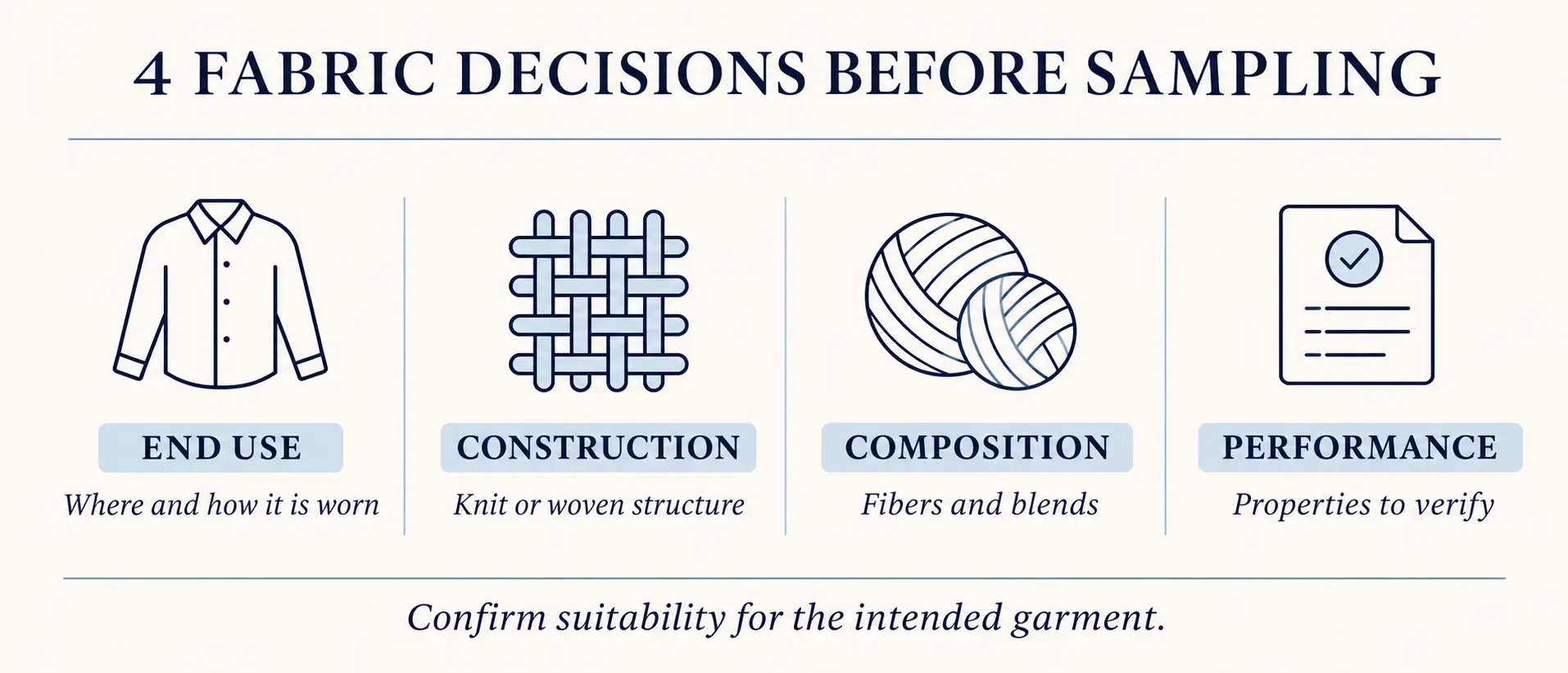
Decision 1: Define the Garment’s Intended Use
Start by identifying how, where, and under what conditions the garment will be worn.
Consider whether the product is intended for:
- Everyday casual wear
- Sports and physical activity
- Corporate or school uniforms
- Workwear
- Fashion collections
- Outdoor use
- Sleepwear or loungewear
- Children’s clothing
The intended use should guide the properties requiring evaluation.
For example, activewear may require relevant stretch recovery, moisture-management properties, and colorfastness to perspiration. A uniform intended for repeated laundering may place greater emphasis on color retention, durability, and dimensional stability.
Where protective performance is required, the applicable safety and regulatory standards must also be identified.
A conventional fashion fabric should not be considered suitable for specialized protective clothing without appropriate qualification.
Decision 2: Choose the Fabric Construction
Fabric construction describes how yarns or fibers are arranged to form a textile.
For many apparel products, the principal categories are knitted and woven fabrics.
Knitted fabrics generally use interconnected loops, while woven fabrics typically use interlaced warp and weft yarns.
The construction influences stretch behavior, stability, drape, surface appearance, cutting characteristics, and sewing performance.
A casual T-shirt may use single jersey knit fabric, while a formal shirt may use a woven poplin construction.
The fiber composition alone does not establish these structural differences.
Decision 3: Select the Fiber Composition
Composition identifies the fibers used to manufacture the material.
Examples include:
- 100% cotton
- 100% polyester
- Cotton-polyester blends
- Polyester-viscose blends
- Nylon-elastane blends
- Cotton-elastane blends
Each option can offer particular advantages, but its actual performance depends on the construction, yarn, finishing, and other material characteristics.
A 100% cotton fabric is not automatically softer, more durable, or higher quality than every blended alternative.
Likewise, polyester content alone does not guarantee suitable moisture management or garment comfort.
Decision 4: Establish Measurable Performance Requirements
Performance requirements should reflect the garment’s intended use and potential failure risks.
They may include:
- Dimensional stability after laundering
- Colorfastness to washing or rubbing
- Pilling resistance
- Abrasion resistance
- Stretch and recovery
- Moisture management
- Air permeability
- Seam strength or slippage
- Water resistance
- Relevant safety and chemical requirements
The buyer should define which characteristics matter and how they will be evaluated.
A requirement such as “good colorfastness” is less useful than a specification identifying the relevant test method, exposure conditions, and agreed acceptance criteria.
Fabric Selection Decision Matrix
| Garment / End Use | Possible Construction | Illustrative GSM Direction | Possible Composition | Key Risks to Evaluate |
|---|---|---|---|---|
| Casual T-Shirt | Single jersey or interlock | Lightweight to medium | Cotton, polyester, or blends | Shrinkage, spirality, pilling, opacity |
| Polo Shirt | Piqué, jersey, or interlock | Medium | Cotton, polyester, or blends | Shape retention, shrinkage, colorfastness |
| Hoodie | French terry or fleece-backed knit | Medium to heavyweight | Cotton, polyester, or blends | Pilling, shrinkage, handfeel consistency |
| Woven Shirt | Poplin, twill, or other suitable weave | Lightweight to medium | Cotton, polyester, viscose blends | Wrinkling, seam behavior, dimensional change |
| Activewear | Engineered knit or stretch woven | Application dependent | Polyester, nylon, elastane blends | Recovery, perspiration fastness, abrasion |
| Chino Trousers | Twill or other suitable woven | Medium to heavyweight | Cotton or blended fibers | Abrasion, colorfastness, seam strength |
| Denim Jeans | Denim twill | Product dependent | Cotton with optional stretch fibers | Wash shrinkage, color transfer, recovery |
These are candidate directions, not prescribed specifications. Final GSM, composition, construction, and test requirements must be established for the actual garment.
The matrix helps narrow the initial choices. The next step is to evaluate the fabric’s physical and performance properties rather than automatically approving an option because its category appears suitable.
GSM and Fabric Weight: How to Choose the Right Weight for Clothing

GSM is one of the most frequently used fabric specifications in apparel manufacturing. However, its meaning is often misunderstood.
What Does GSM Mean in Fabric?
GSM stands for grams per square meter. It measures the mass of fabric occupying an area of one square meter.
For example:
- A 150 GSM fabric has a mass of 150 grams per square meter.
- A 220 GSM fabric has a mass of 220 grams per square meter.
- A 350 GSM fabric has a mass of 350 grams per square meter.
This measurement is useful for comparing fabric weights, but it does not independently establish the fabric’s quality, durability, thickness, or suitability.
ASTM International’s standard test methods for mass per unit area of fabric, ASTM D3776/D3776M, provide recognized approaches for determining fabric weight using full pieces, full-width samples, smaller specimens, and narrow fabrics. Buyers should specify the appropriate testing method and material condition when comparing results.
Does Higher GSM Mean Better Fabric?
Not necessarily.
A heavier fabric may provide a more substantial appearance or feel for certain products, but this does not make it automatically superior.
For example, a heavyweight jersey T-shirt may suit a structured streetwear collection, while a lightweight engineered knit may be more suitable for a specific running garment.
The correct GSM depends on the product and its intended wearing conditions.
A heavier fabric may also increase garment mass and material consumption.
Other properties such as strength, opacity, air permeability, and surface durability must be evaluated independently when they matter.
GSM vs. Fabric Thickness
GSM and thickness are different measurements.
GSM measures mass per unit area, while thickness describes the distance between the fabric surfaces under specified measuring conditions.
Two fabrics can have identical GSM but different thicknesses.
For example, a compact knitted material may be relatively thin and dense, while a brushed material with the same GSM may feel bulkier because of its raised surface.
Fiber characteristics, yarn structure, fabric density, and finishing all influence the result.
GSM vs. Fabric Opacity
Opacity describes how effectively a fabric prevents light from passing through or limits the visibility of underlying objects.
A higher GSM does not guarantee opacity.
A fabric’s structure, yarn properties, color, and finishing can affect transparency.
Where opacity is commercially important, such as white T-shirts or leggings, buyers should evaluate the actual material under representative wearing and lighting conditions.
Relevant laboratory or physical assessments may also be appropriate.
Illustrative GSM Ranges by Garment Category
| Garment Category | Illustrative GSM Range | Common Material Direction |
|---|---|---|
| Lightweight T-Shirt | 120-160 GSM | Single jersey |
| Everyday T-Shirt | 160-220 GSM | Single jersey or interlock |
| Heavyweight T-Shirt | 220-300 GSM | Compact jersey or other suitable knit |
| Polo Shirt | 180-280 GSM | Piqué, jersey, or interlock |
| Sweatshirt | 240-400 GSM | French terry or fleece-backed knit |
| Hoodie | 280-450 GSM | French terry or fleece-backed knit |
| Activewear Top | 100-220 GSM | Engineered lightweight knit |
| Leggings | 180-300 GSM | Stretch knit or interlock |
| Woven Shirt | 90-180 GSM | Poplin, twill, or related woven |
| Denim | 250-475 GSM | Denim woven construction |
These ranges are broad illustrative product-development examples, not industry standards or mandatory manufacturing specifications. Denim is also commonly traded by fabric weight in ounces per square yard. Actual materials may fall outside these ranges.
A product’s fabric weight should be selected together with its construction, composition, fit, finishing, and required properties.
How GSM Influences Garment Cost
Fabric weight can affect material consumption when other important variables remain comparable.
For example, increasing the GSM of the same fabric construction and usable width may increase the mass required to produce an otherwise similar garment.
However, garment material cost is not determined by GSM alone.
The buyer should also consider:
- Fabric price per kilogram or meter
- Usable fabric width
- Marker utilization
- Fabric relaxation and shrinkage allowances
- Cutting wastage
- Defects and shade separation
- Finishing requirements
- Changes in sewing and handling processes
A low-GSM fabric with poor usable width or unacceptable stability may be less economical than a heavier alternative.
How to Approve GSM Before Bulk Production
The fabric specification should establish:
- Target GSM or an agreed range.
- The applicable permissible variation.
- Measurement method and material condition.
- Whether the requirement applies before or after specified finishing or washing.
- The relevant development and bulk verification stages.
For example, a buyer might specify an illustrative target of 220 GSM with an agreed tolerance of ±5%.
That would produce a permitted range of 209-231 GSM under the stated conditions.
The percentage is an example only. It should not be adopted without agreement on the actual fabric and applicable measuring procedure.
For more detailed weight calculations, consumption examples, and comparisons, our upcoming guide to GSM meaning in fabric and its effect on garment cost will examine how fabric mass interacts with construction and product requirements.
Fabric Composition: Cotton, Polyester, Viscose, Elastane, and Fiber Blends
Fiber composition identifies the materials from which a fabric is made.
It influences numerous characteristics, including moisture behavior, appearance, strength, care requirements, and processing options.
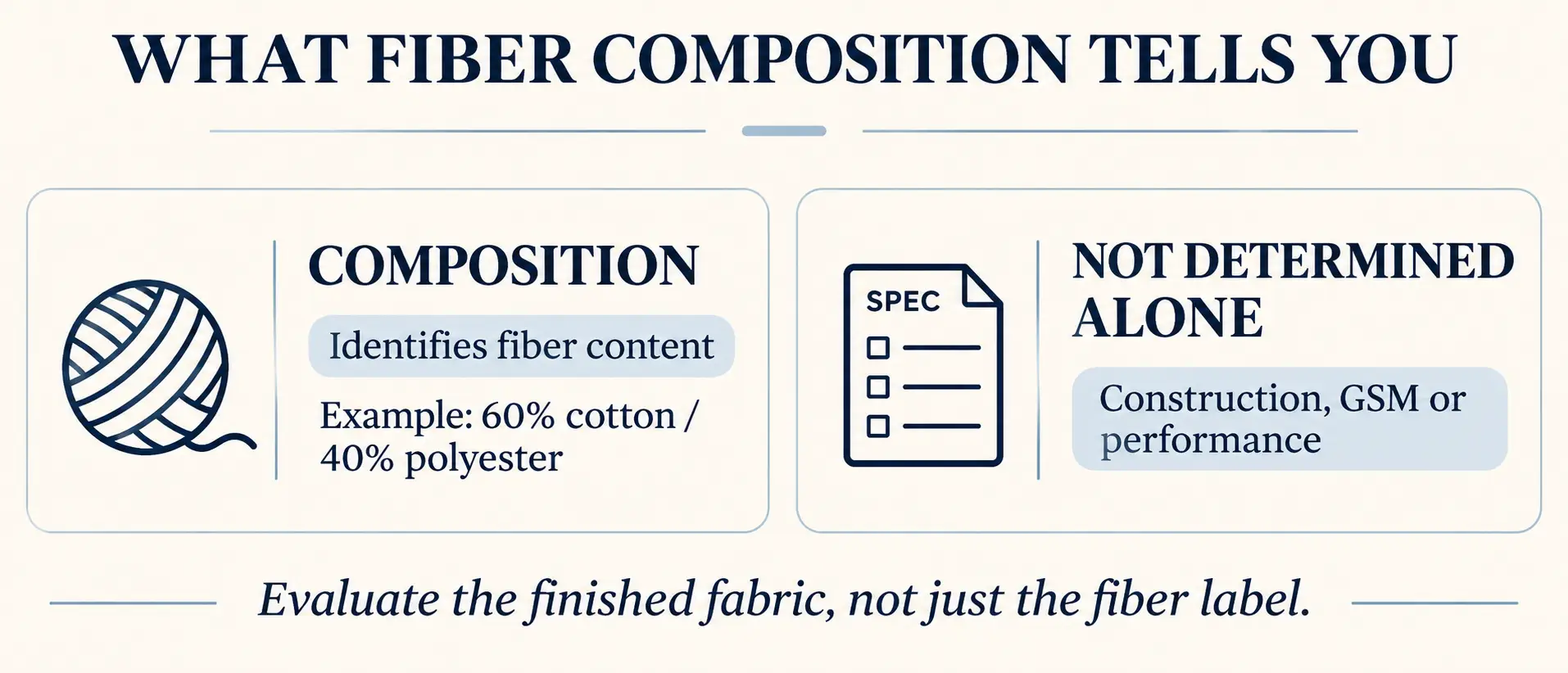
However, a fabric’s performance cannot be reliably predicted from its fiber label alone.
Cotton Fabric
Cotton is a natural cellulosic fiber commonly used in T-shirts, shirts, denim, underwear, casualwear, and many other apparel products.
It is frequently selected for its familiar handfeel and ability to absorb moisture.
Depending on yarn and fabric construction, cotton textiles can also offer suitable comfort and versatility across different product categories.
Important considerations include dimensional stability, drying behavior, wrinkles, and the performance of the selected yarn and finish.
Cotton quality can vary with fiber properties, spinning methods, fabric construction, and processing.
Polyester Fabric
Polyester is a synthetic fiber used in casualwear, sportswear, uniforms, linings, and many blended fabrics.
Its properties can support strength, dimensional stability, and relatively low moisture absorption.
However, the comfort and moisture-management behavior of a polyester garment depend on its yarn engineering, construction, fit, and finishes.
A polyester sportswear fabric may be engineered to transport moisture effectively, while another polyester construction may perform differently.
Polyester content should not be considered automatic proof of cooling, moisture wicking, or odor resistance.
Viscose Fabric
Viscose is a regenerated cellulosic fiber commonly used where softness, fluid drape, and a particular surface appearance are desired.
It can be suitable for dresses, blouses, fashion garments, and blended textiles.
However, stability and care performance depend on its fiber and yarn characteristics, fabric construction, finishing, and manufacturing route.
Certain viscose fabrics may require particular attention to dimensional change, wet handling, and garment care.
These risks should be evaluated through relevant testing rather than assumed to apply equally to every viscose construction.
Nylon or Polyamide Fabric
Nylon, also known as polyamide, is used in applications where strength, abrasion behavior, lightweight construction, or particular handfeel characteristics are important.
It is commonly found in outerwear, sportswear, hosiery, and various technical textiles.
Specific nylon fabrics may differ considerably in stretch, weight, drying behavior, and wear performance.
Relevant characteristics should be specified and verified for the intended garment.
Elastane or Spandex
Elastane, commonly called spandex in some markets, is an elastic fiber added to fabrics to provide stretch and contribute to recovery.
It is frequently used in:
- Leggings
- Sportswear
- Stretch denim
- Fitted dresses
- Stretch woven trousers
- Underwear
- Other body-fitting garments
However, elastane percentage alone does not indicate the fabric’s total stretch or recovery performance.
Yarn arrangement, fabric construction, heat-setting, finishing, and the behavior of accompanying fibers also matter.
For close-fitting garments, buyers should evaluate both stretch and recovery.
A fabric that stretches easily but does not recover sufficiently may produce unwanted bagging or shape distortion.
Fiber Composition Tradeoffs by Product Objective
| Product Objective | Candidate Fiber Direction | Important Considerations |
|---|---|---|
| Natural-fiber handfeel | Cotton or suitable cellulosic fibers | Shrinkage, drying, yarn quality |
| Fluid drape | Viscose or appropriate blends | Dimensional stability, care performance |
| Engineered sportswear | Polyester or nylon blends | Moisture management, recovery, surface durability |
| Stretch and close fit | Blends containing elastane | Stretch, recovery, heat sensitivity |
| Structured casualwear | Cotton or blended woven fabrics | Wrinkling, abrasion, seam behavior |
| Easy-care uniforms | Suitable synthetic or blended fabrics | Color retention, care performance, comfort |
| Soft brushed garments | Suitable cotton, polyester, or blends | Pilling, surface stability, finishing |
The table identifies possible material directions, not guaranteed performance outcomes.
Why Fiber Blends Are Used
Blending allows manufacturers to combine fibers with different properties.
For example, cotton-polyester blends may be selected to achieve a particular balance of handfeel, care behavior, durability, cost, and manufacturing performance.
A polyester-elastane blend may be selected for fitted activewear when the fabric’s construction supports the required extension and recovery.
Yet two fabrics with the same blend percentage can behave very differently.
A 60% cotton and 40% polyester composition does not specify the yarn, knit structure, density, GSM, finish, or final performance.
Those characteristics must be documented separately.
Our guide to fiber blend choices for clothing manufacturing will examine how different blend combinations influence comfort, garment care, strength, stretch, and production requirements.
Sustainable Fabric Selection: What Buyers Should Verify
Environmental material claims should be evaluated using relevant evidence.
Terms such as recycled, organic, responsible, or sustainable do not automatically establish the complete environmental performance of a garment.
For products making specific material claims, relevant checks may include:
- Documented fiber composition
- Applicable third-party certification
- Supplier and facility certification status
- Chain-of-custody or transaction records, where required
- Traceability of the claimed material
- Authorized use of certification names and labels
- Restricted-substance or chemical requirements
- Product performance and durability
The applicable documentation depends on the claim and certification scheme.
Textile Exchange’s standards development and materials certification framework explains how its programs address material production, processing, and related assurance requirements. Textile Exchange published the Materials Matter Standard in December 2025, with an effective date of December 31, 2026, and a subsequent mandatory transition date of December 31, 2027 within its standards system. Buyers should confirm the applicable program and transition requirements for any claim.
Environmental credentials should complement, not replace, technical fabric approval.
A certified material still needs to meet the garment’s relevant fit, stability, appearance, performance, and manufacturing specifications.
Fabric Construction: Knit vs. Woven vs. Denim and Other Textile Structures
Fabric construction describes how yarns or fibers are assembled into a textile.
It influences garment flexibility, stability, drape, seam behavior, appearance, and manufacturing requirements. For apparel buyers, understanding the difference between knitted and woven materials is particularly important.

What Is Knitted Fabric?
Knitted fabric is made by forming interconnected loops of yarn.
Its loop structure often allows more extension than a comparable conventional woven fabric, although actual stretch depends on the specific knit construction and materials.
Knitted fabrics are widely used for T-shirts, sportswear, underwear, sweatshirts, leggings, and other clothing categories.
Common knit constructions include:
Single Jersey: Frequently used for casual T-shirts and lightweight garments. Depending on yarn and finishing, it can provide a soft handfeel and suitable drape.
Some single-jersey fabrics may show edge curling, dimensional changes, or spirality.
Rib Knit: Commonly used for neckbands, cuffs, waistbands, and fitted garments. Rib structures can provide significant extension, but their recovery must be appropriate for the intended application.
Interlock: A double-knit construction that can provide a relatively balanced surface and a different combination of stability, thickness, and stretch from single jersey. Actual properties depend on the yarn, knitting settings, and finish.
Piqué: A textured construction commonly associated with polo shirts. Piqué fabrics can be produced using different knitting structures and are selected for their characteristic surface appearance.
French Terry: A knit fabric often featuring a relatively smooth face and looped reverse surface. It is commonly used in sweatshirts, shorts, joggers, and casualwear.
Fleece-Backed Knit: A fabric with a raised or brushed reverse surface, frequently used in sweatshirts and hoodies. The term fleece can also describe other raised-surface textile products, so the buyer should identify the actual construction and finishing requirements.
What Is Woven Fabric?
Woven fabric is formed by interlacing yarns running primarily in two directions.
These are commonly called:
- Warp: Lengthwise yarn direction
- Weft: Crosswise or filling yarn direction
Conventional woven fabrics generally have different extension behavior from knitted fabrics, although stretch yarns, elastane, finishing, and particular weave arrangements can change this.
Common woven constructions include:
Plain Weave and Poplin: Often selected for shirts and other garments requiring a relatively smooth, structured appearance.
Twill: Characterized by a diagonal weave pattern. Twill constructions are common in trousers, chinos, denim, and certain workwear fabrics.
Satin Weave: Designed with relatively long yarn floats that can create a smooth or lustrous surface. Depending on the material, these fabrics may require attention to snagging, abrasion, and handling.
Canvas: Often associated with relatively firm or substantial woven constructions used in bags, structured garments, and workwear applications. Actual performance depends on yarn, weave density, fiber composition, and finishing.
Where Does Denim Fit?
Denim is generally a woven fabric, commonly using twill construction. It is not a third construction method equivalent to knitting and weaving.
However, denim deserves separate consideration in apparel selection because yarn coloration, finishing, stretch characteristics, and garment-washing processes can strongly influence the final product.
Rigid Denim: Commonly uses constructions without elastane, although exact fiber composition and mechanical behavior vary. It may be selected for structured jeans and other denim garments.
Stretch Denim: Contains stretch fibers or uses other stretch-related engineering to support comfort and movement.
Relevant risks may include growth, recovery, dimensional change, and appearance changes during garment washing.
Denim product development should consider the intended washing and finishing processes before final fabric approval.
A denim fabric that is acceptable before garment washing may behave differently after the planned treatment.
Knit vs. Woven vs. Denim: Buyer Comparison
| Characteristic | Knitted Fabric | Conventional Woven Fabric | Denim (Woven) |
|---|---|---|---|
| Construction | Interconnected yarn loops | Interlaced warp and weft yarns | Usually twill weave |
| Typical Extension | Often relatively flexible | Usually more restrained without stretch engineering | Depends on rigid or stretch construction |
| Common Uses | T-Shirts, knitwear, activewear | Shirts, trousers, dresses, jackets | Jeans, denim jackets, skirts |
| Stability Concerns | Dimensional change, growth, spirality | Skew, bowing, dimensional change | Wash shrinkage, skew, growth |
| Sewing Considerations | Fabric extension, feeding, seam elasticity | Seam behavior, fraying, puckering | Fabric bulk, seam construction, heavy operations |
| Surface Risks | Pilling, snagging, distortion | Snagging, abrasion, seam issues | Color transfer, abrasion, wash variation |
| Cost Considerations | Yarn, knitting, finishing, usable yield | Yarn, weaving, finishing, usable yield | Yarn coloration, finishing, washing, construction |
The comparison describes common tendencies, not fixed rules.
The National Cotton Council’s explanation of cotton fabric manufacturing describes how cotton yarns are prepared for knitting and weaving, including the differences between interlooped knitted structures and interlaced woven structures. These fundamentals help explain why fabric construction affects apparel manufacturing methods.
What About Nonwoven, Felted, Bonded, and Braided Materials?
Some textile components are manufactured without conventional knitting or weaving. Nonwoven materials can be formed through mechanical, thermal, or chemical bonding of fibers or filaments. They may be used in interlinings, insulation layers, and certain specialized apparel components.
Felted materials are formed through processes that consolidate fibers into a coherent textile structure.
Bonded fabrics combine textile layers or materials using an appropriate bonding process.
Braided structures are made by interlacing yarns or strands along defined paths and are frequently used for selected garment components and accessories.
These materials may be important for particular products, but most conventional clothing fabric decisions begin by identifying the relevant knit or woven construction.
Our upcoming guide to different types of fabric construction will explain how knitted, woven, denim, nonwoven, felted, bonded, and braided textile structures differ and where each is useful in apparel manufacturing.
Video: Identifying Knitted Fabric Structure in a Textile Laboratory
The following demonstration from US fabric manufacturer Signet Mills, Counting Wales and Courses, shows how a knitted fabric’s loop structure can be examined using magnification. It focuses on the vertical columns of loops (wales) and horizontal rows of loops (courses). This provides a practical example of why knitted fabric construction involves more technical information than fiber composition or GSM alone.
Performance Fabric: How to Choose Materials for Functional Clothing
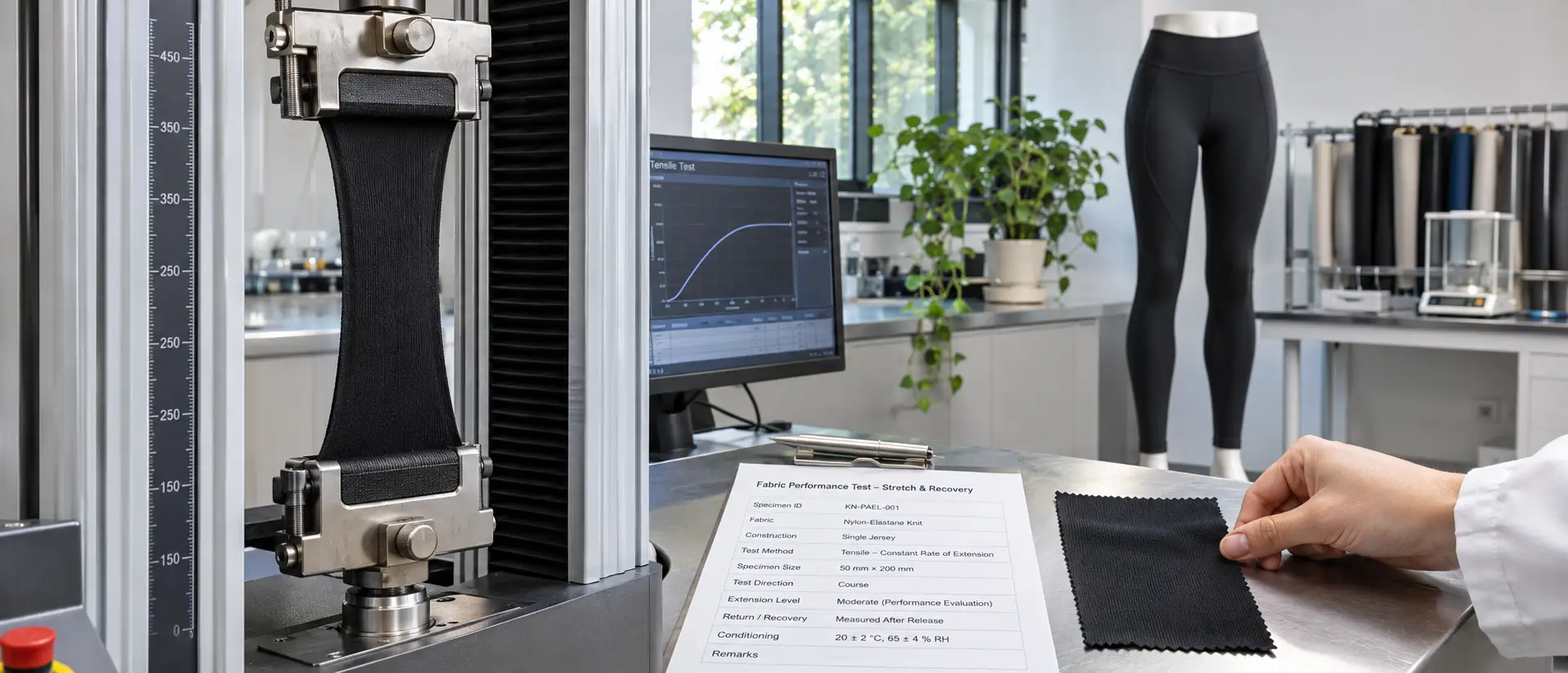
The term performance fabric is commonly used to describe textiles designed to deliver particular functional characteristics.
However, a material should not be considered technically suitable simply because a supplier describes it as breathable, moisture-wicking, durable, quick-drying, or high-performance.
Such properties should be evaluated against defined requirements.
Moisture Management and Drying
Moisture management concerns how a textile interacts with liquid moisture under the relevant conditions. This may involve wetting, absorption, transport, or evaporation.
Different products require different behavior.
For example, a running top may benefit from suitable moisture transport and drying characteristics, while a casual cotton garment may prioritize a different balance of feel, absorption, and comfort.
Fiber type alone does not establish the complete moisture-management performance. Yarn engineering, fabric construction, surface treatment, and garment design may all contribute. Where a specific claim is important, buyers should identify a suitable test method and acceptance criteria.
Stretch and Recovery
Stretch describes how a material extends under a specified force or condition.
Recovery describes how effectively it returns toward its original dimensions after extension. These properties matter for leggings, sportswear, fitted trousers, waistbands, and other garments requiring freedom of movement.
A fabric with high extension but poor recovery may experience unwanted growth or bagging during use. The buyer should therefore avoid approving a stretch fabric only because it feels elastic during a brief manual inspection.
Abrasion Resistance
Abrasion occurs when a fabric surface experiences friction or rubbing.
Abrasion resistance can be important for workwear, trousers, sportswear, outdoor garments, and products exposed to frequent contact.
Performance depends on fiber properties, yarn construction, fabric structure, finishing, and the applicable conditions.
Laboratory abrasion tests help evaluate defined aspects of surface durability, but the results do not guarantee an exact product lifespan.
Air Permeability and Comfort
Air permeability describes the passage of air through a textile under specified conditions. It can contribute to comfort, particularly where ventilation is relevant.
However, air permeability is not the same as moisture-vapor transmission, moisture wicking, or overall wearer comfort.
A garment’s fit, layering, intended activity, environmental conditions, and design also influence performance.
Water Resistance and Water Repellency
Water-resistant and water-repellent fabrics may be appropriate for particular jackets, uniforms, and outdoor garments.
However, water repellency, resistance to water penetration, and the waterproof performance of a finished garment are different characteristics.
A water-repellent surface finish does not automatically make a garment waterproof. Seams, closures, construction, and finishing must also be considered where relevant.
Durability of Performance Finishes
Certain performance properties may be influenced by chemical or mechanical finishing treatments.
When a performance claim depends on a finish, buyers should determine whether its effectiveness must remain acceptable after specified washing or use conditions.
For example, a water-repellent finish may require evaluation after an agreed number of laundering cycles.
Likewise, claims concerning odor management, cooling, or other specialized functions should have a defensible technical basis.
Performance Fabric Verification Checklist
Before approving an engineered textile, ask:
- What specific functional property is required?
- How does that property support the intended garment use?
- Is the performance related to fiber, yarn, construction, finishing, or a combination?
- Which test method is applicable?
- What result or acceptance criterion is required?
- Has the selected fabric and finish been tested?
- Does the performance need to remain acceptable after washing?
- Are special manufacturing or care conditions necessary?
- Will bulk fabric follow the approved processing route?
- What changes would require further verification?
Performance should be evaluated using suitable methods rather than marketing descriptions alone.
Fabric Quality Parameters Buyers Should Check Before Approval
Fabric selection also requires attention to material characteristics that influence manufacturing consistency.
A fabric can meet its stated GSM and composition but still create difficulties because of unstable dimensions, inconsistent width, shade variation, or construction defects.

Usable Width
Fabric width affects pattern placement and material consumption.
Buyers should distinguish between nominal or total width and the usable width available for cutting under the relevant specification. The usable width may exclude unsuitable edge areas or other material that cannot be included in the marker.
For example, two fabrics with the same price per kilogram may produce different garment costs if one offers less usable cutting width.
Width measurement and acceptable variation should therefore be included in the fabric specification.
Fabric Handfeel
Handfeel describes the material’s tactile characteristics. Buyers often use subjective words such as soft, smooth, premium, substantial, crisp, or fluid. These descriptions can communicate design intent but may be interpreted differently by suppliers.
A more useful approach combines a physical reference swatch with agreed descriptions.
For example:
- Smooth rather than heavily textured
- Brushed rather than unbrushed
- Crisp rather than fluid
- Dry touch rather than slippery
- Compact rather than open
- Soft against the skin without unacceptable surface roughness
Where handfeel is important, a retained physical reference can provide a practical comparison standard.
Fabric Surface and Appearance
Material appearance may be affected by:
- Yarn irregularities
- Knitting or weaving defects
- Surface contamination
- Uneven brushing or finishing
- Shade variations
- Streaks, lines, or other visible faults
- Inconsistent surface texture
Acceptable variation should be established according to the product’s requirements.
Dimensional Stability
Dimensional stability describes how a material maintains its dimensions under specified conditions. The material may shrink, grow, or otherwise change shape during relaxation, washing, drying, or processing.
This can affect garment measurements and fit. Dimensional stability should therefore be evaluated in the relevant fabric direction and under appropriate conditions.
Spirality, Bowing, and Skew
Fabric distortion can affect garment appearance and construction.
Spirality is particularly relevant to certain knitted fabrics and can contribute to seam twisting or rotational distortion after laundering. Bowing and skew describe different forms of directional distortion that may occur in woven or knitted materials.
The relevant risks and permitted limits depend on the fabric and product.
Fabric Quality Parameters Checklist
| Parameter | Specification Format | Verification | Potential Problem |
|---|---|---|---|
| Composition | Fiber percentages and applicable rules | Composition verification | Wrong material or labeling |
| Construction | Defined knit or weave specification | Structure examination | Incorrect stretch, feel, or appearance |
| GSM | Target and tolerance | Mass-per-unit-area test | Weight variation |
| Usable Width | Minimum or agreed width | Width measurement | Consumption and cutting problems |
| Handfeel | Approved reference and description | Physical evaluation | Inconsistent material feel |
| Dimensional Stability | Directional results and limits | Specified laundering or relaxation method | Incorrect garment dimensions |
| Colorfastness | Relevant methods and minimum results | Laboratory testing | Color change or transfer |
| Pilling | Method and acceptance criteria | Surface-change testing | Premature visible pilling |
| Stretch and Recovery | Defined conditions and results | Appropriate mechanical testing | Growth or poor fit recovery |
| Spirality / Skew | Applicable limits | Defined distortion assessment | Twisted seams or misalignment |
| Fabric Defects | Agreed inspection criteria | Fabric inspection | Cutting loss or garment appearance defects |
Not every parameter is equally important for every fabric.
The correct specification depends on the intended product, material structure, and buyer requirements.
Fabric Shrinkage: Understanding Dimensional Change Before Bulk Production
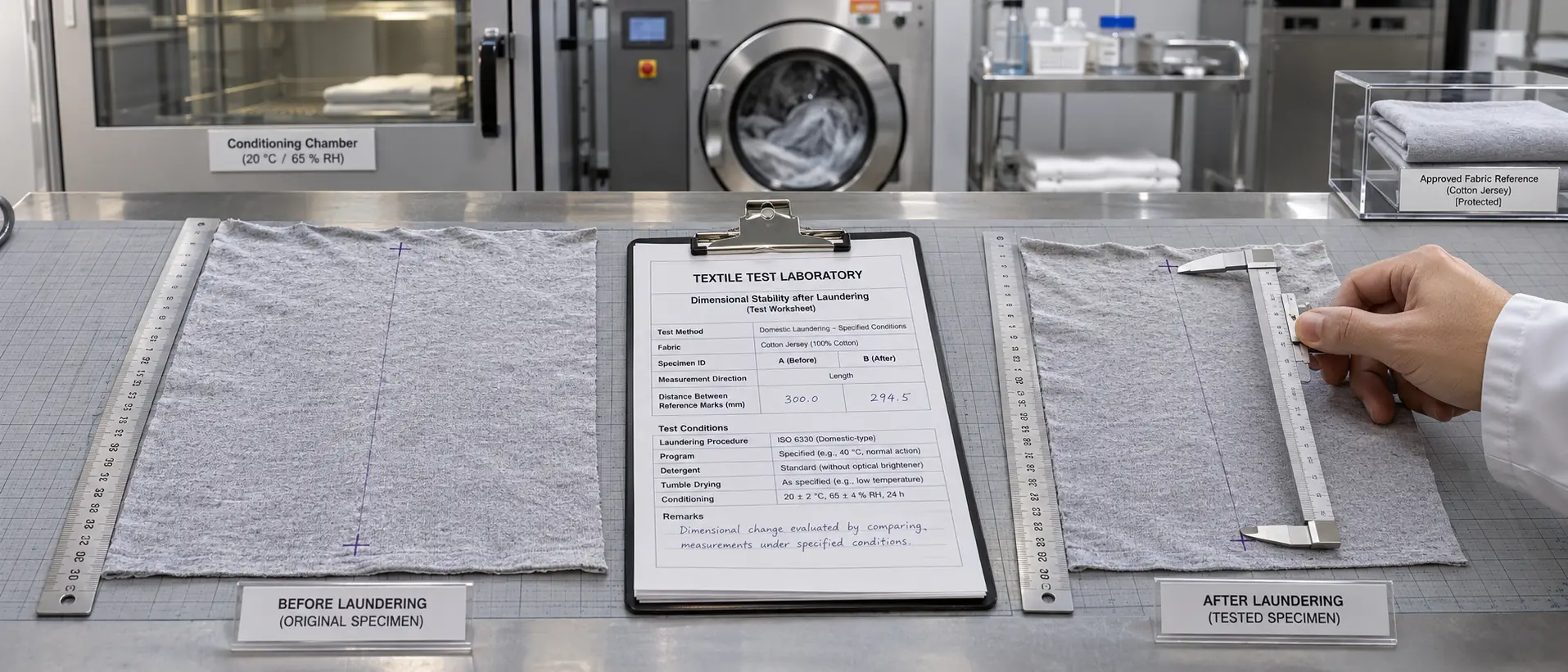
Shrinkage is one of the most important material risks affecting garment measurements and fit.
A fabric may appear suitable during development but change dimensions after relaxation, washing, drying, heat exposure, or another process. The effect depends on the material and the conditions to which it is exposed.
What Causes Fabric Shrinkage?
Possible contributing factors include:
- Residual tension from yarn or fabric manufacturing
- Fabric construction and density
- Fiber characteristics
- Relaxation during wet processing
- Washing and drying conditions
- Heat exposure
- Mechanical agitation
- Finishing and stabilization methods
Different fabrics respond differently.
A knitted fabric may experience changes as its loop structure relaxes, while a woven fabric may respond to the release of manufacturing tensions and other factors.
Types of Dimensional Change
Relaxation Shrinkage: Dimensional reduction associated with the release of tension or changes in the material’s physical state.
Laundering-Related Dimensional Change: Changes that occur after specified washing and drying processes. These changes may involve shrinkage or growth.
Heat-Related Dimensional Change: Changes influenced by exposure to relevant temperatures and processing conditions.
Shape Distortion: Changes in geometry, such as spirality or skew, that may not be fully described by lengthwise or widthwise shrinkage results.
The relevant evaluation method should reflect the garment’s intended care and use.
Fabric Shrinkage Calculation Example
Suppose a fabric specimen measures 50 cm in the length direction before an agreed laundering procedure.
After the procedure, it measures 48.5 cm.
The percentage dimensional change is:
((48.5-50)/50)*100=-3%
The result is -3% dimensional change, representing 3% shrinkage in the measured direction.
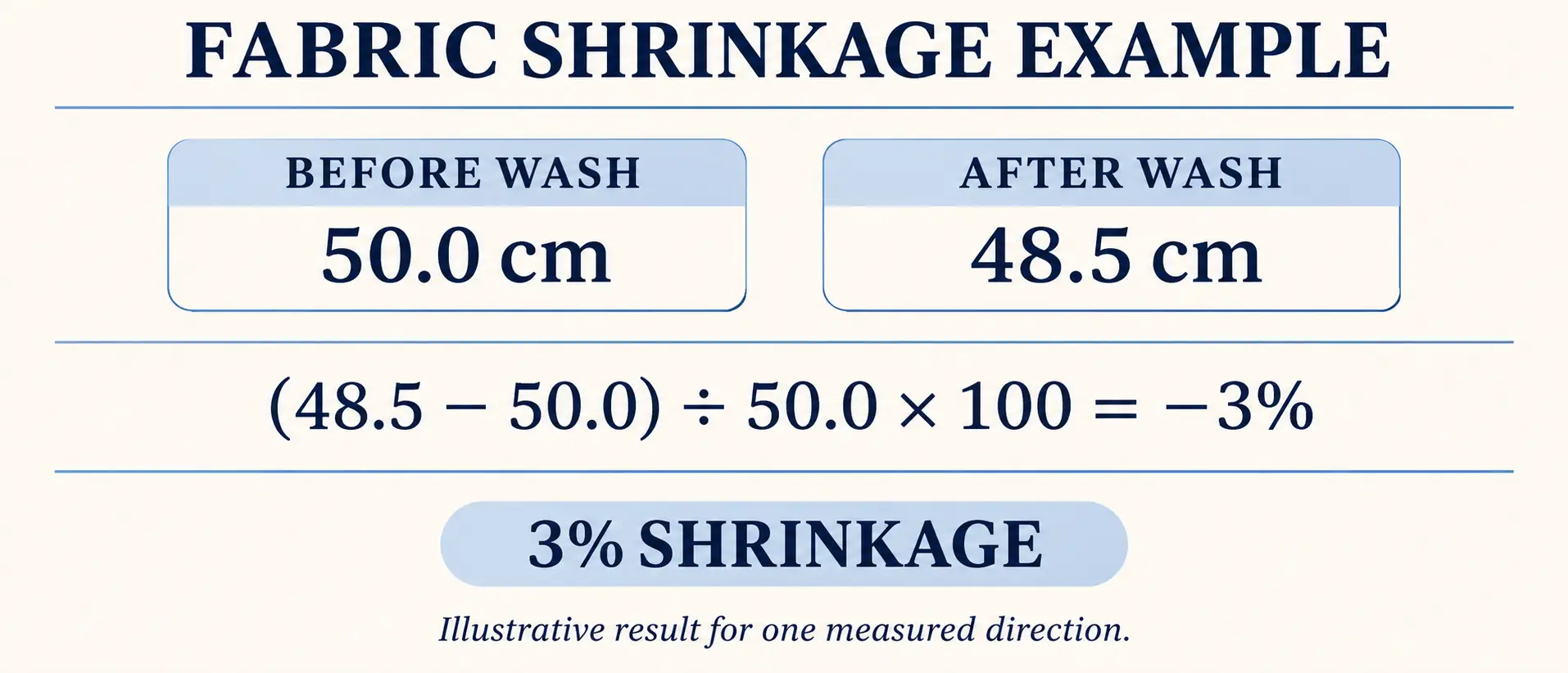
If the post-treatment dimension were greater than the original dimension, the calculation would produce a positive value representing growth.
The acceptance decision depends on the product’s applicable limits and test conditions.
How to Manage Shrinkage During Development
A practical approach includes:
- Establish the appropriate dimensional-stability test conditions.
- Test a representative material.
- Review the results in relevant fabric directions.
- Determine whether the behavior is suitable for the garment.
- Review pattern allowances and finished-measurement requirements.
- Confirm the approved material and finishing process.
- Perform additional verification when required by the production plan.
Finishing techniques such as compaction or heat-setting may help manage dimensional behavior in suitable materials.
However, their effectiveness must be verified rather than assumed.
Fabric Colorfastness and Shade Control: Avoiding Appearance and Transfer Problems
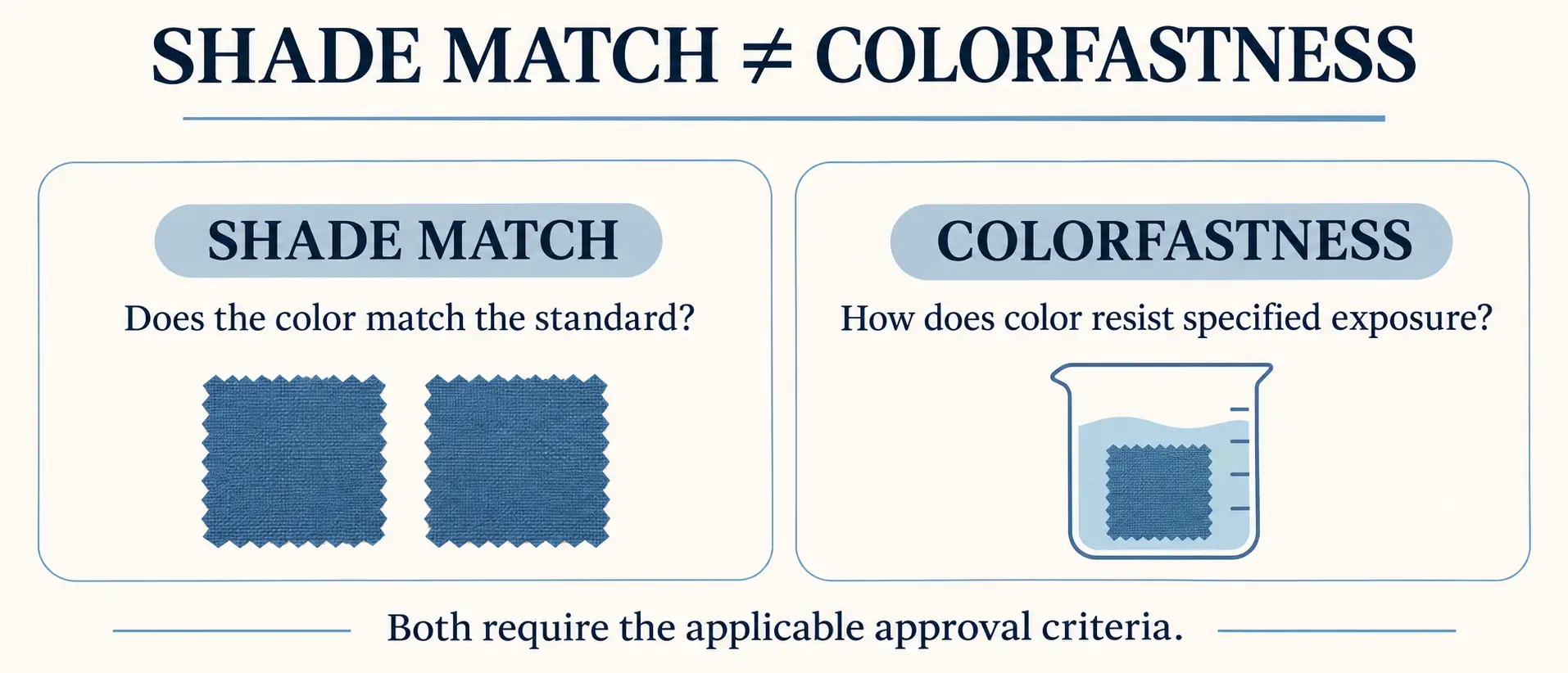
Color selection involves two related but distinct activities:
Shade approval determines whether a fabric’s color matches the accepted reference.Colorfastness evaluation determines how the fabric resists color change or staining under defined conditions. A fabric may match the approved shade initially yet still have unsuitable colorfastness.
Colorfastness to Washing
This evaluates color change and staining associated with a specified washing procedure. The actual test conditions and acceptance criteria must be selected according to the product requirements.
Colorfastness to Rubbing
Also called crocking, this evaluates the tendency of color to transfer through rubbing under defined conditions. Dry and wet rubbing may produce different results. This property can be important for dark-colored garments and denim products.
Colorfastness to Perspiration
This evaluates color change or staining under specified perspiration-related testing conditions. It may be relevant for sportswear, uniforms, and garments frequently exposed to perspiration.
Colorfastness to Light
This evaluates resistance to color change under defined light exposure. It may be important for garments exposed to sunlight or other relevant lighting conditions.
Colorfastness Test Plan
| Exposure | Example Method Family | What Is Evaluated | Application |
|---|---|---|---|
| Washing | Applicable ISO or AATCC method | Color change and staining | Laundered apparel |
| Rubbing | Applicable ISO or AATCC method | Dry and wet color transfer | Denim, dark shades, relevant fabrics |
| Perspiration | Applicable ISO or AATCC method | Color change and staining | Activewear and other relevant garments |
| Light | Applicable ISO or AATCC method | Light-exposure color change | Outdoor or exposed garments |
The applicable standards and buyer specifications must identify the exact procedures and acceptance grades. A test-method designation alone does not necessarily establish a universal passing requirement.
Why Lab Dip Approval Is Not Enough
A lab dip helps establish whether a proposed dyeing result matches the buyer’s intended shade.
However, it does not independently prove that the fabric meets required colorfastness or bulk shade-consistency criteria.
Bulk production may involve different quantities, equipment, dye lots, and processing conditions. Buyers should therefore establish relevant bulk shade-submission and inspection requirements. Where shade variation creates an unacceptable appearance risk, cutting procedures may also need to control material lot mixing.
Our planned guide to the color approval process for lab dips and bulk shade control will examine shade submissions, approvals, dye-lot variation, and production color consistency in greater detail.
Pilling Resistance: How to Evaluate Fabric Surface Durability
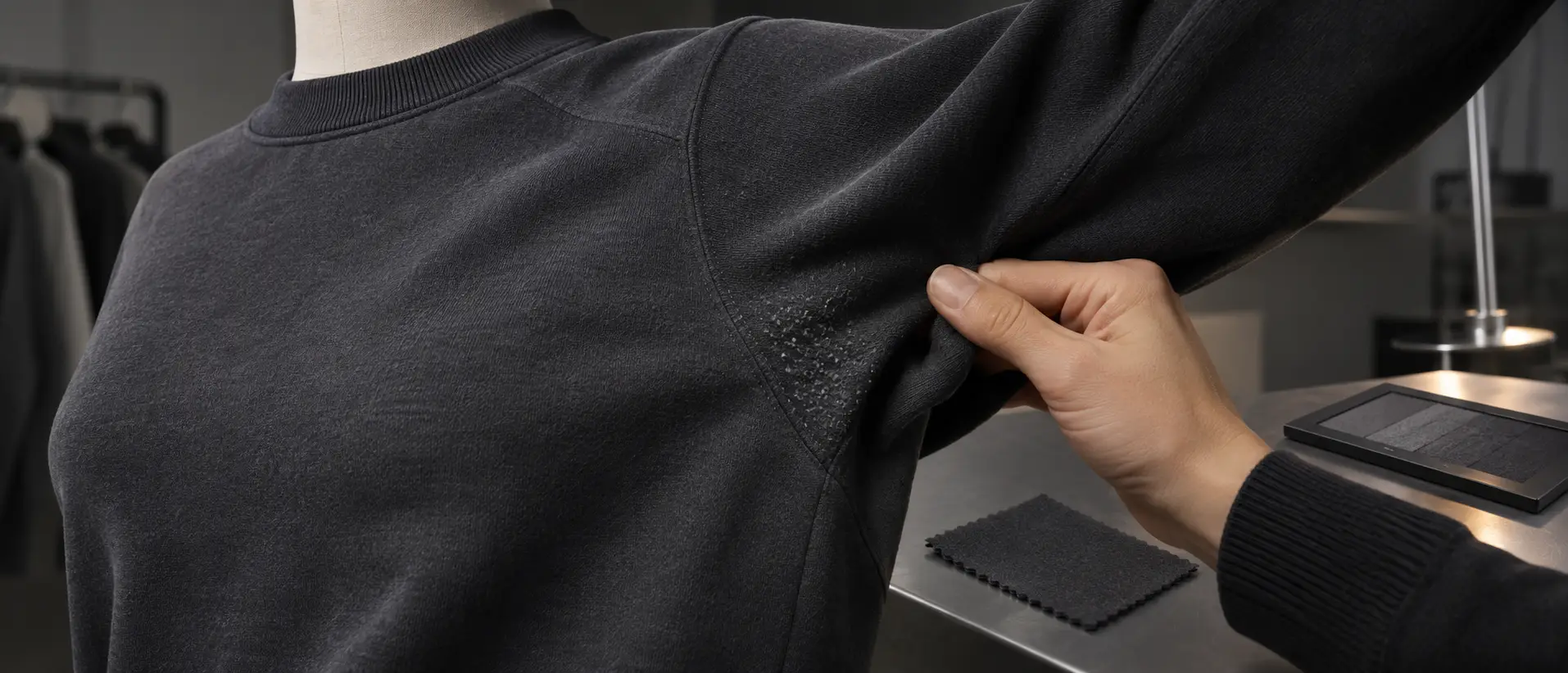
Pilling occurs when loose fibers become entangled into small surface formations during friction or wear.
It can affect the appearance of T-shirts, sweatshirts, knitwear, trousers, and other garments.
Pilling tendency depends on several interacting factors, not only the fabric’s fiber name.
What Influences Fabric Pilling?
Potential factors include:
Fiber Characteristics: Fiber length, strength, and other properties can influence surface fiber behavior and pill formation.
Yarn Structure: Yarn twist, spinning method, and other characteristics affect how fibers are retained within the yarn.
Fabric Construction: Loop structure, weave density, and surface characteristics influence exposure to abrasion.
Finishing: Brushing, sueding, peaching, singeing, and other processes may change surface fiber behavior.
Garment Use: Repeated friction in particular areas can affect pilling appearance.
Where Does Pilling Commonly Occur?
Areas exposed to repeated friction may include:
- Underarms
- Inner thighs
- Waistbands
- Bag contact areas
- Seat areas
- Sleeve contact points
These locations depend on the garment and its intended use.
Does Polyester Pill More Than Cotton?
A universal comparison would be misleading.
Certain polyester-containing materials may retain visible pills because of fiber strength and the way pills remain attached to the fabric. Cotton materials can also pill, and their behavior depends on yarn, construction, fiber characteristics, and finishing.
The appropriate selection method is to evaluate the actual fabric using an agreed procedure.
How to Approve Pilling Resistance
Where pilling resistance is important, the buyer should define:
- Applicable test method
- Relevant specimen and material condition
- Test duration or exposure
- Evaluation procedure
- Required result or grade
- Development and production verification requirements
Real-wear observations can supplement laboratory testing, particularly when the garment experiences distinctive friction patterns.
However, informal wear trials should not replace required laboratory evaluation.
Fabric Testing Requirements: Building a Practical Buyer Test Plan
Fabric testing provides evidence about properties that may not be apparent during visual inspection or manual handling.
The objective is to verify the material characteristics that matter for the garment’s intended use and production requirements.
A testing plan should be specific enough to support purchasing, development, and approval decisions.
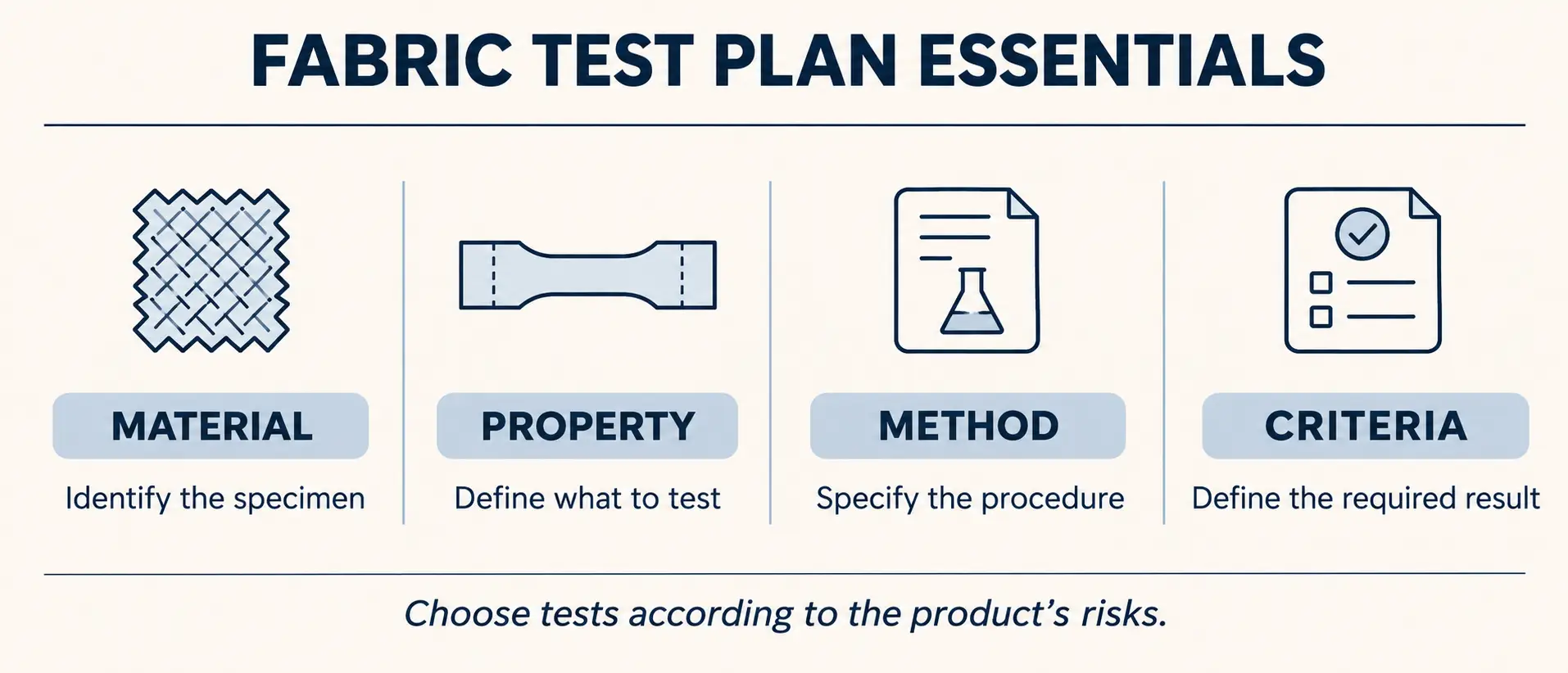
What Should a Fabric Lab Test Report Include?
A useful report should identify:
- Tested fabric or material reference
- Relevant supplier or manufacturer details
- Color or shade identification
- Lot or sample identification, where available
- Test method and applicable version
- Specimen condition and preparation
- Test results and units
- Relevant rating scale
- Buyer acceptance criteria, when supplied or incorporated
- Report identification and testing date
The buyer should confirm whether the tested material represents the intended production fabric.
A report from a different composition, finishing process, or material version may have limited relevance to the current product.
Minimum Fabric Testing Matrix
| Product Risk | Relevant Test | Typical Verification Point | Approval Evidence |
|---|---|---|---|
| Garment shrinkage or growth | Dimensional stability | Development and relevant production verification | Directional test results |
| Color change during laundering | Washing colorfastness | Approved color or material stage | Color-change and staining results |
| Color transfer | Rubbing colorfastness | Relevant color and fabric evaluation | Dry and/or wet ratings |
| Surface pilling | Pilling resistance | Fabric development | Surface-change assessment |
| Seam twisting | Spirality or skew evaluation | Fabric development and applicable wash checks | Distortion results |
| Poor elastic recovery | Stretch and recovery evaluation | Development and relevant bulk verification | Extension and recovery results |
| Surface wear | Abrasion resistance | Material qualification | Specified test result |
| Functional moisture requirement | Appropriate moisture-management test | Performance development | Result against agreed criteria |
| Material identity | Fiber composition analysis | Supplier qualification or required verification | Composition results |
This is a risk-selection guide, not a mandatory universal testing package. Applicable legal, buyer, and product-specific requirements take precedence.
How to Select Recognized Testing Methods
Established organizations publish methods and procedures for evaluating textile properties.
AATCC’s standard textile test methods and procedures cover numerous areas of textile evaluation, including colorfastness, appearance, physical performance, and related properties. Buyers should identify the applicable method and edition rather than requesting an unspecified “standard fabric test.”
Similarly, Intertek’s textile testing solutions for apparel and fabrics describe physical, colorfastness, dimensional-stability, performance, and related testing services. Such laboratory capabilities help buyers verify material specifications where independent or specialized evaluation is required.
Video: Practical Fabric Testing in a Textile Laboratory
The following demonstration, Basic Fabric Testing from US textile manufacturer Signet Mills, shows physical fabric-evaluation activities involving fabric width, weight, thickness, and color transfer. These measurements illustrate how a buyer’s material requirements can be translated into practical checks using appropriate equipment and documented procedures.
The demonstration provides an educational overview. Actual acceptance decisions should use the applicable test methods, calibrated equipment, material conditions, and buyer criteria.
When Should Fabric Testing Happen?
Testing can be scheduled at several points.
During Development: Establish whether the candidate material is suitable for the intended garment.
Before Relevant Production Release: Verify required properties of the approved material or production-representative fabric.
During Bulk Material Verification: Apply required inspection or testing controls to the relevant production lots.
Not every property must be retested at every stage.
Testing frequency should reflect product risks, supplier history, buyer requirements, and changes affecting the approved material.
What Fabric Changes May Require Reverification?
Examples include:
- Fiber composition changes
- Substantial yarn changes
- Fabric construction changes
- Different finishing processes
- A change in material supplier or production route
- Changes affecting approved performance properties
- A new dye lot where the agreed control plan requires further checks
The next step depends on the technical effect of the change.
For example, a new color lot may primarily require shade and relevant fastness checks, while a major composition change may affect several material properties.
A complete repeat of every test is not automatically necessary unless the applicable requirements demand it.
Our upcoming guide to fabric testing basics for shrinkage, colorfastness, pilling, and spirality will provide a more detailed breakdown of testing reports, acceptance criteria, and common interpretation mistakes.
Fabric Sourcing: How to Choose Suppliers Without Losing Material Consistency
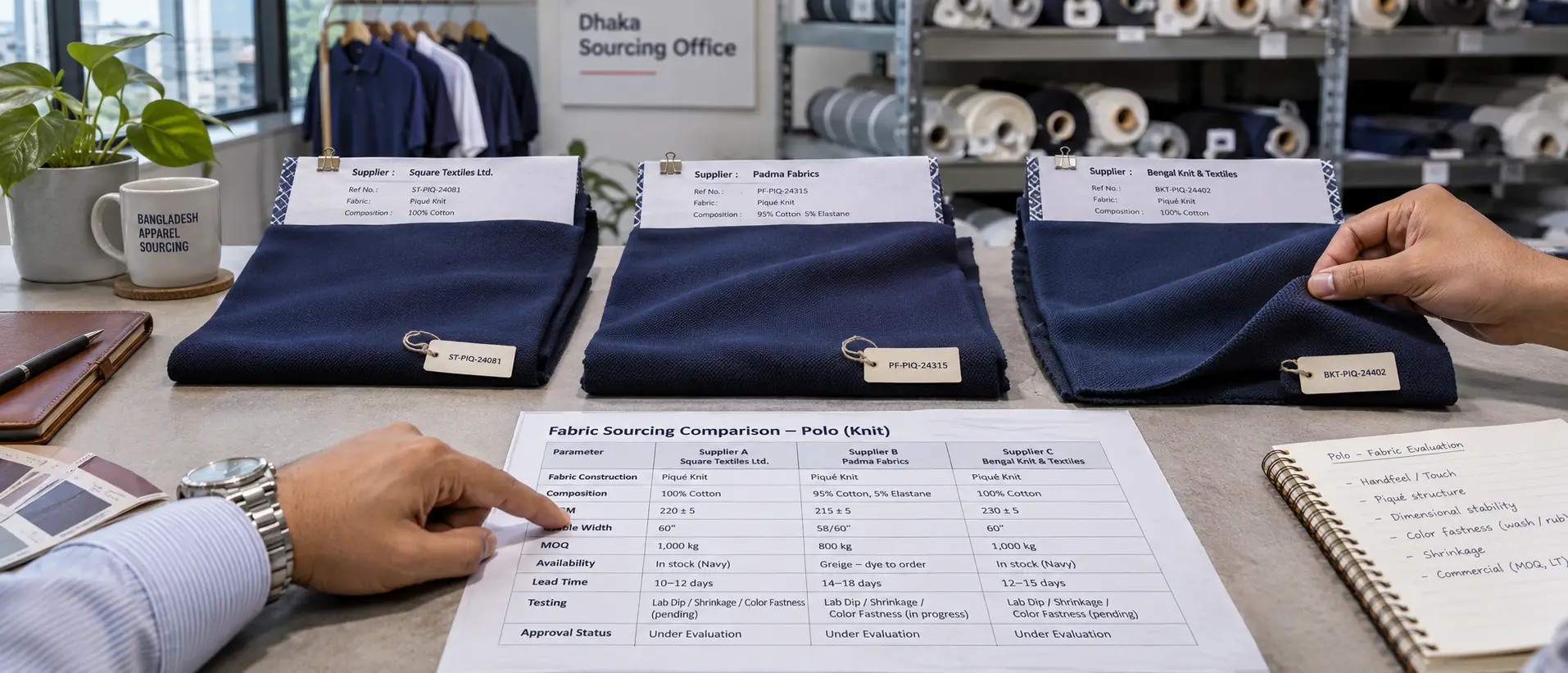
Fabric selection is only commercially useful when the chosen material can be sourced under realistic production conditions.
A successful fabric supplier should be able to provide the required construction, composition, finishing, performance, quantity, and delivery arrangements.
The sourcing decision should consider more than the price of a sample swatch.
Fabric Sourcing Options for Clothing Brands
Buyer-Nominated Fabric Mill: The brand identifies a particular textile manufacturer or material source. This can support continuity when an established supply relationship and approved production route already exist. However, nominated sourcing does not automatically guarantee short lead times or low minimum quantities.
Manufacturer-Sourced Fabric: The apparel manufacturer proposes fabrics through its available supplier relationships. This may simplify procurement coordination, provided the buyer’s technical requirements are clear and the proposed material is approved.
Open Fabric Sourcing: Multiple suppliers propose materials against the same specification. This can provide alternative options, but comparisons must account for actual construction, quality, testing, finishing, and production conditions.
Fabric Sourcing Checklist
Before approving a supply route, confirm:
- Supplier identity and relevant production capability.
- Required fiber composition and construction.
- Target GSM and usable width.
- Approved material reference.
- Available colors and dyeing requirements.
- Material minimum order quantity (MOQ).
- MOQ conditions by color or finishing process.
- Development fabric availability.
- Bulk production lead time.
- Required testing and approval responsibilities.
- Applicable material certifications and documentation.
- Shade and lot traceability arrangements.
- Substitution approval procedure.
- Repeat-order availability.
- Commercial terms and agreed delivery basis.
These details should be coordinated before the buyer commits to a fabric-based manufacturing quotation.
Why Fabric Substitutions Need Control
Two fabrics may have identical descriptions but differ in important properties.
For example, replacing a 220 GSM cotton-polyester jersey with another fabric of the same stated weight and blend does not automatically preserve:
- Yarn characteristics
- Knit density
- Handfeel
- Shrinkage
- Pilling resistance
- Stretch behavior
- Dyeing performance
- Usable width
A supplier substitution should be evaluated against the properties that matter for the garment.
Where the change affects previously approved requirements, additional review may be necessary.
Fabric Sourcing for Repeat Orders
Repeat orders require attention to consistency.
The buyer should determine whether the approved fabric remains available from the intended production route and whether any material changes have occurred.
A previous approval provides useful reference evidence, but it should not automatically cover a materially different fabric.
Repeat-order procedures may include material identification, shade comparison, supplier confirmation, and relevant performance verification.
How RYZEAL Supports Fabric Sourcing Coordination
RYZEAL SOURCING works with apparel buyers and a network of specialized independent manufacturing partners in Bangladesh.
Fabric-related coordination may include communicating material requirements, reviewing sourcing options, arranging development discussions, following sample approvals, and supporting manufacturing preparation.
The appropriate supply arrangement depends on the garment category, required material, quantity, and technical specifications.
Fabric Cost: Why Price per Kilogram Does Not Equal Garment Material Cost
Fabric price is an important commercial factor, but it should not be evaluated without considering material consumption and usable yield.
A fabric with a lower price per kilogram can produce a higher garment material cost if its width, shrinkage, defect levels, or cutting utilization are unfavorable.
Similarly, a heavier material can sometimes be commercially competitive when the overall fabric arrangement is more efficient.

Main Fabric Cost Drivers
Fabric-related costs may be influenced by:
- Fiber and raw material prices
- Yarn quality and processing
- Knitting or weaving operations
- GSM and construction
- Dyeing and finishing
- Fabric width
- Minimum production quantity
- Testing and certification requirements
- Quality variation and usable yield
- Transportation and sourcing arrangements
Some of these costs are reflected in the fabric price, while others affect the cost of converting the fabric into finished garments.
Example: Comparing Two Fabrics for a Garment
Consider two hypothetical fabrics proposed for a casual garment.
| Cost Factor | Fabric A | Fabric B |
|---|---|---|
| GSM | 200 | 220 |
| Usable Width | 1.60 m | 1.80 m |
| Price | $5.00/kg | $4.80/kg |
| Assumed Marker Length per Garment | 1.25 m | 1.00 m |
| Illustrative Additional Wastage | 8% | 8% |
The estimated fabric mass can be modeled as:
Mass (kg) = (GSM × Width (m) × Length (m)) / 1000
For Fabric A:
(200 × 1.60 × 1.25) / 1000 = 0.40 kg
Including the illustrative 8% additional wastage:
0.40 × 1.08 × $5.00 = $2.16
For Fabric B:
(220 × 1.80 × 1.00) / 1000 = 0.396 kg
Including the same illustrative wastage:
0.396 × 1.08 × $4.80 ≈ $2.05
Under these hypothetical assumptions, Fabric B produces a slightly lower estimated material cost despite its higher GSM.
However, this conclusion depends on the assumed marker lengths, material prices, widths, and wastage.
The two fabrics must also be technically suitable for the same garment.
These are illustrative calculations, not supplier quotations. Marker lengths must be established from actual patterns and cutting arrangements. The example assumes that the marker consumption and additional wastage are separate and do not double-count losses.
Why Usable Width Matters
A wider fabric may allow more efficient arrangement of garment pattern pieces. However, this depends on the pattern shapes, size mix, grain requirements, and fabric properties.
A wider fabric is not automatically more economical in every situation. The appropriate comparison uses the material’s actual usable yield for the garment.
Special Finishes and Performance Costs
Specialized finishing can affect the fabric price and processing requirements.
Examples include:
- Heavy brushing or peaching
- Water-repellent finishes
- Special dyeing techniques
- Wrinkle-resistant treatments
- Additional stabilization processes
- Specialized performance treatments
Where these are required, the buyer should communicate the expectations during initial sourcing and costing.
Adding new requirements after quotation may change both price and lead time.
Fabric Cost vs. Total Garment Cost
The material cost is only one component of the finished garment cost.
Other components may include trims, decoration, cutting, sewing, finishing, quality control, packaging, commercial expenses, and the applicable delivery terms.
An accurate clothing quotation should connect fabric consumption with the approved garment specifications.
The guide to building a Bill of Materials for clothing explains how fabric, trims, components, consumption, sourcing details, and other relevant inputs can be documented to support accurate apparel costing and procurement.
How to Document Fabric Selection in the Tech Pack and Fabric Specification Sheet
Selecting a fabric is not complete until the material requirements are documented clearly enough for sourcing, sampling, testing, and manufacturing.
A physical swatch communicates appearance and handfeel, but it cannot independently communicate every technical or performance requirement.
A fabric specification sheet should therefore establish the material’s critical characteristics and approval conditions.
Minimum Fabric Specification Sheet
| Specification Field | Example Entry | Why It Matters |
|---|---|---|
| Fabric Reference | FAB-001 | Identifies the approved material |
| Intended Application | T-Shirt Body | Establishes where the material is used |
| Composition | 100% Cotton | Identifies the specified fibers |
| Construction | Single Jersey | Defines the material structure |
| GSM | 200 GSM | Establishes the target weight |
| GSM Tolerance | Buyer-approved range | Controls accepted variation |
| Usable Width | 160 cm minimum | Supports consumption and cutting |
| Yarn Characteristics | As agreed | Controls relevant yarn requirements |
| Color Reference | Approved shade standard | Supports color matching |
| Finishing | Defined approved process | Controls appearance and performance |
| Dimensional Stability | Test method and agreed limits | Protects fit and dimensions |
| Colorfastness | Relevant methods and criteria | Controls color performance |
| Pilling Resistance | Method and acceptance criteria | Supports surface-quality requirements |
| Handfeel | Approved physical swatch | Establishes tactile reference |
| Sourcing | Approved supplier or route | Supports material continuity |
| Approval Status | Approved / Pending / Revision Required | Establishes control |
The entries illustrate specification formatting. Actual tolerances, test requirements, yarn characteristics, and performance criteria must be determined for the material.
Where Should Fabric Specifications Be Recorded?
Fabric requirements may be maintained across several coordinated documents.
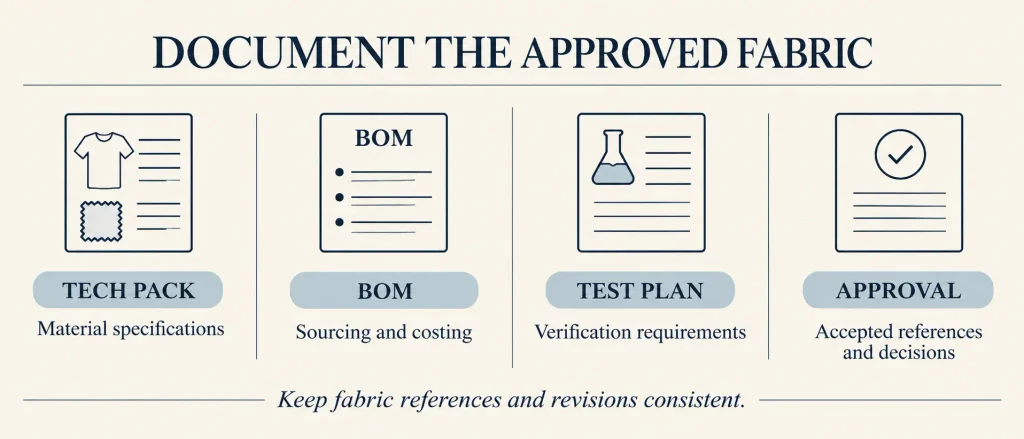
Tech Pack Fabric Page: Defines the material characteristics and their application within the garment.
Bill of Materials: Identifies the fabric as a sourcing and costing component.
Testing Plan: Establishes the required verification methods, acceptance criteria, and testing responsibilities.
Approval Record: Identifies accepted swatches, relevant test reports, authorized decisions, and applicable revisions.
These documents should refer to the same controlled fabric identification and specifications.
Why Revision Control Matters
A fabric specification may change during development.
For example, a brand may decide to replace the original jersey with a different construction after reviewing prototype fit or garment appearance.
That decision can affect the fabric specification, BOM, pattern, costing, testing, and approved sample.
The change should be documented and communicated to the relevant parties.
An updated fabric page should not conflict with an older BOM or manufacturing instruction.
Connect Fabric Selection With the Tech Pack
The fabric specification is an important part of the garment’s overall technical package.
Our guide to creating a clothing tech pack explains how garment drawings, measurements, construction details, materials, artwork, and production information can be organized for manufacturer communication.
The upcoming guide to fabric specifications buyers need before manufacturing will explain how to prepare more detailed and measurable fabric specification sheets for sourcing, quotation, testing, and bulk approval.
Fabric Approval Handover Before Bulk Production
Before the affected bulk manufacturing activities begin, confirm that:
- The current fabric specification is approved.
- Required material references are identifiable.
- The appropriate BOM version is available.
- Relevant testing requirements have been satisfied.
- Material substitutions are resolved.
- Applicable shade and lot arrangements are confirmed.
- Pattern and garment requirements reflect the approved fabric behavior.
- The manufacturer has the information needed for the relevant production process.
These checks support continuity between sample development and bulk manufacturing.
Need Expert Guidance on Fabric Selection for Your Clothing Collection?
Discuss your garment concept, fabric construction, GSM, composition, sourcing requirements, and production expectations directly with RYZEAL SOURCING. Arrange a meeting to explore the technical and commercial considerations for your apparel project.
Common Fabric Selection Mistakes Clothing Brands Should Avoid
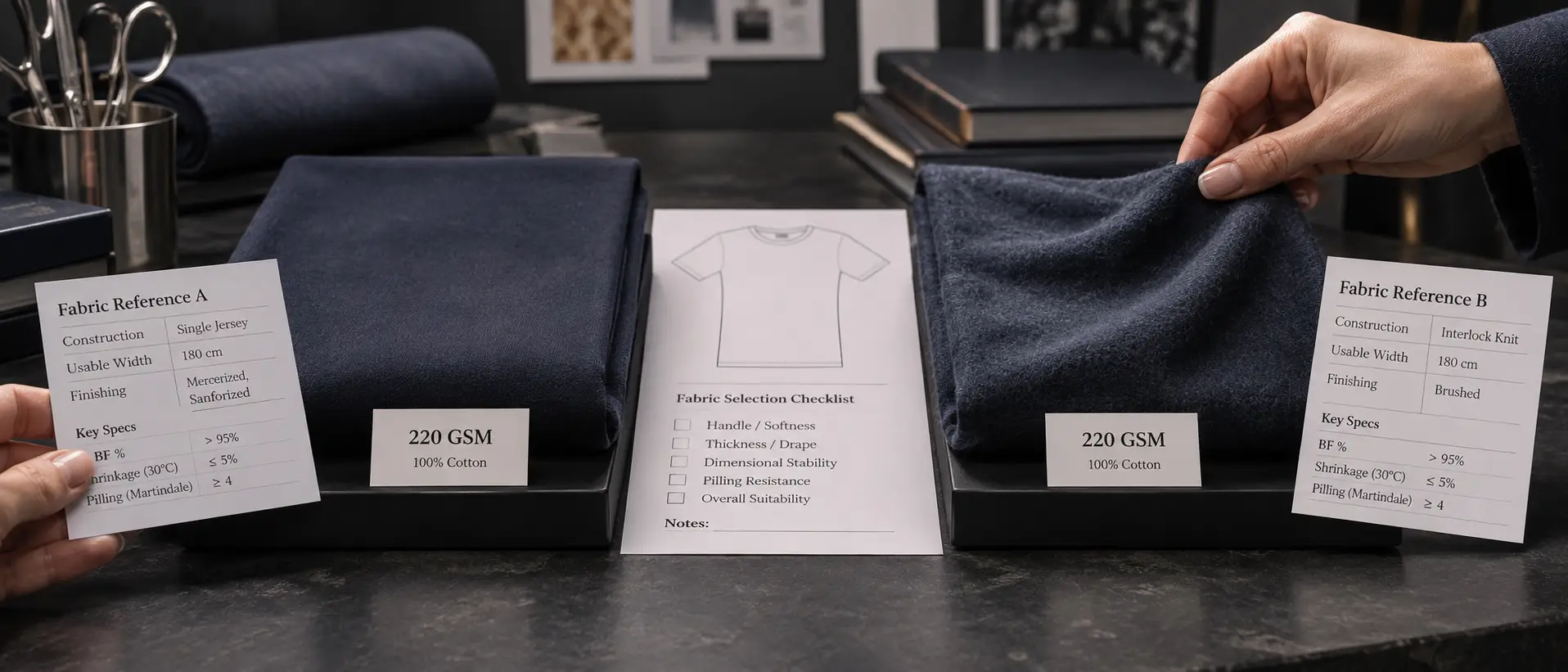
Fabric selection problems are not always caused by choosing an obviously unsuitable material.
They often arise when important requirements remain undefined or when a development approval is applied beyond its intended scope.
1. Choosing Fabric Based Only on GSM
A higher fabric weight does not automatically provide better durability, opacity, breathability, or garment quality.
Better practice: Evaluate GSM with composition, construction, finishing, and required performance.
2. Assuming Fiber Composition Guarantees Performance
Two fabrics with identical fiber content can have different physical properties.
Better practice: Specify relevant yarn, construction, finishing, and performance requirements rather than relying on composition alone.
3. Selecting Materials Without Considering End Use
A fabric suitable for a fashion T-shirt may not meet the needs of a performance running garment.
Better practice: Define how the garment will be worn and which properties are essential.
4. Ignoring Fabric Shrinkage During Pattern Development
A material that changes dimensions after washing may affect the garment’s finished measurements and fit.
Better practice: Evaluate dimensional stability at an appropriate stage and connect the results to garment specifications.
5. Treating Shade Approval as Colorfastness Approval
A visually approved color does not establish resistance to washing, rubbing, perspiration, or light.
Better practice: Separate shade approval from the required performance tests.
6. Approving Only the Development Swatch
A material used during sampling may not represent the final production route.
Better practice: Establish which approved material properties must be verified on production-representative fabric.
7. Comparing Fabric Quotes Without Consumption Data
The lowest price per meter or kilogram may not produce the lowest garment material cost.
Better practice: Compare usable width, marker consumption, wastage, finishing, and relevant production requirements.
8. Accepting Uncontrolled Material Substitutions
A substitute fabric may match several stated characteristics but differ in stretch, shrinkage, handfeel, or performance.
Better practice: Evaluate changes against the approved specification and apply the agreed reapproval procedure.
9. Using Vague Handfeel Descriptions
Words such as premium or luxury can mean different things to different suppliers.
Better practice: Use agreed physical references and clear descriptions.
10. Forgetting the Relationship Between Fabric and Garment Sampling
A fabric change can invalidate previously accepted fit or production-representative results.
Better practice: Connect material approvals with the wider product development and sample management process.
The apparel product development process involves coordinated decisions about garment design, materials, technical specifications, sampling, and production readiness. Fabric selection should remain connected to those decisions rather than being treated as an isolated purchasing activity.
Frequently Asked Questions About Fabric Selection for Clothing Manufacturing
1. What is fabric selection in clothing manufacturing?
Fabric selection is the process of choosing and approving materials that meet a garment’s design, functional, quality, cost, and manufacturing requirements. It involves evaluating composition, construction, GSM, performance, sourcing feasibility, and relevant test results.
2. How do I choose fabric for a clothing brand?
Start with the intended garment and how it will be worn. Identify suitable construction and fiber options, determine the required weight and performance, compare physical swatches, verify important properties, and confirm bulk sourcing availability before final approval.
3. What does GSM mean in fabric?
GSM means grams per square meter. It measures fabric mass per unit area and helps compare textile weights. It does not independently determine fabric thickness, durability, opacity, breathability, or overall quality.
4. Is higher GSM always better for clothing?
No. A heavier fabric may be appropriate for certain structured or substantial garments, while a lighter material may be preferable for other uses. The correct GSM depends on construction, fit, comfort, performance, and product requirements.
5. Is fabric composition more important than construction?
Neither should be considered independently. Composition identifies the fibers used, while construction determines how the yarns or fibers form the textile. Both affect the material’s behavior.
6. What is the difference between knitted and woven fabrics?
Knitted fabrics generally use interconnected yarn loops, while woven fabrics use interlaced warp and weft yarns. These structural differences influence stretch, stability, cutting, sewing, and garment performance.
7. Which fabric is best for T-shirt manufacturing?
Single jersey is widely used for T-shirts, although interlock, piqué, and other constructions may also be suitable. The appropriate composition, GSM, and finishing depend on the desired fit, appearance, feel, and performance.
8. What is the best fabric for activewear?
There is no single best fabric for every activewear product. Polyester, nylon, elastane blends, and other engineered materials may be suitable depending on the intended activity and required stretch, recovery, moisture management, durability, and comfort.
9. What causes fabric shrinkage?
Dimensional change can result from manufacturing tensions, fiber properties, fabric construction, washing, drying, heat exposure, and finishing. The relevant behavior should be evaluated under specified conditions.
10. How can buyers check fabric colorfastness?
Buyers can request testing using appropriate methods for washing, rubbing, perspiration, light, or other relevant exposures. Reports should identify the tested material, method, result, and applicable acceptance criteria.
11. What makes a fabric resistant to pilling?
Pilling resistance depends on factors such as fiber characteristics, yarn construction, textile structure, finishing, and wear conditions. Where pilling matters, buyers should evaluate the actual fabric using an appropriate method.
12. What fabric tests are needed before bulk production?
The test plan depends on the garment’s risks and requirements. Relevant tests may include dimensional stability, colorfastness, pilling, abrasion, stretch and recovery, fabric strength, composition, or applicable safety and chemical evaluations.
13. What should a fabric specification sheet contain?
It should identify the material, composition, construction, GSM, usable width, relevant yarn characteristics, finishing, color requirements, performance criteria, applicable tolerances, and approval references.
14. How does fabric selection affect garment cost?
Fabric selection affects material price, consumption, usable width, cutting efficiency, finishing, testing, and potential wastage. A lower-priced fabric does not necessarily produce a lower-cost garment.
15. Can a supplier change the fabric after sample approval?
A proposed material change should be evaluated against the approved requirements. Where the change affects previously approved fit, appearance, performance, or manufacturing conditions, further review or testing may be necessary.
16. How can brands verify sustainable fabric claims?
Buyers should examine the claim’s scope, relevant certification requirements, supplier documentation, traceability records, and applicable chain-of-custody evidence. The fabric must also meet the product’s technical and performance requirements.
Final Takeaway: Effective Fabric Selection Connects Design, Performance, Cost, and Manufacturing
Fabric selection is not simply choosing between cotton and polyester or deciding whether a garment should use lightweight or heavyweight fabric.
It requires a coordinated evaluation of the material’s intended use, GSM, composition, construction, appearance, performance, sourcing availability, and manufacturing implications.
For clothing brands, the most reliable approach is to begin with the product requirements and then select materials capable of meeting them.
A practical fabric selection process should answer these questions:
- What will the garment be used for?
- Which textile construction suits the design?
- Which fiber composition supports the intended characteristics?
- What GSM and usable width are appropriate?
- Which performance properties need verification?
- Can the selected supplier reproduce the material consistently?
- How will the material affect garment consumption and cost?
- What specifications and approvals must be documented?
When those answers are clear, buyers and manufacturing partners can compare material alternatives on a more consistent basis.
RYZEAL SOURCING supports apparel manufacturing and sourcing through a vetted network of specialized independent manufacturing partners in Bangladesh. Our team helps brands coordinate material requirements, supplier options, technical development, sample approvals, and relevant manufacturing activities according to their product needs.
Explore How RYZEAL Coordinates Fabric Sourcing and Apparel Manufacturing
Learn how RYZEAL SOURCING works with clothing brands, buyers, material suppliers, and specialized manufacturing partners in Bangladesh. Explore our partnership approach and how coordinated sourcing and development help connect material requirements with suitable manufacturing capabilities.
The best fabric is not necessarily the heaviest, softest, most expensive, or most technically complex material.
It is the fabric that meets the garment’s intended requirements, can be verified against agreed specifications, and can be sourced and manufactured with appropriate consistency at the required commercial scale.
Connect with RYZEAL SOURCING