
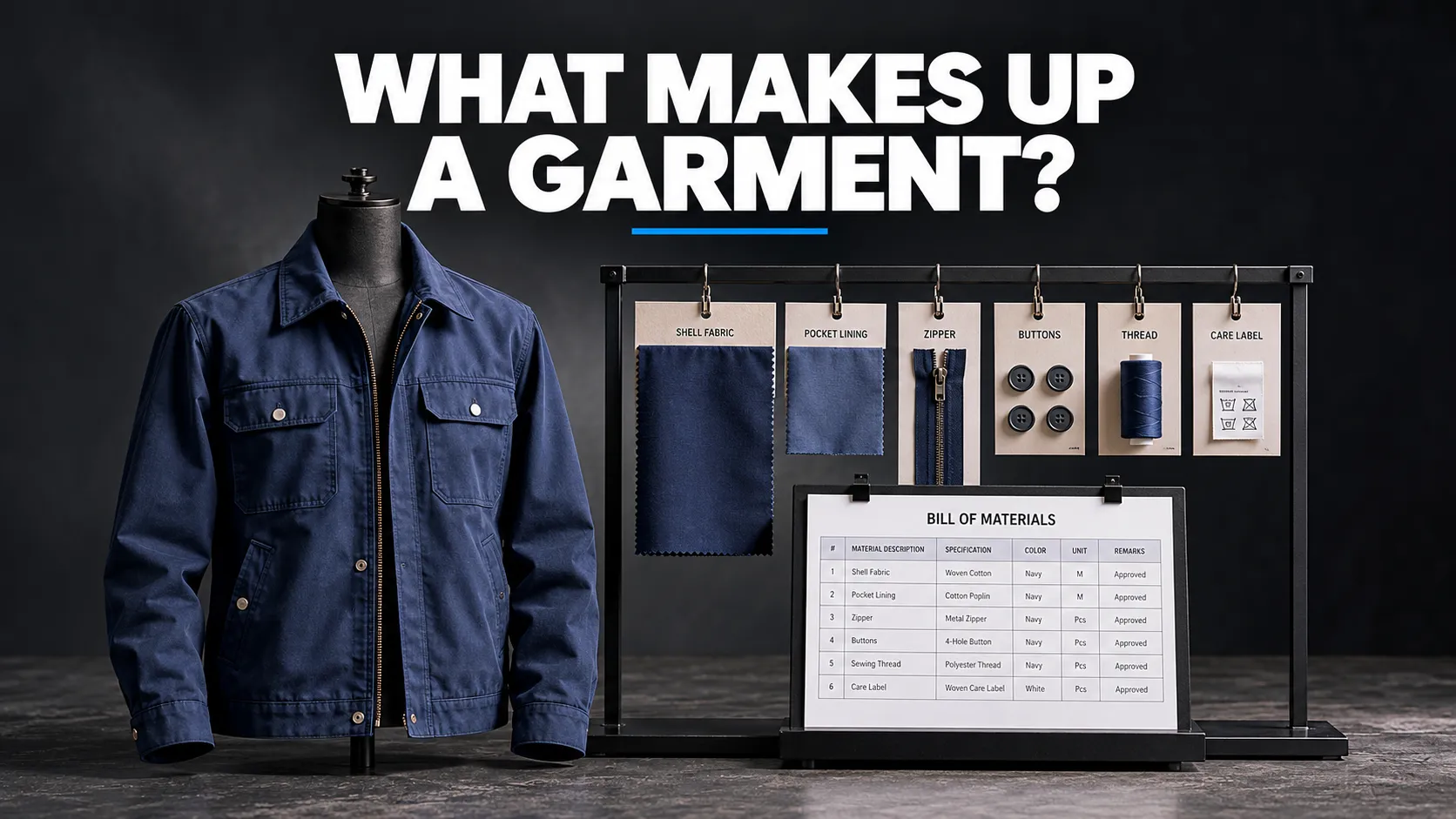
Learning how to build a BOM is an essential part of apparel product development because even small material omissions can affect garment costing, sampling, sourcing, and bulk production.
A Bill of Materials (BOM) is more than a list of fabrics and accessories. It is a structured reference that identifies what materials are required, their specifications, how much is needed, where they come from, and whether they have been approved.
For clothing brands, designers, merchandisers, and sourcing teams, an incomplete BOM can create uncertainty in quotations, material substitutions, procurement delays, and differences between approved samples and production garments.
A properly managed BOM helps reduce these risks by connecting material specifications with consumption calculations, supplier responsibilities, approval status, and revision control.
This guide explains how to build a BOM page for clothing manufacturing, including the essential columns, a practical garment BOM example, material cost calculations, packaging requirements, and procedures for managing changes.
The BOM is one important component of a complete technical package. Our guide to preparing a clothing tech pack explains how the BOM connects with technical drawings, construction instructions, measurement specifications, and development approvals.
If you are preparing specifications for a quotation or first sample, the tech pack checklist for quotation and sampling helps identify which information manufacturers need at each stage.
Table of Contents
What Is a BOM in Apparel Manufacturing?
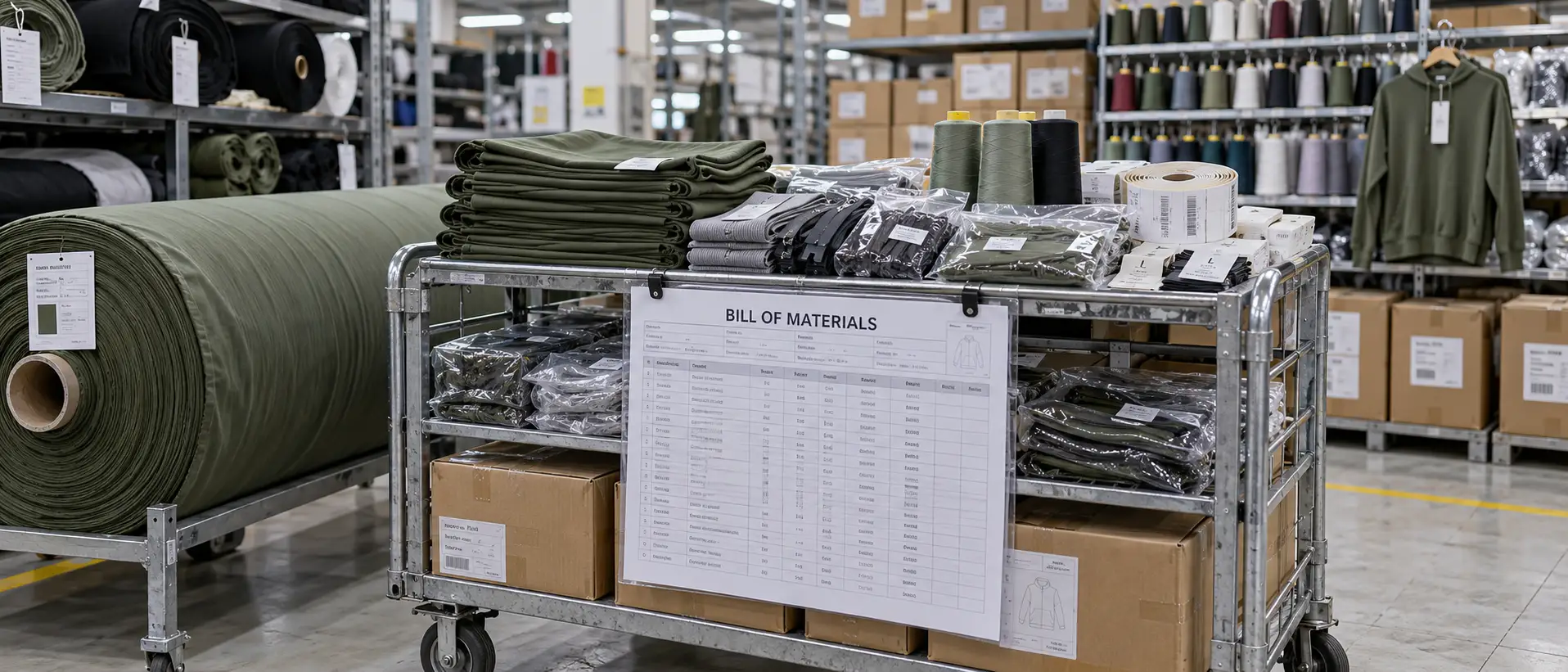
BOM stands for Bill of Materials, a structured record of the physical materials and components required to manufacture a product.
In clothing manufacturing, the BOM typically identifies:
- Main and secondary fabrics
- Rib, lining, interlining, and pocketing materials
- Sewing threads
- Buttons, zippers, elastics, drawcords, and other trims
- Brand, size, composition, and care labels
- Hangtags and decorative components
- Individual packaging and relevant shipping materials
Some companies also include printing, embroidery, washing, or other manufacturing processes within an extended BOM or associated costing sheet.
These operations should be distinguished from physical materials because their consumption and costing methods may differ.
Why BOM Accuracy Matters
The BOM connects three important manufacturing activities.
Material sourcing: Merchandisers and procurement teams use the BOM to identify required materials, evaluate suppliers, verify availability, and coordinate purchases.
Garment costing: Costing teams use material descriptions, consumption quantities, and applicable unit prices to estimate material expenditure per garment.
Production control: The approved BOM provides a reference for confirming that the intended materials and components are used during manufacturing.
When information is incomplete, a manufacturer may request clarification, prepare a quotation using documented assumptions, or propose alternative components.
These responses are not necessarily mistakes. The risk arises when provisional information or substitutions are treated as approved specifications without the buyer’s agreement.
BOM vs. Tech Pack: What Is the Difference?
A tech pack describes the garment’s overall technical requirements, including design, construction, measurements, materials, artwork, and relevant approvals.
The BOM focuses specifically on what physical components are required, how they are specified, and how their quantities and sourcing are controlled.
For example, a technical drawing may identify a front zipper on a hoodie. The BOM should specify the zipper’s type, length, material, finish, color, supplier reference, and required quantity.
The drawing communicates the design intent, while the BOM identifies the component needed to execute it.
How to Build a BOM for Clothing: Step-by-Step Process
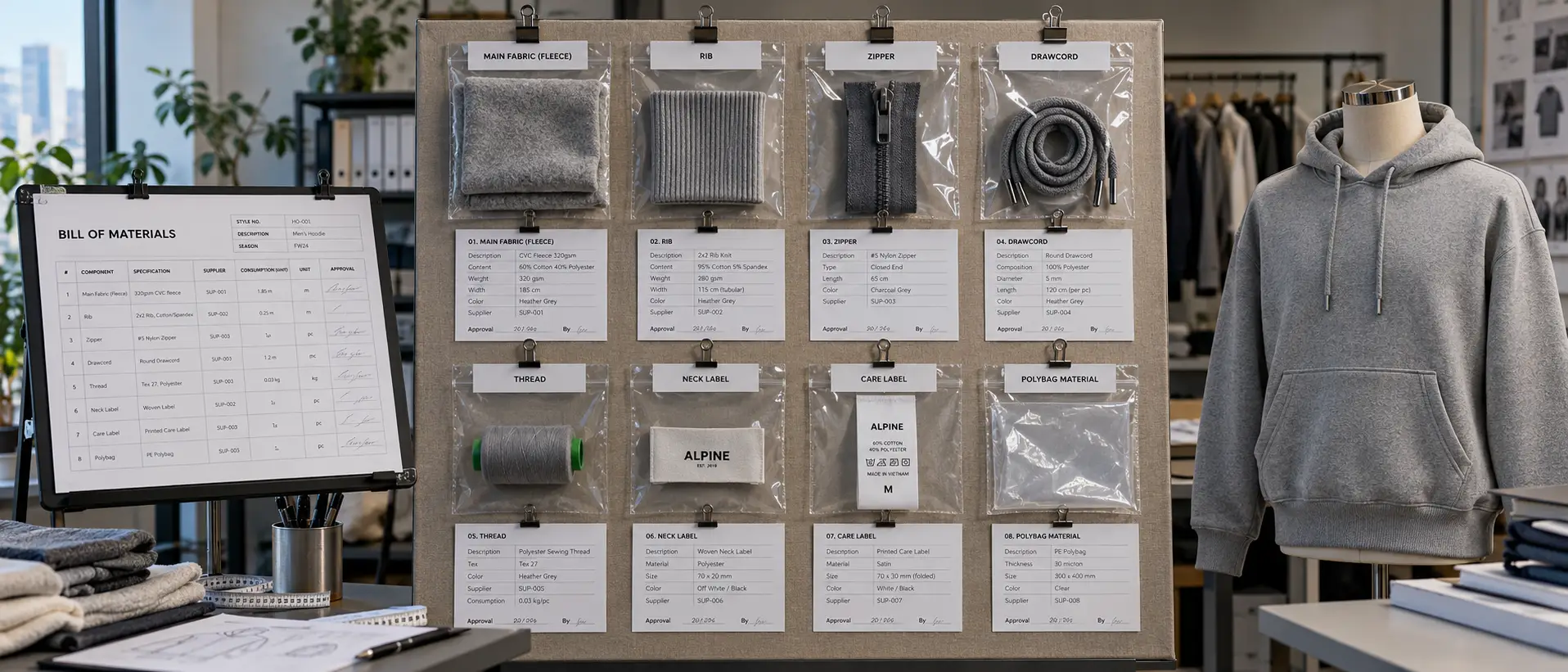
A consistent preparation process helps ensure that fabrics, trims, labels, and packaging components are identified before they create sourcing or costing problems.
The following steps can be used for a T-shirt, hoodie, jacket, trousers, dress, or another apparel product.
Step 1: Identify the Garment and Its Components
Start with the approved or working technical design.
Review the front and back drawings, construction details, reference samples, and available product specifications.
Identify every physical component required for the intended garment.
For a zip-up hoodie, this might include the main fleece fabric, rib cuffs, rib waistband, front zipper, drawcord, sewing thread, labels, hangtag, and packaging materials.
Check details that are easy to overlook, such as zipper pullers, drawcord ends, eyelets, back-neck tape, or special reinforcement components, where applicable.
Step 2: Group Components Into Categories
Organize the identified materials into logical groups:
- Fabrics: Main fabric, secondary fabrics, rib, lining, and interlining
- Trims: Zippers, buttons, elastics, drawcords, hardware, and threads
- Labels: Main labels, size labels, care labels, and special identification labels
- Packaging: Polybags, hangtags, barcode stickers, inserts, and cartons
Keep manufacturing operations such as embroidery, printing, and washing in a linked process or costing schedule when they are not being managed as material items.
Step 3: Write a Technical Specification for Each Item
Replace general descriptions with specifications that can support sourcing.
For example, “navy fabric” is insufficient when the design requires a particular fabric composition, weight, construction, and finish.
A stronger material description might be:
80% cotton / 20% polyester, 320 GSM brushed fleece, navy color reference C01, approved hand-feel and finishing standard.
The exact level of detail depends on the material and its effect on garment quality, cost, and performance.
Step 4: Identify Sourcing Responsibilities
Determine whether each component is:
- Buyer-nominated: A particular supplier, material code, or approved product reference is specified.
- Manufacturer-sourced: The manufacturer can propose a component that meets the buyer’s requirements.
- Buyer-supplied: The buyer provides the material directly, subject to agreed delivery and handling responsibilities.
Specify whether alternatives are allowed and who must approve them.
A manufacturer-sourced item does not automatically mean unrestricted substitution.
Step 5: Establish Consumption and Units
Identify how each material is purchased and consumed.
Examples include kilograms for certain fabrics, meters for fabric or tape, pieces for zippers and labels, and cartons for outer packaging.
The quantity field must use the same unit basis as the price field when calculating material costs.
For fabric, the consumption estimate should reflect relevant pattern, size, width, marker, and processing conditions.
Record any additional allowance separately if it has not already been included.
Step 6: Record Colorways and Material Variations
Different garment colors may require different fabric shades, threads, zippers, labels, or other trims.
Assign identifiable colorway references and connect each material to the corresponding color.
When a component is shared across several colorways, document that relationship rather than creating conflicting specifications.
Step 7: Add MOQ, MCQ, and Material Availability Notes
Identify materials with potential minimum order or minimum color requirements.
Custom woven labels, specialty hardware, unique fabric shades, and branded packaging may need larger purchase quantities than the garment order alone would suggest.
Record supplier availability and lead-time information when confirmed, and distinguish estimated values from supplier-verified conditions.
Step 8: Calculate Material Costs
Combine the relevant material quantities with supplier prices and applicable wastage or purchase allowances.
Keep material costs separate from manufacturing operations and commercial charges so quotation changes remain traceable.
Step 9: Assign Approval Status
Use clear statuses such as:
- Proposed: Suggested material awaiting review
- Sample Approved: Accepted for the specified sample or development purpose
- Production Approved: Authorized for the relevant production requirement
- Rejected: Not accepted
- Pending Confirmation: Requires additional information, testing, or decision
An approval for an early prototype does not necessarily authorize the same material for bulk production.
Step 10: Release and Maintain the Controlled BOM
Assign a version number and establish responsibility for reviewing changes.
Whenever an approved material, consumption figure, supplier, color, or packaging specification changes, update the BOM and assess the related cost and production implications.
The output should be a clearly identified BOM that sourcing, development, costing, and production teams can use consistently.
Bill of Material Format for Garments: Essential BOM Columns
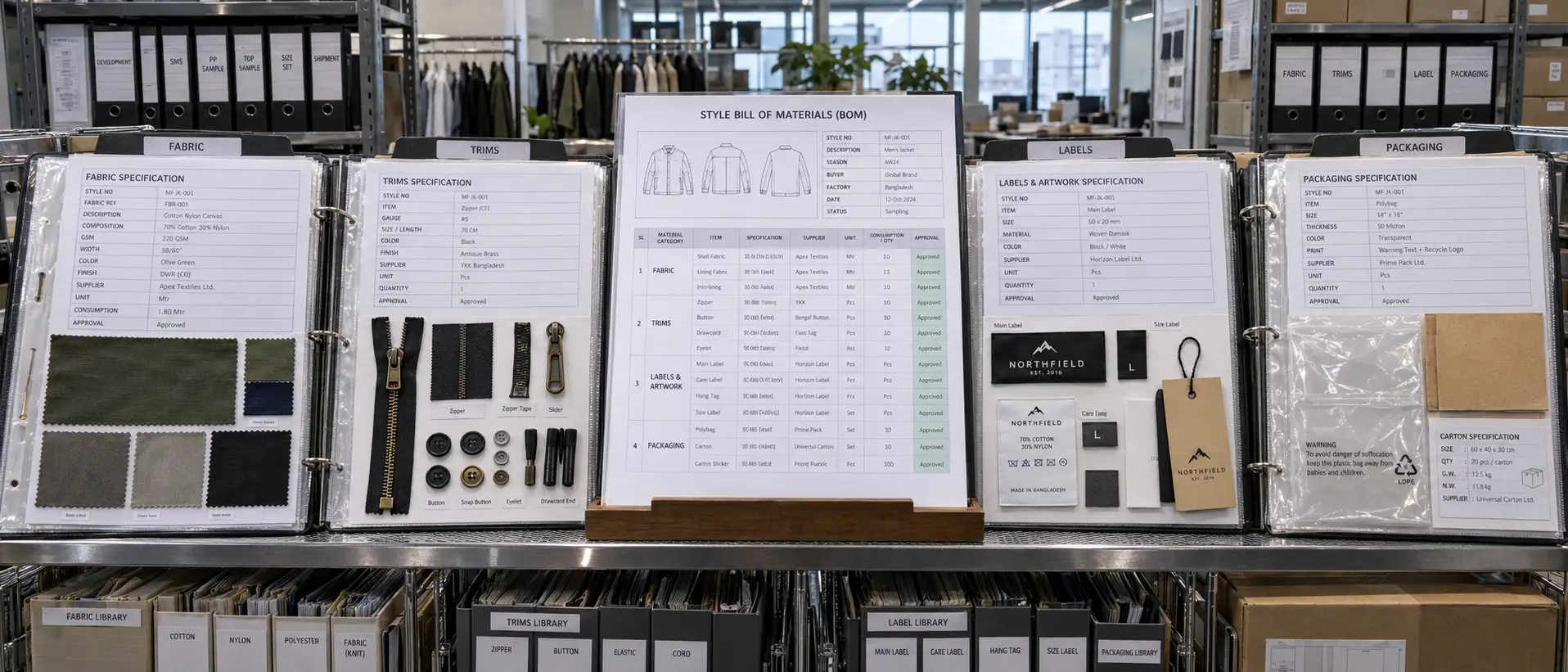
A useful BOM page must be readable by the people responsible for development, purchasing, costing, and material verification.
The best format makes important decisions visible without requiring users to interpret vague notes or search through separate conversations.
BOM Page Column Checklist
| Column | Purpose | Risk if Missing |
|---|---|---|
| Category | Groups fabrics, trims, labels, and packaging | Components become difficult to organize |
| Item Code | Provides a unique component identifier | Similar items may be confused |
| Item Description | Identifies the required material or component | Incorrect material may be proposed |
| Technical Specification | Defines composition, dimensions, finish, or other requirements | Sourcing differences may go unnoticed |
| Color Reference | Identifies the applicable shade or colorway | Incorrect color selection |
| Supplier / Sourcing Rule | Identifies the source and sourcing responsibility | Unauthorized or unsuitable alternatives |
| Unit of Measure | Defines kg, meter, piece, carton, or another purchasing unit | Incorrect consumption or costing calculations |
| Consumption | Records the quantity required per garment or packing unit | Material requirements may be underestimated |
| Wastage / Allowance | Records applicable additional material requirements | Insufficient or duplicated allowances |
| MOQ / MCQ | Identifies minimum purchasing conditions | Unexpected material commitments |
| Unit Cost | Records the applicable price per purchasing unit | Incomplete material costing |
| Approval Status | Distinguishes proposed and approved components | Unapproved materials may enter production |
| Notes / References | Connects supporting documents, testing, and special conditions | Important requirements may be overlooked |
Not every component needs every field. For example, a woven label generally does not require a fabric GSM entry, while a main fabric requires more detailed material specifications than a carton sticker.
The goal is to create a consistent structure with enough flexibility for different material categories.
Single-Level vs. Multi-Level BOM
A single-level BOM lists the components required for a finished product. It is generally sufficient for many basic garments.
A multi-level BOM divides larger assemblies into smaller components when this supports purchasing or control.
For example, a specialized zipper assembly might include zipper tape, teeth, slider, puller, and stops. If these parts are purchased separately, recording them as a controlled assembly can help prevent omissions.
The same approach may be useful for elaborate packaging sets or garments containing detachable components.
Use a multi-level structure when the additional detail improves sourcing, costing, or approval control. A simple garment does not require unnecessary complexity.
Garment Bill of Materials Example: Zip-Up Hoodie
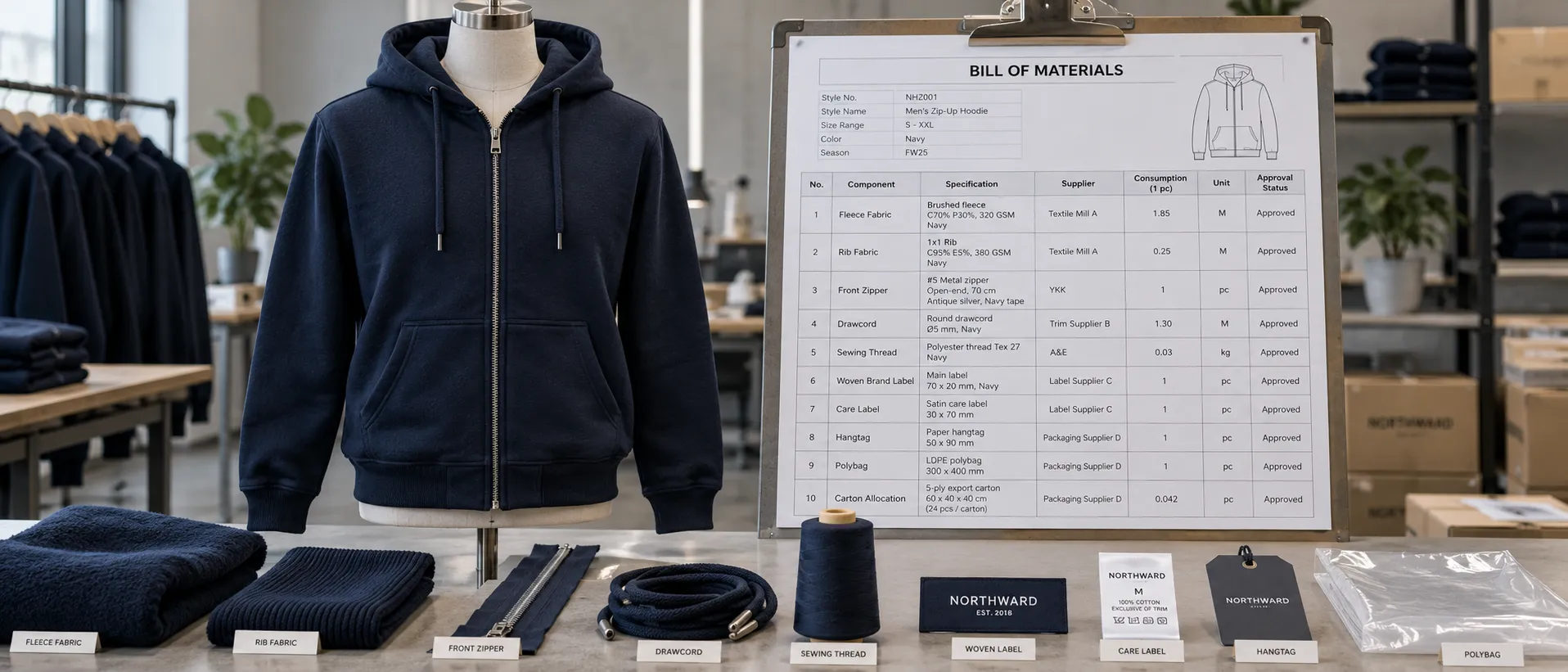
The following example demonstrates how a clothing BOM can be organized for a basic zip-up hoodie.
Product assumptions: The example uses a size L hoodie with a navy main fabric, rib cuffs and waistband, a full-length front zipper, a hood drawcord, standard brand labels, and individual packaging.
The quantities are illustrative and represent preliminary base consumption figures before the separate allowances used in the costing example.
Example Apparel BOM
| Category | Component | Specification | Color | Sourcing | Base Consumption | Approval Status |
|---|---|---|---|---|---|---|
| Fabric | Main Body Fabric | 80% cotton, 20% polyester, 320 GSM brushed fleece | Navy C01 | Manufacturer-sourced | 1.20 kg | Proposed |
| Fabric | Rib Fabric | 95% cotton, 5% elastane, 400 GSM rib | Navy C01 | Manufacturer-sourced | 0.12 kg | Proposed |
| Trim | Front Zipper | #5 zipper, 65 cm, approved finish | Navy | Manufacturer-sourced | 1 pc | Pending approval |
| Trim | Hood Drawcord | Polyester drawcord, specified length and finish | Navy | Manufacturer-sourced | 1 pc | Proposed |
| Trim | Sewing Thread | Polyester thread, agreed ticket and color | Navy | Manufacturer-sourced | 60 m | Proposed |
| Label | Main Brand Label | Woven label, approved dimensions and artwork | Black / White | Buyer-nominated | 1 pc | Sample approved |
| Label | Care Label | Printed composition and care label | White | Manufacturer-sourced | 1 pc | Pending approval |
| Packaging | Hangtag | Printed tag with approved artwork | Multicolor | Buyer-nominated | 1 pc | Pending approval |
| Packaging | Individual Polybag | Clear bag, specified size and sealing method | Clear | Manufacturer-sourced | 1 pc | Proposed |
| Packaging | Master Carton | Shipping carton, 20 garments per carton | Brown | Manufacturer-sourced | 0.05 carton | Proposed |
Illustrative example only. Actual material consumption, zipper length, component specifications, purchase allowances, and approval requirements must be confirmed for the garment and order.
What This BOM Example Demonstrates
Each line identifies a physical component and provides enough information to begin technical review or sourcing discussions.
The table also shows that different materials may be at different approval stages.
For instance, the woven brand label has been approved for a sample, but this does not automatically authorize bulk procurement if artwork, dimensions, or other relevant requirements subsequently change.
The master-carton consumption of 0.05 carton per garment assumes 20 garments per carton:
\[ 1 \div 20 = 0.05 \]
This type of allocation is useful for estimating unit packaging cost, while actual cartons must be ordered in whole quantities according to the packing plan.
Review Colorways and Size Variations
A BOM prepared for one size and color cannot automatically represent every variation in a production order.
Larger sizes may require more fabric. Different colors may require different thread or zipper references. Certain designs may use different artwork or trims by size.
A production BOM should therefore connect relevant components to the approved size range, colorways, and consumption assumptions.
For a clearer understanding of how a Bill of Materials fits into apparel technical documentation, the following video by 383 Design Studio introduces the role of a BOM in a fashion tech pack. It complements the example above by explaining why garment components and material specifications need to be properly documented.
BOM Cost Calculation: How to Estimate Material Cost per Garment
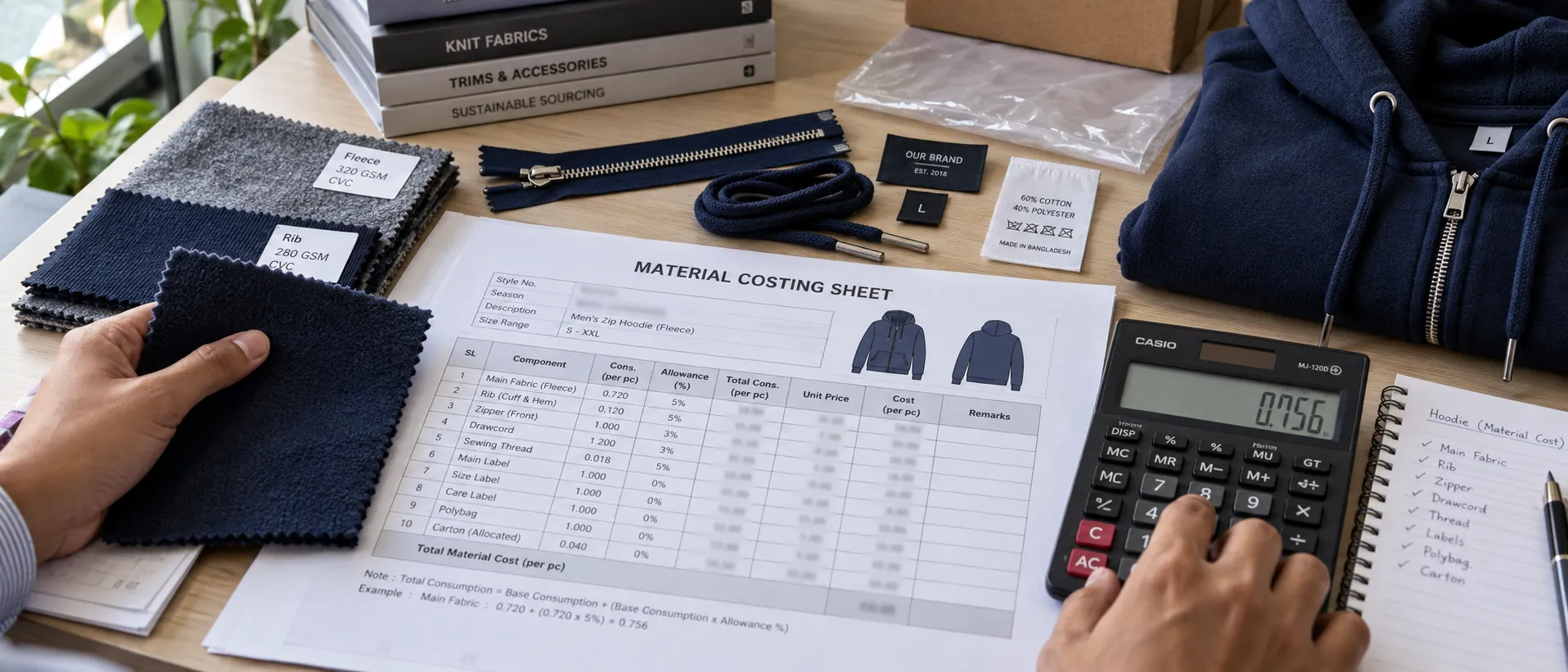
BOM cost is the calculated cost of the materials and components required for the garment.
A BOM cost analysis helps buyers understand which items contribute to the material cost and how changes in consumption, prices, or specifications affect the total.
It is particularly useful when comparing fabric options, evaluating alternative trims, or investigating a revised quotation.
However, BOM material cost must not be confused with the complete garment manufacturing price.
Basic BOM Cost Formula
For a material whose additional wastage allowance has not already been included:
\[ \text{Extended Cost} = \text{Base Consumption} \times (1+\text{Allowance Rate}) \times \text{Unit Price} \]
This formula uses an additive purchase allowance. If loss is instead expressed as a percentage of the purchased quantity, a yield-based calculation may be appropriate.
The method should be agreed with the costing team and applied consistently.
Important: If the consumption estimate already includes cutting waste, shrinkage, or other relevant allowances, those amounts must not be added again.
Worked Example: BOM Cost Analysis for a Hoodie
Using the hoodie BOM from the previous section, the following illustrative calculation estimates material cost for one base-size garment.
| Material | Base Consumption | Unit Price | Additional Allowance | Extended Cost |
|---|---|---|---|---|
| Main Fleece Fabric | 1.20 kg | $4.00/kg | 5% | $5.04 |
| Rib Fabric | 0.12 kg | $5.00/kg | 5% | $0.63 |
| Front Zipper | 1 pc | $0.65/pc | 0% | $0.65 |
| Hood Drawcord | 1 pc | $0.20/pc | 0% | $0.20 |
| Sewing Thread | 60 m | $0.003/m | 0% | $0.18 |
| Main Brand Label | 1 pc | $0.05/pc | 0% | $0.05 |
| Care Label | 1 pc | $0.04/pc | 0% | $0.04 |
| Hangtag | 1 pc | $0.08/pc | 0% | $0.08 |
| Individual Polybag | 1 pc | $0.10/pc | 0% | $0.10 |
| Master Carton Allocation | 0.05 carton | $2.00/carton | 0% | $0.10 |
| Total Estimated BOM Material Cost | $7.07 |
All prices and consumption values are illustrative. They are not current supplier quotations or confirmed costs for RYZEAL SOURCING.
How the Fabric Calculation Works
For the main fleece fabric:
Base consumption = 1.20 kg
Additional purchase allowance = 5%
Unit price = $4.00 per kg
\[ 1.20 \times 1.05 \times 4.00 = \$5.04 \]
For the rib fabric:
\[ 0.12 \times 1.05 \times 5.00 = \$0.63 \]
The remaining components in this example are calculated using the listed quantities and unit prices without an additional allowance.
Adding the extended costs produces an estimated material BOM cost of $7.07 per garment.
Is BOM Cost the Same as FOB Price?
No.
The material BOM identifies one major portion of garment manufacturing cost, but a complete FOB quotation may also include:
- Cutting, sewing, and finishing operations
- Printing, embroidery, washing, or other specialized processes
- Applicable testing and quality-control costs
- Manufacturing overhead
- Commercial and documentation expenses
- Inland handling and delivery costs covered by the agreed FOB terms
- Supplier margin and other agreed commercial allowances
The inclusion and allocation of these costs depend on the manufacturer’s costing method and quotation terms.
A BOM should support the garment costing process, not be presented as the complete selling price.
Common BOM Costing Mistakes
Costing errors can arise when:
- Fabric consumption is based on an incorrect size or pattern.
- Kilograms, meters, yards, and pieces are mixed without conversion.
- Waste or shrinkage allowances are applied twice.
- A fabric price is quoted in a different unit from the consumption unit.
- Custom trim MOQs require purchasing excess material.
- Packaging and labeling items are omitted.
- Decoration or special-process costs are not included in the wider costing schedule.
These problems can often be reduced through consistent units, clearly documented estimates, and supplier confirmation.
BOM Cost Optimization Without Losing Product Quality
Cost optimization should start by identifying the components that materially influence price.
For example, replacing a custom zipper with an approved standard zipper may reduce component cost and minimum-order constraints.
Similarly, using common packaging across several styles may simplify sourcing and purchasing.
However, a lower-priced material is not necessarily an acceptable substitute.
Before approving an alternative, review its construction, performance, appearance, durability, availability, and applicable buyer requirements.
The following garment-costing tutorial demonstrates how an Excel-based costing sheet can help organize garment cost calculations and support accurate pricing decisions. It complements the BOM discussion above by showing how material costs fit into the broader process of estimating garment production costs.
Connecting BOM Costs With Quotations
A structured Request for Quotation should identify the relevant BOM version, materials, estimated quantities, and unresolved cost assumptions.
Our guide to writing an RFQ to a clothing manufacturer explains how buyers can communicate technical and commercial requirements more clearly when requesting comparable manufacturing quotations.
Need Help Preparing Your BOM for Quotation and Sampling?
Share your garment specifications, fabric requirements, BOM details, or product references with RYZEAL SOURCING to discuss technical preparation and material requirements through our apparel manufacturing network.’ | CTA button: ‘Prepare Your Technical Specifications
BOM Components: Fabrics, Trims, Threads, and Labels
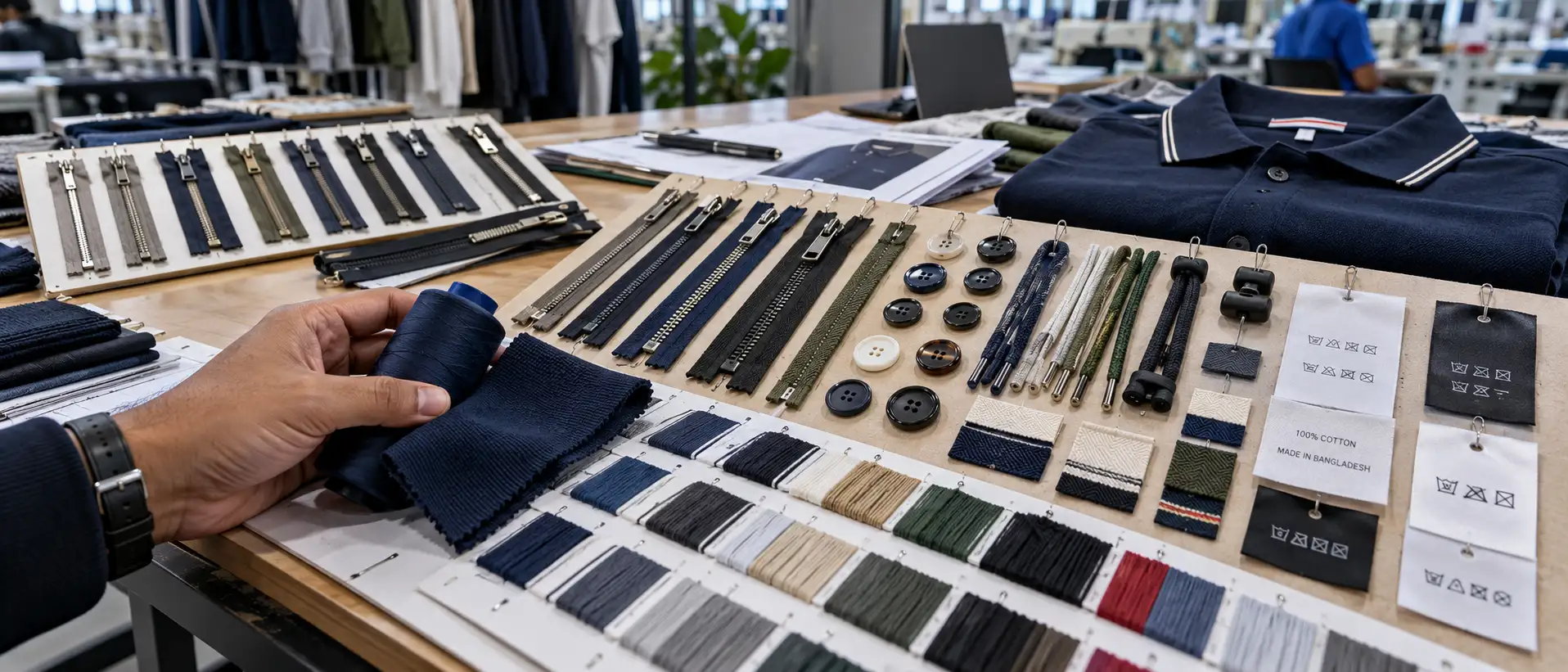
An effective BOM describes materials in terms suitable for purchasing and technical verification.
Different material categories require different specifications. Applying one generic description format to every component may leave important details unrecorded.
Fabric BOM Checklist
For each relevant fabric, include:
- Fabric name and item reference
- Fiber composition
- Knit or woven construction
- Fabric weight, where applicable
- Width or usable width
- Color reference and approved shade
- Finishing requirements
- Relevant dimensional stability or performance requirements
- Estimated consumption and purchase unit
- Supplier or sourcing responsibility
- Material approval status
Fabric requirements should reflect the garment’s intended function.
For example, stretch recovery may be particularly important for certain activewear materials, while dimensional stability and appearance after washing can be important for many everyday garments.
Where testing is required, identify the applicable test reference, acceptance criteria, and approval responsibility.
Trim BOM Checklist
For zippers, buttons, elastics, drawcords, and similar items, check:
- Component type and description
- Material and dimensions
- Size, length, or gauge where relevant
- Color and surface finish
- Supplier or approved product reference
- Quantity per garment
- Any applicable functionality or durability requirement
- Approved alternatives, if permitted
- MOQ, MCQ, or sourcing constraints
A zipper described only as “metal zipper” may leave its size, type, finish, strength, and compatibility uncertain.
These details can influence both cost and product performance.
Sewing Thread Specifications
Sewing thread may require a separate BOM line or inclusion in the manufacturer’s controlled materials specification.
Relevant details can include:
- Fiber composition or thread type
- Thread ticket or size designation
- Color matching requirement
- Specific construction or seam applications
- Applicable thread performance requirements
- Estimated consumption or costing allocation
Thread consumption varies according to stitch type, seam length, stitch density, construction method, and other factors.
A preliminary estimate may be used for costing, but the appropriate thread specification should be confirmed for the actual fabric and sewing requirements.
Label and Branding Components
Labels should also be included as material components where applicable.
Specify the required label type, material, dimensions, color, artwork reference, placement, attachment method, and quantity.
Care and composition labels may require additional product information and market-specific review.
A label can be inexpensive relative to the garment, but using the wrong content or artwork can create significant compliance or customer requirements problems.
Packaging BOM: How to Control Packing Materials and Errors
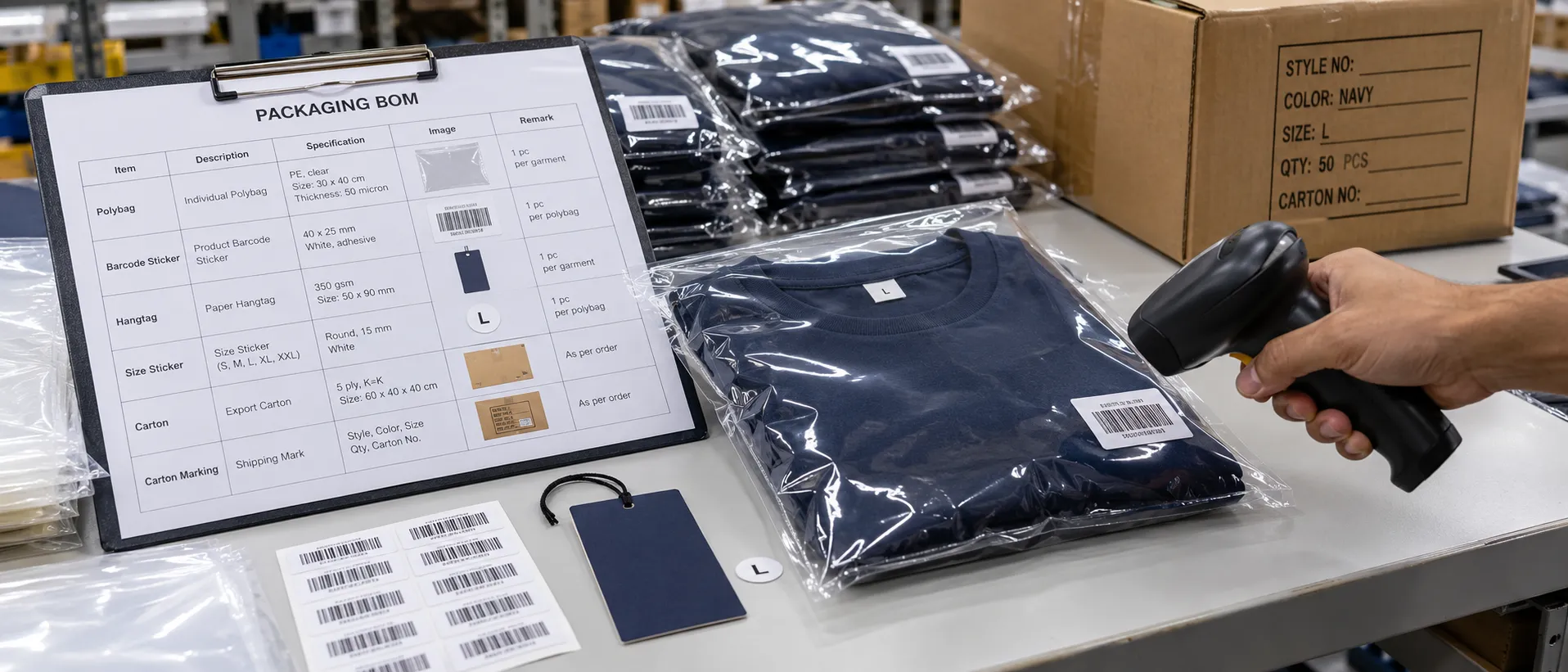
Packaging materials should be included in the BOM or a linked packaging schedule because they affect purchasing, costing, identification, and shipment preparation.
The requirements depend on the garment, sales channel, destination market, and buyer’s packing instructions.
For example, an e-commerce garment may use different individual packaging from a product supplied to a retailer with specific barcode and carton requirements.
Packaging BOM Checklist
| Packaging Item | Specification Requirements | Consumption Basis | Potential Risk | Approval Reference |
|---|---|---|---|---|
| Polybag | Material, size, thickness if specified, sealing method | Per garment | Incorrect bag or protection | Material specification / packed sample |
| Barcode Sticker | Barcode data, size, position, printing requirement | Per garment or package | Identification or scanning errors | Approved artwork / scan check |
| Hangtag | Artwork, dimensions, material, attachment method | Per garment | Incorrect branding | Approved hangtag sample |
| Tissue / Insert | Material, size, printing, and placement | Per garment where applicable | Presentation inconsistency | Approved packing reference |
| Warning Label | Applicable text, language, and location | Per package where required | Market-specific compliance issue | Approved warning artwork |
| Master Carton | Dimensions, material specification, packing quantity | Per carton | Packing or shipment mismatch | Approved packing instruction |
| Carton Marking | Required identification, size/color details, shipping marks | Per carton | Incorrect shipment identification | Approved carton-marking artwork |
How Packaging Changes Affect BOM Cost
Packaging costs may increase when buyers introduce custom inserts, specialty polybags, additional barcodes, premium cartons, or revised hangtag requirements.
These changes can also affect supplier minimum orders.
For example, a custom printed packaging item may require purchasing more units than the current garment order needs.
In such cases, distinguish the actual purchase commitment from the component cost allocated per garment.
Unused stock may represent inventory for future orders, a separate development cost, or another commercial arrangement, depending on the agreement.
When Should Packaging Be Approved?
Packaging requirements should be confirmed at the appropriate development stage.
An early fit sample may not need complete retail packaging. A pre-production sample or packing trial may need to demonstrate the final folding method, labels, barcode placement, and packaging components.
Approvals can be supported by artwork, photographs, material specifications, physical packed samples, or other suitable references.
The BOM should point to the approved packaging information rather than attempt to reproduce every packing instruction in one table.
BOM Management: Material Approvals, Substitutions, and Change Control
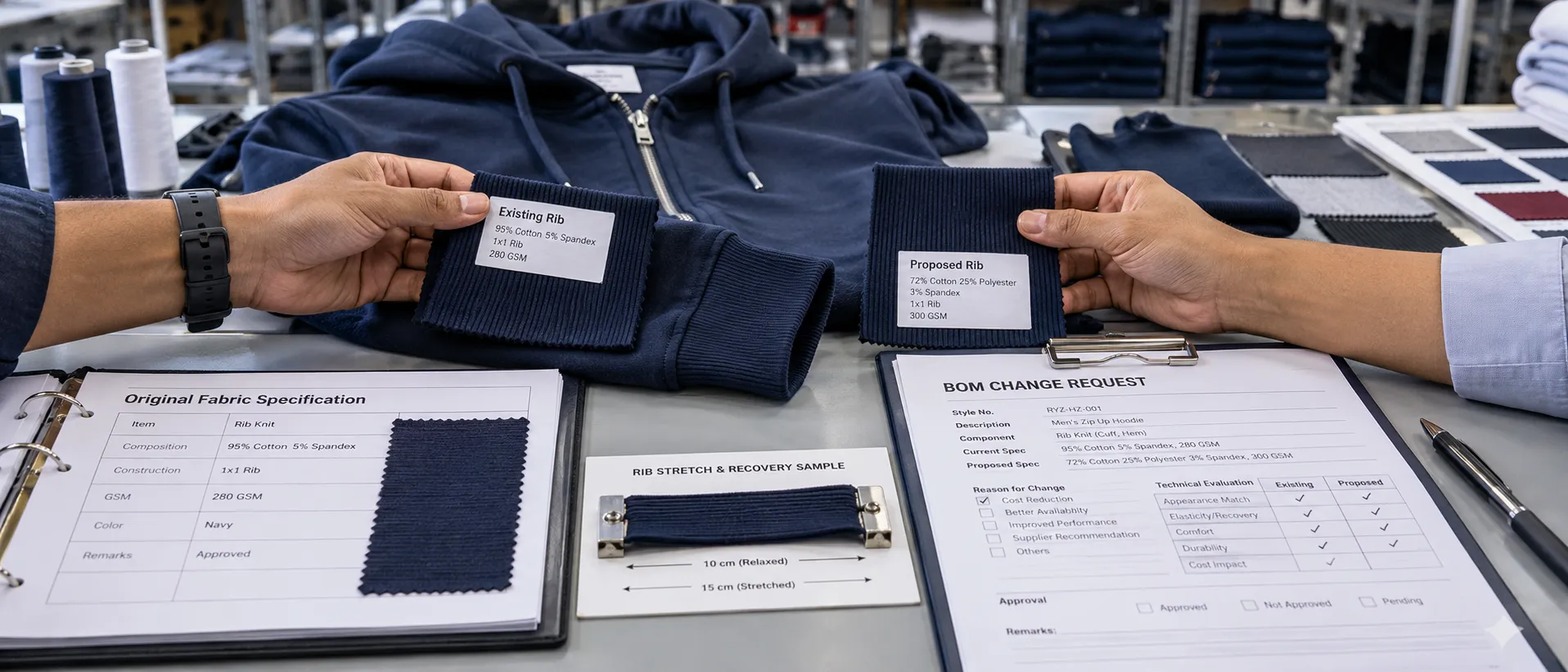
BOM management is the process of keeping material specifications, sourcing responsibilities, cost information, approvals, and revisions accurate throughout product development and manufacturing.
A well-prepared initial BOM is useful, but it cannot remain reliable if approved changes are not recorded.
Material availability, garment specifications, supplier proposals, and buyer requirements may all change during development.
Establish Clear Material Approval Status
Every material that requires approval should have an identifiable status.
For example:
Proposed: The material has been suggested but not yet accepted.
Under Review: The buyer or technical team is evaluating the material.
Sample Approved: The material is approved for the specified sample or development purpose.
Production Approved: The material is authorized for the relevant production stage.
Rejected: The submitted material does not meet the agreed requirements.
Pending Clarification: Additional information, testing, or a buyer decision is required.
The terminology can vary between organizations, but the meaning of each status should be understood by everyone involved.
How to Manage Material Substitutions
A substitution should not be treated as a simple product-name change.
Before approving an alternative material, check its effect on:
- Product appearance and color
- Fit and fabric behavior
- Construction compatibility
- Durability and required performance
- Applicable compliance requirements
- Material cost
- Sourcing quantity and availability
- Existing samples and approvals
If the alternative changes the approved garment standard, the relevant technical documents and approval records should be updated.
BOM Change Control Process
Use a consistent sequence:
- Request the change: Identify the affected component and proposed revision.
- Evaluate the impact: Review technical, costing, sourcing, testing, and development implications.
- Obtain approval: Confirm the responsible decision-maker and approval scope.
- Update the BOM: Revise the component specification, status, or other affected fields.
- Link the documents: Align the BOM with the corresponding tech pack, sample, or material reference.
- Communicate the revision: Notify the relevant sourcing, development, and manufacturing teams.
This creates a traceable record of decisions rather than relying on separate conversations.
Example BOM Change Log
| Version | Date | Change | Reason | Cost Impact | Approval | Linked Tech Pack |
|---|---|---|---|---|---|---|
| V01 | 01 Oct 2026 | Initial BOM prepared | Development baseline | Baseline | Proposed | TP-V01 |
| V02 | 05 Oct 2026 | Zipper reference updated | Approved component change | +$0.08/pc | Approved | TP-V02 |
| V03 | 09 Oct 2026 | Rib fabric specification revised | Fit and recovery review | Pending confirmation | Under review | TP-V03 |
| V04 | 12 Oct 2026 | Polybag specification updated | Buyer packaging requirement | +$0.02/pc | Approved | TP-V04 |
Illustrative change log. Dates, versions, costs, and approval statuses are examples only.
Keep BOM and Sample Approvals Connected
A material approved for an early development sample may not be suitable as the final production reference.
For example, a prototype may use an available substitute fabric to evaluate the silhouette. Later development may require the intended production fabric to evaluate fit, shrinkage, appearance, and performance.
That is why the BOM should distinguish provisional materials from approved production materials.
A structured system of sampling approval gates and material standards helps buyers connect BOM revisions with sample evaluations, approved material references, and production-readiness decisions.
Excel BOM Template: How to Structure and Manage Your BOM Sheet
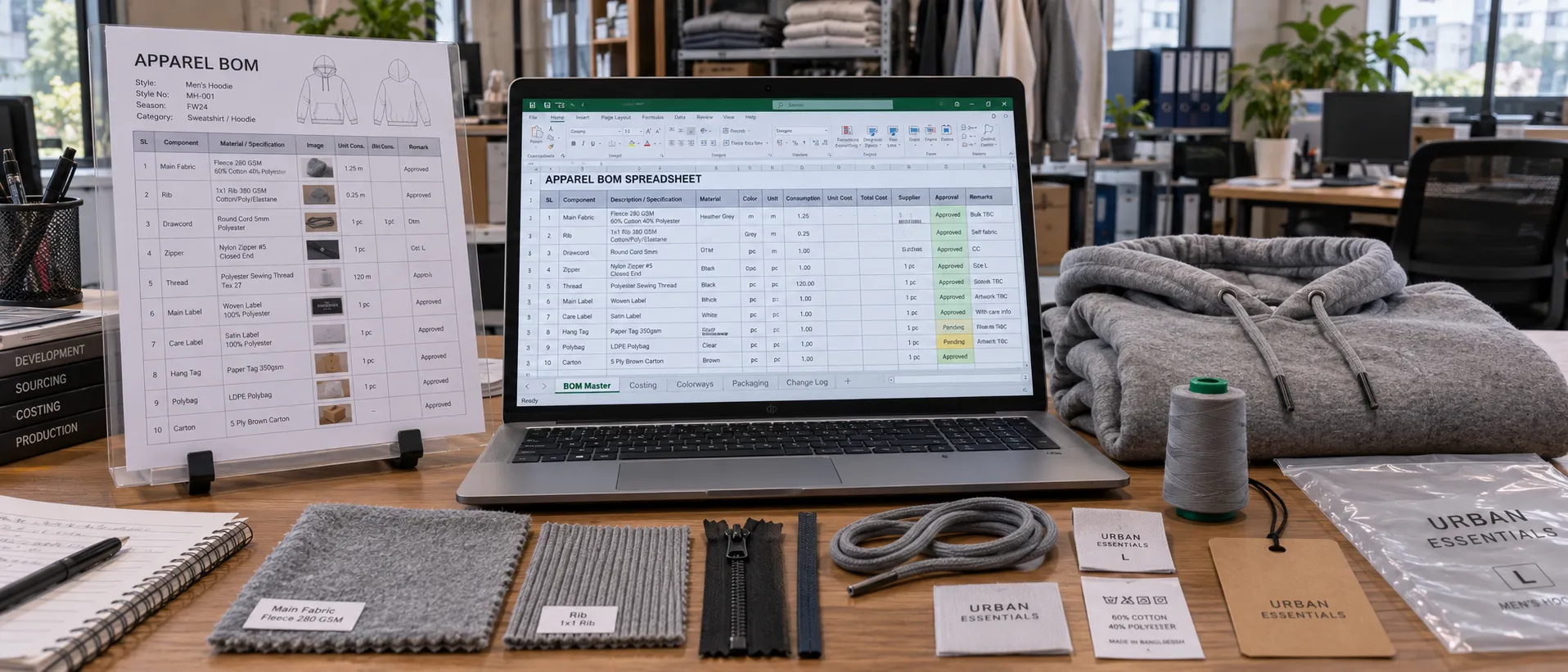
An Excel BOM template or another spreadsheet-based system can be a practical starting point for smaller apparel brands and development teams.
Spreadsheets make it relatively easy to organize component specifications, calculate estimated costs, compare material options, and maintain revision records.
However, the effectiveness of the system depends on how accurately it is maintained.
Recommended BOM Spreadsheet Structure
A reusable workbook can contain separate sheets for:
1. BOM Master: Style identification, components, technical specifications, units, consumption, sourcing, and approval status.
2. Material Costing: Unit prices, applicable allowances, extended costs, and total estimated material cost.
3. Colorway Details: Material and component references for each garment color.
4. Packaging BOM: Individual and master-packing materials, quantities, and approvals.
5. Change Log: Revisions, approval decisions, cost impacts, and linked tech pack versions.
Smaller teams may combine certain sheets if the information remains easy to locate and control.
Excel BOM Formula Examples
If a component’s base consumption is in cell G2, its additional allowance is in H2, and its unit price is in I2, an illustrative extended-cost formula is:
=G2*(1+H2)*I2
This assumes that the allowance cell contains a valid percentage and the units are consistent.
For a roll-up of calculated item costs in cells J2 through J20:
=SUM(J2:J20)
These formulas should be adapted to the workbook structure and costing method.
Where components have different purchasing units or consumption rules, use the appropriate conversion or calculation before extending their costs.
Prevent Uncontrolled Spreadsheet Changes
A practical BOM management system should include:
- One identified master file
- Controlled editing permissions
- Consistent style and version references
- Protected formulas where appropriate
- Defined material approval responsibilities
- A revision log
- A clear method for distributing current specifications
A PDF export can be useful for sharing a fixed review version, while the controlled spreadsheet remains the editable master.
When Should You Consider PLM?
Product Lifecycle Management (PLM) systems may be appropriate when a brand manages many styles, complex material libraries, frequent revisions, several suppliers, and multiple approval teams.
They can help centralize technical information and establish more structured approval and revision workflows.
However, implementing PLM does not automatically improve BOM accuracy.
A well-managed spreadsheet may be entirely suitable for a smaller development program.
The best system is one that supports reliable documentation and can be maintained consistently by the people responsible.
Common BOM Errors That Cause Cost Surprises and Material Problems
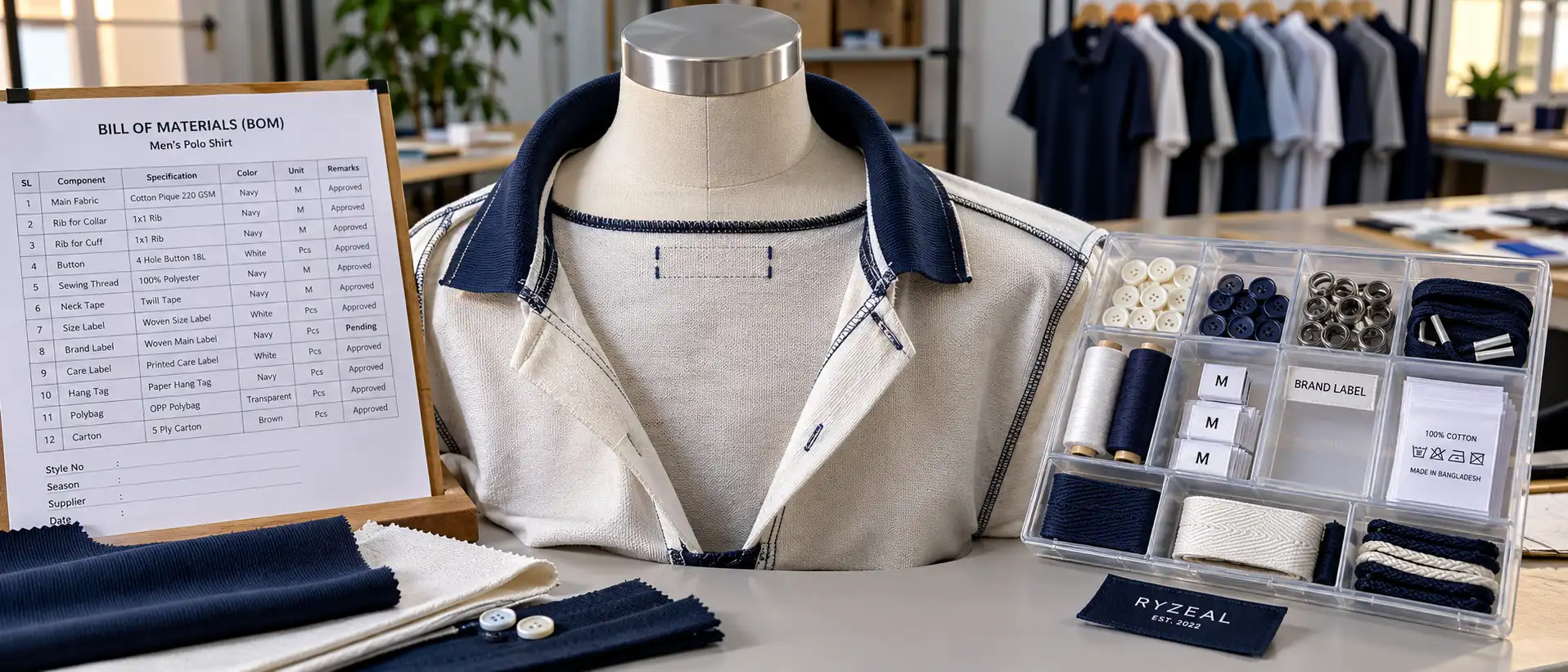
Most BOM problems are easier to correct before materials are purchased or production begins.
A final BOM review should focus on completeness, technical accuracy, sourcing feasibility, and approval control.
Common BOM Errors
1. Missing material components
A BOM lists the main fabric but omits labels, thread, trims, or packaging.
Prevention: Review the garment’s construction and packing requirements component by component.
2. Vague material descriptions
A fabric is identified only by composition without sufficient construction, weight, color, or finishing details.
Prevention: Specify the technical properties that influence sourcing and manufacturing suitability.
3. Incorrect consumption calculations
Fabric or trim quantities are underestimated because of inconsistent units or incomplete assumptions.
Prevention: Confirm the consumption method, relevant garment sizes, and applicable purchase allowances.
4. Double-counted wastage
A consumption figure already includes cutting loss, but an additional percentage is applied without justification.
Prevention: Identify exactly which allowances are included in each quantity.
5. Unconfirmed MOQ or MCQ
A custom component requires a larger purchase commitment than the garment order initially suggests.
Prevention: Confirm sourcing minimums and document the cost or inventory implications.
6. Unapproved substitutions
A proposed alternative is treated as an approved component without adequate technical review.
Prevention: Establish approval responsibilities and permitted substitution rules.
7. Missing packaging requirements
Custom labels, stickers, cartons, or packing components are introduced after costing.
Prevention: Review the packaging BOM during development and quotation preparation.
8. Outdated BOM versions
Sourcing or production teams use material information that no longer matches the approved garment.
Prevention: Maintain a controlled revision process and communicate relevant changes.
Final BOM Accuracy Checklist
Before releasing a BOM for the intended manufacturing activity, verify:
- All relevant physical materials and components are listed.
- Technical specifications are sufficiently clear.
- Component codes and color references are consistent.
- Sourcing responsibilities are identified.
- Consumption and purchasing units are compatible.
- Wastage or purchase allowances are not duplicated.
- MOQ and MCQ considerations have been reviewed.
- Material cost estimates use the correct price basis.
- Packaging requirements are included where relevant.
- Approval status is recorded for applicable components.
- Substitution rules are understood.
- The BOM version matches the current development reference.
- Open technical or commercial decisions are identified.
A BOM can be used for preliminary quotation or sampling while certain details remain provisional, provided those conditions are clearly communicated.
For production release, the applicable components and specifications should be confirmed and authorized according to the agreed approval process.
Frequently Asked Questions About Building a BOM
What is a BOM in clothing manufacturing?
A BOM, or Bill of Materials, is a structured list of the physical materials and components required to manufacture a garment. It generally includes fabrics, trims, threads, labels, and packaging, together with relevant specifications and quantities.
How do you build a BOM for apparel?
Start by identifying all garment components from technical drawings and construction details. Group the materials into categories, then add technical specifications, sourcing rules, color references, consumption quantities, relevant allowances, costs, and approval status.
What is the difference between a BOM and a tech pack?
A BOM focuses on materials, components, consumption, sourcing, and related approvals. A tech pack covers the broader technical requirements of the garment, including drawings, construction instructions, measurements, artwork, and other relevant specifications.
What is a standard bill of materials format for garments?
A typical garment BOM includes component category, item code, description, specification, color, supplier or sourcing rule, unit of measure, consumption, wastage or allowance, MOQ/MCQ information, and approval status. Cost fields may be included in the BOM or a linked costing sheet.
How do you calculate BOM material cost?
Multiply the relevant material consumption by its unit price, applying additional purchase allowances where necessary and not already included. Repeat the calculation for each component and add the extended costs to estimate total material BOM cost.
Does BOM cost include garment manufacturing labor?
Not necessarily. A material BOM cost typically represents fabrics, trims, labels, and packaging materials. Labor, manufacturing operations, overhead, commercial expenses, and margins may be calculated separately as part of the overall garment costing process.
Should printing and embroidery be included in a BOM?
The physical materials used for decoration may be listed in the BOM. Printing and embroidery operations themselves can be recorded in a linked process or costing schedule. The objective is to ensure that all relevant material and processing requirements are represented without confusing their costing methods.
What should be included in a packaging BOM?
A packaging BOM can include polybags, hangtags, barcode stickers, inserts, warning labels where required, cartons, and other relevant packing materials. Each component should have appropriate specifications, quantities, sourcing information, and approval references.
Can manufacturers substitute materials listed in the BOM?
Manufacturers may propose alternative materials, but substitutions should follow the agreed sourcing and approval rules. Alternatives that affect garment appearance, quality, performance, compliance, cost, or approved specifications should be reviewed before use.
How does BOM management prevent material errors?
BOM management maintains controlled material specifications, approval records, sourcing responsibilities, and revision history. It helps teams identify current requirements and reduces the risk of using outdated or unapproved material information.
Is Excel suitable for creating an apparel BOM?
Yes. Excel or another spreadsheet application can be suitable for smaller teams. It supports structured material records, cost calculations, and change logs. Larger organizations may benefit from PLM systems when they need more extensive collaboration and lifecycle management.
What causes unexpected BOM cost increases?
Common causes include changes in material prices, incorrect consumption assumptions, added trims, packaging revisions, special processing requirements, supplier minimums, and unapproved specification changes. A controlled BOM and costing record helps make these changes more visible.
Final Takeaway: A Reliable BOM Connects Materials, Costs, and Production
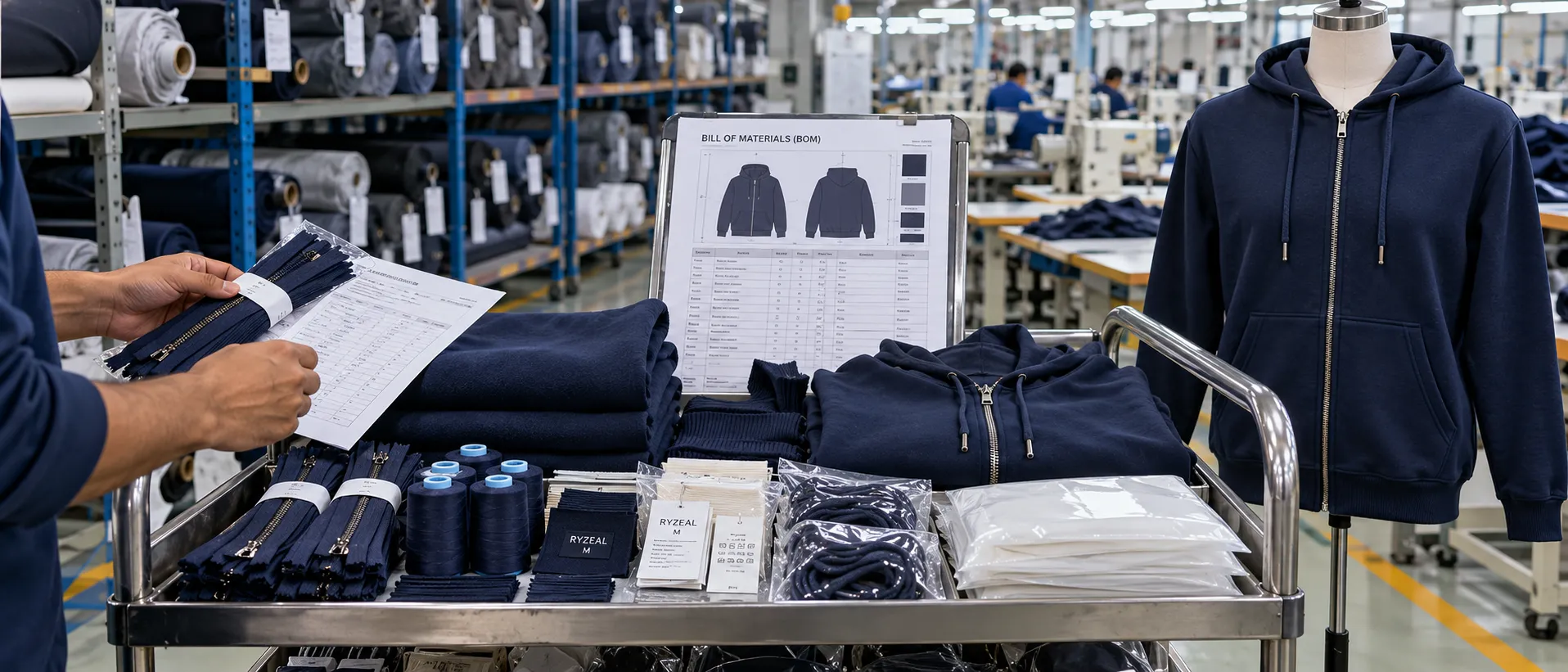
Understanding how to build a BOM means learning to manage more than a list of garment components.
An effective apparel BOM identifies the materials required, describes them accurately, connects them with sourcing responsibilities, calculates relevant consumption and cost assumptions, and records their approval status.
For buyers, this creates better visibility into material costs and sourcing decisions.
For manufacturers, it provides a clearer reference for procurement, sample development, and production preparation.
For both parties, controlled revisions help reduce uncertainty when fabrics, trims, labels, or packaging requirements change.
The BOM should also remain connected to the wider apparel product development process, where technical specifications, material approvals, sampling, and production readiness are coordinated.
At RYZEAL SOURCING, apparel manufacturing and sourcing support is coordinated through a vetted network of specialized manufacturing partners in Bangladesh. Material sourcing, product development, sampling, and production follow-up are aligned with the buyer’s specifications and the selected partner’s capabilities.
Ready to Request a Clothing Manufacturing Quote?
Have your garment specifications, BOM, fabric requirements, and estimated order quantities ready? Share your project with RYZEAL SOURCING to discuss material sourcing, costing, and manufacturing through suitable partner factories in Bangladesh.
A clear BOM cannot eliminate every sourcing or production challenge, but it gives buyers and manufacturers a more reliable foundation for making decisions, managing material changes, and maintaining the intended garment standard.
Connect with RYZEAL SOURCING