
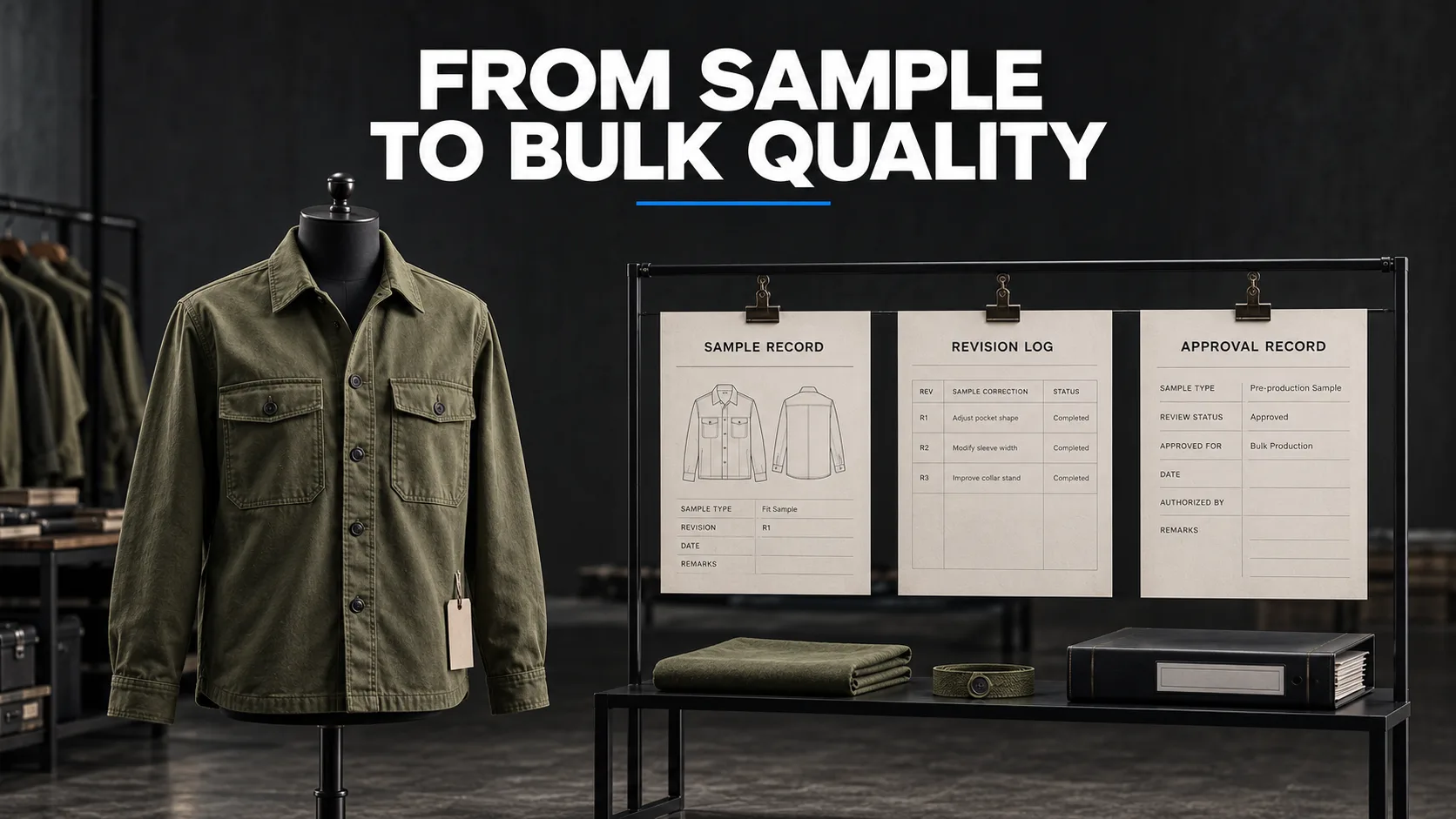
A sample management system helps clothing brands organize garment development, control sample revisions, manage approvals, and prepare manufacturing specifications for bulk production.
Sampling is where garment designs are tested against real materials, measurements, construction methods, and workmanship expectations. It is also where unclear instructions, fragmented feedback, delayed decisions, and uncontrolled document revisions can create unnecessary development rounds.
For startup clothing brands, product developers, merchandisers, technical designers, and quality assurance teams, managing sampling effectively requires more than requesting a prototype and sending correction comments.
A structured system connects each sample to a specific objective, identifies the technical documents being used, records evaluation results, assigns responsibilities, and establishes the conditions for moving to the next stage.
This guide explains how to establish and manage an apparel sample management system, including sample types, feedback templates, revision tracking, timeline management, pre-production samples, approval gates, digital tools, and production-readiness checks.
The system builds on the wider apparel product development workflow, where technical specifications, material sourcing, sampling, and approvals are coordinated before manufacturing.
What Is a Sample Management System in Apparel Manufacturing?
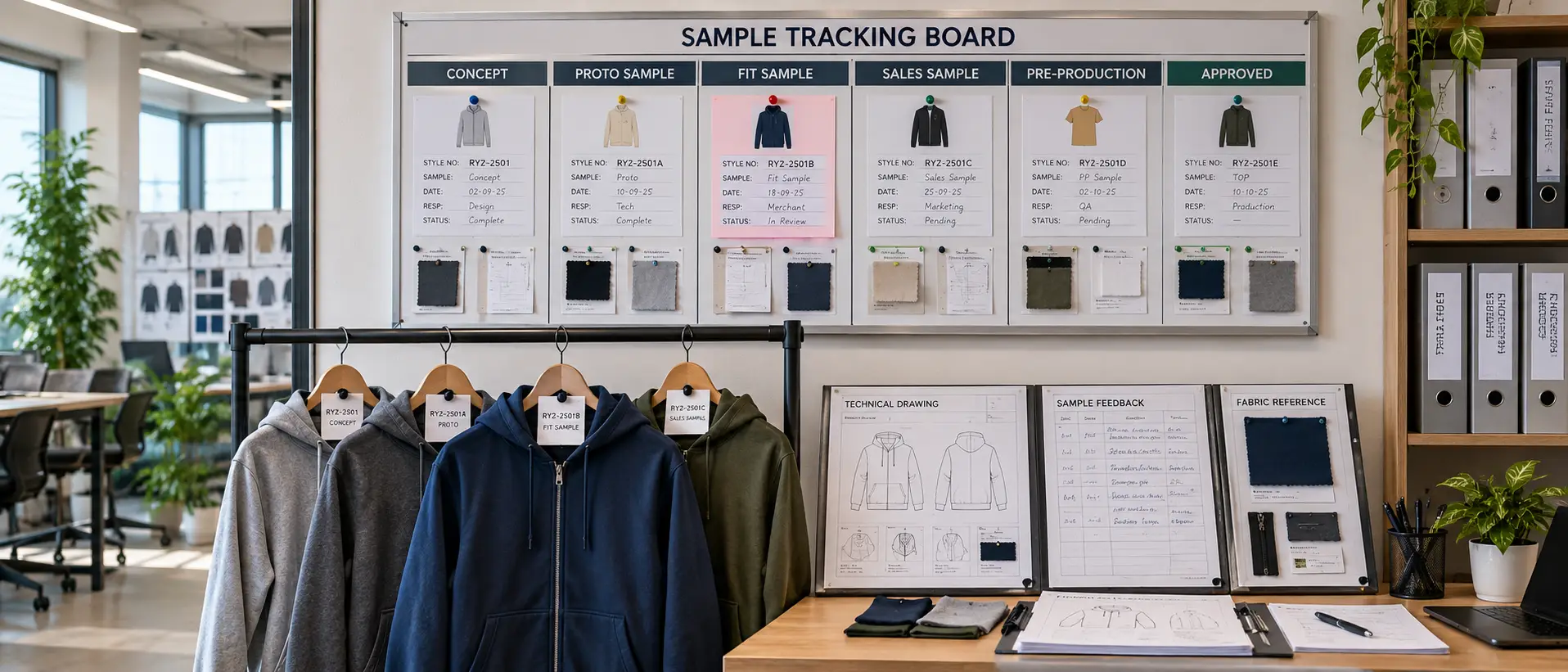
A sample management system is a structured workflow for planning, tracking, evaluating, and approving garment samples throughout product development.
It establishes how sampling requests are submitted, how each development round is evaluated, who provides feedback, and which requirements must be confirmed before the next activity begins.
The system may operate through spreadsheets, shared documents, Product Lifecycle Management (PLM) software, or dedicated sample-tracking platforms.
The software itself is not the system. The essential element is a consistent process that connects technical information with decisions and responsibilities.
Five Core Elements of a Sample Management System
A practical system should include:
- Sample objectives: What each sample is intended to demonstrate or validate.
- Technical references: The applicable tech pack, BOM, measurement chart, artwork, and supporting specifications.
- Feedback management: A consolidated record of findings, corrections, and required decisions.
- Timeline and status tracking: Responsible parties, target dates, actual progress, and unresolved blockers.
- Approval control: Documented decisions identifying what has been accepted, what remains open, and which specifications apply.
These elements help prevent different teams from working with conflicting instructions or assuming that a sample has received approval when only certain features were reviewed.
Why Sample Management Matters
Without a defined workflow, several problems can emerge.
A buyer may review a sample against a newer specification than the one used during development. Different departments may issue contradictory comments. A material substitution may be accepted for a prototype but mistakenly carried into the next sample. Or a manufacturer may receive a revised artwork file without updated placement instructions.
A sample management system helps make these differences visible and establishes a controlled procedure for resolving them.
Its purpose is not to eliminate every sampling revision. The objective is to make each revision necessary, traceable, and useful.
Apparel Sampling Process: From Request to Approval
The sampling process in apparel manufacturing is best managed as a series of development and evaluation activities.
A practical sequence is:
Sample request → Technical review → Sample development → Measurement and evaluation → Consolidated feedback → Approved corrections → Revised sample or decision → Next approval stage
The sequence may vary depending on garment complexity and the buyer’s requirements, but the underlying controls remain relevant.
Step 1: Submit a Clear Sampling Request
The buyer should identify the garment, intended sample type, relevant specifications, quantities, and development expectations.
Supporting documents may include:
- Technical drawings and construction instructions
- Base-size measurements and fit references
- Fabric and trim specifications
- Bill of Materials (BOM)
- Artwork and decoration requirements
- Relevant testing or finishing instructions
- Available reference garments or photographs
Not every detail must be finalized for an initial prototype. However, provisional information should be identified.
The tech pack checklist for quotation and sampling helps buyers distinguish between the information required for preliminary development and the more complete specifications needed for later sample stages.
Step 2: Review Technical Feasibility
The manufacturer or development partner reviews the available information.
Questions may involve material availability, construction methods, measurements, artwork techniques, or the feasibility of the intended design.
The review should identify open decisions and confirm whether development can proceed using the current information.
Step 3: Develop the Sample
The manufacturer produces the sample according to the agreed objectives and applicable technical references.
Depending on the stage, sample development may involve pattern making, cutting, sewing, printing, embroidery, washing, or other processes.
Any provisional materials or deviations from the requested specification should be recorded.
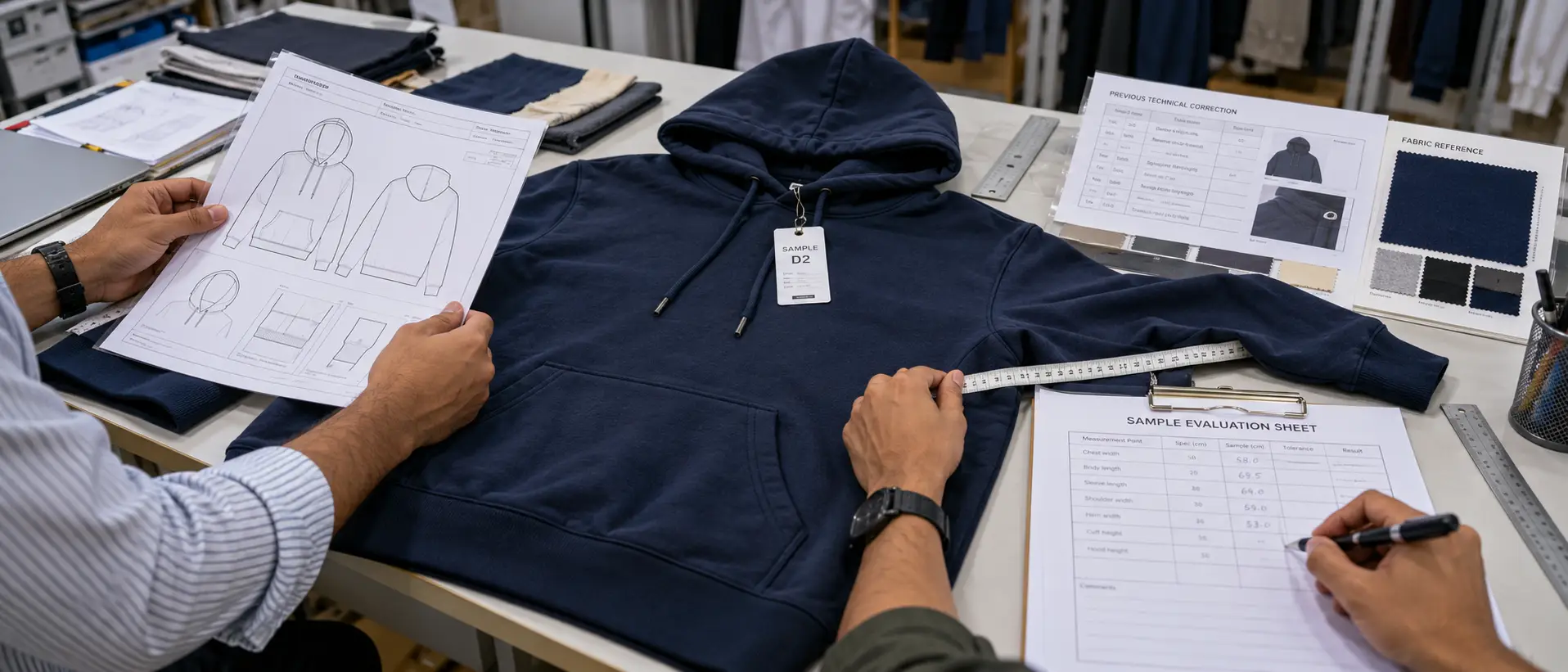
Step 4: Evaluate the Sample
The sample is reviewed against its intended purpose.
A prototype may be evaluated primarily for construction and design direction, while a fit sample requires more detailed dimensional and physical fit checks.
The evaluation should separate measurable deviations from appearance-based feedback and technical recommendations.
A structured sample evaluation should examine design accuracy, physical fit, and construction quality against the submitted specifications. StartUp FASHION’s guide to reviewing your first garment sample explains how buyers can compare a prototype with its tech pack, check measurements and workmanship, and prepare clearer factory comments before requesting revisions.
Step 5: Consolidate Feedback
Comments from design, technical, merchandising, and quality teams should be combined into one controlled record.
The record must identify the exact issue, required correction, responsible party, and relevant reference.
Step 6: Confirm Revisions and Next Actions
The manufacturer reviews the comments, identifies feasibility concerns, and confirms the proposed correction plan.
Several related changes may be implemented in one round when their effects are understood and documented.
The important requirement is traceability, not restricting every round to one change.
Step 7: Record the Approval Decision
The authorized reviewer determines whether the sample can advance, needs further work, or requires additional technical clarification.
Approvals should identify the relevant sample and specification version, along with any conditions or limitations.
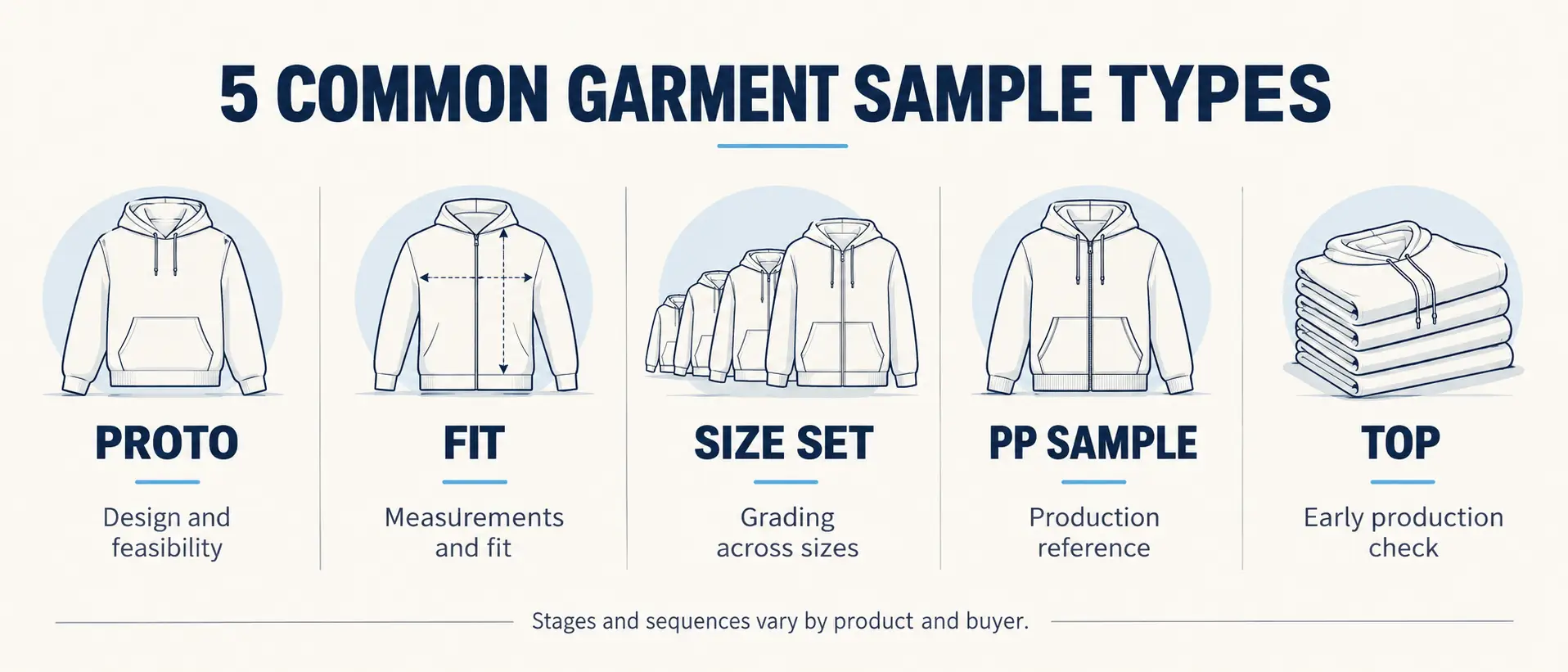
Types of Garment Samples and Their Approval Objectives
Different sample types serve different purposes during apparel development.
A prototype is not necessarily expected to demonstrate final fabric performance. A fit sample may not establish final packaging requirements. A pre-production sample should represent the applicable approved manufacturing specifications more completely.
The names and sequence of sample types may differ between brands and manufacturers.
Sample Stages and Exit Criteria
| Sample Stage | Main Objective | Required Inputs | Evaluation Focus | Typical Exit Criteria |
|---|---|---|---|---|
| Prototype / Proto | Evaluate the design concept and construction feasibility | Drawings, basic measurements, construction direction | Silhouette, proportions, construction possibilities | Major design and feasibility questions addressed |
| Fit Sample | Evaluate intended fit and relevant dimensions | Pattern, POM chart, fit reference, suitable material | Measurements, comfort, balance, fit | Fit corrections resolved or documented for the next stage |
| Size Set | Evaluate grading and fit across selected sizes | Size specifications, grading rules, approved fit direction | Size consistency, proportions, critical measurements | Applicable sizes and grading requirements accepted |
| Pre-Production (PP) | Confirm production-representative product specifications | Approved materials, construction, artwork, measurements, relevant labels and packaging | Appearance, workmanship, dimensions, production requirements | Authorized PP approval or documented decision |
| Top of Production (TOP) | Check actual early production output | Approved production references, applicable specifications | First production output against approved standards | Findings addressed under the agreed production QC procedure |
These are common development stages, not a mandatory universal sequence. Buyers may combine, repeat, or omit certain sample stages when appropriate to the product and agreed risk controls.
Prototype Sample: Confirming Design Feasibility
A prototype is an early physical interpretation of the garment concept.
It may use substitute fabric or provisional trims where these are suitable for evaluating the intended design features.
The review often focuses on construction possibilities, approximate proportions, silhouette, and design details.
The prototype should not automatically be treated as approval of final materials, fit, or workmanship.
Fit Sample: Confirming Measurements and Wearability
A fit sample helps evaluate how the garment fits and moves.
It should use sufficiently representative material properties for meaningful fit assessment and follow the relevant measurement specifications.
The review may identify pattern changes, dimensional corrections, balance issues, or construction adjustments.
A garment can meet individual measurement tolerances while still having an unsuitable overall fit, so physical assessment remains important.
Size Set: Confirming Grading
Size-set sampling evaluates whether the approved fit direction has been translated appropriately across the intended size range.
Depending on the product and buyer requirements, selected sizes or a broader size set may be reviewed.
Important considerations include garment proportions, measurement targets, fit consistency, and size-specific construction requirements.
Pre-Production Sample: Confirming the Manufacturing Reference
A pre-production sample is intended to reflect the relevant approved product specifications before bulk production.
It generally uses production-representative fabric, trims, construction, artwork, and finishing.
The buyer should confirm any remaining differences from the intended bulk standard before granting the applicable approval.
TOP Sample: Checking Actual Production
A Top of Production (TOP) sample is selected from actual production output.
It helps verify that early bulk production corresponds to the approved technical and physical references.
A TOP sample is not normally a substitute for the PP approval process, because it is taken after production has begun.
Understanding the different types of garment samples helps buyers establish suitable development stages, determine what each sample can approve, and avoid treating preliminary samples as final production references.
Sample Feedback Form Template: Turning Comments Into Actionable Instructions
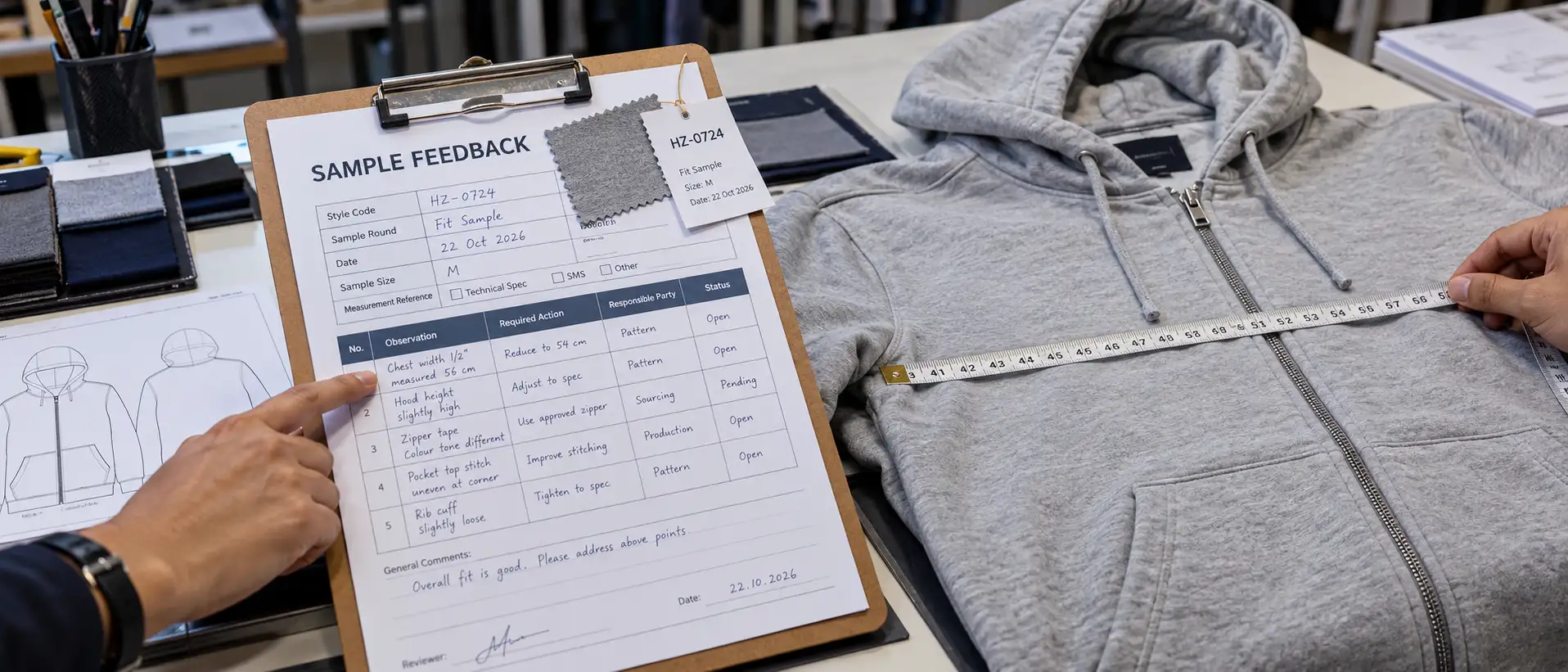
A sample feedback form helps convert technical observations into clear development instructions.
Without a consolidated record, comments may become scattered across email conversations, messaging applications, photographs, and separate spreadsheets.
This creates a risk that the manufacturer receives conflicting or incomplete instructions.
A controlled feedback process should make it easy to identify what needs attention, where the problem occurred, and how the correction will be evaluated.
Essential Sample Feedback Fields
A practical form can include:
- Style code and sample identification
- Sample stage and round number
- Current tech pack or specification version
- Issue category
- Exact location or POM reference
- Observed condition
- Required correction or clarification
- Supporting photographs or measurements
- Priority and responsible party
- Manufacturer response
- Target date and closure status
Sample Feedback Form Example
The following example uses a development sample for a zip-up hoodie.
| Field | What to Record | Example |
|---|---|---|
| Style and Round | Style identification and sample revision | HD-204 / Fit Sample V02 |
| Issue Category | Fit, construction, artwork, material, or other | Measurement |
| Location | Exact garment area or POM | POM-01, chest width |
| Observation | Actual finding | Measured 55.5 cm |
| Approved Target | Target and applicable tolerance | 54.0 cm ±1.0 cm |
| Required Action | Correction or technical review | Review chest pattern and reduce excess width |
| Evidence | Supporting measurement or annotated photo | Measurement sheet M02, Photo 04 |
| Responsible Party | Team handling the correction | Manufacturer technical team |
| Status | Open, clarification, corrected, or approved | Correction required |
This format is more actionable than an instruction such as “make the hoodie slightly narrower.”
Separate Observation From Correction
The person reviewing the sample may identify an issue without knowing the appropriate technical solution.
For example, a garment may show pulling near the armhole. Possible causes include the pattern, sleeve shape, seam construction, or fabric behavior.
The reviewer should describe the observed problem and intended result.
The technical team can then recommend the appropriate correction.
This avoids directing changes that might solve one visible issue while introducing another.
Can Several Corrections Be Made in One Sample Round?
Yes.
Multiple corrections can be combined when they are technically compatible, adequately documented, and can be evaluated together.
For example, adjusting sleeve length and changing a hangtag reference may have little direct interaction.
However, simultaneous changes to fabric stretch, pattern dimensions, and seam construction may make the effects more difficult to distinguish.
The goal is to manage changes according to their relationships and risks.
How to Close a Sample Comment
A sample comment should not be marked complete merely because the manufacturer acknowledges it.
A closed correction should have an appropriate response, updated documentation where necessary, and verification that the issue has been addressed.
The required evidence depends on the issue.
An approved artwork file may resolve a graphic clarification. A fit-related change may require a revised sample or measurement evaluation.
For a more detailed review of fit, workmanship, artwork, and packaging, a sample approval checklist can help establish consistent acceptance criteria across development stages.
A structured sample approval checklist can help reviewers assess fit, measurements, stitching, artwork placement, labeling, and packaging using clear evaluation criteria and documented decisions.
Fit reviews also benefit from consistent sample identification, updated measurement records, and controlled approval comments. Techpacker’s end-to-end garment fitting and fit sign-off guide provides a practical explanation of receiving fit samples, recording sample details, evaluating measurements, and documenting decisions throughout the fitting process.
Ready to Start Your Clothing Sample Development?
Share your garment sketches, tech pack, measurements, or product references with RYZEAL SOURCING to discuss technical feasibility, sample requirements, and development through suitable specialized manufacturing partners in Bangladesh.
Sample Timeline Management: How to Prevent Avoidable Delays
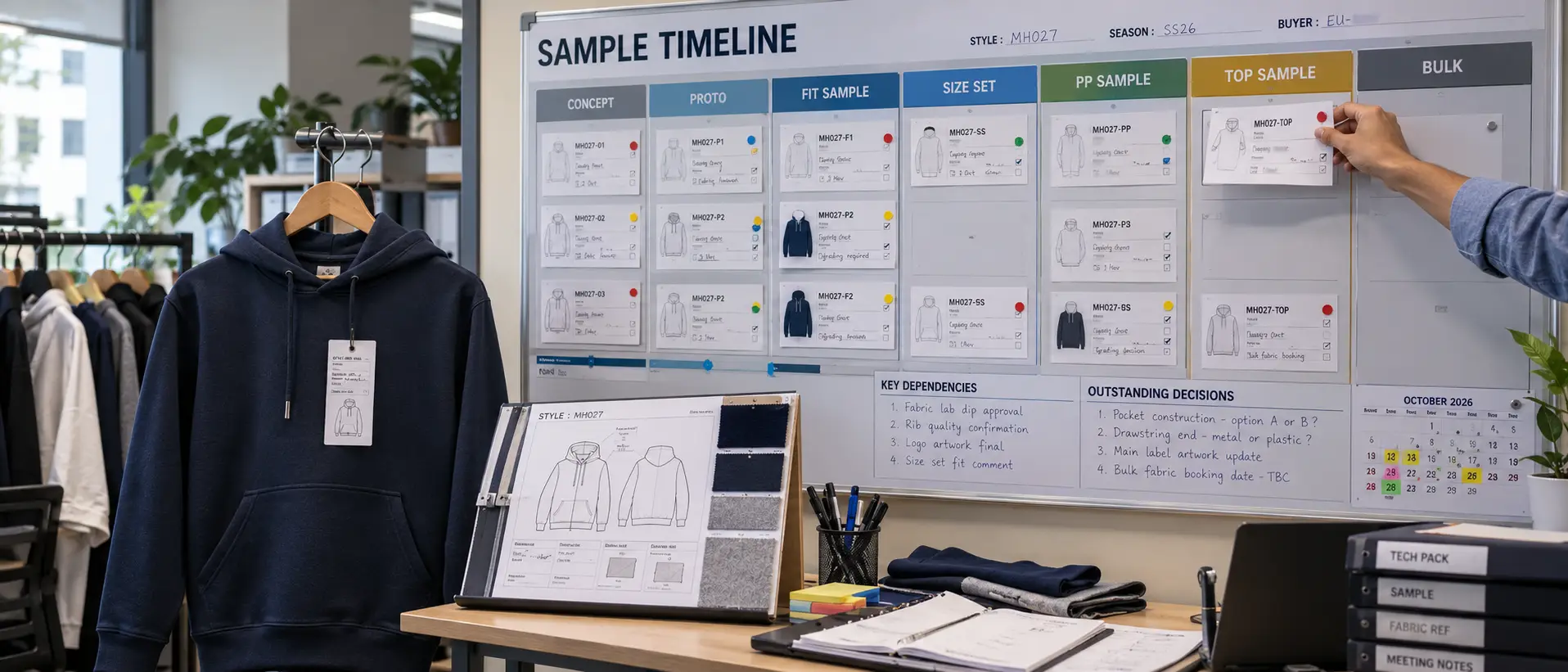
A sample timeline should account for more than the time needed to sew a garment.
The complete development cycle can involve technical clarification, material sourcing, pattern preparation, sample construction, testing, shipment, buyer evaluation, and revisions.
If these activities are not coordinated, a project can experience delays even when individual teams complete their own tasks promptly.
A sample management system makes the timeline visible by identifying responsible parties, expected completion dates, actual progress, and unresolved issues.
What Should a Sample Timeline Include?
The timeline should identify:
- Sampling request and technical review
- Outstanding specifications or material approvals
- Material availability
- Pattern and sample development
- Applicable testing or decoration activities
- Internal sample inspection
- Shipment and transit
- Buyer review and feedback
- Manufacturer response and revision planning
- Subsequent sample development and approval
Some activities may run in parallel, while others depend on earlier decisions.
For example, artwork approval and fabric sourcing may progress simultaneously, but a sample requiring a particular print method cannot fully demonstrate the intended result until the applicable technique and materials are available.
Sample Timeline Tracker
| Stage | Planned Date | Actual Date | Responsible Party | Status / Blocker | Next Action |
|---|---|---|---|---|---|
| Technical Review | To agree | Pending | Development Coordinator | Fabric specification open | Confirm material reference |
| Material Arrangement | To agree | Pending | Manufacturer / Sourcing | Awaiting supplier confirmation | Verify availability |
| Sample Construction | To agree | Pending | Manufacturing Partner | Awaiting required inputs | Confirm start date |
| Internal Sample Review | To agree | Pending | Manufacturer QC | Not started | Check dimensions and workmanship |
| Sample Dispatch | To agree | Pending | Merchandising / Logistics | Awaiting sample completion | Confirm shipping arrangements |
| Buyer Evaluation | To agree | Pending | Buyer / Technical Team | Awaiting sample | Consolidate feedback |
| Revision Planning | To agree | Pending | Development Coordinator | Awaiting buyer comments | Agree corrections and schedule |
This is an illustrative tracking structure, not a prescribed sample timeline.
The dates should be agreed for the actual garment and development program.
Establish Practical Response-Time Expectations
Buyers and manufacturers can agree on response targets for reviewing samples, acknowledging comments, and confirming revision plans.
For example, a team may aim to return consolidated feedback within two or three working days after receiving a sample.
However, that should be treated as an agreed planning target, not a universal requirement.
Complex fit evaluations, laboratory testing, international shipping, and multiple approval stakeholders may require additional time.
The main objective is to establish realistic responsibilities and identify delays early.
How to Plan Sample Revisions
A useful revision timetable should consider:
Technical changes: Pattern, construction, grading, or material corrections.
Required resources: Fabric, trims, artwork, pattern development, and suitable production equipment.
Verification needs: Measurements, fit evaluation, workmanship checks, or relevant tests.
Communication: Buyer feedback, clarification, and approval time.
Logistics: Sample dispatch, international transport, and receipt.
If the manufacturer cannot meet a target date, the team should identify the cause and agree on a revised plan rather than allowing the delay to remain unreported.
How Many Sample Rounds Should You Plan?
There is no universal number of sample rounds for apparel manufacturing.
A straightforward repeat style with established materials and construction may require fewer iterations than a new technical garment using unfamiliar fabric, multiple trims, or complex finishing.
The number of rounds may also depend on the quality of the initial specifications, availability of materials, sample objectives, and buyer decisions.
It is more useful to budget for possible corrections and establish clear exit criteria than to assume that every garment will be approved within a fixed number of attempts.
Understanding planning garment sample rounds and development timelines helps buyers estimate development resources, account for revision risks, and coordinate sampling with collection launch schedules.
Pre-Production Sample Process: Establishing the Approved Product Reference
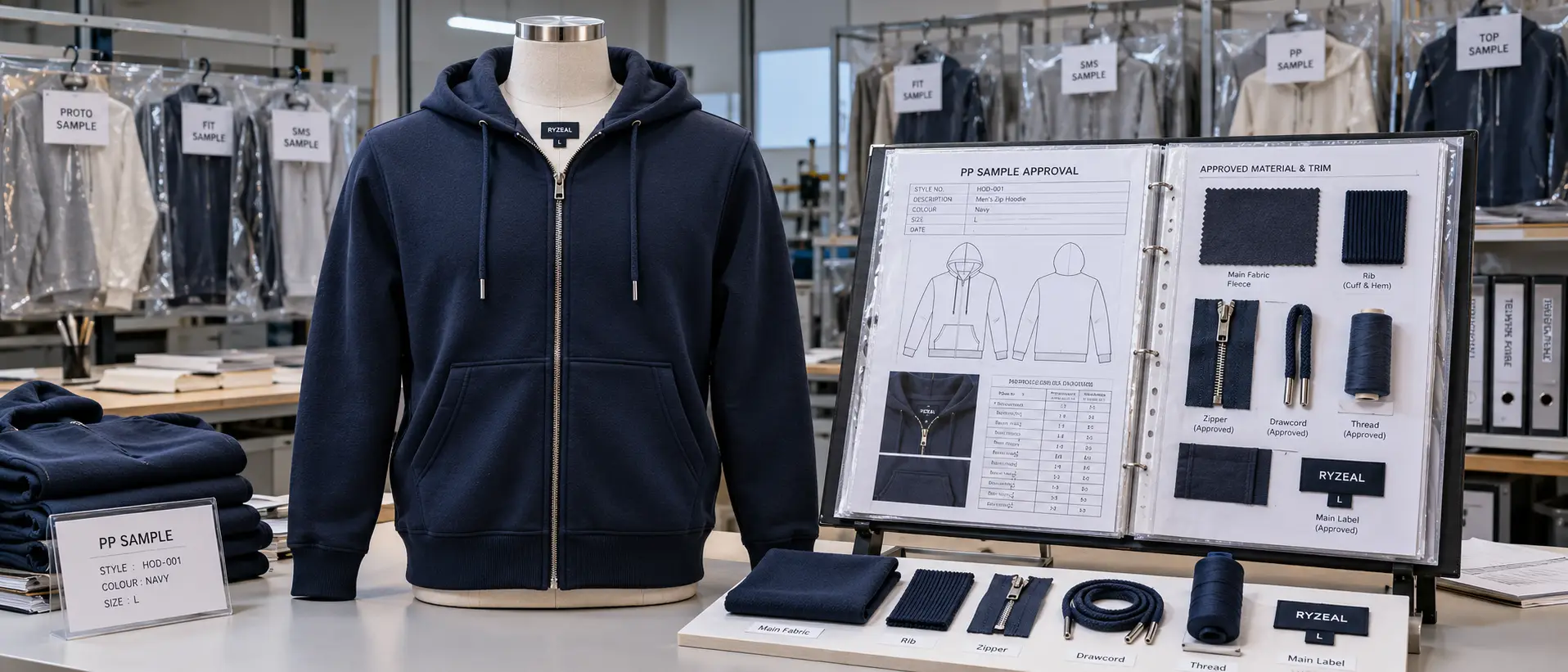
The pre-production sample process is an important transition between garment development and manufacturing preparation.
Earlier samples may focus on design direction, fit, or technical feasibility. A pre-production (PP) sample is intended to demonstrate the relevant approved specifications for the garment that will be manufactured.
It should use production-representative materials, construction, workmanship, and applicable finishing requirements.
A PP sample should not be evaluated only on visual appearance.
What Should a Pre-Production Sample Confirm?
Depending on the garment and order requirements, the PP sample review may include:
- Approved fabric and trim references
- Garment construction and seam details
- Finished measurements and applicable tolerances
- Physical fit and overall appearance
- Print, embroidery, or other decoration quality
- Label content and placement
- Relevant washing or finishing requirements
- Packaging details where included in the PP approval scope
- Applicable testing and material approval records
The exact checklist depends on the sample’s agreed purpose.
Some packaging details may be approved through separate packing samples or other documentation.
Does a PP Sample Have to Be Made on the Bulk Production Line?
Not necessarily.
A PP sample may be prepared by a specialized sampling team using approved materials and intended manufacturing methods.
In other programs, the buyer may require production-line preparation or a pilot run to evaluate actual manufacturing conditions.
These arrangements should be agreed in advance.
A sample made in a sample room can establish an important physical product reference, but it does not independently demonstrate that the bulk production line can reproduce the result consistently.
Production-line verification remains a separate responsibility.
What Is a Sealed Sample?
A sealed sample, sometimes called an approved master or reference sample, is a physical garment identified as an authorized reference for subsequent manufacturing and quality checks.
The approval record should identify the relevant style, size, colorway, version, date, and scope of approval.
Depending on the buyer’s procedures, an approved reference may be retained by the manufacturer, buyer, or both.
The sample should remain traceable to the applicable technical specifications.
A sealed sample is a useful physical standard, but it does not replace the tech pack, measurement chart, BOM, or other required technical documents.
What Happens After PP Approval?
After the applicable PP approval, the manufacturer should confirm that the required materials, specifications, production arrangements, and quality controls are ready for the authorized manufacturing activities.
Any subsequent changes affecting the approved product should follow the agreed change-control process.
Where required, a production trial or TOP sample can provide additional evidence that actual manufacturing output corresponds to the approved reference.
Sample Approval Gates: How to Make Consistent Decisions
An approval gate is a defined checkpoint where the responsible team evaluates whether a sample or development activity meets the requirements for proceeding.
Approval gates help prevent important decisions from being lost in informal correspondence.
They should establish what is being reviewed, what evidence is needed, who can approve the result, and how unresolved issues are handled.
Sample Approval Gate Checklist
| Review Area | Acceptance Criteria | Supporting Evidence | Decision Responsibility |
|---|---|---|---|
| Construction and Workmanship | Applicable seams, stitches, assembly, and finishing meet agreed requirements | Sample review, technical notes, relevant photographs | Buyer Technical / Manufacturer QA |
| Measurements | Applicable POMs meet approved specifications or receive authorized disposition | Measurement report and measuring instructions | Technical / QA |
| Fit and Appearance | Garment meets intended fit, balance, silhouette, and appearance | Fit assessment and comments | Buyer / Authorized Approver |
| Fabric and Trims | Relevant materials match approved specifications | BOM, material approvals, testing where required | Sourcing / Technical |
| Artwork and Decoration | Placement, dimensions, colors, and method meet approved references | Artwork approval, strike-off, decorated sample | Buyer / Design |
| Labels and Packaging | Applicable wording, positioning, and packing requirements are satisfied | Label proofs, packing references, relevant sample | Buyer / Merchandising |
| Documentation | Correct revisions and decisions are recorded | Tech pack, feedback log, approval record | Development Coordinator |
Not every area needs to be approved at every sample stage.
For example, an early prototype may be reviewed for construction feasibility without final packaging approval.
The required checks should reflect the sample objective.
Evaluating sample workmanship requires attention to the garment’s actual construction, fabric behavior, seams, finishing, and component quality. In the following demonstration, garment-construction educator Bernadette Banner examines physical clothing details that can help reviewers recognize quality differences. While this is not a factory inspection procedure, it offers useful visual examples of workmanship characteristics to consider alongside approved technical specifications.
Go, Conditional Go, and Hold Decisions
A practical sample management system can use three decision categories.
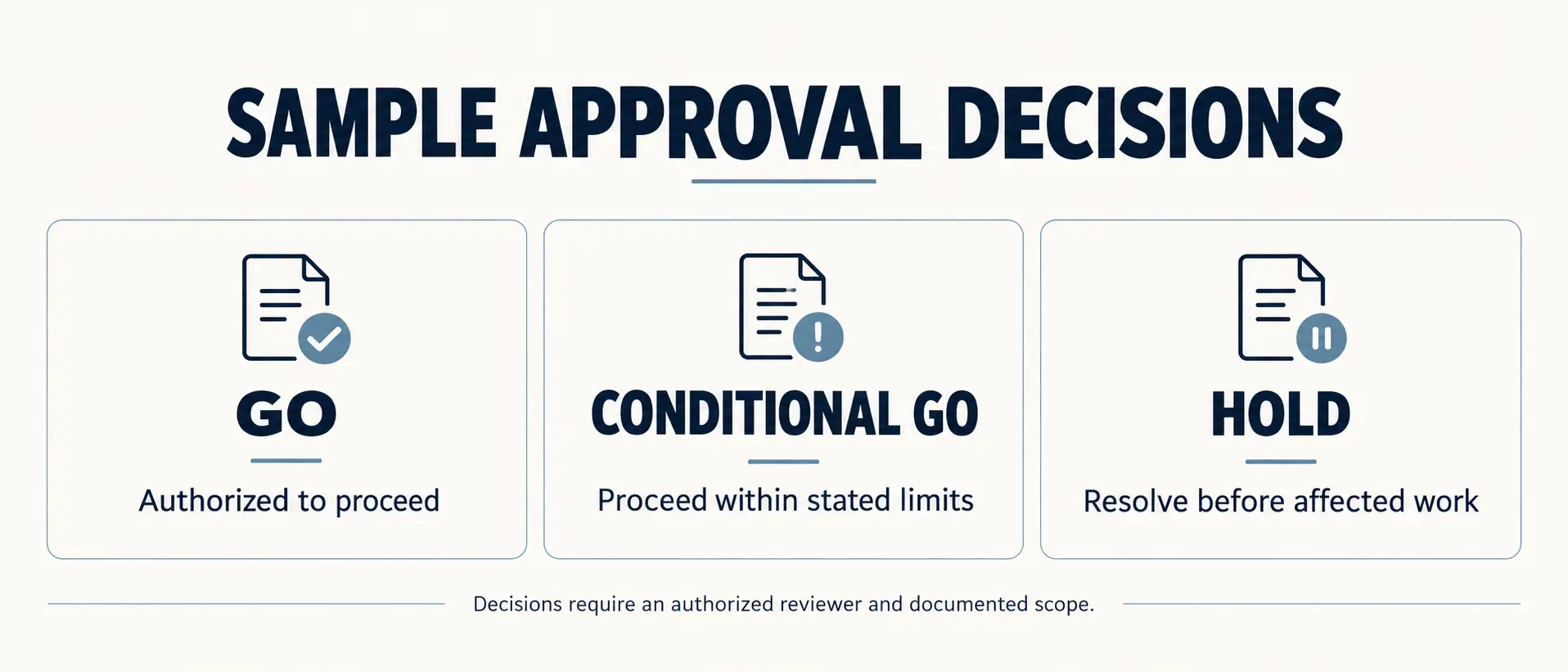
Go / Approved
The applicable requirements for the stage have been satisfied, and the authorized reviewer permits the next activity.
Conditional Go
Certain activities may proceed under documented conditions while specific non-blocking matters remain open.
The approval record should identify the conditions, responsible parties, deadlines, and activities that cannot begin until the outstanding matters are resolved.
Hold / Revision Required
A critical requirement remains unresolved, or the available evidence is insufficient to authorize the next activity.
The team must address the issue before proceeding with the affected work.
A conditional approval must not be used to bypass essential safety, legal, technical, or contractual requirements.
How to Document an Approval
An approval record should include:
- Style and sample identification
- Sample type and revision number
- Technical specification version
- Relevant evaluation results
- Decision and scope of approval
- Any conditions or exceptions
- Name or role of the authorized approver
- Approval date
- Next permitted activity
The record should clearly distinguish approval to continue development from approval to begin a production activity.
Connecting Sample Gates With the Wider Approval Workflow
Garment sampling is one part of a broader approval process that may also include fabric colors, trims, artwork, testing, packaging, and manufacturing readiness.
Our apparel approval workflow map blog explains how these checkpoints help buyers coordinate technical decisions and prevent unresolved issues from moving unnoticed into production.
From Approved Sample to Bulk Production: PP, Sealed, and TOP Checks
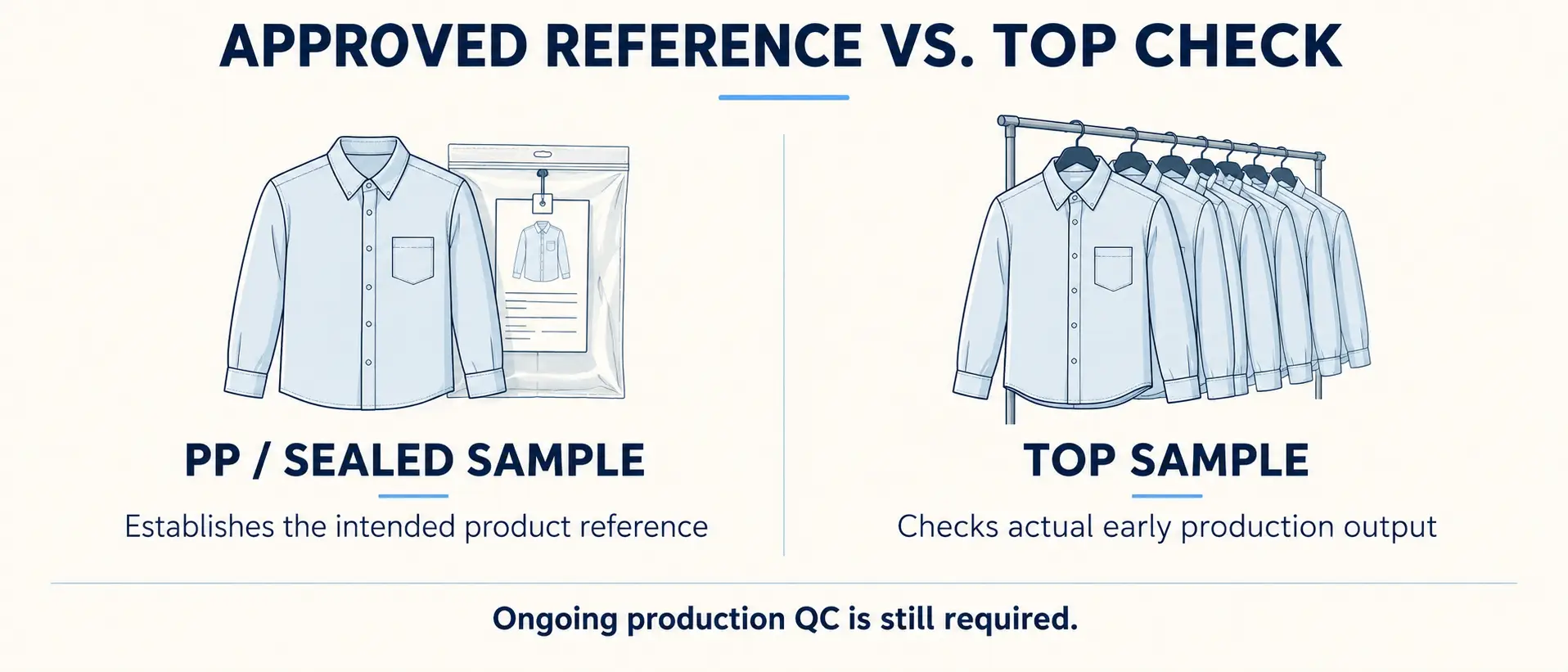
The transition from sampling to bulk manufacturing requires two related controls.
The first is establishing what the approved garment should be.
The second is verifying whether the selected manufacturing process can reproduce that standard.
An approved PP or sealed sample helps establish the intended product reference.
Actual production checks help evaluate execution under bulk conditions.
What a TOP Sample Can Verify
A TOP sample is taken from early production output.
It may be reviewed for:
- Measurements against approved specifications
- Construction and workmanship
- Fabric and trim consistency
- Artwork or embroidery execution
- Label placement
- Appearance and finishing
- Other applicable buyer requirements
This check can identify differences between the approved development reference and actual production.
However, a satisfactory TOP result does not guarantee that every garment produced later will meet the same standard.
Ongoing quality control, process monitoring, and applicable inspections remain necessary.
Why Sample Approval Alone Cannot Guarantee Bulk Quality
Bulk production introduces additional variables that may not be fully represented by a development sample.
These can include:
- Differences between material batches
- Machine setup and operating conditions
- Cutting and sewing variation
- Finishing-process consistency
- Production handling and workflow
- Size and colorway differences
Consequently, sample approval must be supported by suitable manufacturing preparation and quality controls.
The approved sample establishes the intended reference. Production checks determine whether manufacturing continues to meet that reference.
Digital Sample Management Tools: Spreadsheet vs. Dedicated Software
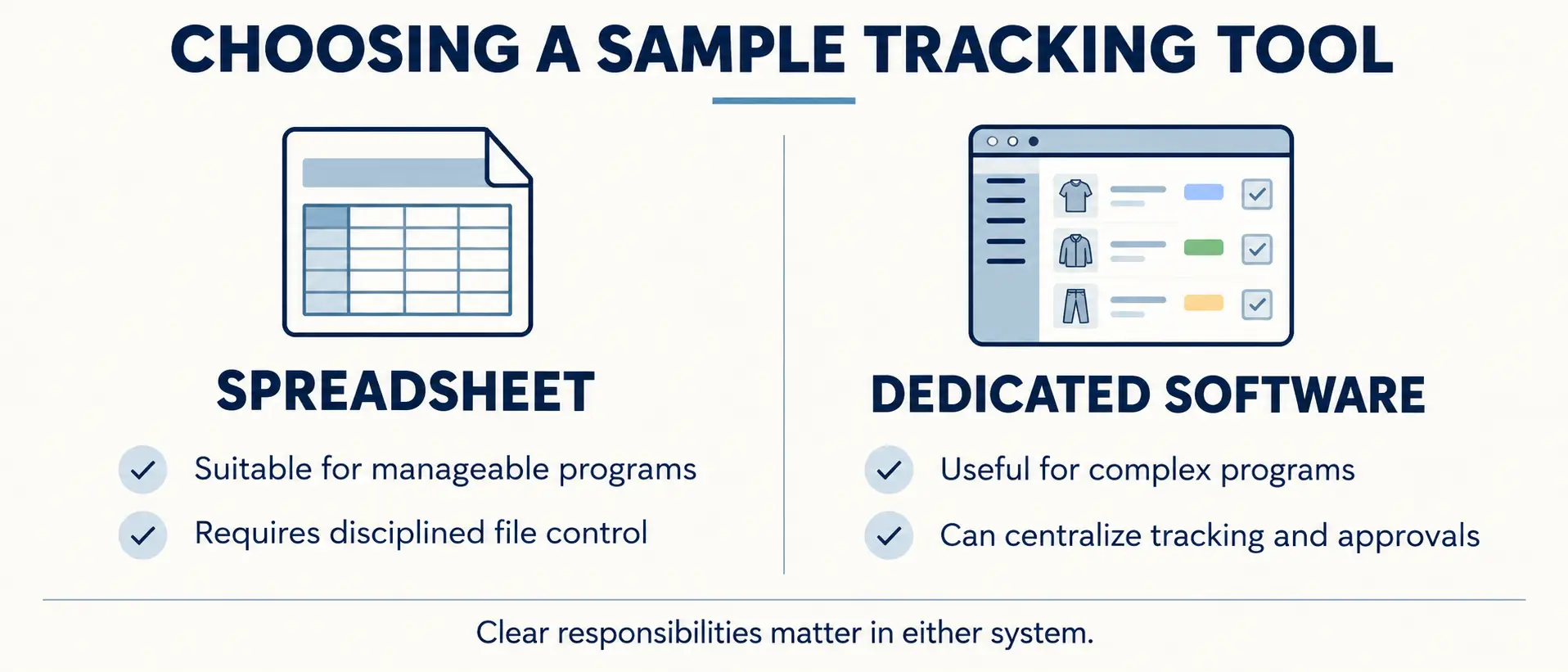
A sample management system does not necessarily require specialized software.
A smaller apparel brand may manage development effectively using spreadsheets, shared folders, controlled documents, and a consolidated approval record.
However, managing many styles, manufacturing partners, sample rounds, and approval stakeholders can make manual tracking more difficult.
The appropriate solution depends on the complexity of the development program and the team’s ability to maintain accurate information.
When a Spreadsheet Is Sufficient
A spreadsheet-based system may work well when:
- The number of styles is manageable.
- Sampling responsibilities are clearly assigned.
- A controlled folder structure is maintained.
- Feedback is consolidated into one record.
- Version updates are documented.
- Approval decisions can be retrieved easily.
Spreadsheets can track dates, owners, revisions, comments, and approval status without requiring a dedicated platform.
The following tutorial demonstrates how technical documentation supports garment development, including sample evaluation, approval comments, and sample tracking. It provides a practical example of how tech packs and organized records help fashion brands manage revisions and maintain consistency throughout the development process.
When Dedicated Sample Management Software May Help
A more structured digital system may be useful when:
- Many styles are being developed simultaneously.
- Several manufacturers or sourcing partners are involved.
- Different departments must approve the same product.
- Sampling timelines frequently overlap.
- Multiple revisions create document confusion.
- Teams need automated notifications and approval histories.
Depending on the platform, specialized systems may provide dashboards, document versioning, permission controls, sample tracking, and approval workflows.
These functions can improve visibility, but software cannot compensate for unclear responsibilities or poorly defined acceptance criteria.
For a practical example of digital fit and measurement documentation, the following Techpacker tutorial demonstrates how to create a garment fit table within a technical design platform. It complements the sample feedback form above by illustrating how measurement specifications can be organized for sample evaluation and technical communication.
Minimum Fields for a Digital Sample Tracker
Regardless of the tool, each sample record should contain enough information to identify its status and next action.
Useful fields include:
- Style code and product description
- Buyer or brand reference
- Manufacturing partner
- Sample type and round
- Colorway and base size
- Applicable tech pack version
- Sample request date
- Planned and actual completion dates
- Sample status
- Responsible development coordinator
- Open technical issues
- Buyer comments and revision status
- Approval decision
- Supporting document references
A consistent naming format can help connect files with tracker entries.
For example:
STYLECODE_COLORWAY_FIT02_V03_YYYY-MM-DD
The precise format can vary, but it should identify the garment and the relevant development record.
Maintain One Controlled Source of Information
A sample management system works best when there is one identifiable current record for each style and round.
That does not mean every document must be combined into one file.
The tech pack, measurement chart, BOM, artwork files, and feedback records may remain separate, provided they are correctly identified, versioned, and connected.
Outdated versions should remain available for traceability without being confused with current instructions.
Digital document control can make revisions easier to trace when technical requirements change between sample rounds. Techpacker’s technical pack version-control guide demonstrates how saved document versions can preserve development changes and allow teams to share an identified revision with manufacturing partners. The same principle applies whether a brand uses specialized software or a carefully managed spreadsheet system.
Production Readiness Checklist: What Must Be Confirmed Before Bulk
Production readiness means that the necessary product requirements, approvals, resources, and manufacturing arrangements have been confirmed sufficiently for the activities being authorized.
A product may have an approved sample but still require further material, technical, quality, or production preparation.
That is why a sample management system should connect sample approvals with a separate production-readiness review.
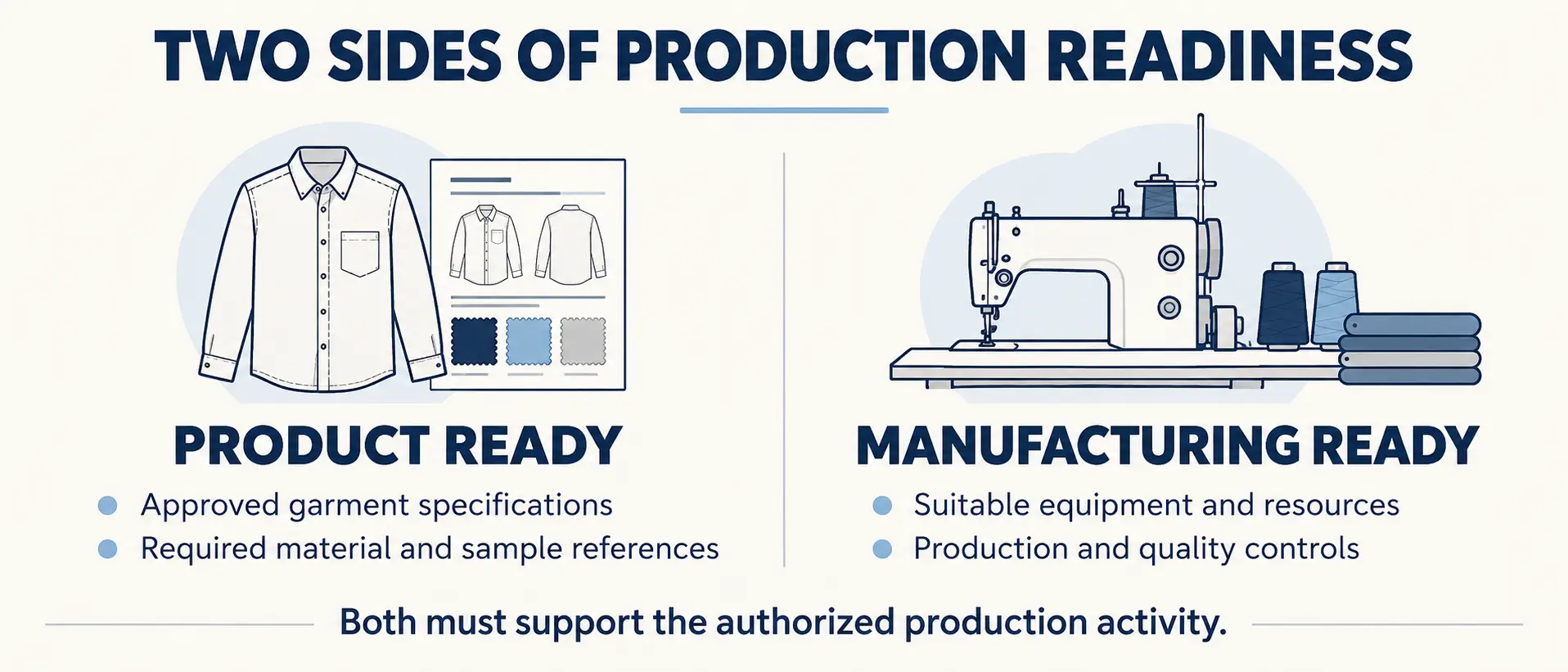
Product Readiness vs. Manufacturing Readiness
Product readiness focuses on whether the applicable garment specifications and approvals are sufficiently established.
These can include materials, measurements, fit, construction, artwork, labeling, packaging, and physical sample references.
Manufacturing readiness focuses on whether the selected production facility can execute the authorized work using suitable resources, approved inputs, operational arrangements, and quality controls.
The two are connected but should not be treated as identical.
Production Readiness Checklist
| Requirement | What Must Be Confirmed | Evidence | Release Status |
|---|---|---|---|
| Technical Specifications | Applicable construction, measurements, and revisions are authorized | Controlled tech pack | Go / Conditional Go / Hold |
| Fabric and Trims | Required materials and relevant approvals are available | BOM and material records | Go / Conditional Go / Hold |
| Fit and Grading | Applicable fit and size requirements are accepted | Fit approval, size specifications | Go / Conditional Go / Hold |
| PP / Approved Reference | Suitable approved product reference is identified | Sample approval record | Go / Conditional Go / Hold |
| Artwork and Decoration | Applicable design, method, and placement requirements are approved | Artwork and decoration approvals | Go / Conditional Go / Hold |
| Labels and Packaging | Requirements affecting the authorized production stage are confirmed | Label proofs and packing specifications | Go / Conditional Go / Hold |
| Testing Requirements | Required tests and acceptance criteria are addressed | Relevant test records | Go / Conditional Go / Hold |
| Production Capability | Selected facility and required processes are suitable | Technical and capacity review | Go / Conditional Go / Hold |
| Quality Control | Inspection criteria, responsibilities, and checkpoints are established | QC or inspection plan | Go / Conditional Go / Hold |
| Production Schedule | Materials, capacity, and key milestones are coordinated | Production schedule | Go / Conditional Go / Hold |
The table is a planning framework. Actual production-release criteria must be established for the garment, manufacturer, contract, and applicable requirements.
How to Handle Conditional Readiness
A Conditional Go decision may be suitable when certain preparatory activities can continue without affecting unresolved critical requirements.
For example, production planning or procurement of an approved component may proceed while a separate packaging artwork decision remains open.
However, the affected packaging activity must not begin using an unapproved specification.
Similarly, bulk cutting should not be authorized if essential fabric, pattern, shrinkage, or measurement requirements remain unresolved.
Each conditional decision should define the authorized scope and the activities that remain blocked.
Manufacturing Capability Verification
Before releasing an order to bulk production, buyers may also need to confirm whether the selected manufacturing facility has appropriate machinery, technical capabilities, production capacity, and quality-control arrangements.
These requirements depend on the garment category.
A manufacturer suited to basic knitwear may not necessarily have the specialized equipment or experience required for complex outerwear, bonded garments, or technical performance apparel.
For buyers evaluating partner facilities, a factory visit can support the assessment of production capabilities, workflow, quality-control processes, and relevant operating conditions.
Want to Verify Manufacturing Capabilities Before Bulk Production?
RYZEAL SOURCING can help coordinate an online or physical visit to a suitable manufacturing partner in Bangladesh, allowing your team to review relevant production capabilities, quality systems, and manufacturing arrangements before proceeding.
Connecting Sampling With Pre-Production Planning
Sampling approval and production readiness should be aligned with the manufacturer’s pre-production preparation.
This may include reviewing the approved specifications, material availability, construction methods, production sequence, quality requirements, and outstanding decisions with the responsible teams.
Our pre-production meeting checklist explains which technical, material, and quality-control requirements should be reviewed before bulk manufacturing activities begin.
Common Sample Management Problems and How to Prevent Them
Repeated sampling difficulties often arise from a combination of technical uncertainty, communication gaps, and unclear decision responsibilities.
Identifying warning signs early makes it easier to respond before they affect later development stages.
Common Failure Patterns
| Problem | Likely Cause | Early Warning | Practical Correction |
|---|---|---|---|
| Repeated sample corrections | Unclear objectives or incomplete specifications | Similar issues appear across rounds | Confirm technical requirements and review criteria |
| Conflicting buyer comments | Feedback sent through multiple uncontrolled channels | Manufacturer receives different instructions | Consolidate comments under one coordinator |
| Incorrect specification used | Weak version control | Sample does not match latest approved instructions | Verify document revisions and reissue controlled files |
| Fit disagreements | Unclear POM methods or tolerance requirements | Buyer and factory report different measurements | Align measuring methods and specifications |
| Material changes during development | BOM or substitution approvals not controlled | Sample uses unexpected fabric or trims | Establish sourcing and approval responsibilities |
| Missed development dates | Unclear dependencies or response ownership | Activities remain pending without updated dates | Maintain timeline, blockers, and next-action records |
| Incomplete PP approval | Review scope not clearly established | Critical production requirements remain open | Define PP exit criteria and approval conditions |
| Differences in early production | Manufacturing process differs from sample conditions | TOP findings differ from approved reference | Investigate production setup and implement corrective controls |
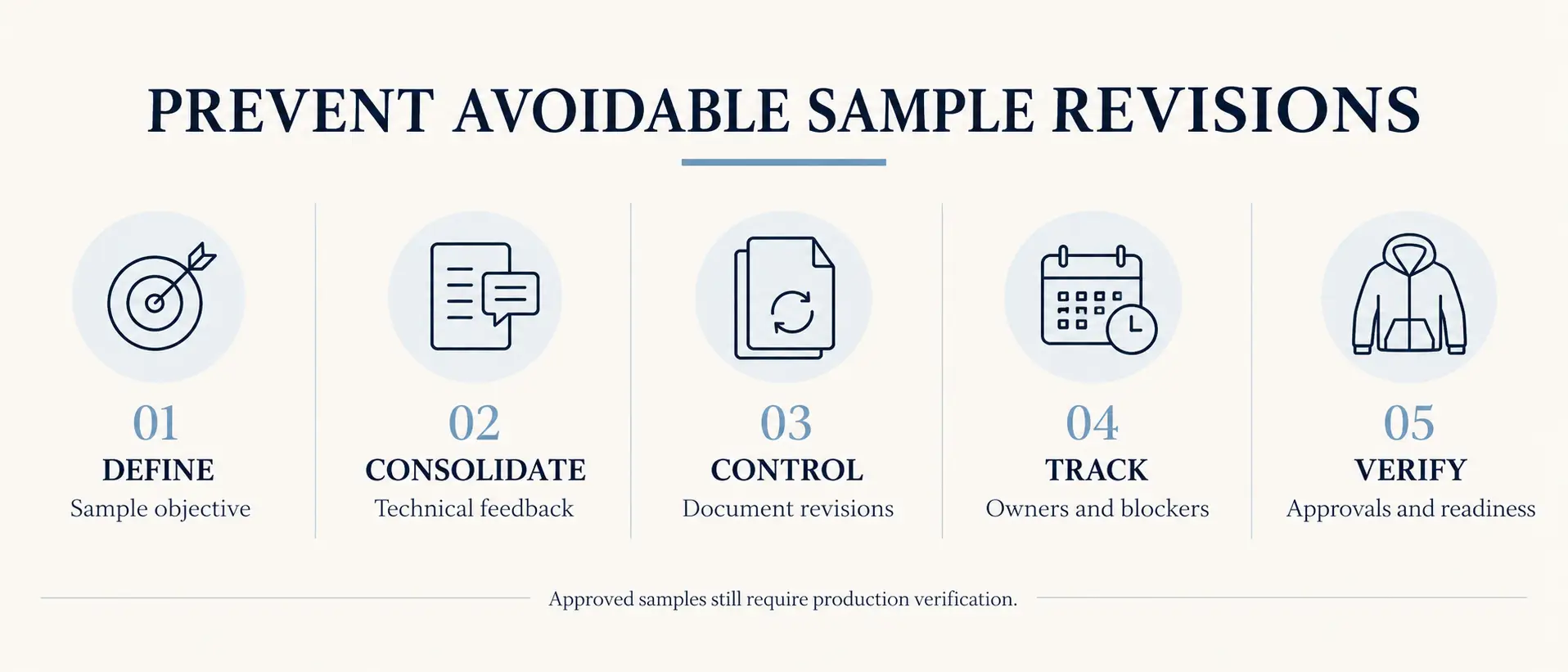
Five Practices That Improve Sample Management
1. Define the objective before requesting each sample
- A sample should have a clear purpose and a suitable evaluation method.
2. Maintain one consolidated feedback record
- Multiple reviewers can contribute, but the manufacturer should receive coordinated decisions.
3. Control technical revisions
- Approved changes should be connected to the correct sample and specification versions.
4. Track responsibilities and dependencies
- Every outstanding issue should have an identifiable owner and next action.
5. Separate sample approval from production verification
- A satisfactory development sample establishes an important reference, but bulk manufacturing still requires appropriate process and quality controls.
These practices can reduce avoidable revisions and improve development coordination without imposing unnecessary administrative requirements.
Frequently Asked Questions About Sample Management Systems
What is a sample management system in apparel manufacturing?
A sample management system is a structured workflow for organizing garment sample requests, development rounds, technical feedback, approvals, timelines, and related documents. It helps buyers and manufacturing teams maintain clear responsibilities and traceable decisions.
What is the sampling process in the apparel industry?
The apparel sampling process generally involves reviewing technical requirements, developing a sample, evaluating the result, documenting corrections, making necessary revisions, and recording the applicable approval decision. The precise stages depend on the garment and buyer requirements.
How can clothing brands reduce unnecessary sample rounds?
Brands can reduce avoidable revisions by submitting clear specifications, defining each sample’s purpose, consolidating feedback, controlling document versions, and verifying corrections before advancing to the next stage.
How many sample rounds are normally required?
There is no universal number. Repeat styles with established specifications may require fewer rounds, while new or complex products can require additional development. Buyers should plan according to technical complexity, material availability, and expected review requirements.
What should a sample feedback form include?
A sample feedback form should identify the style, sample version, issue location, observations, technical references, requested correction, supporting evidence, responsible party, and resolution status.
What is the purpose of a pre-production sample?
A pre-production sample helps confirm the intended production-representative garment requirements, including relevant materials, construction, measurements, appearance, and finishing. Its approval may establish the physical reference for subsequent manufacturing checks.
What is the difference between a PP sample and a TOP sample?
A PP sample is reviewed before the applicable bulk production release and helps establish the intended product standard. A TOP sample is selected from actual early production output to verify whether manufacturing corresponds to approved references.
What is a sealed sample?
A sealed sample is an identified and approved physical garment retained as a reference for manufacturing or quality evaluation. It should be linked to the applicable technical specifications and approval record.
How should sample revisions be tracked?
Each revision should be connected to the correct style, sample round, technical document version, approved changes, responsible parties, and review outcome. A shared tracker or PLM system can help maintain this information.
Can a sample receive conditional approval?
Yes, when the buyer’s procedures allow it. Conditional approval should identify the unresolved items, responsible parties, permitted activities, and requirements that must be completed before affected work proceeds.
Is sample approval enough to begin bulk production?
Not by itself. The relevant product specifications and approvals must be supported by suitable material availability, manufacturing preparation, technical capability, quality controls, and other applicable production-release requirements.
When should a clothing brand use digital sample management software?
Dedicated software may be useful when many styles, manufacturing partners, sample rounds, and approvers make manual tracking difficult. Smaller teams can often use controlled spreadsheets and shared files effectively.
Final Takeaway: Better Sample Management Creates Stronger Production Control
An effective sample management system transforms apparel sampling from a sequence of loosely connected revisions into a coordinated development and approval process.
For clothing brands, it provides greater visibility into sample progress, unresolved technical issues, responsibilities, and approval decisions.
For manufacturing partners, it creates clearer instructions, organized feedback, and more reliable references for development.
For quality and production teams, it helps connect approved samples with the specifications and controls needed for manufacturing preparation.
The central principles are straightforward: define each sample’s objective, maintain controlled technical references, consolidate feedback, track revisions, document approvals, and verify production readiness before authorizing the relevant manufacturing activities.
A structured system cannot guarantee that every sample will pass immediately or that bulk production will be defect-free. However, it provides a stronger foundation for reducing avoidable sampling rounds, resolving technical issues earlier, and maintaining consistency between approved development requirements and finished garments.
At RYZEAL SOURCING, apparel sampling, product development, manufacturing coordination, and quality follow-up are supported through a vetted network of specialized independent manufacturing partners in Bangladesh. This approach helps buyers coordinate technical requirements, sample approvals, and production preparation through a connected sourcing and manufacturing process.
Connect with RYZEAL SOURCING