

Fabric specs are the technical requirements that tell textile mills, apparel manufacturers, and testing laboratories exactly what material must be supplied, how it should perform, and which variations are acceptable. They translate a clothing brand’s fabric expectations into measurable information that can be used for quotation, sampling, sourcing, quality control, and bulk manufacturing.
A fabric specification should identify more than fiber composition and GSM. It may also need to define construction, usable width, yarn characteristics, finishing, dimensional stability, colorfastness, pilling resistance, applicable testing methods, and material approval conditions.
For example, describing a fabric as “premium 200 GSM cotton jersey” leaves several important questions unanswered. Is the cotton carded or combed? What knitting structure is required? What is the acceptable GSM variation? How wide must the usable fabric be? What shrinkage limits apply after washing, and which finishing processes are permitted?
When these details remain unclear, suppliers may quote or manufacture different materials while believing they have satisfied the original request. A sample may appear acceptable, but the fabric supplied for bulk production can differ in handfeel, stability, appearance, or performance.
A well-prepared fabric specification sheet helps prevent those misunderstandings by establishing a shared technical reference. It also gives buyers a clearer basis for comparing material proposals, reviewing laboratory results, approving fabric swatches, and controlling changes throughout production.
This guide explains how to specify fabric using practical formats, example requirements, tolerance calculations, inspection checklists, and approval records. It covers fabric GSM, composition, construction, width, finishing, shrinkage, colorfastness, spirality, pilling, laboratory testing, fabric defects, sourcing, and documentation.
The objective is straightforward: create fabric specs that suppliers can understand, manufacturers can use, and quality teams can verify.
Before developing a specification, buyers should first establish which material characteristics suit their garment. Our fabric selection guide for clothing manufacturing explains how to compare GSM, composition, construction, performance, sourcing considerations, and material suitability before documenting the final requirements.
Table of Contents
What Are Fabric Specs, and Why Do They Matter in Apparel Manufacturing?
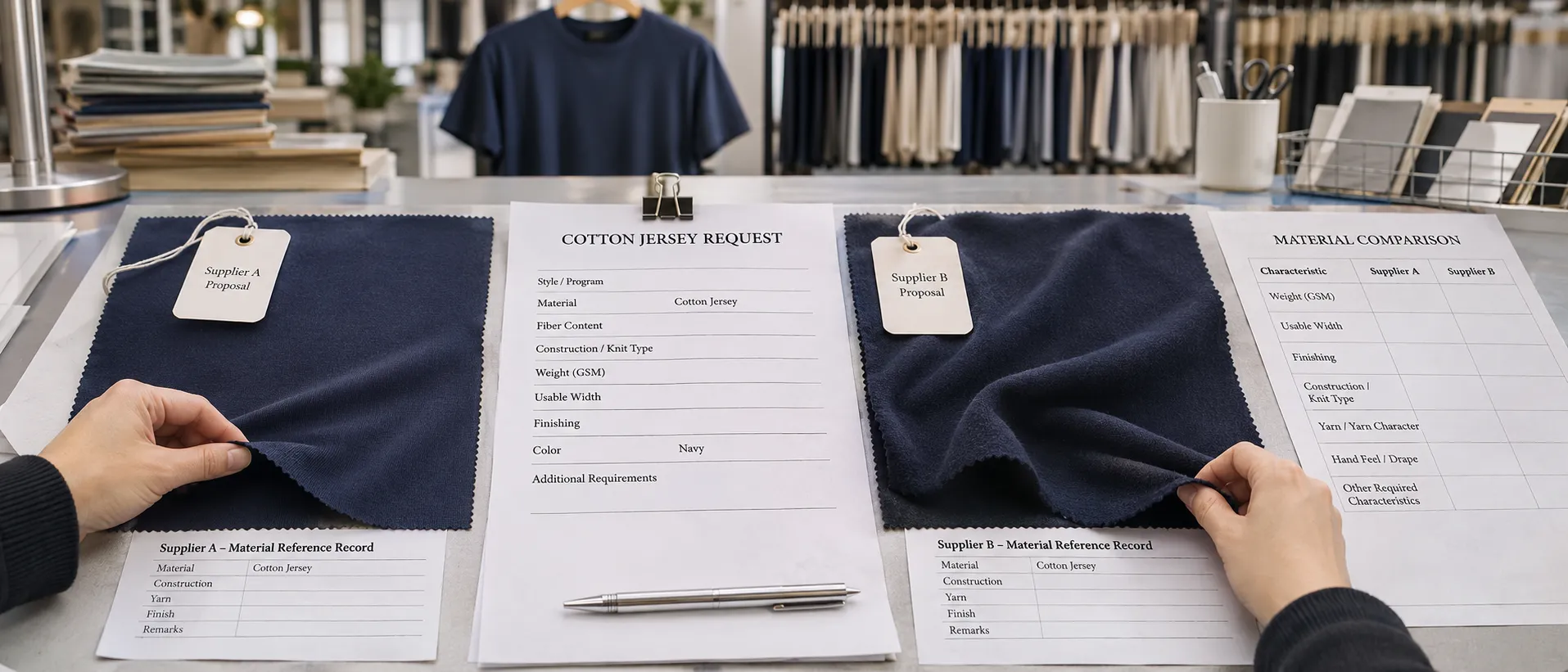
Fabric specs are the documented technical characteristics, tolerances, performance requirements, and approval conditions used to define a textile material.
They establish what the buyer expects and provide a basis for verifying whether the supplier’s material meets those expectations.
A complete specification may contain both measurable and descriptive requirements. For example, GSM and width can be measured, while handfeel may require comparison with an approved physical reference.
Fabric Selection vs. Fabric Specification
Fabric Selection: The process of deciding which material properties are appropriate for a garment. This involves comparing fabric options according to design, comfort, performance, manufacturing suitability, and cost.
Fabric Specification: The process of documenting the chosen material’s technical requirements so suppliers can reproduce and verify it. The specification establishes the necessary information, allowed variation, and applicable approval evidence.
The distinction matters because selecting a suitable fabric does not automatically communicate enough information to manufacture it consistently.
Why Vague Fabric Requirements Create Problems
Buyers sometimes describe material requirements using expressions such as “soft cotton,” “premium jersey,” “heavy fabric,” or “same as sample.” These descriptions can be useful during initial product discussions, but they rarely provide sufficient technical information for bulk production.
For example, a supplier may interpret “heavy cotton jersey” as 220 GSM, while the buyer expects approximately 280 GSM. Both parties may consider their interpretation reasonable because the original request did not define the target.
Similar misunderstandings can occur when buyers omit usable width, finishing requirements, measurement tolerances, or testing conditions.
The result may include revised quotations, unsuitable development samples, additional fabric approvals, or production delays.
How to Describe Fabric Quality More Accurately
When considering how to describe fabric quality, separate characteristics that can be measured from those that require physical comparison.
Measurable Characteristics: GSM, width, composition, dimensional change, stretch, colorfastness, and other properties evaluated using appropriate methods.
Descriptive Characteristics: Handfeel, drape, surface texture, visual appearance, softness, and certain design-related expectations. These should be supported by reference swatches, agreed terminology, or evaluation criteria where appropriate.
Manufacturing Characteristics: Construction, yarn requirements, finishing processes, material supply route, and other details necessary to obtain the intended fabric.
The more precisely these characteristics are documented, the easier it becomes to compare suppliers against the same requirements.
Red Flags That Your Fabric Specification Is Incomplete
- The material is described only by a photograph or garment reference.
- GSM is listed without an agreed tolerance or verification condition.
- The description uses “cotton blend” without specifying percentages.
- Fabric construction is identified only as “knit” or “woven.”
- The specification lists total width but does not clarify usable or cuttable width.
- Finishing is described only as “premium soft finish.”
- Required performance characteristics have no defined test methods.
- Color approval and colorfastness requirements are confused.
- No approved swatch or material reference can be identified.
- Material substitutions and changes are not controlled.
These gaps do not guarantee a production failure. They indicate where additional clarification may be necessary before the buyer can confidently approve the material.
Fabric Specification Sheet: Minimum Fields, Formats, and a Complete Example
A fabric spec sheet should communicate the material requirements in a consistent format that can be used during quotation, sample development, material procurement, and quality evaluation.
The information should be sufficiently detailed for the stage of development without requiring every possible test or production condition before initial supplier discussions can begin.
Fabric Spec Sheet vs. Mill Specification vs. Laboratory Report
Buyer Fabric Spec Sheet: Records the buyer’s requirements, target values, permitted variations, and necessary approvals. It explains what the supplied material must meet.
Mill or Supplier Specification: Describes the material the supplier proposes or confirms it can manufacture. It may include yarn details, construction, processing routes, production conditions, and supplier-specific material identification.
Fabric Lab Test Report: Records the results of particular tests performed on identified specimens. It helps evaluate the material against the applicable requirements but does not replace the buyer’s specification.
These documents should refer to consistent material identification and technical requirements. Where a supplier proposes an alternative specification, the buyer should evaluate and authorize the relevant changes before treating the alternative as approved.

Minimum Viable Fabric Specification for Quotation and Sampling
An initial fabric specification should usually identify:
- Material name or reference code
- Intended garment application
- Required fiber composition
- Fabric construction
- Target GSM and relevant tolerance
- Required usable width
- Important yarn or surface characteristics
- Essential finishing requirements
- Color reference and applicable approval method
- Key performance requirements
- Physical reference swatch, if available
Additional information may be necessary for technically demanding products.
For example, a stretch garment may require early confirmation of extension and recovery, while a garment using a specialized protective textile may require specific performance and compliance evidence before development proceeds.
Complete Fabric Specs Sheet: Example for a Cotton T-Shirt
The following example demonstrates how a buyer can communicate a proposed material for a premium casual T-shirt.
| Specification Field | Illustrative Requirement |
|---|---|
| Fabric Reference | FAB-TS-001 |
| Product Application | Casual T-Shirt Body |
| Composition | 100% Cotton |
| Construction | Single Jersey Knit |
| Yarn Specification | Combed Cotton, Yarn Count to Be Confirmed |
| Target Weight | 200 GSM |
| GSM Tolerance | ±10 GSM |
| Nominal Width | 180 cm |
| Minimum Usable Width | 176 cm |
| Surface | Smooth Face, No Heavy Brushing |
| Finishing | Approved Softening and Stabilization Process |
| Color | Black, Approved Shade Reference Required |
| Dimensional Stability | Length and Width Limits to Be Approved |
| Colorfastness | Washing and Rubbing Requirements to Be Defined |
| Pilling Resistance | Test Method and Grade to Be Approved |
| Spirality | Applicable Limit and Assessment Method to Be Defined |
| Reference Swatch | SW-TS-001-V01 |
| Material Supplier | Approved Supplier or Proposed Source |
| Verification | Development Tests and Risk-Based Bulk Checks |
| Approval Status | Pending Technical Confirmation |
All values and requirements are illustrative. The undefined fields must be completed before the material is treated as fully approved for the relevant manufacturing activity.
This is an example of a fabric specs sheet, not a production-ready specification for every 200 GSM cotton jersey.
The important distinction is that the buyer can identify which information is already defined and which items still require technical confirmation.
What Should Be Added Before Bulk Production?
For bulk manufacturing, the specification should also identify applicable control requirements.
These may include:
- Final approved yarn and construction information
- Relevant fiber-content and labeling requirements
- Measurement methods and allowable variation
- Approved finishing process or equivalent performance criteria
- Complete testing plan
- Required laboratory results
- Fabric shade approval procedure
- Swatch identification and approval status
- Roll and lot traceability
- Material inspection requirements
- Substitution approval rules
- Responsibilities and approval stages
The appropriate level of detail depends on the garment and its technical risks.
How to Maintain One Controlled Fabric Reference
Each material should have an identifiable code or reference that links the fabric specification, supplier confirmation, swatches, testing records, and material-related BOM entries.
For example, FAB-TS-001 can identify the material, while V02 can identify a revised specification.
The revision record should state what changed, when it changed, and which approvals are affected.
Using consistent identification prevents the manufacturer from receiving a revised fabric sheet while the costing or sampling team continues using an outdated material description.
GSM in Fabric: How to Write Weight Targets and Tolerances

Fabric GSM represents the mass of textile material per square meter. It is an important specification because fabric weight can influence material consumption, garment handling, perceived substance, and certain aspects of appearance.
However, GSM does not independently determine textile quality, thickness, strength, breathability, or durability.
GSM in Fabric vs. Handfeel and Thickness
Two fabrics with identical GSM values may have noticeably different characteristics because of variations in yarn, structure, and finishing.
For example, a compact single jersey and a brushed knit may have the same measured mass per area but different thickness, texture, and drape.
Buyers should therefore avoid using GSM as a substitute for other technical requirements.
How to Write a GSM Specification
A complete fabric-weight requirement should identify the target, tolerance, measurement method, and fabric condition.
For example:
GSM Requirement: Target 200 GSM, permitted variation ±10 GSM, evaluated using the agreed mass-per-unit-area method on fabric in the specified condition.
This produces the following range:
Lower Limit: 200 – 10 = 190 GSM. The material should not fall below this value when evaluated under the specified conditions.
Upper Limit: 200 + 10 = 210 GSM. The material should not exceed this value when evaluated under the specified conditions.

Therefore, the illustrative acceptable range is 190-210 GSM.
The allowance is an example agreed for a hypothetical product. It is not a universal textile tolerance.
Fabrication Tolerance Standard vs. Buyer-Approved Fabric Tolerance
Buyers may search for a fabrication tolerance standard or standard fabrication tolerances when deciding how much variation to permit.
However, those expressions do not identify one universal set of acceptable textile manufacturing variations.
Different parameters may be measured under specific ASTM, ISO, AATCC, or other methods, while the permitted commercial variation is established through the applicable buyer requirements, product specification, or contractual agreement.
A measurement method and an acceptable tolerance perform different functions.
Measurement Method: Defines how a property is evaluated under specified conditions. It supports consistency and comparison of test results.
Acceptance Tolerance: Defines which results the buyer agrees to accept. It should reflect the garment’s intended use, production capability, technical risks, and other applicable requirements.
ASTM International’s standard test methods for fabric mass per unit area, ASTM D3776/D3776M, describe established procedures for determining fabric weight. They provide a recognized measurement basis, but buyers must still establish their applicable acceptance requirements.
Example GSM Tolerance Table
| Product Material | Illustrative Target | Illustrative Tolerance | Permitted Range |
|---|---|---|---|
| Lightweight Jersey | 160 GSM | ±8 GSM | 152-168 GSM |
| Casual T-Shirt Jersey | 200 GSM | ±10 GSM | 190-210 GSM |
| Polo Piqué | 240 GSM | ±12 GSM | 228-252 GSM |
| Sweatshirt Fabric | 320 GSM | ±16 GSM | 304-336 GSM |
| Stretch Knit | 250 GSM | ±10 GSM | 240-260 GSM |
These examples demonstrate specification formatting only. They are not recommended industry-wide tolerances for the listed product categories.
When Should GSM Be Checked?
The buyer should determine whether weight verification is needed during sample development, material qualification, bulk fabric receipt, or multiple stages.
A change in finishing, material condition, or supplier may require further evaluation where it affects the approved requirement.
The verification plan should also distinguish between routine supplier checks and testing conducted under an agreed formal method.
Video: Fabric Preparation and Material Checks Before Garment Making
The English-language educational lesson Preparation of Fabrics for Garment Making, provided by the English and Foreign Languages University and indexed by the National Digital Library of India, discusses fabric preparation, material faults, width considerations, and fabric handling before cutting. It provides useful context for why measured material specifications must be connected with the condition of the actual fabric used in garment production.
Our supporting guide to GSM meaning in fabric and fabric weight calculations will explain how fabric weight affects consumption, garment characteristics, and material costing.
Fabric Composition: How to Specify Fiber Percentages and Control Substitutions
Fabric composition identifies the fibers used to manufacture a textile and their declared proportions. The specification should describe the required material accurately, rather than using broad expressions such as cotton blend, poly-cotton, or performance fiber.
Composition affects material sourcing, dyeing, garment care, labeling, and some performance characteristics. However, it does not independently establish fabric quality, because yarn characteristics, construction, and finishing also influence the result.
How to Write Fabric Composition Requirements
For a proposed cotton-elastane jersey, a buyer might specify:
Required Composition: 95% Cotton / 5% Elastane. The supplier must confirm the intended fiber content and applicable verification requirements before material approval.

For a different product, the buyer may specify 60% Cotton / 40% Polyester, or another combination suitable for the intended garment.
The values should represent actual material requirements rather than approximate descriptions used to invite unrestricted substitutions.
Composition Tolerances and Labeling Requirements
A fiber percentage specification may need to consider testing uncertainty, applicable textile labeling regulations, and the buyer’s permitted manufacturing variation.
A statement such as “95% cotton / 5% elastane ±1 percentage point” should not automatically be adopted as a universal allowance. Different products, legal requirements, and evaluation procedures may require different treatment of fiber content.
Fiber-Content Verification: Confirms the composition according to the applicable method and reporting rules. It does not automatically establish permission to manufacture a different blend.
Material Substitution Approval: Determines whether a supplier may offer an alternative composition, yarn source, or material. Any relevant technical and commercial consequences should be reviewed before acceptance.
These requirements should remain separate in the specification.
Fabric Composition Chart for Supplier Comparisons
A fabric composition chart can help buyers evaluate alternative material proposals without confusing them with approved substitutions.
| Composition Option | Possible Application | Important Requirements |
|---|---|---|
| 100% Cotton | Casual T-Shirt | Yarn, handfeel, stability, care behavior |
| 95% Cotton / 5% Elastane | Fitted Casualwear | Stretch, recovery, dimensional stability |
| 60% Cotton / 40% Polyester | Casualwear or Uniform | Handfeel, colorfastness, care performance |
| 88% Polyester / 12% Elastane | Performance Apparel | Extension, recovery, moisture management |
| 100% Viscose | Fashion Garment | Drape, stability, care requirements |
These are examples of possible fabric directions, not interchangeable alternatives.
If the buyer specifies one composition, the supplier should not substitute another merely because both fabrics have similar GSM or appearance.
How to Describe Fabric Beyond Composition
When deciding how to describe fabric for a manufacturer, include relevant yarn and physical properties in addition to fiber percentages.
For example, “100% cotton single jersey, smooth face, combed yarn, 200 GSM” communicates more information than “premium cotton fabric.” The description becomes more useful when combined with the approved width, finishing, testing, and swatch requirements.
Our guide to fiber blend specifications for cotton, polyester, viscose, and elastane will examine how different combinations influence material properties and manufacturing requirements.
Fabric Construction: How to Specify Knit, Woven, and Denim Materials
Fabric construction describes how yarns or fibers are arranged to form a textile. It is a key part of fabric identity because two materials with identical composition and GSM can behave differently when their structures are not the same.
A specification that states only “knitted fabric” or “woven cotton” may be insufficient for accurate supplier comparison.

Construction of Fabric: Use Recognizable Technical Terms
For knitted fabrics, relevant descriptions may include single jersey, rib, interlock, piqué, or French terry.
For woven materials, a specification may identify plain weave, twill, satin weave, or another appropriate structure.
Denim is generally a woven material, commonly using a twill construction, but its yarn coloration, finishing, stretch properties, and garment-washing requirements may justify additional details.
The term construction fabric sometimes appears in supplier searches, but fabric construction is clearer professional terminology. Buyers should identify the actual structure rather than rely on an imprecise phrase.
Fabric Construction Fields That Reduce Substitution Risk
| Field | Illustrative Specification | Purpose |
|---|---|---|
| Construction Family | Knitted | Identifies the textile category |
| Structure | Single Jersey | Identifies the relevant knit structure |
| Yarn Requirements | Combed Cotton, Count to Be Approved | Supports yarn consistency |
| Surface | Smooth Face | Establishes the intended appearance |
| Stretch Requirement | Approved Result Under Defined Conditions | Controls functional behavior |
| Stability Requirement | Defined Dimensional Change Limits | Supports fit and size consistency |
| Finishing | Approved Softening and Stabilization | Controls the intended processed material |
| Application | T-Shirt Body | Identifies the garment component |
A more technical fabric may also require information about machine gauge, yarn count, stitch density, thread density, weave construction, coatings, lamination, or other relevant manufacturing characteristics.
The level of detail should reflect the specific material and the buyer’s requirements.
Construction vs. Finishing
A construction requirement should not be confused with the finishing process used to change a material’s surface or behavior.
For example, a single-jersey fabric may receive different finishing treatments without ceasing to be single jersey. However, those treatments can still change handfeel, dimensional stability, or appearance.
Likewise, the word fleece can describe certain raised-surface textiles rather than one universally defined knitting structure.
Buyers should specify the intended construction and the relevant finishing characteristics separately when necessary.
Our detailed guide to fabric construction types for knit, woven, denim, and nonwoven materials will explain how different textile structures affect garment suitability, stability, and manufacturing requirements.
Fabric Width: Standard, Typical, Usable, and Cuttable Width Explained
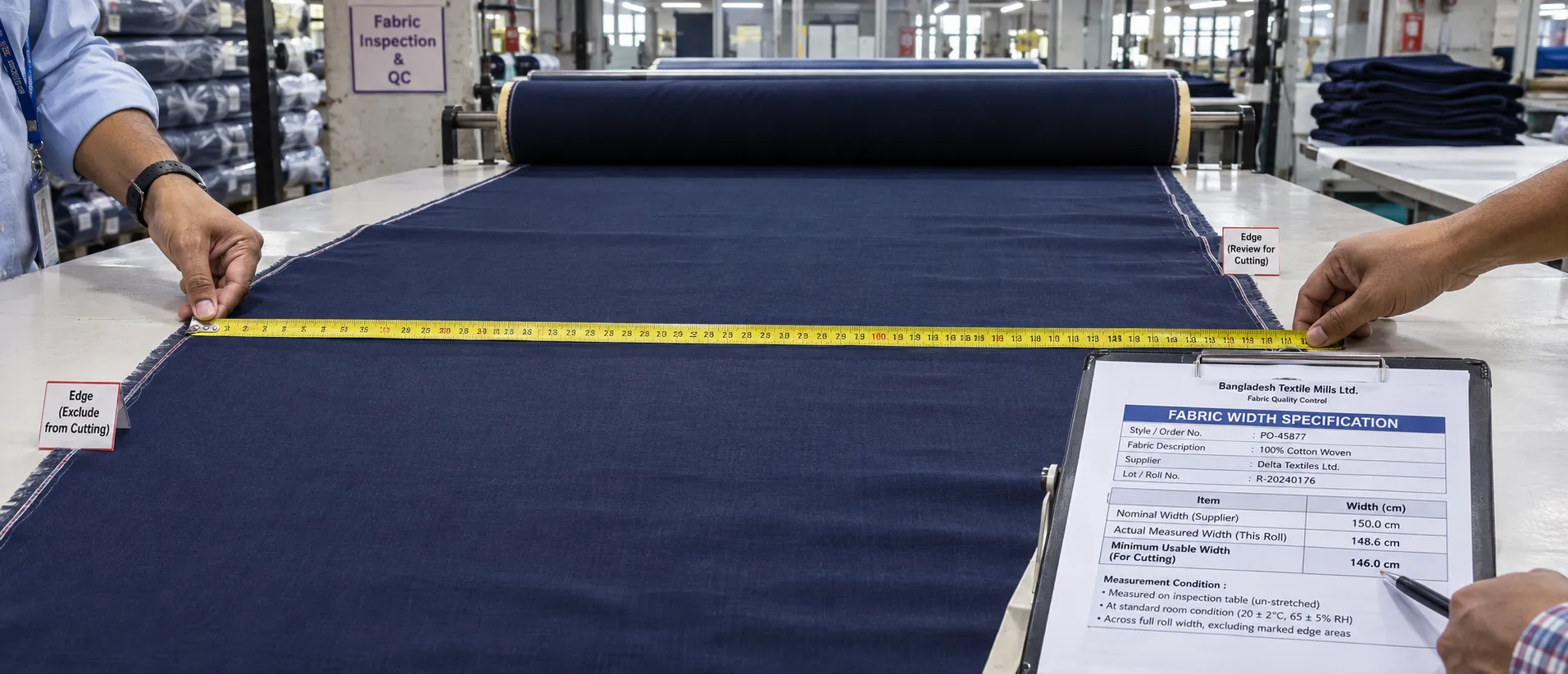
Fabric width is a major commercial specification because it influences material consumption and cutting arrangements. A supplier may quote a fabric using its stated width, while the manufacturer calculates garment consumption using the width that is actually suitable for production.
These values are not always identical.
What Is Standard Fabric Width?
The expression standard fabric width is commonly used in supplier discussions, but it does not identify one fixed measurement applicable to all fabrics.
Different textile constructions, manufacturing equipment, finishing processes, and product requirements produce different widths.
The specification should therefore state the intended width and clarify how it will be evaluated.
What Is Typical Fabric Width?
Buyers asking about typical fabric width often want to estimate consumption before selecting a supplier.
Knitted fabrics may be produced and supplied in different open-width or tubular configurations, while woven fabrics may be offered in various widths according to loom and processing arrangements.
A typical width range may provide preliminary planning guidance, but it should not replace supplier confirmation.
The final width requirement must reflect the material and the garment’s cutting needs.
Nominal vs. Measured vs. Usable vs. Cuttable Width
Nominal Width: The fabric width stated in the supplier’s description or commercial specification. It may represent the intended or commonly supplied width rather than the exact value measured on every roll.
Measured Width: The width obtained from an actual fabric measurement under specified conditions. Results may vary along the roll and with the measurement procedure.
Usable Fabric Width: The width considered suitable for the intended application under the agreed material-quality requirements. It may exclude unsuitable edges or other portions of the textile.
Cuttable Width of Fabric: The width available to the garment-cutting operation after considering the relevant material and cutting restrictions. In some programs, usable width and cuttable width are used interchangeably, so their meanings should be agreed rather than assumed.
Example Fabric Width Chart
| Width Parameter | Illustrative Value | Buyer Requirement |
|---|---|---|
| Nominal Width | 180 cm | Supplier-stated target |
| Measured Width | 179 cm | Actual recorded roll measurement |
| Minimum Usable Width | 176 cm | Width available after relevant exclusions |
| Approved Cuttable Width | 176 cm | Width used for the agreed marker plan |
| Measurement Condition | Flat, without unintended tension | Follow approved procedure |
Illustrative values only. Actual usable width, measurement conditions, and cutting requirements must be established for the material and production program.
A fabric width chart like this allows merchandising, sourcing, and cutting teams to compare consistent information rather than using different definitions of width.
Worked Example: Why Width Affects Material Consumption
Suppose a fabric is quoted at 180 cm nominal width, but only 176 cm is available for the relevant cutting arrangement.
The difference is:
Width Difference: 180 – 176 = 4 cm.
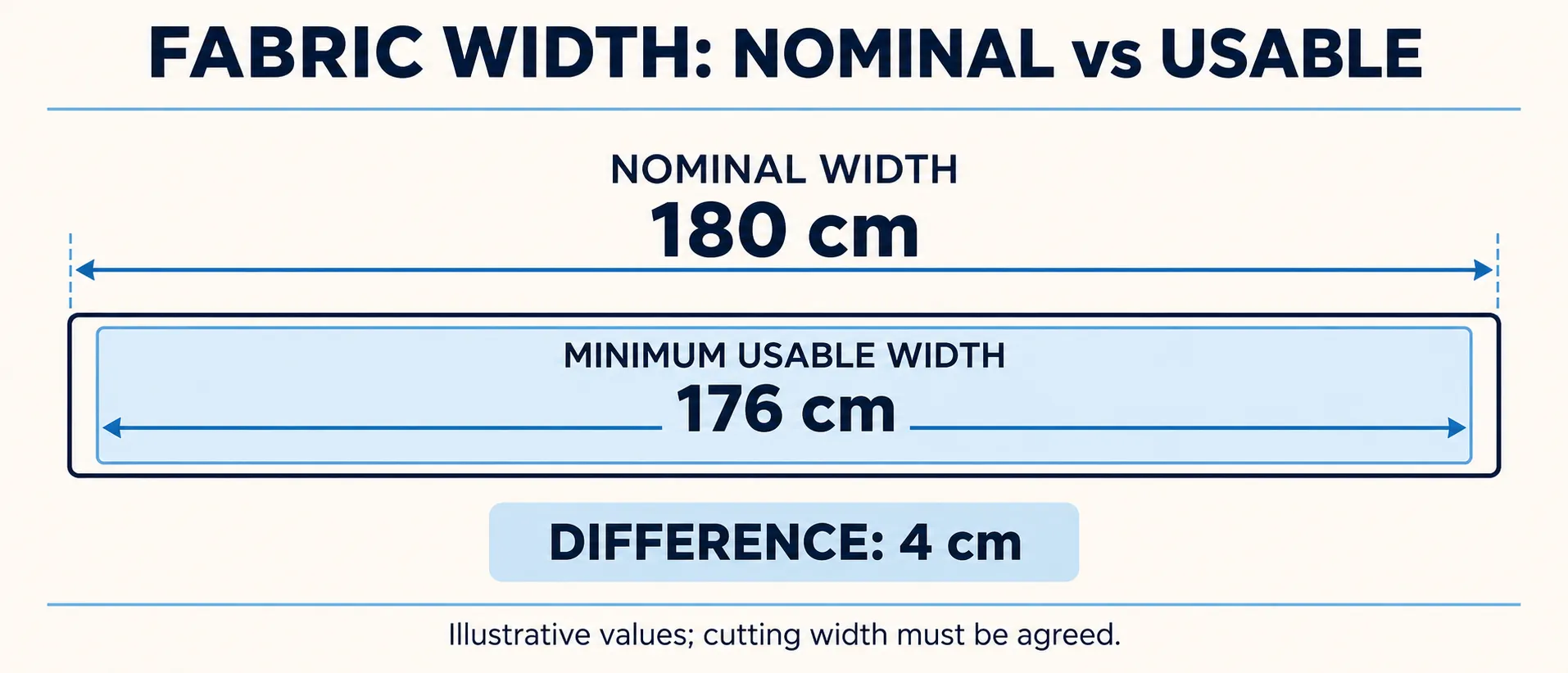
The proportional reduction relative to nominal width is:
Width Reduction: (4 / 180) × 100 = 2.22%.
This calculation shows the reduction in available width. It does not mean the garment’s fabric consumption automatically increases by 2.22%.
Actual consumption depends on the pattern arrangement, garment sizes, marker length, grain requirements, and other cutting conditions.
The manufacturer should calculate consumption using the approved cutting arrangement.
How to Write a Width Requirement
A practical specification might state:
Fabric Width Requirement: Nominal width 180 cm. Minimum usable or cuttable width 176 cm under the agreed measurement condition, with any excluded portions defined in the material inspection procedure.
ASTM International’s standard test method for width of textile fabric, ASTM D3774, covers the measurement of textile width and usable width using specified approaches. Buyers can use an appropriate recognized method while separately defining their accepted minimum width.
What Happens When Width Is Below Specification?
If the actual usable width is insufficient, the manufacturer should assess the effect on cutting, consumption, and product requirements.
Possible actions may include remeasuring the material, reviewing the marker arrangement, segregating affected rolls, requesting supplier clarification, or rejecting material that fails the applicable acceptance criteria.
The next step should be documented before the affected fabric is released for cutting.
Fabric Finishing: How to Specify Treatments, Handfeel, and Performance

Fabric finishing refers to mechanical, chemical, thermal, or other processes used to modify textile properties or appearance. Finishing may affect surface feel, dimensional stability, color, drape, durability, and certain functional characteristics.
Because finishing can change material behavior, a fabric specification should identify the treatments or final outcomes that are important to the garment.
Fabric Finish Definition and Specification
A practical fabric finish definition identifies the treatment or finished-property requirement relevant to the material.
However, writing only the name of a finish may not provide enough information for approval.
For example, “compacted fabric” tells the supplier that a stabilization process is expected, but it does not establish the resulting dimensional-stability performance.
Likewise, “brushed soft” does not define acceptable surface appearance or pilling resistance.
Different Types of Fabric Finishes
Different fabric finishes can be grouped according to their purpose.
Surface Finishes: Treatments such as brushing, peaching, sueding, and certain surface-softening processes modify the fabric’s tactile or visual character. Their use should be balanced against relevant surface-durability risks.
Dimensional Stabilization: Processes such as compaction or heat-setting may help control material behavior in suitable fabrics. The expected result must still be verified under the agreed conditions.
Appearance Finishes: Certain processes modify sheen, surface texture, color appearance, or the washed look. Buyers should identify the intended visual reference and acceptable variation.
Functional Finishes: Treatments may be used to achieve water repellency, wrinkle resistance, or another defined performance characteristic. The supplier should confirm the appropriate performance verification and any necessary durability requirements.
Fabric Finishes Examples and Specification Requirements
| Finish | Intended Outcome | Important Risk | What to Specify |
|---|---|---|---|
| Compaction | Improve applicable dimensional behavior | Residual shrinkage | Required results and verification |
| Heat-Setting | Stabilize suitable thermoplastic components | Distortion or altered recovery | Process suitability and performance criteria |
| Brushing | Raised, soft surface | Pilling or surface variation | Approved surface reference and testing |
| Peaching | Fine, softened surface | Uneven texture or appearance | Reference swatch and allowable variation |
| Enzyme Processing | Modify selected surface or appearance properties | Excessive treatment or shade change | Approved process or resulting reference |
| Water-Repellent Finish | Achieve defined resistance to surface wetting | Performance loss during care | Applicable test results and durability |
| Softener Application | Modify handfeel | Variation between batches | Reference handfeel and relevant performance |
These examples illustrate what buyers may need to communicate. They do not establish that each finish is suitable for every fiber or construction.
Knit Fabric Finishing Techniques
Common knit fabric finishing techniques may include relaxation, washing, compaction, heat-setting, brushing, and other processes selected for the material.
Their effects depend on the fabric construction, yarn, fiber content, and operating conditions.
For example, a cotton single jersey may be compacted to help manage dimensional behavior, but the buyer should still verify the specified shrinkage and spirality requirements.
Denim Fabric Finishing Process
A denim fabric finishing process may involve treatments applied to the fabric before garment manufacture, while a separate garment-washing or finishing route can create the intended final jeans appearance.
The specification should identify which treatment stage is being discussed.
For example, rigid and stretch denim may respond differently to washing and heat exposure. A stretch-denim product may require attention to recovery, dimensional behavior, color transfer, and the effects of the planned wash process.
An approved raw-denim reference does not automatically establish the appearance or measurements of the finished garment after washing.
How to Approve Finishing Requirements
The buyer should confirm the intended treatment or performance, physical reference, applicable testing, and relevant supplier process information.
Where a specific route is essential, it should be documented. Where alternative processing may be permitted, the supplier should demonstrate that the resulting material satisfies the approved requirements.
Our guide to garment finishing processes and material appearance control will examines how finishing, color development, and related components influence the final garment.
Fabric Shrinkage Standards: How to Write Dimensional Stability Requirements

Fabric shrinkage describes a reduction in textile dimensions under particular conditions. However, fabric dimensions may also increase, so the broader technical concept is dimensional change or dimensional stability.
A useful fabric specification should identify the relevant test procedure, measurement directions, washing or processing conditions, and acceptable results.
Fabric Shrinkage Scale and Result Interpretation
Some teams use the expression fabric shrinkage scale when discussing how dimensional changes are measured or compared with internal acceptance categories.
There is no single universal shrinkage rating scale that establishes acceptable results for every apparel fabric.
Buyers should document the actual percentage change and compare it with the applicable product requirements.
Lengthwise Change: Measures dimensional change in the fabric length direction under the agreed procedure. It should be recorded separately from widthwise change when both are relevant.
Widthwise Change: Measures dimensional change across the fabric width. A material may show different behavior in the two directions, so one overall shrinkage number can be misleading.
Shape Distortion: Spirality, skew, and other changes may need separate evaluation because a dimensional change percentage does not fully describe every geometric problem.
Fabric Shrinkage Calculation Example
Suppose a specimen measures 50 cm before an agreed laundering procedure and 48.5 cm afterward.
Dimensional Change Formula: ((After – Before) / Before) × 100
Worked Calculation: ((48.5 – 50) / 50) × 100 = -3%
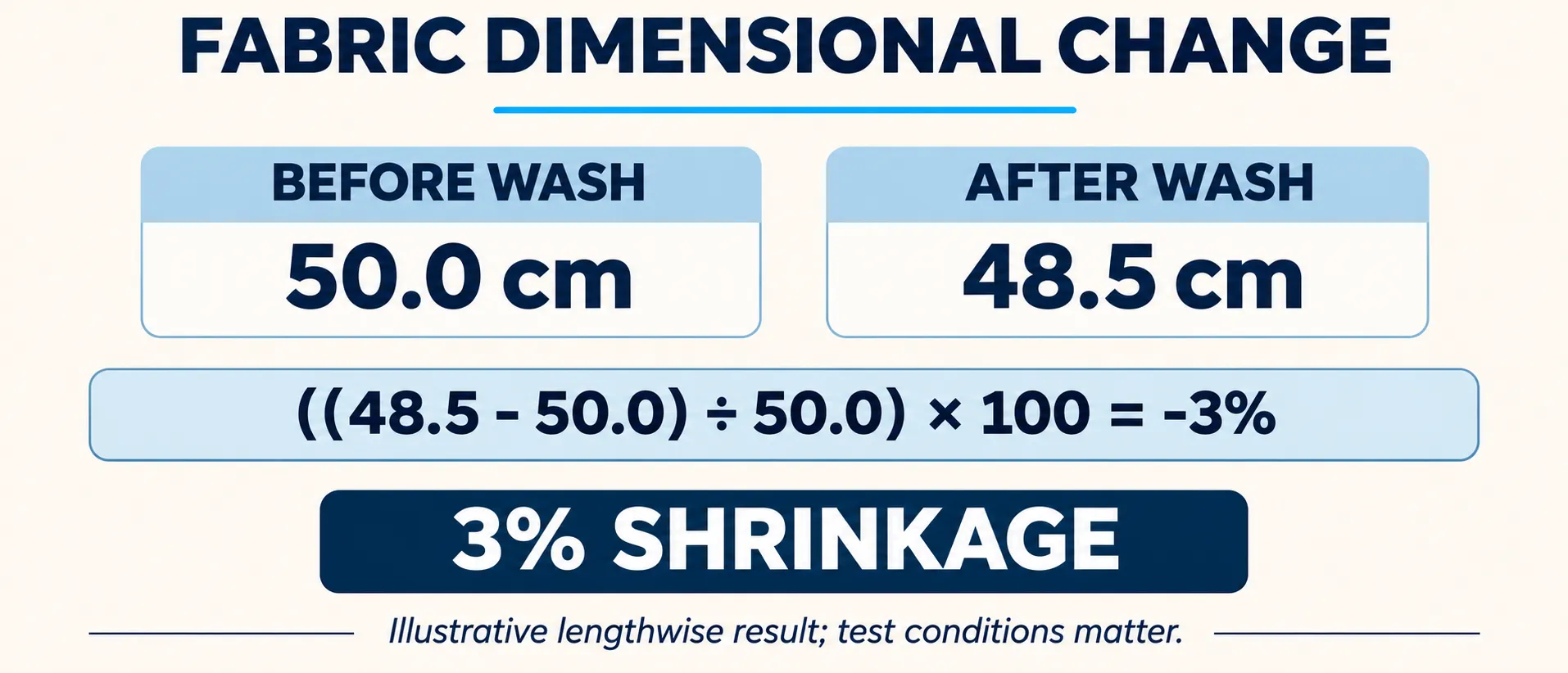
The result is -3% dimensional change, meaning 3% shrinkage in the measured direction.
If the specimen became longer rather than shorter, the same formula would produce a positive percentage representing growth.
How to Write Shrinkage Targets
An illustrative buyer requirement might state:
Lengthwise Dimensional Change: Maximum permitted shrinkage 3%, evaluated under the specified laundering and drying procedure.
Widthwise Dimensional Change: Maximum permitted shrinkage 2%, evaluated under the same applicable procedure.
Growth: Maximum permitted increase to be defined separately if relevant to the product.
The percentage values are examples only. Actual acceptance limits must be selected according to the garment and its requirements.
Fabric Shrinkage Testing and Recognized Methods
Fabric shrinkage testing should use an appropriate procedure that represents the intended assessment conditions.
AATCC’s TM135 test method for dimensional changes of fabrics after home laundering describes standardized procedures for evaluating lengthwise and widthwise dimensional changes under selected home-laundering conditions. Buyers must still establish the relevant conditions and their own acceptance limits.
Fabric Shrinkage Standards and Approval Timing
When discussing fabric shrinkage standards, distinguish the testing procedure from the permitted result.
The test method helps ensure results are obtained under defined conditions, while the garment specification identifies what is acceptable.
A practical verification plan may involve initial material qualification, production-representative evaluation, and further bulk checks where required.
If a fabric fails the applicable requirement, possible actions include technical investigation, suitable reprocessing, material replacement, or an authorized specification review.
A material should not automatically receive a wider shrinkage allowance merely because the supplier cannot meet the original requirement.
Color Fast Fabric and Shade Continuity: Writing Measurable Requirements
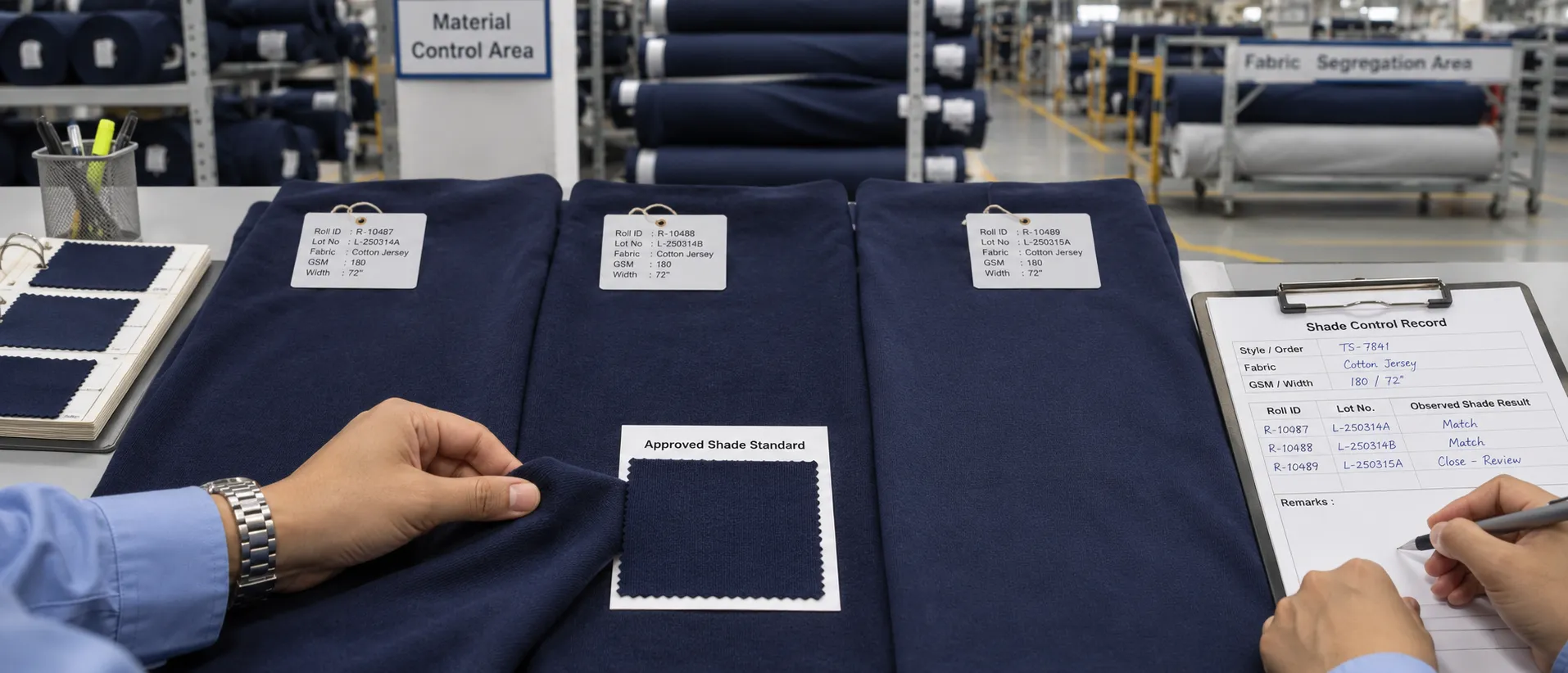
A color fast fabric is a textile that demonstrates appropriate resistance to color change or staining under specified exposures. The term does not mean that a textile will never fade or transfer color under every possible condition.
Fabric colorfastness should be evaluated according to the material, intended use, and applicable buyer requirements.
What Is Color Fast Fabric?
Buyers asking what is color fast fabric generally want to know whether the textile will maintain its appearance or avoid unacceptable color transfer during washing, rubbing, perspiration exposure, or other relevant conditions.
The answer depends on the specific exposure and the required performance level.
A fabric may perform well during one test and less satisfactorily during another, so broad statements such as “colorfastness passed” are not sufficiently informative.
Color Fastness Test for Fabrics
A color fastness test for fabrics evaluates a defined aspect of color performance using a specified procedure.
Common test categories include:
- Colorfastness to washing
- Colorfastness to dry rubbing
- Colorfastness to wet rubbing
- Colorfastness to perspiration
- Colorfastness to light
The required tests should reflect the garment’s intended use and the buyer’s quality expectations.
Fabric Color Fastness Specification Table
| Exposure | Method Requirement | Result Format | Verification Stage |
|---|---|---|---|
| Washing | Applicable ISO or AATCC method | Color-change and staining results | Defined material approval stage |
| Dry Rubbing | Applicable method | Relevant rating | Material qualification or bulk control |
| Wet Rubbing | Applicable method | Relevant rating | Where dye-transfer risk applies |
| Perspiration | Applicable method | Color-change and staining results | Relevant apparel development stage |
| Light | Applicable method | Applicable lightfastness result | Where required by intended use |
The applicable specification must identify the exact method and version, required result, specimen identification, and acceptance criteria.
How to Check Color Fastness of Fabric
When deciding how to check color fastness of fabric, buyers should request evidence linked to the material actually being evaluated.
The report should identify the fabric reference, color or shade, test method, result, and relevant acceptance criteria. Where the tested material differs from the intended bulk version, the limitation should be considered before approval.
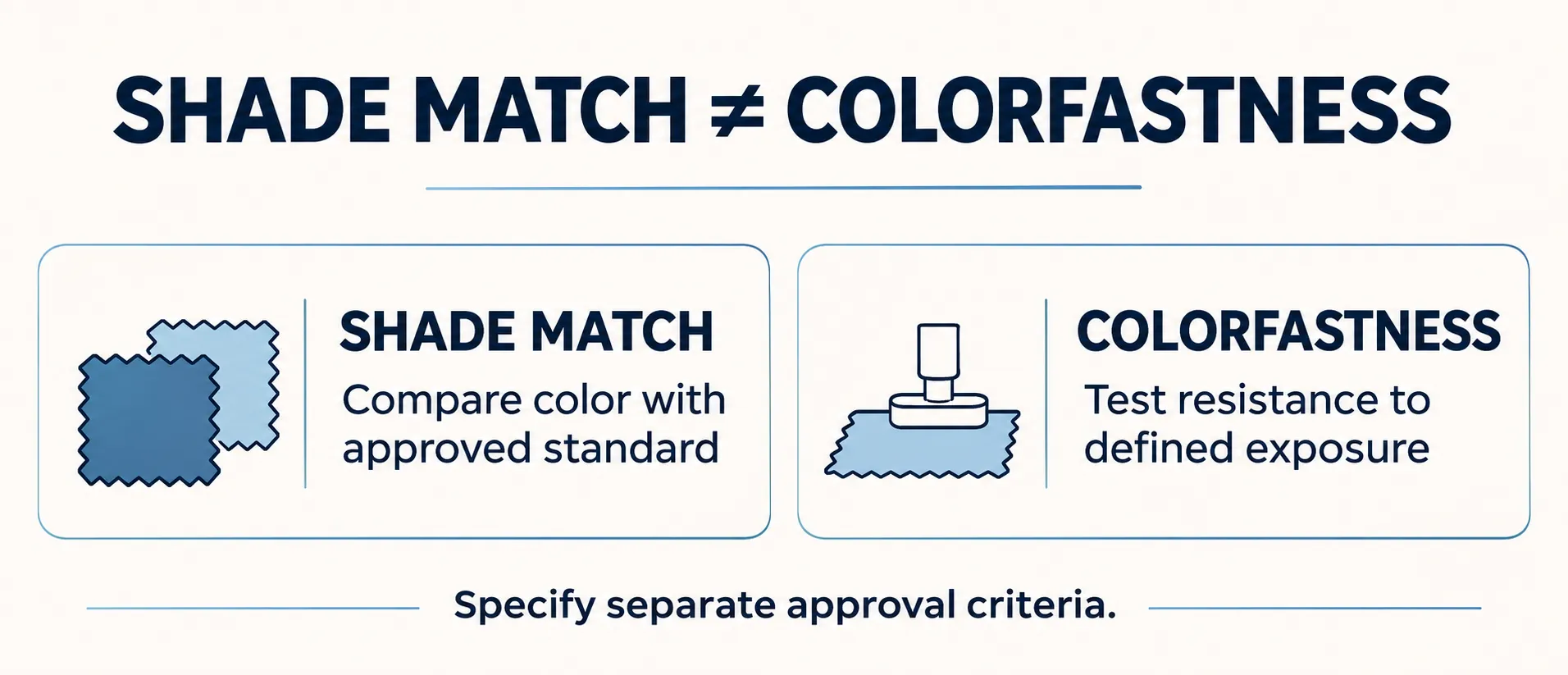
Shade Matching Is a Separate Approval
Colorfastness testing does not establish that a fabric matches the intended visual shade.
Shade approval may rely on an agreed physical color standard, lab dip, bulk cutting, or other applicable reference.
A textile can meet its colorfastness requirements while differing visibly from the approved shade.
Bulk Shade Continuity
The material control plan should identify how shade differences between lots or rolls will be evaluated.
For garments with visible matching panels, cutting arrangements may need to prevent unacceptable shade combinations.
However, not every colorway or order requires identical segregation rules. The appropriate process depends on the approved shade limits and product risks.
Our guide to the color approval process for lab dips and bulk shade control will explain how brands establish visual color references, review dye-lot variation, and coordinate production shade approvals.
Pilling Resistant Fabric: Specifying Surface-Durability Requirements
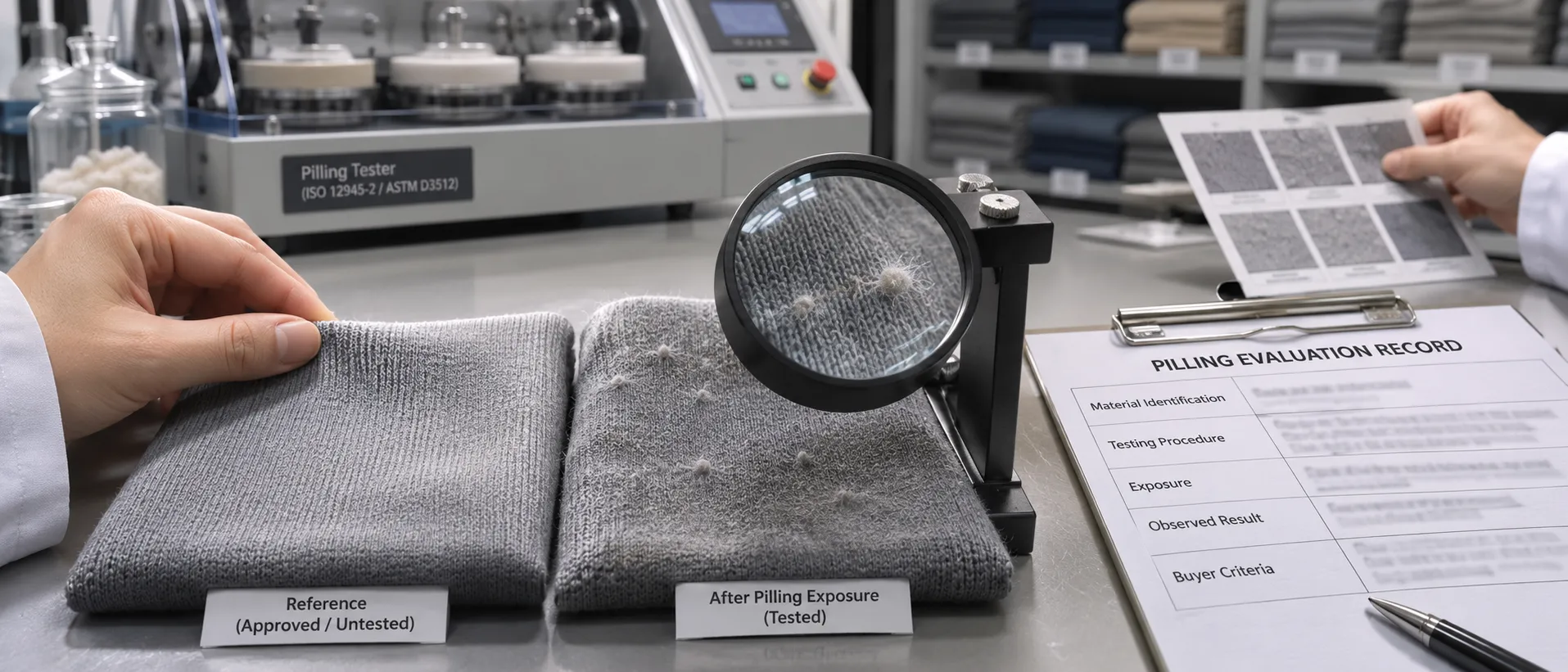
A pilling resistant fabric is one that demonstrates the required resistance to pill formation under the selected evaluation procedure.
Pilling occurs when loose surface fibers become entangled through friction or wear.
Its appearance depends on the fiber, yarn, construction, finishing, and conditions to which the material is exposed.
What Should a Pilling Specification Include?
The buyer should identify the method, test conditions, required rating, and relevant material condition.
For example:
Pilling Requirement: Evaluate the approved finished fabric using the specified pilling method and agreed acceptance grade.
The result should be supported by a report identifying the tested specimen.
A requirement such as “no pilling ever” is not an adequately defined technical specification because it does not establish an evaluation procedure or exposure condition.
Pilling Risk Predictors
- Fiber characteristics and staple length
- Yarn structure and twist
- Knit or woven construction
- Surface brushing or other raised finishes
- Material blend and processing
- Garment abrasion zones
- Intended wear and laundering conditions
GSM may be relevant to the overall construction but should not be treated as a reliable standalone predictor of pilling performance.
When Should Pilling Be Retested?
Further testing may be necessary if a change affects the approved material’s surface or construction.
For example, substantially changing the brushing process or yarn characteristics could justify additional evaluation.
The testing decision should follow the product’s risk assessment and agreed change-control requirements.
Fabric Spirality: How to Specify and Evaluate Twisting in Knitted Fabrics

Fabric spirality refers to a form of structural or geometric distortion associated with certain knitted fabrics. In garment applications, it may contribute to twisting or rotation of seams after laundering.
It is particularly relevant where the garment has visible side seams or a construction sensitive to rotational distortion.
What Is Spirality in Fabric?
Buyers asking what is spirality in fabric are usually concerned about fabric or garment twisting.
Spirality in fabric may arise from interactions between yarn torque, knitting construction, processing conditions, and relaxation behavior.
It is not necessarily caused by one isolated manufacturing error.
Spirality in Knitted Fabric
Spirality in knitted fabric can become visible after washing or relaxation when the material’s loop structure and yarn characteristics contribute to rotational distortion.
Single jersey may be susceptible, although the actual result depends on the specific material and processing conditions.
A knitted garment may have acceptable width and length measurements but still show objectionable twisting.
Spiral Fabric vs. Fabric Spirality
The search phrase spiral fabric can refer to decorative spiral designs or to fabric-twisting problems.
For production quality discussions, fabric spirality or garment spirality is the more precise terminology when the concern is unintended rotation or distortion.
Fabric Spirality Control Table
| Requirement | What to Specify | Verification |
|---|---|---|
| Applicable Product | Relevant knitted garment or fabric | Product identification |
| Spirality Limit | Approved maximum result | Buyer-defined acceptance criteria |
| Test Method | Applicable fabric or garment evaluation method | Documented test procedure |
| Test Condition | Defined laundering or relaxation process | Test record |
| Approval Stage | Development or relevant production verification | Authorized decision |
| Change Control | Reassessment when relevant inputs change | Technical review |
The actual numerical limit should be established for the product, not copied from an unrelated fabric specification.
Potential corrective actions may involve reviewing yarn characteristics, knitting settings, finishing conditions, or other relevant manufacturing variables.
Sewing corrections alone may not resolve distortion originating from the fabric.
Fabric Lab Testing: What an Approval-Ready Test Report Must Show
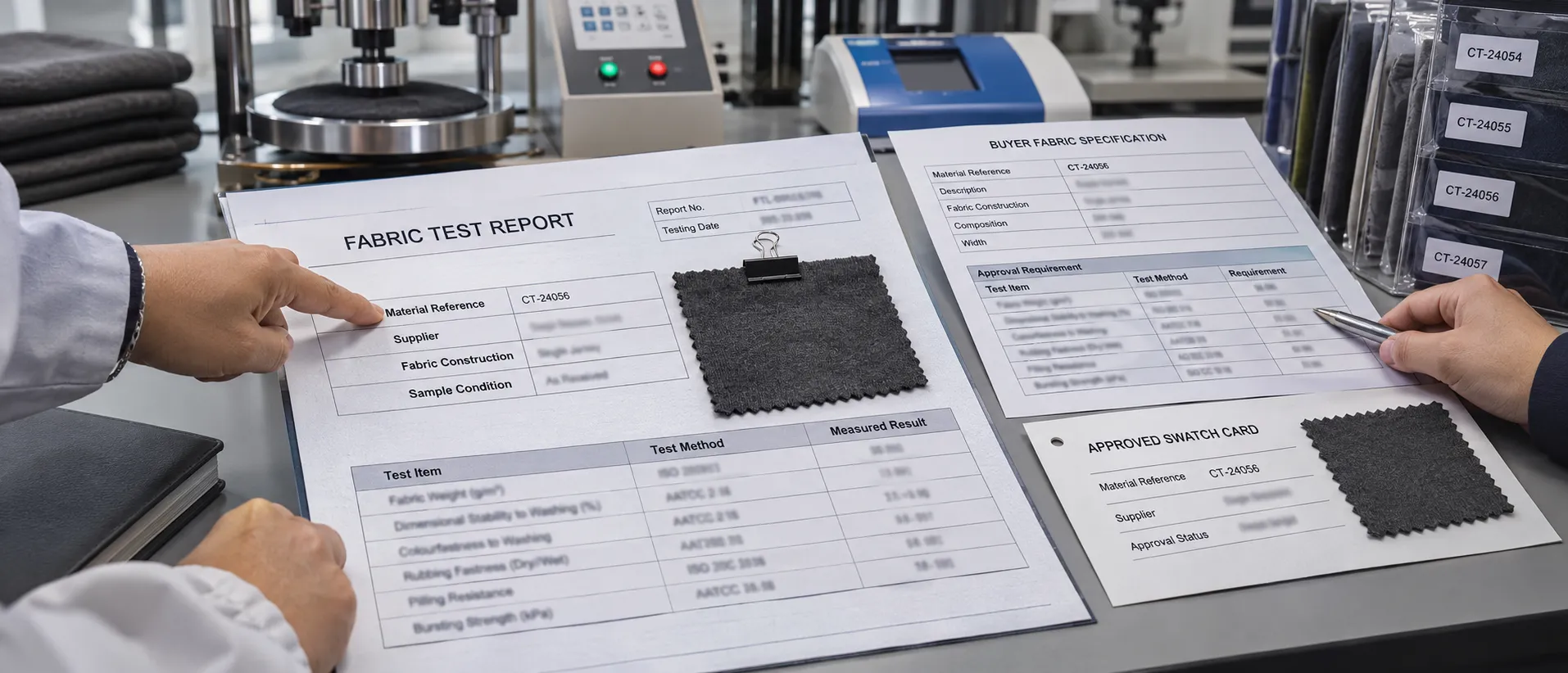
Fabric lab testing provides evidence about material characteristics that cannot always be evaluated reliably through appearance or handfeel.
A test report is most useful when it identifies what was tested, how it was evaluated, and whether the result satisfies the relevant buyer requirement.
Fabric Lab Test Report Checklist
A decision-ready fabric lab test report should normally include:
- Tested material reference
- Supplier or submitting party
- Relevant fiber composition and construction identification
- Color, finishing, and material condition as applicable
- Lot or sample identification
- Applicable test method and edition
- Test result with appropriate units or rating
- Required acceptance criterion, where supplied
- Date and laboratory identification
- Clear link to the correct development or bulk material
Where test results do not include buyer-specific pass or fail judgments, the authorized technical team should evaluate them separately against the applicable specification.
A report does not become invalid simply because it lacks a buyer’s internal approval decision.
Industrial Fabric Lab Testing vs. In-House Checks
Industrial Fabric Lab Testing: Uses applicable laboratory methods and equipment to evaluate defined textile properties. Depending on the requirement, tests may be carried out by a qualified in-house laboratory or an independent laboratory.
In-House Material Checks: May include rapid assessments of width, visible defects, fabric weight, shade, and other characteristics. These checks support routine control but do not automatically replace a required formal test.
The specification should identify who provides the evidence and which type of verification is necessary.
Minimum Fabric Testing Matrix
| Risk | Test or Evaluation | Possible Stage | Evidence |
|---|---|---|---|
| Weight Variation | Fabric Mass per Unit Area | Development / Bulk | GSM Results |
| Width Variation | Fabric Width | Receipt / Bulk | Measurement Record |
| Dimensional Change | Specified Laundering Test | Development / Relevant Production Stage | Directional Results |
| Color Change or Transfer | Relevant Colorfastness Tests | Material Approval | Laboratory Ratings |
| Surface Pilling | Applicable Pilling Test | Material Qualification | Reported Result |
| Spirality | Applicable Twist or Distortion Assessment | Knit Development | Measured Result |
| Poor Elastic Recovery | Stretch and Recovery Test | Stretch Fabric Qualification | Extension and Recovery Results |
| Physical Durability | Relevant Strength or Abrasion Tests | Risk-Based Material Evaluation | Laboratory Report |
This matrix is a selection tool. Required testing must be determined by the product, buyer, and applicable regulatory or technical obligations.
Reverification After Material Changes
A supplier may propose a new yarn source, mill, finishing route, or material lot.
The buyer should assess whether the change affects approved properties and which verification activities need to be repeated.
For example, a new dye lot may require shade evaluation and certain colorfastness checks under the buyer’s control plan. A change in fiber composition could have broader implications for labeling, performance, and manufacturing behavior.
Intertek’s textile testing services for apparel and fabrics describe laboratory evaluations covering material composition, dimensional stability, colorfastness, physical performance, and other textile requirements. Such services help buyers obtain documented technical evidence when material qualification or independent verification is necessary.
Our supporting guide to fabric testing basics for shrinkage, colorfastness, pilling, and spirality will explain the relevant reporting formats, evaluation methods, and common interpretation mistakes.
See How Fabric Specifications Move From Sampling to Bulk
Explore how RYZEAL SOURCING coordinates technical requirements, sample development, approval stages, and bulk manufacturing follow-up through suitable specialized apparel manufacturing partners in Bangladesh. Understand the process before planning your next garment order.
Fabric Swatches: How to Manage Material References and Approvals

Fabric swatches are physical material samples used to evaluate or communicate textile characteristics. They may support fabric selection, handfeel comparison, construction verification, color matching, and other approval activities.
However, not every swatch has the same purpose or approval status.
A development swatch may represent a proposed material, while an approved bulk reference may represent specific characteristics that the supplier is required to maintain.
What Is Swatch Fabric?
The search phrase what is swatch fabric generally refers to the small pieces of textile supplied for examination or comparison.
A swatch of fabric can provide useful information about surface appearance, construction, handfeel, and certain physical properties.
Nevertheless, its size and condition may limit what can be evaluated. A small swatch does not necessarily provide enough material for meaningful garment fitting, cutting trials, or every required laboratory test.
Apparel Fabric Swatches vs. Clothing Fabric Swatches
The expressions apparel fabric swatches and clothing fabric swatches generally describe the same type of material reference in garment-development contexts.
The important distinction is not the wording, but the swatch’s purpose and identification.
A brand may request swatches for preliminary comparison, approved reference retention, shade evaluation, or material testing.
These should be identified appropriately so the manufacturer understands what the swatch is intended to demonstrate.
What Information Should Fabric Swatches for Clothing Include?
A practical swatch label may contain:
- Fabric reference code
- Supplier name or identification
- Fiber composition
- Construction
- GSM
- Relevant width information
- Color or shade reference
- Finishing details
- Date and version
- Approval status
Not all information will be available at the earliest development stage. Missing values should be identified rather than presented as confirmed.
Fabric Swatch Approval Register
| Swatch ID | Purpose | Fabric Reference | Version | Status |
|---|---|---|---|---|
| SW-001 | Initial Material Proposal | FAB-TS-001 | V01 | Under Review |
| SW-002 | Revised Handfeel Reference | FAB-TS-001 | V02 | Approved |
| LD-001 | Black Lab Dip | FAB-TS-001 | V01 | Revision Required |
| LD-002 | Revised Black Lab Dip | FAB-TS-001 | V02 | Approved |
| BC-001 | Bulk Fabric Cutting | FAB-TS-001 | V01 | Pending Verification |
Illustrative identifiers and statuses.
Swatch Approval Stages
Development Reference: A proposed or approved material used to establish the intended construction, handfeel, appearance, or other applicable characteristics.
Lab Dip: A color-development submission used to evaluate shade matching against the relevant approved reference.
Production-Representative Cutting: A specimen intended to represent material produced through the relevant planned manufacturing route.
Bulk Fabric Cutting: A specimen selected from actual bulk material for required approval or verification purposes.
These stages may overlap or differ by buyer. They are not universally required in an identical sequence.
How to Prevent Swatch Version Confusion
The buyer and supplier should identify which reference is current and which requirements it controls.
For example, accepting a revised handfeel swatch does not automatically mean the buyer has approved a new shade, GSM, or construction.
Approval records should therefore describe the scope of the decision.
Fabric Lot Control: Preventing Unacceptable Variation During Bulk Production
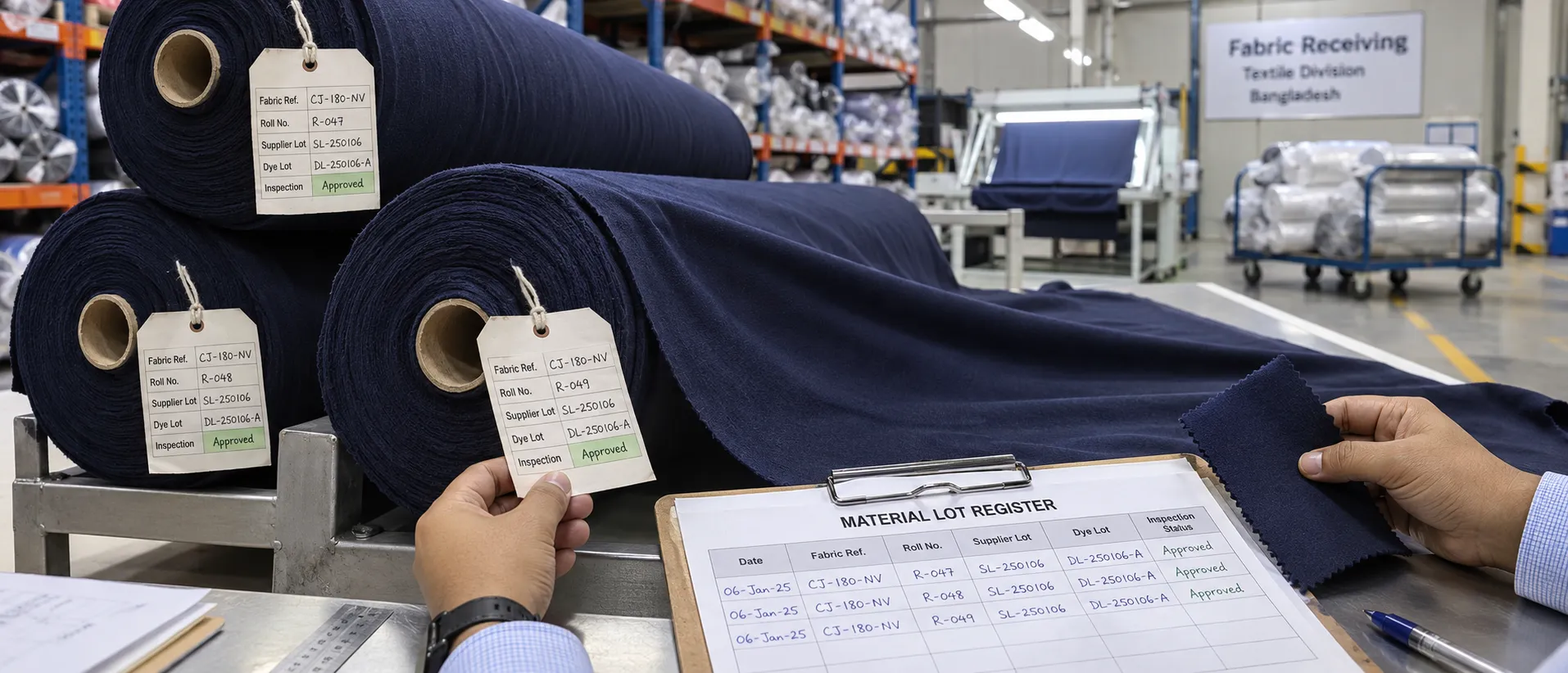
A fabric lot is a defined quantity or batch of material identified for production, processing, quality control, or traceability purposes.
Materials from different lots may show variations in shade, finishing, dimensions, or other characteristics, even when the nominal specification remains unchanged.
The relevant differences should be evaluated against the buyer’s requirements.
Why Fabric Lot Identification Matters
Lot identification helps connect bulk materials with supplier production records, inspection findings, and quality decisions.
For example, if one fabric batch shows unacceptable shade variation, traceability can help identify the affected rolls or garment components.
Without suitable records, determining which materials were used in particular garments may become more difficult.
Fabric Lot Control Rules
A practical fabric lot control procedure may include:
- Each roll has an identifiable reference.
- Supplier or mill lot information is retained.
- Relevant dye-lot information is available.
- Material inspection results can be linked to the rolls.
- Approved and rejected material statuses are identifiable.
- Shade-sensitive materials follow agreed segregation rules.
- Cutting records support required traceability.
- Changes affecting material approvals are reviewed.
The level of traceability should reflect the product, buyer requirements, and manufacturing risks.
Should Different Fabric Lots Always Be Separated?
Not necessarily across every garment or purchase order.
Where visible shade mismatch is a significant risk, the buyer may require additional controls to avoid combining incompatible lots within one garment.
In other situations, material from different lots may be acceptable when the required properties and appearance are adequately controlled.
The policy should identify where mixing is permitted, where it is restricted, and which evidence is needed.
Repeat Orders and Material Continuity
A repeat order should use the applicable approved fabric specs, but previous material approval does not automatically establish that a newly manufactured lot is identical.
The supplier should confirm relevant changes, and the buyer should apply any necessary verification.
This approach supports material continuity without assuming that every repeat order needs a complete restart of the original development process.
Defects in Fabric: Types, Identification, and Prevention Before Cutting

Defects in fabric can affect garment appearance, cutting efficiency, sewing, and finished-product quality.
Some defects are visible during fabric inspection, while others become more apparent after washing, relaxation, or garment construction.
Identifying important material problems before cutting allows the manufacturer to assess the affected rolls and determine suitable actions.
Common Fabric Defect Types
Fabric defects may originate during yarn preparation, knitting, weaving, dyeing, printing, finishing, handling, or storage.
A useful fabric defects list can group issues according to their appearance or likely production stage.
| Defect Type | Common Description | Possible Garment Impact |
|---|---|---|
| Hole | Opening or damaged area in the textile | Visible damage or reduced material usability |
| Slub or Yarn Irregularity | Local yarn-thickness variation | Surface inconsistency |
| Barré | Unintended horizontal or repeated visual bands | Visible appearance variation |
| Needle Line | Linear defect associated with knitting | Surface lines or appearance problems |
| Missing or Broken Yarn | Irregularity in the textile structure | Weakened or visibly defective area |
| Oil Mark | Localized contamination | Visible staining |
| Shade Band | Color variation across the material | Panel mismatch |
| Skew or Bowing | Geometric distortion of the textile structure | Pattern or alignment issues |
| Uneven Brushing | Inconsistent raised surface | Handfeel and appearance differences |
| Printing Defect | Unintended omission, misalignment, or irregularity | Incorrect printed appearance |
The appropriate classification and disposition depend on the product and agreed fabric-quality criteria.
Fabric Defect Detection at Receiving
Fabric defect detection should be included in the material receiving and inspection process where required.
An inspection may involve checking fabric rolls for visible faults, width consistency, shade differences, and other relevant characteristics.
The exact inspection scope depends on the product, material history, supplier reliability, and buyer requirements.
Fabric Defect Identification and Reporting
Fabric defect identification is more useful when findings include the affected material reference and location.
A defect record may include:
- Roll identification
- Fabric lot
- Defect description
- Approximate defect location
- Size or extent, where relevant
- Photograph
- Applicable defect classification
- Inspection decision
- Corrective or containment action
Documenting fabric defects and identification together helps the sourcing and quality teams communicate problems without relying on vague reports such as “fabric has many faults.”
Fabric Receiving Inspection Checklist
- Confirm fabric reference and supplier.
- Verify roll and lot identification.
- Review relevant delivery documentation.
- Check the applicable fabric width requirement.
- Evaluate material shade against the approved reference.
- Inspect for relevant visible defects.
- Record findings using the agreed method.
- Identify material requiring further evaluation.
- Segregate unacceptable or pending material where necessary.
- Confirm disposition before affected cutting activities.
This checklist should be adapted to the applicable material inspection procedure.
Fabric Inspection System: How the Four-Point Method Works
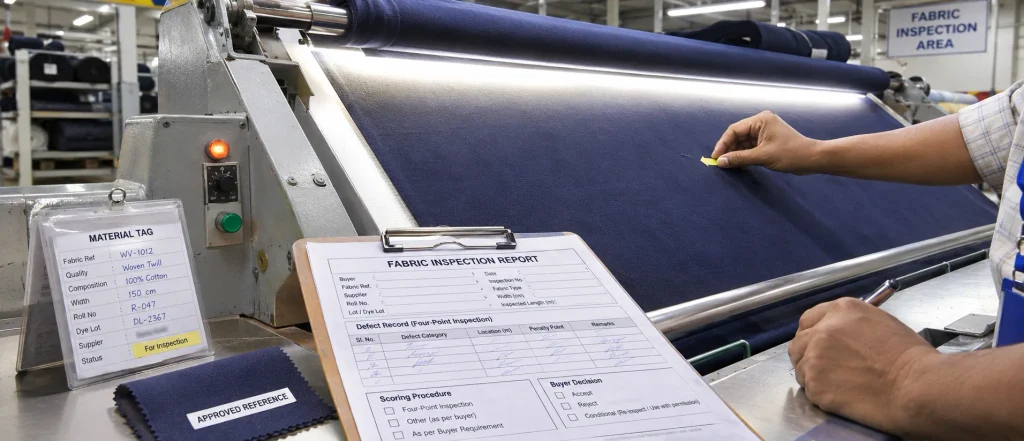
A fabric inspection system establishes how material is examined, how defects are recorded, and how the results are evaluated against the buyer’s acceptance requirements.
Laboratory test reports and visual inspection serve different purposes.
A laboratory result may confirm dimensional stability or colorfastness, while roll inspection can identify localized defects that a limited laboratory specimen may not reveal.
What Is Four-Point Fabric Inspection?
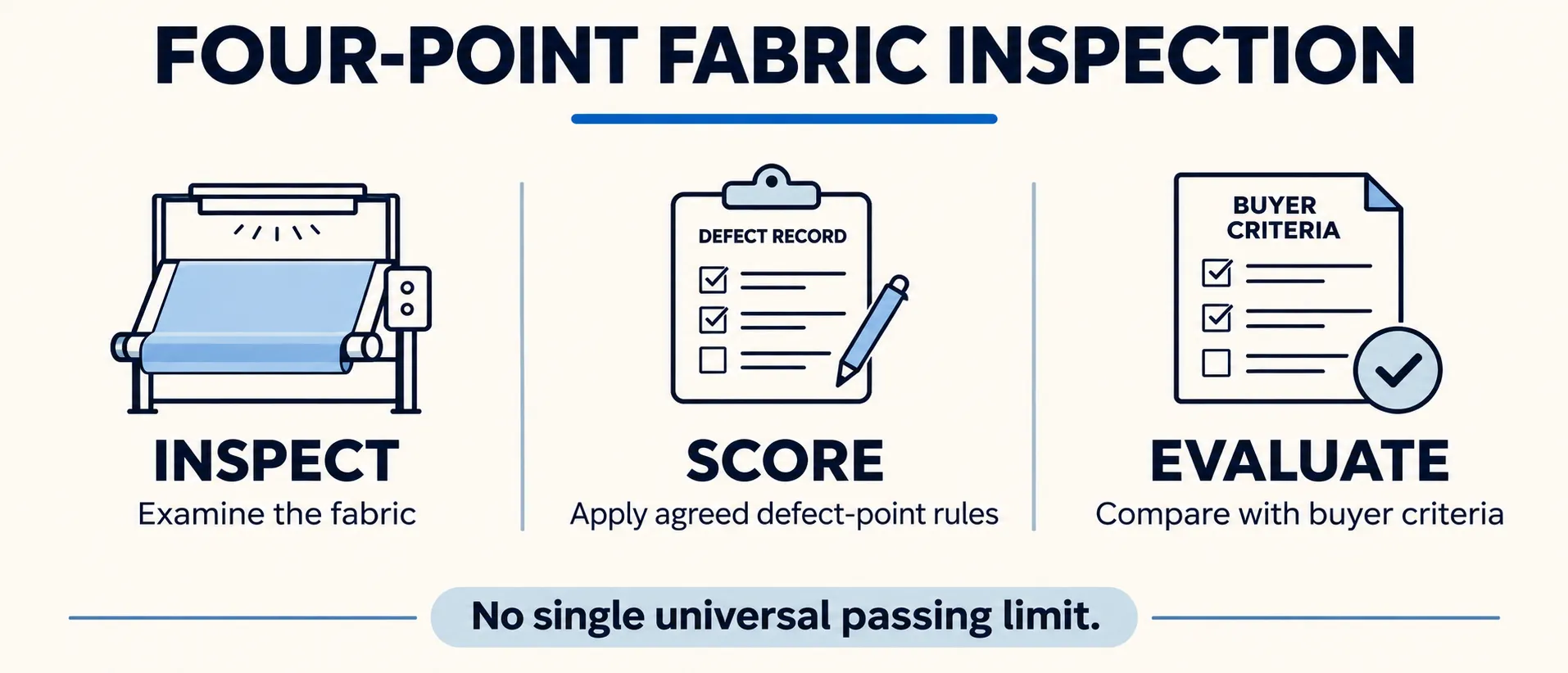
4 point fabric inspection is a commonly used approach to assigning penalty points to identified fabric defects.
It is used to help assess fabric quality according to an agreed inspection and grading procedure.
The result depends on the selected defect-scoring rules, inspected material quantity, and reporting method.
The buyer and supplier should use the same agreed procedure to avoid inconsistent interpretations.
Does the Four-Point System Have One Universal Passing Limit?
No.
Defect scoring and fabric acceptance are related but separate decisions.
The inspection procedure establishes how defects are evaluated and reported. The buyer or applicable agreement establishes which results are acceptable.
Different products or customers may use different inspection scopes and acceptance limits.
A four-point inspection result should therefore not be interpreted without knowing the relevant acceptance criteria.
Fabrication Quality Control Checklist
The phrase fabrication quality control checklist is sometimes used broadly to describe manufacturing checks. For textile material control, fabric inspection checklist is generally more precise.
A complete fabric inspection checklist should identify the inspection method, relevant fabric details, defect recording requirements, acceptance criteria, and action required when material does not comply.
Inspection Findings and Corrective Actions
A material inspection report should identify which rolls were inspected and how the results were determined.
Where results fall outside the applicable acceptance requirements, the manufacturer may need to segregate the material, obtain supplier clarification, carry out additional checks, or request replacement.
The disposition should be recorded before the affected material enters cutting.
ASTM International’s standard test methods for visually inspecting and grading fabrics, ASTM D5430, describe established procedures for fabric visual inspection and grading. The selected point-assignment option should be applied consistently, while actual acceptance requirements remain subject to the applicable buyer and supplier agreement.
Video: Major Fabric Faults and Fabric Inspection
The English-language educational lesson Major Fabric Faults and Fabric Inspection, provided by the English and Foreign Languages University and indexed by the National Digital Library of India, explains fabric faults and inspection concepts used in garment preparation. It complements the receiving-inspection checklist by helping readers understand why material faults should be identified and evaluated before cutting.
Fabric Sourcing Checklist: Confirming Suppliers Can Meet the Specification
Fabric sourcing involves selecting the appropriate supply route for material procurement and production.
An accurate fabric specification provides a stronger basis for supplier comparison, but sourcing decisions must also consider commercial and operational requirements.

Fabric Sourcing Tips for Apparel Buyers
Confirm Technical Capability: Ask whether the supplier can provide the required construction, composition, GSM, width, finishing, and relevant performance. A supplier’s available stock should not automatically be considered equivalent to the requested material.
Check Minimum Order Quantities: Fabric MOQ can differ by material, color, finishing process, or production arrangement. These details should be established before the buyer commits to a garment quantity or quotation.
Confirm Lead Times: Development fabric, lab dips, bulk processing, and transportation may have different schedules. The supplier should clarify which activities are included in its quoted lead time.
Review Quality Evidence: Relevant swatches, test reports, and material history help assess whether the supplier can meet the requirements.
Agree on Substitution Controls: Changes in supplier, composition, construction, or finishing may affect approved properties. The buyer should identify which changes require authorization.
Fabric Sourcing Checklist for Brands
| Requirement | What to Confirm | Status |
|---|---|---|
| Supplier Capability | Required fabric can be produced or sourced | Pending |
| Composition | Proposed blend matches approved requirement | Pending |
| Construction | Correct textile structure | Pending |
| GSM and Width | Targets and tolerances confirmed | Pending |
| Finishing | Required outcome and process suitability | Pending |
| MOQ | Quantity conditions by material and color | Pending |
| Lead Time | Development and bulk availability | Pending |
| Testing | Responsibility and required evidence | Pending |
| Swatches | Correct physical references | Pending |
| Shade Control | Applicable bulk color approval procedure | Pending |
| Lot Traceability | Required records available | Pending |
| Substitutions | Approval procedure agreed | Pending |
This checklist can be used during supplier qualification or quotation review.
Why the Lowest Fabric Quote May Not Be the Best Choice
Fabric cost is affected by more than the quoted price per kilogram or meter.
Usable width, material consumption, finishing, wastage, testing, and manufacturing behavior can affect the actual garment material cost.
Two suppliers offering the same nominal fabric may produce different commercial results because their material characteristics and supply arrangements differ.
Buyers should compare offers using the approved specification and realistic consumption information.
Where Fabric Specs Belong in the Tech Pack and Bill of Materials

Fabric requirements should be coordinated with the broader garment technical package.
A fabric specification identifies the material’s technical characteristics, while the garment tech pack explains how that material is used within the product.
The Bill of Materials provides the relevant material and component identification for sourcing, consumption, and costing.
Fabric Specification Page in the Tech Pack
The garment’s tech pack may include a dedicated fabric page or attached specification document.
It should identify the relevant material code and the approved fabric requirements.
Our guide to making a clothing tech pack explains how garment specifications, technical drawings, measurements, construction details, and material references can be organized for communication with apparel manufacturers.
Fabric BOM Line Item
The BOM should refer to the same approved material used in the fabric specification.
Relevant information may include:
- Fabric reference code
- Garment component
- Supplier or approved source
- Material description
- Consumption unit
- Estimated consumption
- Unit price
- Relevant sourcing and approval information
The guide to building a clothing Bill of Materials explains how fabric and trim identification, consumption, sourcing, and costing information can be organized for accurate quotations and material procurement.
Align the Fabric Specification, BOM, and Test Plan
A consistent documentation system should connect three questions.
What Material Is Required? The fabric specification defines the material’s technical properties and acceptance requirements.
What Material Must Be Purchased? The BOM identifies the relevant material component, approved source, consumption, and commercial information.
How Will It Be Verified? The testing and approval plan describes which evidence is necessary and when it must be reviewed.
The documents should use consistent identification and revision references.
Final Fabric Specification Handover
Before the relevant bulk manufacturing activities begin, confirm that:
- The latest fabric specs are approved.
- The correct material references are available.
- Relevant swatches and approval records are identifiable.
- Required test results have been evaluated.
- The BOM matches the approved fabric.
- Applicable lot and shade procedures are defined.
- Material substitutions have been resolved.
- The manufacturer has the appropriate cutting and production instructions.
These checks support continuity between material development, purchasing, and garment manufacturing.
Common Fabric Specification Mistakes and How to Prevent Them
A fabric specification can be detailed yet still fail to control the characteristics that matter most.
The following mistakes deserve particular attention.
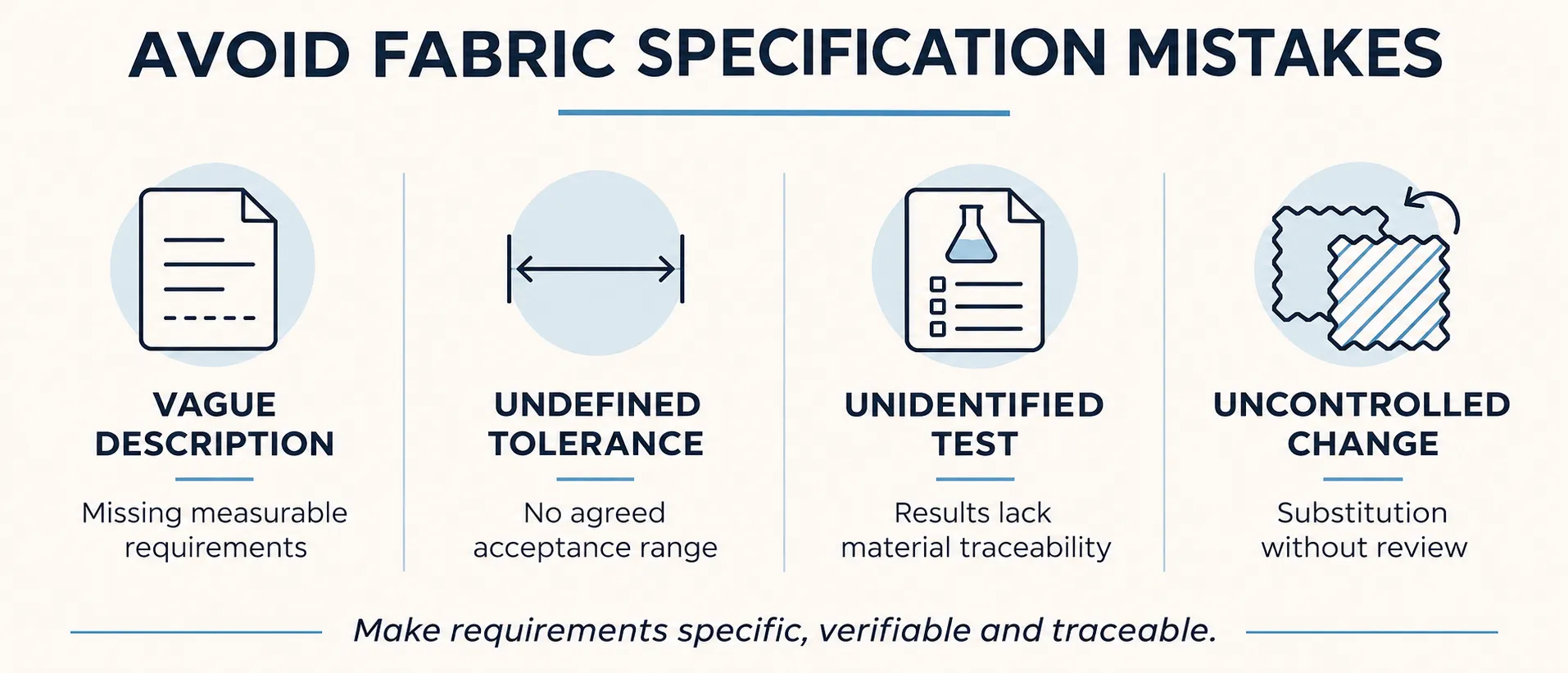
1. Using Only a Reference Photograph: A photograph can communicate appearance but cannot establish composition, GSM, construction, width, or test performance. Request relevant material information and a physical swatch where necessary.
2. Treating GSM as a Quality Rating: Fabric weight alone does not prove strength, opacity, durability, or suitability. Evaluate the required properties separately.
3. Leaving Tolerances Undefined: A target value without an agreed allowance may create disputes about normal variation. Specify the measurement conditions and relevant acceptance limits.
4. Ignoring Usable Width: Quoting from nominal width alone may produce inaccurate consumption assumptions. Confirm which width is appropriate for the intended cutting arrangement.
5. Describing Finishing Too Vaguely: Expressions such as “very soft” may be interpreted differently. Use an approved reference and specify relevant finishing or performance requirements.
6. Mixing Shade and Colorfastness Approvals: A fabric can match the approved color while failing the required fastness tests. Treat these as separate evaluations.
7. Using Unidentified Laboratory Reports: Results from a different material or finishing route may not establish compliance with the current specification. Confirm specimen identification and applicability.
8. Failing to Control Swatch Versions: Multiple physical references without clear identification can create confusion. Record the version and approval scope.
9. Allowing Unreviewed Material Substitutions: Similar descriptions do not guarantee equivalent fabric behavior. Assess changes against the relevant approved requirements.
10. Approving Fabric Without Production Considerations: A technically attractive material may still create sourcing, cutting, or manufacturing difficulties. Confirm commercial availability and production suitability before final commitment.
Frequently Asked Questions About Fabric Specs
1. What are fabric specs, and how are they different from fabric selection?
Fabric selection determines which material is suitable for a garment. Fabric specs document the required technical characteristics, allowable variation, and verification conditions so the selected material can be sourced and manufactured consistently.
2. What should a fabric specification sheet include?
A fabric specification sheet should identify composition, construction, GSM, usable width, finishing, relevant yarn characteristics, color requirements, performance criteria, tolerances, and applicable approval records. Additional information depends on the material and product.
3. How do I write fabric GSM and tolerances?
Specify a target GSM, the permitted variation, the relevant measurement procedure, and the material condition. For example, 200 GSM ±10 GSM represents an illustrative acceptable range of 190-210 GSM under the agreed conditions.
4. What is cuttable width of fabric?
Cuttable width is the portion of the fabric width available for the intended cutting arrangement after considering the relevant quality and production restrictions. It influences marker planning and potential fabric consumption.
5. How do I describe fabric handfeel accurately?
Use an approved swatch and descriptive characteristics such as smooth, brushed, crisp, fluid, compact, or textured. Where handfeel is important, identify the material reference and relevant finishing requirements.
6. Which fabric finishing requirements should buyers specify?
Buyers should specify finishing treatments or resulting characteristics that affect the garment’s intended appearance and performance. These may include stabilization, brushing, peaching, softening, or specialized functional finishes.
7. What makes a fabric lab test report approval-ready?
A useful report identifies the material, specimen condition, test method, result, and relevant testing details. The authorized reviewer must then determine whether the results satisfy the applicable requirements.
8. What is spirality in knitted fabric?
Spirality describes certain forms of rotational distortion that may occur in knitted materials. It can affect seam alignment and garment appearance, particularly after relaxation or laundering.
9. How can clothing brands prevent fabric substitutions?
Brands should identify approved materials, maintain relevant technical specifications, establish supplier confirmation requirements, and define which changes need further evaluation or authorization.
10. Can fabric specs be created from a physical swatch?
A swatch provides a useful starting point. The buyer can identify visible and measurable characteristics, request supplier confirmation, and obtain relevant laboratory information. A swatch alone may not establish every production requirement.
11. Is four-point fabric inspection required for every order?
No. Four-point grading is one possible fabric inspection approach. The relevant procedure, sampling scope, defect-scoring method, and acceptance requirements should follow the buyer’s agreement and product risks.
12. How do fabric specifications affect garment costing?
Specifications influence material price, usable yield, finishing, testing, sourcing, and consumption assumptions. Accurate material information helps suppliers prepare more comparable garment quotations.
Final Takeaway: Better Fabric Specs Create Clearer Manufacturing Requirements
Reliable fabric specs connect a clothing brand’s material expectations with the technical information needed for sourcing, production, and quality verification.
A useful specification should establish the material’s identity, measurable properties, applicable tolerances, performance requirements, and approval conditions.
For buyers, the most important questions are:
- Is the material clearly identified?
- Can the supplier understand and reproduce its requirements?
- Are the important properties measurable or verifiable?
- Have acceptable variations been defined?
- Are swatches, test reports, and approvals traceable?
- Can the selected material be sourced for bulk production?
- Are the relevant manufacturing and cutting requirements understood?
When these questions are answered, the fabric specification becomes more than a material description. It provides a shared reference for technical development, commercial comparison, supplier communication, and production quality control.
RYZEAL SOURCING supports apparel manufacturing and material sourcing through a vetted network of specialized independent manufacturing partners in Bangladesh. Our team helps buyers coordinate garment specifications, sourcing options, sampling requirements, material approvals, and manufacturing follow-up according to the needs of each project.
Need Help Reviewing Your Fabric Specifications?
Share your fabric specification sheet, garment design, material references, composition, GSM, performance requirements, or production questions with RYZEAL SOURCING. Our merchandising and sourcing team can discuss suitable material options and apparel manufacturing coordination through our partner network in Bangladesh.
The goal is not to write the longest possible specification. It is to document the material requirements that matter, establish how they will be verified, and ensure everyone involved in manufacturing works from the same approved information.
Connect with RYZEAL SOURCING