
If you are trying to understand how to find a clothing manufacturer, the real answer is not only “search on Google” or “contact factories.” The safer method is to follow a controlled process: define your product, shortlist the right suppliers, verify their capability, send a clear RFQ, manage sampling, compare quotes correctly, and lock production controls before bulk starts. This is especially important in Bangladesh, where the apparel supply chain is strong, but buyer results depend heavily on product clarity, MOQ reality, factory fit, and approval discipline.
Many startups and small fashion brands begin by asking how to find a clothing manufacturer after they already have designs, references, or a rough tech pack. But a clothing manufacturer is not simply a sewing unit. The right partner must understand your product category, fabric expectations, construction details, quality standards, packaging needs, timeline, and target market. If those details are unclear, even a capable supplier can give inaccurate pricing, delayed samples, or unstable bulk production.
This guide explains how to find a clothing manufacturer in Bangladesh using a practical buyer-first method. It is written for startups, DTC brands, private label brands, and growing companies that want a reliable production route without wasting months on random outreach. You will learn how to search, shortlist, vet, sample, compare pricing, and control production before shipment.
At RYZEAL SOURCING, we work as a single manufacturing partner managing a vetted factory network. That means buyers deal with one accountable workflow while we coordinate the right production route, sampling, quality control, and shipment support through suitable factories. If you are researching how to find a clothing manufacturer but do not want to manage multiple factories alone, this guide will help you understand what to check before moving forward.
Quick Answer: The 9-Step Method to Find the Right Clothing Manufacturer
If you want to know how to find a clothing manufacturer without wasting time, follow this 9-step method:
- Define your product category first. A T-shirt, hoodie, denim pant, activewear set, and outerwear jacket require different factory capabilities.
- Decide your MOQ reality before outreach. If you need a low MOQ, you must check fabric minimums, trim minimums, color count, and development cost.
- Search through multiple channels, including Google, directories, trade shows, LinkedIn, referrals, industry networks, and sourcing partners.
- Shortlist only suppliers that already produce your category. Do not choose a manufacturer only because they say “we can make anything.”
- Ask for evidence before paying for samples. Similar product photos, QC reports, sample records, and basic compliance documents matter.
- Send a structured RFQ so every supplier quotes the same product under the same assumptions.
- Use sampling as a proof system. A sample should confirm fit, construction, fabric behavior, workmanship, trims, artwork placement, and communication discipline.
- Normalize quotes before comparing prices. A cheap quote may exclude testing, packaging, inspection, trims, or realistic lead-time planning.
- Lock production control gates before bulk. PP meeting, in-line checks, final inspection, packing audit, and shipment release should be clearly defined.
Bring your RFQ, product idea, or supplier shortlist. We’ll help you identify the safest production route.
Table of Contents
How to Find a Clothing Manufacturer Without Wasting Months
The fastest way to learn how to find a clothing manufacturer is to stop treating supplier search like a contact-collection activity. You do not need hundreds of names. You need a short, evidence-backed list of suppliers that fit your product, MOQ, quality expectation, and timeline. A smaller shortlist with stronger proof is more valuable than a large list of unverified factories.

When buyers ask how to find clothing manufacturers, they often start with directories or Google search results. That is fine, but search results alone do not prove production capability. A supplier’s website may show many product types, but that does not mean they regularly produce your exact style, fabric, construction, and finishing standard. The first mistake is assuming visibility equals capability.
If you are wondering how to find a garment manufacturer in Bangladesh, begin by mapping your product category. Knit products like T-shirts, polo shirts, sweatshirts, hoodies, leggings, and activewear need one type of production base. Woven shirts, trousers, denim, jackets, and outerwear need different machines, patterns, washing processes, and quality checks. A manufacturer that is strong in one category may not be the best choice for another.
The smarter approach is to build a funnel. First, search widely. Second, shortlist based on category fit. Third, verify proof. Fourth, send a structured RFQ. Fifth, start sampling only with the strongest candidates. This is the practical answer to how to find a clothing manufacturer when you want speed with control, not just fast replies.
Where to Find Clothing Manufacturers
If you are asking where to find clothing manufacturers, there are several useful channels. Google search can help you discover manufacturers, sourcing companies, and buying houses. Directories can give you broad contact lists. For Bangladesh-specific discovery, buyers can also use the BGMEA member search to identify registered manufacturers. A directory listing is only a starting point, so buyers should still verify current product capability, factory location, capacity, and production experience. LinkedIn can help you reach decision-makers. Trade shows can help you speak directly with suppliers. Referrals can be useful if they come from people who have actually produced similar products.
However, each channel has risk. Directories may be outdated. Referrals may be biased. Trade show conversations may sound strong but still need follow-up proof. LinkedIn outreach may attract agents who cannot control production. Google results may show strong SEO but not necessarily strong manufacturing discipline. That is why how to find a clothing manufacturer is only the first question. The better question is: how do you validate the manufacturer after you find them?
For startups and DTC brands, a manufacturing partner can reduce search time because one accountable team can route the product to a suitable factory network. But even then, you must verify the partner’s workflow, QC system, communication discipline, and accountability. The best method is to use the same validation rules across every channel.
Sourcing Channels Comparison
Before choosing a supplier, compare each sourcing channel by risk, validation method, and best use case. A supplier found through Google or directories still needs the same proof-based vetting as a supplier found through referrals or trade shows.
| Channel | Best For | Typical Risk | Validation Step | When to Use |
|---|---|---|---|---|
| Google Search | Finding websites and company profiles | Good online visibility may not equal real capability | Request similar product proof and process details | Early discovery |
| Directories | Building a broad supplier list | Outdated data or inflated claims | Ask for current capability and recent production examples | First shortlist |
| Trade Shows | Direct supplier conversations | Sales promises without proof | Follow up with RFQ and evidence request | Category-specific sourcing |
| Reaching owners, merchandisers, sourcing teams | Unverified intermediaries | Ask qualifying questions and request documents | Targeted outreach | |
| Referrals | Higher initial trust | Limited options or biased opinion | Ask what went wrong in past orders | Faster screening |
| Manufacturing Partner | One accountable route | Must verify control system | Review approval gates and QC process | When buyer wants managed execution |
Use this table as a first shortlist filter, not a final decision tool. The next step is to request evidence, compare capability, and move only qualified suppliers into the sampling stage.
Shortlist Filters for Startups and DTC Brands
Once you understand how to find a clothing manufacturer, the next step is filtering. Startups often lose time because they continue talking to suppliers who were never a good fit. They ask for price too early, then discover later that the supplier cannot support their MOQ, fabric, quality level, or sample development needs.
The first filter is product category. If you are making T-shirts, look for strong knitwear production. If you are making denim, look for denim sewing and washing experience. If you are making activewear, check stretch fabric handling, seam strength, recovery, opacity, and fit control. If you are making outerwear, check lining, padding, trims, needle damage prevention, and durability.
The second filter is MOQ fit. A low MOQ clothing manufacturer claim is not enough. You must ask MOQ by style, color, fabric, trim, print, embroidery, and size range. Sometimes a factory can sew 100 pieces, but the fabric mill may require a larger dye lot. Sometimes trims or labels create the real minimum.
The third filter is communication. If a supplier cannot answer clearly during early discussions, they will not become magically organized during bulk. Good communication means clear answers, written confirmations, file discipline, timeline awareness, and one accountable contact. This is one of the most important lessons in how to find a clothing manufacturer for startups.
Use these shortlist filters:
Category and MOQ Fit
Execution and Risk Control
- Product category match
- MOQ reality by fabric and trims
- Fabric and trim sourcing capability
- Ability to scale after the first order
- Sampling speed and discipline
- Communication clarity
- Quality control system
- Compliance basics
- Quote transparency
- One accountable production workflow
How to Choose a Clothing Manufacturer After You Build a Shortlist
Knowing how to find a clothing manufacturer is only the beginning. Choosing the right one requires evidence. A supplier may reply quickly, offer a low price, and share attractive product photos, but those signals are not enough. You need to check whether the manufacturer can repeatedly deliver your product with stable quality, realistic timing, and clear accountability.
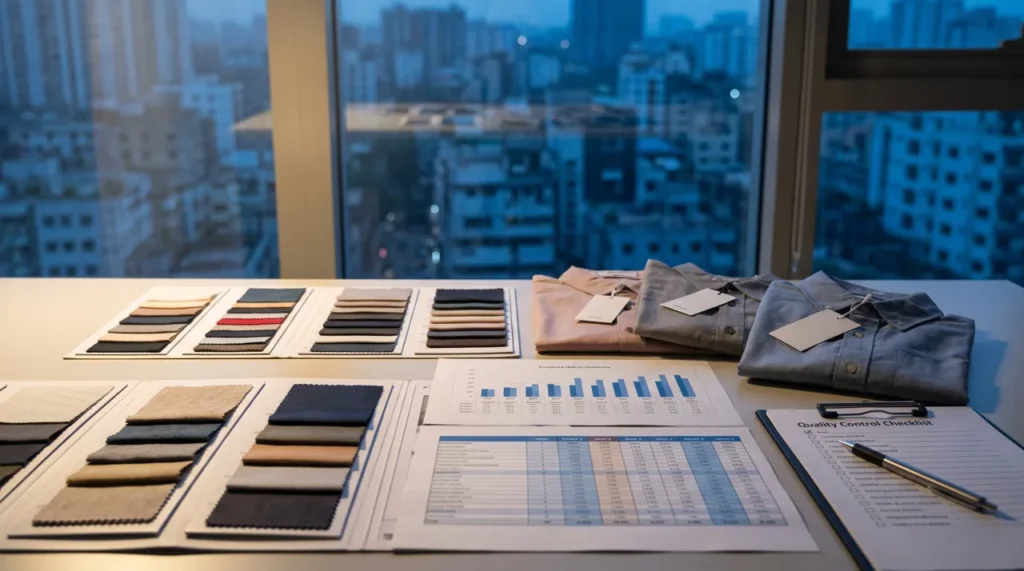
The best way to choose a clothing manufacturer is to compare suppliers using the same decision criteria. Do not judge one supplier by price, another by friendliness, and another by photos. Use one scorecard for all. This keeps your decision objective and helps you avoid emotional supplier selection.
For a clothing brand, the right manufacturer must fit the product, not just the budget. If you are building a premium brand, the lowest quote may create quality issues. If you are testing a startup collection, a factory that only wants large orders may not give proper attention to your sample. If you are producing private label clothing, repeatability and documentation become more important than one-time speed.
A strong manufacturer selection process answers these questions: Can they make this product? Can they make it at the needed quantity? Can they source the right fabric? Can they control quality? Can they communicate clearly? Can they handle approvals? Can they scale if the order grows? This is the practical buyer’s answer to how to find a clothing manufacturer and choose the right one.
The Manufacturer Selection Scorecard
A scorecard helps you compare suppliers without confusion. When buyers research how to find a clothing manufacturer, they often collect supplier names but do not create a scoring system. That creates subjective decisions. A scorecard turns vague impressions into measurable comparison.
Your scorecard should include technical, commercial, and operational criteria. Technical criteria include product category match, fabric capability, sample quality, construction accuracy, and QC system. Commercial criteria include MOQ, pricing transparency, payment terms, and lead time realism. Operational criteria include communication, accountability, documentation, and problem-solving.
Manufacturer Shortlist Scorecard
Use this scorecard to compare suppliers objectively before paying for samples. Score each supplier from 1 to 5 for every criterion, then use the weight column to prioritize the areas that matter most for production risk, quality control, and delivery reliability.
| Criteria | Weight | Buyer Score 1-5 | Evidence Required | Buyer Notes |
| Product category match | 10 | Similar product examples | ||
| MOQ reality | 8 | MOQ by fabric/color/trim | ||
| Sampling process | 10 | Sample timeline and approval flow | ||
| Fabric sourcing access | 8 | Fabric options and mill route | ||
| QC system | 10 | QC checklist and report sample | ||
| Communication discipline | 8 | Response quality and written follow-up | ||
| Compliance capability | 6 | Basic documents or audit status | ||
| Lead time realism | 8 | Critical path breakdown | ||
| Costing transparency | 8 | Quote assumptions and exclusions | ||
| Subcontracting transparency | 6 | Written disclosure rules | ||
| Corrective action process | 6 | CAPA or issue closure method | ||
| Shipment readiness control | 6 | Final inspection and packing process |
A supplier with a high score should show clear evidence, not only strong claims. If a supplier scores poorly on QC system, sampling process, communication discipline, or subcontracting transparency, keep them out of the sampling stage until the missing proof is provided.
Red Flags Before You Pay for Samples
The sample stage costs time and money, so eliminate weak suppliers early. A supplier who avoids evidence, gives unclear answers, or pressures for payment before scope is defined should not move forward. This is especially true when you are trying to work with custom clothing manufacturers for startups, where every sample round matters.
The first red flag is unrealistic pricing. A low cost clothing manufacturer may look attractive, but if the quote excludes testing, packing, trims, fabric wastage, or inspection, the final cost may become higher. The second red flag is unclear MOQ. If a supplier says “any quantity is possible” but cannot explain fabric and trim minimums, the answer is incomplete.
The third red flag is weak technical response. If the manufacturer does not ask about fabric GSM, composition, measurement tolerance, print method, packing, or target market, they may be guessing. A good supplier asks questions before quoting because accurate pricing depends on accurate assumptions.
Reject or pause suppliers that show these signs:
- No similar product proof
- No clear sample timeline
- No written RFQ response
- No quality control process
- No explanation of MOQ
- No fabric or trims sourcing clarity
- No accountability for subcontracting
- Pressure for payment before scope clarity
- Unrealistic lead time
- Price that is too low without explanation
What “Clothing Manufacturer” Means in Practice
When buyers search how to find a clothing manufacturer, they may assume every manufacturer owns a factory. In reality, the apparel industry works through different models. Some suppliers own factories. Some work as OEM manufacturers. Some offer private label manufacturing. Some operate through a managed factory network. What matters most is not the label. What matters is accountability, control, and execution.
A private label clothing manufacturer usually supports products sold under the buyer’s brand. An OEM clothing manufacturer produces according to the buyer’s design, tech pack, or product specification. Custom clothing manufacturers may support product development from reference samples, sketches, fabric ideas, and brand requirements. These models can overlap, so buyers should focus on process, not only terminology.
If you are comparing private label clothing manufacturers, custom clothing manufacturers, and an OEM clothing manufacturer, ask the same core questions. Who owns the timeline? Who manages sampling? Who checks quality? Who sources fabric? Who controls subcontracting? Who fixes problems? The answers matter more than the title on the website.
For buyers, this model provides one accountable workflow while production is matched to the most suitable factory within a vetted network.
Factory-Owned vs Factory-Network Partner
A factory-owned manufacturer controls its own facility. This can be useful when the product matches the factory’s specialization. But factory ownership alone does not guarantee good communication, accurate sampling, strong QC, or suitable MOQ. A large factory may still be the wrong partner for a small or complex startup order.
A factory-network partner manages production through selected factories based on product type, quantity, process, and capability. This model can be helpful when buyers need multiple categories or do not want to manage many suppliers directly. The key risk is control. The partner must prove that it manages approvals, production tracking, QC, and issue resolution.
The best choice depends on your business. If your product is simple and you already know exactly which factory type you need, direct factory sourcing may work. But if your collection includes different product types, uncertain fabrics, small starting quantities, or multiple development stages, a single manufacturing partner may reduce complexity.
Buying House vs Clothing Manufacturer: The Single Manufacturing Partner Model
A buying house is commonly known as a sourcing and coordination company. A clothing manufacturer is commonly understood as a production partner. But for buyers, the practical need is often simpler: one accountable partner who can manage production from RFQ to shipment. This is where the single manufacturing partner model makes sense.
RYZEAL SOURCING operates as a single manufacturing partner through a vetted factory network, matching each product with the most suitable production route while managing sampling, approvals, quality control, production monitoring, and shipment readiness. For buyers researching how to find a clothing manufacturer, this model can be useful because it reduces the need to manage multiple entities.
The risk in any factory-network model is weak control. So the buyer should ask: does the partner have a documented workflow? Do they manage QC? Do they provide updates? Do they have escalation rules? Do they control sample comments, PP meetings, and shipment release? If yes, the model can be practical and efficient.
The benefit is one accountable workflow. Instead of coordinating fabric suppliers, sample rooms, factories, printing units, embroidery units, QC teams, and logistics separately, the buyer works through one managed system.
Buyer → RYZEAL SOURCING → Vetted Factory Network → QC and Shipment Control
This model gives the buyer one accountable workflow while production may be handled through the most suitable factory route. The key is not factory ownership alone, but control over sampling, approvals, quality checks, communication, and shipment readiness.
The Shortlist-to-Shipment Framework
The strongest way to understand how to find a clothing manufacturer is to see the full journey. A supplier is not truly selected when they reply to your message. They are selected when they pass each gate from search to shipment. A gate-based workflow protects buyers from rushing into samples, approving weak quotes, or starting production without controls.
The shortlist-to-shipment framework includes nine gates: search, shortlist, vetting, RFQ, sampling, quote comparison, PP meeting, bulk production control, and shipment release. Each gate must produce evidence. If a gate does not produce evidence, the buyer is moving forward based on trust alone.
This guide explains the complete journey at a high level. For detailed guidance on vetting, RFQs, sampling, pre-production meetings, and approval workflows, use the related guides linked throughout the article.
Search → Shortlist → Vet → RFQ → Sample → Quote → PP Meeting → Bulk → QC → Shipment
Each gate should produce clear evidence before the buyer moves forward. Search creates options, shortlist removes poor-fit suppliers, vetting confirms proof, RFQ standardizes inputs, sampling tests execution, and QC protects shipment readiness.
Gate 1 to 3: Search, Shortlist, Vet
Gate 1 is search. This is where you identify possible manufacturers through online search, directories, referrals, trade shows, LinkedIn, sourcing partners, or a manufacturing partner. At this stage, the goal is not to select. The goal is to collect possible options.
Gate 2 is shortlist. Now you remove suppliers that do not fit your product, MOQ, quality level, or response expectations. If you are making premium hoodies, do not shortlist factories that only show basic T-shirts. If you are making denim, do not shortlist a supplier without denim washing experience.
Gate 3 is vetting. This is where manufacturer vetting and due diligence turns the search process into an evidence-based decision.
Gate 4 to 6: RFQ, Sampling, Quote Comparison
Gate 4 is RFQ. A structured RFQ clothing manufacturer onboarding system helps suppliers quote the same product under the same assumptions. Without a structured RFQ, one supplier may include packaging, another may exclude it, one may assume stock fabric, and another may assume custom dyeing. Then the prices cannot be compared fairly.
Gate 5 is sampling. A sample should test the manufacturer’s ability to follow instructions, control measurements, manage fabric and trims, and respond to feedback. It is not only about whether the sample looks nice in photos.
Gate 6 is quote comparison. Buyers often compare the final number only. That is a mistake. Compare inclusions, exclusions, MOQ, fabric assumptions, trims, testing, packaging, lead time, and inspection responsibilities. This is one of the most important steps in how to find a clothing manufacturer that will not surprise you later.
Gate 7 to 9: PP Meeting, QC, Shipment Release
Gate 7 is the PP meeting. Before bulk starts, the buyer and manufacturer must lock the approved sample, fabric, trims, measurements, artwork placement, packing, testing, production plan, and QC checkpoints. If the PP meeting is weak, bulk starts with assumptions.
Gate 8 is quality control. This includes incoming material checks, cutting checks, in-line QC, end-line QC, final inspection, and packing audit. Strong quality control in clothing manufacturing prevents defects from becoming shipment problems.
Gate 9 is shipment release. Goods should be released only after final inspection, packing verification, document check, and approval of any corrective actions. The goal is not only to ship. The goal is to ship approved goods that match the buyer’s standard.
Manufacturer Vetting and Due Diligence Before Sampling
Vetting is the point where how to find a clothing manufacturer becomes a risk-control process. You are not just checking whether the supplier exists. You are checking whether they can repeatedly produce your product with stable quality, realistic lead time, and transparent communication.

A manufacturer may make a good first sample but still fail in bulk if the system is weak. The OECD garment and footwear due-diligence guidance provides an internationally recognized framework for identifying, preventing, mitigating, and addressing risks connected to suppliers and apparel supply chains. That is why due diligence must happen before serious spending. Ask for proof of capacity, quality system, communication structure, compliance basics, and subcontracting control.
For startups, vetting protects budget. For growing brands, it protects launch dates. For private label buyers, it protects repeatability. For buyers producing in Bangladesh, vetting also helps identify which suppliers can support the correct product category, quantity level, and quality standard.
The purpose is not to make the supplier uncomfortable. A professional supplier should understand why buyers request information. If a manufacturer cannot answer basic vetting questions, that is already a signal.
Capacity and Category Fit
Capacity does not only mean factory size. It means whether the supplier has the right production line, machines, operators, fabric access, and process discipline for your product. A factory may be large but still unsuitable for your category.
If you are producing knitwear, ask about knit line setup, sewing machines, rib handling, shrinkage control, and finishing. If you are producing woven garments, ask about pattern accuracy, seam control, pressing, and tolerance discipline. If you are producing denim, ask about wash control, shade banding, shrinkage, and finishing.
For a clothing brand, manufacturing capacity also depends on order quantity and product complexity. A small order with many colors may be harder than a larger order with one fabric and one color. This is why MOQ must be discussed honestly.
Ask these questions:
- What product categories do you produce regularly?
- What similar styles have you produced recently?
- What is your minimum by style, color, and fabric?
- What processes are done in-house and outsourced?
- What is the sample and bulk lead time?
- What happens during peak season?
Quality System Proof
A good manufacturer must show quality control as a system, not just a promise. If you are learning how to find a clothing manufacturer, this is one of the most important checks. Quality is not created at final inspection. It is controlled throughout production.
Ask for incoming material checks, in-line QC process, final inspection method, measurement records, and corrective action process. If the supplier says “we check everything” but cannot show any report format, checklist, or control point, the system may be weak.
For quality control in garment production, the buyer should know how defects are classified, how measurement tolerances are handled, and how issues are corrected. A manufacturer should also explain what happens if defects appear during bulk.
Minimum QC proof to request:
Fabric and trim inspection method
Measurement sheet format
In-line QC checklist
Final inspection report format
AQL or acceptance criteria
Defect classification
Corrective action workflow
Packing audit checklist
Where AQL is used for final inspection, the buyer and manufacturer should agree on the lot definition, inspection level, sample size, defect classifications, and acceptance numbers before production. ISO 2859-1 provides the international framework for acceptance sampling by attributes, but it should support, not replace, in-line quality control.
Communication and Accountability
Communication is not a soft issue. It is a production-control issue. Many delays happen because instructions were unclear, files were not updated, sample comments were not confirmed, or decisions were made verbally.
A reliable supplier should have one accountable contact for the buyer. They should confirm changes in writing, maintain file versions, and provide updates during sampling and bulk. If you are working with a factory-network partner, there should also be a clear internal owner who manages factory communication.
When studying how to find a clothing manufacturer, pay attention to how the supplier communicates before money is involved. Slow, vague, or careless communication during early discussion often becomes worse later.
Good communication signs:
Clear response within a reasonable time
Questions that show technical understanding
Written confirmation after discussion
Organized file sharing
One point of contact
Escalation process
Regular update rhythm
Compliance and Subcontracting Transparency
Compliance is not only about certificates. It is also about whether production happens in a controlled environment. A supplier may show attractive products, but if subcontracting is hidden, quality and traceability can become unstable.
Use a structured clothing manufacturer vetting checklist to ask for basic factory identity, business documents, audit status if available, health and safety basics, and subcontracting policy. If printing, embroidery, washing, or special processes are outsourced, that is not automatically bad. The problem is uncontrolled outsourcing without buyer approval. When a supplier provides an accredited management-system certificate, buyers should verify the organization name, site address, certification scope, issuing body, and current status through IAF CertSearch instead of relying only on a PDF copy. For Bangladesh production, the Better Work Bangladesh programme is a useful reference for workplace standards, factory participation, management improvement, and labour-related risk assessment.
For private label clothing manufacturers, traceability matters because your brand name is on the product. If there is a quality, safety, or compliance issue, the buyer faces the market risk. So subcontracting transparency should be discussed before sampling or bulk.
Sampling System: What to Request, Approve, and Lock
Sampling is one of the most misunderstood parts of how to find a clothing manufacturer. A sample is not just a preview. It is a proof tool. It shows whether the manufacturer can understand instructions, follow measurements, control workmanship, source materials, and respond to feedback.
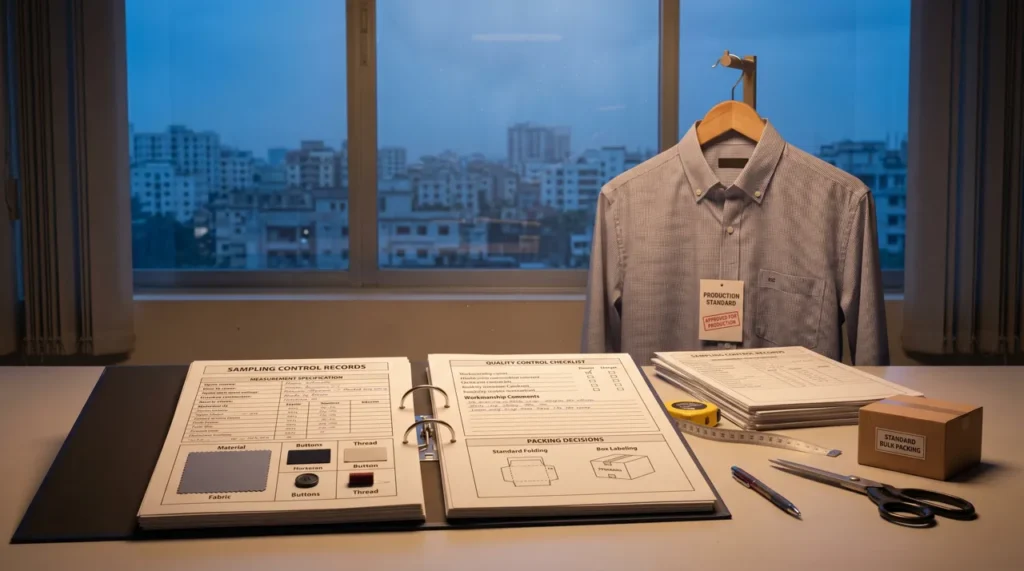
Many buyers waste time because they request samples without a clear approval system. They send references, receive a sample, give vague comments, and repeat the process. This creates delays and frustration. A better sampling system defines what each sample stage should prove.
For clothing samples manufacturers, the important question is not only whether they can make a sample. It is whether they can make a sample that leads to stable bulk production. A beautiful sample is not enough if the process behind it is not repeatable.
Sampling should always connect to bulk. Every comment, measurement change, fabric approval, artwork placement, trim approval, and packing decision should be documented. The final approved sample should become the production standard.
Sample Types Buyers Should Understand
A proto sample is usually the first development sample. It helps test construction, shape, and basic design interpretation. It may not use the final fabric, especially if the fabric must be developed or dyed.
A fit sample focuses on measurement, balance, silhouette, and comfort. This is where buyers should give detailed comments by measurement point, not only visual feedback.
A size set sample checks grading across sizes. This is especially important when the buyer wants multiple sizes and fit consistency.
A PP sample, or pre-production sample, should represent the approved bulk standard. It should use confirmed fabric, trims, construction, artwork, labels, and packaging where possible.
A GPT or pilot sample may be used to test production readiness, especially for complex styles. This checks whether the factory can reproduce the approved standard on the production line.
What to Ask Before Ordering Samples
Before ordering samples, use a clear what to ask before sampling checklist so you know what the sample will prove. Will it use available fabric or final fabric? Will it include actual trims? Will print or embroidery be real or only placeholder? How many days will it take? Is the sample fee refundable or adjustable against bulk?
Some buyers search for free sample clothing manufacturers, but free samples are not always realistic, especially for custom development. If fabric must be knitted, dyed, printed, washed, or trimmed specially, sample development costs money. For small quantities, factories may not refund sample fees because development cost is high.
For a low MOQ clothing manufacturer, sample cost may also be higher because the order does not spread development cost across a large quantity. Buyers should understand this before negotiation.
Ask these questions before sampling:
What fabric will be used?
Is the color available or custom dyed?
What trims will be included?
What is the sample timeline?
How many revision rounds are included?
What is the sample fee?
Is shipping included or separate?
What documents are required from the buyer?
What approval is needed before bulk?
Sample Approval Checklist
A sample approval must be technical. Do not approve a sample only because it looks good. Check measurements, fit, construction, workmanship, fabric behavior, trims, artwork placement, color, wash result, and packaging.
If the sample is approved with unclear comments, bulk production may follow the wrong standard. Every approval should be written and connected to evidence. Photos, measurement sheets, and marked comments reduce confusion.
Use the checklist below to confirm whether a sample is ready to become the bulk production standard. Each area should be checked with evidence, not only visual approval.
| Area | What to Check | Pass Criteria | Evidence |
|---|---|---|---|
| Measurements | POM vs spec | Within tolerance | Measurement sheet |
| Fit | Shape, balance, comfort | Matches fit intent | Fit photos and comments |
| Construction | Stitch, seam, structure | Matches tech pack | Close-up photos |
| Fabric | GSM, handfeel, shrinkage | Matches approved standard | Fabric record/test |
| Artwork | Print/embroidery placement | Matches artwork spec | Placement photo |
| Trims | Labels, buttons, zippers, elastics | Matches BOM | Trim approval |
| Workmanship | Loose threads, puckering, stains | No major defect | QC photos |
| Packaging | Folding, poly, label, carton | Matches packing spec | Packing sample photo |
If any area fails, the sample should be revised before bulk approval. A sample approval is only useful when the buyer and manufacturer both understand what has been accepted, what needs correction, and which evidence will be used as the reference during production.
Approval Workflow Map
A proper approval workflow map protects both buyer and manufacturer. Lab dips approve color. Strike-offs approve print or embroidery. Size sets approve grading. PP samples approve the final production standard. GPT or pilot output confirms production readiness.
If these approvals are skipped, bulk production starts with open questions. That is where disputes happen. The buyer may expect one shade, the factory may follow another. The buyer may expect one print placement, but production may follow the first sample. Documentation avoids this.
For buyers researching how to find a clothing manufacturer, approval discipline is a key selection factor. A supplier that cannot explain lab dips, strike-offs, PP samples, and production release gates may not be ready for controlled bulk.
Pricing and Quote Accuracy: How to Compare Manufacturers Fairly
Price comparison is one of the most dangerous parts of how to find a clothing manufacturer because buyers often compare incomplete quotes. A quote is not only a number. It is a set of assumptions. If those assumptions are different, the prices are not comparable.
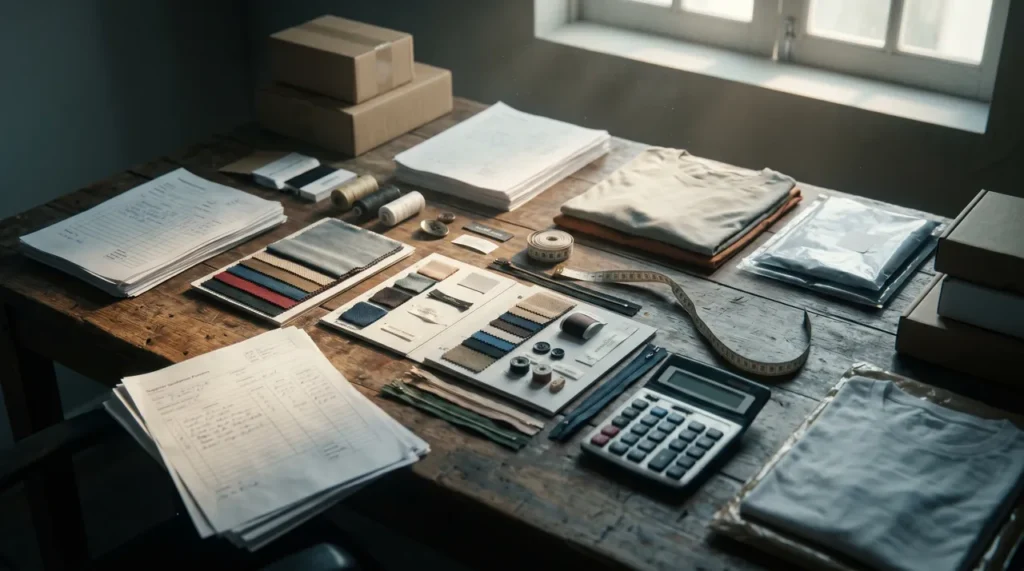
A quote should clearly state fabric, GSM, composition, trims, construction, print/embroidery, wash, packaging, testing, MOQ, lead time, and incoterm. If a supplier gives only one unit price with no assumptions, the quote is weak. It may become expensive later.
For private label clothing manufacturers, quote accuracy is important because repeat orders depend on stable assumptions. For startups, it is important because budget is limited and every unexpected cost hurts. For DTC brands, it is important because delays can affect launch calendars and marketing plans.
When you ask how to find a clothing manufacturer, remember that the right supplier is not always the cheapest. The right supplier is the one who gives a clear, realistic, and controllable quote.
Why Low-Cost Quotes Can Be Risky
A low cost clothing manufacturer may look attractive, but low price can hide missing scope. Maybe testing is not included. Maybe packing is basic. Maybe fabric quality is lower. Maybe the lead time is unrealistic. Maybe inspection is weak. Maybe the supplier is assuming a fabric that is not actually available.
Low quotes often break during sampling or bulk. After the sample is approved, the supplier may say the fabric cost changed, trims cost extra, printing is more expensive, or the packing spec was not included. This creates frustration and delays.
The buyer’s job is not to reject every low quote. The job is to verify why it is low. If the supplier has efficient fabric sourcing, stable production, and a clear cost structure, a competitive price can be valid. But if the low quote is vague, it is a risk.
Common hidden risks:
Testing excluded
Packing excluded
Fabric substitution
Wrong GSM assumption
Unrealistic lead time
No inspection cost
No wastage allowance
No trim MOQ explanation
No rework responsibility
Low MOQ Reality for Startups
A low MOQ clothing manufacturer can help startups test the market, but low MOQ has real constraints. MOQ is not only about sewing. It is about fabric, trims, dyeing, printing, embroidery, washing, labels, and production setup.
If a buyer wants many colors at small quantities, cost increases. If the fabric must be custom developed, MOQ increases. If labels, zippers, or special trims need custom production, MOQ increases. If the style needs washing or complex finishing, cost and lead time increase.
For custom clothing manufacturers for startups, the best strategy is often to reduce complexity. Use fewer colors, available fabrics, standard trims, and clear size ratios. Start with a focused collection, then scale after market testing.
This is a more practical answer to how to find a clothing manufacturer for a startup: do not only search for “low MOQ.” Search for a supplier who can explain what drives MOQ and help you design a realistic first production route.
Quote Comparison Checklist
To compare quotes fairly, make every supplier quote the same product. Use the same tech pack, same fabric spec, same color requirement, same trims, same quantity, same packing, same testing, same delivery window, and same incoterm.
A quote comparison checklist helps you avoid the “cheapest quote wins” mistake. It also helps you ask better follow-up questions. If one supplier includes testing and another does not, the price difference may not be real. If one supplier quotes FOB and another quotes CMT, the scope is different. For international transactions, buyers should specify the exact Incoterm and named place or port rather than writing only “FOB” or “CIF.” The ICC Incoterms 2020 rules explain how tasks, costs, and risks are divided between buyers and sellers.
Quote Comparison Checklist table
Use this quote comparison checklist before accepting a price. A quote should only be compared when the same product, same scope, same quality expectation, and same delivery terms are being reviewed.
| Quote Item | What Must Be Confirmed | Risk If Missing |
|---|---|---|
| Fabric | GSM, composition, width, source | Wrong cost or quality |
| Trims | Labels, tags, buttons, zippers, elastic | Delays and extra charges |
| Print/Embroidery | Method, size, placement | Artwork mismatch |
| Washing/Finishing | Process and standard | Shade/handfeel variation |
| Testing | Required tests and owner | Shipment hold or claims |
| Packaging | Polybag, carton, barcode, labels | Chargebacks or repacking |
| MOQ | By style, color, fabric, trim | False low MOQ |
| Lead Time | Sample and bulk lead time | Late delivery |
| Incoterm | FOB, CMT, EXW, CIF, etc. | Cost responsibility confusion |
| Exclusions | What is not included | Surprise cost |
If any item is unclear, ask the supplier to revise the quote before moving forward. A cheaper price is not useful if the quote excludes testing, packaging, inspection, trims, or realistic lead-time planning.
RFQ and Onboarding Pack: What to Send Before Production Starts
A structured RFQ is one of the most important tools in how to find a clothing manufacturer. Without an RFQ, suppliers guess. With an RFQ, suppliers can quote the same product under the same assumptions. This improves price accuracy, sample clarity, and timeline planning.
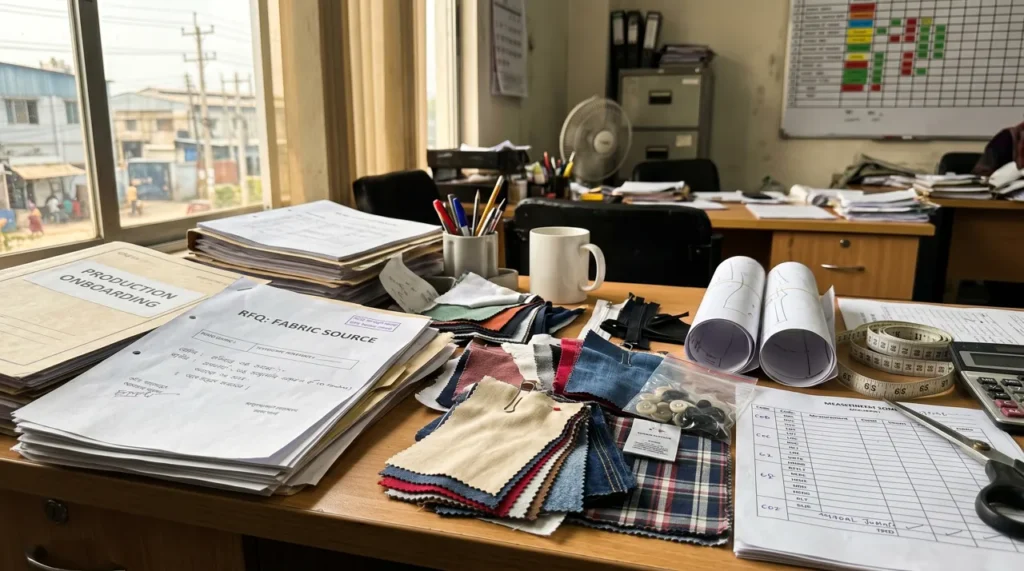
An RFQ is not just a price request. It is the first test of supplier discipline. A good supplier will review the RFQ, ask technical questions, identify missing details, and provide structured feedback. A weak supplier may give a fast number without understanding the style.
For an OEM clothing manufacturer, the RFQ should include technical details because the supplier is producing to your specification. For private label clothing manufacturers, the RFQ should still include branding, packaging, quantity, and quality expectations. For custom product development, reference samples and photos can support the RFQ, but they should not replace specs.
Onboarding starts after the supplier is shortlisted and the RFQ is aligned. This includes file control, timeline agreement, approval owners, sample route, quote confirmation, payment terms, and production tracking method.
RFQ Template Fields
A strong RFQ to a clothing manufacturer should include enough information to make quotes comparable. If you only ask, “What is the price for a hoodie?” you will not get useful quotes. The manufacturer needs product type, fabric, GSM, construction, trims, color, print, quantity, size range, packing, testing, delivery, and incoterm.
When buyers ask how to find a clothing manufacturer, they often underestimate how much the buyer’s own preparation affects supplier performance. A clear RFQ helps good suppliers respond properly and helps weak suppliers reveal their limitations.
RFQ fields to include:
Product category
Style description
Reference photos
Tech pack
Measurement chart
Fabric composition
GSM
Fabric construction
Color references or Pantone
Print or embroidery artwork
Artwork placement
Trims and labels
Size range and ratio
Quantity by style/color/size
Packaging requirement
Testing requirement
Target delivery window
Target MOQ
Incoterm
Sample requirement
Quote deadline
Tech Pack Minimum Standard for Startups
Even if you are a startup, you need a minimum spec package. It does not have to be perfect, but it must communicate the important details. A manufacturer cannot accurately quote or sample a style from moodboard images alone.
At minimum, include product photos or sketches, measurement points, target fit, fabric idea, color reference, trims, artwork placement, size range, and packaging requirement. If you do not have a full tech pack, create a starter version and improve it during sampling.
For custom clothing manufacturer development, physical samples or detailed reference photos can be very helpful. But the buyer must clearly explain what should match and what can be changed.
Minimum tech pack content:
Front and back view
Measurement points
Tolerance
Fabric spec
BOM
Artwork placement
Trims
Labels and branding
Packing requirement
Reference sample notes
Supplier Onboarding Before Bulk
A structured RFQ clothing manufacturer onboarding system turns a selected supplier into an execution partner. This stage aligns communication, documents, sample approvals, production timeline, QC plan, and reporting method. Without onboarding, even a good manufacturer can face confusion.
For buyers learning how to find a clothing manufacturer, onboarding may seem like a later step, but it should be planned early. Ask the supplier how they manage approvals, how they track production, who updates the buyer, and what happens if a delay or quality issue appears.
A basic onboarding pack should include:
Final RFQ
Confirmed quotation
Tech pack
BOM
Approved sample references
Color approvals
Artwork approvals
Packing instructions
Production timeline
QC checklist
Inspection requirement
Payment terms
Communication owner
Escalation rules
Production Control: PP Meeting, In-Line Checks, Final Inspection, and Shipment Release
Finding the right supplier is not complete until you know how production will be controlled. Many buyers understand how to find a clothing manufacturer, but they lose control after sample approval. That is when bulk risk begins.
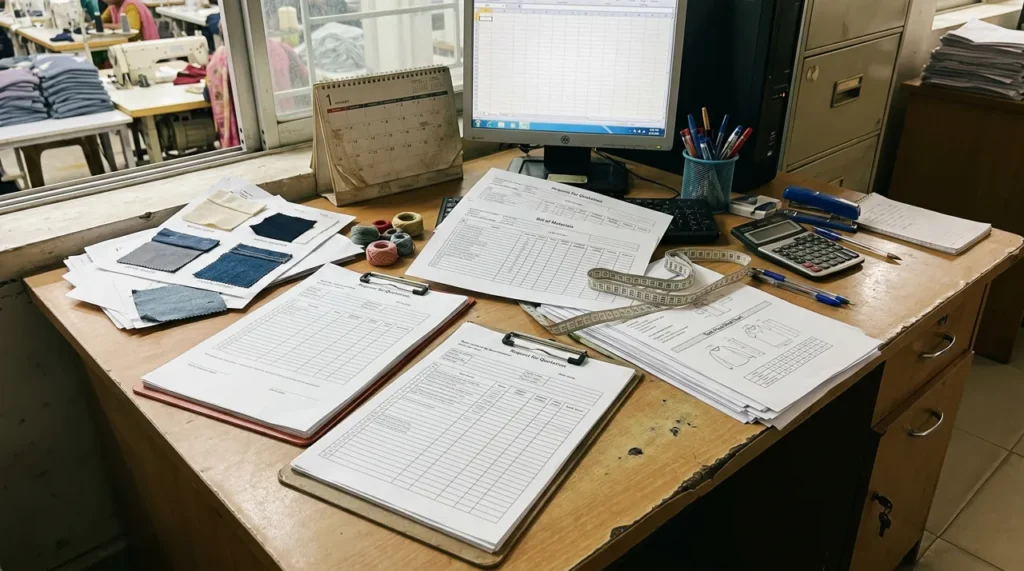
Production control means every major decision is locked before cutting and sewing. The approved sample, fabric, trims, measurements, artwork, packaging, testing, and inspection plan should be confirmed. The factory should know exactly what standard to follow.
A manufacturer who cannot explain production control may still make a sample, but bulk can become inconsistent. This is why buyers should ask about PP meetings, in-line checks, final inspection, packing audit, and corrective action before placing bulk orders.
Good quality control in clothing manufacturing is not about blaming the factory at the end. It is about building checkpoints that prevent small issues from becoming large failures.
Pre-Production Meeting Checklist
The PP meeting is the final control room before bulk starts. It confirms that buyer, manufacturer, factory team, QC team, and production team understand the same standard.
A pre-production meeting checklist should cover approved sample, fabric, trims, measurements, artwork, packing, testing, line plan, QC checkpoints, shipment schedule, and responsibilities. If the meeting is informal, assumptions remain open.
The PP meeting should produce written outputs. Who approved fabric? Which sample is the final standard? Which measurement tolerance applies? Which artwork file is final? Which packing method is approved? What is the inspection method? These must be clear before bulk.
Quality Control Gates
Quality control gates protect the order during production. Incoming material checks confirm fabric and trims. Cutting checks confirm pattern, shade, and size ratio. In-line QC catches defects early. End-line checks review completed pieces. Final inspection confirms shipment readiness. Packing audit confirms assortment, labeling, and carton accuracy.
If you are researching how to find a clothing manufacturer, ask about these gates before bulk. A manufacturer’s QC system should be visible, not only promised.
Important gates:
Fabric and trims inspection
Cutting approval
First output approval
In-line QC
Measurement checks
End-line review
Final inspection
Packing audit
Shipment release
Corrective Action and Shipment Decision
Problems can happen in any production. The difference is how the manufacturer handles them. Corrective action should include containment, root cause analysis, correction, reinspection, and documented closure.
If a measurement issue appears, affected pieces should be identified. If a seam problem appears, the cause should be checked. If a packing mistake appears, cartons should be reviewed. The goal is to prevent the same issue from spreading.
Shipment should only be released when inspection results, packing records, and corrective actions are acceptable. A shipment is not ready because production is finished. It is ready when the order matches the approved standard.
How RYZEAL SOURCING Helps Buyers Find the Right Production Route
RYZEAL SOURCING helps buyers who are trying to understand how to find a clothing manufacturer and want a practical production route in Bangladesh. Instead of forcing buyers to manage many factories, we support them through one accountable workflow: product review, RFQ clarification, sampling coordination, factory matching, production monitoring, quality control, and shipment support.
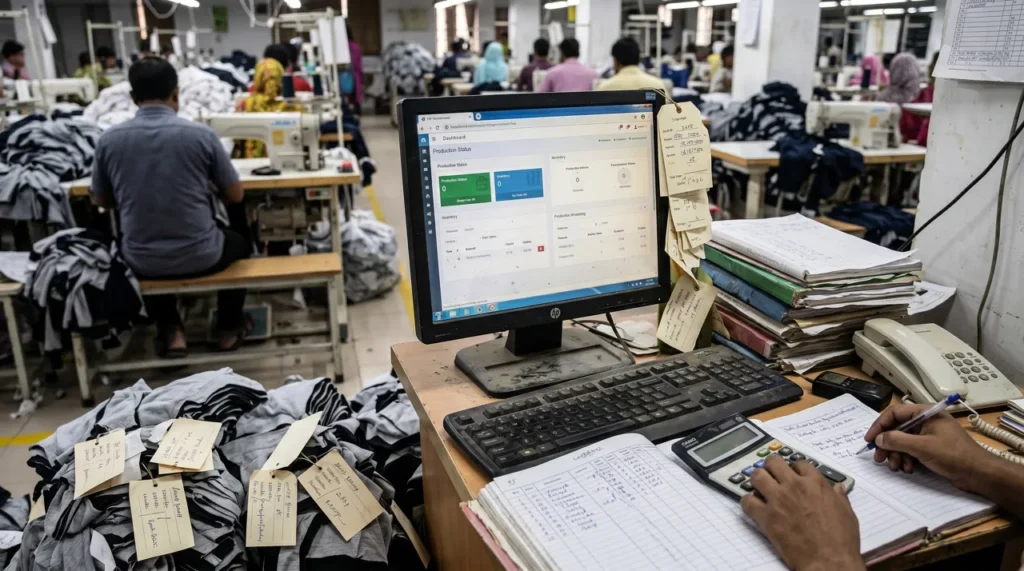
Our role is especially useful for startups, small brands, DTC companies, and private label buyers who may not know which factory type fits their product. A buyer may have a strong design idea but not know whether the product should go to a knit factory, woven factory, denim unit, sweater facility, activewear specialist, or outerwear manufacturer. We help identify the right route.
RYZEAL SOURCING operates as a single manufacturing partner through a vetted factory network, matching each product with the most suitable production route while managing sampling, approvals, quality control, production monitoring, and shipment readiness.
If you are asking how to find a clothing manufacturer because you are preparing your first collection, replacing an unreliable supplier, or planning production in Bangladesh, an appointment can help you avoid common mistakes before you spend on samples.
What to Prepare Before Booking an Appointment
Before booking an appointment, prepare the information that affects quote accuracy and production feasibility. You do not need a perfect tech pack, but you should share enough details for a realistic review.
Prepare:
Tech pack if available
Reference garment photos
Design sketches
Target MOQ
Target delivery window
Fabric preference
GSM or composition idea
Color requirements
Print or embroidery details
Target market
Compliance needs
Packaging requirement
Budget expectation if available
What You Get From the Appointment
The appointment is designed to turn your idea or RFQ into a clearer production route. We review your product requirements, identify missing information, explain MOQ and sampling reality, and suggest the right next step.
You may receive:
Shortlist review
RFQ improvement suggestions
Sampling route
MOQ reality check
Quote comparison guidance
Risk map
Production control recommendations
Next action plan
Bring your RFQ, product reference, or tech pack. We will help you understand the best production route before you move forward.
Related Guides
If you are still learning how to find a clothing manufacturer, this hub gives the full system. For deeper execution, read the related guides below. Each guide expands one part of the manufacturer selection journey, from vetting and sampling to RFQ, PP meeting, and approval workflow.
Supplier Vetting and Sampling
- Manufacturer Vetting and Due Diligence: How to Evaluate a Clothing Manufacturer
- Clothing Manufacturer Vetting Checklist: Capacity, Quality Systems, Communication, Red Flags
- What to Ask a Clothing Manufacturer Before Sampling: MOQ, Lead Time, Testing, Compliance
- Buying House vs Clothing Manufacturer: The Single Manufacturing Partner Model Explained
RFQ, Production Start, and Approval Control
- RFQ Clothing Manufacturer Onboarding System: How to Start Production With a Clothing Manufacturer
- How to Write an RFQ to a Clothing Manufacturer That Gets Accurate Quotes
- Pre-Production Meeting Guide: What Must Be Locked Before Bulk Starts
- Approval Workflow Map: Lab Dips, Strike Offs, Size Set, PP Sample, GPT, Shipment
FAQ: How to Find a Clothing Manufacturer
-
How do I find a clothing manufacturer in Bangladesh for a small brand?
The best way to find a clothing manufacturer in Bangladesh is to start with your product category, target MOQ, fabric requirement, and quality level. Then shortlist suppliers that already produce similar products and verify their sampling process, QC system, and communication discipline before paying for samples.
-
Where can I find clothing manufacturers that accept low MOQs?
You can find clothing manufacturers through Google, LinkedIn, directories, referrals, trade shows, and sourcing partners. But for low MOQ, you must confirm what the MOQ means by style, color, fabric, trims, and printing method, because sewing quantity is not the only minimum.
-
How do I choose a clothing manufacturer after shortlisting suppliers?
Choose based on evidence, not promises. Check product category match, MOQ reality, sample quality, quote transparency, lead time, QC process, communication, compliance basics, and subcontracting control.
-
What is the difference between a garment manufacturer and a clothing manufacturer?
The terms are often used similarly. A garment manufacturer or clothing manufacturer produces apparel products, but the exact capability depends on product category, fabric type, construction, quality system, and production setup.
-
What should I ask a clothing manufacturer before ordering samples?
Ask about sample fee, fabric availability, MOQ, lead time, trims, testing, revision policy, sample shipping cost, and what the sample will prove. You should also ask whether the sample will use available fabric or final bulk fabric.
-
Do custom clothing manufacturers for startups charge sample fees?
Yes, many custom clothing manufacturers charge sample fees, especially when the product requires pattern work, fabric sourcing, custom trims, printing, embroidery, or washing. Sample fees may or may not be adjustable against bulk depending on quantity and development cost.
-
What is the difference between private label clothing manufacturers and OEM clothing manufacturers?
Private label clothing manufacturers usually produce products under the buyer’s brand, sometimes with existing development routes. OEM clothing manufacturers produce according to the buyer’s specific design, tech pack, and requirements. In both cases, clear specs and approvals are essential.
-
How do I compare quotes from multiple clothing manufacturers?
Compare quotes only after normalizing assumptions. Check fabric, trims, packaging, testing, MOQ, lead time, incoterm, inspection scope, exclusions, and payment terms. Do not compare only the final unit price.
-
What are the biggest red flags when finding a clothing manufacturer?
Major red flags include vague quotes, unrealistic lead times, unclear MOQ, no similar product proof, no QC process, weak communication, refusal to explain subcontracting, and pressure for payment before scope is clear.
-
What quality control steps should a clothing manufacturer follow?
A reliable clothing manufacturer should follow incoming material checks, cutting checks, in-line QC, measurement checks, final inspection, packing audit, and corrective action. Quality control should be documented, not only verbally promised.
-
How long does it take to move from first contact to bulk production?
The timeline depends on product complexity, fabric availability, sample rounds, lab dips, trims, testing, and factory capacity. Delays usually happen when the RFQ is unclear, sample comments are vague, or approvals are not locked before bulk.
-
Can RYZEAL SOURCING help me review my RFQ and shortlist?
Yes. RYZEAL SOURCING can review your RFQ, product references, MOQ expectations, and shortlist to suggest a practical production route. This helps you understand how to find a clothing manufacturer in Bangladesh with clearer sampling, costing, and production-control steps.
Connect with RYZEAL SOURCING
 English
  Chinese
  French
  Dutch
Dutch  Japanese