

Garment finishing processes include the textile treatments, garment operations, and related quality controls that establish a clothing product’s final appearance, handfeel, dimensions, and performance. In apparel manufacturing, these processes may involve fabric finishing, garment washing, pressing, decoration, and other treatments applied before the product is ready for delivery.
For clothing brands, successful finishing also requires a reliable approval system. The intended color must be reproduced consistently, finishing treatments must deliver the approved characteristics, and garment trims and accessories must remain functional throughout the product’s expected use.
A garment can use the correct fabric composition, GSM, and construction but still fail to meet buyer expectations. Shade differences between panels, excessive shrinkage after washing, cracked prints, unreliable zippers, and elastics that lose recovery can all affect the finished product.
Preventing these problems requires more than approving an attractive sample. Buyers must establish technical requirements, approved physical references, relevant test methods, acceptable variation, and procedures for reviewing changes before bulk manufacturing proceeds.
This guide explains how to manage the color approval process, select appropriate fabric finishing types, approve garment washing and decoration, and specify durable garment trims and accessories. It also provides practical approval tables, inspection checklists, and documentation requirements for apparel brands, merchandisers, product developers, and quality teams.
Material selection provides the foundation for these decisions. Understanding fabric selection for clothing manufacturing helps buyers establish the composition, construction, GSM, and performance requirements that finishing operations must preserve or improve.
Table of Contents
The Three Essential Controls: Color, Finishing, and Trims
Reliable garment finishing processes depend on coordinating three connected areas:
color consistency, finishing performance, and component quality.
These controls influence different aspects of the garment, but their outcomes often interact.
For example, a fabric may match the approved color before washing but appear lighter afterward. A softening treatment may improve handfeel while affecting surface appearance. A zipper may function correctly before processing but become difficult to operate if its tape shrinks differently from the garment.

The Three-Control System
| Control Area | What Buyers Must Approve | Main Risk |
|---|---|---|
| Color | Shade reference, lab dip, bulk shade variation | Mismatch, fading, color transfer |
| Finishing | Process or required outcome, handfeel, stability | Shrinkage, distortion, surface change |
| Trims | Component specifications, function, appearance | Breakage, poor recovery, discomfort |
Color Control: Establishes the intended color and acceptable visual variation, including how material is assessed before and after applicable finishing operations.
Finishing Control: Establishes which treatments or finished properties are required, which changes are permitted, and how dimensional and appearance requirements will be verified.
Trim Control: Establishes the specifications and approval conditions for zippers, elastics, labels, sewing threads, and other components that influence garment function or presentation.
Why Appearance Problems Begin Before Final Inspection
Many appearance defects originate during material development or manufacturing preparation, even if they become visible only after the garment is finished.
When the specification says only “soft finish,” suppliers may use different softening treatments that produce different results. Similarly, an instruction such as “black fabric” does not adequately define the approved shade, viewing conditions, or acceptable production variation.
The same issue affects trims. Describing a component as a quality trim does not establish its dimensions, material, functional requirements, or approved source.
Who Controls Each Requirement?
Brand or Buyer: Establishes the intended appearance, functional expectations, relevant acceptance criteria, and approval authority.
Fabric Mill or Processor: Confirms material capabilities and controls the applicable dyeing, textile finishing, and production conditions.
Garment Manufacturer: Coordinates garment construction, decoration, washing, pressing, trim attachment, inspection, and other relevant operations.
Merchandising and Quality Teams: Connect specifications, supplier confirmations, samples, inspection results, and approval records throughout production.
Responsibilities may differ between manufacturing arrangements, but they should be established before the relevant work begins.
Warning Signs of Missing Approval Controls
- Bulk fabric shows visible shade differences from the approved reference.
- Garment panels differ in color after cutting or sewing.
- Handfeel changes significantly between development and bulk.
- Finished garment measurements differ after washing.
- Printing cracks, peels, or transfers color.
- Embroidery puckers or creates discomfort.
- Zippers jam, elastics lose recovery, or labels become unreadable.
- Suppliers change materials or processing without documented review.
These issues indicate where additional specification, testing, or approval controls may be necessary.
A practical rule is to require an identifiable approval whenever a material or process change could significantly affect the garment’s appearance, dimensions, durability, or intended function.
Color Approval Process: From Color References to Lab Dips and Bulk Shade
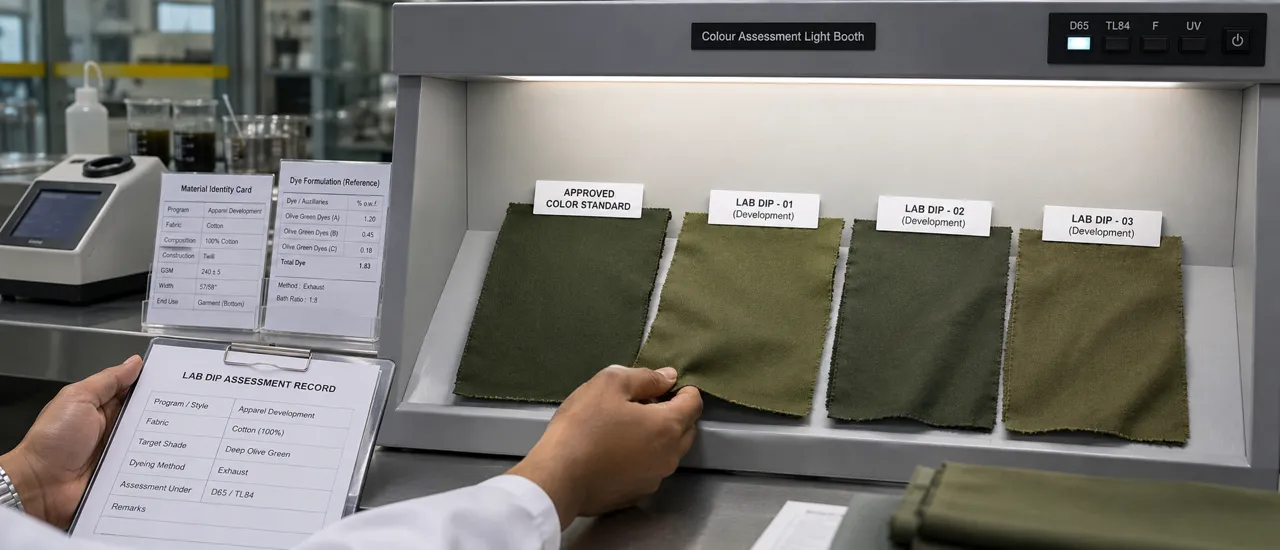
A reliable color approval process establishes how the desired color is communicated, reproduced, evaluated, and maintained through bulk production.
The process usually begins with a color standard, progresses through laboratory shade development, and continues with appropriate checks on production materials.
Color approval must also consider the final garment condition. Dyeing, fabric finishing, printing, and garment washing may change how a particular shade appears.
Step 1: Establish the Color Reference
Buyers may provide a physical color standard, approved fabric swatch, or a recognized color-system reference.
Pantone Color Matching: A Pantone reference can communicate the intended color direction, but the selected physical or digital standard, substrate, and evaluation conditions must be appropriate for the product. A printed color reference does not automatically reproduce identically on every textile.
Physical Color Standard: An approved swatch may provide a practical reference for material appearance. Its identification, storage, and approval status should be controlled.
Viewing Conditions: Consistent assessment requires defined lighting and appropriate viewing conditions. Color may appear different under different illuminants, so a comparison that looks acceptable under one light may not appear identical under another.
Light Box Color Matching: A controlled light box can help assess visual color matching under specified lighting conditions. The selected illuminants should be relevant to the buyer’s approval requirements.
Step 2: Complete the Lab Dip Approval Process
Lab Dip Approval: The process of evaluating a small, laboratory-dyed specimen against the intended color standard before the relevant bulk dyeing activity begins.
A lab dip demonstrates how a proposed dye formulation performs on a particular substrate under the selected laboratory conditions. It does not guarantee that bulk production will produce an identical shade without further control.
The lab dip approval process commonly follows these steps:
- Receive the approved color standard and material details.
- Develop a suitable laboratory dye formulation.
- Dye the representative textile specimen.
- Rinse, process, dry, and condition the specimen as applicable.
- Compare the result against the reference using agreed methods.
- Record approval, rejection, or requested adjustments.
- Retain the approved submission and relevant formulation reference.
The number of lab dip options and correction rounds depends on the buyer’s approval procedure. Multiple submissions may help identify the most suitable direction, but no fixed submission count applies to every textile program.
CottonWorks’ detailed lab dip process for textile color development explains how a color standard, spectrophotometer, dye formulation, laboratory sample, and approval decision are connected before the formulation is transferred toward production. The process also illustrates why material identification and controlled evaluation are essential.
Video: How Textile Lab Dips Are Prepared for Color Approval
The following How to Make Lab Dip for Color Approval in Textile Laboratory video from Textile School introduces laboratory dye-sample preparation, shade matching, and the role of lab dips before bulk dyeing. It provides a practical visual introduction to the color-development activities discussed above.
Step 3: Evaluate Color Instrumentally and Visually
A spectrophotometer color check measures the spectral characteristics of the sample and allows comparison with an established color reference.
Instrumental evaluation may use a color-difference calculation, commonly expressed as Delta E.
Delta E Tolerance: A permitted color-difference limit established using an identified formula, measurement configuration, and approval requirements. There is no universally acceptable Delta E value that applies to every garment color or textile construction.
Instrumental measurements can support consistent evaluation, but they do not automatically replace visual assessment. Surface texture, luster, lighting, and other material characteristics can influence perceived differences.
Where both methods are required, the specification should clarify how their results contribute to the final decision.
Step 4: Approve Bulk Shade Cloth and Shade Bands
Bulk Shade Cloth: A specimen taken from actual bulk-produced material for evaluation against the approved reference.
Shade Band Approval: A procedure that establishes or evaluates the permitted visual range of shade variation, often using representative physical specimens.
These controls are important because color may vary between dye lots, machines, rolls, or production conditions.
An approved laboratory sample does not automatically establish that every bulk fabric roll satisfies the buyer’s color requirements.
A practical bulk shade procedure should identify the relevant sampling points, comparison conditions, permitted variation, and approval authority.
Where shade mismatch between garment panels is a concern, cutting teams may need to segregate material according to approved shade groups or other relevant controls. The appropriate segregation rule depends on the product and the agreed acceptance criteria.
Color Approval Gate Table
| Stage | Required Submission | Main Evaluation | Reapproval Trigger |
|---|---|---|---|
| Color Standard | Physical or controlled digital reference | Target identification | Reference change |
| Lab Dip | Labeled dyed specimen | Match under agreed conditions | Rejected shade or relevant formulation change |
| Bulk Shade | Production fabric cutting | Alignment with approved standard | Unacceptable bulk variation |
| Shade Band | Representative shade specimens | Permitted shade range | Results outside approval |
| Finished Garment | Applicable production-representative garment | Final appearance after processing | Significant wash or finishing change |
Dye Quality and Color Continuity
A high quality fabric dye should not be selected by marketing description alone. The appropriate dye class depends on the fiber, intended shade, processing route, performance requirements, and applicable chemical restrictions.
Similarly, quality fabric dye selection is only one element of reliable color production. Proper processing, fixation, washing-off, and material control can be equally important.
Consistent lab dip approval and bulk shade control help buyers confirm that textile colors remain within the agreed requirements from laboratory development through production and finishing.
Color Fastness Standards: How to Protect Appearance During Use
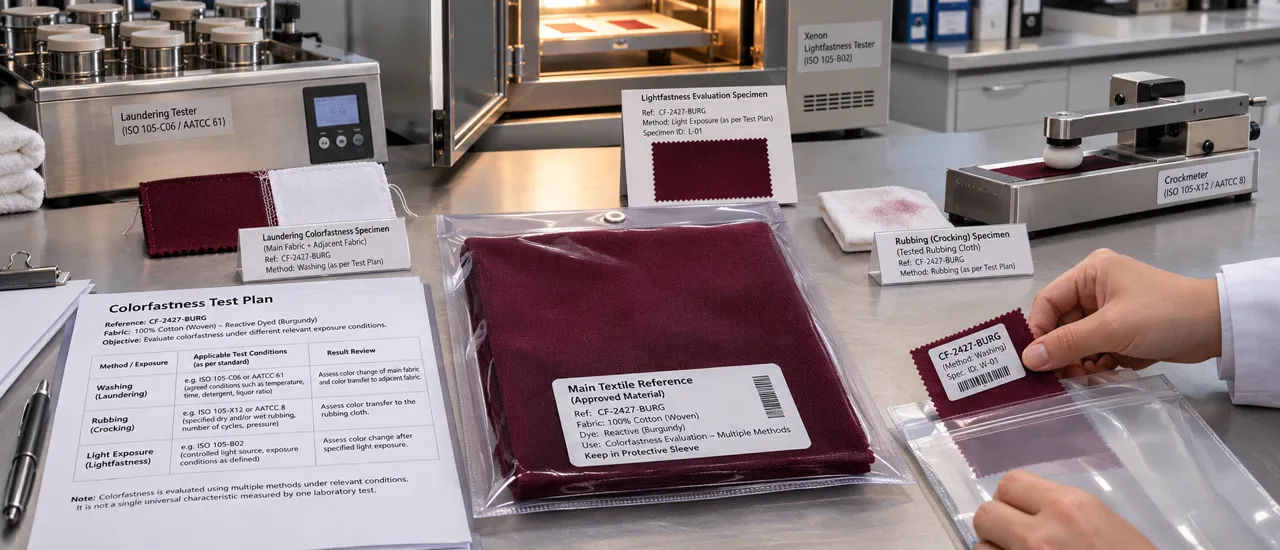
Color approval confirms whether a textile matches the intended shade. Color fastness standards address a different question:
how resistant is the material to color change or transfer under specified conditions?
A fabric may match its approved color perfectly but still fade during washing or transfer dye onto another garment.
For this reason, colorfastness should be verified separately from visual shade approval.
Color Fastness to Washing Standard
A color fastness to washing standard establishes a defined laboratory procedure for assessing color change and staining during laundering-related exposure.
Examples include AATCC TM61 and ISO 105-C06. These methods use defined conditions and reporting approaches, but they do not automatically establish the buyer’s acceptable grade.
For everyday apparel, the specification should identify the applicable test method, test conditions, minimum required results, and whether evaluation is needed before or after relevant finishing operations.
Color Fastness to Light Standard
A color fastness to light standard evaluates a textile’s resistance to color change under specified light exposure.
Examples include ISO 105-B02 and AATCC TM16 methods.
Lightfastness may be particularly relevant for garments expected to receive substantial sunlight exposure, as well as products where long-term shade consistency is an important quality requirement.
The relevant target should reflect the material and intended use.
Color Fastness to Rubbing Standard
A color fastness to rubbing standard evaluates color transfer caused by friction, commonly called crocking.
ISO 105-X12 and AATCC TM8 are examples of recognized rubbing-fastness methods.
Dry and wet rubbing results may differ significantly, particularly for some dark-dyed textiles and selected garment-washed products.
For example, dark denim may require careful evaluation when it will contact light-colored clothing or accessories.
Colorfastness Testing Matrix
| Exposure | Example Test Method | What It Evaluates | Possible Failure |
|---|---|---|---|
| Washing | ISO 105-C06 / AATCC TM61 | Color change and staining | Fading or bleeding |
| Rubbing | ISO 105-X12 / AATCC TM8 | Dry or wet color transfer | Staining other materials |
| Light | ISO 105-B02 / AATCC TM16 | Resistance to light exposure | Fading or shade change |
| Perspiration | ISO 105-E04 / AATCC TM15 | Color change and staining from simulated sweat | Staining or discoloration |
These are examples of applicable methods. Their editions, conditions, and acceptance targets must be confirmed for the specific product.
Intertek’s colorfastness testing for textiles and apparel explains the different evaluations used for washing, rubbing, light, and perspiration. These procedures provide evidence of performance under selected test conditions rather than a guarantee that the material will never fade or transfer color.
What Should a Colorfastness Report Include?
A useful laboratory report should identify the material, specimen condition, color, relevant method, result, and evaluation details.
The buyer should compare those results with the applicable acceptance requirements. A general statement such as “colorfastness passed” is insufficient when the exposure, test method, and expected performance are not identified.
Appropriate fabric testing for colorfastness, shrinkage, pilling, and spirality helps manufacturers evaluate material performance using defined procedures and product-specific acceptance criteria.
Fabric Finishing Types: Mechanical, Chemical, and Thermal Treatments

Different fabric finishing types are used to modify textile appearance, handfeel, stability, or functional characteristics.
A finishing requirement should identify the intended result and, where necessary, the process required to achieve it.
For example, specifying “soft fabric” may communicate a general preference, but an approved swatch and measurable requirements provide a stronger basis for production.
What Is Fabric Finishing?
Fabric finishing refers to relevant processing that gives a textile or garment desired characteristics after or alongside other preparation, coloration, or manufacturing stages.
It may influence surface texture, softness, dimensional stability, wrinkle behavior, color appearance, or selected functional properties.
The finishing process in garment industry workflows can occur at different stages. Some treatments are applied to fabric at the mill before cutting, while others are applied to completed or partially completed garments.
The term garment finishing can also refer to final operations such as thread trimming, pressing, inspection, and packing. These final preparation activities should be distinguished from chemical or mechanical treatments that deliberately change textile properties.
Different Types of Fabric Finishes
The following overview groups common types of fabric finishes by their general processing approach.
| Finish or Treatment | Main Purpose | Important Risk | Approval Evidence |
|---|---|---|---|
| Brushing or Raising | Create a raised surface | Pilling, uneven texture | Physical reference, surface evaluation |
| Peaching | Produce a fine surface feel | Appearance inconsistency | Approved swatch |
| Compaction | Control applicable dimensional behavior | Residual shrinkage | Dimensional testing |
| Heat Setting | Stabilize suitable thermoplastic textile systems | Distortion, property changes | Width, stability, and recovery results |
| Softener Treatment | Modify handfeel | Variable softness or performance | Approved reference |
| Anti-Pilling Finish | Reduce pill formation | Inadequate durability of effect | Pilling test results |
| Water-Repellent Finish | Improve resistance to surface wetting | Performance deterioration during care | Relevant performance testing |
The effects and suitability of these treatments depend on the fabric, fiber composition, construction, and processing conditions.

Mechanical Fabric Finishes
Mechanical finishes change textile characteristics through physical action.
Brushing, raising, shearing, calendaring, and certain compaction processes are examples.
Brushing and Raising: Modify the surface by lifting or exposing fibers, potentially creating a softer or warmer-feeling material. However, the raised surface may require additional attention to pilling and abrasion resistance.
Calendaring: Uses pressure and, in certain processes, heat to modify surface appearance or texture. The actual effect depends on the textile and equipment.
Compaction: Can help control dimensional behavior in suitable fabrics, particularly knitted materials. The resulting shrinkage still needs verification under the applicable conditions.
Chemical Fabric Finishes
Chemical finishing uses appropriate treatments to modify textile characteristics.
Softening agents, resins, water-repellent treatments, and certain anti-pilling technologies are examples.
The buyer should distinguish between specifying a particular chemical process and specifying the desired finished performance. Different processing approaches may be acceptable where the buyer permits them and the required results are achieved.
Chemical suitability, applicable restrictions, and compatibility with subsequent care or manufacturing processes must also be considered.
Heat Setting Process in Textile Manufacturing
The heat setting process uses controlled thermal conditions to stabilize suitable textiles, especially materials containing thermoplastic fibers.
A heat setting process in textile production may help control dimensions, fabric width, and selected structural characteristics.
However, temperature and exposure conditions can also influence elastic components, handfeel, or other properties.
Heat-setting should not be treated as a universal remedy for cotton shrinkage, spirality, or construction problems.
The specification should identify the required outcome and the relevant verification, with processing conditions confirmed by the responsible manufacturer.
Anti-Pilling Finish: What Does It Actually Do?
An anti pilling finish is intended to reduce the development or retention of surface pills.
A treatment may improve performance in a suitable textile, but it cannot guarantee complete resistance to pilling under every wearing condition.
Fiber characteristics, yarn structure, brushing, finishing, and abrasion exposure remain important.
For materials where pilling is a significant risk, buyers should require the appropriate test method and agreed acceptance grade instead of accepting the treatment name as proof.
How to Approve Different Fabric Finishes
When comparing different types of fabric finishes, buyers should request the information necessary to evaluate the actual final material.
This generally includes an approved physical reference, the intended finished properties, relevant testing requirements, and confirmation of any important processing or substitution restrictions.
The final choice should support the intended garment’s performance rather than simply reproduce a fashionable finishing description.
Garment Wash: How Washing Changes Shade, Handfeel, and Dimensions

A garment wash is a processing operation applied to an assembled garment to achieve a specified cleaning, appearance, surface, or handfeel result.
Depending on the product and process, washing may remove processing residues, change color appearance, soften the material, or create a particular worn effect.
It may also affect shrinkage, distortion, surface characteristics, and the performance of attached components.
Why Garment Washing Needs Separate Approval
A fabric may meet its dimensional and color requirements before garment washing but behave differently after the intended wash treatment.
For example, a black cotton hoodie may become visibly lighter after a particular washing route. A denim garment may develop a designed faded appearance, while an unsuitable process could create unwanted unevenness or excessive strength loss.
Therefore, the garment’s approved appearance should represent the stage relevant to final product acceptance.
Enzyme Softener Wash: Process and Tradeoffs
An enzyme softener wash may refer to a sequence combining enzyme treatment with softening.
These stages perform different functions.
Enzyme Treatment: Uses suitable enzymes to affect a specific substrate or material characteristic. Cellulase treatments, for example, may modify cotton-fiber surfaces, while other enzymes may serve different purposes.
Softener Treatment: Uses an appropriate finishing agent or process to modify material handfeel.
The complete treatment should be assessed according to the garment’s fiber content, construction, intended appearance, and relevant quality requirements.
Excessive processing may lead to unwanted color loss, fabric damage, weight reduction, or changes in garment dimensions.
CottonWorks’ garment finishing and denim washing processes explain how washing, enzyme treatment, surface effects, drying, and final preparation interact. The resource also distinguishes ordinary cleaning from treatments intended to alter fabric appearance or performance.
Video: Industrial Enzyme Washing Process
The following documentary-style demonstration, Enzyme Washing Process in Textile by Textile Vlog, presents garment enzyme-washing operations. It offers practical context for understanding why the washing method, material condition, and process controls affect the final appearance and feel of apparel products.
Garment Wash Approval Checklist
- Identify the garment style and fabric reference.
- Confirm the intended wash type and visual result.
- Approve a representative physical wash sample.
- Record important process requirements or approved recipe reference.
- Establish the applicable shade and handfeel criteria.
- Confirm required finished garment measurements.
- Review relevant shrinkage, distortion, and colorfastness results.
- Evaluate printing, embroidery, labels, and trims after the wash when necessary.
- Identify significant changes requiring further approval.
A wash approval should document the final result and applicable manufacturing controls. A photograph alone may be insufficient to assess handfeel, dimensions, and material performance.
Printing and Embroidery: How to Control Decoration Durability
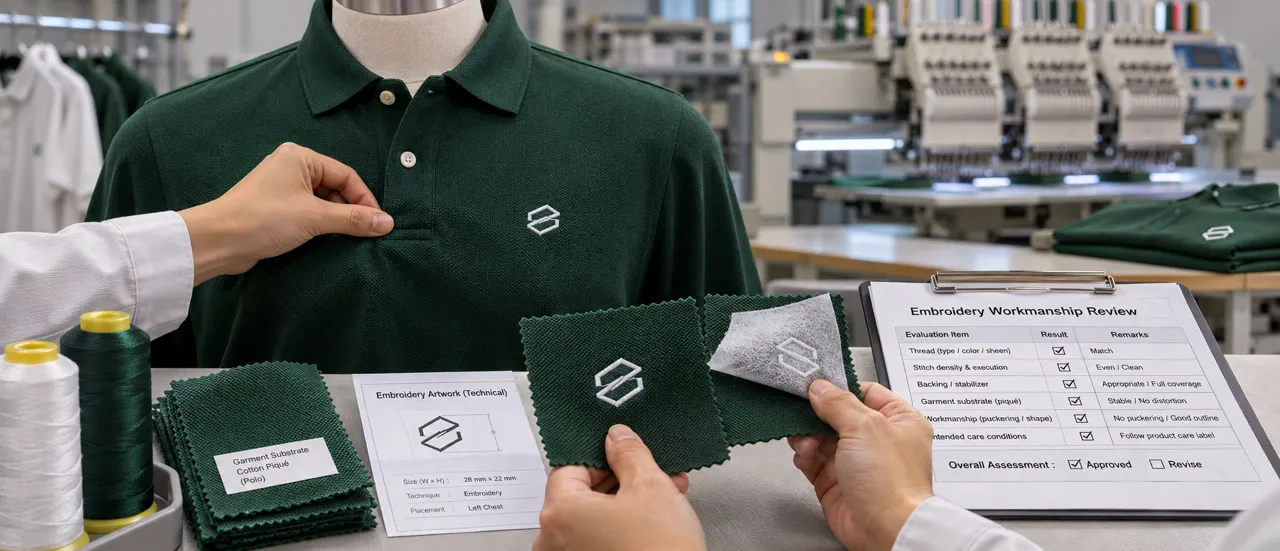
Printing and embroidery influence garment appearance, brand identity, and customer perception. Their durability depends on more than the approved artwork.
The application method, substrate, processing conditions, and subsequent washing or care may affect how a decoration performs.
Durable Print: What Buyers Should Approve
A durable print should retain the required appearance and function under the agreed use and care conditions.
Important risks include cracking, peeling, color migration, fading, and changes in texture.
For screen printing, heat transfer, DTF, DTG, or other decoration methods, buyers should identify the applicable artwork reference, dimensions, placement, color, application method, and durability expectations.
Strike Off Approval: A strike-off is a trial representation of the proposed print or decoration, used to review relevant visual and application characteristics before proceeding with the approved production method.
An approved artwork file establishes design information, but it does not necessarily prove that the print will perform correctly on the selected fabric.
Durable Embroidery: Thread, Backing, and Construction
Durable Embroidery: Requires suitable embroidery threads, stitch density, backing, placement, and compatibility with the garment fabric.
Poorly controlled embroidery can cause puckering, excessive stiffness, thread breakage, or discomfort against the skin.
A physical approval sample helps establish appearance and workmanship expectations. Relevant washing or durability checks may also be necessary.
Decoration Durability Controls
| Method | Important Risk | Approval Requirement |
|---|---|---|
| Screen Printing | Cracking, color change | Print reference and relevant durability |
| Heat Transfer | Peeling, edge lifting | Application approval and wash performance |
| DTF / DTG | Wash deterioration, handfeel | Approved print on intended fabric |
| Embroidery | Puckering, thread breakage | Stitching, backing, appearance |
| Decorative Patch | Detachment, deformation | Attachment method and durability |
Decoration requirements should be connected to the applicable garment-care and finishing conditions.
A transfer approved on an unwashed sample should not automatically be considered suitable for a garment subjected to a significantly different bulk finishing process.
Garment Trims and Accessories: Labels, Zippers, Elastics, and Sewing Thread
Garment trims and accessories include functional and decorative components used in clothing manufacturing.
They may represent a relatively small part of the garment’s material cost, but they can significantly influence appearance, comfort, functionality, and durability.
A broken zipper or poorly recovering waistband can make a garment unacceptable even when the main fabric meets its specifications.

Clothing Trims and Accessories vs. Fashion Accessories
Clothing Trims and Accessories: Include components such as sewing thread, zippers, buttons, elastics, labels, tapes, drawcords, and certain decorations used in the garment.
Fashion Trims and Accessories: May refer to decorative elements or other design-related components that enhance the garment’s appearance.
These commercial terms overlap. The important distinction is whether the component has functional, decorative, informational, or compliance-related requirements.
Label Specs and Care Label Requirements
Label Specs: Should identify the label type, material, dimensions, approved artwork or wording, placement, attachment method, and relevant durability requirements.
Garment labels may communicate brand information, size, fiber composition, care instructions, country of origin, or other information required by the destination market.
Care Label Requirements: Depend on the applicable market and product. Care instructions should accurately reflect how the complete garment, including relevant attached components, can be maintained.
Wash Care Symbol Compliance: Requires the symbols or wording to follow the applicable rules and recognized system for the intended destination market. Different jurisdictions do not necessarily use identical labeling requirements.
For example, the US Federal Trade Commission’s guidance on complying with the Care Labeling Rule explains the responsibilities of manufacturers and importers of covered apparel, including the need for a reasonable basis supporting care instructions.
Quality Zipper Supply and Functional Verification
Quality Zipper: A zipper that meets the intended requirements for appearance, operation, component compatibility, and durability under the garment’s expected conditions.
Reliable quality zipper supply begins with an accurate item specification.
Relevant information may include zipper type, chain size, length, tape material, teeth or element material, slider, puller, color, and approved supplier reference.
The applicable performance checks depend on the zipper’s intended use.
Zipper Pull Strength Test: Can refer to selected strength evaluations involving the zipper’s puller, slider, stops, chain, or associated components. These characteristics should not be treated as one interchangeable test.
YKK’s zipper product testing methods describe several strength evaluations, including chain strength and holding strength of zipper components. Such methods help suppliers assess whether a particular zipper design is suitable for its intended application.
High Quality Elastic Bands: Stretch and Recovery
High Quality Elastic Bands: Should provide the appropriate dimensions, extension, recovery, comfort, and care performance for their intended garment application.
A high quality elastic may stretch sufficiently during fitting but still fail if it does not return adequately toward its original dimensions after repeated use.
The best quality elastic is therefore the material that satisfies the product’s specific requirements, not simply the thickest or strongest available elastic.
Elastic Stretch and Recovery: Should be evaluated under suitable conditions where waistband performance, fit retention, or repeated extension is important.
Heat and laundering compatibility may also require attention, particularly when the garment undergoes substantial finishing.
Thread Selection Guide for Garment Durability
A practical thread selection guide should consider the fabric, seam type, required strength, stretch behavior, stitch appearance, and manufacturing conditions.
A suitable sewing thread for a woven shirt may differ from one selected for a stretch garment or heavily washed denim product.
The specification may identify the approved thread type, size or ticket reference, color, and relevant performance requirements.
Thread selection also needs to be compatible with the needle, stitch type, machine settings, and intended seam construction.
Trim Specification Starter Table
| Component | Important Specification Fields | Main Risk |
|---|---|---|
| Care Label | Content, material, position, durability | Incorrect information, fading |
| Zipper | Type, size, length, slider, tape, source | Jamming, separation, breakage |
| Elastic | Width, composition, stretch, recovery | Bagging, loss of fit |
| Sewing Thread | Type, size, color, application | Seam breakage, poor appearance |
| Drawcord | Material, diameter, length, ends | Fraying, functional failure |
| Patch | Material, dimensions, attachment | Detachment or distortion |
Clear garment trims and accessories specification requirements help suppliers maintain component consistency, identify suitable materials, and prevent avoidable functional and appearance defects.
Explore Apparel Sourcing and Quality Control Services
RYZEAL SOURCING supports fabric and trim sourcing, sampling, finishing coordination, and quality assurance through specialized apparel manufacturing partners in Bangladesh. Explore how our team coordinates development and production requirements across different garment categories.
Trim Failure Prevention: Incoming Inspection, Testing, and Change Control
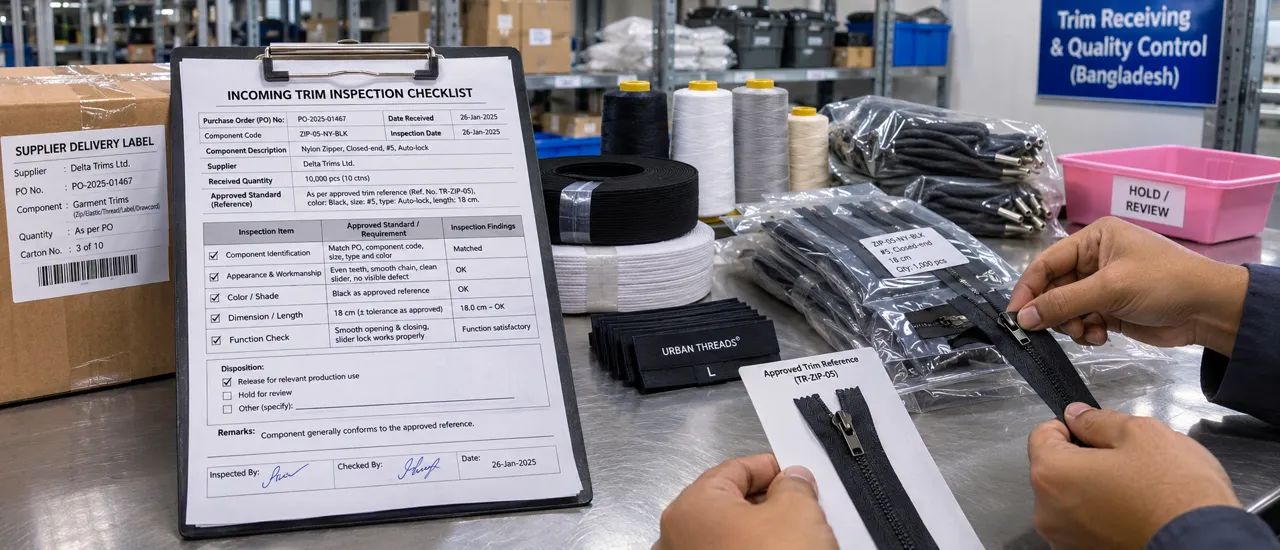
Trim failure can occur because of unsuitable component selection, manufacturing defects, poor attachment, incompatible care conditions, or unauthorized substitution.
Identifying these risks before bulk production reduces the likelihood of discovering functional problems during final inspection or after delivery.
Common Trim Failure Patterns
Zippers: May suffer from slider jamming, chain separation, puller failure, or tape distortion.
Elastics: May lose recovery, curl, deform, or become unsuitable after exposure to relevant processing or care conditions.
Labels: May lose legibility, detach, irritate the skin, or contain incorrect product information.
Sewing Threads: May break, change appearance, or contribute to seam problems when their characteristics are unsuitable for the application.
Trim Failure Prevention Checklist
- Confirm each required trim’s reference and specification.
- Identify approved suppliers or acceptable alternatives.
- Review samples for relevant appearance and function.
- Define applicable trim testing requirements.
- Inspect incoming components according to the quality plan.
- Confirm compatibility with garment washing and finishing.
- Record supplier or component substitutions requiring approval.
- Maintain suitable traceability for relevant production materials.
Incoming Inspection: Verifies that delivered components match the applicable order and quality requirements.
Change Control: Establishes when a revised component requires additional review or approval before being used.
Not every trim requires the same testing program. Functional importance, previous supplier performance, buyer requirements, and expected use should determine the relevant controls.
What to Document in the Tech Pack and BOM Before Production
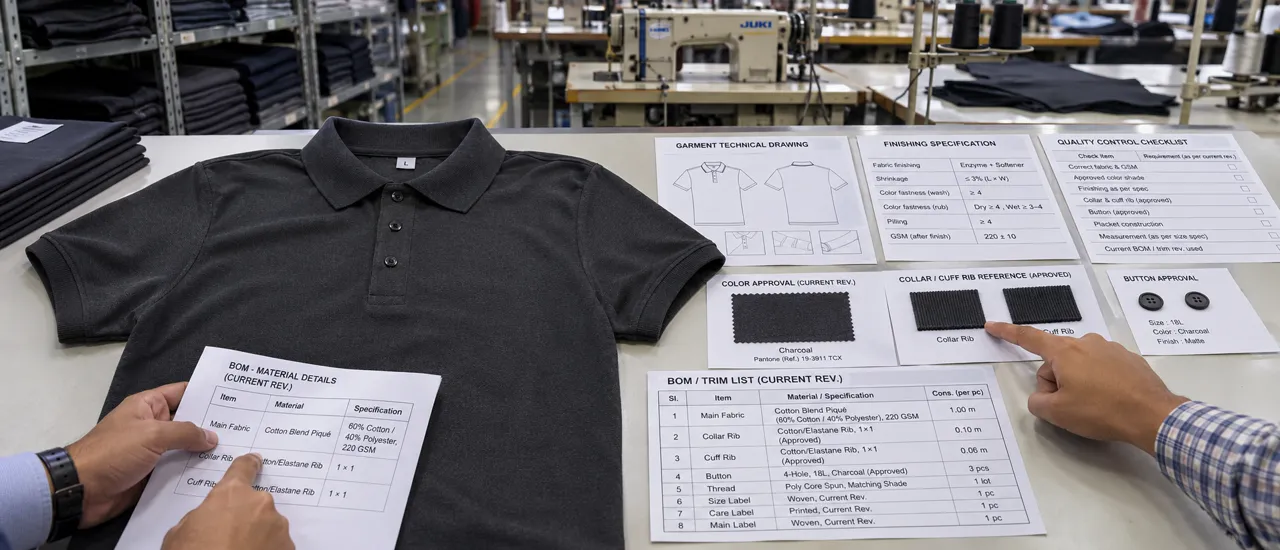
The final objective of garment finishing processes is to ensure that suppliers and manufacturers work from consistent, approved requirements.
Color references, finishing instructions, decoration approvals, trim specifications, and relevant testing evidence should be connected to the correct garment style and document version.
Where Different Requirements Belong
| Document | Main Information |
|---|---|
| Tech Pack | Colorways, finishing, washing, decoration, labeling, construction |
| Fabric Specification | Material properties, finishes, shade, performance |
| Bill of Materials | Fabric and trim codes, sources, quantities, costing |
| Approval Register | Submitted references, results, decisions, revisions |
| Quality Control Plan | Inspection stages, test methods, acceptance criteria |
The garment tech pack development process helps teams organize manufacturing instructions, approved materials, measurements, artwork, and revisions in a consistent technical reference.
Likewise, fabric specification requirements for clothing manufacturing should identify the material characteristics, tolerances, and approval evidence needed to maintain consistent production quality.
Example: Approval Controls for a Black Cotton-Blend Hoodie
Consider a black hoodie made from cotton-polyester fleece with a printed logo, rib cuffs, a drawcord, and sewn labels.
The buyer’s approval system might include the following requirements.
Color: An identified black shade standard, approved lab dip, relevant bulk shade evaluation, and appropriate colorfastness requirements.
Fabric Finishing: Approved fleece surface, handfeel, dimensional stability, and relevant pilling performance.
Garment Washing: Approved process where applicable, with final appearance and garment measurements evaluated after treatment.
Printing: Approved artwork, placement, appearance, and relevant wash durability.
Trims: Defined rib, drawcord, labels, sewing thread, and any additional component requirements.
Quality Verification: Applicable inspection results, laboratory evidence, and approval records linked to the correct style and material versions.
These controls help prevent a situation in which individual components are approved separately but fail to work together in the finished garment.
What Triggers Reapproval?
A change should be reviewed when it could affect an approved requirement.
Examples include a different dyeing route, revised finishing treatment, new wash procedure, altered decoration method, or replacement trim supplier.
However, a new dye lot or routine production change does not automatically require complete reapproval of every characteristic. The necessary verification should reflect the applicable control plan and risk.
Final Production Release Checklist
- Correct tech pack and BOM revisions are available.
- Relevant color standards and lab dip decisions are recorded.
- Required bulk shade controls are established.
- Applicable fabric finishing and garment washing references are approved.
- Decoration artwork and production references are confirmed.
- Labels and functional trims meet the relevant specifications.
- Necessary material and component testing has been reviewed.
- Unresolved changes have been evaluated and authorized.
- The responsible manufacturer has the required production instructions.
The purpose of this checklist is to establish readiness for the relevant activities. The exact requirements should match the product and manufacturing program.
Frequently Asked Questions About Garment Finishing Processes
1. What are garment finishing processes in apparel manufacturing?
Garment finishing processes include operations used to achieve the required final garment appearance and characteristics, such as washing, pressing, surface treatments, and preparation. Buyers also need related approvals and verification to control those results.
2. What is the color approval process?
It is a controlled method of defining, developing, evaluating, and approving textile color. Lab dip approval is usually an early stage, followed by applicable bulk shade verification.
3. Why is bulk shade cloth important after lab dip approval?
Bulk shade cloth represents actual production material. It helps buyers evaluate whether the bulk shade remains consistent with approved references after scaling from laboratory dyeing.
4. Which color fastness standards should buyers specify?
The appropriate standards depend on the garment’s intended use. Washing, rubbing, perspiration, and lightfastness may require separate methods and acceptance criteria.
5. What are the main fabric finishing types?
Common categories include mechanical, chemical, and thermal treatments. The appropriate selection depends on the fabric and the intended appearance or performance.
6. When is heat setting necessary?
Heat setting may be appropriate for certain materials containing thermoplastic fibers where dimensional or structural stabilization is required. Suitability and processing conditions depend on the material.
7. Does an anti-pilling finish prevent all pilling?
No. Anti-pilling treatments aim to improve resistance to pill formation, but actual results depend on fiber, yarn, construction, finishing, and use conditions.
8. How does garment washing affect durability?
Garment washing may change shade, handfeel, dimensions, and surface characteristics. Aggressive or unsuitable processes can also affect fabric strength or attached components.
9. What should label specifications include?
Label specifications should identify the approved information, material, dimensions, placement, attachment method, and applicable durability or market requirements.
10. What causes zipper and elastic failures?
Common causes include unsuitable component specifications, manufacturing defects, poor attachment, incompatible washing conditions, and unapproved substitutions. Relevant testing and incoming inspection help identify these risks.
Final Takeaway: Control Appearance and Durability Before Bulk Production
Effective garment finishing processes combine suitable manufacturing methods with clear technical requirements, representative samples, appropriate testing, and documented approvals.
Color, fabric finishing, garment washing, printing, embroidery, and trims should be evaluated according to their individual requirements and their interactions within the finished product.
For apparel buyers, the most reliable approach is to establish what must be achieved, identify acceptable variation, confirm the necessary evidence, and review significant changes before they affect production.
RYZEAL SOURCING supports clothing brands through a vetted network of specialized independent manufacturers in Bangladesh, coordinating material sourcing, sampling, finishing requirements, quality follow-up, and apparel manufacturing according to each project’s needs.
Discuss Your Garment Finishing and Quality Requirements
Developing clothing that requires precise color matching, special fabric finishes, garment washing, durable decoration, or reliable trims? Schedule a discussion with RYZEAL SOURCING to review your product requirements and explore suitable manufacturing and quality coordination options through our partner network in Bangladesh.’ | CTA button: ‘Book an Appointment With RYZEAL
The goal is not simply to achieve the right appearance in one sample. It is to maintain the approved appearance, functionality, and performance throughout manufacturing and into the finished garment.
Connect with RYZEAL SOURCING