
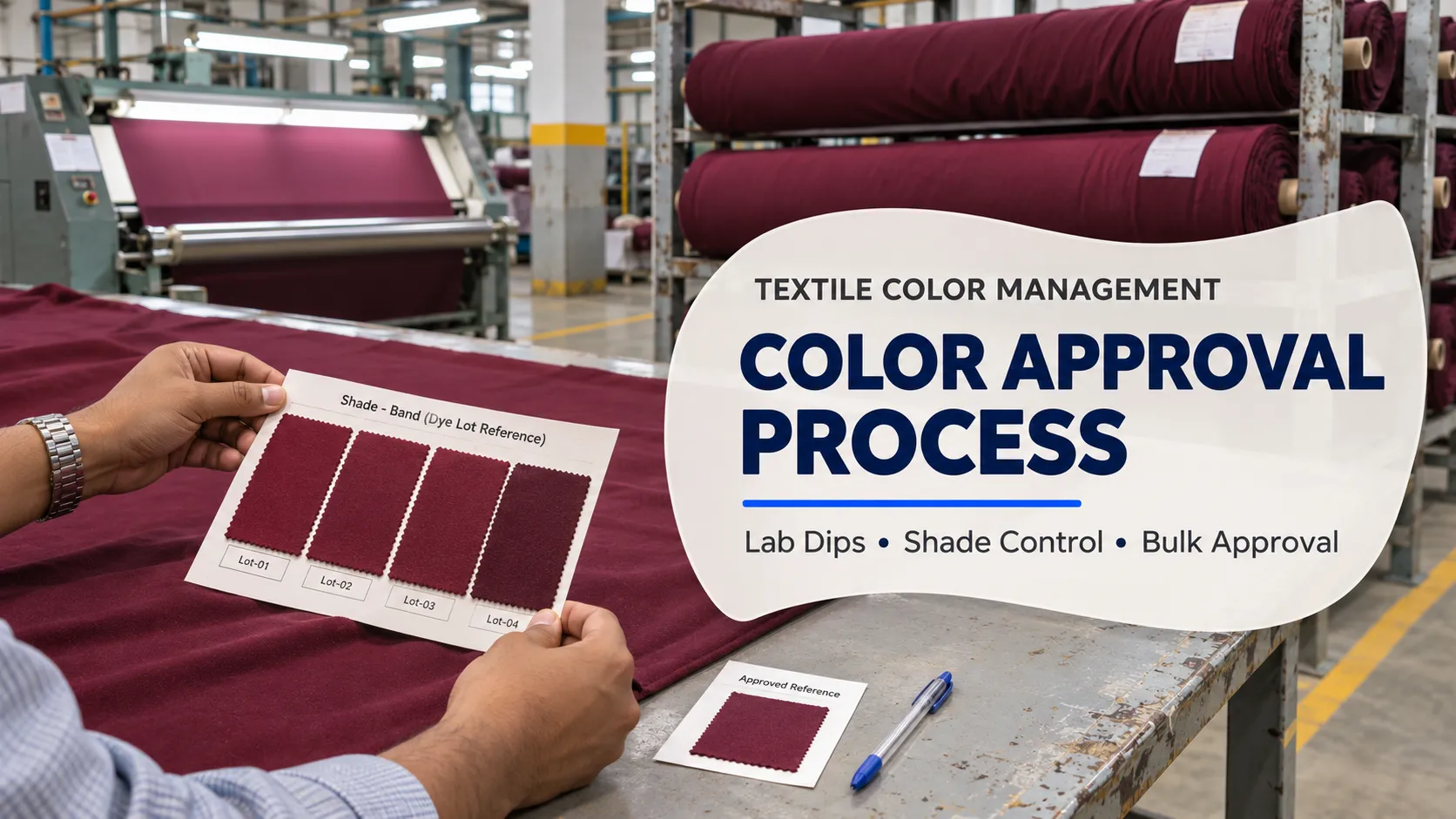
The color approval process in clothing manufacturing is a controlled workflow used to develop, evaluate, approve, and maintain the intended color of fabric or garments throughout production. It connects the buyer’s color reference with laboratory dyeing, bulk fabric processing, shade evaluation, and final product verification.
Color approval is not simply choosing a Pantone shade or accepting a lab dip. A successful process establishes the approved reference, fabric substrate, viewing conditions, acceptable variation, and responsibilities for each approval stage. These details help buyers, textile mills, and garment manufacturers work toward consistent results.
Problems often arise when an approved lab dip does not represent the final fabric, different dye lots are mixed during cutting, or suppliers evaluate shades under inconsistent lighting. Such gaps can produce shade variation in fabric, panel shading, rejected materials, and disagreements over what was originally approved.
A reliable system connects lab dip approval, printed strike-offs where applicable, bulk shade cloth evaluation, shade band control, instrumental color measurement, and relevant colorfastness testing. These activities form part of the wider garment finishing processes that determine a product’s appearance and durability.
This guide explains how to establish each approval gate, identify critical risk points, and maintain documented color continuity from development through bulk garment manufacturing.
Table of Contents
What Is the Color Approval Process in Clothing Manufacturing?
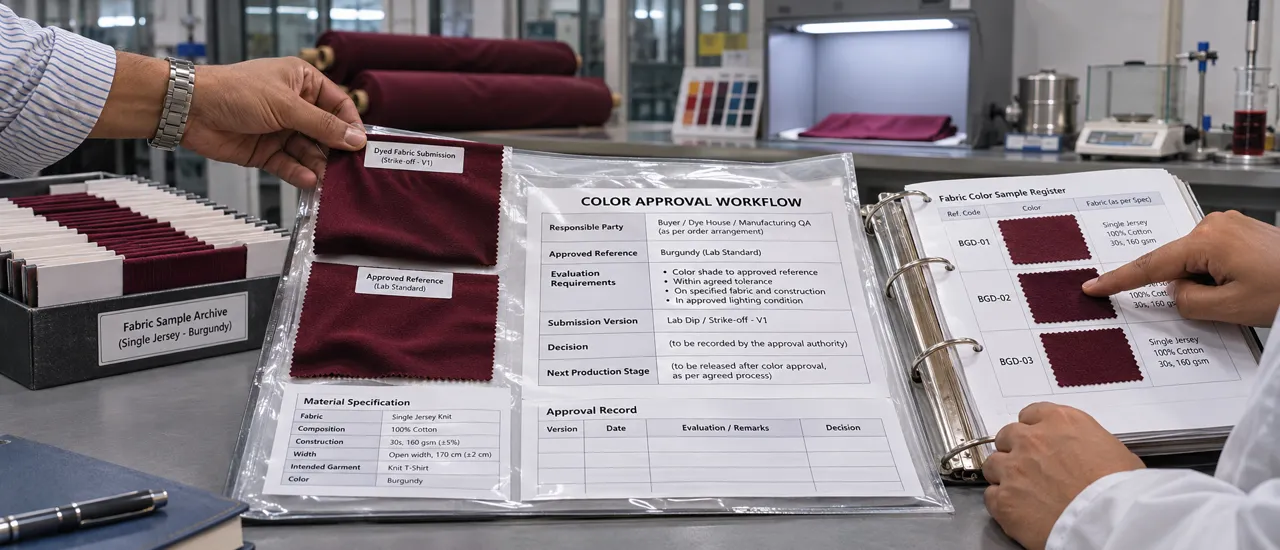
The color approval process defines how a proposed color becomes an accepted manufacturing standard. It establishes what the supplier must reproduce, how the result will be assessed, and who has authority to approve or reject a submission.
A color can look acceptable to one person and noticeably different to another. Fabric composition, surface texture, finishing, lighting, and measurement conditions can influence appearance. Therefore, approval should rely on an identifiable reference and agreed evaluation procedure rather than an informal description such as “close enough.”
Color Matching: Comparing a submitted fabric or garment color with an approved reference under defined conditions.
Color Approval: The documented decision confirming that a submission meets the applicable visual and measurable requirements.
Color Continuity: Maintaining acceptable color consistency across production lots, garment components, shipments, and repeat orders.
Who Is Responsible for Color Approval?
| Party | Main Responsibility |
|---|---|
| Brand or Buyer | Defines the reference, acceptance requirements, and final approval authority |
| Fabric Mill or Dye House | Develops dye recipes, submits lab dips, and controls bulk dyeing |
| Garment Manufacturer | Maintains approved shade groups during cutting, sewing, washing, and finishing |
| Merchandising and Quality Teams | Coordinate submissions, documentation, inspections, and corrective actions |
| Testing Laboratory | Provides relevant measurement or performance test results when required |
A practical approval workflow identifies the decision owner, required evidence, and production activity affected by each decision. It also explains when development can proceed and when bulk dyeing, printing, or cutting must be held for approval.
For custom-dyed fabric, the basic sequence normally moves from an agreed color reference to lab dip approval, production-representative shade evaluation, and bulk control. Printed garments may require a separate strike-off approval, while garment-dyed products need evaluation after their applicable dyeing and finishing operations.
Lab Dip Approval Process: The First Major Color Control Gate
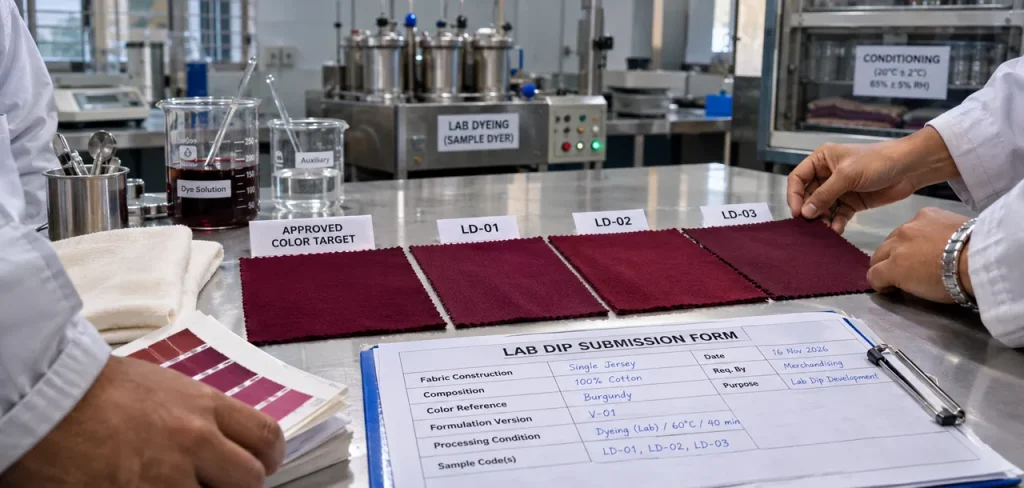
Lab dip approval is the procedure through which a buyer evaluates a small-scale dyed textile sample against the specified color standard before authorizing the relevant bulk dyeing process.
The lab dip process helps a dye house establish a suitable dye formulation and demonstrate that the intended shade can be achieved on the required material. However, a laboratory result does not automatically guarantee identical behavior when processing larger fabric quantities.
Step 1: Submit the Correct Color and Fabric Requirements
A useful lab dip request identifies both the intended color and the material on which that color must be produced.
The buyer should provide:
- Color reference, such as a Pantone textile code or approved physical swatch.
- Fabric composition, construction, and relevant GSM requirements.
- Fabric condition and intended finishing treatment.
- Proposed dyeing method, where known or specified.
- Required color matching light box conditions.
- Applicable instrumental tolerance or visual acceptance procedure.
- Relevant colorfastness requirements.
- Submission deadline, responsible person, and approval procedure.
For example, a lab dip developed on unfinished cotton single jersey may not represent the final appearance of a compacted, softened, or garment-washed material. The substrate and intended processing conditions must therefore be clear.
Step 2: Develop and Evaluate the Lab Dip
The dye house prepares the submission using a dye formulation compatible with the fabric. Some buyers request several shade options around the target, while others use a measured or digitally managed color-development procedure.
The submitted samples are compared with the specified standard under agreed viewing conditions. If instrumental evaluation is required, the supplier records the measurement results using the defined procedure.
X-Rite’s explanation of textile color matching and formulation describes how dye houses can use digital standards, spectrophotometers, dye recipes, and controlled visual assessment to improve color development.
Step 3: Approve, Reject, or Request Revision
The buyer evaluates the submitted shade according to the agreed criteria. The decision should be recorded against the correct sample identification and communicated to the mill or manufacturing partner.
Approved: The submitted sample meets the applicable requirements and becomes an identified reference for subsequent production controls.
Revision Required: The shade does not meet the required criteria, and the supplier must submit an adjusted version.
Conditional Approval: A specifically authorized deviation is accepted under documented conditions. It should not be treated as unrestricted permission to alter the approved shade.
An approved lab dip establishes an important development reference, but actual bulk fabric must still be checked according to the agreed production control plan.
Lab Dip Submission Checklist
| Required Information | What to Record |
|---|---|
| Color Reference | Pantone code, physical sample, or approved digital standard |
| Fabric Identity | Composition, construction, GSM, and supplier reference |
| Processing Condition | Dyeing route and relevant finishing state |
| Sample Identification | Submission code, revision, and date |
| Viewing Requirement | Light source and evaluation conditions |
| Measurement Requirement | Agreed color-difference formula and tolerance, if applicable |
| Approval Decision | Approved, rejected, or conditionally accepted |
| Next Approval Stage | Bulk shade submission and relevant release requirements |
Common Lab Dip Approval Risk Points
The first risk point is evaluating a sample produced on the wrong substrate or under different finishing conditions. Another is accepting a visually similar shade without recording the correct reference and viewing conditions.
Missing revision identification can also cause confusion. A supplier may accidentally use an earlier lab dip even though the buyer approved a later correction.
The essential rule is to connect every lab dip approval with the exact material, color reference, submission version, and subsequent production requirement.
Strike-Off Approval: Controlling Printed Colors
A print strike-off is a trial print produced for evaluation before the relevant bulk printing operation. It allows the buyer to assess printed colors, artwork execution, placement, and the appearance of the decoration on the intended material.
Strike-off approval differs from lab dip approval. A lab dip primarily evaluates the dyed textile shade, whereas a strike-off evaluates how the selected printing process reproduces the required design or color on the fabric.
The original artwork may appear accurate on a monitor but behave differently after printing. Ink formulation, fabric absorbency, print method, curing, and subsequent washing can affect the result.
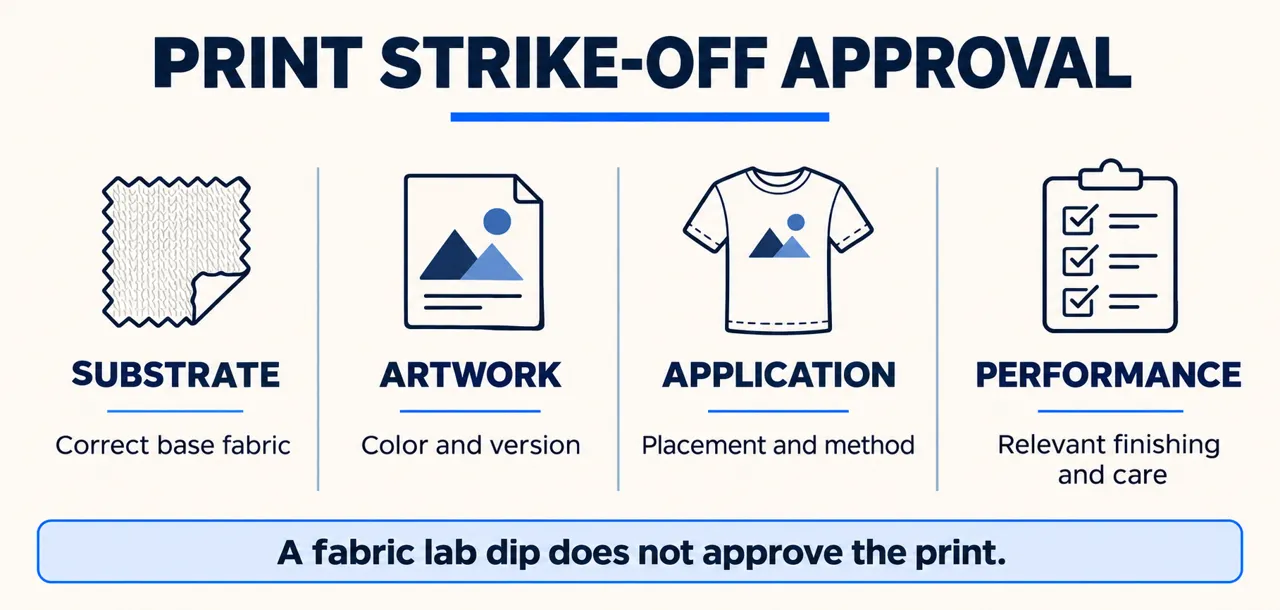
What Should Buyers Verify?
- Actual or representative approved base fabric.
- Intended printing technology and ink system.
- Artwork version and color reference.
- Print placement, size, and relevant registration.
- Approved curing and finishing conditions.
- Appearance after required washing or processing.
- Appropriate durability and performance requirements.
For printed apparel, strike-off approval should be linked to the artwork version and the intended production process. A change in base fabric, printing method, or finishing treatment may require another evaluation.
It is also important to distinguish printed color from dyed fabric color. A successful lab dip does not automatically approve the appearance or performance of a print applied afterward.
Bulk Shade Cloth and Shade Band: Controlling Actual Production

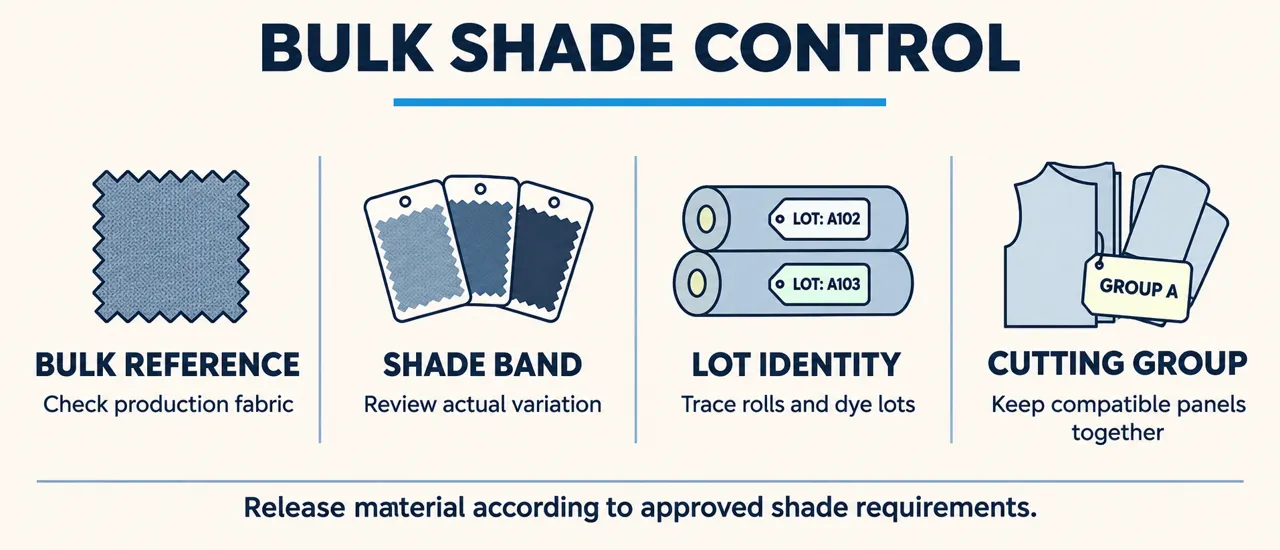
Lab dip approval demonstrates that the target shade can be developed under laboratory conditions. Bulk shade cloth provides evidence of the color achieved during actual production.
The dyeing machine, batch size, processing conditions, material variation, and finishing operations can introduce differences between laboratory and bulk results. Consequently, the bulk shade approval stage is a critical part of the color approval process.
What Is Bulk Shade Cloth?
Bulk shade cloth is a fabric cutting or sample representing material dyed through the actual bulk production route. It allows the buyer or authorized technical team to compare the achieved shade with the approved reference.
A bulk shade cloth fabric submission should be traceable to its production batch, dye lot, and relevant processing information.
Depending on the agreed procedure, buyers may evaluate a first bulk lot, multiple dye lots, representative roll samples, or additional fabric where variation is detected.
The important question is whether the submitted bulk shade fabric accurately represents the material intended for garment manufacturing.
What Is a Shade Band?
A shade band is an organized presentation of shade variation found within the bulk material. It helps the buyer and supplier determine whether the variations are acceptable and how the fabric should be grouped for production.
For example, rolls from different dye lots may show slightly lighter, darker, warmer, or cooler appearances. These differences can be evaluated against the applicable color standard and the acceptable shade range.
A shade band is not permission to accept unlimited variation. Samples outside the agreed requirements must be reviewed separately.
Color Continuity Card and Shade Grouping
A color continuity card is a controlled reference record containing approved material swatches used to assess shade consistency across relevant production stages or repeat orders.
A continuity card may include the original approved standard, accepted bulk reference, shade identification, dates, and approval information.
Shade grouping then translates the color assessment into an operational cutting plan. Rolls with compatible appearance are grouped according to the agreed shade-control rules.
Panel Shading: A visible color difference between garment components, such as front and back panels, sleeves, collars, or other adjoining parts.
Panel shading can occur when incompatible shade groups are combined, even if the fabrics belong to the same nominal color.
Bulk Shade Band Approval Rules
| Control Item | Required Action | Risk if Ignored |
|---|---|---|
| Bulk Reference | Compare production fabric with the approved standard | Incorrect overall shade |
| Lot Identification | Record dye lot and roll references | Lost traceability |
| Shade Band | Evaluate and document actual shade variation | Unapproved differences |
| Shade Grouping | Separate incompatible groups according to the cutting plan | Panel shading |
| Cutting Release | Confirm the required shade approvals before affected cutting | Costly rework |
| Replacement Fabric | Recheck new or additional material | Mixed-shade garments |
| Continuity Record | Retain identifiable approved references | Repeat-order inconsistency |
What Causes Shade Variation in Fabric?
Shade variation can result from several interacting factors:
Dye Lot Differences: Changes in processing conditions, dye formulation, or material behavior between batches.
Material Variation: Differences in fiber composition, yarn characteristics, construction, or absorbency.
Finishing Variation: Changes introduced during drying, heat-setting, softening, washing, or other treatments.
Within-Roll Variation: Uneven shade across the width or length of a fabric roll, which may require additional inspection and control.
These variations should be assessed according to their actual location, magnitude, and relevance to the garment.
Bulk Cutting Controls: Preventing Panel Shading
The cutting department must understand the approved shade grouping before fabric is issued for production. Even a well-documented shade band provides little protection if roll identification is lost during spreading or bundles are mixed during sewing.
Practical cutting controls include:
- Identify every roll with its relevant lot and shade-group information.
- Separate incompatible shade groups during spreading and cutting.
- Keep garment components within their approved shade compatibility requirements.
- Label cut bundles so shade identity remains traceable through sewing.
- Check collars, rib components, pockets, and other visible attachments for compatibility.
- Evaluate replacement fabric before using it in an existing production run.
- Escalate unidentified or unapproved fabric before releasing it for cutting.
Different dye lots are not automatically prohibited from the same order. What matters is whether the fabrics satisfy the agreed shade requirements and are allocated so that individual garments and relevant shipment groups remain visually consistent.
Approval Gate: Where bulk shade approval is required before cutting, the affected material should not be released until the authorized decision is documented.
Prepare Your Apparel Specifications for Sampling
Need help organizing fabric requirements, color references, finishing details, and approval conditions? Share your technical specifications with RYZEAL SOURCING to discuss suitable apparel development and manufacturing options.
Pantone Color Matching and Controlled Lighting
Pantone references provide a standardized starting point for communicating color requirements. However, specifying a Pantone code does not automatically guarantee that a particular textile can reproduce the same appearance under every production condition.
The color approval process must connect the chosen reference with the actual material, agreed viewing environment, and approved fabric sample.
How to Use Pantone for Fabric Color Matching
Pantone provides different color systems for different applications. The Pantone Matching System (PMS) is primarily associated with graphics and printing, while the Fashion, Home + Interiors (FHI) system includes references developed for textiles and related products.
For apparel, TCX references represent textile colors on cotton fabric. TPG references are associated with pigments and coatings on paper-based guides.
A Pantone color match should therefore use an appropriate reference system and identify the specific code being evaluated. Pantone’s official color systems explanation distinguishes these applications and their intended materials.
A Pantone matching system color chart or Pantone color match card is useful during color selection, but the approved dyed fabric sample normally becomes the practical reference for controlling the specific production material.
Pantone-to-Fabric Approval Checklist:
- Confirm the complete Pantone code and reference system.
- Specify the target fabric composition and construction.
- Identify the applicable physical or digital standard.
- Agree on color evaluation conditions.
- Define acceptable variation where required.
- Archive the approved material sample and decision record.
Color Matching Light Box: Why Lighting Matters
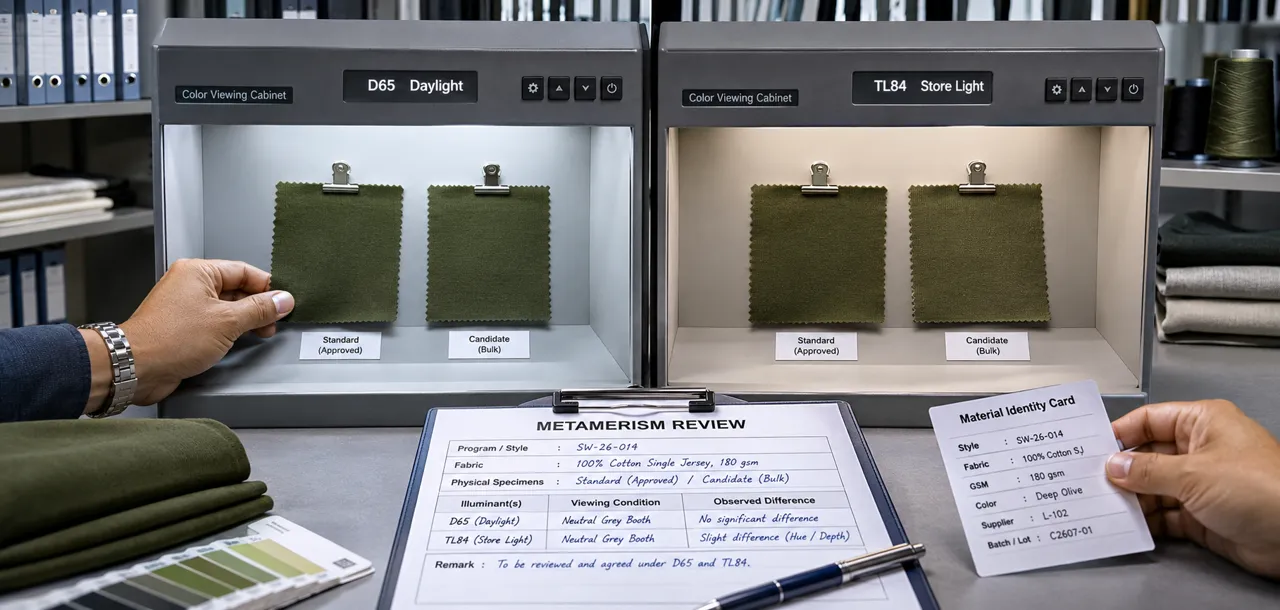
A color matching light box provides controlled illumination for comparing color samples under defined viewing conditions.
Without controlled lighting, two people can evaluate the same fabric differently. A shade that appears acceptable under one light source may appear too yellow, blue, red, or dull under another.
D65 Light Source: A standardized daylight illuminant commonly used for color evaluation, including textile applications.
D50 Light Source: A standardized illuminant commonly associated with graphic arts and color-critical printing workflows.
Metamerism: A condition in which two materials appear to match under one light source but show a visible difference under another because their spectral properties differ.
For visual color evaluation, ASTM D1729-22 provides a recognized practice for assessing color differences in diffusely illuminated opaque materials. It emphasizes standardized observation conditions and appropriate evaluation procedures.
Buyers should specify the required viewing conditions rather than assuming that every light box setting provides an interchangeable result.
The following X-Rite demonstration introduces the operation of a SpectraLight QC light booth, a controlled-lighting system used for visual color evaluation. It is useful for understanding why consistent viewing equipment and procedures matter when comparing approved standards with production samples.
A light box reduces one important source of evaluation disagreement, but it does not eliminate differences caused by sample preparation, observer judgment, surface characteristics, or measurement procedures.
Spectrophotometer and Delta E: Measuring Color Differences
Visual evaluation is important, but it can become difficult when approvals involve multiple suppliers, locations, or repeated production batches.
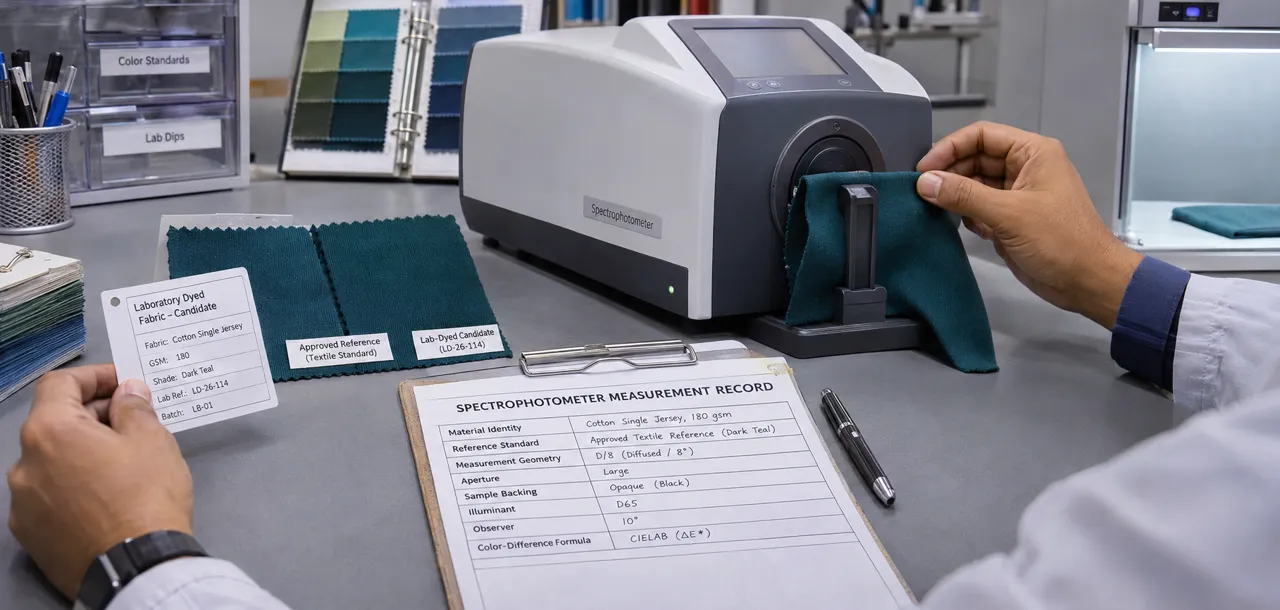
A color spectrophotometer provides numerical information about a sample’s spectral reflectance. This data can be used to calculate color coordinates and compare the submitted material with a defined standard.
In apparel manufacturing, spectrophotometer color measurement can support lab dip development, bulk shade verification, and ongoing color consistency.
How Does a Color Spectrophotometer Work?
A reflectance spectrophotometer directs light toward a material and measures how much light is reflected at different wavelengths. Its software processes the spectral information to support color evaluation under specified measurement and calculation conditions.
The basic measurement workflow involves preparing a representative specimen, calibrating the instrument, measuring the approved reference, and evaluating the submitted sample using compatible settings.
Fabric texture, thickness, backing, orientation, sample layering, and measurement position may influence results. Therefore, reliable color measurement by spectrophotometer requires controlled specimen preparation and an agreed procedure.
What Is Delta E in Color Matching?
Delta E (ΔE) is a numerical expression of the difference between two colors calculated using a specified color-difference formula.
A smaller Delta E value generally indicates a smaller calculated color difference under the selected method. However, the number alone does not fully describe how noticeable or commercially important that difference will be.
Different color-difference formulas exist, including CIELAB ΔE*ab and CIEDE2000 (ΔE00). They are not interchangeable, and the selected formula must be recorded.
What Is an Acceptable Delta E Tolerance?
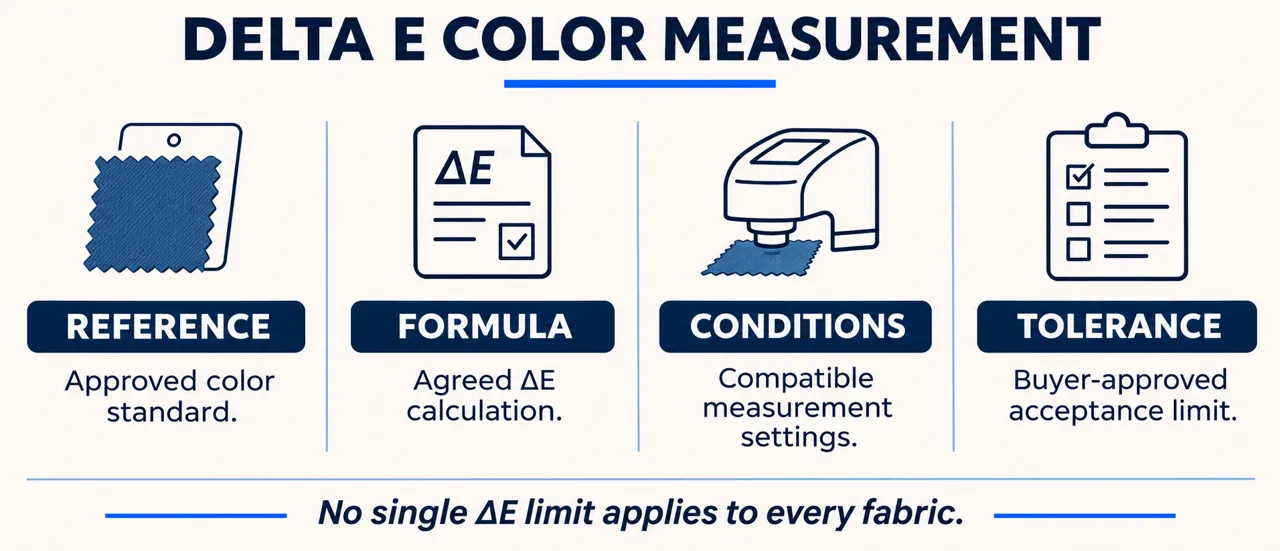
There is no universal acceptable Delta E tolerance that applies to all fabrics, garments, brands, and colors.
An appropriate tolerance depends on the material, target shade, surface characteristics, product application, visual expectations, and the manufacturing process’s demonstrated capability.
Datacolor’s guidance on Delta E tolerance standards explains why color acceptance limits should be established for the specific product and evaluation conditions rather than adopted as one universal number.
The buyer should also determine how an instrumental result will be reconciled with visual evaluation. A sample can meet its numerical limit while still presenting an objectionable appearance difference in the actual application.
Delta E Specification Fields for Buyers
| Specification Field | What Must Be Defined |
|---|---|
| Reference Standard | Approved physical or compatible digital color standard |
| Color-Difference Formula | CIELAB ΔE*ab, CIEDE2000, or other agreed method |
| Acceptance Tolerance | Buyer-approved limit for the applicable material and shade |
| Illuminant and Observer | Agreed calculation settings |
| Instrument Details | Relevant model, geometry, aperture, and calibration procedure |
| Sample Preparation | Conditioning, backing, layers, orientation, and measurement positions |
| Evaluation Stage | Lab dip, production-representative sample, or bulk verification |
| Decision Rule | How instrumental and visual results determine approval |
Important: A tolerance specification is not complete merely because it says “Delta E must pass.” The formula, measurement procedure, reference, acceptance limit, and approval responsibility must be clear.
The following X-Rite educational presentation explains spectral color data, common spectrophotometer measurement geometries, and how instrument measurements support accurate color communication.
Spectrophotometers improve consistency and documentation, but they should support an appropriately designed approval process rather than replace technical judgment.
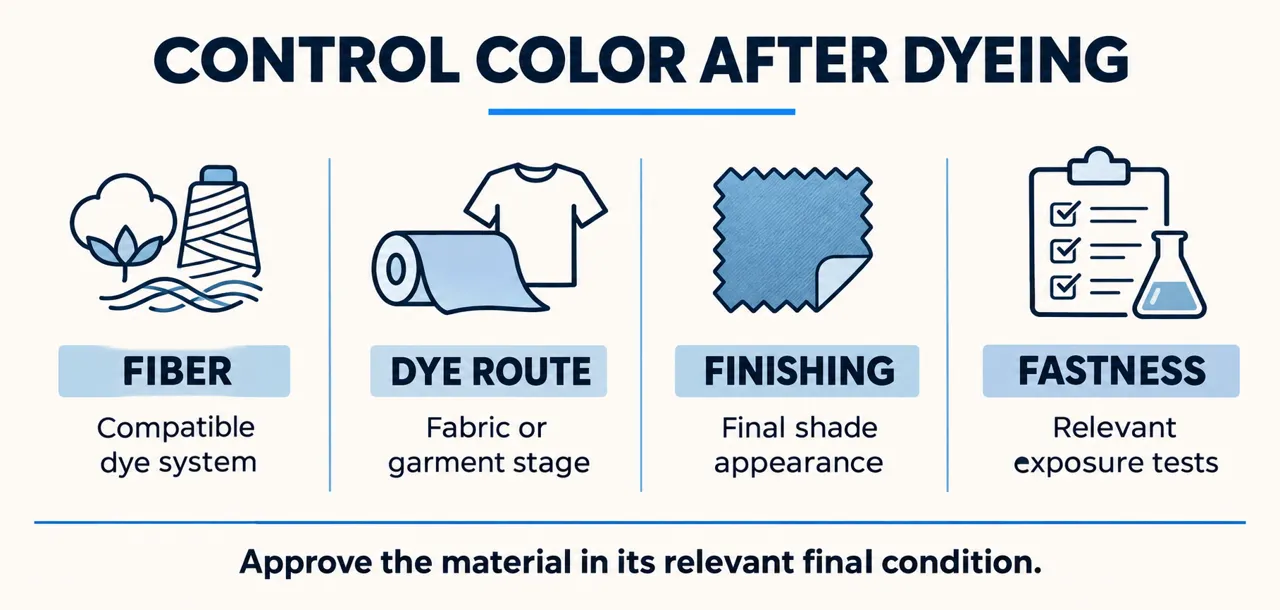
Dye Methods and Colorfastness: Preventing Shade Changes After Approval
An approved shade must remain acceptable through the production operations and relevant conditions the finished garment is expected to experience.
Dyeing method, fiber composition, finishing treatment, and subsequent washing can influence both initial appearance and colorfastness performance. The color approval process should therefore account for the actual manufacturing route.
Piece Dye vs Garment Dye
Piece Dyeing: Fabric is dyed before garment cutting and assembly. Bulk shade evaluation normally focuses on the dyed and finished textile before cutting.
Garment Dyeing: Assembled garments are dyed, subject to the suitability of their materials and components. Shade evaluation must consider the resulting finished garment and its applicable processing conditions.
The distinction matters because garment dyeing can produce different visual characteristics around seams, stitching, and constructed areas. Garment components and sewing threads may also respond differently depending on their fiber composition.
Reactive Dye and Disperse Dye
Fiber Reactive Dye: A dye class commonly used for cellulosic fibers such as cotton and viscose. Reactive dyes can form chemical bonds with suitable fibers under appropriate dyeing conditions.
Disperse Dye: A dye class commonly associated with polyester and certain other synthetic fibers. Disperse dyeing uses processing conditions appropriate to the fiber and dye system.
These are examples of dye classes, not universal prescriptions for every textile. Fabric blends may require different dyeing strategies, and the finished appearance depends on the actual material and process.
| Dyeing Method | Main Color Risk | Important Control |
|---|---|---|
| Fabric Piece Dyeing | Lot-to-lot or within-roll shade variation | Bulk fabric and shade band approval |
| Garment Dyeing | Uneven garment appearance or component response | Finished garment shade evaluation |
| Reactive Dyeing | Incorrect shade, fixation, or subsequent wash-off performance | Suitable dyeing controls and fastness checks |
| Disperse Dyeing | Shade variation associated with processing conditions | Appropriate process and shade verification |
| Garment Washing | Appearance changes after dyeing or finishing | Approved post-wash reference |
The appropriate material selection and dyeing process should be evaluated together. Fabric selection for clothing manufacturing influences which color-development methods and finishing requirements are technically suitable.
Colorfastness Testing and Approval
Colorfastness describes a textile color’s resistance to change or transfer under specified exposure conditions.
A fabric can match its approved color reference initially but fail the applicable performance requirement after laundering, rubbing, perspiration, or exposure to light.
A color fastness test evaluates defined aspects of that behavior using a specified method. The method itself does not automatically determine the buyer’s acceptable performance grade.
The AATCC textile test methods include established procedures for colorfastness to rubbing, perspiration, light, and other exposures. Buyers should select the applicable procedures and acceptance criteria according to their product requirements.
Colorfastness Test Plan by Exposure
| Exposure | Main Risk | Evidence to Request |
|---|---|---|
| Washing | Color change or staining during laundering | Applicable washing colorfastness test report |
| Dry and Wet Rubbing | Color transfer onto another surface | Applicable rubbing or crocking results |
| Perspiration | Color change or staining under perspiration conditions | Applicable perspiration colorfastness results |
| Light | Color change following relevant light exposure | Applicable lightfastness test results |
The testing plan should identify the relevant material, method, acceptance criteria, testing stage, and responsibility for evaluating the report.
Appropriate fabric testing for shrinkage and colorfastness provides evidence that approved materials meet the applicable dimensional and color-performance requirements.
Not every property needs to be tested at every manufacturing stage. Development qualification and risk-based bulk verification should reflect the garment’s intended use, buyer requirements, and material or process changes.
Managing Color Claims, Risk Points, and Approval Records
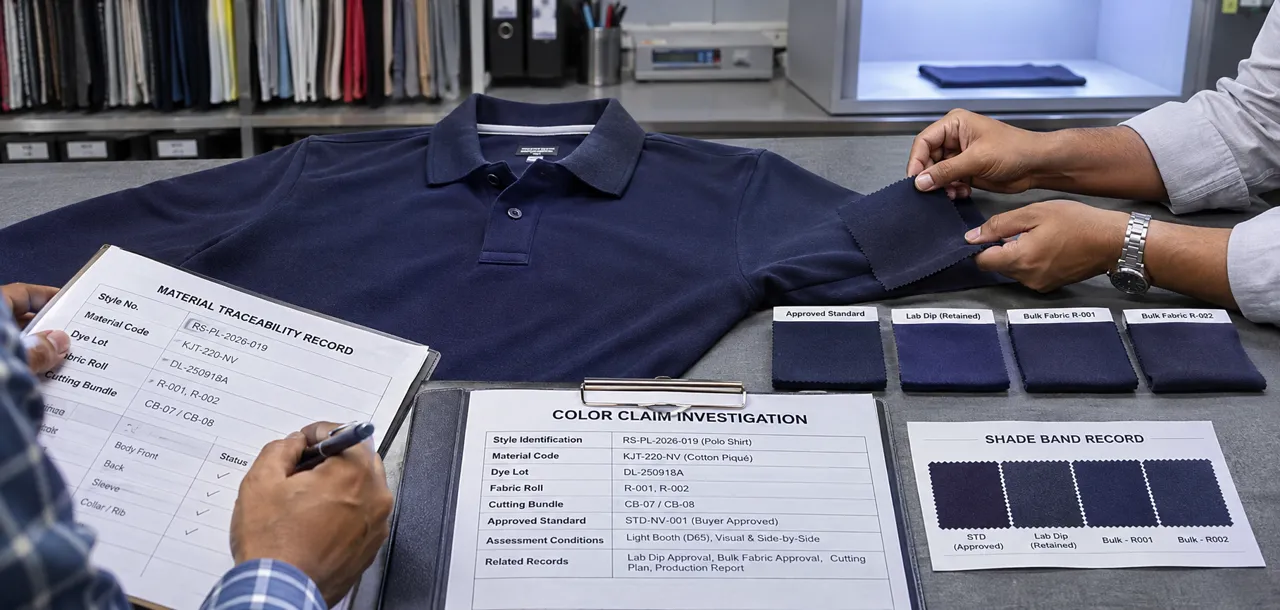
A color claim may arise when supplied material or finished garments fail to meet the agreed shade requirements. The disagreement may concern the overall color, lot consistency, panel shading, or appearance following an applicable processing operation.
Color claims are easier to investigate when all parties have retained the correct standards, submissions, measurements, and approval decisions.
Common Process Risk Points
A process risk point is a stage where an uncontrolled decision or production condition may cause an unacceptable result.
| Risk Point | Possible Consequence | Preventive Action |
|---|---|---|
| Unclear Color Standard | Conflicting interpretations | Identify the approved reference |
| Wrong Lab Dip Substrate | Bulk shade mismatch | Confirm material and processing condition |
| Uncontrolled Lighting | Disagreement during evaluation | Specify viewing conditions |
| Missing Delta E Method | Inconsistent numerical results | Record formula and procedure |
| Unapproved Bulk Shade | Material released outside requirements | Establish a bulk approval gate |
| Mixed Shade Groups | Visible panel shading | Control cutting and bundle traceability |
| Changed Finishing Route | Altered final appearance | Review and reapprove affected requirements |
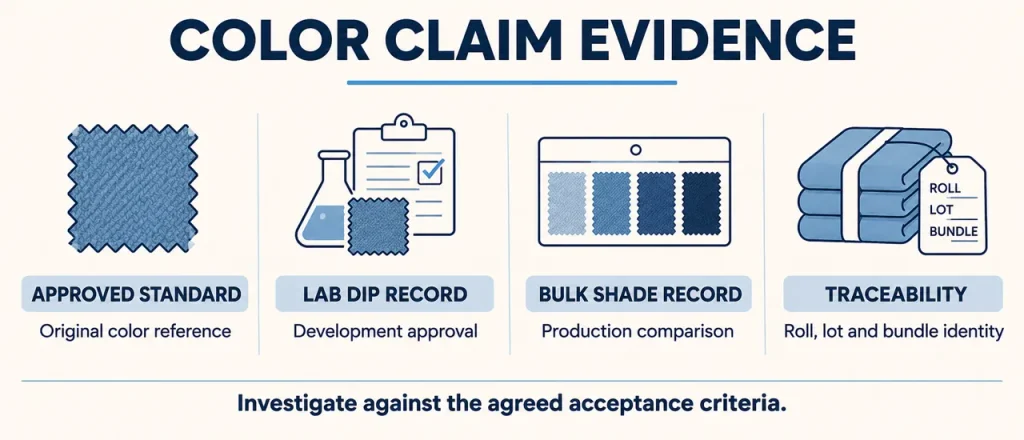
Color Claim Evidence Checklist
When investigating a possible shade failure, the buyer and supplier should collect:
- Approved color reference and relevant retained swatches.
- Lab dip submission and approval records.
- Bulk shade cloth and shade band evaluation records.
- Dye lot, roll, and production identification.
- Defined viewing conditions and evaluation procedure.
- Spectrophotometer results and settings, if applicable.
- Relevant colorfastness reports.
- Cutting, sewing, or processing traceability records.
- Representative samples of the affected material or garments.
- Documented communications and authorized changes.
The investigation should determine which requirement was not met, which material or production stages were affected, and whether the evidence supports the reported deviation.
Corrective actions may include additional sorting, controlled reprocessing, replacement material, or an agreed commercial resolution. The appropriate outcome depends on technical feasibility, contractual requirements, and the actual extent of the problem.
How to Record Color Approval in Fabric Specifications
The fabric specification and technical approval documents should identify the requirements that control color development and bulk manufacturing.
At minimum, relevant documents should include the color reference, fabric identity, viewing conditions, acceptance method, lab dip approval status, bulk shade requirements, and reapproval triggers.
A properly prepared fabric specification sheet also connects these color requirements with composition, construction, finishing, and applicable testing conditions.
Reapproval Triggers: A material change, new dyeing route, altered finishing treatment, different supplier, or other change affecting an approved requirement should trigger an assessment of whether renewed approval or verification is necessary.
Clear documentation protects both buyers and manufacturers by making responsibilities and decisions traceable.
Frequently Asked Questions About the Color Approval Process
1. What is the color approval process in clothing manufacturing?
The color approval process is a documented system for establishing, evaluating, and maintaining approved fabric or garment colors. It includes relevant laboratory submissions, bulk shade verification, evaluation conditions, and production controls.
2. What is lab dip approval, and when should I request it?
Lab dip approval confirms whether a laboratory-dyed sample meets the specified color requirements. For custom-dyed fabric, it is normally requested during development before the relevant bulk dyeing operation is authorized.
3. What is the difference between lab dip approval and strike-off approval?
Lab dip approval focuses on dyed material shade, while strike-off approval evaluates printing on the intended fabric. Both require identifiable references and appropriate evaluation conditions.
4. What is bulk shade cloth, and why is it needed after lab dips?
Bulk shade cloth represents fabric produced through actual bulk processing. It helps determine whether the achieved production shade remains acceptable against the approved reference.
5. What is a shade band, and how does a color continuity card work?
A shade band presents variation found in bulk material for evaluation and grouping. A color continuity card preserves identifiable approved references for consistent evaluation across relevant production stages or repeat orders.
6. What is Delta E, and what is an acceptable Delta E tolerance?
Delta E expresses a calculated color difference between a standard and a sample. Acceptable tolerance depends on the agreed formula, measurement conditions, material, shade, and buyer requirements.
7. Do I need a spectrophotometer for color matching, or is visual approval enough?
Controlled visual approval may be suitable for some requirements, while spectrophotometers provide useful numerical evidence for repeatable evaluation. The appropriate approach depends on the color risk and agreed approval procedure.
8. Why do colors match in a light box but mismatch under another light source?
Different illumination can change the perceived appearance of materials. Metamerism may cause two samples to appear similar under one light source but different under another.
9. How do I test colorfastness before bulk production?
Identify the relevant exposures, select appropriate testing methods, and establish acceptance criteria. Evaluate representative development material and require further production verification according to the agreed testing plan.
10. What evidence should I collect to raise a color claim fairly?
Collect approved standards, submission records, bulk shade approvals, relevant laboratory results, and traceability information. Evaluate the affected material using the agreed requirements and conditions before determining responsibility or corrective action.
Conclusion: Building a Reliable Color Approval Process
A successful color approval process connects the buyer’s color expectations with the realities of textile dyeing, finishing, and garment manufacturing.
The most important controls are clear color references, accurate lab dip submissions, properly evaluated bulk shades, consistent lighting and measurement conditions, appropriate fastness requirements, and traceable cutting decisions.
No single Pantone code, lab dip, Delta E result, or final inspection can guarantee complete color consistency. Reliable outcomes depend on coordinated approvals and appropriate controls throughout the manufacturing process.
RYZEAL SOURCING helps clothing brands coordinate material development, sampling, sourcing, and production through a vetted network of specialized manufacturing partners in Bangladesh. Our team supports clear technical communication and approval follow-up so buyers can make informed manufacturing decisions.
Start Your Custom Apparel Sampling
Have a clothing design, fabric reference, or specific color requirement? Share your product details with RYZEAL SOURCING to discuss sample development and suitable manufacturing options through our partner network in Bangladesh.
The goal is not to eliminate every possible shade difference. It is to establish what variation is acceptable, verify production against the approved requirements, and prevent uncontrolled differences from reaching the finished garment.
Connect with RYZEAL SOURCING