
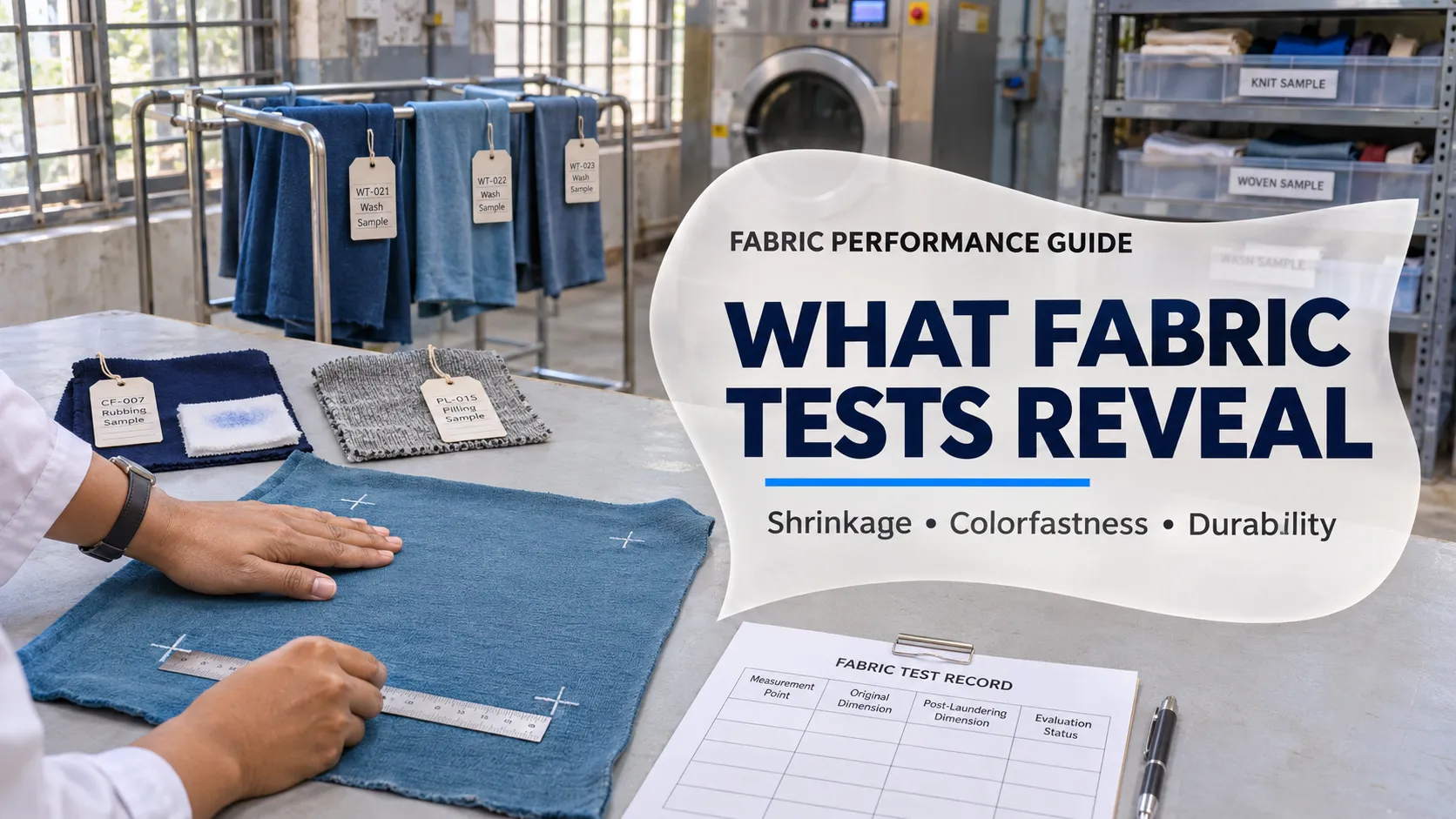
Fabric testing is the systematic evaluation of textile materials using defined test methods to determine whether they meet specified quality, performance, and durability requirements. In clothing manufacturing, it helps buyers verify properties such as dimensional stability, colorfastness, pilling resistance, spirality, fabric strength, and other characteristics before materials are approved for production.
A fabric may look excellent during sampling but behave differently after washing, rubbing, stretching, or prolonged use. Without appropriate testing, shrinkage can affect garment measurements, poor colorfastness can cause fading or staining, and fabric pilling can damage surface appearance. Spirality may also cause knitted garments to twist after laundering, even when their original measurements were acceptable.
Effective fabric testing converts these risks into measurable requirements. Instead of relying on descriptions such as “good quality,” “low shrinkage,” or “durable fabric,” buyers establish appropriate test methods, acceptance criteria, testing stages, and documented approval decisions. This provides a clearer basis for communication between brands, textile mills, laboratories, and garment manufacturers.
This guide explains the most important types of fabric testing for apparel, how testing laboratories and in-house quality teams work together, when tests should be performed, and how to interpret laboratory reports. It also includes practical checklists and a minimum fabric testing matrix that buyers can adapt to their product specifications.
The starting point is selecting materials suitable for the product’s intended use. A structured approach to fabric selection for clothing manufacturing helps identify which performance characteristics require verification before bulk production.
Table of Contents
What Does Fabric Testing Cover in Apparel Manufacturing?
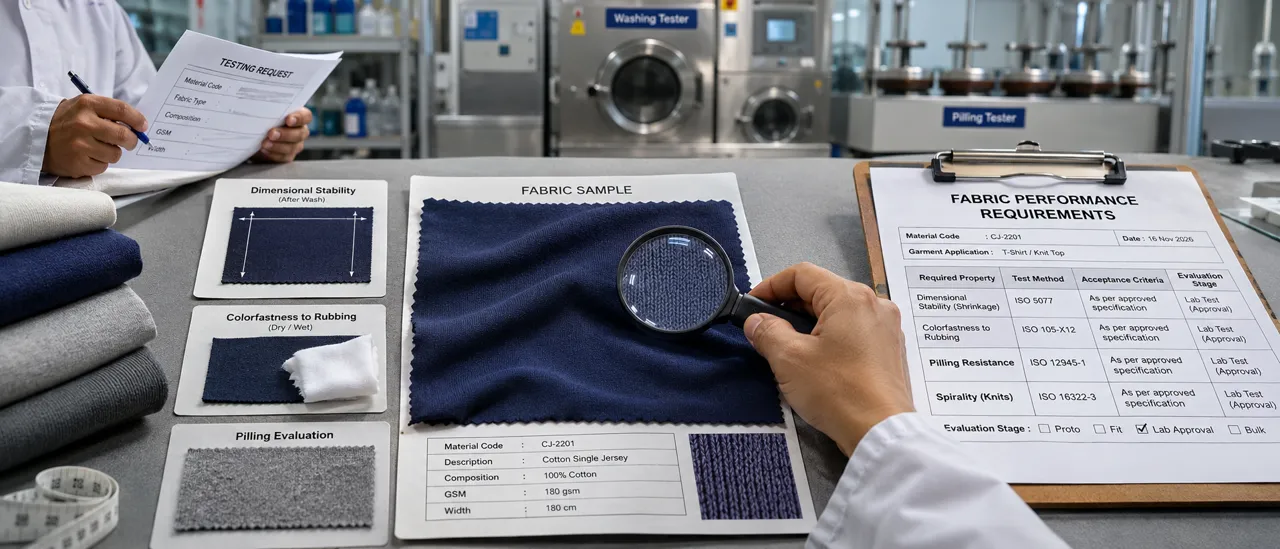
Fabric testing evaluates measurable material properties under controlled conditions. Its purpose is to establish whether a textile meets the requirements of a particular garment, rather than simply determining whether the material looks or feels attractive.
Different fabric testing methods examine different performance risks. Dimensional stability tests measure changes in fabric size, colorfastness tests evaluate color change or transfer, and surface durability tests assess problems such as pilling and abrasion.
Fabric Testing vs Fabric Inspection vs Garment Quality Control
These activities are related, but they serve different purposes.
| Quality Control Activity | Main Purpose | Typical Examples |
|---|---|---|
| Fabric Laboratory Testing | Measure material performance under defined conditions | Shrinkage, colorfastness, pilling, strength |
| Fabric Inspection | Identify visible defects and bulk material variation | Holes, stains, bars, uneven shade |
| Garment Quality Control | Evaluate finished garment construction and conformity | Measurements, stitching, workmanship, appearance |
| Garment Performance Testing | Verify relevant finished-product characteristics | Post-wash fit, seam performance, garment spirality |
A fabric that passes laboratory performance tests may still contain unacceptable manufacturing defects. Similarly, a garment may have excellent stitching but fail after laundering because its material has poor dimensional stability.
Fabric Quality Testing: Verification of selected physical, chemical, or performance properties against defined requirements.
Fabric Performance Test: A method used to evaluate how a material behaves under a particular condition, such as washing, rubbing, stretching, or exposure to light.
Fabric Testing Parameters: The conditions and measurements required to conduct and interpret a test, including specimen preparation, equipment settings, procedures, and reporting criteria.
A complete quality-control plan combines material testing with appropriate receiving inspection and production checks. It does not assume that one successful laboratory result guarantees the performance of every garment manufactured from that material.
Fabric Testing Laboratory vs In-House Checks: Who Should Test What?
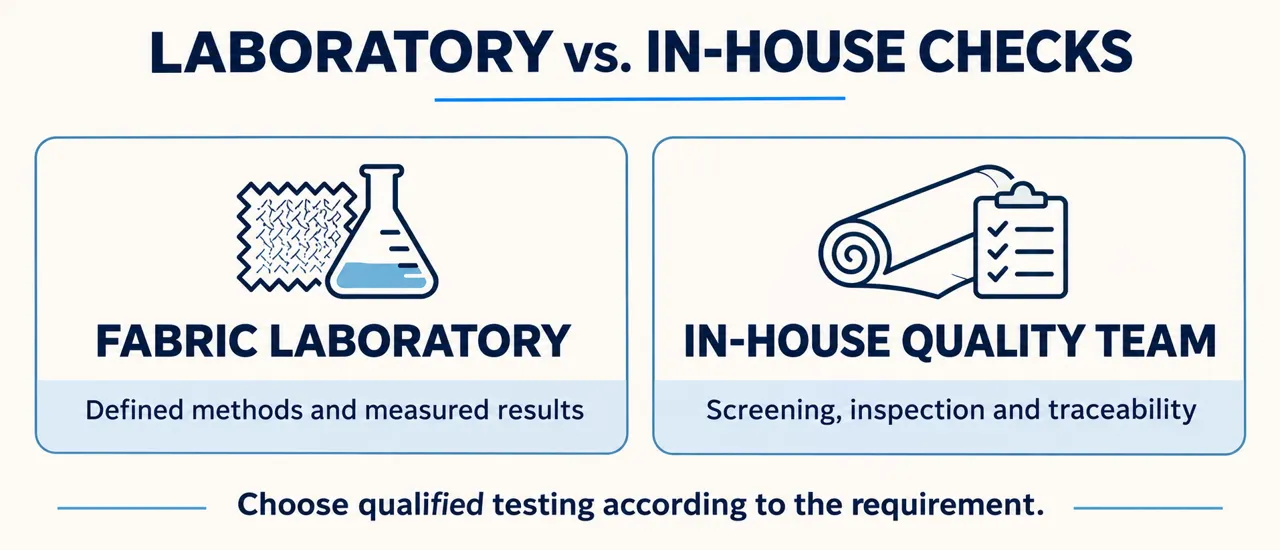
A fabric testing laboratory uses specialized instruments, controlled procedures, and documented methods to measure textile properties. Depending on the requirements, testing may be performed by a supplier’s qualified internal laboratory or an independent third-party laboratory.
Independent testing is particularly useful when buyers require impartial verification, specified accreditation, or reports from an approved laboratory.
What Equipment Is Used for Fabric Testing?
Common fabric testing equipment includes laboratory washing and drying machines, rubbing testers, Martindale pilling and abrasion instruments, tensile-strength machines, bursting-strength testers, air-permeability instruments, thickness gauges, and electronic balances.
Each fabric testing machine performs a particular function. Selecting the correct instrument is important because different equipment and procedures may measure different properties, even when their results appear similar.
For example, a thickness gauge measures fabric thickness under specified conditions, while a GSM cutter and balance can be used to determine fabric mass per unit area.
What Can In-House Quality Teams Check?
In-house teams can perform useful screening and receiving inspections before submitting materials for formal laboratory verification.
These checks may include:
- Reviewing fabric width, GSM, appearance, and visible defects.
- Comparing color against approved physical references.
- Checking identification labels and material traceability.
- Performing preliminary absorbency or wetting checks when relevant.
- Screening dimensional changes through controlled internal wash trials.
- Identifying potentially incorrect materials before costly testing.
A basic fabric burn test is sometimes used for preliminary fiber identification, but burning behavior cannot conclusively establish fiber composition. Fiber blends, finishes, and chemical treatments can affect observations, so reliable composition verification requires an appropriate identification method.
What Must a Fabric Lab Test Report Include?
A useful fabric lab testing report must identify the tested material and explain how the reported results relate to the buyer’s requirements.
Approval-Ready Fabric Testing Report Checklist:
- Laboratory identity and report number.
- Buyer, supplier, and sample identification.
- Fabric composition, construction, and relevant sample condition.
- Production lot or material reference, where applicable.
- Test method and applicable edition or procedure.
- Equipment or conditioning information when required.
- Actual results, units, and grades.
- Buyer acceptance criteria or referenced specification.
- Pass/fail decision when the laboratory is authorized to assess conformity.
- Test date, relevant observations, and report authorization.
A measured result and an approval decision are not the same thing. If the laboratory reports a dimensional change of -4%, the buyer must compare that result with the agreed requirement before determining whether the material passes.
When Should Fabric Testing Be Performed?
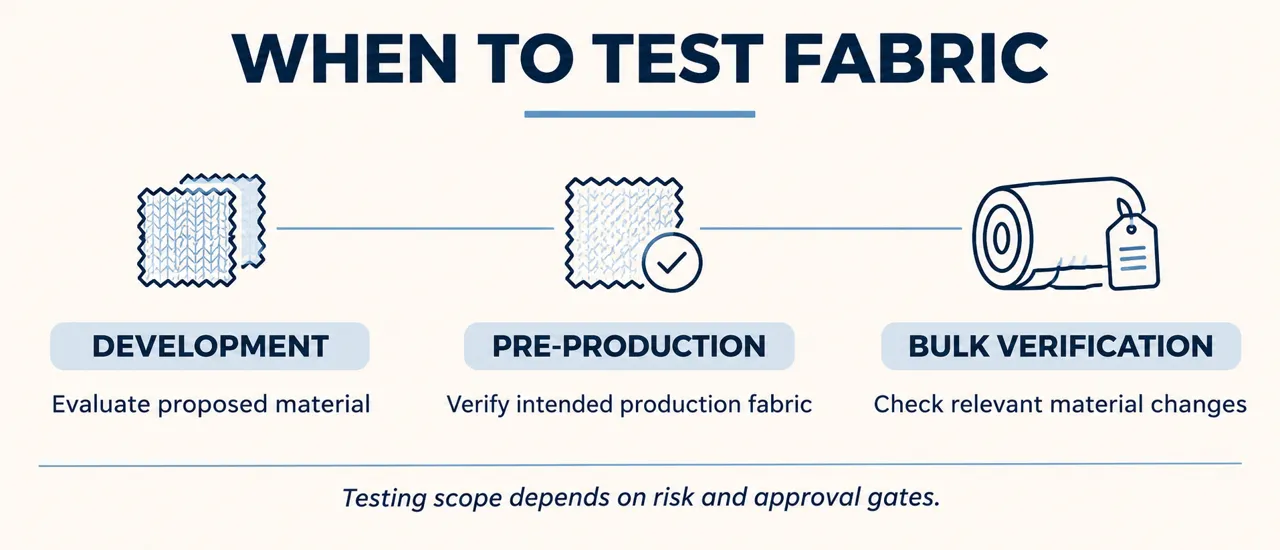
Fabric testing should be planned around material development, production approval, and relevant bulk verification stages. The objective is to identify problems early enough to correct them without unnecessarily repeating every possible test.
Development Testing
Development-stage testing evaluates proposed materials before important product decisions are finalized.
For example, a brand developing a fitted cotton jersey T-shirt may investigate shrinkage, spirality, colorfastness, and pilling before approving the fabric and fit.
If the results are unsuitable, the supplier can review fabric construction, yarn, processing, or finishing options before bulk commitments increase.
Pre-Production Testing
Pre-production testing verifies that the selected production material meets the agreed specifications before the activities controlled by the approval are released.
The test specimen should represent the relevant finished fabric condition, including dyeing and finishing treatments that may influence performance.
A test performed on unfinished development fabric should not automatically be treated as evidence that the final processed bulk fabric meets the same requirements.
Bulk Verification and Retesting
Bulk fabric testing helps detect changes associated with production lots, suppliers, or processing conditions. The frequency and scope should reflect the buyer’s quality plan and the material’s actual risk.
Potential retesting triggers include a new dyeing route, changed fabric composition, modified finishing treatment, new manufacturing source, or unexpected bulk performance.
Approval Gate: The buyer and supplier should identify which testing results must be accepted before the related material is released for cutting, processing, or shipment.
A documented approval workflow helps assign responsibility for reviewing test results and deciding whether the affected production activity can proceed.
Dimensional Stability Testing and Fabric Shrinkage Tests
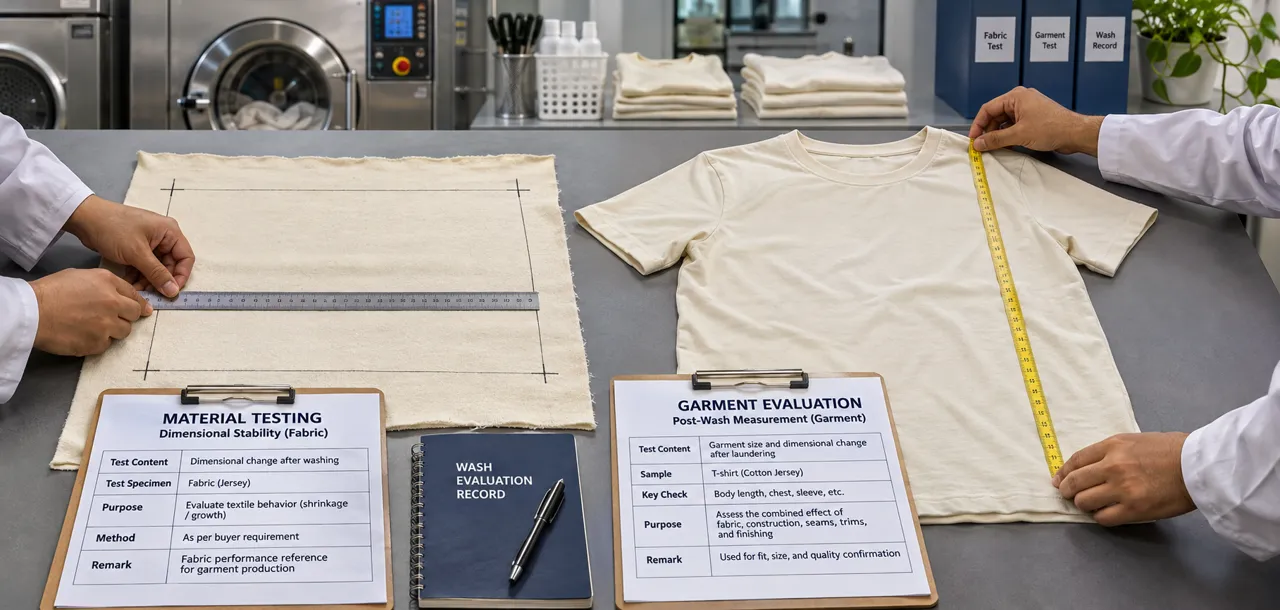
Dimensional stability testing evaluates how textile dimensions change after defined treatments, commonly washing and drying. It is particularly important for garments where post-wash changes can affect fit, length, width, and overall appearance.
A fabric shrinkage test measures reductions in dimension under the specified procedure. Dimensional stability is the broader concept because fabric can either shrink or grow.
How Does a Fabric Shrinkage Test Work?
A typical dimensional-change assessment involves preparing and conditioning a representative specimen, recording initial measurements, applying a specified washing and drying procedure, and measuring the specimen afterward.
The result is calculated separately for relevant directions, usually length and width.
Dimensional Change (%): ((After Measurement – Before Measurement) / Before Measurement) × 100
Shrinkage (%): ((Before Measurement – After Measurement) / Before Measurement) × 100
For example, suppose a marked fabric length measures 50 cm before washing and 48.5 cm afterward.
Dimensional Change: ((48.5 – 50) / 50) × 100 = -3%
This indicates 3% shrinkage in the measured direction. A positive dimensional-change result would indicate growth instead.
The figures above are illustrative, not universal acceptance limits.
Fabric Shrinkage Standards: ISO 6330 and ISO 5077
Two important standards work together in dimensional stability testing.
ISO 6330:2021: Specifies domestic washing and drying procedures used in textile testing. It defines relevant laundering conditions rather than establishing a universal permissible shrinkage percentage.
ISO 5077:2007: Specifies the determination of dimensional change after appropriate washing and drying procedures. It provides a measurement framework, while acceptable performance remains dependent on the applicable product specification.
Buyers should specify the laundering procedure, drying method, number of cycles, measurement directions, and acceptance criteria. Results from different washing or drying procedures should not be treated as automatically comparable.
Fabric Wash Test vs Garment Wash Test
A wash test for fabrics evaluates material behavior before garment assembly. A garment wash test examines the assembled product and can reveal additional changes caused by construction, seams, trims, garment washing, and finishing.
Both may be necessary when the finished garment will undergo processing that differs from the original fabric testing conditions.
Shrinkage Control Test Plan
| Fabric Type | Main Risk | Recommended Evaluation | Reporting Requirement |
|---|---|---|---|
| Cotton Single Jersey | Length or width change | Dimensional stability and relevant spirality checks | Directional % change and agreed limit |
| Knit Fleece | Relaxation shrinkage and surface change | Wash stability and pilling assessment | % change and appearance results |
| Woven Poplin | Dimensional change affecting fit | Specified laundering and dimensional measurement | Length/width % and pass/fail |
| Denim | Changes following garment washing | Production-representative wash assessment | Post-wash dimensions and appearance |
These are suggested evaluation categories, not fixed testing requirements for every fabric.
For buyers, dimensional stability results should be reviewed alongside garment measurements and fitting requirements. A material can appear acceptable before washing yet produce unacceptable garment dimensions after the intended care process.
The following demonstration introduces fabric shrinkage testing, including specimen measurement, washing evaluation, and dimensional-change calculation.
Color Fastness Testing: Preventing Fading, Staining, and Color Transfer
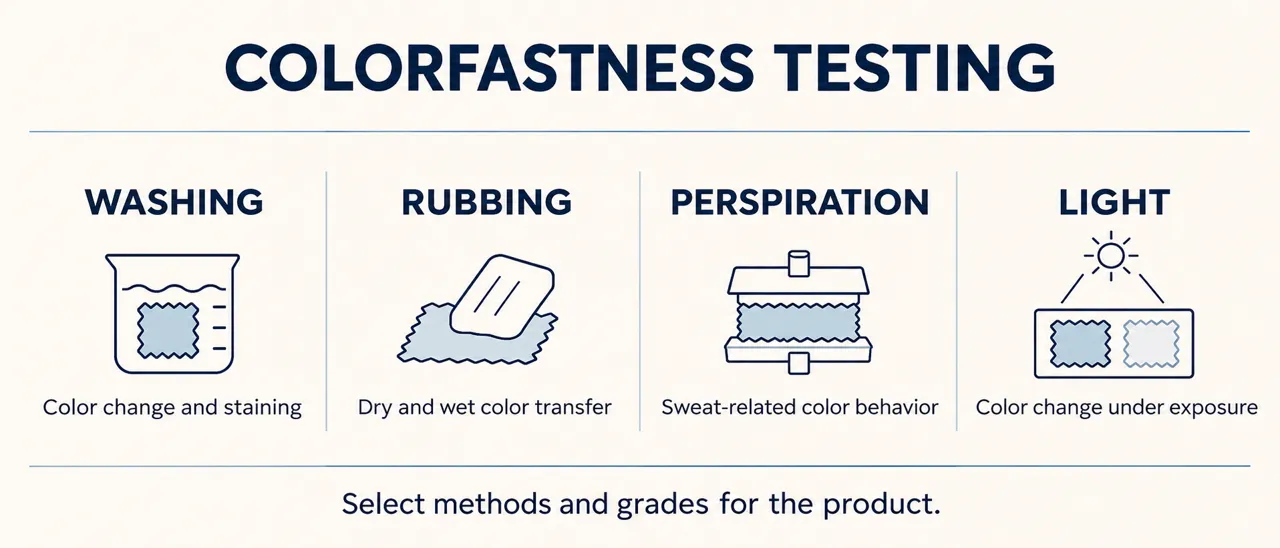
Color fastness testing measures how a textile’s color responds to specific exposures, such as washing, rubbing, perspiration, and light. It helps buyers assess whether dyed or printed materials meet the required performance characteristics during intended use and care.
A fabric can match its approved color reference but still experience unacceptable fading or staining. Therefore, the testing plan should address both initial color appearance and performance after relevant exposures.
What Is a Color Fastness Test?
A color fastness test for fabrics evaluates color change, staining, or transfer under a defined procedure.
Color Change: An alteration in the original shade of the tested material.
Staining: Color transferred onto an adjacent material during the test.
These outcomes should be distinguished because the same fabric can perform differently for color retention and staining resistance.
Rubbing Fastness and Crocking Tests
A rubbing fastness test, also known as a crocking test, evaluates the transfer of color from a textile surface during controlled rubbing.
Dry and wet rubbing are commonly evaluated separately because moisture can influence color transfer.
This matters for dark garments, denim, prints, and fabrics that frequently contact skin, bags, footwear, or lighter-colored materials.
Color Fastness to Washing, Perspiration, and Light
Washing Fastness: Evaluates color change and staining after specified laundering exposure. It is especially important for garments intended for repeated home washing.
Perspiration Fastness: Assesses color behavior under defined artificial perspiration conditions. It can be relevant to activewear, uniforms, underwear, and garments exposed to frequent sweating.
Lightfastness: Evaluates color change after exposure to a defined light source. The applicable method and rating system should be identified, particularly for outdoor clothing and products subject to prolonged light exposure.
Different color fastness test methods may use different specimen preparation, exposure procedures, grading scales, and reporting conventions. AATCC publishes established colorfastness testing methods, including TM8 for crocking, TM15 for perspiration, TM16 for light, and TM61 for accelerated laundering.
Minimum Color Fastness Test Matrix
| Exposure | Example Method | Result to Record | Main Risk |
|---|---|---|---|
| Washing | AATCC TM61 | Color change and staining grades | Fading and staining |
| Dry/Wet Rubbing | AATCC TM8 | Separate dry and wet results | Color transfer |
| Perspiration | AATCC TM15 | Relevant color change and staining results | Sweat-related staining |
| Light | AATCC TM16, applicable option | Lightfastness result and grading system | Color change under light |
The methods listed are examples. Buyers may use applicable ISO or other recognized methods when agreed with the supplier.
A laboratory’s reported grade should be compared with a buyer-approved acceptance criterion rather than assuming that every test has the same passing requirement.
A documented color approval process connects initial shade development with bulk shade evaluation, controlled viewing conditions, and relevant colorfastness requirements.
Fabric Pilling, Snagging, and Abrasion Resistance Testing
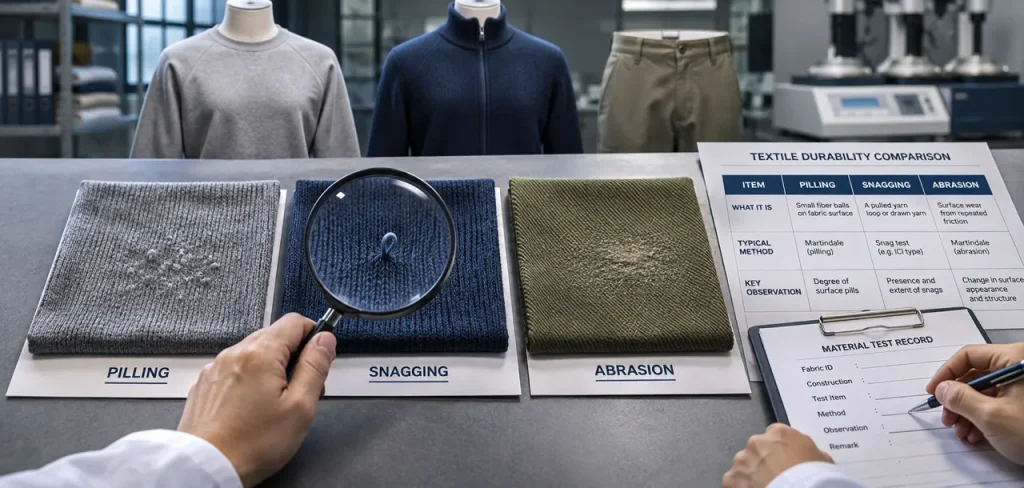
Surface durability is an important part of fabric testing because deterioration may become visible through normal wear, washing, or repeated contact with other materials.
Pilling, snagging, and abrasion are related to fabric durability, but they describe different behaviors and require appropriate evaluation methods.
What Is a Fabric Pilling Test?
A fabric pilling test evaluates a textile’s tendency to develop small, tangled collections of fibers on its surface after controlled mechanical action.
Pilling depends on several factors, including fiber characteristics, yarn structure, fabric construction, finishing, and exposure conditions.
A fabric containing polyester is not automatically unsuitable, and cotton does not automatically guarantee low pilling. The actual material and its construction must be evaluated.
ISO 12945-2:2020 specifies a modified Martindale method for assessing the tendency of textile fabrics to develop pilling, fuzzing, and matting.
Fabric Snagging and Abrasion Resistance
Fabric Snagging Test: Evaluates the tendency of yarns or loops to be pulled from the fabric surface during contact with an object or testing element.
Abrasion Resistance Test: Evaluates a fabric’s resistance to deterioration caused by mechanical rubbing under specified conditions.
Snagging may be particularly relevant for exposed knit structures, while abrasion resistance can be important for workwear, uniforms, trousers, and garments with high-contact areas.
A Martindale instrument can support both abrasion and pilling testing, but the applicable procedures and evaluation criteria are different.
Pilling and Surface Durability Risk Checklist
Before approving fabric, buyers should consider:
- Fiber composition and yarn characteristics.
- Knit or woven construction.
- Brushed, raised, or otherwise modified surfaces.
- Garment use and expected contact conditions.
- Relevant washing and finishing treatments.
- Test method, assessment stage, and grading criteria.
A pilling grade is meaningful only when accompanied by the relevant method and evaluation conditions. The buyer should establish the acceptable result according to the garment’s intended use.
The following laboratory demonstration illustrates the modified Martindale approach used to evaluate a textile’s tendency to develop surface fuzzing and pilling.
Spirality Testing for Knitted Fabrics: Preventing Garment Twisting
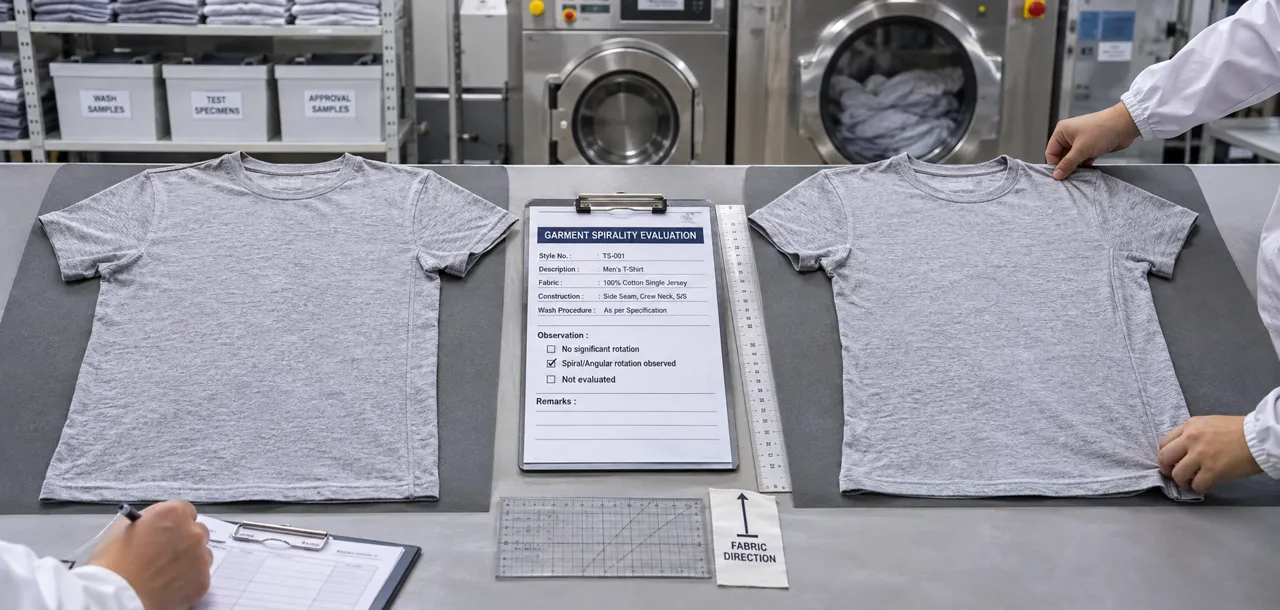
Spirality describes a tendency for textile structures or finished garments to develop angular distortion or twisting. In knitted garments, it may become particularly visible when side seams move away from their intended positions after laundering.
A spirality test for knitted fabrics helps buyers evaluate this risk before committing to bulk garment production.
Why Does Spirality Occur?
Spirality can be influenced by yarn twist, knitting construction, fabric relaxation, finishing conditions, and other manufacturing factors.
Certain single jersey and tubular knitted fabrics may be more susceptible to visible distortion. However, the risk cannot be determined from construction name alone.
Shrinkage and spirality should not be treated as identical properties. A fabric may show acceptable dimensional change while still displaying objectionable angular distortion.
Fabric Spirality vs Garment Spirality
Fabric spirality testing assesses the behavior of a textile specimen, while garment testing evaluates the finished product after the specified treatment.
ISO 16322-3:2021 covers the measurement of spirality or torque in woven and knitted garments after domestic laundering. It provides procedures for assessing post-laundering distortion rather than the initial appearance of an unwashed garment.
Spirality Control Plan
| Material or Product | Important Risk | Evaluation Stage | Acceptance Requirement |
|---|---|---|---|
| Single Jersey | Post-wash twisting | Development and production-representative sampling | Agreed spirality result |
| Tubular Knit | Angular distortion after relaxation | Development and relevant bulk verification | Agreed fabric test result |
| Knit T-Shirt | Side seam rotation | Finished garment wash evaluation | Buyer-defined garment limit |
| Denim Garment | Leg twisting after washing | Relevant garment wash assessment | Approved appearance and distortion criteria |
The appropriate test method, measurement format, and permissible result should be established before testing.
If spirality is unacceptable, possible corrective actions may involve reviewing yarn properties, knitting parameters, fabric finishing, garment construction, or washing procedures. Any change should be verified before the affected material or product is approved.
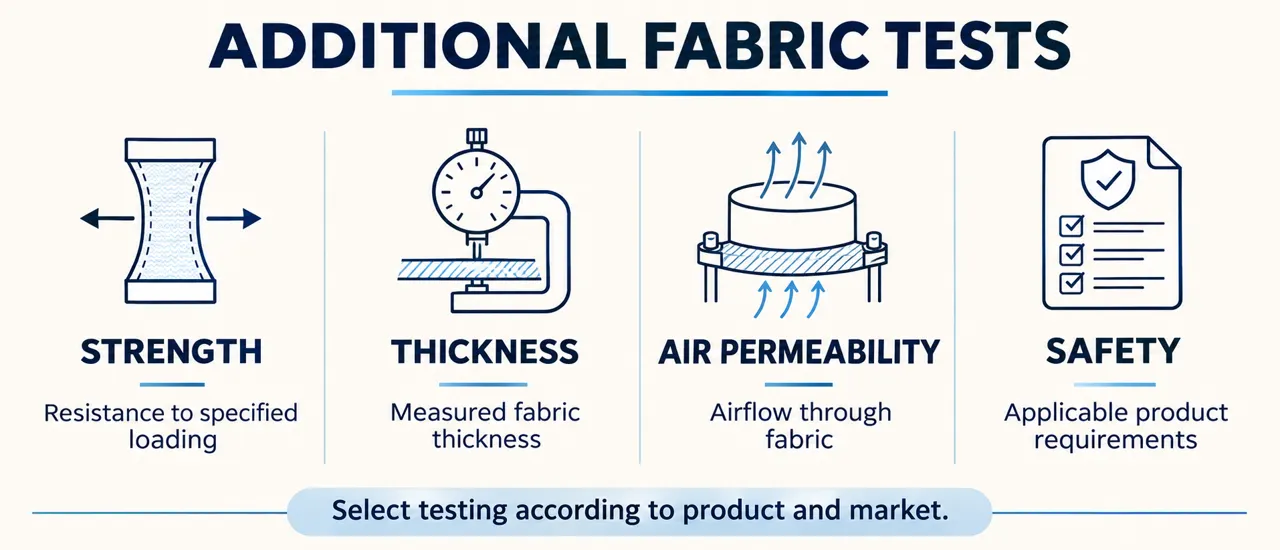
Additional Physical Fabric Testing: Strength, Thickness, Breathability, and Safety
Not every garment requires an extensive test program. However, buyers should understand which additional fabric physical testing methods may be relevant to their product.
Strength and Seam Performance
Bursting Strength of Knitted Fabric: Measures resistance to rupture under multidirectional loading using the specified test method. It is commonly relevant to knitted materials.
Tensile Strength of Woven Fabric: Measures resistance to pulling forces in a specified direction. It can help evaluate suitability for garments exposed to mechanical stress.
Seam Slippage Test: Evaluates yarn displacement at or near a seam under defined loading conditions. This can be important for loose woven constructions and garments where seam appearance or integrity is critical.
A seam slippage test method should specify the relevant procedure, specimen preparation, and acceptance requirement. Strength and seam-slippage results are not interchangeable.
Fabric Thickness, GSM, and Air Permeability
A fabric thickness test measures thickness under defined pressure and measurement conditions.
GSM measures fabric mass per unit area. Two fabrics can have similar GSM but different thickness because of yarn characteristics, construction, or finishing.
An air permeability test for fabric measures airflow through textile material under specified conditions. This may support evaluation of ventilation-related performance, but it does not automatically establish moisture-vapor permeability or overall wearer comfort.
Similarly, an absorbency test for fabric evaluates a specific wetting or absorption property. The correct method depends on whether the buyer needs to evaluate water absorption, wicking, drying, or another moisture-management characteristic.
Fabric Flammability and Identification Tests
A fabric burn test may provide preliminary observations relevant to fiber identification. However, visual burning behavior is not reliable proof of exact fiber composition, particularly for blends and treated textiles.
A flammability test for fabric is different. It evaluates specified fire-related behavior according to an applicable laboratory method or regulatory requirement.
Testing requirements depend on the product category and destination market. Children’s sleepwear, protective clothing, and other regulated products may be subject to requirements different from those for general apparel.
A fabric flammability test standard must be selected according to the relevant product and legal requirements. A general burn test chart cannot substitute for compliance testing.
Specialized claims, such as antimicrobial performance, also require suitable methods and evidence. Buyers should not infer antimicrobial effectiveness from ordinary fabric quality testing.
Physical Testing Menu by Fabric Type
| Fabric Category | Possible Testing Priorities |
|---|---|
| Knit Jersey | Bursting strength, stability, spirality, pilling |
| Woven Shirting | Tensile strength, seam slippage, dimensional stability |
| Denim | Strength, abrasion, colorfastness, wash stability |
| Activewear | Extension, recovery, moisture management, perspiration fastness |
| Specialized Apparel | Product-specific safety, durability, and performance requirements |
These testing priorities should be selected according to actual product risk, not applied as universal standards.
Fabric Inspection and GSM Verification: Controlling Bulk Material
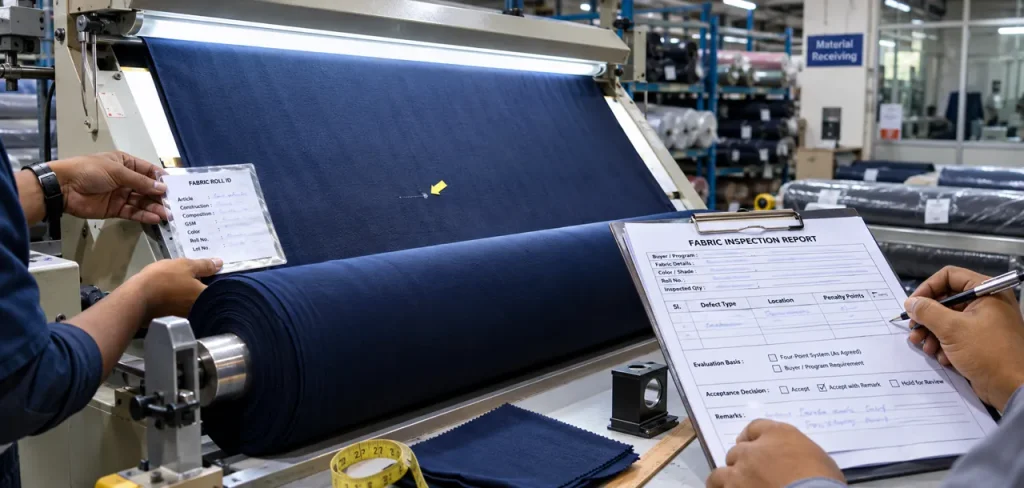
Laboratory testing cannot identify every defect present in delivered fabric rolls. Even when a representative specimen passes performance testing, other parts of the shipment may contain weaving, knitting, dyeing, printing, or finishing defects.
Fabric inspection therefore complements laboratory verification.
Four-Point Fabric Inspection
The four-point fabric inspection system is a widely used approach in which identified fabric defects receive assigned penalty points under an agreed grading procedure.
Depending on the agreed system, the inspection may consider holes, stains, bars, missing yarns, printing defects, contamination, and other visible abnormalities.
ASTM D5430-26 provides recognized methods for visually inspecting and grading fabrics. The grading option, reporting basis, sampling plan, and commercial acceptance limit should be agreed rather than assumed.
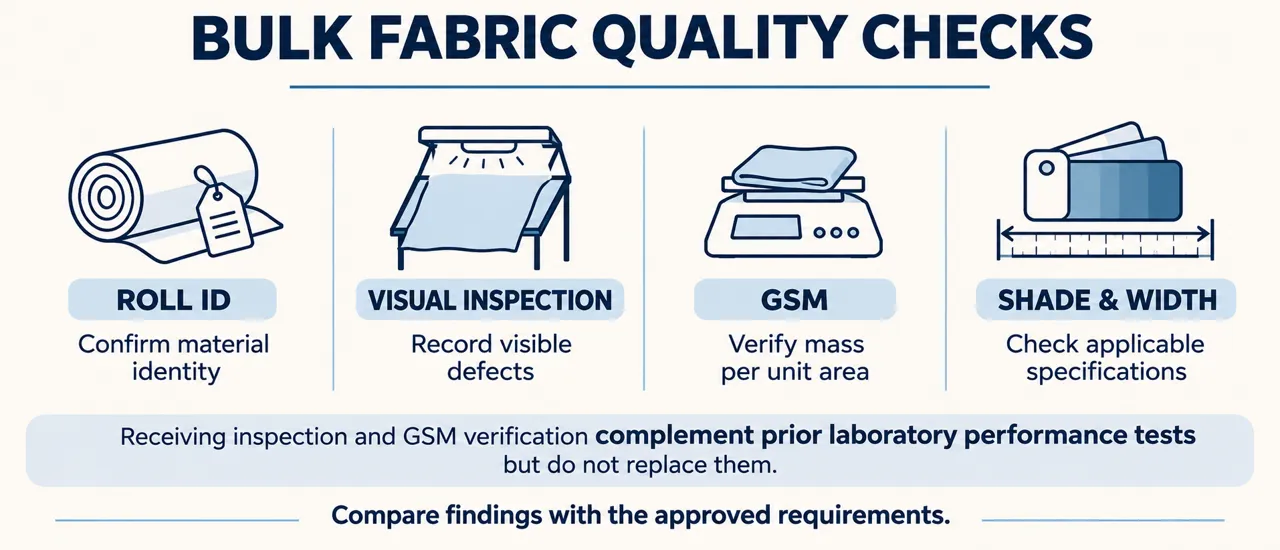
Fabric Receiving Inspection Checklist:
- Verify material identification and received quantity.
- Check roll labeling, width, and shade information.
- Inspect for visible defects under appropriate conditions.
- Record defect type, location, and relevant grading details.
- Compare material characteristics with approved specifications.
- Segregate questionable material pending review.
GSM Testing and Fabric Weight Control
A GSM testing method determines fabric mass per square meter using a defined sampling and weighing procedure.
Buyers should identify whether GSM is being measured before or after relevant finishing operations. Changes in processing can influence the final measured weight.
The selected method and testing condition should remain consistent when comparing development samples with production fabric.
GSM verification supports material specification and commercial consistency, but it does not independently confirm fabric strength, thickness, or performance.
Minimum Fabric Testing Matrix Buyers Can Attach to Specifications
A minimum fabric testing matrix translates product risks into specific verification requirements. It should identify the test, method, sample stage, evidence provider, and acceptance decision.
The matrix below is a practical starting point. Each buyer should adjust it for the fabric, garment category, destination market, and relevant quality requirements.
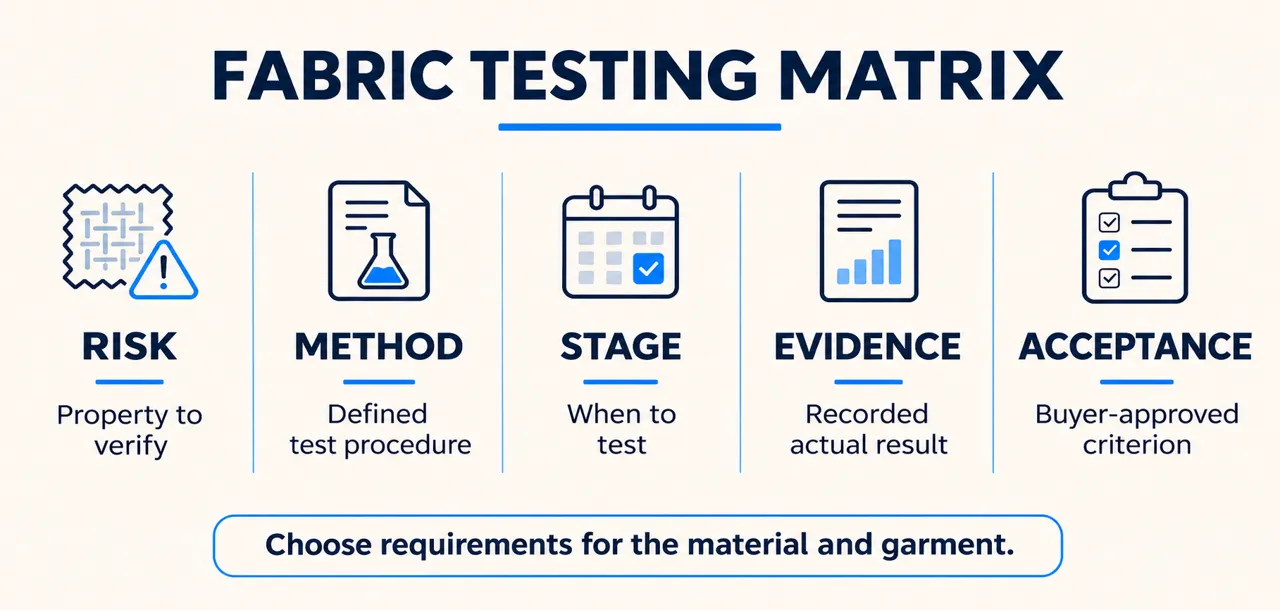
| Risk | Required Test | Example Method | Testing Stage | Evidence / Acceptance |
|---|---|---|---|---|
| Dimensional Change | Shrinkage / stability | ISO 6330 + ISO 5077 | Development, PP, risk-based bulk | Directional % vs agreed limit |
| Washing Colorfastness | Color change and staining | AATCC TM61 | Development, relevant bulk | Recorded grades vs buyer target |
| Rubbing Transfer | Dry/wet crocking | AATCC TM8 | Development, relevant bulk | Separate results vs target |
| Perspiration | Sweat fastness | AATCC TM15 | Development, as required | Applicable grades vs target |
| Light Exposure | Lightfastness | AATCC TM16 | Development, as required | Specified rating vs target |
| Surface Pilling | Pilling resistance | ISO 12945-2 | Development, PP as needed | Grade and assessment conditions |
| Garment Twisting | Spirality after wash | ISO 16322-3 | Development, PP | Measured result vs agreed limit |
| Strength | Bursting or tensile test | Applicable ASTM/ISO method | Development, as needed | Result and product requirement |
| Visual Defects | Fabric inspection | ASTM D5430 | Receiving / bulk | Inspection result vs agreed plan |
| Fabric Weight | GSM measurement | Agreed GSM method | Development and bulk | GSM vs specification |
PP means pre-production. The stages and methods above are examples rather than compulsory testing schedules for every order.
How to Read a Fabric Test Report Quickly
A buyer reviewing a laboratory report should answer five questions:
- Was the correct material tested? Confirm composition, construction, sample identity, and relevant production condition.
- Was the correct method used? Check the standard reference, procedure, and applicable testing parameters.
- What was the actual result? Review measurements, units, individual directions, and reported grades.
- Did it meet the agreed requirement? Compare results with the buyer’s documented acceptance criteria.
- What happens next? Record approval, conditional acceptance, rejection, corrective action, or additional verification.
A report without an identifiable specimen or applicable acceptance requirement cannot independently establish whether the buyer’s product specification has been satisfied.
Clear fabric specifications help connect laboratory results with the material properties and performance requirements approved before manufacturing.
What Happens When a Fabric Test Fails?
When a result falls outside the agreed requirement, the buyer and supplier should first verify the specimen identity, procedure, and applicable acceptance criterion.
The affected material may require investigation, corrective processing, replacement, additional testing, or an authorized commercial decision.
A failed result should not automatically trigger unrestricted retesting until a passing sample appears. Any retesting must follow the agreed procedure and reflect the actual material under evaluation.
[TBA – CTA: CTA Heading: ‘Explore Fabric Sourcing and Quality Assurance Support’ | CTA Para: ‘RYZEAL SOURCING helps clothing brands coordinate fabric sourcing, material specifications, sampling, manufacturing follow-up, and quality-control requirements through suitable manufacturing partners in Bangladesh. Explore how our services support organized apparel production.’ | CTA button: ‘Explore Our Services’ | CTA destination path: ‘/our-services/’]
Frequently Asked Questions About Fabric Testing
1. What is fabric testing, and when should a brand start it?
Fabric testing evaluates textile properties using defined methods and measurements. Brands should begin relevant testing during product development and verify production-representative materials at appropriate approval stages.
2. What is the difference between fabric lab testing and in-house checks?
Laboratory testing uses specified methods, controlled equipment, and documented procedures. In-house checks support preliminary screening, receiving inspection, and ongoing production control.
3. Which fabric testing methods are mandatory for first production?
There is no single universal fabric testing list for every garment. The required tests depend on the material, product category, buyer specifications, end use, and applicable regulatory requirements.
4. How do I read a fabric lab test report quickly?
Confirm the specimen identity, method, actual results, and acceptance criteria. Then check whether the tested material satisfies the approved requirements.
5. What is dimensional stability testing, and how is it different from shrinkage?
Dimensional stability testing evaluates changes in textile dimensions after defined treatment. Shrinkage describes a reduction in dimension, while the broader assessment also covers dimensional growth.
6. What is the minimum color fastness test plan for apparel?
The plan should address relevant exposures such as washing, rubbing, perspiration, and light. Required methods, grades, and testing stages depend on the garment’s intended use.
7. What is a fabric pilling test, and what grade should I request?
A fabric pilling test evaluates the tendency to develop surface pills or fuzz under specified conditions. The acceptable grade should be established according to the product’s requirements and the selected method.
8. When do I need a spirality test for knitted fabrics?
Spirality testing is particularly relevant when knitted fabric construction, finishing, or garment design creates a risk of visible twisting after laundering.
9. How does four-point fabric inspection reduce bulk surprises?
It provides a structured approach to identifying and grading visible fabric defects before cutting. The inspection should follow an agreed grading system and acceptance plan.
10. What changes require fabric retesting even when the material looks identical?
Changes in composition, supplier, dyeing process, finishing, or other performance-relevant conditions may require renewed verification. The scope of retesting should reflect the affected risks and buyer requirements.
Conclusion: Make Fabric Testing Part of Every Material Approval Decision
Effective fabric testing helps clothing brands move from material assumptions to documented performance evidence. Shrinkage, colorfastness, pilling, and spirality are especially important because their effects may become visible only after garments have been manufactured, washed, or worn.
A reliable testing plan identifies the required material properties, appropriate methods, acceptance criteria, testing stages, and approval responsibilities. Laboratory results should be supported by bulk fabric inspection, traceability, and relevant garment quality controls.
RYZEAL SOURCING helps brands manufacture clothing in Bangladesh through a vetted network of specialized manufacturing partners. Our sourcing, merchandising, and quality teams coordinate material requirements, development, production follow-up, and applicable quality verification with selected facilities.
[TBA – CTA: CTA Heading: ‘Discuss Your Apparel Manufacturing Requirements’ | CTA Para: ‘Planning a clothing collection or bulk apparel order? Share your garment specifications, fabric requirements, estimated quantities, and relevant testing expectations with RYZEAL SOURCING to discuss manufacturing feasibility, suitable production partners, and quotation options.’ | CTA button: ‘Request a Manufacturing Quote’ | CTA destination path: ‘/rfq-to-ryzeal-sourcing/’]
The objective is not to test every material for every possible property. It is to identify the risks that matter, select the appropriate tests, and verify that the fabric meets the requirements before those risks become finished-garment problems.