
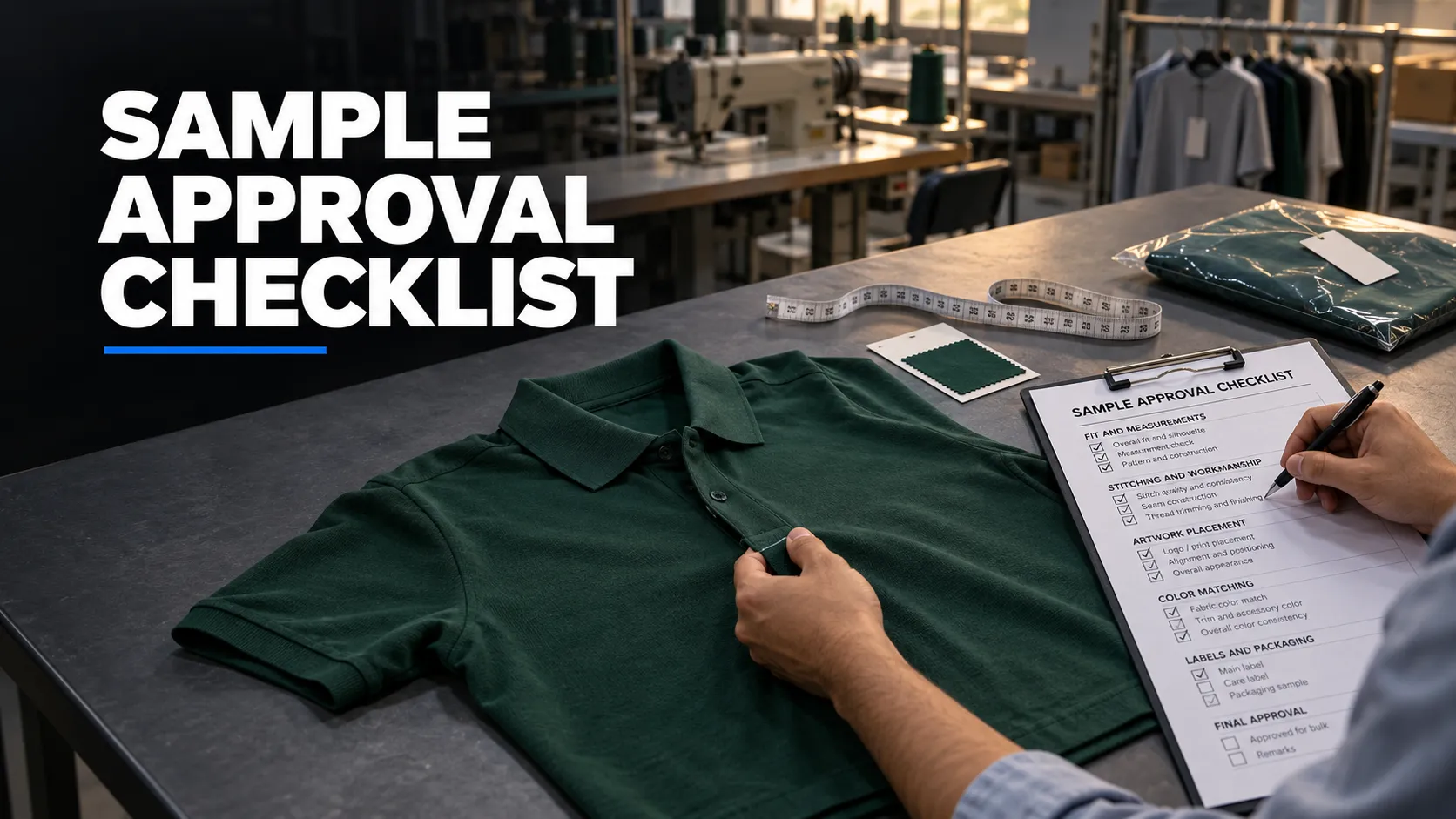
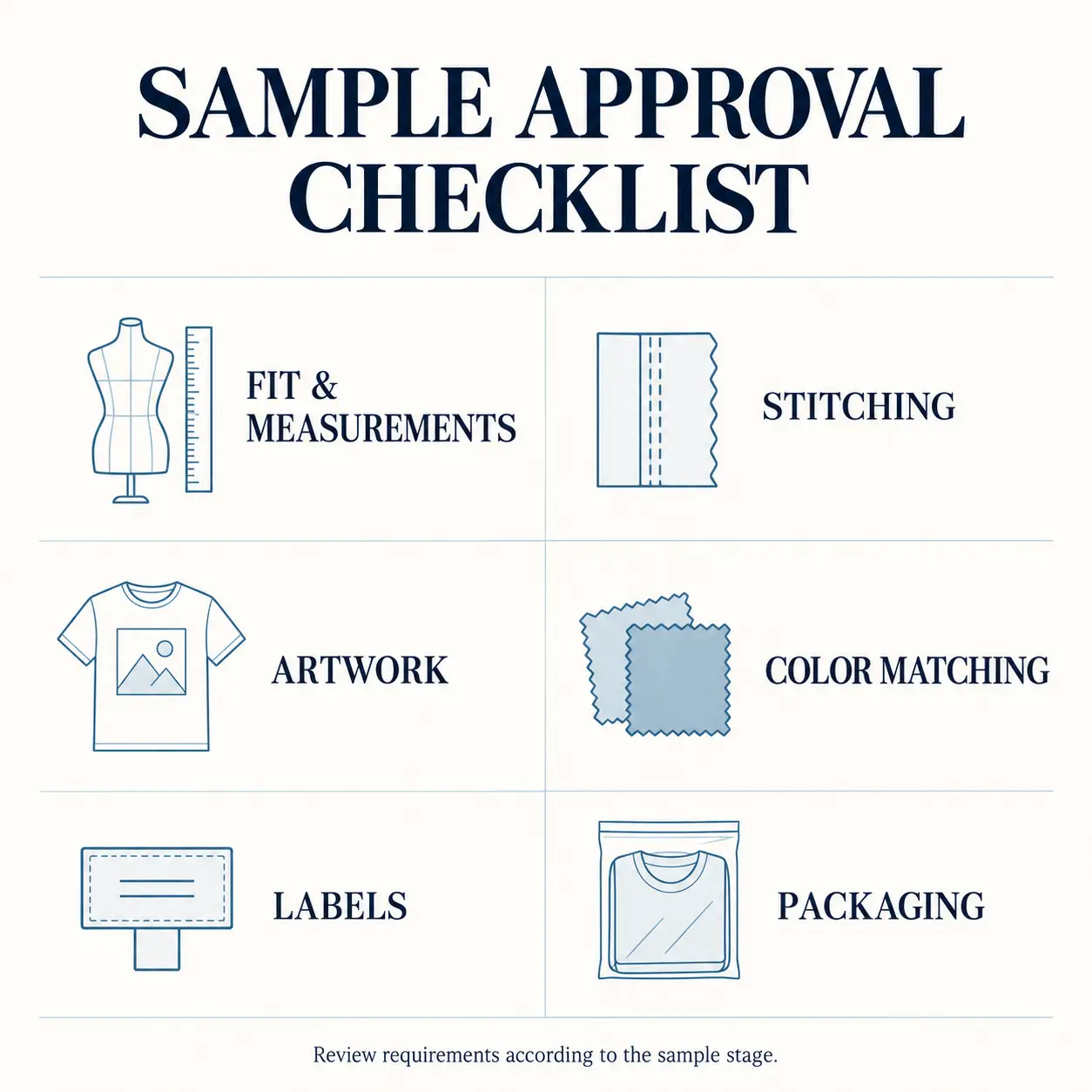
A sample approval checklist helps clothing brands evaluate garment samples against defined technical requirements before accepting development changes or authorizing the next manufacturing stage. It provides a structured way to review fit, measurements, stitching quality, artwork placement, colors, labels, and packaging without relying only on visual impressions.
Sample approval problems often arise when measurements are checked inconsistently, workmanship comments are vague, print placement is judged by eye, or different teams approve different document versions. A sample may look acceptable during an initial review but still contain errors that affect production quality, branding, comfort, or buyer requirements.
For startup clothing brands, technical designers, merchandisers, product developers, and quality assurance teams, the solution is to use clear acceptance criteria, consistent inspection methods, documented evidence, and controlled approval decisions.
This guide provides a practical garment sample approval checklist, including a measurement check sheet, stitching defect log, print placement requirements, color matching, label and packaging checks, and a final sample review and sign-off process.
It complements the broader sample management system for apparel sampling and approval, which explains how to organize sample rounds, consolidate feedback, control revisions, and manage approval gates throughout product development.
Table of Contents
What Is a Sample Approval Checklist in Apparel Manufacturing?

A sample approval checklist is a structured evaluation document used to determine whether a garment sample meets the requirements established for its particular development stage.
It identifies the areas to inspect, the specifications used for comparison, the evidence required, and the people responsible for making approval decisions.
The checklist may be used for a fit sample, size-set sample, pre-production sample, or another relevant garment-development stage.
However, the approval requirements should match the purpose of the sample.
A fit sample may be reviewed primarily for body balance, garment measurements, and comfort. A pre-production sample generally requires a broader evaluation of production-representative materials, workmanship, decoration, labeling, and other applicable specifications.
Why a Sample Approval Checklist Matters
A structured checklist can help buyers and manufacturers:
- Identify missing specifications before approval.
- Evaluate garment dimensions against agreed tolerances.
- Record workmanship and construction defects.
- Verify artwork size and placement.
- Confirm relevant fabric and trim approvals.
- Review labeling and packaging requirements.
- Document corrective actions and unresolved issues.
- Maintain a record of what was approved and by whom.
The checklist should be used alongside the approved tech pack, Bill of Materials (BOM), measurement chart, artwork references, and other technical documents.
It does not replace those specifications.
Sample Approval vs. Bulk Production Inspection
Sample approval evaluates a particular development sample against its intended requirements.
Bulk inspection evaluates selected production garments or a production lot using the applicable inspection procedure.
These activities are related but different.
For example, a buyer may reject a pre-production sample because its chest print is incorrectly positioned. That finding requires correction and evaluation of the sample or affected specification.
During bulk inspection, the same type of defect may be evaluated using a defined defect classification and sampling plan.
Approval of one physical sample should not be interpreted as proof that every future production garment will meet the standard.
Master Sample Approval Checklist: What Buyers Should Inspect
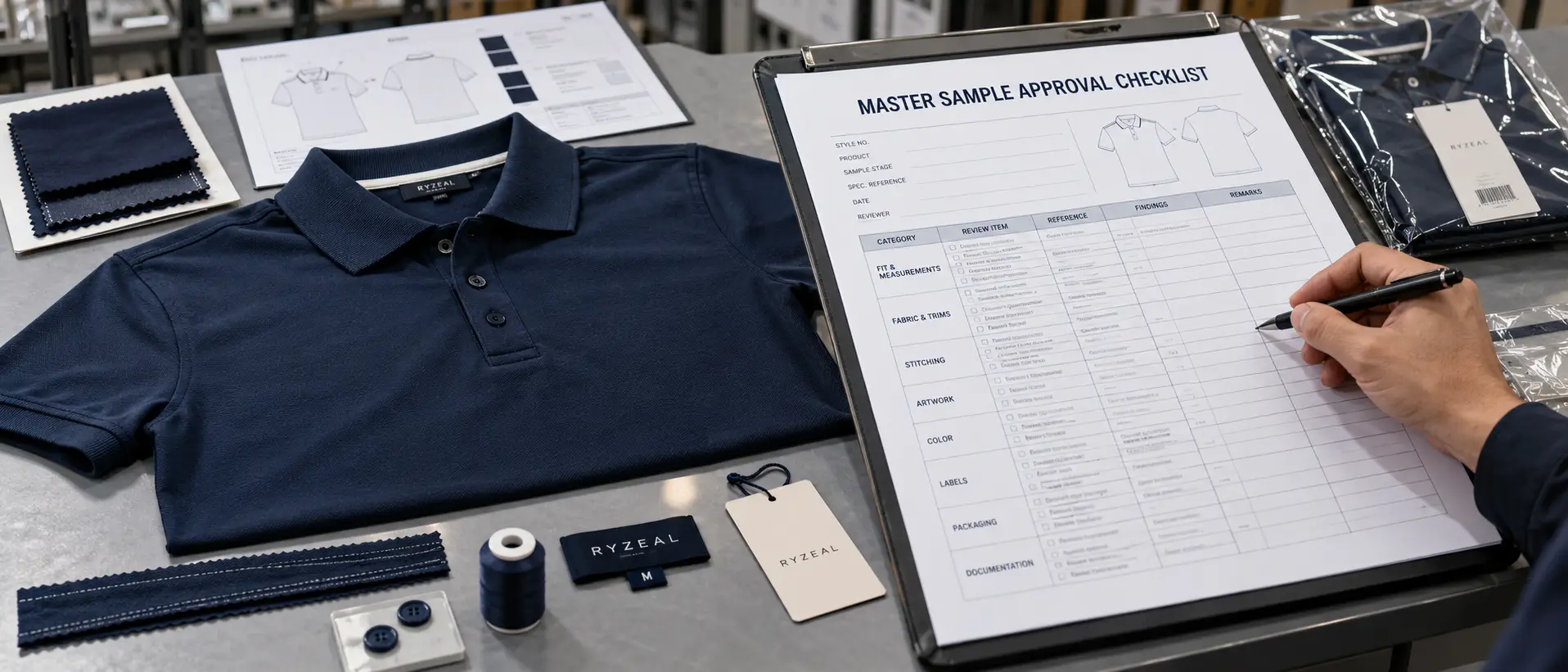
The most practical starting point is a master checklist that brings together the major approval areas.
This framework can be adapted for T-shirts, hoodies, jackets, trousers, dresses, and other apparel products.
Master Garment Sample Approval Checklist
| Approval Area | What to Check | Acceptance Criteria | Evidence Required | Typical Reviewer |
|---|---|---|---|---|
| Fit | Silhouette, balance, comfort, movement | Meets intended fit direction | Fit comments and photographs | Buyer / Technical Designer |
| Measurements | Relevant Points of Measure (POM) | Meets approved targets and tolerances or receives authorized disposition | Measurement sheet | Technical / QA |
| Fabric and Trims | Material type, construction, color, components | Matches approved specifications or documented alternatives | BOM and material approvals | Sourcing / Technical |
| Stitching and Workmanship | Seam construction, stitch quality, reinforcement, finishing | Meets approved construction and workmanship requirements | Inspection notes and defect photographs | Technical / QA |
| Artwork and Decoration | Print or embroidery size, method, placement, appearance | Matches approved artwork and execution requirements | Artwork reference and sample photographs | Design / Technical |
| Color Matching | Fabric, rib, thread, trims, decoration | Matches applicable approved color standards and acceptance criteria | Approved swatches or color records | Color / Technical Team |
| Labels | Type, location, content, orientation, attachment | Meets applicable buyer and market requirements | Label approvals and sample photographs | Merchandising / Compliance |
| Packaging | Folding, polybag, barcode, carton, packing arrangement | Matches approved packing specifications | Packing sample, artwork, or inspection record | Packaging / Merchandising |
| Documentation | Version, sample identity, comments, decisions | Current references and approvals correctly identified | Controlled review record | Development Coordinator |
Not every category must receive final approval at every sample stage.
For example, the packaging review may be marked Not Applicable at This Stage for an early fit sample when retail packaging is not part of its intended purpose.
How to Use the Checklist
Before reviewing a sample, identify:
- The style, colorway, and size being evaluated.
- The sample type and development round.
- The applicable tech pack and specification versions.
- The approved physical and digital references.
- The inspection areas relevant to this sample stage.
- The responsible reviewers and authorized approver.
Each applicable check should receive a documented result.
A useful status system is:
- Pass: The reviewed requirement is satisfied.
- Fail / Correction Required: The requirement is not satisfied and needs action.
- Pending: More information or evaluation is required.
- Not Applicable: The requirement is outside the agreed review scope.
The final approval decision should consider these findings and any conditions established by the buyer.
Who Should Own Sample Approval?
One development coordinator or merchandiser should generally consolidate comments, maintain the review record, and communicate the agreed outcome to the manufacturer.
However, different specialists may have approval authority over different requirements.
A technical designer may approve fit, a design team may approve artwork, and an authorized compliance specialist may review regulated labeling information.
The coordinator ensures the decisions remain organized. The coordinator does not automatically replace the relevant technical approvers.
Fit Sample Approval: Evaluating Shape, Balance, and Wearability
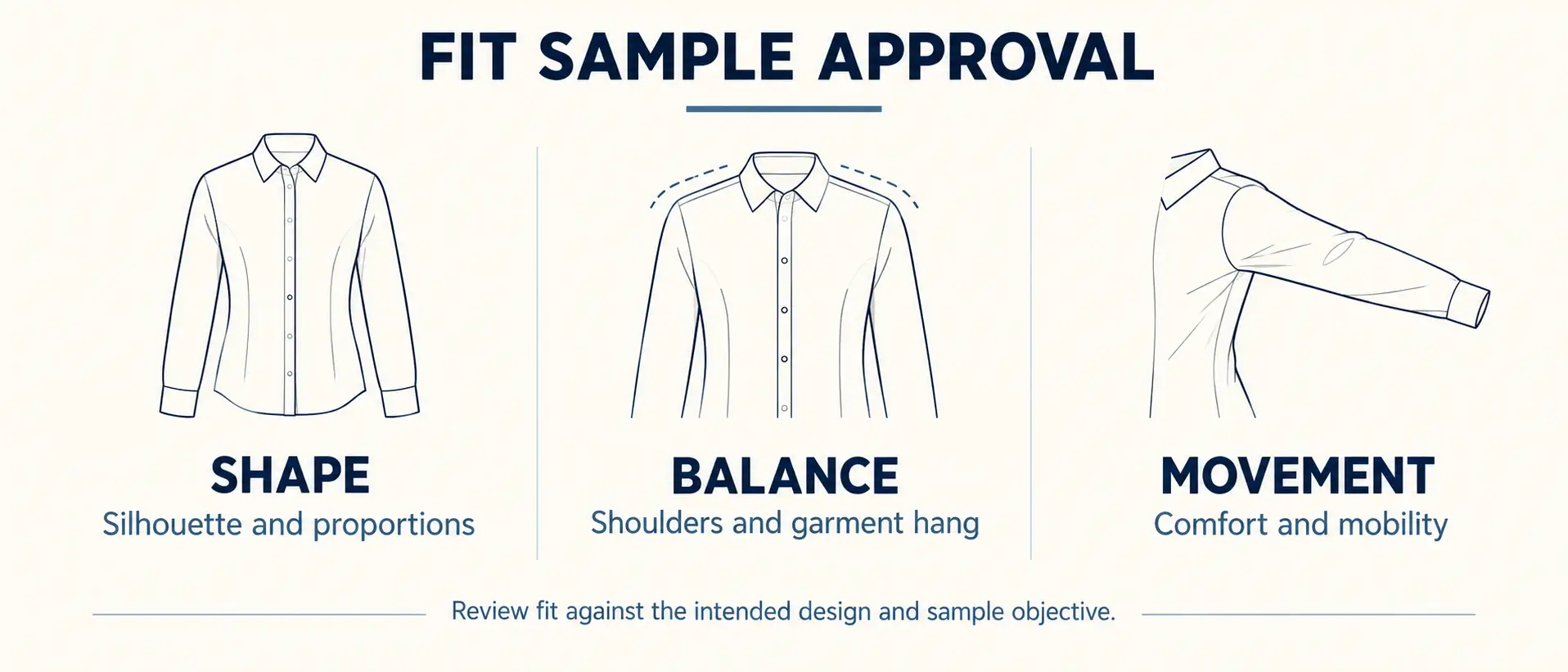
Fit sample approval determines whether a garment achieves the intended body shape, proportions, comfort, and overall appearance.
A fit sample should be reviewed against the approved design direction and relevant size specifications.
The review should not be limited to whether the garment looks attractive on a mannequin.
Fit Sample Approval Checklist
- Overall silhouette reflects the design intent.
- Shoulder position and garment balance are appropriate.
- Chest, waist, hip, and other relevant areas have suitable ease.
- Sleeve shape and movement are satisfactory.
- Armhole and neckline construction support the intended fit.
- Garment length and proportions are appropriate.
- Side seams and major design lines hang as intended.
- Garment does not show unintended pulling, twisting, or excess distortion.
- Fit is suitable for the intended customer and size.
- Required fit corrections are documented.
The exact checks depend on garment construction and category.
For example, trousers require particular attention to rise, seat, crotch shape, inseam, and movement. A relaxed T-shirt requires a different approach from a fitted woven shirt.
Fit Evaluation Requires More Than Measurements
A garment can satisfy its listed dimensional tolerances and still have an undesirable fit.
This may occur because of pattern shape, fabric properties, garment balance, or construction details that are not fully described by individual POM measurements.
For example, a T-shirt may have an acceptable chest width but an uncomfortable armhole.
The technical team may need to review the armhole curve, sleeve pattern, or construction rather than changing the chest measurement.
Similarly, a sleeve that restricts movement may require more than a sleeve-length adjustment.
How to Write Effective Fit Comments
Avoid vague instructions such as:
“Armhole looks wrong.”
A better comment describes the actual issue and the intended improvement:
“Armhole restricts movement when the arm is raised. Review armhole shape and sleeve construction against the approved fit reference, and propose the required pattern correction.”
Where a specific measurement change is appropriate, the comment should identify the affected POM and proposed revised target.
Where the technical cause remains uncertain, request investigation rather than inventing a measurement correction.
Documenting Fit Approval
The fit review should identify the sample version, fit model or form where applicable, key findings, corrections, and approval status.
Techpacker’s garment fitting and fit sign-off process explains how technical teams can review sample measurements, conduct physical fitting sessions, consolidate feedback, and document updated specifications before recording a fit decision.
A fit approval confirms the applicable fit direction. It does not automatically approve final trims, decoration, retail labels, or packaging.
Measurement Check: Comparing Garment Dimensions With Approved Tolerances
Measurement verification is one of the most objective elements of sample approval.
The reviewer compares actual dimensions with the approved measurement chart using the specified measurement method and garment condition.
What a Garment Measurement Check Requires
A consistent measurement process should define:
- The applicable Points of Measure.
- Target dimensions by size.
- Permitted measurement tolerances.
- Starting and ending reference points.
- Whether the garment is flat, relaxed, stretched, or fastened.
- Whether measurements are taken before or after a specified process.
- The required units and recording precision.
These conditions are important because two people can obtain different results from the same garment when their measuring procedures differ.
Example Garment Measurement Check Sheet
Consider an illustrative printed cotton T-shirt in size M.
The garment is measured flat and relaxed using the approved POM instructions.
| POM | Target | Actual | Tolerance | Deviation | Result |
|---|---|---|---|---|---|
| Chest Width | 52.0 cm | 53.5 cm | ±1.0 cm | +1.5 cm | Fail |
| Body Length | 70.0 cm | 70.5 cm | ±1.0 cm | +0.5 cm | Pass |
| Shoulder Width | 45.0 cm | 45.2 cm | ±0.5 cm | +0.2 cm | Pass |
| Sleeve Length | 22.0 cm | 22.4 cm | ±0.5 cm | +0.4 cm | Pass |
| Bottom Opening | 51.0 cm | 50.6 cm | ±1.0 cm | -0.4 cm | Pass |
All measurements and tolerances are illustrative. Actual requirements must be approved for the product, fabric, size, and intended fit.
How to Evaluate a Measurement Failure
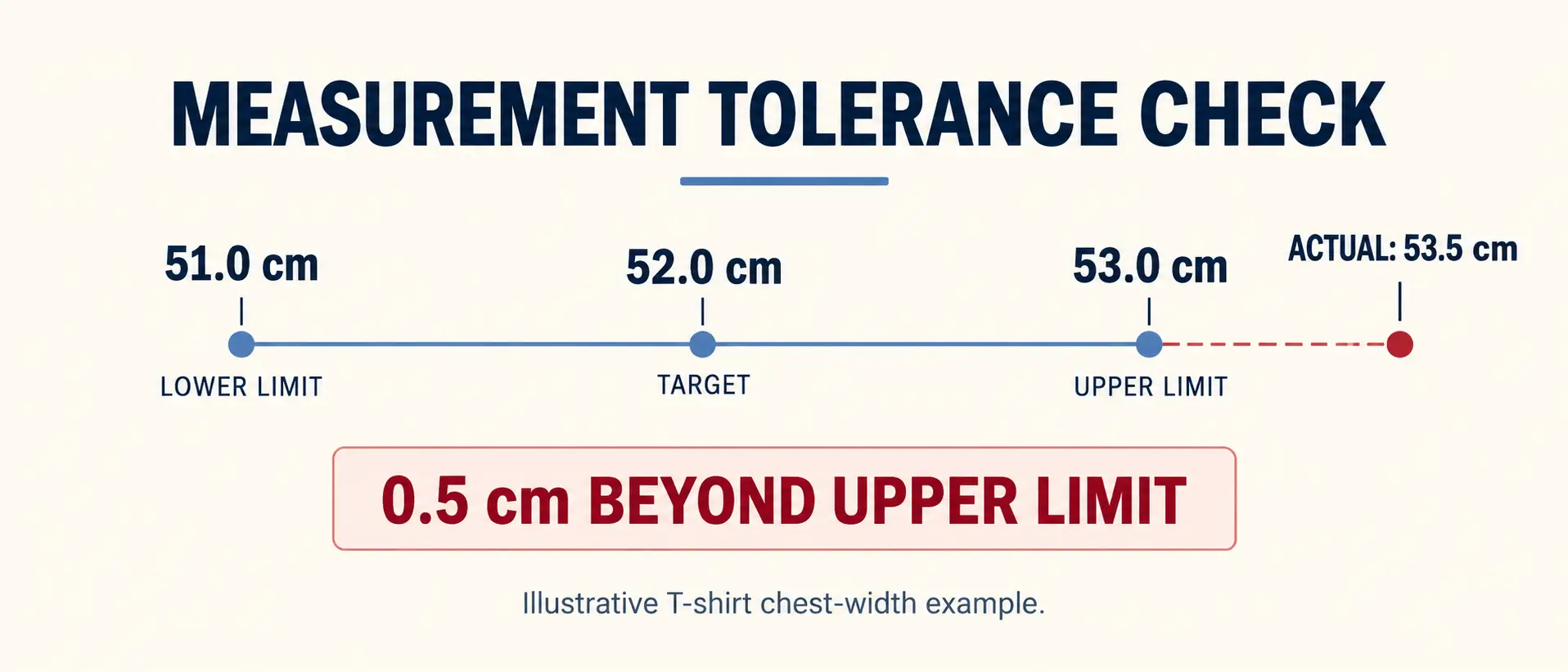
In the example, the chest-width target is 52.0 cm with a tolerance of ±1.0 cm.
The permitted range is:
51.0 cm to 53.0 cm
The actual measurement is 53.5 cm.
Therefore, the garment is:
- 1.5 cm above the target.
- 0.5 cm beyond the upper tolerance limit.
The sample record should identify this finding as an out-of-tolerance measurement.
An actionable comment would be:
“POM-01 Chest Width: Actual 53.5 cm against target 52.0 cm ±1.0 cm. Exceeds upper limit by 0.5 cm. Verify the measuring method and review the pattern or construction correction.”
The approved inspection procedure determines the required disposition.
A measurement failure does not automatically authorize changing the tolerance or rejecting an entire production lot.
Measurement Evidence Checklist
- Correct sample and size identified.
- Current approved measurement chart available.
- Garment measured in the specified condition.
- POM reference points followed consistently.
- Actual results recorded without inappropriate rounding.
- Deviations calculated correctly.
- Out-of-tolerance results identified.
- Supporting photographs provided where useful.
- Corrective actions and decisions recorded.
The garment measurement tolerance guide explains how POM definitions, measurement methods, dimensional limits, and grading requirements can be established to reduce disputes during apparel sampling.
Stitching Quality and Seam Inspection: Checking Garment Workmanship
Stitching and seam construction affect garment appearance, durability, comfort, and performance.
During sample approval, workmanship should be evaluated against the applicable construction specifications and approved quality references.
General comments such as “improve sewing quality” provide limited guidance because they do not identify the defect or its location.
A more effective approach is to inspect relevant seams and record specific observations.

Stitching Quality Checklist
Inspect the following where applicable:
- Stitch type: Matches the construction requirements.
- Stitch density: Meets the specified stitches per inch (SPI) or stitches per centimeter.
- Thread tension: Stitches are appropriately formed without unintended looping or distortion.
- Skipped stitches: No unacceptable gaps in stitch formation.
- Broken stitches: No unacceptable damage to relevant seams or stitching.
- Seam puckering: No unacceptable wrinkling or gathering along seams.
- Seam allowance: Appropriate for the approved construction.
- Needle damage: No unacceptable holes, cuts, or fabric damage.
- Reinforcement: Required bartacks, backtacks, or other reinforcements are present.
- Panel alignment: Relevant seam intersections and design lines align correctly.
- Inside finishing: Specified overlocking, binding, or other seam finishes are properly completed.
- Thread trimming: Loose thread ends are controlled according to workmanship requirements.
The importance of each check depends on the garment.
A performance garment may need particular attention to seam extension and construction durability, while a tailored garment may require detailed assessment of visible topstitching and alignment.
High-Risk Garment Areas to Inspect
For a printed T-shirt, relevant areas include:
- Neckline joining seam
- Shoulder seams
- Armhole seams
- Side seams
- Sleeve hems
- Bottom hem
- Main label attachment
- Areas affected by decoration
For trousers or jackets, additional checks may include crotch seams, pocket corners, zipper ends, waistband joins, and other load-bearing areas.
Example Stitching and Workmanship Defect Log
| Defect | Location | Potential Severity | Evidence | Required Action |
|---|---|---|---|---|
| Skipped Stitches | Left armhole seam | Major, subject to buyer criteria | Photo ST-01 | Investigate stitch formation and correct affected seam |
| Seam Puckering | Right side seam | Minor or major depending on severity | Photo ST-02 | Review feeding, tension, construction, and material behavior |
| Incorrect Stitch Type | Bottom hem | Major if construction requirement is not met | Photo ST-03 | Confirm specified stitch and correct construction |
| Loose Thread Ends | Inside neckline | Usually minor if cosmetic | Photo ST-04 | Trim and verify finishing |
| Missing Reinforcement | Specified stress point | Potentially major | Photo ST-05 | Apply approved reinforcement and verify |
Severity classifications are illustrative. Critical, major, and minor definitions must follow the applicable buyer or inspection requirements.
How to Classify Workmanship Defects
Defect classifications are typically established by the buyer or inspection procedure.
Critical defects may involve safety risks, legal noncompliance, or other unacceptable hazards.
Major defects may significantly affect product function, durability, appearance, or the applicable customer requirements.
Minor defects may involve limited departures from workmanship expectations that do not substantially impair the garment’s intended use.
The actual classification depends on the product, defect location, severity, and contractual acceptance requirements.
A defect that is minor on one product may be more important on another.
Distinguish Defect Detection From Technical Diagnosis
Inspectors should document the defect accurately.
However, they should not automatically assume its cause.
For example, seam puckering may involve thread tension, fabric feeding, material properties, needle selection, or construction methods.
The manufacturer should investigate the relevant factors and propose a suitable correction.
QIMA’s garment quality control checklist for textile and apparel inspections describes how measurement, workmanship, materials, labeling, packaging, and product-specific quality requirements can be incorporated into inspection procedures.
Video: Identifying and Preventing Seam Puckering
The following practical demonstration, Quick Tips for Preventing Seam Puckering by National Sewing Circle, features sewing instructor ZJ Humbach explaining how stitch settings, thread tension, needle selection, fabric handling, and stabilization can influence seam appearance. It demonstrates real stitching problems and potential corrections, helping sample reviewers understand why puckered seams should be investigated rather than accepted or corrected blindly.
The demonstration illustrates sewing principles. Actual garment-sample acceptance must still follow the approved construction specifications and workmanship requirements.
Need Help Preparing Your Garment for Sample Approval?
Share your garment drawings, measurement charts, construction requirements, or existing tech pack with RYZEAL SOURCING. Our team can review the available specifications and help coordinate the technical preparation needed for quotation and sampling through suitable apparel manufacturing partners in Bangladesh.
Artwork Placement: Approving Screen Prints, Embroidery, and Decorations
Artwork approval involves more than accepting the graphic design.
The final decoration must also be evaluated for dimensions, positioning, orientation, method, appearance, and compatibility with the garment.
An approved artwork file does not automatically mean its placement on a physical sample is correct.

Print Placement Guide Checklist
For a printed or decorated garment, review:
- Correct artwork and revision.
- Approved decoration method.
- Artwork width and height.
- Placement reference point.
- Horizontal and vertical positioning.
- Alignment and rotation.
- Required position relative to seams or garment features.
- Applicable scaling rules across garment sizes.
- Decoration colors and appearance.
- Print or embroidery quality.
- Applicable performance or durability requirements.
The placement rules should identify how measurements are taken.
For example, a front-chest print may be positioned relative to the neckline and center front.
However, the exact reference points and permitted variation must be specified.
Example Screen Print Placement Approval
Consider the same printed T-shirt used in the measurement example.
The approved artwork specification states:
- Print width: 25.0 cm
- Print height: 18.0 cm
- Horizontal position: Centered on the garment’s defined center front
- Vertical position: Artwork top edge 8.0 cm below the specified neckline reference
- Placement tolerance: ±0.5 cm vertically
- Decoration method: Screen printing
Suppose the sample’s artwork top edge measures 9.0 cm below the reference.
The permitted vertical range is 7.5 to 8.5 cm.
The sample is therefore 0.5 cm beyond the lower permitted placement boundary.
The reviewer should record the deviation and evaluate the required correction.
All values are illustrative. There is no universal approved print distance or placement tolerance for every garment.
Print Placement Approval Record
| Check | Approved Requirement | Sample Finding | Result |
|---|---|---|---|
| Artwork Version | ART-V03 | ART-V03 | Pass |
| Print Width | 25.0 cm | 25.0 cm | Pass |
| Print Height | 18.0 cm | 18.0 cm | Pass |
| Vertical Position | 8.0 cm ±0.5 cm | 9.0 cm | Fail |
| Horizontal Position | Approved center-front reference | Appears centered; verify measured alignment | Pending |
| Print Appearance | Approved print reference | Requires physical evaluation | Pending |
The result should be connected to the artwork file, sample identification, and required correction.
Screen Print Placement vs. Embroidery Placement
The same principle of controlled placement applies to screen printing and embroidery, but their manufacturing methods differ.
Screen printing may require attention to screen registration, platen setup, garment loading, ink application, and curing.
Embroidery may require attention to hooping, stabilization, stitch density, fabric distortion, and embroidery-machine positioning.
A sample should represent the relevant intended decoration process.
If a development sample uses a different method from the intended bulk operation, the buyer should determine whether further verification is necessary.
Video: Practical T-Shirt Print Alignment and Placement
The following English-language instructional webinar from Transfer Express, Print Placement Tips for Perfect Alignment and Unique Looks, demonstrates practical alignment methods using tools such as placement rulers, T-squares, and laser guides. It also discusses chest, sleeve, and other garment-print positions. The demonstration focuses on transfer decoration, but the principles of positioning artwork against defined garment references are useful when evaluating sample print placement.
The video’s placement techniques are practical examples, not universal measurements that override a buyer’s approved artwork specifications.
Color Match Sample: Preventing Fabric and Decoration Color Disputes
Color matching should be included in sample approval when the garment has specified fabric, trim, thread, or decoration colors.
A product can meet its construction requirements while still having unacceptable color differences.
For example, a navy T-shirt may have rib fabric or sewing thread that does not match the approved body fabric closely enough for the brand’s design requirements.
A sample review should therefore identify the relevant color standards and verify the components that require matching.
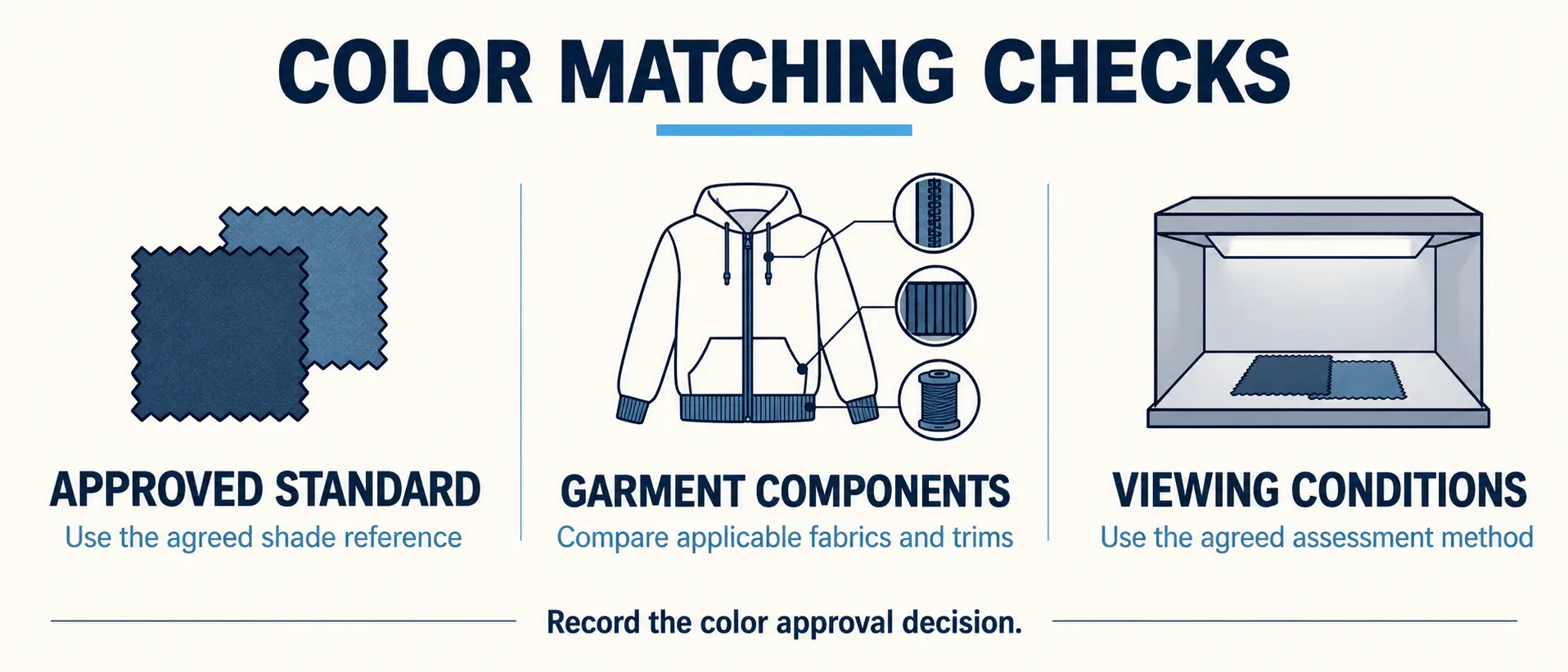
Color Approval Checklist
- Correct colorway identified.
- Approved physical or digital color references available, as applicable.
- Main fabric compared with the approved standard.
- Secondary fabric or rib evaluated.
- Sewing thread color checked where relevant.
- Trims and accessories compared with their specifications.
- Printed or embroidered decoration colors reviewed.
- Applicable shade differences evaluated using the agreed method.
- Results and approval status documented.
How Should Textile Colors Be Compared?
Color assessment should use suitable, consistent viewing conditions and an agreed standard.
The type of standard may include an approved fabric swatch, lab dip, material cutting, or another accepted reference.
A digital image or screen display is generally not a reliable substitute for physical color evaluation when precise color matching is required.
Lighting conditions also matter because materials can appear different under different light sources.
AATCC’s Evaluation Procedure for Visual Assessment of Color Difference of Textiles (EP9) describes principles and procedures for visually evaluating textile color differences against a standard. The procedure supports consistency in color assessment but does not independently determine a brand’s permitted color difference.
Color Approval Does Not Automatically Cover Every Material Lot
An approved development sample may establish the intended color appearance, but subsequent material batches can vary.
Where color consistency is important, sourcing and quality teams may need to apply approved shade standards and relevant batch-control procedures during bulk production.
Print colors may also require separate evaluation because printing inks and dyed fabrics behave differently.
Any approved color variation should be recorded according to the buyer’s requirements rather than decided informally.
Clothing Label Placement: Main Labels, Size Labels, and Care Labels
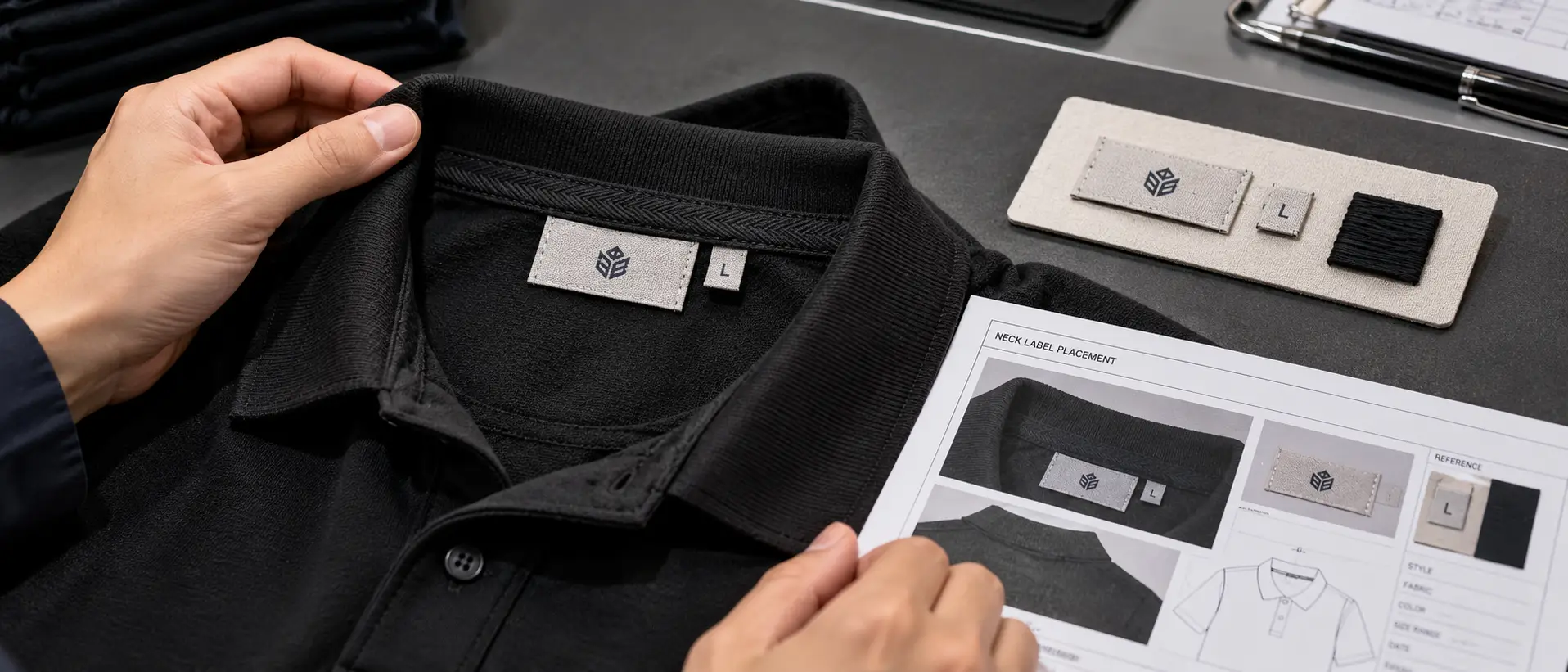
Labels are important for branding, product identification, customer information, and applicable regulatory requirements.
Label approval should address both the physical component and its information.
A correct label placed in the wrong location may fail a buyer’s technical requirements. A label attached correctly but containing inaccurate product information can create a different and potentially more serious problem.
Clothing Label Placement Checklist
Review the following details for each applicable label:
- Label type and item reference
- Material and dimensions
- Approved artwork or text
- Correct garment location
- Orientation
- Attachment method
- Stitching and finishing quality
- Readability and wearer comfort
- Required product information
- Applicable market-specific labeling requirements
- Approval status and revision
Example Label Approval Matrix
| Label Type | Placement | Attachment Method | Content Status | Approval Decision |
|---|---|---|---|---|
| Main Brand Label | Center back neckline | Approved seam attachment | Artwork approved | Pass |
| Size Label | Adjacent to main label | Approved stitch method | Size confirmed | Pass |
| Care and Composition Label | Left side seam, specified location | Approved seam attachment | Final content under review | Pending |
| Printed Neck Label | Inside back neck, where applicable | Specified printing method | Artwork approved | Not applicable to this version |
Illustrative example. Label positions and requirements are determined by the garment, buyer, and applicable destination market.
Care Label Placement and Compliance
Care-label requirements depend on the product and market.
For example, in the United States, covered clothing products are subject to the Federal Trade Commission’s Care Labeling Rule.
The FTC’s guide to complying with the Care Labeling Rule explains requirements concerning care instructions, their supporting basis, attachment, permanence, and legibility for covered products. Other destination markets may have different legal requirements.
Buyers should confirm the requirements applicable to their product and intended sales markets rather than assuming that one labeling system satisfies every jurisdiction.
Can Label Placement Be Approved Before the Final Text?
Sometimes.
The buyer may provisionally accept the location and attachment method while final artwork or content remains under review.
However, that decision should be explicitly limited to the aspects being approved.
It should not authorize affected labels to be produced or garments to proceed through an activity requiring finalized information.
Any mandatory content must be confirmed before the relevant production or product-release requirement applies.
Avoid Mixing Label Approvals
Approving the main brand label does not automatically approve the size label, care label, printed neck label, or other required identification.
Each relevant component should be connected to its approved artwork, specification, or physical reference.
Packaging Approval Checklist: Polybags, Barcodes, Folding, and Cartons
Packaging approval is another important part of garment development and production preparation.
Incorrect packing materials or identification details can affect product presentation, shipment handling, retailer requirements, and order accuracy.
However, final retail packaging does not necessarily need to be approved during an early fit-sample review.
The packaging approval stage should reflect the manufacturer’s activities and the buyer’s requirements.
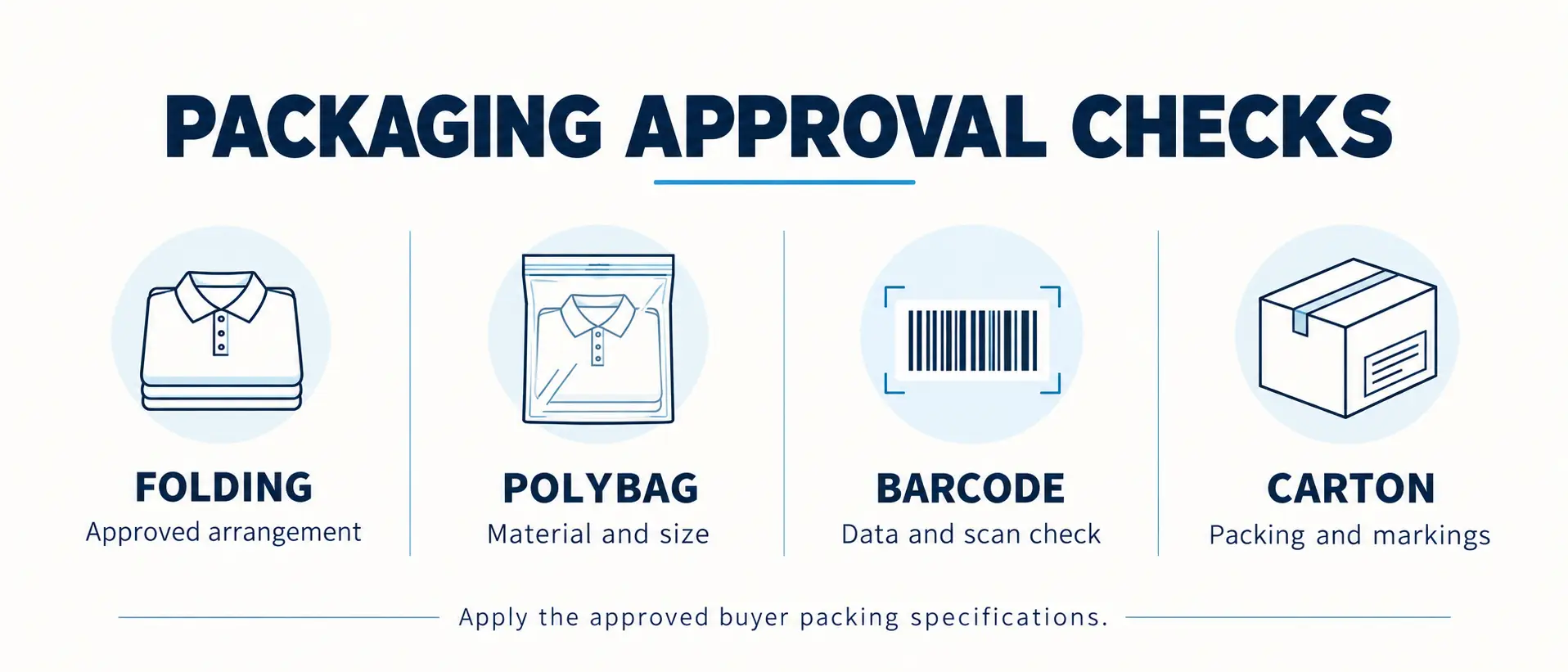
Packaging Approval Checklist
Review the applicable packaging components and instructions:
Individual Garment Packaging
- Approved folding method
- Required tissue paper or inserts
- Polybag size and material
- Polybag thickness, where specified
- Closure or sealing method
- Applicable warning text and placement
- Barcode label and product identification
- Hangtag or other retail presentation requirements
Master Carton Packaging
- Approved carton dimensions
- Carton material or construction requirements
- Packing quantity
- Size and color assortment
- Carton markings
- Purchase order or shipment references, where required
- Applicable handling instructions
- Packing-list consistency
Packaging Approval Matrix
| Packaging Item | Specification to Check | Evidence | Responsible Reviewer | Status |
|---|---|---|---|---|
| Polybag | Material, size, sealing method | Approved packing sample | Packaging / Merchandising | Pending |
| Barcode Sticker | Correct data, size, placement, scannability | Artwork and scan verification | Packaging / Buyer | Pending |
| Folding Method | Agreed folding arrangement | Packed garment photograph | Merchandising | Pass |
| Hangtag | Artwork, material, size, attachment | Approved hangtag reference | Design / Buyer | Pass |
| Carton | Dimensions, packing quantity, construction | Packing specification | Packaging / Logistics | Pending |
| Carton Marking | Required shipping and product details | Approved carton-marking artwork | Merchandising / Logistics | Pending |
The status should reflect the actual review results.
Polybag Approval
When a garment requires individual polybag packaging, confirm the bag’s physical specifications and how the garment is inserted, folded, and sealed.
Any required warning statements should be reviewed according to the destination-market and buyer requirements.
Do not assume that identical warning text applies to every packaging material or destination.
Barcode and Sticker Approval
Barcode approval requires more than checking whether the sticker looks correctly positioned.
The barcode should also correspond to the correct product identification data.
Relevant checks may include:
- Correct product identifier
- Correct barcode symbology
- Appropriate dimensions
- Adequate contrast
- Suitable quiet zones
- Legible print quality
- Correct sticker location
- Scanning performance
GS1’s guidance on checking barcode quality identifies factors such as symbol dimensions, contrast, quiet zones, printing defects, and positioning that can affect barcode readability. The applicable specifications depend on the barcode type and intended use.
Carton Marking and Packing Accuracy
Carton markings should match the approved packing instructions and the relevant shipment documentation.
Depending on buyer requirements, information may include:
- Purchase order reference
- Style or product identification
- Color and size details
- Quantity
- Carton number
- Destination or shipping references
- Applicable handling symbols
The required fields and format should be confirmed before carton printing or marking.
Packaging BOM and Material Control
The packaging BOM should identify the packaging components, specifications, quantities, and sourcing responsibilities.
A missing packaging item can affect both the material cost estimate and manufacturing preparation.
Our guide to building an apparel BOM explains how fabrics, trims, labels, packaging materials, sourcing rules, and approval records can be controlled to reduce material-related errors and cost surprises.
Final Sample Product Review Template: Recording Approval Decisions
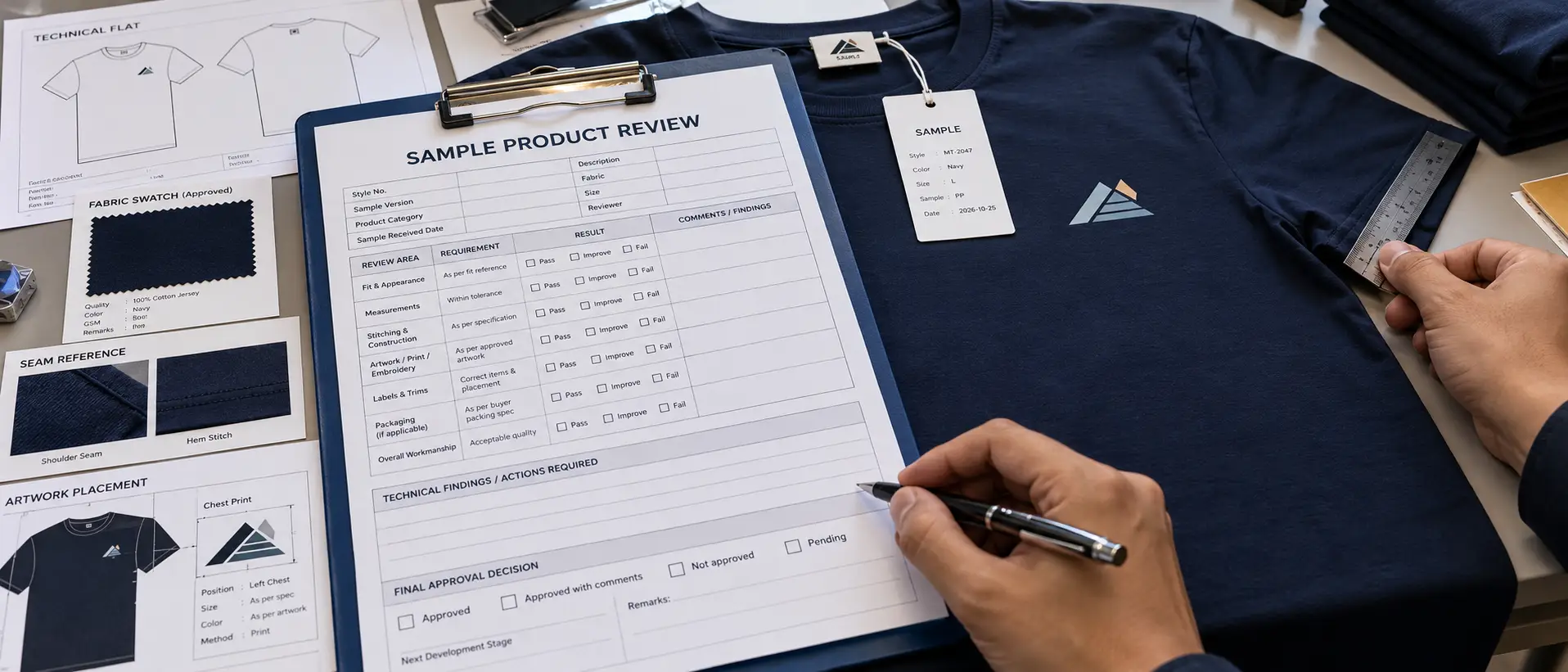
After completing the applicable checks, the review findings should be consolidated into one approval record.
This ensures that technical feedback, unresolved issues, and decisions are connected to the correct sample.
An effective review document should be easy for the buyer, manufacturer, and responsible coordinator to interpret.
Example Sample Product Review
The following review continues the illustrative printed T-shirt example.
Sample Identification
| Field | Example |
|---|---|
| Style Code | TS-105 |
| Product | Printed Cotton T-Shirt |
| Colorway | Navy |
| Sample Type | Pre-Production Sample |
| Sample Size | M |
| Sample Revision | PP-V02 |
| Tech Pack Version | TP-V04 |
| Review Date | To be recorded |
| Review Coordinator | Assigned Merchandiser |
Approval Summary
| Review Area | Finding | Status | Next Action |
|---|---|---|---|
| Fit | Overall fit direction acceptable | Pass | Record approval |
| Measurements | Chest width exceeds approved tolerance | Fail | Technical correction required |
| Stitching | Skipped stitches at left armhole | Fail | Investigate and correct seam |
| Artwork Placement | Print positioned outside vertical tolerance | Fail | Correct placement and verify |
| Color Matching | Fabric shade accepted against approved reference | Pass | Retain approval record |
| Labels | Care-label content not finalized | Pending | Complete content approval |
| Packaging | Final barcode and packing review incomplete | Pending | Submit packing evidence |
All findings are illustrative and are not observations from an actual garment.
How Should the Sample Be Approved?
In this example, the sample has several unresolved requirements.
An appropriate decision would be Revision Required / Hold for the affected approval stage.
The manufacturer should review the chest-width deviation, correct the stitching defect, adjust the print placement, and address the relevant label and packaging requirements before seeking the necessary approvals.
The team should not mark the complete PP sample as unconditionally approved simply because the overall appearance is acceptable.
Three Sample Approval Decisions
1. Approved
The sample meets the applicable requirements for the stage, and the authorized reviewer permits the next activity.
2. Conditionally Approved
Specified activities may proceed while clearly identified non-blocking matters remain open.
The record should state the conditions, decision owner, due dates, and activities that cannot proceed until the remaining requirements are satisfied.
3. Revision Required / Hold
The sample has unresolved requirements that prevent approval for the affected activity.
Corrections, clarification, testing, or further evaluation must be completed as required.
Sample Approval Sign-Off Fields
The final review record should include:
- Style code and sample identification
- Sample stage and version
- Applicable tech pack and BOM revisions
- Areas reviewed
- Findings and outstanding issues
- Required corrections
- Supporting evidence references
- Individual technical approvals
- Final decision and scope
- Authorized approver
- Approval date
- Next permitted development or manufacturing activity
The record should be retained with the applicable sample and technical documents.
Sample Performance Review Template
For products requiring performance evaluation, the sample approval record may also include a linked testing summary.
| Test Area | Applicable Method | Result | Evaluation | Notes |
|---|---|---|---|---|
| Dimensional Stability | Buyer-approved test method | Awaiting report | Pending | Confirm laundering conditions |
| Colorfastness | Applicable test method | Report received | Review required | Compare with buyer criteria |
| Seam Strength | Applicable test method | Not required for this review | N/A | Confirm scope |
| Decoration Durability | Buyer-approved method | Awaiting results | Pending | Relevant to printed design |
Tests should only be listed as required where they apply to the product and its agreed testing plan.
A pass or fail decision cannot be determined without the relevant method, acceptance criteria, and actual results.
Sample Quality Control Before Bulk Production
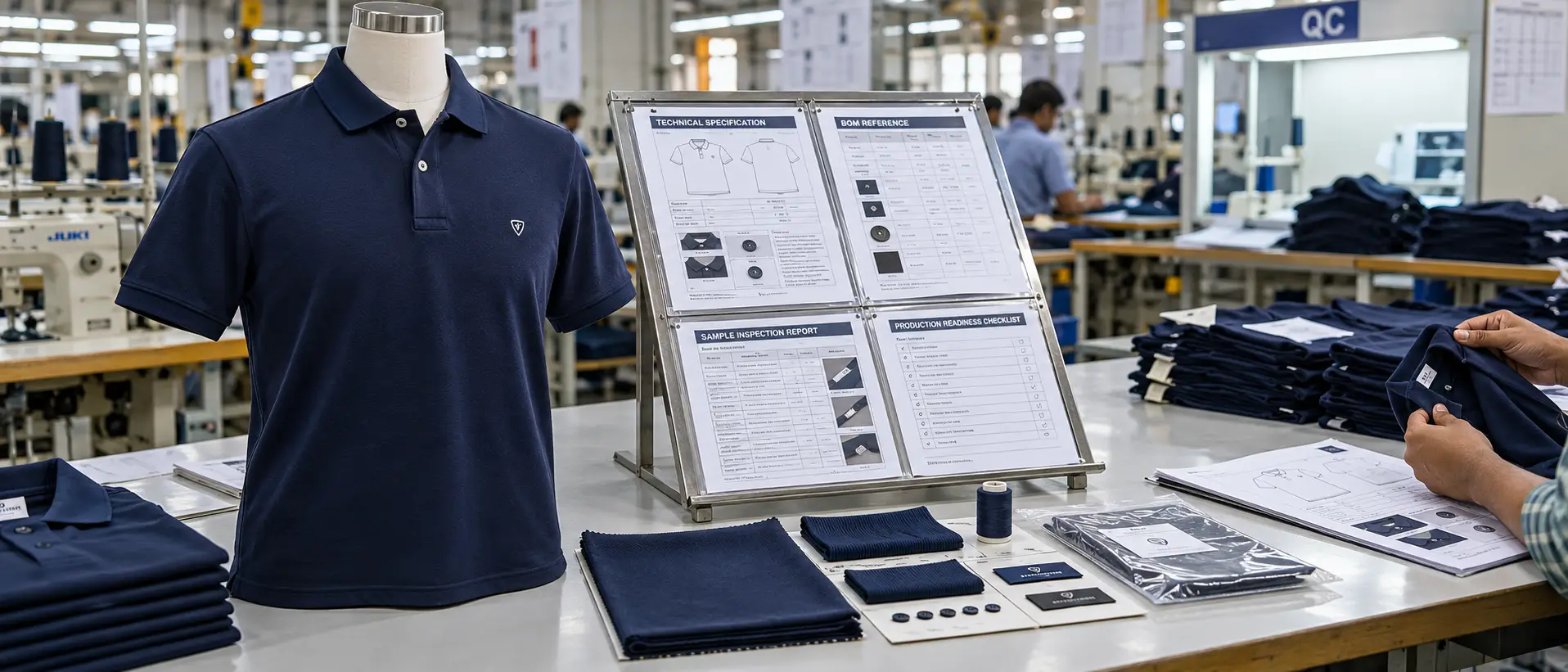
A production-representative sample is an important reference for manufacturing, but approving it does not independently establish that the entire bulk production process is ready.
Sample approval should be connected with appropriate technical, material, and manufacturing preparation.
What Should Be Confirmed Before Bulk?
Depending on the product and order, relevant requirements include:
- Approved technical specifications
- Applicable pattern and measurement approvals
- Fabric and trim approval status
- Relevant testing requirements
- Fit and size-set decisions
- Construction and workmanship standards
- Artwork and decoration approvals
- Label and packaging readiness
- Approved sample references
- Production equipment and process suitability
- Applicable quality-control arrangements
These requirements may be coordinated through a pre-production review.
PP Sample Approval vs. Bulk Production Readiness
A PP sample should represent the intended product requirements, but it may have been prepared by a sampling team rather than the actual bulk production line.
Consequently, manufacturers may need to verify production setup, equipment, process methods, operator instructions, and quality checkpoints separately.
A pilot run or Top of Production sample may provide additional information, depending on the buyer’s requirements.
Actual production output must continue to be monitored against the approved specifications and relevant sample references.
Approvals Must Follow the Correct Scope
An early fit approval should not be interpreted as final artwork approval.
A signed artwork proof should not be interpreted as acceptance of printed garment placement.
Similarly, approval of a PP sample does not eliminate the need to verify required labeling, packaging, testing, and manufacturing arrangements.
The apparel approval workflow map explains how relevant material, size-set, PP, testing, and shipment-related approval stages can be coordinated with documented responsibilities and evidence.
Preventing Uncontrolled Changes After Approval
Once a sample or specification receives approval, subsequent changes affecting the approved requirements should be reviewed and recorded.
For example, changing the fabric after PP approval may affect shrinkage, fit, sewing behavior, or appearance.
A different print method may affect color, hand-feel, durability, or decoration positioning.
Such changes should be evaluated according to their technical significance rather than accepted through informal messages.
This supports continuity between the approved sample and the garment ultimately manufactured.
Common Sample Approval Mistakes and How to Avoid Them
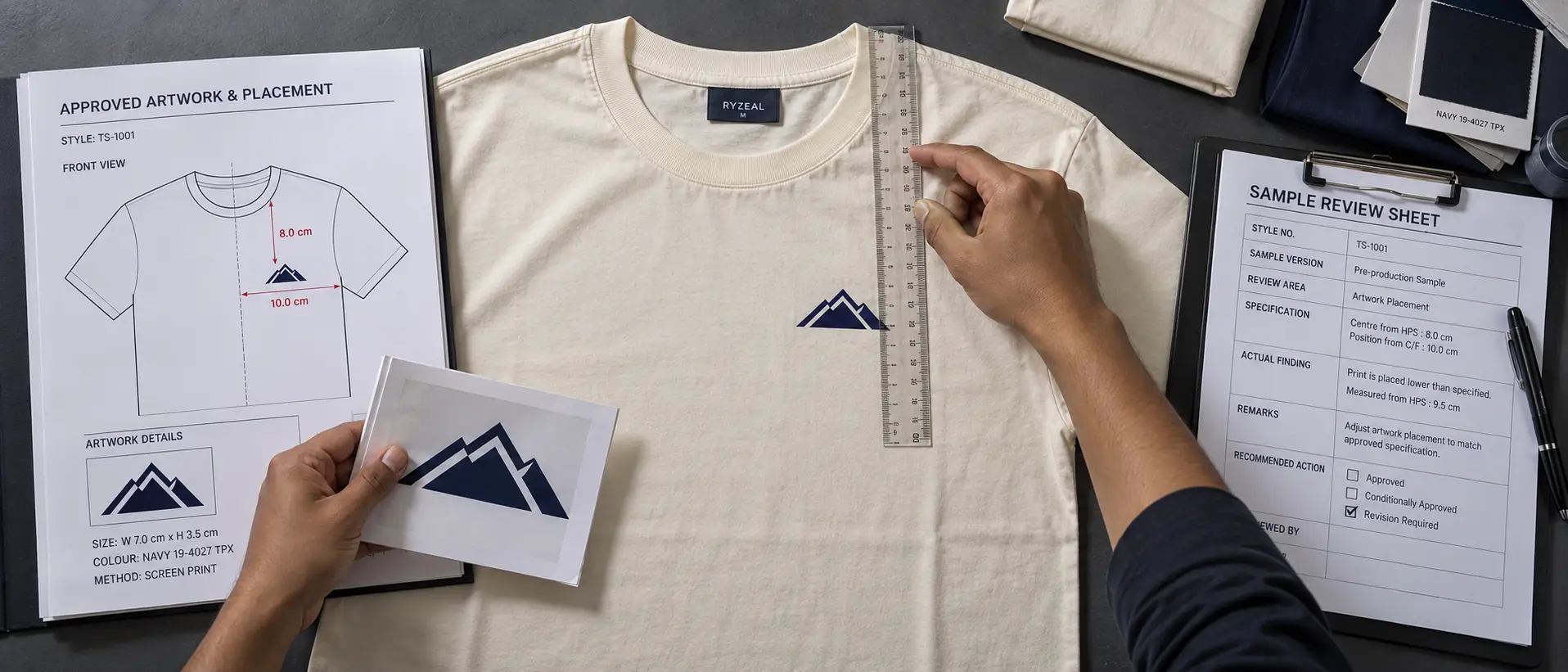
Even experienced development teams can overlook problems when their evaluation process lacks consistency.
The following mistakes are particularly relevant to clothing brands working across multiple sample rounds or manufacturing partners.
1. Approving Based Only on Appearance
A garment may look attractive while containing incorrect measurements, construction defects, or material differences.
Better practice: Combine physical appearance reviews with the applicable technical checks.
2. Using Outdated Specifications
The manufacturer and buyer may evaluate the same sample using different document versions.
Better practice: Identify the applicable tech pack, measurement chart, artwork, and BOM revisions before starting the review.
3. Sending Conflicting Feedback
Separate comments from design, merchandising, and QA teams may request incompatible changes.
Better practice: Consolidate technical feedback before communicating the approved correction plan.
4. Approving Fit Without Reviewing Fabric Behavior
A garment made with provisional fabric may fit differently when produced using the intended material.
Better practice: Confirm whether the sample material is sufficiently representative for the intended approval.
5. Ignoring Small Construction Details
Problems with seam reinforcement, stitch formation, or thread selection can affect durability and workmanship.
Better practice: Review relevant construction requirements and inspect higher-risk garment areas.
6. Approving Artwork Without Measuring Placement
An approved design can still be applied incorrectly.
Better practice: Check the physical decoration against the agreed dimensions and reference points.
7. Leaving Labels and Packaging Until the End
Late changes to barcode information, care labels, packing arrangements, or carton markings may affect manufacturing and shipment preparation.
Better practice: Identify the required approval stage for each component and confirm it before the affected activity begins.
8. Treating Conditional Approval as Full Approval
Unresolved requirements may be overlooked when a sample is described simply as approved.
Better practice: Record exactly what was accepted, what remains open, and which activities are authorized.
Frequently Asked Questions About Sample Approval Checklists
What is a sample approval checklist?
A sample approval checklist is a structured document used to evaluate garment samples against applicable technical and quality requirements. It may cover fit, measurements, workmanship, artwork, materials, labels, packaging, and approval records.
What should be checked before approving a garment sample?
The relevant checks depend on the sample stage. Common areas include garment fit, dimensions, fabric and trims, stitching quality, artwork placement, color consistency, labeling, and packaging.
How do you approve a fit sample?
Evaluate the garment’s silhouette, balance, comfort, and movement against the intended fit direction. Compare relevant measurements with the approved specifications and document any necessary pattern or construction corrections.
What should a garment measurement check include?
It should include the Point of Measure, target measurement, actual result, applicable tolerance, deviation, measuring method, and evaluation outcome.
How should stitching quality be inspected?
Review the specified stitch and seam construction, stitch formation, tension, skipped or broken stitches, puckering, reinforcement, seam allowances, and finishing. Findings should identify the exact location and relevant correction.
How do you approve screen print placement?
Compare the physical print with the approved artwork dimensions, location references, alignment requirements, and any specified placement tolerances. Document deviations and confirm the intended decoration method.
What is a color match sample?
A color match sample is a material or garment reference evaluated against an approved color standard. It helps establish the intended appearance of fabrics, trims, threads, or decoration components.
Can clothing label placement be approved before final label content?
In some circumstances, placement and attachment can receive provisional approval while content remains pending. The decision must identify its limitations, and mandatory information must be finalized before the applicable production or release requirement.
What should a packaging approval checklist include?
Relevant checks may include folding instructions, polybag specifications, barcode data and placement, hangtags, inserts, carton dimensions, packing quantities, and carton markings.
Does an approved PP sample mean bulk production can begin immediately?
Not necessarily. The applicable technical and product approvals must be supported by suitable materials, production arrangements, required testing, and quality-control preparations before the relevant manufacturing activities are authorized.
Who should approve a garment sample?
Approval authority depends on the organization and technical requirement. Fit, artwork, materials, labeling, and packaging may involve different authorized reviewers. A development coordinator should maintain the consolidated decision record.
What should happen when a sample fails an approval check?
Record the finding, identify its technical implications, agree on the required correction or investigation, and determine whether the affected activity must remain on hold. Updated evidence should be evaluated before the relevant approval is granted.
Final Takeaway: A Sample Approval Checklist Creates Clearer Manufacturing Standards
An effective sample approval checklist helps clothing brands evaluate garment development using clearly defined requirements rather than informal judgments.
Fit should be reviewed against the intended silhouette and physical wearability. Measurements should be checked using agreed POM methods and tolerances. Stitching and workmanship should be evaluated against construction specifications.
Artwork placement, color matching, labels, and packaging should also be reviewed at the appropriate development or approval stages.
The objective is not to increase paperwork. It is to ensure that each approval identifies what was evaluated, what met the requirements, what remains unresolved, and which manufacturing activities may proceed.
When these decisions are documented and connected to controlled technical specifications, brands and manufacturing partners have a stronger foundation for reducing avoidable corrections and maintaining the intended product standard.
RYZEAL SOURCING supports apparel manufacturing and product development through a vetted network of specialized independent manufacturing partners in Bangladesh. Our team helps coordinate technical preparation, material sourcing, sampling, development communication, and manufacturing follow-up according to buyers’ product requirements.
Ready to Develop Your Clothing Samples?
Have a clothing design, tech pack, measurement chart, or reference garment ready? Share your requirements with RYZEAL SOURCING to discuss sample development, fit evaluation, construction requirements, and manufacturing coordination through suitable partner facilities in Bangladesh.
A complete checklist cannot guarantee that every sample will pass or that bulk manufacturing will be free from defects. It can, however, make technical expectations clearer, approval decisions more traceable, and the transition from development to manufacturing better controlled.
Connect with RYZEAL SOURCING