
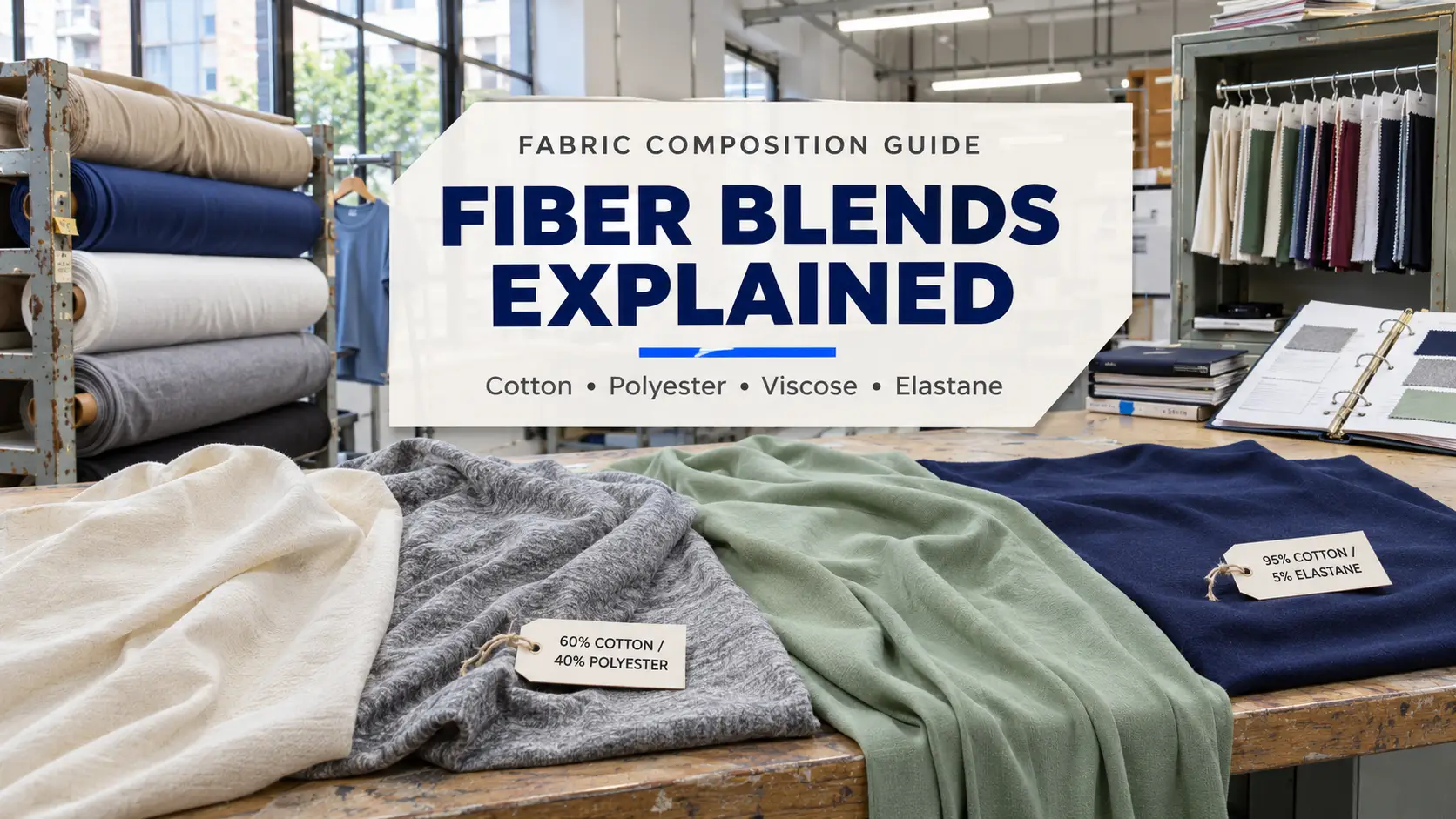
A fiber blend combines two or more textile fibers in defined proportions to achieve particular material characteristics. Clothing manufacturers use fiber blends to balance comfort, durability, softness, stretch, drying behavior, wrinkle resistance, and production cost.
Common examples include 60% cotton / 40% polyester for casualwear, 95% cotton / 5% elastane for fitted garments, and viscose-elastane combinations for soft, stretchable fashion clothing.
However, blending fibers does not automatically create a better fabric. A 100% cotton T-shirt can perform well or poorly depending on yarn quality, construction, and finishing. Similarly, a cotton-polyester blend may provide excellent comfort and durability or develop unacceptable pilling, shrinkage, and handfeel problems if its manufacturing conditions are unsuitable.
For apparel buyers, the important question is not whether a fabric contains natural or synthetic fibers. It is whether the selected composition supports the intended garment and whether the supplier can reproduce its characteristics consistently during sampling and bulk production.
This guide explains the tradeoffs between cotton, polyester, viscose, and elastane; the meaning of common blend percentages; and how fiber selection affects moisture management, stretch recovery, durability, cost, and sourcing decisions. It also provides practical recommendations for T-shirts, hoodies, polos, activewear, and other clothing categories.
Understanding fabric selection for clothing manufacturing helps buyers evaluate fiber composition alongside fabric construction, GSM, finishing, and performance requirements before committing to a particular material.
Table of Contents
What Is a Fiber Blend, and Why Do Clothing Manufacturers Use Blends?

A fiber blend is a textile material containing two or more fiber types combined in specified proportions. Different fibers may be blended during yarn production, used in separate yarn systems, or otherwise incorporated into a fabric to achieve the intended composition.
When buyers ask what is a fiber blend or what is fiber blend, they are usually trying to understand why manufacturers combine fibers rather than use one material exclusively.
The primary reason is to balance characteristics that one fiber may not deliver as effectively for a particular application.
For example, cotton is valued for absorbency and natural-fiber handfeel, while polyester is commonly used for strength, dimensional behavior, and faster drying. Elastane provides elastic extension and recovery, while viscose can contribute softness, absorbency, and fluid drape.
A blended fiber yarn may combine cotton and polyester within the yarn structure. Alternatively, a fabric may achieve a mixed composition by using different yarns in its construction.
Comfort vs. Durability: The Main Buyer Tradeoff
Comfort: Involves characteristics such as surface softness, moisture behavior, flexibility, thermal comfort, and how the material feels against the skin.
Durability: Involves resistance to relevant forms of wear, such as abrasion, pilling, dimensional change, and loss of shape.
The comfort vs durability decision is not always a direct compromise. Well-engineered materials can perform effectively in both areas, but buyers should identify which characteristics matter most to the garment.
A premium casual T-shirt may prioritize softness and drape while requiring acceptable wash stability. A workwear uniform may place greater emphasis on abrasion resistance, easy care, and repeated laundering.
Even a durable long fiber fabric depends on more than fiber length. Yarn structure, construction, finishing, and garment use affect the finished material’s performance.
The objective is to balance comfort and durability according to the intended product rather than assume that one fiber combination is universally superior.
Define Fabric Composition: What Fiber Percentages Mean
To define fabric composition, identify the fibers present in a textile and their respective proportions, normally expressed as percentages by mass under the applicable reporting convention.
For example, a fabric described as 60% Cotton / 40% Polyester contains those fiber proportions according to its declared composition.
This information is different from the fabric’s construction, weight, or finishing.
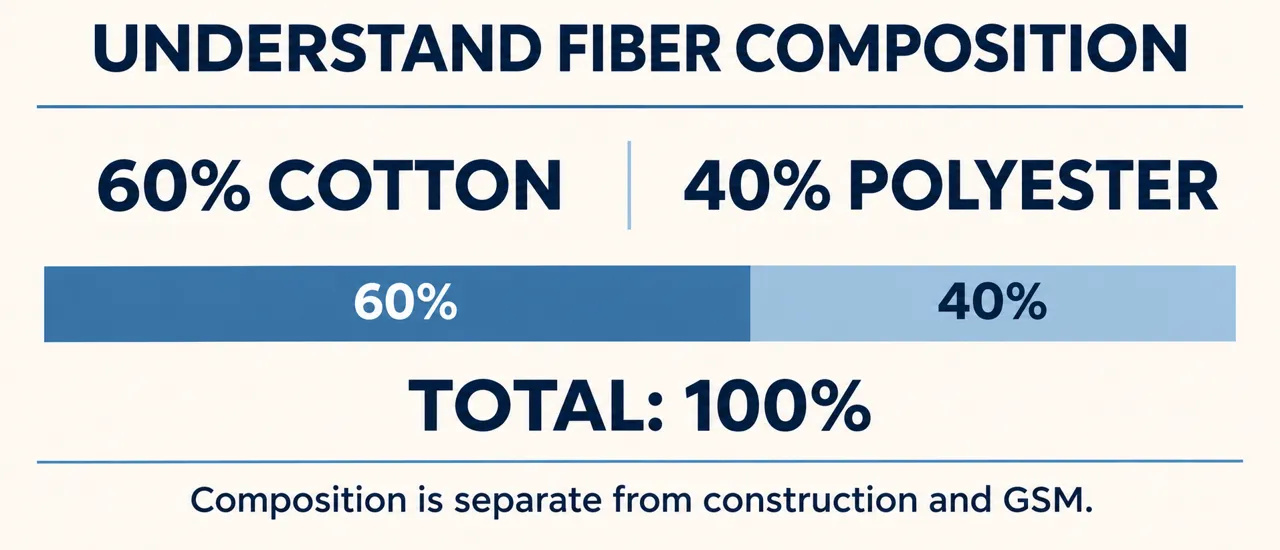
A 60/40 cotton-polyester material can be manufactured into different knitted or woven structures, each with different physical characteristics.
How to Describe Fabric Composition Correctly
| Specification Field | Example | Why It Matters |
|---|---|---|
| Fiber Composition | 60% Cotton / 40% Polyester | Identifies the required fiber proportions |
| Construction | Single Jersey Knit | Identifies the textile structure |
| Fabric Weight | 200 GSM | Specifies mass per unit area |
| Finishing | Approved Softening and Stabilization | Defines relevant finishing expectations |
| Material Reference | FAB-001 | Links samples, approvals, and reports |
| Substitution Rule | Written Approval Required | Prevents unauthorized material changes |
A buyer should not use descriptions such as “cotton blend” or “poly-cotton” as complete technical specifications because they do not identify the actual percentages.
Blended Percentage and Composition Tolerances
The blended percentage should be written clearly, identifying every relevant fiber and its declared amount.
For example, a cotton blend percentage of 60% cotton and 40% polyester should not be changed to 50% cotton and 50% polyester without reviewing and approving the alteration.
Any permitted variation must reflect applicable measurement methods, labeling regulations, buyer requirements, and material specifications. There is no universal ±2% allowance that can automatically be applied to every fiber blend.
AATCC’s TM20A quantitative fiber analysis test method provides procedures for determining textile fiber composition using appropriate mechanical, chemical, or microscopic techniques. This allows composition to be evaluated using recognized testing methods rather than relying solely on a supplier’s description.
Cotton Polyester Blend: How to Choose the Right Ratio
A cotton polyester blend is widely used in casualwear, uniforms, T-shirts, polos, sweatshirts, and other apparel categories.
Cotton and polyester have different properties, so combining them allows manufacturers to adjust fabric characteristics according to the product’s intended use.
However, the actual results depend on the percentages, yarn characteristics, construction, finishing, and relevant quality controls.
Cotton and Polyester Blend vs. Polyester Cotton Blend
The expressions cotton and polyester blend and polyester cotton blend describe fabrics containing both fibers. The word order may suggest which fiber is dominant in commercial descriptions, but it does not establish a precise composition.
For example, both of the following contain cotton and polyester but are different materials:
Cotton-Dominant Blend: 60% Cotton / 40% Polyester. This may suit garments intended to retain a relatively cotton-forward character while incorporating polyester.
Polyester-Dominant Blend: 65% Polyester / 35% Cotton. This may suit selected garments where quicker drying, reduced wrinkling, or easier care is important.
The percentages should always be confirmed rather than inferred from the material name.

Chief Value Cotton (CVC): Meaning and Application
Chief Value Cotton Meaning: CVC is a common industry abbreviation for Chief Value Cotton, generally describing a cotton-dominant blend, particularly in cotton-polyester fabrics.
When buyers ask what is chief value cotton, they are usually referring to materials in which cotton represents the larger component, commonly more than half of the composition.
For example, 60% Cotton / 40% Polyester may be marketed as CVC, but the label alone does not establish the exact ratio.
CVC fabrics are used in certain T-shirts, polos, sweatshirts, and casualwear programs. Their actual softness, shrinkage, pilling resistance, and durability must still be evaluated.
Common Cotton-Polyester Blend Comparisons
| Illustrative Composition | Potential Application | Important Considerations |
|---|---|---|
| 100% Cotton | Casual and premium basics | Shrinkage, care, handfeel |
| 60% Cotton / 40% Polyester | Casualwear, polos, fleece | Softness, pilling, dimensional stability |
| 50% Cotton / 50% Polyester | Basics, uniforms, sweatshirts | Handfeel, drying, appearance |
| 65% Polyester / 35% Cotton | Easy-care clothing, selected uniforms | Comfort, static, dyeing, pilling |
| 80% Cotton / 20% Polyester | Cotton-rich sweatshirts and hoodies | Surface finishing, shape retention |
These are common material directions, not universal recommendations. A particular fiber ratio cannot guarantee the stated performance without suitable yarn, construction, finishing, and testing.
Polyester vs. Cotton: Which Fiber Performs Better?
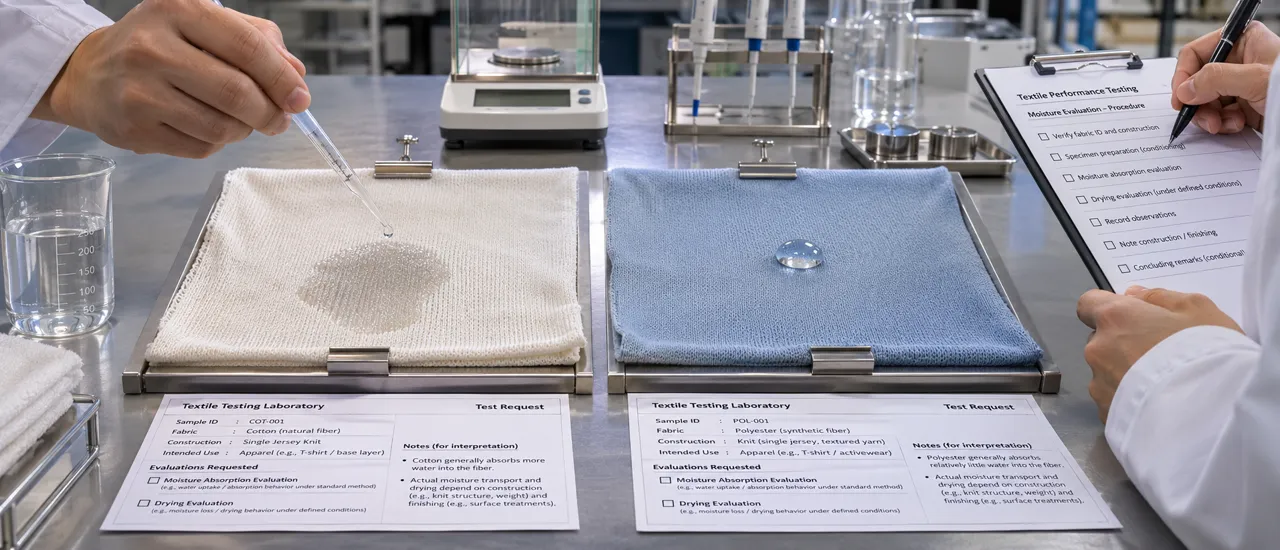
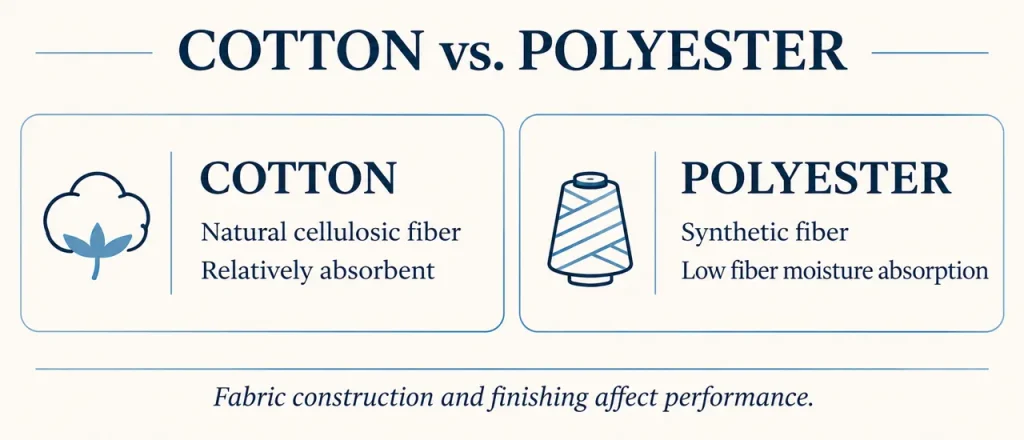
The polyester vs cotton comparison is important because these fibers behave differently in moisture absorption, drying, wrinkle recovery, and surface characteristics.
Cotton is a natural cellulosic fiber known for its absorbency and familiar handfeel. Polyester is a synthetic fiber commonly used where strength, dimensional stability, and relatively quick drying are desirable.
The cotton vs polyester decision depends on the finished garment rather than the fiber names alone.
Benefits of Polyester in Clothing Manufacturing
Faster Drying: Polyester generally absorbs less water into the fiber than cotton, which can support quicker drying. However, drying performance also depends on fabric construction, thickness, and finishing.
Wrinkle Resistance: Polyester can help reduce wrinkling in suitable fabric constructions, making it useful for certain easy-care garments and uniforms.
Strength and Durability: Polyester can contribute strength and abrasion resistance, although pilling and surface wear remain possible, particularly in some staple-fiber yarns and raised finishes.
Dimensional Performance: Polyester can support shape stability in suitable constructions, but fabric shrinkage and distortion still require evaluation.
These benefits of polyester can be valuable in casualwear, activewear, and workwear, but they should not automatically outweigh the intended garment’s comfort requirements.
Microfiber Polyester vs. Cotton
The comparison microfiber polyester vs cotton involves more than fiber chemistry.
Microfiber generally refers to extremely fine fibers or filaments, which may produce a smoother, softer textile depending on the yarn and construction.
A microfiber polyester fabric can feel substantially different from a polyester fabric made with coarser fibers. Buyers should therefore evaluate actual fabric samples rather than assume all polyester materials have the same handfeel.
Video: How Polyester Fiber Is Manufactured
The following educational video from Textile Vlog, Polyester Fiber – Production Process, Properties and Uses, explains polyester production and its textile applications. It provides useful context for how polyester differs from naturally occurring cotton fibers before the materials are incorporated into garment fabrics.
Viscose vs. Cotton: Softness, Drape, and Durability Tradeoffs

Viscose vs cotton is an important material comparison for clothing brands developing soft tops, dresses, loose-fitting trousers, and other garments where drape and handfeel matter.
Cotton is a natural cellulosic fiber, while viscose is a manufactured, regenerated cellulosic fiber produced from processed plant-derived cellulose.
Both are cellulose-based, but their production methods and physical characteristics differ.
Viscose Rayon vs. Cotton: What Is Viscose?
The term viscose rayon vs cotton describes the distinction between a manufactured regenerated cellulose fiber and naturally grown cotton fiber.
Viscose is commonly produced using cellulose derived from wood pulp or other suitable plant sources. The cellulose is processed and regenerated into textile fibers.
Textile Exchange’s explanation of manmade cellulosic fibers and viscose production identifies viscose, modal, and lyocell as regenerated cellulosic materials while distinguishing their production processes and sourcing considerations.
Benefits of Viscose in Apparel
Softness and Drape: Viscose can provide a smooth surface and fluid drape, making it suitable for certain dresses, blouses, and fashion tops.
Absorbency: Viscose is absorbent and may support comfortable moisture interaction, although actual wearing comfort depends on the fabric.
Appearance: Suitable viscose constructions may create an attractive flowing silhouette and smooth visual appearance.
The benefits of viscose should be balanced against its processing requirements. Conventional viscose may be more sensitive to wet-state handling and dimensional changes than some alternative fibers, depending on its characteristics and fabric construction.
These viscose fabric benefits make the fiber useful for selected fashion categories, but they do not mean every viscose material is suitable for repeated intensive laundering.
Cotton Viscose Blend
A cotton viscose blend combines two cellulosic fibers to achieve a particular handfeel, drape, or material character.
For example, a cotton-viscose jersey may provide a different surface and drape from an otherwise comparable 100% cotton jersey.
However, the blend’s composition alone cannot predict shrinkage or durability. Actual sample evaluation remains necessary.
Bamboo Viscose vs. Cotton
The comparison bamboo viscose vs cotton frequently appears in discussions about softness, absorbency, and environmental characteristics.
Bamboo-derived viscose is not the same as mechanically extracted natural bamboo fiber. It is regenerated cellulose made using bamboo as a feedstock.
The benefits of bamboo viscose may include characteristics associated with suitable viscose fabrics, such as softness and drape, but antibacterial, environmental, or other special claims should not be assumed from the bamboo source.
The US Federal Trade Commission‘s guidance on accurate labeling of bamboo-derived viscose textiles distinguishes actual bamboo fiber from rayon or viscose manufactured using bamboo cellulose. It also warns against unsupported claims concerning environmental or antimicrobial properties.
Video: Viscose Rayon Manufacturing Process
The following Textile Vlog video, Viscose Rayon Manufacturing Process, Properties and Uses, demonstrates how viscose is produced from cellulose and describes its textile applications. It helps clarify why viscose is classified as a regenerated fiber rather than an unchanged natural plant fiber.
Elastane vs. Spandex: Understanding Stretch and Recovery

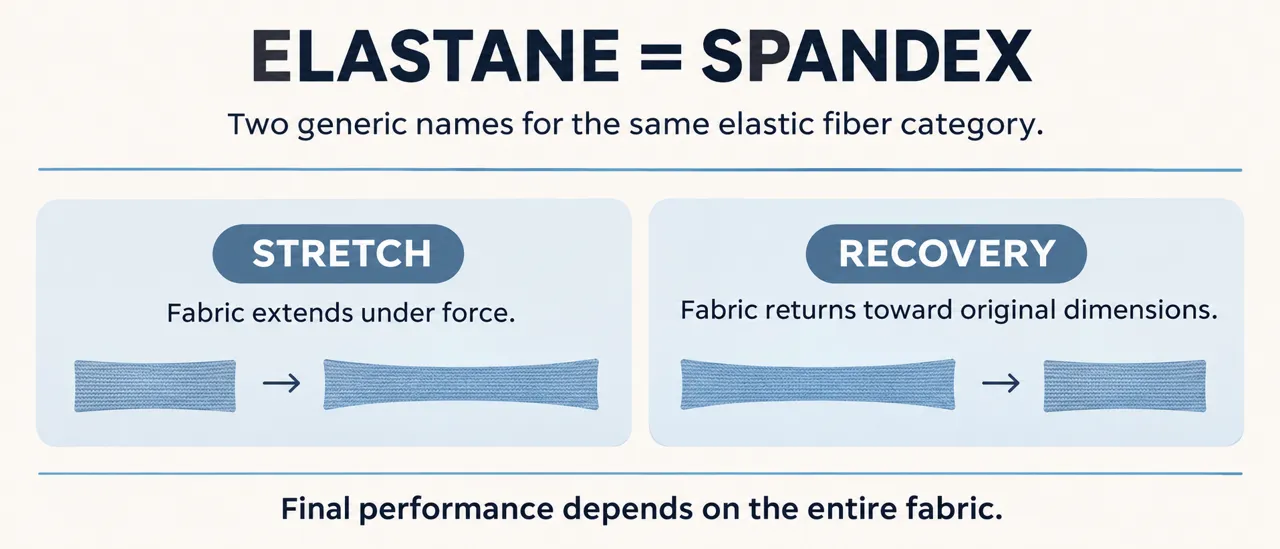
Elastane vs spandex is primarily a terminology difference, not a comparison between two unrelated fibers.
Spandex is the generic term widely used in the United States, while elastane is commonly used in other markets. Both refer to the same general category of highly elastic synthetic textile fibers.
Is Elastane the Same as Spandex?
Yes. The questions is elastane the same as spandex and is spandex and elastane the same have the same answer: the terms identify the same generic fiber category.
A fabric described as elastane spandex fabric should not be interpreted as containing two separate stretch fibers merely because both terms appear.
LYCRA is a trademarked fiber brand, not the generic name for every elastane product.
The LYCRA Company’s explanation of the difference between LYCRA, spandex, and elastane confirms these naming conventions and distinguishes its branded fibers from the broader generic category.
What Is Elastane Made Of?
When buyers ask what is elastane or what is elastane made of, the practical answer is that elastane is a manufactured elastic fiber based on segmented polyurethane-type chemistry.
It is typically incorporated into fabrics containing other fibers, often in relatively small proportions, to provide the intended elastic behavior.
A cotton elastane blend such as 95% Cotton / 5% Elastane may be selected for certain fitted T-shirts, leggings, or other garments that require additional extension.
However, the percentage alone does not establish the finished fabric’s actual stretch or recovery.
Stretch Recovery and Bagging Risk
Stretch: Describes how much a fabric extends under specified conditions.
Stretch Recovery: Describes how effectively the fabric returns toward its original dimensions after the stretching force is removed.
A garment can stretch comfortably while recovering poorly. This may contribute to unwanted bagging at knees, elbows, or other areas.
For elastane-containing fabrics, buyers should verify relevant stretch, recovery, growth after laundering, and sensitivity to care conditions.
Higher elastane content does not automatically guarantee better recovery, comfort, or durability.
Moisture Management: Natural Fibers, Wicking, and Breathability
Moisture behavior is an important consideration when choosing a fiber blend for casualwear, activewear, and clothing intended for warm environments.
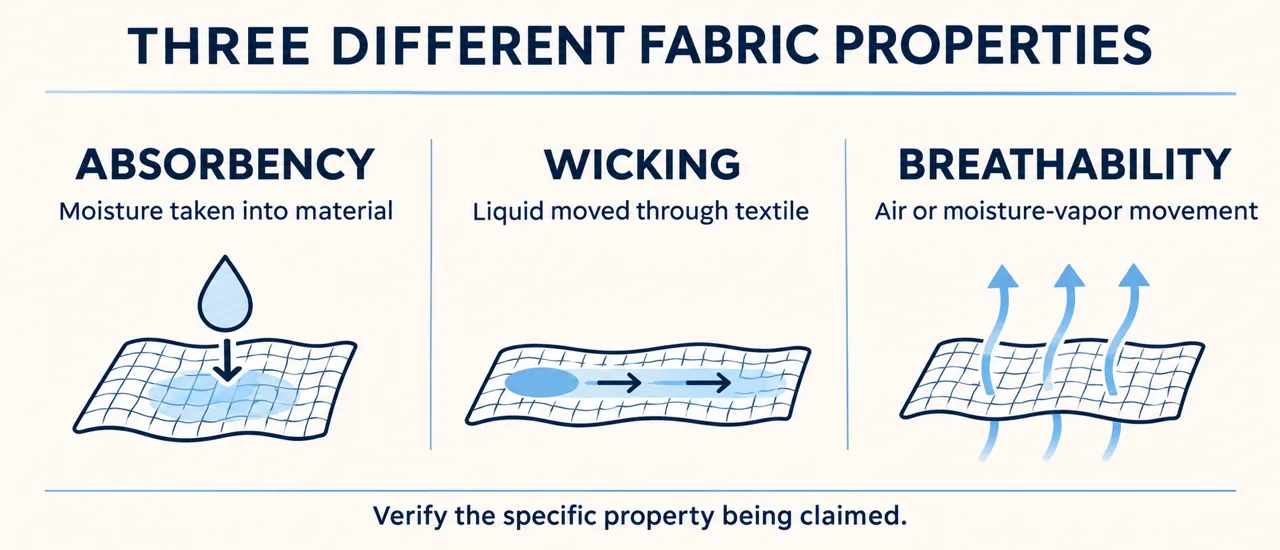
However, moisture absorption, wicking, and breathability describe different properties.
Absorbency: Describes how a material takes up moisture. Cotton and viscose are relatively absorbent fibers, but absorption does not automatically mean rapid drying.
Moisture Wicking: Describes liquid movement through or across a textile structure. Fabrics made using suitable moisture wicking fibers, yarns, constructions, or finishes may transport perspiration away from the skin.
Breathability: Describes relevant air or moisture-vapor movement through a textile. Describing fibers as breathable fibers does not establish how breathable the finished fabric will be.
Natural Fibers That Wick Moisture
When buyers compare natural fibers that wick moisture, they should distinguish the fiber’s absorbency from the finished textile’s ability to transport liquid.
Cotton can absorb substantial moisture but may retain it longer than certain engineered polyester fabrics. Polyester absorbs relatively little moisture into the fiber, yet suitable yarn and fabric constructions can support effective liquid transport.
To ensure comfort, fiber blend selection should therefore consider the garment’s construction, wearing environment, drying behavior, and appropriate moisture-management testing.
For clothing marketed with specific moisture-performance claims, buyers should request relevant verification rather than relying on composition alone.
Sustainable Fiber Claims: Recycled Polyester and Responsible Sourcing
A sustainable fiber claim should be supported by evidence rather than broad descriptions such as “green,” “eco,” or “environmentally friendly.”
For example, recycled polyester may reduce demand for virgin polyester feedstock, but its environmental performance depends on sourcing, processing, energy use, product design, and other lifecycle considerations.

Benefits of Eco-Friendly Fabrics and Recycled Polyester
When evaluating the claimed benefits of eco-friendly fabrics, recycled polyester is one material option brands may consider. However, recycled content does not automatically establish that the entire garment has a lower environmental impact under every assessment.
Buyers should review the following:
- The claimed recycled-content percentage.
- Relevant supplier and material identification.
- Applicable certification and chain-of-custody documents.
- Material performance and durability.
- Dyeing and finishing compatibility.
- The permitted scope of product and marketing claims.
The Textile Exchange guidance on recycled-content certification and claims explains how the Recycled Claim Standard (RCS) and Global Recycled Standard (GRS) support recycled-material verification and chain-of-custody controls. Certifications and claims must follow the applicable standard requirements rather than relying on unsupported supplier statements.
Fiber composition and environmental claims should also remain separate from performance approval. Recycled polyester can still exhibit pilling, shrinkage, or shade variation when the fabric is not adequately controlled.
Best Fiber Blend for T-Shirts, Hoodies, and Other Clothing

The best blend for t shirts or hoodies depends on what the brand expects the garment to achieve.
Softness, fit, durability, drying behavior, price, and intended customer preferences should be evaluated together rather than choosing a composition based on popularity.
Best Fabric Blend for T-Shirts
When deciding what is the best blend for t shirts, buyers should distinguish between everyday basics, fitted garments, promotional T-shirts, and performance apparel.
Cotton-forward compositions may suit garments emphasizing a familiar natural-fiber handfeel. Cotton-polyester combinations may be appropriate when reduced wrinkling or easier care is important, while polyester-rich fabrics can suit performance products with suitable moisture-management engineering.
Best Blend for Hoodies
The best blend for hoodies depends on the sweatshirt fabric’s construction, surface finishing, intended weight, and wearing conditions.
Cotton-rich fleece may provide the desired handfeel for a casualwear collection, while cotton-polyester blends are commonly considered where brands want to balance comfort, durability, and care characteristics.
Pilling and dimensional stability still require attention, particularly when the fabric has a heavily brushed surface.
Fiber Blend Selection Matrix by Product
| Product | Illustrative Blend | Main Selection Goal | Important Verification |
|---|---|---|---|
| Casual T-Shirt | 60% Cotton / 40% Polyester | Handfeel and easy care | Shrinkage, pilling |
| Fitted T-Shirt | 95% Cotton / 5% Elastane | Stretch and comfort | Recovery, dimensional stability |
| Polo Shirt | 50% Cotton / 50% Polyester | Appearance and maintenance | Pilling, shrinkage |
| Hoodie | 80% Cotton / 20% Polyester | Softness and garment substance | Pilling, finishing, stability |
| Activewear | 88% Polyester / 12% Elastane | Movement and flexibility | Stretch, recovery, colorfastness |
| Fashion Top | 95% Viscose / 5% Elastane | Drape and comfortable extension | Shrinkage, recovery, care |
All compositions are illustrative starting points, not universal recommendations or performance guarantees. The final material must be selected and verified for the intended product.
Different types of fabric construction and their effects on garment performance must be considered alongside fiber composition because knitted and woven structures can behave differently even when their fiber percentages are identical.
Understanding GSM meaning in fabric also helps buyers evaluate how material weight affects garment drape, handling, consumption, and cost without confusing fiber composition with fabric mass.
Test Your Fabric Blend Before Bulk Production
Developing a T-shirt, hoodie, activewear collection, or another apparel product? RYZEAL SOURCING can help coordinate sample development, material sourcing, and technical reviews through suitable specialized manufacturing partners in Bangladesh.
Fiber Blend Risks: Shrinkage, Pilling, Recovery, and Colorfastness
A fiber blend should be evaluated according to the characteristics that matter for the finished garment.
The same composition may produce different results when yarn characteristics, fabric construction, finishing, or processing conditions change.
| Risk | What Affects It | Relevant Verification |
|---|---|---|
| Shrinkage Risk | Fibers, construction, finishing | Dimensional change testing |
| Pilling Risk | Staple fibers, yarn, surface finishing | Pilling evaluation |
| Poor Stretch Recovery | Elastane system, construction, processing | Stretch and recovery testing |
| Shade Variation | Fiber dye affinity and processing | Shade approval and relevant colorfastness |
| Moisture-Management Failure | Fiber, yarn, construction, finish | Relevant moisture-performance tests |
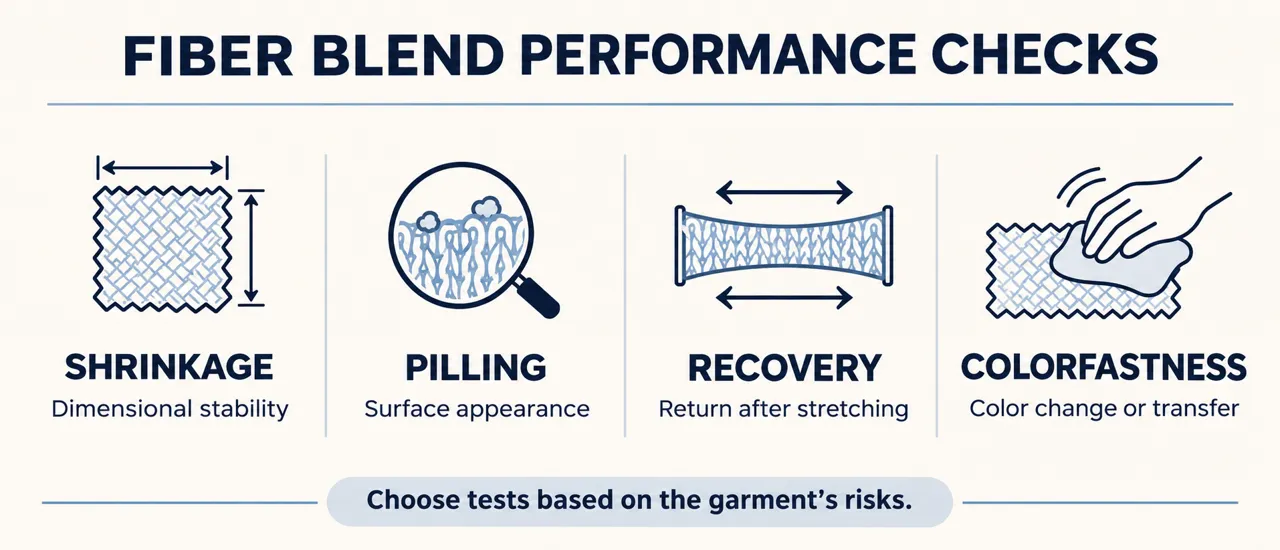
Color Fastness to Sweat: This is particularly important for garments exposed to perspiration, including certain activewear and fitted clothing. The specification should identify the applicable colorfastness-to-perspiration method and acceptance criteria.
Testing requirements should reflect the material and product risks. A complete laboratory test package is not automatically necessary for every blend or every production lot.
Appropriate fabric testing for shrinkage, pilling, colorfastness, and spirality helps identify material-performance problems before they affect garment quality and customer satisfaction.
How to Write Fiber Blend Requirements Into a Fabric Specification Sheet
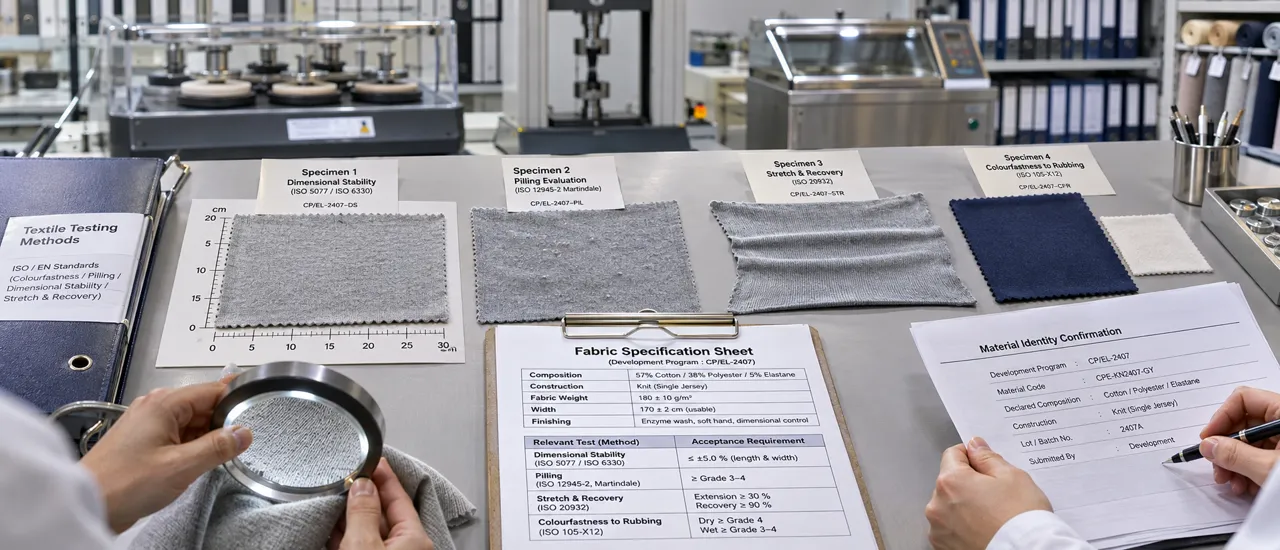
A buyer should document fiber composition using exact percentages and the relevant material identification.
For example:
Fabric Composition: 60% Cotton / 40% Polyester.
Fabric Construction: Single Jersey Knit.
Material Reference: FAB-001.
Substitution Requirement: Changes to the approved composition require written authorization.
Verification: Supplier confirmation and applicable fiber-content testing according to the approved quality plan.
The specification should also identify relevant weight, width, finishing, performance, and approval requirements.
Clear fabric specifications for clothing manufacturing help buyers and suppliers maintain consistent material requirements during quotation, sampling, procurement, and bulk production.
Frequently Asked Questions About Fiber Blends
1. What is a fiber blend, and why do clothing brands use blends?
A fiber blend combines two or more textile fibers in defined proportions. Brands use blends to balance characteristics such as comfort, durability, moisture behavior, stretch, and cost.
2. What should a fabric composition label include?
It should identify the required fiber names and percentages according to applicable textile-labeling regulations. A technical specification may also include tolerance, verification, and substitution requirements.
3. What cotton-polyester percentages are common for T-shirts?
Compositions such as 60/40 and 50/50 are commonly used, but neither guarantees a particular result. Actual suitability depends on the yarn, construction, finishing, and intended garment.
4. What is Chief Value Cotton (CVC)?
CVC commonly describes a cotton-dominant blend, particularly one containing more cotton than polyester. The actual fiber percentages should still be specified.
5. Polyester vs. cotton: which is better for durability?
Polyester can offer advantages in strength, wrinkle resistance, and drying behavior, while cotton may provide a preferred natural-fiber handfeel. Durability depends on the complete fabric construction.
6. Viscose vs. cotton: which provides better comfort?
Viscose can offer soft handfeel and fluid drape, while cotton is commonly valued for its familiar feel and absorbency. The better option depends on the garment and wearing conditions.
7. Is elastane the same as spandex?
Yes. Elastane and spandex are generic names for the same category of elastic synthetic fiber, commonly used in different markets.
8. How much elastane should a fabric contain?
There is no universal ideal percentage. The required amount depends on the intended stretch, recovery, garment fit, and fabric construction.
9. Can recycled polyester improve a garment’s environmental performance?
It may reduce the need for virgin polyester inputs, but the environmental outcome depends on sourcing, processing, product design, and other factors. Recycled-content claims require appropriate evidence.
10. How can buyers ensure comfort when selecting a fiber blend?
Evaluate physical swatches, intended fabric construction, moisture behavior, stretch, surface handfeel, and relevant testing results. Fiber composition should be one part of the material selection process.
Final Takeaway: Choose Fiber Blends for the Garment, Not the Label
The right fiber blend depends on the garment’s intended comfort, durability, movement, appearance, and manufacturing requirements.
Cotton, polyester, viscose, and elastane each offer useful characteristics, but combining them requires an understanding of their tradeoffs. A cotton-rich blend may suit everyday comfort, a polyester-rich blend may support selected easy-care or performance applications, and elastane-containing fabrics may provide the extension needed for fitted garments.
The important step is to define the required outcome, select a suitable composition, and verify the finished material rather than assuming that a particular fiber percentage guarantees quality.
RYZEAL SOURCING supports apparel brands through a network of vetted independent manufacturing partners in Bangladesh, coordinating material sourcing, sample development, manufacturing requirements, and quality follow-up according to each project’s needs.
Check MOQ Feasibility for Your Custom Fiber Blend
Planning custom T-shirts, hoodies, activewear, or other clothing with a particular fiber composition? Share your product details, preferred fabric blend, estimated order quantity, and customization requirements with RYZEAL SOURCING to discuss suitable sourcing and manufacturing options.
A successful fiber blend is not defined by the most impressive composition label. It is defined by how consistently the material meets the garment’s intended requirements.
Connect with RYZEAL SOURCING