

Understanding the different types of fabric is essential for clothing brands because textile construction affects how a garment stretches, drapes, fits, and performs during manufacturing and everyday use.
Fabric construction describes how yarns or fibers are assembled to form a textile. The three principal construction groups commonly discussed in apparel are knitted, woven, and nonwoven fabrics. Other important structures include denim, which is generally woven; felt, which is commonly classified as nonwoven; bonded or laminated materials, which combine layers; and braided structures used in particular textile components.
These distinctions matter because two fabrics made from the same fiber can behave very differently. A cotton single-jersey T-shirt and a cotton poplin shirt may both contain 100% cotton, but their construction produces different stretch, stability, drape, and sewing characteristics.
Selecting the wrong structure can create problems with fit, dimensional stability, fabric durability, garment appearance, and manufacturing costs. Even when GSM and composition match the buyer’s requirements, an unsuitable construction can prevent the finished garment from achieving its intended performance.
This guide explains the main fabric types, their manufacturing methods, advantages, limitations, common defects, and apparel applications. It also compares knitted and woven fabrics, rigid and stretch denim, nonwoven materials, felt, laminated textiles, and braided components.
The most effective approach is to identify the garment’s intended use first, choose a suitable construction, and then confirm the composition, weight, finishing, and relevant performance requirements.
A broader fabric selection framework for clothing manufacturing helps connect these construction decisions with fiber composition, GSM, sourcing, and material testing.
Table of Contents
Types of Fabric vs. Types of Fabric Material: Understanding the Difference
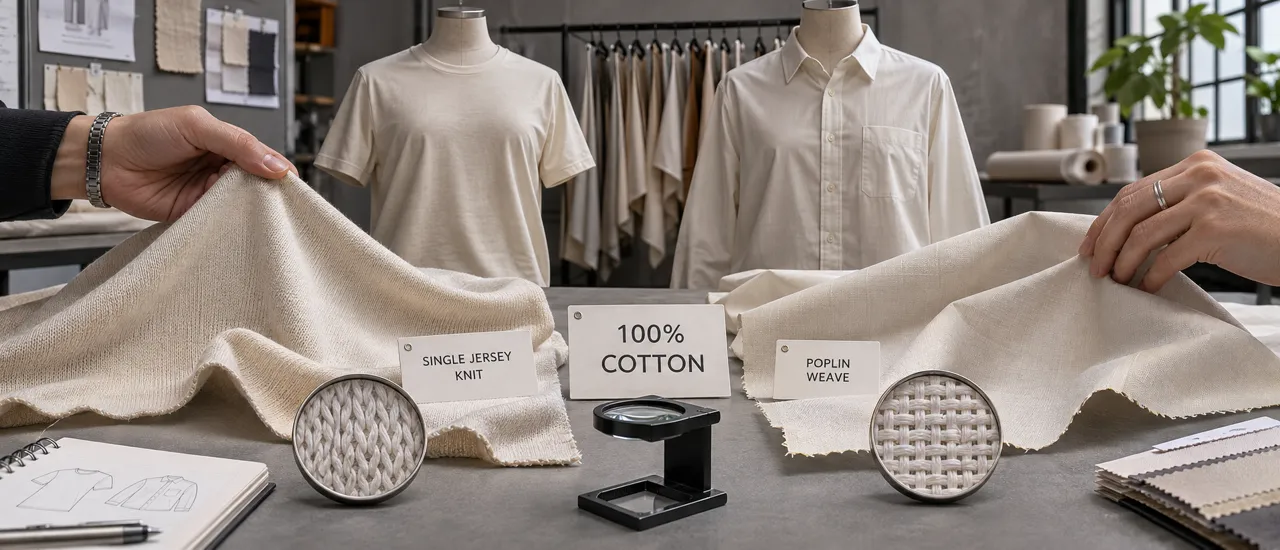
The expressions types of fabric material and fabric construction are often used interchangeably, but they describe different characteristics.
Fabric Material:
Refers to the fibers used to manufacture a textile, such as cotton, polyester, viscose, wool, nylon, or elastane. Fiber content can influence moisture behavior, strength, care requirements, and other properties.
Fabric Construction:
Refers to how the textile is formed through knitting, weaving, bonding, felting, braiding, or another manufacturing method. Construction influences extension, stability, drape, surface characteristics, and production behavior.
The distinction matters when comparing fabric material types because identical fiber compositions can produce different textiles.
Construction vs. Material Examples
| Garment or Component | Fiber Material | Fabric Construction |
|---|---|---|
| Cotton T-Shirt | Cotton | Single Jersey Knit |
| Cotton Shirt | Cotton | Plain-Weave Poplin |
| Cotton Jeans | Cotton | Woven Denim Twill |
| Stretch Leggings | Polyester / Elastane | Engineered Knit |
| Collar Interlining | Polyester or Other Fibers | Nonwoven |
| Structured Accessory | Wool or Blended Fibers | Felted Material |
For example, the types of fabric materials available for a T-shirt may include cotton, polyester, or their blends. However, these material choices do not automatically determine whether the fabric will be single jersey, interlock, rib, or another structure.
Buyers should therefore document composition and construction separately to prevent suppliers from treating different textiles as interchangeable.
Different Types of Fabric Construction: Main Groups and Specialized Structures

The different types of fabric construction can be understood through three broad groups, followed by specialized structures and manufacturing combinations.
What Are the 3 Types of Fabric Construction?
The simplified classification commonly identifies knitted, woven, and nonwoven textiles.
Knitted Fabrics:
Formed by intermeshing yarns into loops. They are frequently used for T-shirts, sweaters, underwear, activewear, and other garments where flexibility may be important.
Woven Fabrics:
Formed by interlacing warp and weft yarns. They are commonly used for shirts, trousers, denim, jackets, uniforms, and structured garments.
Nonwoven Fabrics:
Made from engineered fibrous assemblies that obtain structural integrity through suitable physical or chemical bonding processes rather than conventional weaving or knitting. They are widely used for interlinings, reinforcement, insulation, and specialized textile applications.
This three-group model is a helpful introduction, but buyers should recognize that some textile products require more specific descriptions.
Specialized Fabric Structures
| Structure | Classification | Common Apparel Application |
|---|---|---|
| Jersey, Rib, Interlock | Knitted | T-Shirts, cuffs, sportswear |
| Poplin, Twill, Satin | Woven | Shirts, trousers, dresses |
| Denim | Woven subgroup | Jeans, jackets, skirts |
| Spunbond, Spunlace | Nonwoven | Interlinings, functional components |
| Felt | Commonly nonwoven | Structured accessories, panels |
| Bonded / Laminated | Layered or composite material | Outerwear, technical garments |
| Braided | Separate interlacing construction | Drawcords, straps, tapes |
These categories are not all equivalent branches of one classification. For example, a laminated fabric may have a knitted or woven base, and a bonded textile can combine several materials.
How Fabric Production Methods Create Different Structures
Different fabric production methods produce different arrangements of yarns or fibers.
Knitting machines create interconnected loops. Weaving machines interlace two yarn systems, while nonwoven production methods form and consolidate fibrous webs. Braiding equipment interlaces strands along paths that commonly produce cords, tapes, or tubular structures.
Understanding these methods of fabric production helps buyers identify which textile properties originate from construction and which come from fiber content or finishing.
Knit vs. Woven Fabric: Stretch, Stability, Drape, and Defects
The knit vs woven comparison is one of the most important decisions in apparel manufacturing.
Knitted fabrics generally use interconnected loops, while woven fabrics use interlaced yarn systems. These differences influence flexibility, dimensional stability, sewing behavior, and the finished garment’s appearance.
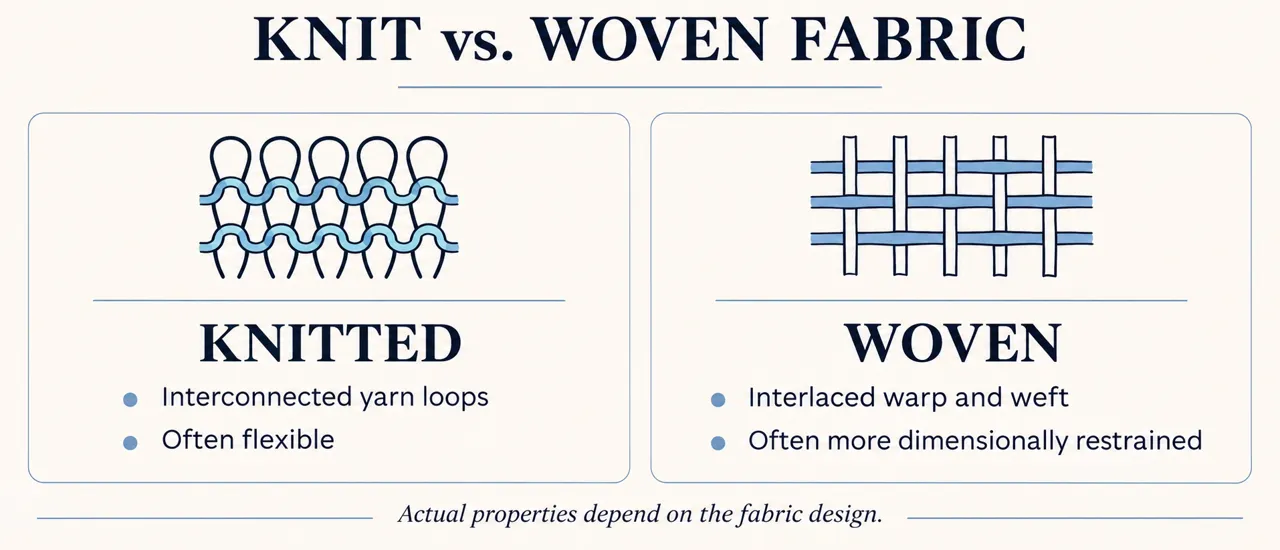
Knit vs. Woven: What Changes Structurally?
Knitted Fabric:
Yarn loops can rearrange under tension, providing extension in many constructions. However, stretch, recovery, edge curling, and dimensional behavior vary according to the knit structure, yarn, and finishing.
Woven Fabric:
Warp and weft yarns interlace to form a structure that is often more restrained in extension than a comparable conventional knit. Woven fabrics can nevertheless provide flexibility through weave design, mechanical properties, or stretch fibers.
CottonWorks’ technical explanation of knitting fundamentals and knitted fabric structures describes how loops, stitch length, and knitting methods influence fabric behavior. It also distinguishes weft knitting from warp knitting, which use different yarn arrangements and manufacturing systems.
Weft Knit vs. Warp Knit
Weft Knit:
Loops are formed across successive courses using yarns generally supplied in the course direction. Circular and flat-bed knitting machines produce many common weft-knitted materials, including jersey, rib, and numerous sweater structures.
Warp Knit:
Multiple yarns form interconnected loops primarily along the fabric’s lengthwise direction. Warp-knitted constructions such as tricot and raschel are used in various applications, including technical textiles, linings, intimate apparel, and selected sportswear.
The two knitting methods have different structural characteristics. Their actual extension, recovery, and stability depend on the particular fabric.
Advantages and Disadvantages of Knitted Fabrics
The advantages of knitted fabrics often include flexibility, comfort, and adaptability to body movement. Many constructions can also provide the soft drape expected in casualwear and selected performance garments.
When buyers ask what are the advantages of knit fabrics, the most useful answer depends on the intended garment.
Advantages of Knit Fabrics:
Many knitted structures provide useful extension and conformability without requiring a rigid garment silhouette. They are widely used for T-shirts, activewear, underwear, sweaters, and casualwear.
Disadvantages of Knitted Fabrics:
Depending on construction and finishing, knitted materials may experience edge curling, spirality, dimensional change, or distortion during sewing. Some may also be susceptible to pilling or snagging under relevant conditions.
The advantages and disadvantages of knitted fabrics must therefore be evaluated using the actual material rather than assuming every knit behaves identically.
Advantages of Woven Fabrics
The advantages of woven fabrics often include dimensional restraint, shape retention, and suitability for structured garment silhouettes.
A woven shirt fabric may create a crisp appearance, while a suitable twill can provide the structure required for trousers or workwear.
However, woven materials can also wrinkle, fray, distort, or restrict movement depending on their construction. Stretch-woven fabrics may reduce certain mobility limitations, but their recovery requires appropriate evaluation.
Knitted vs. Woven Fabrics: Buyer Comparison
| Characteristic | Knitted Fabric | Woven Fabric |
|---|---|---|
| Construction | Interconnected loops | Interlaced warp and weft |
| Stretch | Often greater inherent extension | Often lower without stretch engineering |
| Drape | Depends on loop structure and yarn | Depends on weave, yarn, and finish |
| Stability | May require careful relaxation control | Often more restrained, but not universally stable |
| Edge Behavior | Curling or unraveling in certain constructions | Fraying in many conventional constructions |
| Common Applications | T-Shirts, activewear, sweaters | Shirts, trousers, jackets |
| Relevant Risks | Spirality, holes, needle lines | Broken yarns, mispicks, skew |
The knitted vs woven fabrics comparison identifies common tendencies, not guaranteed outcomes. Choosing between woven vs knit fabric should begin with the garment’s intended movement, silhouette, and construction requirements.
Common Knitted Fabric Defects and Woven Fabric Defects
Knitted Fabric Defects:
Examples include holes, needle lines, barré, dropped stitches, and certain forms of spirality. These problems may arise from yarn variation, knitting conditions, finishing, or other factors.
Woven Fabric Defects:
Examples include broken ends, missing picks, floats, irregular slubs, bowing, skew, and certain shade streaks. Their acceptability depends on the product and inspection criteria.
Visual references can help teams distinguish knitting defects from intentional fabric textures. When reviewing knit fabric defects with pictures, knitted fabric defects with images, or woven fabric defects with pictures, the examples should be checked against actual inspected materials because similar-looking defects can have different causes.
Video: How Circular Knitting Machines Produce Fabric
The following Knit Fabric Manufacturing Process With Circular Knitting Machines demonstration by Textile Vlog shows industrial circular knitting equipment used to create knitted textile structures. Observing the process helps clarify how knitted fabric is formed through loops rather than the warp-and-weft interlacing used in weaving.
Types of Fabric Weaves: Plain, Twill, and Satin

Woven materials are not all constructed the same way. Different types of fabric weaves influence surface texture, drape, flexibility, appearance, and durability.
Three Basic Weave Structures
Plain Weave:
Warp and weft yarns interlace in a basic alternating arrangement. It is used in fabrics such as poplin and canvas, although their properties vary considerably with yarn and fabric density.
Twill Weave:
Yarn interlacing creates a characteristic diagonal pattern. Twill is commonly used in chinos, denim, workwear, and other garments requiring a particular balance of structure and flexibility.
Satin Weave:
Longer yarn floats can create a smoother or more lustrous appearance. Depending on the fibers and construction, snagging and surface abrasion may require particular attention.
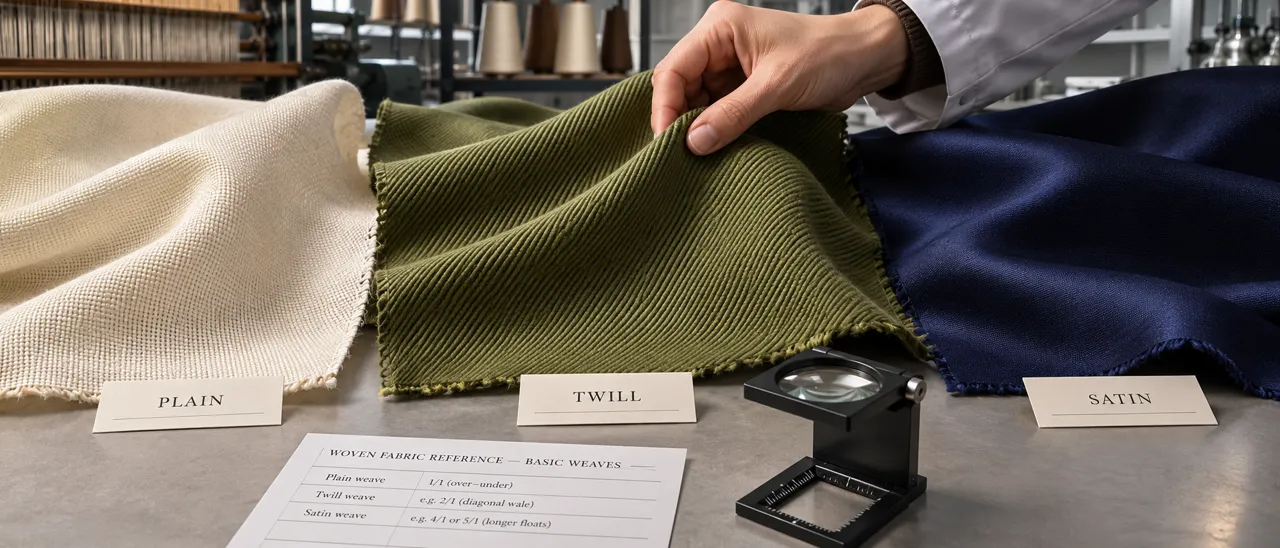
CottonWorks’ guide to weaving basics and woven fabric designs explains how warp and weft yarns form textiles and introduces plain, twill, and satin as the three basic weave structures. These distinctions help buyers understand why different woven materials can behave differently.
Woven Shirt Fabric vs. Woven Fabric Trousers
A woven fabric shirt commonly uses poplin, twill, or another suitable lightweight structure to achieve its intended appearance and wearing characteristics.
By comparison, woven fabric trousers may require different strength, abrasion behavior, opacity, and shape-retention characteristics.
For example, a lightweight poplin can be suitable for a shirt but may not provide the intended structure or durability for work trousers. Buyers should choose woven constructions according to their actual garment requirements.
Video: How Woven Fabric Is Manufactured
The following Weaving Process in Textile Industries – Step by Step Explanation by Textile Vlog demonstrates the industrial weaving process. It covers how warp and weft yarns interact to form a woven fabric, providing a useful comparison with the circular knitting process.
Denim Fabric Construction: Rigid vs. Stretch Denim

Denim fabric construction generally uses woven twill structures, often with indigo-dyed warp yarns and lighter-colored weft yarns. Denim remains a woven fabric even when treated as a distinct commercial category for jeans and other garments.
Its yarn characteristics, weave, finishing, and garment-washing processes strongly influence the finished product.
Denim Fabric for Jeans: Construction and Weight
Common denim jeans fabric types include conventional twill, broken twill, rigid denim, stretch denim, and materials engineered for particular appearance or comfort requirements.
The description denim fabric count and construction refers to relevant yarn sizes, warp-end and weft-pick densities, and weave arrangements. These details help identify the material more accurately than a broad statement such as “heavy denim.“
A typical denim specification may identify a 3/1 twill, an approximate fabric weight, yarn characteristics, composition, and applicable finishing or washing requirements.
CottonWorks’ technical explanation of denim construction, weaves, and weights describes common twill structures, indigo processing, yarn characteristics, and garment-finishing influences. It provides useful background for understanding the characteristics of denim fabric for jeans.
Rigid Denim Definition: What Is Rigid Denim?
Rigid Denim: Conventionally refers to denim manufactured without an intentional elastane-based stretch system. It is commonly selected for structured jeans, heritage-inspired garments, and products where a relatively firm appearance is desired.
However, rigid denim jeans can still exhibit mechanical give or changes in fit through movement, wear, and laundering.
Rigid vs. Stretch Denim
The rigid vs stretch denim decision depends on the desired fit, movement, appearance, and recovery requirements.
Stretch Denim Fabric:
Typically contains elastane or uses another engineered stretch system to provide additional extension. It can support close-fitting jeans and garments requiring greater freedom of movement.
Stretch Denim Jeans:
May offer improved flexibility, but excessive growth, bagging, or poor recovery can affect appearance and fit. The construction, stretch system, and planned washing process should therefore be evaluated together.
| Characteristic | Rigid Denim | Stretch Denim |
|---|---|---|
| Intentional Elastic Stretch | Usually absent | Incorporated through selected materials or engineering |
| Fit Direction | Structured or relaxed | Fitted or movement-oriented |
| Important Risk | Comfort, wash-related dimensional changes | Growth, bagging, recovery |
| Key Verification | Dimensional stability, wash appearance | Stretch, recovery, dimensional stability |
The best denim fabric for jeans depends on the intended silhouette and performance rather than whether the fabric is rigid or elastic.
Does Rigid Denim Stretch?
The question does rigid denim stretch requires distinguishing deliberate elastic extension from ordinary mechanical give.
Rigid denim can soften and change shape through wear, but it is not designed to recover like properly engineered stretch denim.
For consumers asking how to soften rigid denim, appropriate wear and care may gradually change its handfeel. However, aggressive treatments should not be recommended without considering the garment’s care instructions.
Likewise, how to stretch rigid denim should not be treated as a reliable method for correcting unsuitable garment sizing. Brands should communicate realistic fit expectations rather than promise stretch behavior the material cannot consistently provide.
What Is Non Woven Fabric, and Where Is It Used?

Non woven fabric is an engineered fibrous material formed without conventional knitting or weaving. Fibers or filaments are arranged into a structure that receives integrity through appropriate bonding or entanglement methods.
A non woven material may be designed for reinforcement, insulation, filtration, barrier properties, or other specialized purposes.
The official ISO 9092:2026 nonwovens vocabulary distinguishes nonwoven materials from knitted, woven, and paper-based products using defined structural terminology. This helps buyers avoid classifying every sheet-like fibrous material as the same type of textile.
Common Nonwoven Manufacturing Methods
| Nonwoven Type | Manufacturing Approach | Possible Application |
|---|---|---|
| Spunbond Nonwoven | Continuous filaments formed and bonded | Selected interlinings and support layers |
| Meltblown Nonwoven | Fine fibers formed into a web | Barrier or filtration components |
| Spunlace Nonwoven | Fibers entangled using high-pressure water jets | Soft functional layers |
| Needle-Punched Nonwoven | Mechanical fiber entanglement using needles | Padding, insulation, reinforcement |
These methods do not produce interchangeable materials. Fiber composition, bonding method, thickness, strength, and finishing affect suitability.
Advantages and Disadvantages of Non Woven Fabrics
Advantages: Nonwoven technologies can produce materials engineered for specific characteristics, including stiffness, filtration, insulation, or controlled thickness. They can also support certain manufacturing efficiencies depending on the application.
Disadvantages: Some nonwoven constructions may have limited drape, wash durability, or seam performance compared with suitable knitted or woven alternatives. Other engineered nonwovens can be highly durable, so these limitations should not be generalized across every product.

Non Woven Fabric Usage in Apparel
Common non woven fabric usage includes fusible interlinings, reinforcement layers, insulation, and certain functional garment components.
For example, a shirt collar may contain a nonwoven interlining to provide the required structure, even though the outer fabric is woven cotton.
The relevant checks depend on the application and may include compatibility with heat, laundering, bonding, and garment construction.
What Is Felt Fabric, and How Does It Differ From Other Nonwovens?

Felt fabric is generally formed by consolidating and entangling fibers into a coherent structure rather than creating a conventional knitted or woven yarn system.
A felted fabric may be produced using combinations of moisture, heat, pressure, mechanical agitation, or specialized needling processes, depending on the fibers and product.
Felt is commonly treated within the broader nonwoven category, although its manufacturing method should be identified more precisely when required.
When Should Apparel Brands Choose Felt?
Felt can be suitable for structured accessories, decorative components, hats, and other applications where its surface, density, and edge characteristics are desirable.
However, some felt materials may lack the fluid drape or flexibility expected from conventional apparel shell fabrics.
Buyers should evaluate thickness, density, edge behavior, surface fuzz, abrasion resistance, and care requirements before approval.
What Is Bonded Fabric and Laminated Fabric?
Bonded Fabric: A textile product made by joining two or more material layers through an appropriate bonding process. The layers may use woven, knitted, nonwoven, or other substrates.
Laminated Fabric: A layered material commonly incorporating a membrane, film, or other component bonded to a textile substrate to achieve particular characteristics.
A combined fabric may provide improved structure, barrier characteristics, or other performance, but the exact result depends on its components and joining method.

Common Risks With Bonded and Laminated Materials
Delamination: Layers can separate if their bond does not remain suitable under the intended use or care conditions.
Drape and Flexibility: Additional layers can change garment stiffness and movement. A fabric that performs well as a single layer may behave differently after bonding.
Breathability and Comfort: Depending on the membrane and construction, airflow and moisture-vapor behavior may change.
Buyers should evaluate relevant bond durability, dimensional stability, comfort, and functional properties. A laminate should be approved as a complete material system rather than only checking its outer surface.
Braided Fabric: Where Braiding Fits in Clothing Manufacturing
Braided Fabric: A textile structure formed by interlacing yarns or strands along coordinated paths. Braiding commonly produces cords, tapes, narrow structures, and tubular products.
The terms braid fabric and braiding fabric are sometimes used when searching for this construction method.
In apparel, braided structures are frequently found in hoodie drawcords, straps, selected reinforcement tapes, and accessories.

Braided vs. Woven Tape
A braided cord and a woven tape can have different extension, flexibility, abrasion, and strength characteristics. Neither construction is automatically superior.
For functional components, buyers should specify relevant dimensions, material composition, strength, elongation, surface characteristics, and durability requirements.
Drape, Durability, Shrinkage, and Fabric Cost: What Changes With Construction?

A useful comparison of fabrics and their drape considers how the textile hangs, folds, stretches, and responds to movement.
The way fabric drapes depends on more than construction. Fiber characteristics, yarn, weight, thickness, and finishing also influence the result.
When evaluating different fabrics and drapes, buyers should compare physical samples of the intended materials rather than assume that all knits are fluid or all woven fabrics are stiff.
Fabric Durability and Abrasion Resistance
Fabric Durability: Describes how a material withstands relevant conditions of use. The important properties may include abrasion resistance, strength, dimensional stability, pilling resistance, and other characteristics.
There is no universal fabric durability rating that determines which construction is best for every garment.
A high durability fabric for work trousers may need different performance characteristics from a durable stretch fabric for activewear.
ASTM International’s guide to abrasion resistance of textile fabrics, ASTM D3884, describes a rotary-platform abrasion evaluation method and its limitations. Results should be interpreted according to the relevant material and test conditions rather than used as guarantees of actual garment lifespan.
Shrinkage in Fabric
Different constructions may experience dimensional changes during relaxation, washing, drying, or finishing.
The types of shrinkage in fabric depend on fiber characteristics, construction, manufacturing tensions, and processing conditions.
Fabric Shrinkage Control: May involve suitable finishing, material relaxation, pattern allowances, and relevant quality verification. The appropriate method depends on the material.
Fabric Shrinkage Testing: Should use an agreed procedure and acceptance criteria. Relevant fabric shrinkage standards provide measurement methods, but permitted results remain product-specific.
Fabric Cost and Construction
The cost of fabric depends on fiber, yarn, construction complexity, finishing, usable width, quantity, and other commercial factors.
Construction also affects cutting behavior, sewing operations, and material consumption. Therefore, fabric cost should be evaluated together with the actual manufacturing requirements rather than comparing price per kilogram alone.
Understanding GSM meaning in fabric and its relationship with garment weight helps buyers evaluate textile mass alongside construction, drape, consumption, and manufacturing costs.
How to Choose the Right Types of Fabric for Different Garments
The most suitable construction depends on the garment’s function, intended silhouette, care requirements, and expected performance.
A practical way to evaluate fabric choices is to identify the end use before comparing materials.
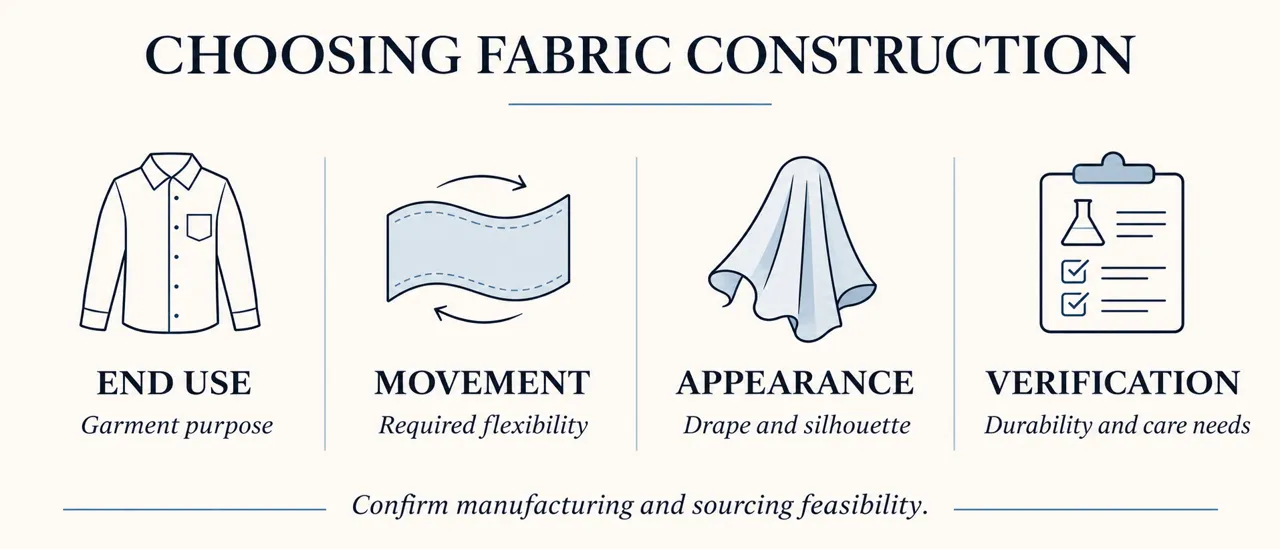
Fabric Construction Decision Matrix
| Garment | Possible Construction | Main Benefit | Important Risk |
|---|---|---|---|
| T-Shirt | Single Jersey Knit | Flexibility and casualwear drape | Shrinkage, spirality |
| Polo Shirt | Piqué or Interlock Knit | Textured or structured appearance | Dimensional stability |
| Formal Shirt | Woven Poplin or Twill | Shape and appearance | Wrinkling, seam behavior |
| Trousers | Woven Twill | Structured fit | Abrasion, mobility |
| Jeans | Denim Twill | Characteristic denim appearance | Wash shrinkage, color transfer |
| Activewear | Engineered Knit or Stretch Woven | Movement and functional performance | Recovery, durability |
| Collar Interlining | Appropriate Nonwoven | Support and structure | Bonding, care performance |
| Functional Outerwear | Woven or Knit Laminate | Engineered barrier properties | Delamination |
| Hoodie Drawcord | Braided Cord | Flexible narrow component | Fraying, wear, strength |
These are candidate material directions, not mandatory construction specifications.
How to Choose Fabric Construction Step by Step
- Define End Use: Identify whether the garment is intended for casualwear, sportswear, workwear, uniforms, fashion, or another application.
- Determine Movement Requirements: Establish whether the garment needs inherent stretch, engineered stretch, or a relatively stable structure.
- Review Drape and Appearance: Compare the intended silhouette with suitable fabric swatches.
- Evaluate Durability and Care: Identify abrasion, shrinkage, pilling, recovery, and other relevant risks.
- Confirm Manufacturing Feasibility: Check material availability, finishing options, suitable production capability, and commercial requirements.
- Approve the Material: Document the construction and verify the properties that matter before the relevant production activities begin.
For four seasons fabric choices, brands should also consider regional climate, layering, garment design, and wearing conditions. A suitable summer garment may prioritize different characteristics from winter outerwear, even when both use woven constructions.
The correct choice among different types of fabrics is therefore the material that supports the product’s intended requirements, not simply the fabric with the most familiar name.
Explore Clothing Manufacturing Options by Product Category
Explore RYZEAL SOURCING’s apparel product capabilities across knit, woven, denim, activewear, uniforms, outerwear, and other categories. Review the garment types that can be developed and manufactured through our specialized partner network in Bangladesh.
How to Specify Fabric Construction for Apparel Manufacturing

After selecting a suitable construction, buyers should communicate it in a measurable and reproducible specification.
A requirement such as “100% cotton fabric” is incomplete because it does not identify how the textile is constructed.
A more useful description might be:
Fabric Construction: Single jersey, 100% cotton, target 200 GSM, approved finishing and dimensional-stability requirements.
The specification should also identify relevant yarn characteristics, usable width, handfeel, test requirements, and an approved reference where necessary.
Clear fabric construction specifications for clothing manufacturing reduce misunderstandings between buyers and suppliers by documenting the required structure, material characteristics, and approval conditions.
Appropriate fiber blend selection for apparel materials should be evaluated together with construction because fiber properties and textile structure jointly influence garment performance.
Frequently Asked Questions About Types of Fabric Construction
1. What are the main types of fabric?
The three broad construction groups commonly discussed are knitted, woven, and nonwoven. Denim, felt, laminated textiles, and braided materials represent important subgroups or specialized construction approaches.
2. What is the difference between fabric types and fabric materials?
Fabric materials describe the fibers used, while construction describes how the textile is formed. Cotton, for example, can be used to manufacture both knitted and woven fabrics.
3. Knit vs. woven fabric: which is better for first-time clothing brands?
Neither is universally better. Knits are commonly suitable for T-shirts and flexible casualwear, while woven constructions are often selected for structured shirts and trousers.
4. What is the best knit fabric for T-shirts?
Single jersey is a common t shirt knit fabric, although interlock and other structures may also be suitable. The best knit fabric for t shirts depends on the intended fit, weight, appearance, and performance.
5. Why does denim behave differently from other woven fabrics?
Denim uses particular woven constructions and often undergoes significant washing or finishing. These processes can affect shade, handfeel, dimensions, and appearance.
6. What is nonwoven fabric used for in clothing?
Nonwoven materials can be used for interlinings, reinforcement, insulation, and specialized functional components. Their properties depend on the fibers and manufacturing process.
7. When should a clothing brand choose felt fabric?
Felt may be suitable for structured accessories or components where its density, surface, and edge characteristics are useful. Its drape and care behavior should be evaluated for the intended application.
8. What is bonded fabric, and what are its main risks?
Bonded fabric combines material layers using a suitable joining process. Important risks may include delamination, changes in stiffness, and inadequate performance after laundering.
9. Where is braided fabric used in apparel?
Braided structures commonly appear in drawcords, narrow tapes, straps, and other textile accessories. Buyers should select them according to the component’s strength, dimensions, flexibility, and durability requirements.
10. Which fabric construction is the most cost-effective?
There is no universal answer. The appropriate construction depends on the garment’s requirements, material consumption, processing needs, supplier capabilities, and quality expectations.
Final Takeaway: Choose Fabric Construction Based on Garment Requirements
Understanding the types of fabric helps clothing brands distinguish textile materials from the methods used to manufacture them.
Knitted fabrics, woven fabrics, denim, nonwovens, felt, bonded or laminated textiles, and braided structures have different applications and technical considerations.
The best approach is to select fabric construction according to the garment’s intended use, then confirm composition, weight, finishing, durability, dimensional behavior, and sourcing requirements.
RYZEAL SOURCING supports clothing brands through a vetted network of specialized independent manufacturing partners in Bangladesh. Our team coordinates material sourcing, product development, sampling, production follow-up, and quality requirements across knit, woven, denim, and other apparel categories.
Find the Right Manufacturing Approach for Your Clothing Collection
Explore how RYZEAL SOURCING supports material sourcing, technical development, factory matching, sampling, quality control, and apparel manufacturing through specialized partner manufacturers in Bangladesh.
Connect with RYZEAL SOURCING