
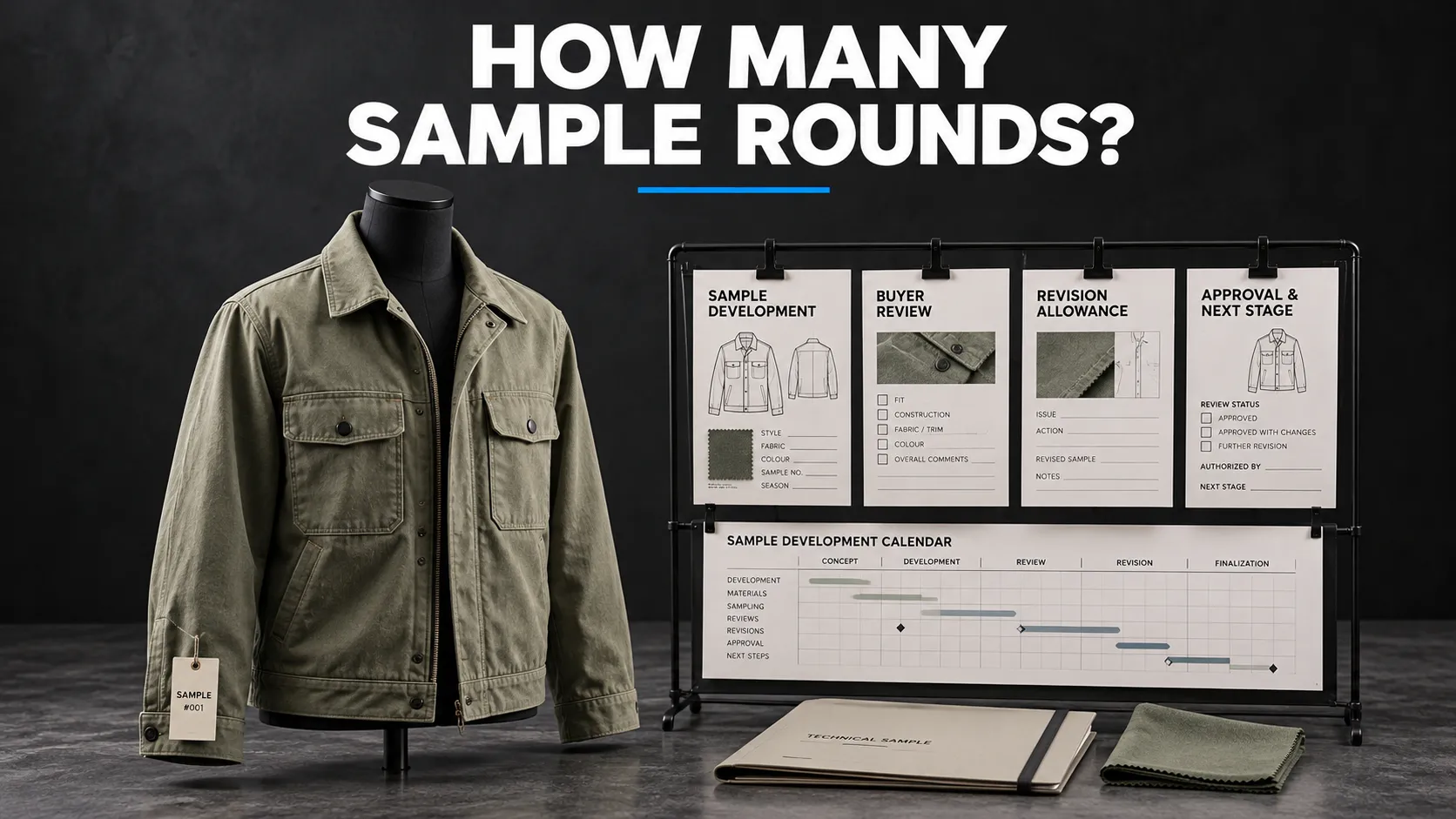
How many sample rounds should a clothing brand plan before bulk production? The answer depends on garment complexity, material availability, technical specifications, fit requirements, testing, and the number of development corrections needed. A basic garment with established construction may require fewer submissions, while a new design using unfamiliar fabrics or specialized manufacturing methods may need several development rounds.
The challenge is not simply choosing a number. Clothing brands must also determine how long each sample takes, which approvals are required, what happens when corrections are necessary, and how sampling affects the overall product launch timeline.
A garment sample may take relatively little time to construct, but the complete approval cycle can include fabric sourcing, pattern preparation, international shipping, buyer evaluation, technical feedback, and revisions. When these activities are not scheduled together, development can consume valuable time before manufacturing even begins.
For startup clothing brands, product developers, merchandisers, sourcing teams, and production planners, a realistic sample timeline helps balance product quality, development costs, and launch commitments.
This guide explains how to estimate sample rounds, calculate garment sampling lead times, prepare a sample revision timetable, identify critical-path activities, build an apparel product development calendar, and control additional sampling costs.
These scheduling activities belong within a broader sample management system for apparel development and approval, which establishes how sample requests, technical revisions, responsibilities, and approval decisions are coordinated.
Table of Contents
How Many Sample Rounds Should You Plan for Clothing Development?
There is no universal number of sample rounds required for apparel development.
A useful planning estimate should consider the garment’s technical complexity, previous development experience, available specifications, material readiness, and the buyer’s approval requirements.
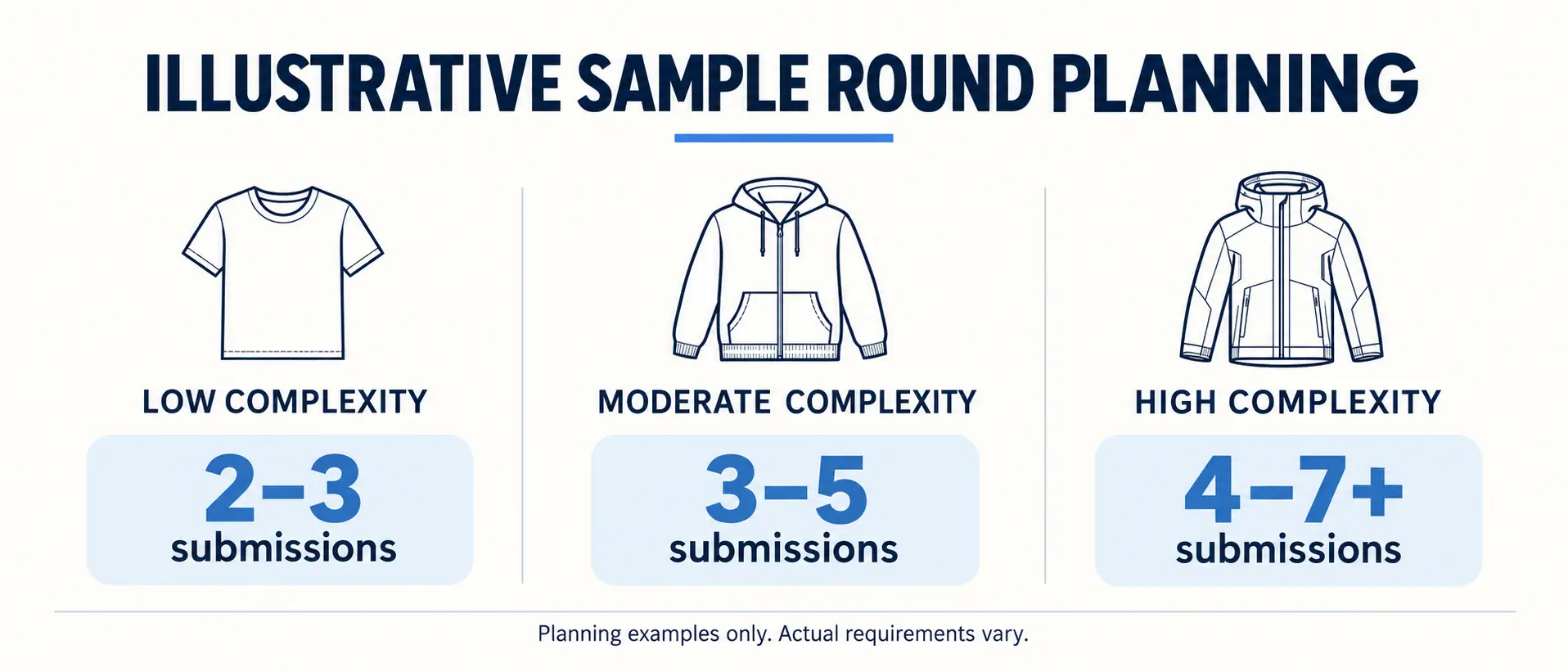
For preliminary budgeting, clothing brands can establish different planning scenarios according to product complexity.
Sample Round Planning Matrix
| Garment Complexity | Illustrative Development Submissions | Possible Sample Stages | Main Planning Risks |
|---|---|---|---|
| Low: Established basic T-shirt or simple shorts | 2-3 | Fit or prototype, revision where needed, PP | Measurement corrections, material substitutions |
| Moderate: New hoodie, detailed trousers, or multi-panel style | 3-5 | Proto, fit, fit revision, size set where needed, PP | Pattern adjustments, trims, construction, grading |
| High: Technical jacket or complex performance garment | 4-7 or more | Development prototypes, multiple fit reviews, size set, PP, additional trials where required | Specialized materials, complex construction, performance requirements |
These ranges are illustrative planning scenarios, not verified industry averages or guaranteed sample counts. Actual programs may require fewer or more submissions.
The ranges count physical development submissions in a hypothetical program. They do not automatically include separate laboratory testing activities or Top of Production (TOP) samples taken after bulk manufacturing has begun.
What Determines the Number of Sample Rounds?
1. Product complexity
A familiar garment with straightforward construction may require fewer development revisions than a product involving unusual patterns, technical materials, complex sewing operations, or multiple functional components.
2. Quality of the initial tech pack
A complete technical package helps manufacturers interpret the garment’s measurements, construction, materials, artwork, and other requirements.
Incomplete instructions may result in clarification requests, provisional development assumptions, or unnecessary revisions.
3. Fabric and trim availability
Sampling with unsuitable substitute materials may produce results that cannot fully validate the intended bulk garment.
If the production fabric differs significantly in stretch, weight, drape, or shrinkage, another evaluation may become necessary.
4. Fit and grading requirements
A new silhouette may require several fit corrections, while an established pattern may need limited adjustment.
Some programs also require size-set verification across selected garment sizes.
5. Buyer approval requirements
Different brands may require specific sample submissions, technical reviews, testing, or approval records before production.
6. Manufacturer capability and communication
Pattern-making expertise, available equipment, material sourcing, and clear communication can influence how effectively development issues are resolved.
Can a Garment Be Approved in One Sample Round?
Yes, in some circumstances.
A repeat product with previously approved specifications, established materials, and a proven manufacturing process may require little additional physical development.
However, approval must still satisfy the applicable product and order requirements.
A new style should not be forced through one submission simply to meet an arbitrary sample-round target.
Is More Sampling Always Better?
No.
Additional samples are valuable when they resolve a meaningful technical issue or provide required approval evidence.
They add less value when teams repeatedly evaluate the same unresolved problem without identifying its cause.
The objective is to use enough sampling to establish the required product standard without repeating unnecessary work.
What Counts as a Sample Round in Garment Manufacturing?
Before deciding how many sample rounds to budget, brands should establish what they are counting.
A sample round normally refers to a defined development submission followed by evaluation and an approval or correction decision.
However, a sample round, a sample type, and an approval gate are not necessarily the same thing.

Sample Round vs. Sample Type
A sample type describes the purpose of the sample.
Examples include:
- Prototype or development sample
- Fit sample
- Size-set sample
- Pre-production (PP) sample
- Sales or presentation sample
- Top of Production (TOP) sample
A sample round identifies a submission or iteration.
For example, one style may require three fit sample submissions before its fit direction is accepted.
Those are three physical development rounds involving the same sample type.
Another style may pass its fit stage with one submission but still require a PP sample and applicable size verification.
The number of fit revisions is therefore not necessarily the same as the total number of development sample submissions.
Techpacker’s guide to the different types of garment samples explains the roles of prototype, fit, size-set, PP, sales, testing, and production samples. Understanding their distinct objectives helps buyers decide which physical submissions belong in the development plan.
The types of samples in the garment industry also need to be considered when budgeting development rounds, because the product may require different sample categories rather than repeated submissions of one category.
Do GPT and TOP Count as Sample Rounds?
Not automatically.
Garment Performance Testing (GPT) is primarily a testing activity performed using appropriate garments or material specimens. Its timing depends on the testing plan, and it may occur alongside other development activities.
TOP samples are selected from actual production output after manufacturing has started. They support early-production verification rather than serving as ordinary pre-production fit revisions.
Both activities can affect the development and production schedule, but they should be tracked separately when necessary.
Define a Sample Round Before Starting
Each planned submission should identify:
- Sample type and round number
- Specific development objective
- Required technical inputs
- Responsible manufacturer or development team
- Planned completion and delivery dates
- Buyer review responsibility
- Acceptance or exit criteria
- Required next action
For example, a fit sample round might aim to confirm shoulder balance, chest width, and sleeve proportions.
If those features are accepted, the next submission may focus on production-representative construction rather than repeating the entire fit evaluation.
How to Calculate a Realistic Garment Sample Timeline
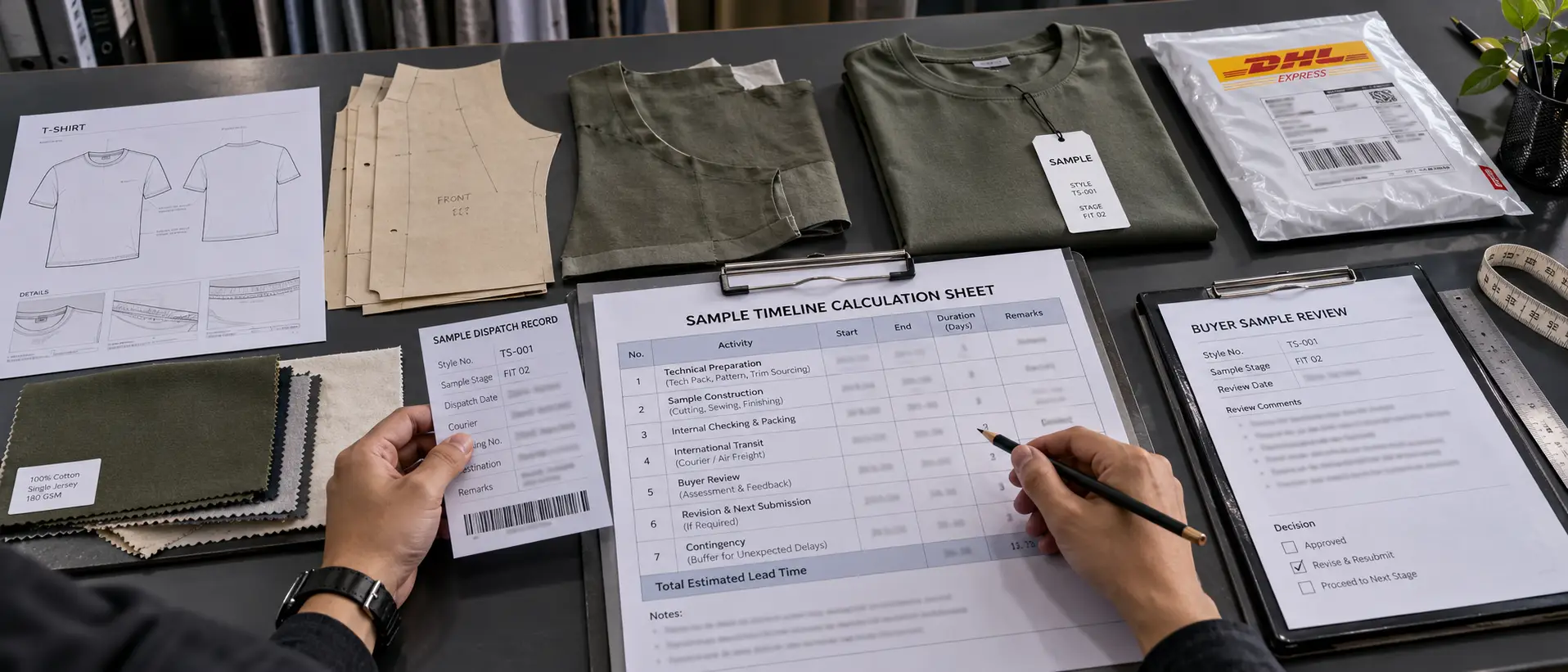
A sample timeline should reflect the complete development and review cycle, not just the time needed to sew a garment.
The total schedule may include technical preparation, material arrangements, pattern development, sample construction, dispatch, transportation, buyer review, corrections, testing, and contingency.
Some activities can occur in parallel. Others cannot begin until earlier requirements are completed.
Basic Sample Timeline Formula
For a simplified sequential development plan:
Total Sampling Time = Initial Preparation + Σ(Build Time + Transit Time + Review Time) + Contingency Time
This simplified formula assumes that each submission is developed, shipped, and reviewed before the next begins.
It is useful for preliminary planning, but a detailed project schedule should account for overlapping activities and actual dependencies.
Worked Example: Three Sample Submissions
Suppose a clothing brand is developing a new casual garment and plans three physical submissions:
- Initial prototype or fit sample
- Revised fit sample
- Pre-production sample
For illustration, assume:
| Activity | Duration | Calculation Basis |
|---|---|---|
| Initial technical preparation | 5 days | Once before sampling |
| Sample construction | 7 days | Per submission |
| Sample transit | 4 days | Per submission |
| Buyer review and consolidated feedback | 3 days | Per submission |
| Schedule contingency | 5 days | Once for the planned sampling period |
Using these assumptions:
5 + (3 × (7 + 4 + 3)) + 5 = 52 days
Illustrative sequential sampling timeline
52 calendar days
5 preparation + 42 across three submissions + 5 contingency
This is a planning example, not a standard apparel sampling lead time.
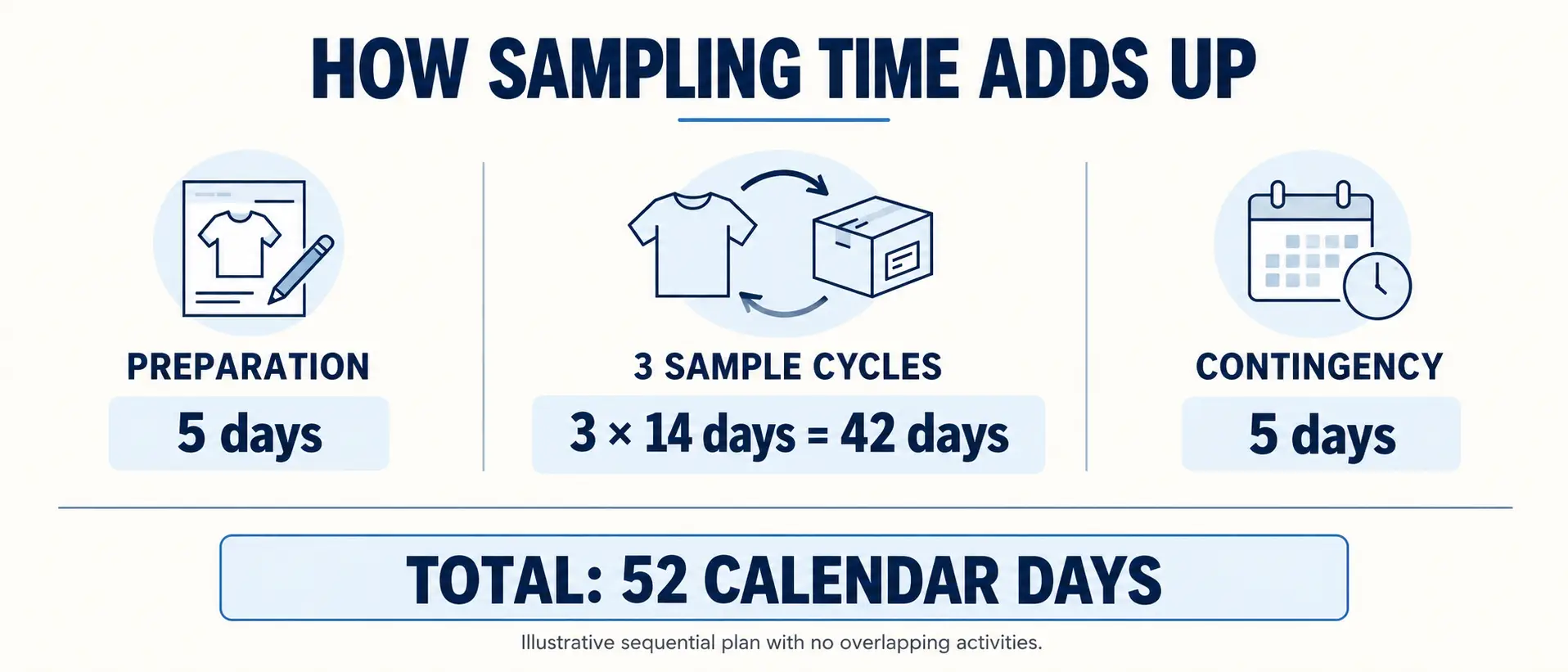
It assumes every activity uses calendar days, no activities overlap, each seven-day construction block already includes the necessary revision work, and no separate material procurement or laboratory-testing delay is added.
The third submission’s review is included. Any approval decision requiring further corrections would need additional time.
Sample Construction Timeline Breakdown
For more accurate planning, obtain separate estimates for the work that must actually be completed.
| Activity | Main Dependency | Possible Schedule Risk |
|---|---|---|
| Technical clarification | Available design information | Missing specifications |
| Pattern preparation or revision | Approved development requirements | Pattern complexity |
| Material arrangement | Fabric and trim availability | Supplier lead time |
| Cutting and sewing | Pattern and required materials | Sample capacity and construction complexity |
| Decoration or washing | Suitable garment and approved process | Equipment availability or process development |
| Internal quality review | Completed sample | Identified corrections |
| Sample dispatch | Sample completion and shipping arrangements | Transit or customs delays |
| Buyer evaluation | Sample receipt and reviewer availability | Slow or conflicting feedback |
These activities should not all be added separately if a manufacturer’s quoted sample construction duration already includes some of them.
For example, if a seven-day factory timeline includes pattern correction, cutting, sewing, decoration, and internal checking, adding those operations again would double-count development time.
Why Sample Construction Time Can Change
Actual sample construction time may depend on:
- Whether materials are already available
- Pattern complexity
- Sample-room workload
- Specialized manufacturing operations
- Required washing, finishing, or testing
- Buyer clarification time
- Number of samples and size variations
- Factory holidays and resource availability
Buyers should request a schedule that identifies assumptions and dependencies rather than relying on a single unexplained lead-time figure.
How Much Contingency Should You Include?
There is no universal percentage of sampling time that should be reserved for delays.
A useful contingency reflects the uncertainty in the development program.
A new technical product with unfamiliar materials may need more flexibility than a repeat garment with established specifications.
Contingency should also distinguish between time reserved for foreseeable risks and additional activities that are already known to be necessary.
A required test is a planned activity, not something that should automatically be hidden inside the contingency allowance.
Sample Revision Timetable: Planning Each Development Round
A sample revision timetable identifies what each submission must achieve and when the next decision should occur.
It turns a general intention to “complete sampling” into a sequence of defined activities with responsible parties and measurable outcomes.
The timetable should be based on the actual garment-development requirements rather than assuming that every sample follows an identical process.
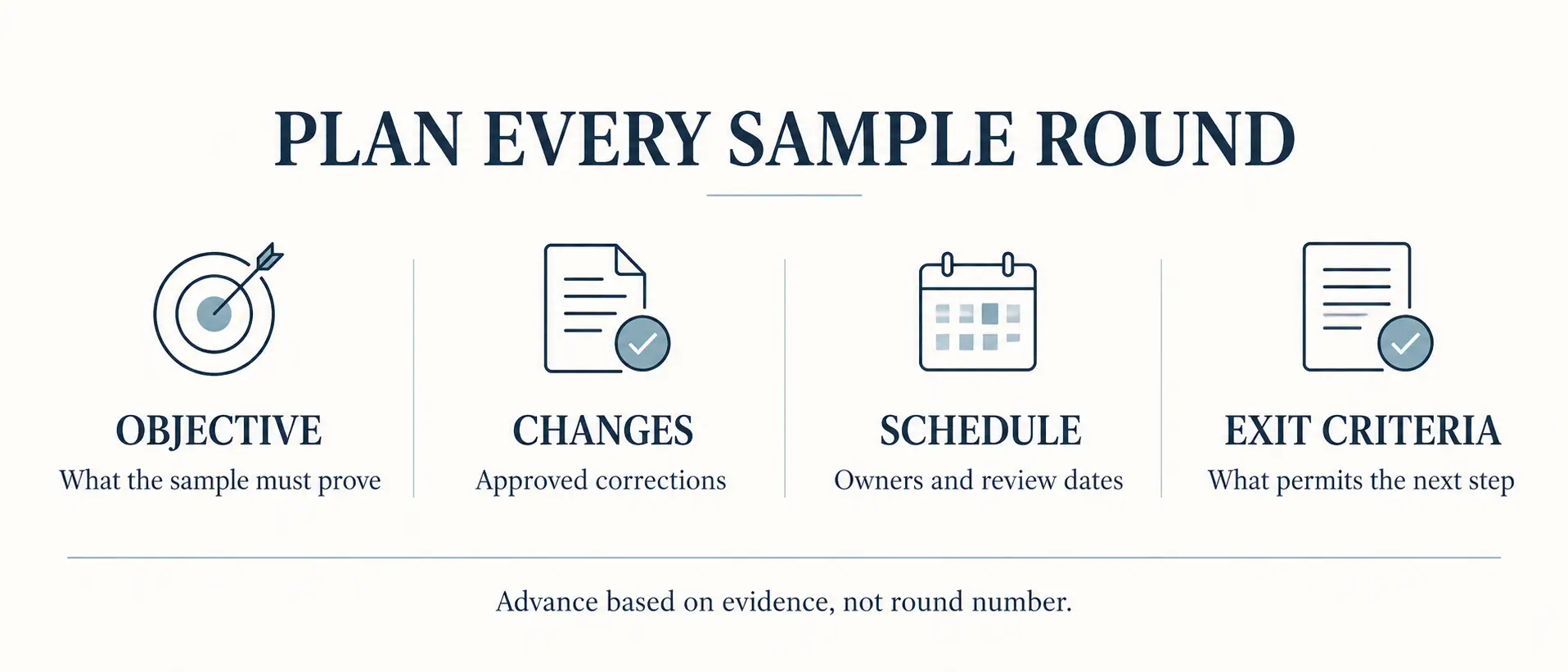
Example Three-Round Revision Timetable
Using the 52-day illustrative plan:
| Stage | Planned Calendar Days | Objective | Review Requirement | Exit Criteria |
|---|---|---|---|---|
| Technical Preparation | Day 1-5 | Confirm initial design and sample requirements | Tech pack and technical clarification | Sufficient information to begin |
| Round 1: Initial Sample | Day 6-19 | Evaluate basic construction and fit direction | Prototype or initial fit evaluation | Major development issues identified |
| Round 2: Revised Fit | Day 20-33 | Evaluate approved pattern and fit corrections | Measurements, fit comments, relevant construction | Fit direction accepted |
| Round 3: PP Sample | Day 34-47 | Verify production-representative specifications | Relevant PP sample approval checklist | Applicable PP requirements accepted |
| Schedule Contingency | Day 48-52 | Allow for identified schedule uncertainty | Review outstanding issues | Required stage complete or plan revised |
Illustrative dates assume sequential activities and the same build, transit, and review durations for each submission. Actual stages and durations may differ.
This timetable does not mean that the manufacturer must make all three samples regardless of development results.
If an established pattern needs no initial prototype, the stages can be adapted.
If the revised fit sample fails an essential requirement, the next appropriate activity may be another fit correction rather than proceeding directly to PP approval.
What Should Every Revision Round Include?
A controlled sample round should identify:
- Round objective: What the next sample is expected to demonstrate.
- Technical reference: Which tech pack, measurement chart, BOM, and artwork versions apply.
- Approved changes: What has been authorized since the previous sample.
- Outstanding issues: Which findings remain unresolved.
- Responsible parties: Who makes the sample and who reviews it.
- Planned dates: Development completion, dispatch, receipt, and review.
- Exit criteria: What must be confirmed before advancing.
These requirements can be maintained in a sample tracker or a dedicated development management system.
Avoid Changing Specifications Through Scattered Messages
A manufacturer may receive sample comments from a designer, product developer, merchandiser, and quality reviewer.
When those comments are issued separately, conflicting instructions can create unnecessary clarification or rework.
The development coordinator should consolidate the feedback and communicate the agreed revision package.
The package should identify the exact changes, supporting evidence, and relevant specification versions.
Can You Correct Several Issues in One Round?
Yes.
Several technically compatible corrections can be implemented together when their effects are understood and their outcomes can be evaluated.
For example, a manufacturer may be able to correct sleeve length, update hangtag artwork, and adjust a pocket position during the same revision.
However, changing fabric stretch, major pattern dimensions, and construction methods simultaneously may make it harder to determine why the garment’s fit has changed.
The correct approach is controlled, risk-based revision planning, not a rigid one-change-per-round rule.
How to Reduce Repeated Fit Sample Rounds
A repeated fit problem may indicate that the team is correcting symptoms without identifying the cause.
For example, repeated shoulder adjustments may not resolve an issue caused by the overall pattern balance or sleeve construction.
Technical reviews should examine the garment’s actual behavior, the applicable measurements, material properties, and pattern shape.
Techpacker’s end-to-end garment fitting and fit sign-off guide explains how technical teams can review sample measurements, document fit observations, organize fitting meetings, and communicate pattern corrections. These practices help make subsequent submissions more focused.
Video: How a Professional Evaluates Garment Fit Corrections
The following English-language demonstration, Mastering Garment Fitting: Muslin Demo and In-Depth Explanation by Susan Elias Couture, shows a professional designer and pattern maker examining a physical garment mock-up and discussing fitting and pattern adjustments. Although it focuses on couture-style development rather than a factory sampling schedule, it demonstrates why a fit problem may require technical diagnosis before another sample is requested.
Ready to Plan Your Clothing Sample Development?
Share your garment designs, technical specifications, required sample types, and target development dates with RYZEAL SOURCING. Our team can review the project requirements and discuss sampling feasibility, timing, and coordination through suitable specialized manufacturing partners in Bangladesh.
Critical Path Method for Apparel Sampling: Identify the Activities That Control Your Deadline
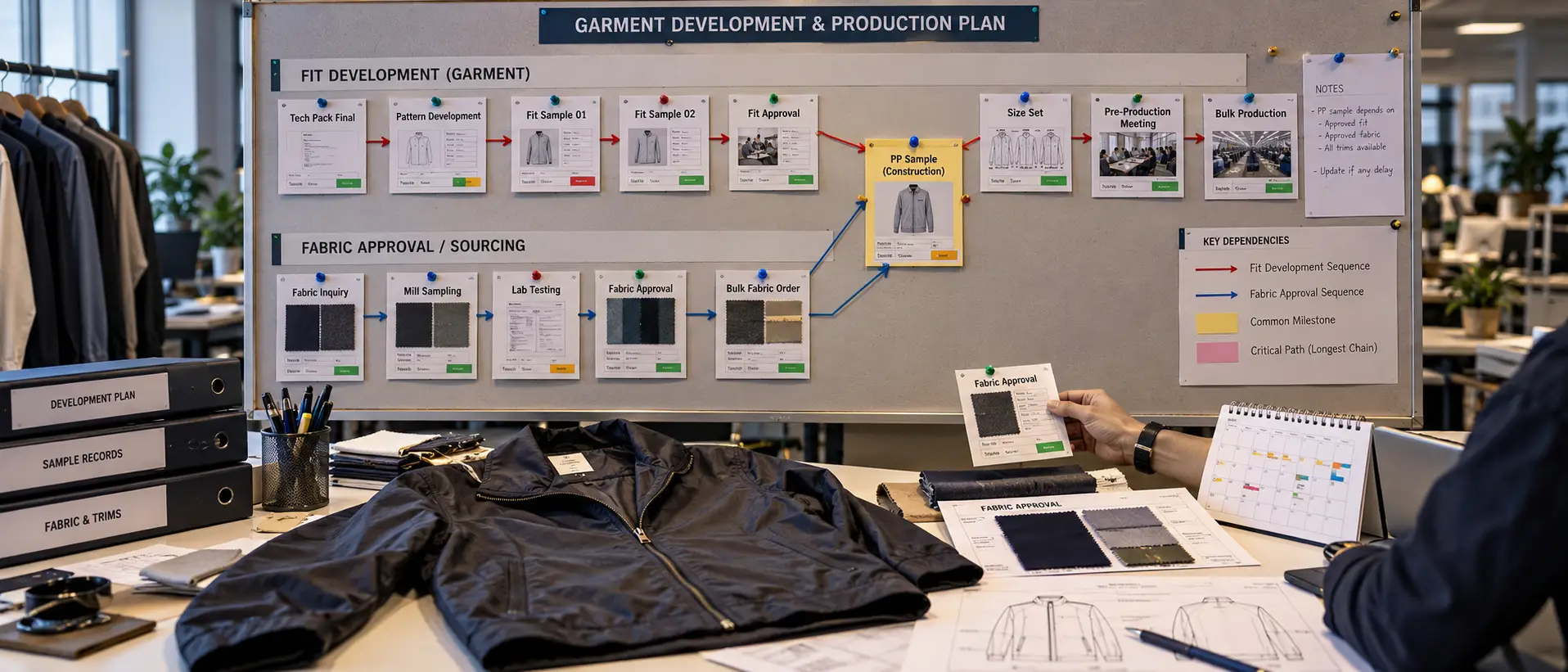
The Critical Path Method (CPM) is a project scheduling technique used to identify the sequence of dependent activities that determines the earliest possible project completion under the modeled schedule.
This is particularly useful for clothing brands working toward a fixed product launch or delivery date.
Sampling involves several connected activities, but not every task must be completed sequentially.
Some approvals, sourcing activities, or technical preparations can occur simultaneously when their requirements allow it.
What Is the Critical Path in Clothing Development?
The critical path is the longest duration path through the project’s dependency network.
In a conventional CPM schedule, activities on this path have no available total float, meaning that a delay affecting the path can delay the modeled project completion date unless corrective scheduling action is taken.
For an apparel development program, possible activities include:
- Technical specification preparation
- Pattern and sample development
- Fit or size-set approvals
- Material procurement
- Required testing
- PP sample approval
- Production preparation
- Bulk manufacturing
- Shipment and delivery
Which activities actually form the critical path depends on their durations and relationships.
Not every sample stage automatically belongs on the critical path.
Example: Sampling and Fabric Sourcing Running in Parallel
Suppose a project has two activities that must be completed before a PP sample can be constructed.
Activity A: Fit Development
The fit-development process requires 28 calendar days.
Activity B: Fabric Approval and Availability
The required fabric approval and arrangement process takes 18 calendar days.
Both activities begin at the same time.
The PP sample cannot begin until both are ready, and constructing the PP sample takes another seven days.
The two simplified paths are:
| Path | Activity Duration | PP Construction | Total |
|---|---|---|---|
| Fit development → PP | 28 days | 7 days | 35 days |
| Fabric readiness → PP | 18 days | 7 days | 25 days |
The earliest modeled PP completion is 35 days, because fit development finishes later than fabric readiness.
The fabric branch has 10 days of schedule flexibility relative to the PP start, assuming no other constraints.
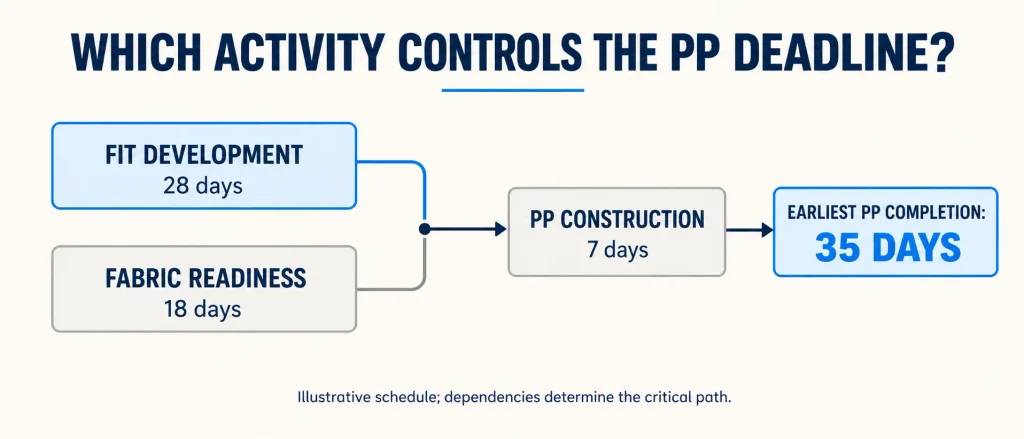
If fabric readiness instead takes 38 days, the earliest PP completion becomes:
38 + 7 = 45 days
The material path would then control the completion date.
This example demonstrates why factory sewing time is not necessarily the main scheduling constraint.
How to Identify Critical-Path Activities
A practical process is:
- Identify all necessary development and production activities.
- Estimate their durations using realistic information.
- Establish which activities depend on the completion of others.
- Identify tasks that can proceed in parallel.
- Calculate the earliest completion dates.
- Determine which chain controls the planned completion date.
- Monitor changes that may shift the critical path.
The Project Management Institute’s guide to Critical Path Method calculations and scheduling explains activity dependencies, forward and backward passes, early and late dates, and schedule float. These concepts can be applied to apparel development calendars when project activities are properly defined.
Critical Path Checklist for Garment Sampling
Before committing to the sampling calendar, ask:
- What must be confirmed before the next sample can be constructed?
- Which materials or technical decisions are not yet available?
- Can any activities proceed in parallel?
- Which required tests could delay the affected production stage?
- Who has authority to approve fit, artwork, materials, or PP samples?
- How long does each approval review require?
- Which activities have schedule flexibility?
- What happens if the critical path changes?
This approach helps distinguish delays that genuinely affect the launch date from activities that still have available schedule flexibility.
Video: Building a Gantt Chart With Dependencies and Milestones
The following English-language tutorial from TeamGantt demonstrates how a project schedule can display tasks, assigned responsibilities, dependencies, baselines, and workload information. While it is a general project-management demonstration rather than an apparel-specific tutorial, the same techniques can be applied to sampling deadlines, material approvals, and development milestones. A Gantt chart helps visualize the plan, while proper dependency and critical-path analysis identifies which activities control its completion.
Product Development Calendar: Plan Backward From Your Clothing Launch Date
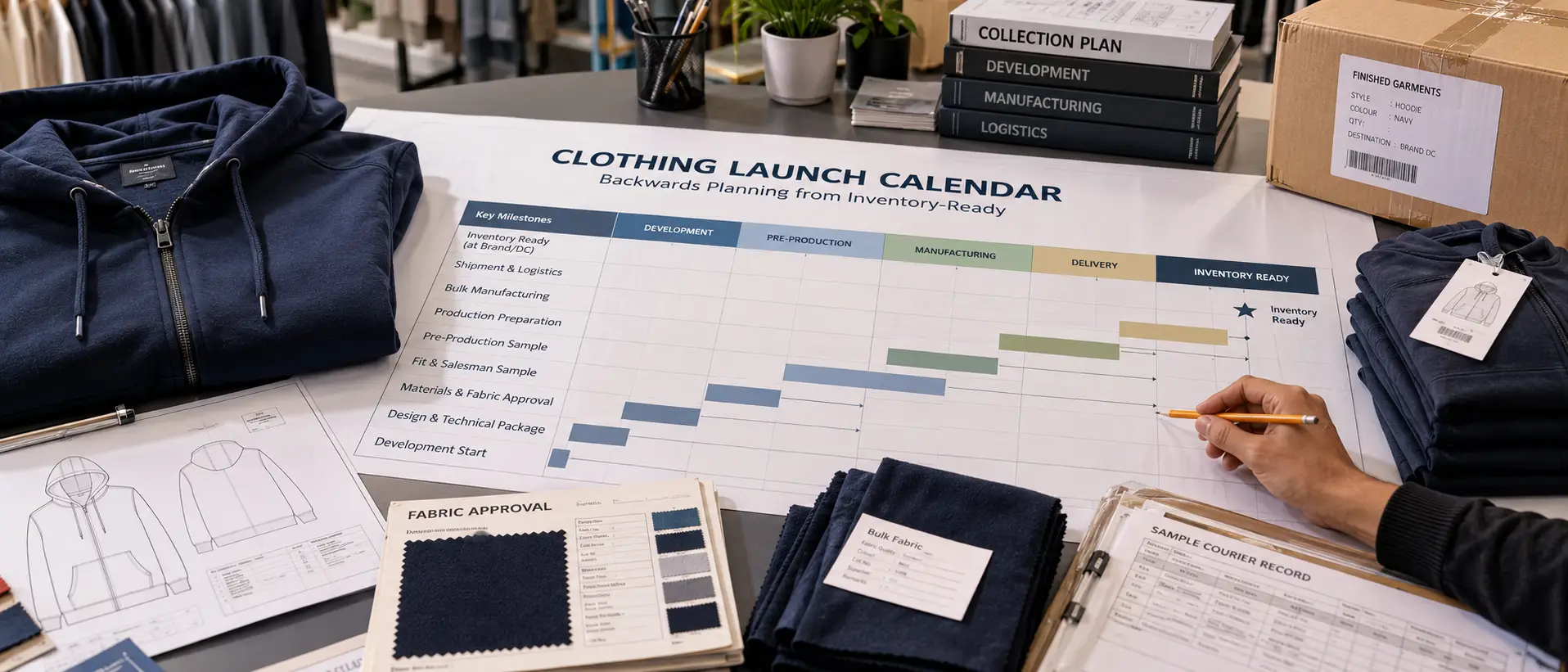
A realistic apparel product development calendar should begin with the date the garments must be available, not simply the date sampling begins.
A clothing brand may have separate deadlines for marketing photography, wholesale presentations, production completion, shipment, warehouse receipt, and retail launch.
Each deadline can affect development decisions.
The calendar should therefore connect sampling with the wider manufacturing and delivery schedule.
Step 1: Establish the Inventory-Ready Date
Determine when the finished garments must be available for the intended commercial activity.
For example, a brand planning an online collection launch may need inventory at its fulfillment warehouse before the launch date.
The warehouse receipt date may be more useful as the final scheduling milestone than the customer-facing launch date itself.
Step 2: Work Backward Through Manufacturing and Delivery
Identify the time required for:
- Transportation and customs-related activities
- Manufacturing and finishing
- Production preparation
- Relevant sample development and approvals
- Material availability and required testing
- Initial technical preparation
The calendar should use durations and dependencies confirmed with the relevant parties wherever possible.
Example Backward Launch Calendar
Assume a hypothetical garment program requires:
- Sampling and development planning: 52 calendar days
- Additional production preparation: 7 calendar days
- Bulk manufacturing: 30 calendar days
- Delivery and logistics: 12 calendar days
The simplified total is:
\[ 52+7+30+12=101\text{ calendar days} \]
Illustrative backward-planned schedule
101 calendar days
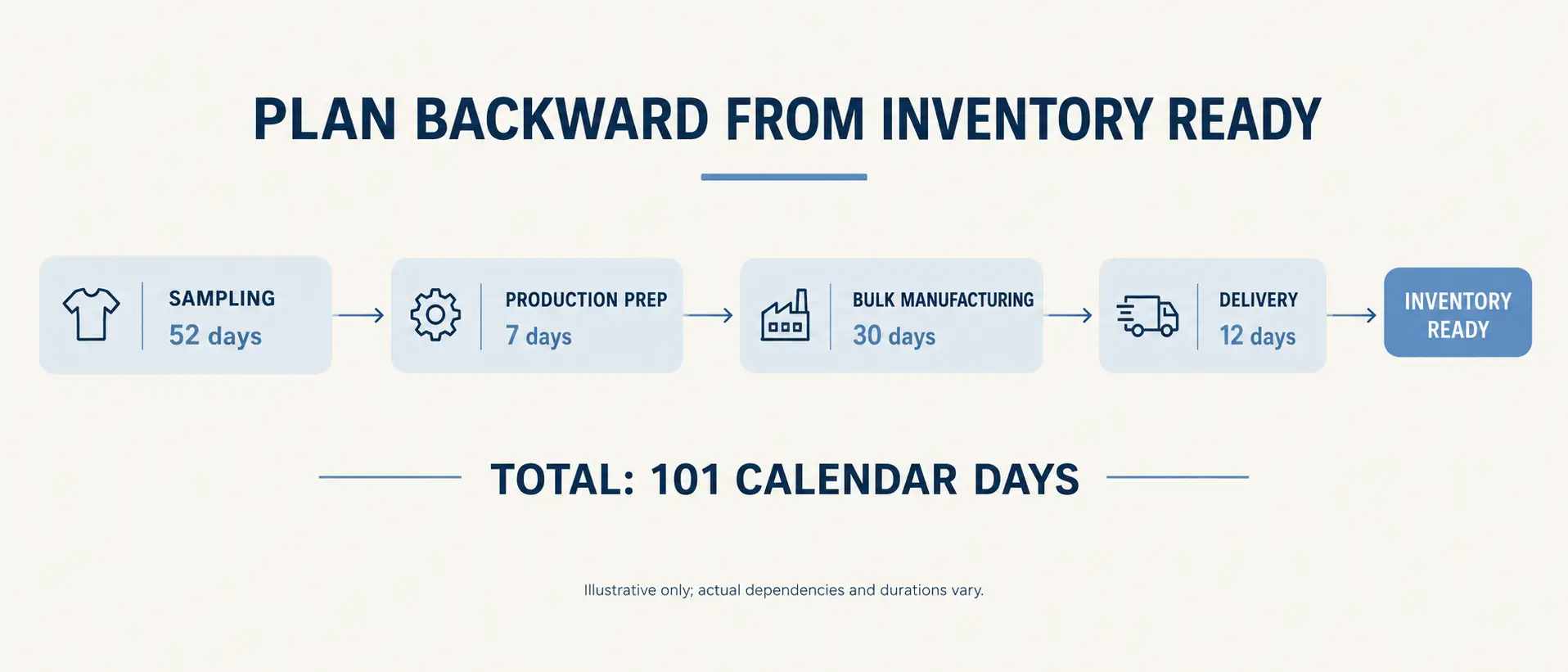
From the start of the modeled development schedule to the inventory-ready milestone
The following table works backward from the day inventory must be available.
| Milestone / Activity | Latest Illustrative Window | Duration | Main Responsibility |
|---|---|---|---|
| Inventory ready | Day 0 | Milestone | Brand / Logistics |
| Delivery and logistics | Day -12 to -1 | 12 days | Logistics Coordinator |
| Bulk manufacturing | Day -42 to -13 | 30 days | Manufacturing Partner |
| Production preparation | Day -49 to -43 | 7 days | Manufacturer / Sourcing Team |
| Sampling and development | Day -101 to -50 | 52 days | Buyer / Development / Manufacturer |
Illustrative sequential schedule only. Actual material lead times, testing, factory capacity, shipment requirements, holidays, and approval dependencies must be incorporated into the project calendar.
In this simplified example, the brand would need to begin the modeled development activities approximately 101 calendar days before the required inventory-ready milestone.
If important activities take longer than assumed, the project must be rescheduled or its dependencies reconsidered.
Step 3: Identify Parallel Activities
Not every task must wait until sampling is fully completed.
Certain material inquiries, packaging development activities, commercial preparations, and capacity discussions may proceed in parallel.
However, activities that depend on approved specifications must not proceed using unresolved requirements without an authorized plan.
For example, a manufacturer might investigate fabric availability before final fit approval, but bulk cutting should not be released against an unapproved pattern or fabric specification.
Step 4: Include Material and Capacity Constraints
A garment may have a relatively short sample construction time but require longer material arrangement or supplier approval.
Likewise, manufacturing capacity must be coordinated with the intended production dates.
A completed PP sample does not automatically mean the selected production facility has immediate capacity available.
These constraints should be documented and reflected in the actual critical-path analysis.
Step 5: Review the Calendar Regularly
The product development calendar should be updated when:
- A sample fails a necessary evaluation.
- Buyer feedback arrives later than planned.
- Required materials become unavailable.
- Testing identifies a technical problem.
- The manufacturer revises its production schedule.
- Shipping or other logistics conditions change.
- The buyer approves a major design revision.
A delayed activity does not necessarily shift the entire calendar by the same amount.
The effect depends on whether the activity lies on the critical path, how much schedule flexibility remains, and whether recovery actions are feasible.
Apparel Product Development Calendar Template
| Field | Information to Record | Example |
|---|---|---|
| Style Code | Unique garment identification | HD-205 |
| Manufacturing Partner | Assigned development or production facility | Partner A |
| Sample Stage | Relevant sample type | Fit Sample V02 |
| Round Objective | What must be demonstrated | Confirm revised chest and sleeve fit |
| Specification Version | Applicable tech pack and related documents | TP-V04 |
| Planned Completion | Agreed sample completion date | Project date |
| Dispatch Date | Planned or actual shipment | Project date |
| Buyer Review Date | Target review completion | Project date |
| Decision Owner | Authorized reviewer | Technical Designer |
| Approval Status | Approved, revision, pending, hold | Pending |
| Blocking Issue | Unresolved dependency | Revised fabric pending |
| Next Action | Required activity and responsible party | Confirm fabric reference |
| Schedule Risk | Current timing assessment | At Risk |
This structure can be maintained in a spreadsheet, project-management platform, or Product Lifecycle Management (PLM) system.
Maker’s Row’s guide to building a production calendar for fashion brands explains how apparel businesses can plan backward from delivery requirements while accounting for material sourcing, sampling, factory scheduling, and manufacturing dependencies. This complements the development-focused calendar by connecting sampling with the wider production schedule.
Connect Sampling With the Broader Development Process
Sampling is only one part of bringing a garment from design to approved production specifications.
The wider apparel product development process connects technical documentation, material decisions, sample evaluations, and manufacturing preparation.
When these activities are planned together, buyers can better understand how design changes influence manufacturing dates and delivery commitments.
Cost of Product Sampling: How Extra Rounds Affect Development Budgets

Additional sample rounds can increase development expenditure even when the individual sample-making charge appears manageable.
The full cost may involve pattern development, sample construction, material purchases, freight, testing, and internal review work.
Repeated revisions can also affect production schedules and commercial planning.
Direct Sampling Costs
Common direct expenses include:
- Pattern preparation
- Sample-making charges
- Pattern or construction revisions
- Special development fabrics and trims
- Printing, embroidery, or washing trials
- Sample delivery and freight
- Required laboratory testing
- Other separately agreed development charges
The actual commercial arrangement should be confirmed with the manufacturing partner.
Some activities may be included in a quoted sampling fee, while others may be charged separately.
Indirect Sampling Costs
Indirect costs may include:
- Product-development staff time
- Technical review and coordination
- Additional meetings and approvals
- Delayed marketing activities
- Rework involving other collection styles
- Potential loss of a commercial selling window
These effects should be considered carefully, but they should not be presented as guaranteed financial losses.
The commercial impact depends on the business and launch circumstances.
Example Product Sampling Cost Calculator
The following hypothetical calculation illustrates how to track development expenses for a garment requiring three sample submissions.
| Cost Item | Unit Cost | Quantity / Frequency | Total |
|---|---|---|---|
| Initial Pattern Development | $140 | 1 | $140 |
| Sample Construction | $110 | 3 submissions | $330 |
| Pattern Revisions | $45 | 2 revisions | $90 |
| Sample Freight | $40 | 3 shipments | $120 |
| Special Development Materials | $65 | 1 allocation | $65 |
| Applicable Performance Testing | $110 | 1 test allocation | $110 |
| Internal Development Review | $20/hour | 5 hours | $100 |
| Total Illustrative Development Cost | $955 |
All amounts are hypothetical budgeting figures, not actual supplier prices, Bangladesh manufacturing quotations, or universal apparel sampling costs.
This example assumes the initial pattern fee, pattern revision charges, sample-making fees, and other expenses are separate and do not overlap.
In an actual quotation, verify which activities are included so they are not counted twice.
The internal review allocation is a management-budgeting estimate, not an additional manufacturer charge.
How to Calculate Sampling Cost per Submission
For preliminary analysis, the total tracked development expenditure can be divided by the number of physical sample submissions.
In the example:
\[ \$955\div3=\$318.33 \]
This produces an average tracked development cost of approximately $318.33 per sample submission.
However, this average includes one-time costs and other expenses that do not necessarily recur with every submission.
It should not be interpreted as the actual cost of making one additional sample.
What Does One Extra Sample Round Cost?
An additional sample submission may incur:
- Revised pattern or technical work
- Sample construction
- Additional material consumption
- Freight
- Internal evaluation time
- Relevant testing or decoration charges
The cost should be estimated using the specific work required.

For instance, if an additional physical sample costs $110 to construct, $40 to ship, and requires $45 in separately charged pattern corrections, the direct incremental amount would be:
\[ \$110+\$40+\$45=\$195 \]
This assumes no additional material, testing, or other charges.
A major redesign could cost substantially more, while a limited correction may cost less.
Should Sampling Costs Be Included in Garment Unit Cost?
Sampling expenses and bulk garment manufacturing costs should be tracked distinctly.
A buyer may account for development expenses as a separate budget, allocate them across a product program, or use another appropriate accounting treatment.
The agreed quotation should establish whether sample charges are separate, included elsewhere, or eligible for any commercial credit.
Maker’s Row’s guide to clothing manufacturing quotations and sampling costs discusses how one-time pattern and development fees, unit manufacturing costs, minimum-order requirements, and logistics charges can appear as separate commercial items. Its US-market examples should not be treated as Bangladesh sourcing price benchmarks.
How Sampling Cost Should Influence Decisions
If development expenses exceed the planned budget, the next step should be a structured review.
The team should identify which technical requirements remain unresolved and whether the additional work is necessary.
A sample-round budget should support decision-making, not create pressure to approve an unacceptable garment.
Approval Bottlenecks: Why Sample Timelines Slip Even With Good Planning
A sampling schedule can fail because of communication and decision delays even when physical sample construction is progressing as expected.
Common bottlenecks include unclear technical requirements, fragmented comments, unavailable approvers, material changes, and poor document control.

Sample Approval Bottleneck and Correction Matrix
| Bottleneck | Warning Sign | Possible Cause | Corrective Action |
|---|---|---|---|
| Delayed buyer feedback | Sample received but no consolidated decision | Review responsibilities unclear | Assign a review owner and agreed response date |
| Conflicting correction comments | Manufacturer receives incompatible instructions | No feedback consolidation | Issue one approved correction record |
| Incorrect document version | Sample differs from current specifications | Uncontrolled technical revisions | Reissue identified current documents |
| Repeated fit failures | Same issue appears across several rounds | Root cause not resolved | Conduct pattern and technical review |
| Material uncertainty | Sample development waits for fabric or trims | Supplier availability unresolved | Confirm sourcing plan and approved alternatives |
| Late artwork changes | Decoration approval delays sample completion | Design revision occurs after sampling | Establish artwork approval dependencies |
| Missing inspection evidence | Approver cannot confirm technical compliance | Incomplete measurement or review records | Define required evidence before submission |
| Unclear approval authority | Multiple reviewers delay the decision | Responsibilities not assigned | Define technical approvers and decision coordinator |
Set Clear Review Responsibilities
The development coordinator should maintain the sample schedule and consolidated decision record.
Relevant specialists may still be responsible for approving fit, material specifications, artwork, testing, or packaging.
Clear coordination does not mean that one person must make every technical decision.
Establish Agreed Response Targets
Brands and manufacturers can agree on reasonable turnaround targets for:
- Technical clarification
- Feedback after sample receipt
- Manufacturer acknowledgement of revisions
- Sample construction updates
- Approval decisions
- Escalation of unresolved issues
These targets may be referred to as internal service-level agreements (SLAs), response commitments, or operating expectations.
There is no universal response-time requirement for every apparel development program.
A complex fitting session involving several stakeholders may reasonably need more review time than a simple artwork confirmation.
What Happens When a Sample Misses Its Objective?
The team should determine whether the failure resulted from:
- Incorrect or incomplete technical instructions
- Unsuitable material properties
- Pattern or construction problems
- Manufacturing execution
- Changed buyer requirements
- Inaccurate measuring or evaluation methods
- Another identified technical cause
Once the cause is understood, the next action may involve revising the pattern, clarifying specifications, changing an unsuitable material, improving manufacturing methods, or scheduling an additional evaluation.
The correction should address the actual issue rather than simply requesting another sample without explanation.
Sample Approval Criteria Reduce Repeated Revisions
A clear sample approval checklist helps buyers evaluate fit, measurements, stitching quality, artwork placement, labeling, packaging, and relevant development evidence consistently.
Using a consistent sample approval checklist can help reviewers record deviations and provide more actionable correction instructions before the next development submission.
The broader apparel approval workflow map also helps explain how lab dips, artwork approvals, size sets, PP samples, testing, and shipment-related decisions affect different manufacturing activities.
What to Do When Sample Rounds Exceed the Plan
A planned sample-round count is useful as a management target, but it should not function as an automatic stopping rule.
If a style requires more development than expected, buyers should review its technical condition, schedule impact, commercial importance, and available options.

Step 1: Identify Why the Planned Rounds Were Exceeded
Review the sample history.
Determine whether repeated rounds involve the same unresolved issue or genuinely new development requirements.
For example, repeated measurement failures may indicate a pattern problem, while a new fabric requirement may introduce additional validation needs.
Step 2: Recalculate the Timeline and Cost
Estimate the duration and cost of the remaining technical work.
Update the critical-path schedule to determine how the new activities affect the intended delivery or launch milestone.
Consider whether any unrelated activities can proceed safely in parallel.
Step 3: Evaluate Technical Alternatives
Depending on the cause, options may include:
- Correcting the development specification
- Revising a pattern or construction method
- Selecting an approved alternative material
- Simplifying a nonessential design feature
- Obtaining additional technical assistance
- Reconsidering the selected manufacturing process
- Adjusting the development or launch schedule
Changes must still satisfy the garment’s required safety, technical, and commercial specifications.
Step 4: Make an Authorized Development Decision
The brand may decide to:
Continue development: Additional work is justified and the schedule remains commercially acceptable.
Revise the scope: Approved changes simplify the garment or development program.
Reschedule: The product remains valuable, but the original deadline is no longer realistic.
Pause development: An important requirement or decision remains unresolved.
Cancel the style: Continued development is no longer commercially or technically justified.
These decisions should be documented.
A planned round limit should never become a reason to skip mandatory testing, accept critical defects, or authorize manufacturing against unapproved requirements.
Frequently Asked Questions About Sample Rounds and Apparel Timelines
How many sample rounds should a clothing brand plan?
There is no universal requirement. The number depends on garment complexity, technical preparation, material readiness, and approval requirements. For budgeting, brands can establish illustrative development scenarios and revise them using actual supplier and project information.
How many sample rounds are needed for a basic T-shirt?
A repeat or straightforward T-shirt may require relatively limited sampling when its pattern, fabric, and construction are established. A completely new style may need prototype, fit, or PP submissions. The exact number should be determined by the required technical evaluations.
What counts as one sample round?
A sample round normally refers to a defined physical development submission followed by evaluation and an approval or correction decision. Different sample types can require different numbers of submissions.
Are fit sample rounds the same as total sampling rounds?
No. Fit rounds focus on evaluating and correcting garment fit. Total development submissions may also include prototype, size-set, PP, or other samples required by the program.
Do GPT and TOP count as sampling rounds?
Not automatically. GPT is primarily a testing activity using appropriate specimens, while TOP samples are selected from actual production. They may affect project timing but should be distinguished from ordinary pre-production development iterations.
How do you calculate garment sample lead time?
Identify the required technical preparation, sample construction, transit, buyer review, revisions, testing, and relevant contingency. Calculate the schedule according to actual dependencies and avoid counting overlapping activities twice.
What is a sample revision timetable?
A sample revision timetable records each development submission’s objective, technical inputs, responsible parties, planned dates, evaluation requirements, and exit criteria.
What is the Critical Path Method in apparel sampling?
The Critical Path Method identifies the sequence of dependent project activities that controls the modeled completion date. It helps buyers understand which sample, approval, sourcing, or manufacturing delays could affect the planned delivery date.
How should a clothing brand plan backward from its launch date?
Start with the required inventory-ready or commercial deadline. Establish realistic durations for delivery, manufacturing, production preparation, sampling, and technical approvals. Then calculate the latest dates while accounting for dependencies, parallel work, and schedule uncertainty.
How much contingency should be added to sampling timelines?
The amount depends on product complexity, previous development performance, material uncertainty, and logistical risks. A project-specific contingency is more useful than a universal percentage or fixed number of days.
What costs increase when another sample round is needed?
Possible additional expenses include sample construction, pattern revisions, special materials, decoration, freight, testing, and internal review time. The actual incremental cost depends on the changes required.
What happens when a style exceeds its planned sample-round count?
The development team should review the unresolved technical problems, update the cost and timeline forecasts, and decide whether to continue, revise the design, reschedule, pause, or cancel the style. Additional rounds should not automatically result in approval or rejection.
Final Takeaway: Plan Sample Rounds Around Technical Risk and Launch Requirements
The question how many sample rounds to plan cannot be answered reliably with one number for every garment.
A basic repeat style may require limited development, while a new technical product may need several physical sample submissions, specialized testing, and additional production verification.
What matters is whether each submission serves a clear purpose and produces evidence that supports the next decision.
For clothing brands, a reliable sampling plan should combine:
- A realistic estimate of required sample submissions
- Defined objectives and exit criteria
- Agreed manufacturer and buyer review responsibilities
- Accurate lead-time and cost calculations
- A controlled sample revision timetable
- Identification of critical-path dependencies
- A product development calendar linked to the intended delivery date
- Clear escalation when technical problems or scheduling risks arise
An effective plan does not eliminate the possibility of revisions. It makes their purpose, cost, and scheduling consequences easier to understand.
At RYZEAL SOURCING, apparel product development, sampling, material sourcing, and manufacturing coordination are supported through a vetted network of specialized independent manufacturing partners in Bangladesh.
By reviewing buyers’ technical requirements, sampling objectives, and intended production arrangements, our team helps coordinate development activities and identify practical sourcing and manufacturing considerations before bulk production.
Planning a Clothing Order Around a Target Delivery Date?
Share your garment specifications, required sample stages, estimated order quantities, and target delivery timeline with RYZEAL SOURCING. Our team can review the requirements and discuss quotation, sampling, sourcing, and manufacturing feasibility through suitable partner factories in Bangladesh.
The best sampling schedule is not simply the shortest one. It is a plan that provides enough time to evaluate the relevant technical risks, document necessary approvals, prepare the selected manufacturing process, and make informed decisions before development delays affect the intended product launch.
Connect with RYZEAL SOURCING