
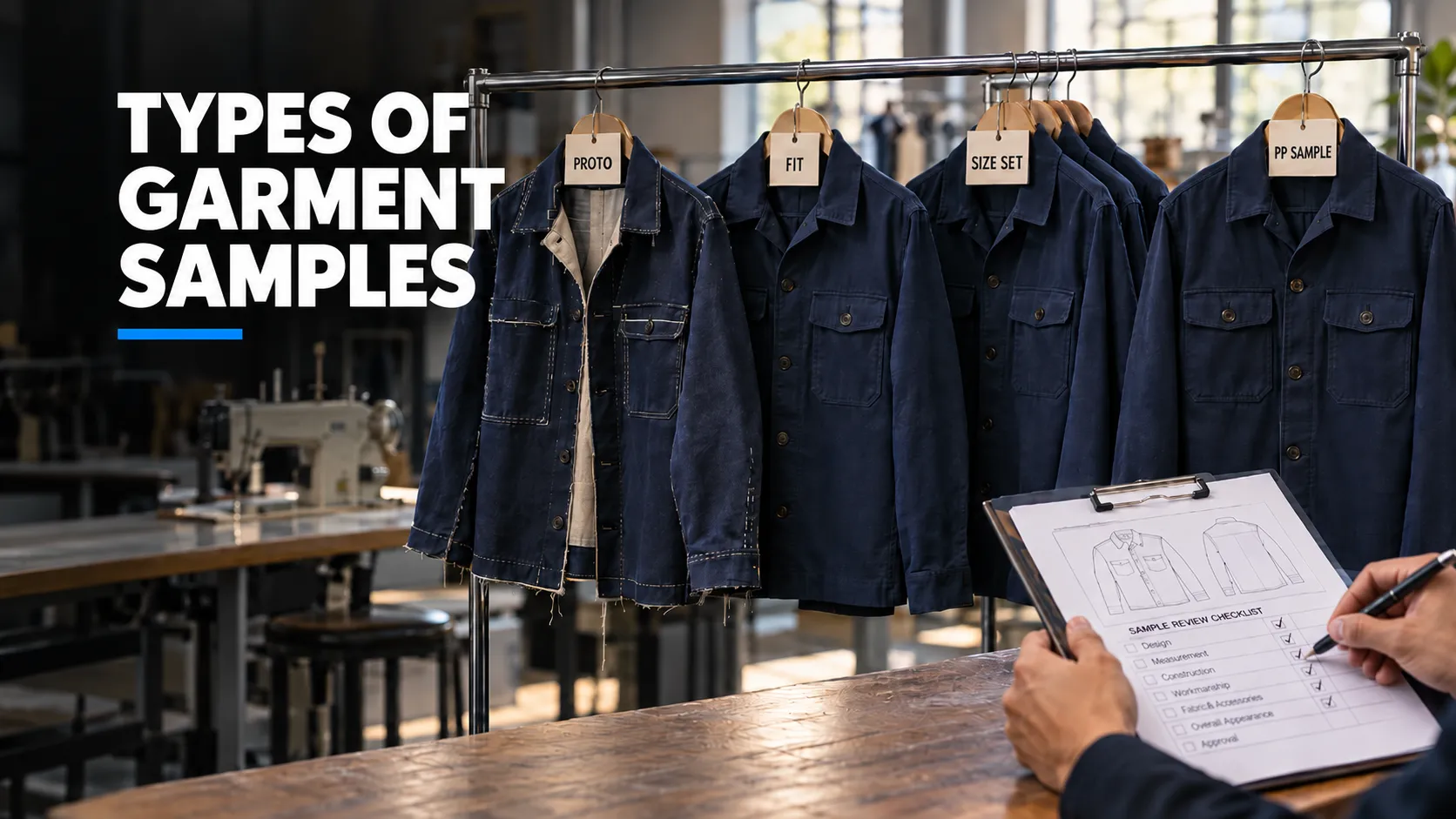
Understanding the types of samples in garment industry is essential for clothing brands that want to evaluate garment designs, improve fit, verify materials, and prepare products for bulk manufacturing. Each sample type serves a different purpose, and confusing these stages can lead to unnecessary revisions, delayed approvals, and production problems.
A prototype helps determine whether a design can be developed as intended. A fit sample evaluates garment shape and wearability. A size-set sample checks grading across sizes, while a pre-production (PP) sample provides a production-representative reference. Garment Performance Testing (GPT) evaluates specified performance requirements, and Top of Production (TOP) samples help verify actual manufacturing output.
However, not every apparel product requires every sample stage. The appropriate sequence depends on garment complexity, fabric behavior, construction methods, buyer requirements, and development risks.
For startup clothing brands, designers, merchandisers, product developers, and quality assurance teams, the important questions are: Which sample should be requested, what must it demonstrate, and what can be approved at that stage?
This guide explains the different garment sample types, their objectives, typical development sequence, required technical information, and approval considerations. It also clarifies the differences between PP, GPT, pilot-run, and TOP samples so buyers can make informed decisions before bulk production.
Sampling works best within a structured development process. Our sample management system for apparel sampling and approval explains how to coordinate sample requests, revisions, timelines, approval records, and manufacturing readiness across multiple development rounds.
Table of Contents
What Are the Different Types of Samples in the Garment Industry?
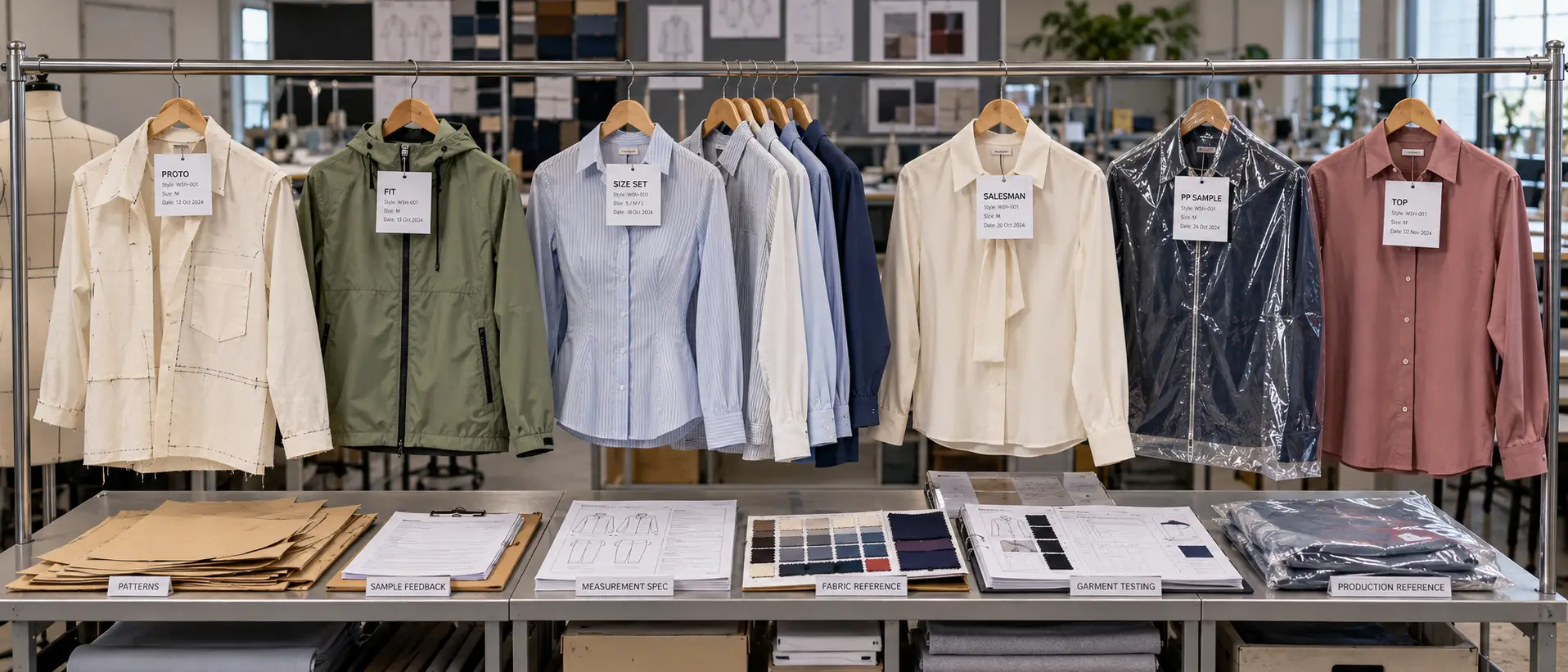
Garment samples are physical or digital representations of a clothing product prepared for specific development, commercial, testing, or production-verification purposes.
Their role extends beyond showing what a garment looks like.
Different samples can help evaluate design feasibility, material suitability, fit, grading, production specifications, garment performance, customer presentation, and manufacturing consistency.
Garment Sample Types Comparison
| Sample Type | Main Purpose | Typical Stage | What It Helps Confirm |
|---|---|---|---|
| Mock-up / Toile | Evaluate basic shape and construction | Early development | Design and pattern feasibility |
| Development / Proto Sample | Interpret the design as a physical garment | Initial development | Construction approach and silhouette direction |
| Fit Sample | Evaluate garment fit and proportions | Development | Fit, balance, measurements, and movement |
| Size Set Sample | Evaluate sizing and grading | After base-fit development | Size specifications and fit across selected sizes |
| Salesman Sample (SMS) | Present the product to commercial buyers | Sales / Pre-production | Product appearance and market presentation |
| Photoshoot / Press Sample | Create marketing and editorial materials | Marketing preparation | Visual presentation |
| Pre-Production (PP) Sample | Establish a production-representative garment | Before applicable bulk release | Approved materials, construction, workmanship, and appearance |
| GPT / Testing Sample | Evaluate specified performance requirements | As defined in test plan | Testing and compliance results |
| Pilot Run / Trial Production Sample | Evaluate manufacturing under production conditions | Production preparation | Process capability and execution |
| Sealed / Approved Reference Sample | Establish a controlled physical benchmark | After applicable approval | Standard for manufacturing comparison |
| TOP Sample | Evaluate early actual production output | During initial bulk production | Conformity with approved references |
| Shipment Sample | Represent finished goods prepared for shipment | Final production / Shipment | Final product and packing presentation |
Sample terminology and sequences vary between buyers, manufacturers, and product categories. These stages are not all mandatory for every garment order.
The apparel product-development platform Techpacker provides an additional overview of 12 common garment sample types, including development, fit, size set, sales, PP, GPT, TOP, and shipment samples. Its classification is a useful terminology reference, although individual buyers may organize or name their stages differently.
Three Main Purposes of Apparel Sampling
Most garment sampling activities can be grouped into three broad purposes.
1. Product Development
- Samples help translate a garment concept into workable patterns, construction, fit, and technical specifications.
- These typically include mock-ups, prototypes, fit samples, and size sets.
2. Product Validation and Approval
- Samples or test specimens help confirm that the garment meets relevant material, performance, appearance, and production requirements.
- These may include PP samples, approved reference samples, and samples submitted for GPT.
3. Commercial Presentation and Production Verification
- Sales and photoshoot samples help present the product commercially, while pilot runs, TOP samples, and shipment samples provide different forms of production-related verification.
- A single sample may support more than one objective, provided its approval scope is clearly documented.
Development and Proto Samples: Testing the Garment Concept
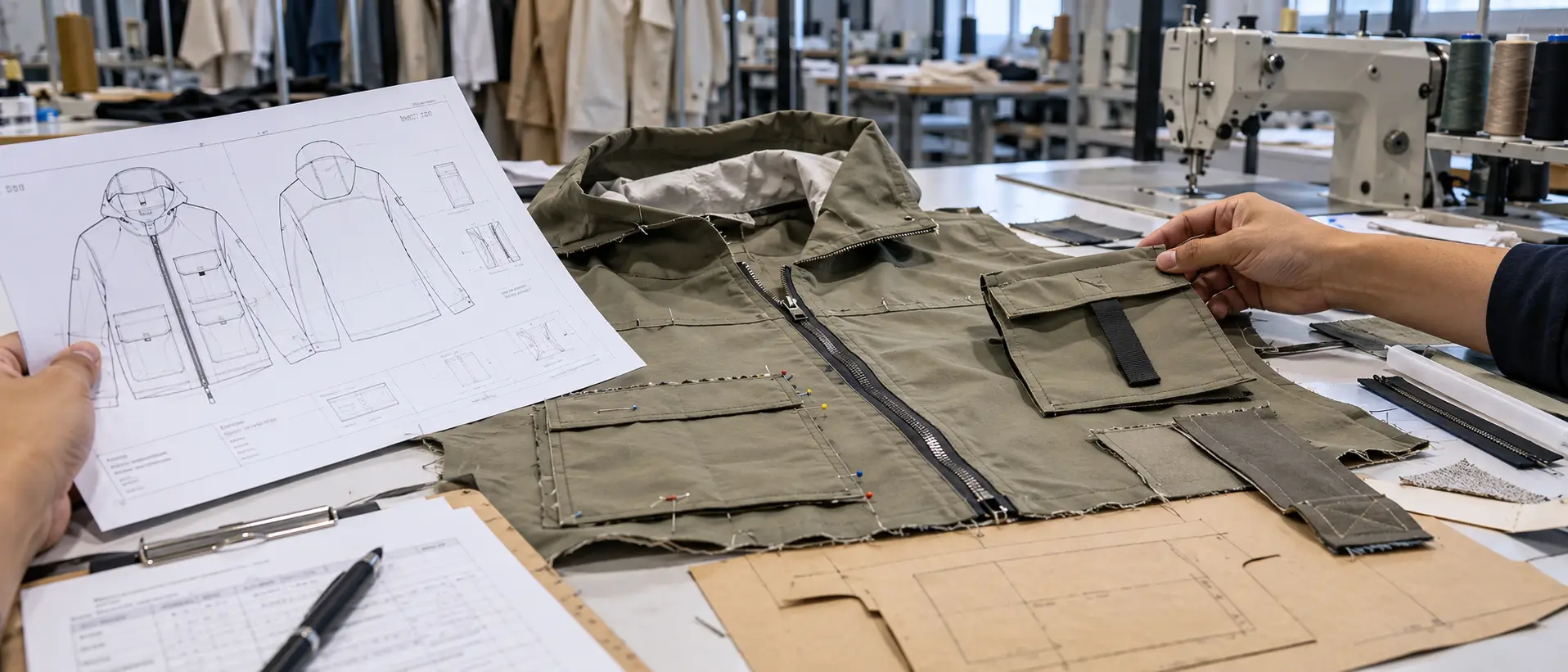
A development sample is an early physical version of a garment used to investigate its design and technical feasibility.
A proto sample, short for prototype sample, commonly serves a similar purpose.
In some apparel development programs, the terms are used interchangeably. Others distinguish an internal development sample from a formal prototype submitted to the buyer.
The distinction should be clarified when requesting samples from a manufacturer.
What Is a Proto Sample in the Garment Industry?
A proto sample is an early garment constructed to evaluate whether the intended design, pattern, and construction approach can be developed successfully.
It may be prepared using provisional materials when the final fabric or trims are not yet available.
For example, a clothing brand developing a new lightweight jacket may request a prototype to evaluate:
- General garment silhouette
- Panel arrangement and seam positioning
- Pocket construction
- Hood or collar design
- Closure arrangement
- Basic pattern proportions
- Potential construction difficulties
The prototype helps identify major technical problems before the project progresses into more detailed fit development or material approval.
What Technical Information Is Needed for a Proto Sample?
A preliminary tech pack should provide enough information for the manufacturer to understand the intended garment.
Useful inputs include:
- Front and back technical drawings
- Key garment dimensions
- Main construction details
- Preliminary fabric characteristics
- Important trim and closure requirements
- Relevant artwork positioning
- Reference photographs or physical samples
- Intended sample objectives
Some information may remain provisional.
However, assumptions should be identified so that the buyer does not mistake a development substitute for an approved production material.
The guide to creating a clothing tech pack explains how to organize technical drawings, construction specifications, measurements, materials, and development references before submitting garment requirements to a manufacturing partner.
What Should a Proto Sample Prove?
A successful prototype should provide sufficient evidence that the overall design direction and construction concept are feasible.
Reviewers may check whether:
- The design is interpreted correctly.
- Important features can be constructed as intended.
- The basic shape and proportions are reasonable.
- The selected construction approach is suitable for further development.
- Technical problems have been identified and documented.
A proto sample does not necessarily need final fabric, labels, packaging, or complete production workmanship.
Its approval should describe the features accepted for the next development stage.
When Is Another Proto Sample Necessary?
A revised prototype may be appropriate when substantial design or construction changes are required.
For example, if the first prototype reveals that a planned pocket arrangement interferes with garment construction, another prototype may be useful before proceeding with fit evaluation.
However, minor adjustments do not always require a separate prototype round.
The decision depends on the technical significance of the changes and the buyer’s development requirements.
Fit Sample: Evaluating Garment Shape, Measurements, and Wearability
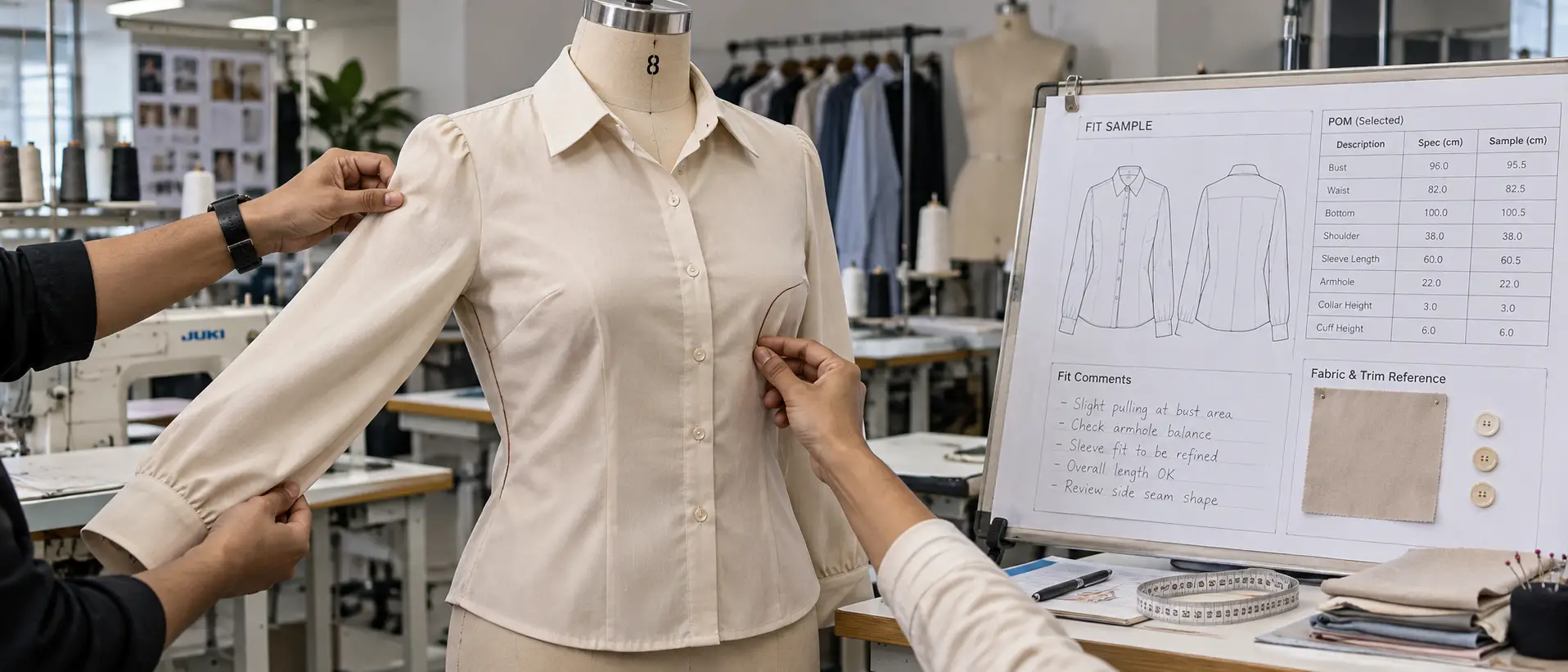
A fit sample is developed to evaluate how a garment fits the intended body shape or fit form.
Its purpose is to assess more than individual measurements.
Fit evaluation considers garment proportions, balance, drape, movement, comfort, and the intended silhouette.
A sample can match several target dimensions while still showing an undesirable fit.
What Is a Fit Sample in Apparel Manufacturing?
A fit sample typically uses a developed pattern and sufficiently representative material characteristics to support meaningful fitting.
For example, if a garment relies on fabric stretch and recovery, using a substantially different material may produce misleading fit results.
The fit sample should therefore use the intended fabric or an agreed alternative with relevant comparable properties.
For a fitted women’s blouse, a fit review might assess:
- Shoulder positioning
- Bust and waist shaping
- Armhole comfort
- Sleeve movement
- Garment balance
- Hem positioning
- Pulling, twisting, or excess fabric
- Fit against the intended design
For an oversized sweatshirt, the review might focus on dropped-shoulder proportions, overall volume, sleeve balance, and fabric drape.
How Is a Fit Sample Evaluated?
A practical fit review combines three activities.
Measurement Review: Compare actual garment measurements with the applicable Points of Measure (POM), target specifications, and agreed tolerances.
Physical Fit Assessment: Evaluate the garment on an appropriate model or fit form, including its shape, balance, comfort, and movement.
Technical Correction Review: Identify whether changes are needed to the pattern, construction, material selection, or garment specifications.
The reviewer should describe observed problems accurately.
For example, “sleeve restricts movement when the arm is raised” provides a clearer starting point than “sleeve looks wrong.”
The pattern-making or technical team can then determine an appropriate correction.
Fit Sample Approval vs. Final Garment Approval
Approving a fit sample means that the relevant fit requirements have been accepted for the applicable development stage.
It does not automatically confirm final artwork, labeling, packaging, material performance, or readiness for bulk production.
If the fabric or construction changes substantially after fit approval, another fitting review may be necessary.
Techpacker’s garment fitting and fit sign-off guide explains how fit samples can be identified, evaluated, measured, and documented so that technical corrections and approval decisions remain traceable.
Video: Professional Garment Fitting and Prototype Evaluation
The following English-language demonstration, Mastering Garment Fitting: Muslin Demo and In-Depth Explanation by Susan Elias Couture, shows how an experienced designer and pattern maker examines a physical garment mock-up to evaluate fit and identify potential corrections. Although it demonstrates a dress rather than a factory fit-sample meeting, the underlying principles of checking garment shape, interpreting fit problems, and refining patterns are relevant to apparel sample development.
Size Set Sample: Checking Grading Across Garment Sizes
A size set sample is used to evaluate whether garment sizing and proportions remain appropriate across the intended size range.
Developing an acceptable fit in one base size does not automatically confirm that the same design will fit correctly in smaller or larger sizes.
A size set helps identify grading and size-specific problems before the relevant specifications are released for manufacturing.
What Is a Size Set Sample?
A size set consists of garments made in selected or all sizes from the intended product range, depending on the buyer’s requirements.
For example, a clothing brand developing a T-shirt range from XS to XXL may request samples in several sizes to evaluate the grading.
The exact size selection should reflect the product’s fit risks, customer profile, and approved development procedure.
What Does a Size Set Sample Evaluate?
Important checks include:
- Chest, waist, hip, and other relevant measurements
- Body and sleeve lengths
- Shoulder and armhole proportions
- Neck and functional openings
- Garment balance across sizes
- Fit on suitable models or forms where required
- Graded pattern consistency
- Size-specific construction requirements
A size set may identify problems that are not visible in the base size.
For example, the approved medium-size T-shirt may have suitable shoulder proportions, but an extra-large sample may show a neckline that has not increased appropriately for the intended fit.
Grading Rules vs. Measurement Tolerances
These two concepts serve different purposes.
Grading rules determine how the target measurements or patterns change between sizes.
Measurement tolerances determine the permitted variation around an approved target measurement.
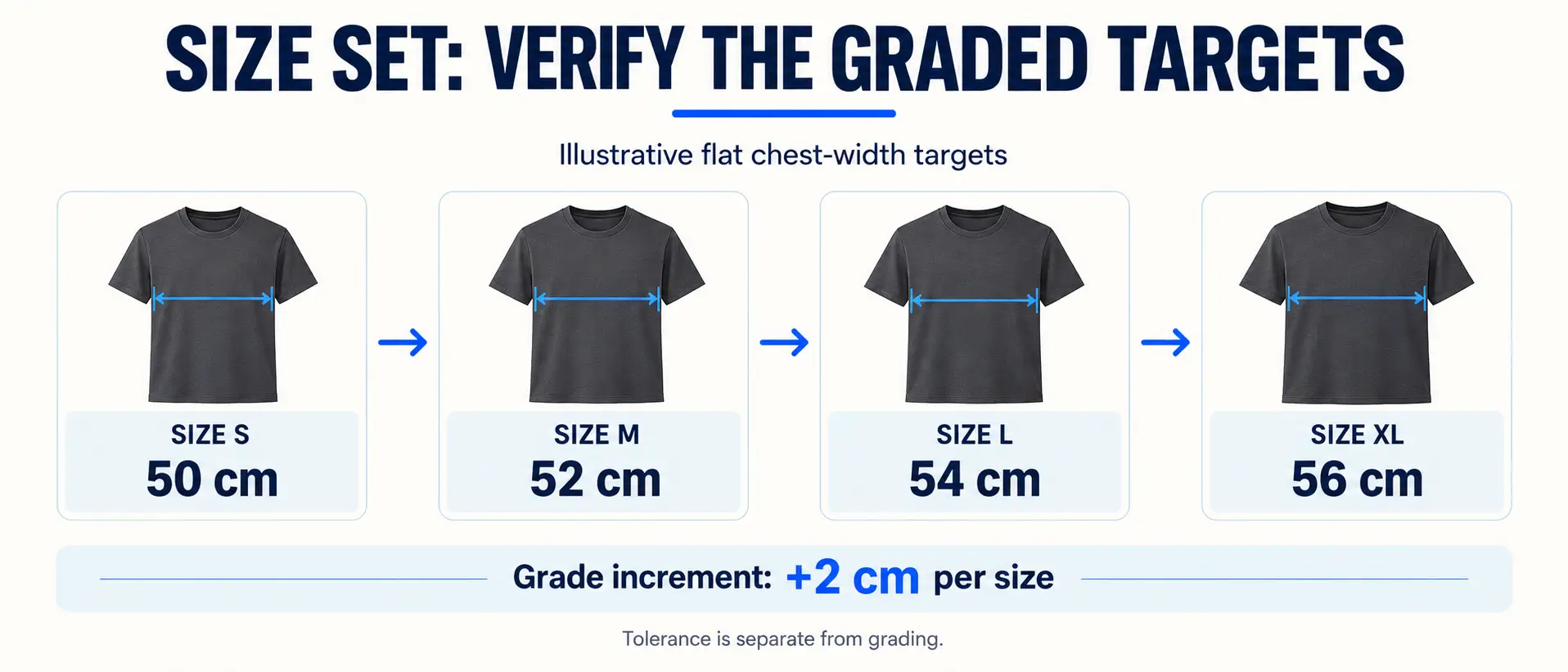
For example, consider a T-shirt chest-width specification:
| Size | Target Chest Width | Illustrative Tolerance |
|---|---|---|
| S | 50 cm | ±1 cm |
| M | 52 cm | ±1 cm |
| L | 54 cm | ±1 cm |
| XL | 56 cm | ±1 cm |
Illustrative example only. Neither the grading increments nor the tolerance values represent universal apparel standards.
The chest-width target increases by 2 cm between the listed sizes. That is the grade increment.
The ±1 cm tolerance is a separate allowance for dimensional variation around each target.
The values must be approved for the actual product.
Techpacker’s technical documentation for apparel grading rules provides an example of how base-size measurements and grade increments can be organized in a size specification. It also illustrates why grading and tolerance values should be recorded separately.
When Should Size Set Sampling Begin?
Size-set development is generally more effective after the relevant base-size fit direction has been established.
If the base pattern is still undergoing substantial changes, the grading may also require revision.
However, preliminary grading work can begin earlier when appropriate to the product development program.
The important requirement is to review the final grade rules against the accepted fit direction.
The garment measurement tolerance guide explains how buyers can establish POM definitions, measurement methods, acceptable dimensional ranges, and grading requirements for consistent evaluation across garment sizes.
When Is a Size Set Approved?
The relevant size-set review should confirm that:
- The selected sizes meet their applicable measurement requirements.
- The graded proportions support the intended fit.
- Important size-specific issues have been addressed.
- The relevant measurement and pattern revisions are documented.
- The authorized reviewer has recorded the decision.
A size-set approval should identify which sizes and specifications were reviewed.
It should not automatically be interpreted as approval of unrelated materials, artwork, or packaging requirements.
Preparing Your Garment for Sampling?
Share your product concept, technical drawings, measurement charts, fabric requirements, or available tech pack with RYZEAL SOURCING to discuss technical preparation and sampling feasibility through our specialized manufacturing partners in Bangladesh.
Pre-Production Sample (PP Sample): Confirming the Intended Bulk Standard
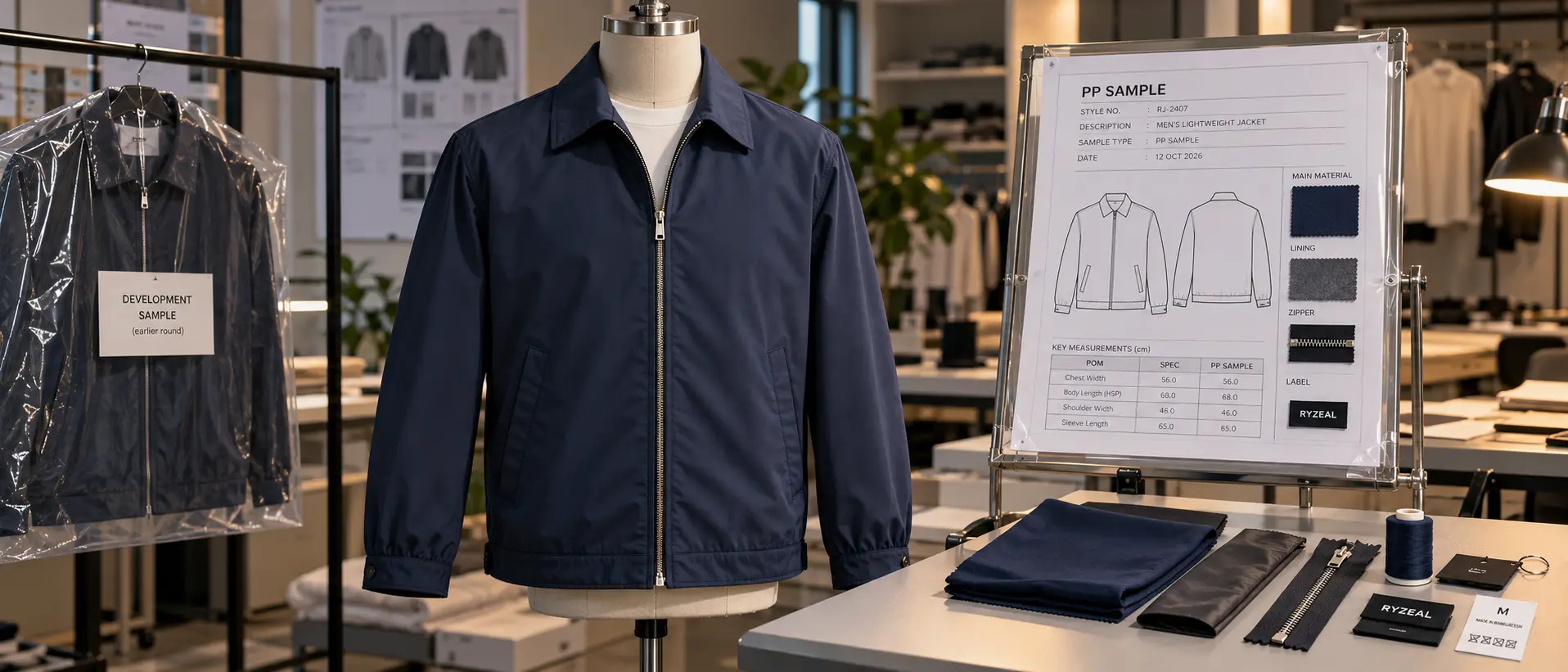
A pre-production sample, commonly called a PP sample, is a garment prepared to represent the specifications intended for bulk manufacturing.
Its purpose is to confirm that the relevant materials, construction, measurements, workmanship, decoration, and other product requirements have been developed sufficiently for an applicable production approval.
This makes PP sampling an important checkpoint before major manufacturing activities are authorized.
What Is a PP Sample in the Garment Industry?
A PP sample is typically produced using production-representative materials and construction requirements.
Depending on the garment and the buyer’s procedure, its review may include:
- Approved fabric and trim references
- Relevant garment measurements and tolerances
- Fit and overall appearance
- Construction and stitching details
- Print or embroidery methods and placement
- Finishing and washing requirements
- Applicable labels and branding
- Relevant packaging requirements
- Workmanship and visual quality
Any provisional materials or differences from the intended bulk standard should be identified before the relevant approval.
PP Sample vs. Fit Sample
The primary distinction is the purpose of evaluation.
| Comparison | Fit Sample | PP Sample |
|---|---|---|
| Main purpose | Evaluate and refine fit | Confirm production-representative specifications |
| Materials | Suitable for meaningful fit assessment | Normally intended or approved production materials |
| Pattern | May require corrections | Should reflect accepted pattern requirements |
| Measurements | Evaluate and refine targets | Verify applicable approved targets |
| Construction | Relevant to fit and development | Should represent intended production construction |
| Approval scope | Fit and related technical decisions | Applicable product standard before manufacturing release |
A PP sample may still reveal a fit issue. If so, the team should investigate the problem rather than treating the later sample stage as automatic approval.
Does a PP Sample Have to Be Produced on the Actual Bulk Line?
Not universally.
Some buyer programs require production-line preparation or a production trial. Others permit a PP sample to be developed in a sampling facility using the approved materials and intended construction specifications.
If the PP sample is made outside the bulk line, the buyer should understand the differences between sample-making and production conditions.
A PP sample can establish an important product reference without independently demonstrating that the selected production line can maintain the same quality at scale.
That question may require additional manufacturing verification.
PP Sample Approval Evidence Checklist
| Review Area | What Should Be Confirmed | Supporting Evidence | Typical Review Responsibility |
|---|---|---|---|
| Fabric and Trims | Applicable materials match approved specifications | BOM and material approvals | Sourcing / Technical |
| Measurements | Relevant POM results meet the approved criteria | Measurement report | Technical / QA |
| Fit | Intended shape, balance, and wearability | Fit evaluation and photographs | Buyer / Technical |
| Construction | Stitching, seams, assembly, and workmanship meet requirements | PP sample and technical specifications | Technical / QA |
| Artwork | Approved method, dimensions, color, and placement | Artwork reference or approved strike-off | Design / Buyer |
| Labels | Correct artwork, content, and attachment | Approved label references | Merchandising / Buyer |
| Packaging | Applicable packing specifications are confirmed | Packaging references or packing sample | Merchandising / Packaging |
| Approval | Decision, version, and open conditions are recorded | Authorized approval record | Designated Approver |
The exact PP review scope should be defined for the garment and manufacturing program.
What Is a Sealed PP Sample?
Once a PP sample or another designated physical reference has been approved, it may be identified and retained as a sealed sample, gold-seal sample, or approved master reference.
The terminology varies between organizations.
This approved garment can be used for comparison during manufacturing and quality inspections.
The reference should be identifiable by its style, size, colorway, revision, approval date, and relevant authorizing information.
A sealed sample supports physical comparison but does not replace the approved tech pack, BOM, measurement chart, testing requirements, or other manufacturing specifications.
Why BOM Stability Matters Before PP Approval
The Bill of Materials controls the physical components required for the garment.
If the production fabric, zipper, label, or another significant component changes after PP approval, the manufacturer and buyer should evaluate whether the modification affects the approved sample and requires additional review.
Our guide to building an apparel BOM explains how material specifications, sourcing rules, consumption, packaging, and component approvals can be documented to reduce unexpected substitutions and material-related costing differences.
GPT Test in Garments: What Garment Performance Testing Proves
GPT commonly refers to Garment Performance Test or Garment Performance Testing in apparel development.
Some buyer programs use the term for garment package testing or a defined set of tests performed on submitted garments.
The exact terminology and testing requirements should be confirmed with the buyer.
Unlike a prototype or fit sample, GPT is primarily a testing activity or a sample submitted for testing, rather than a universally required additional design-development stage.
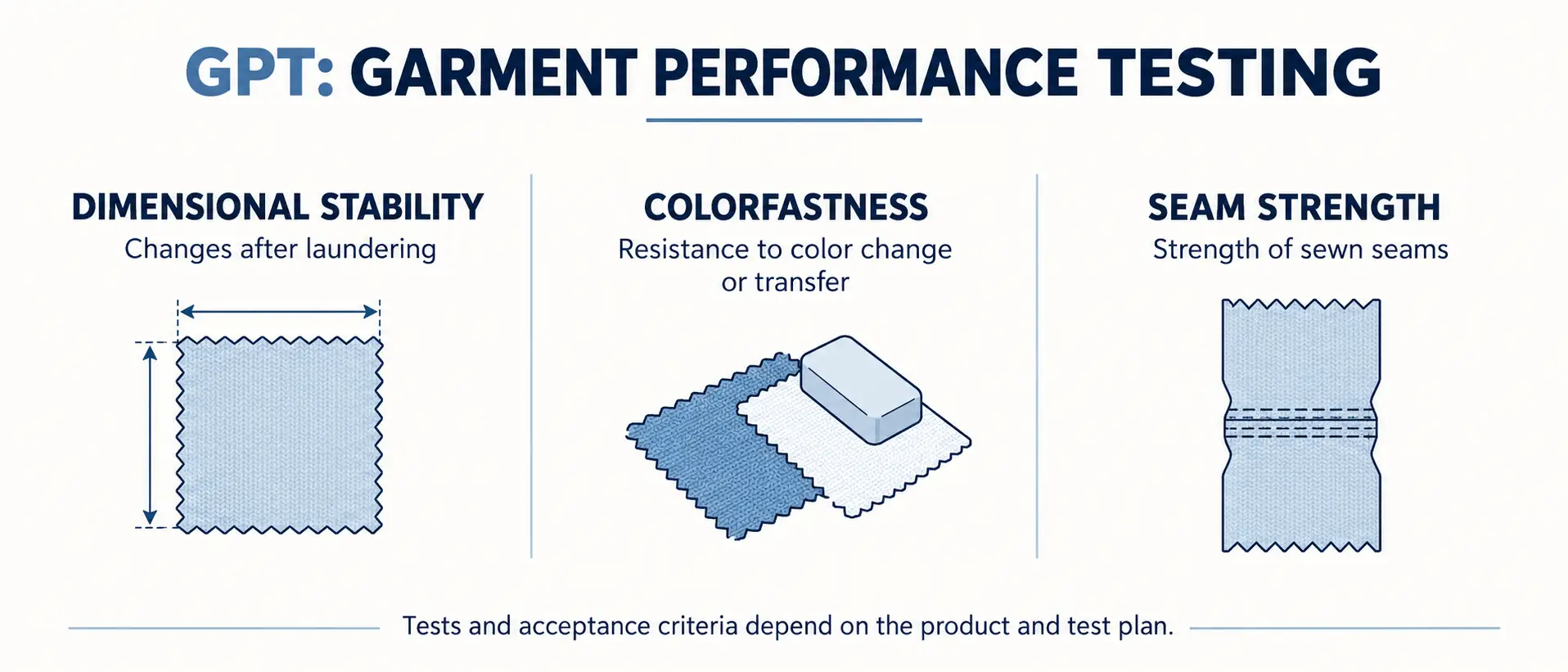
What Is a GPT Sample?
A GPT sample is a garment submitted for tests intended to evaluate specified material, construction, dimensional, chemical, or performance requirements.
Testing may be performed by a manufacturer’s laboratory or an independent testing provider, depending on the applicable requirements.
The submitted garment should be appropriately representative of the product or material condition being evaluated.
For certain tests, fabric or component specimens may also be required.
Common GPT Tests in Apparel
| Test Area | What It Evaluates | When It May Be Relevant |
|---|---|---|
| Dimensional Stability | Changes in dimensions after specified washing or drying | Garments with laundering-performance requirements |
| Colorfastness to Washing | Resistance to color change or staining during washing | Dyed or printed garments |
| Colorfastness to Rubbing | Potential color transfer through rubbing | Relevant dyed materials and garments |
| Pilling Resistance | Tendency to form surface pills under specified conditions | Knitted or other susceptible fabrics |
| Seam Strength | Strength of sewn seams under defined testing conditions | Garments with relevant strength requirements |
| Seam Slippage | Fabric yarn displacement at seams | Relevant woven constructions |
| Stretch and Recovery | Fabric behavior after extension | Stretch garments and activewear |
| Chemical or Safety Testing | Specified chemical or safety requirements | Products subject to applicable regulations or buyer standards |
These examples do not form a mandatory testing package.
The actual tests, methods, sample numbers, and acceptance criteria depend on the product, market, buyer requirements, and applicable standards.
Intertek’s textile testing solutions for apparel describe different testing categories, including dimensional stability, colorfastness, physical strength, performance, and chemical evaluations. This provides useful context for selecting a garment-specific test plan rather than assuming every product requires identical testing.
When Should GPT Be Performed?
The testing schedule depends on the purpose of the tests.
Some material tests are appropriate during fabric development or sourcing, before a garment reaches PP approval.
Other tests may require production-representative garments, particular finishing processes, or specimens from a defined production stage.
A test should be scheduled early enough for its results to inform the activities it affects.
For example, where dimensional stability is important to final measurements, the relevant results may need to be reviewed before pattern and finished-dimension requirements are finalized.
For certain buyer programs, approved testing results may be mandatory before a specified production or shipment release.
Is GPT Required for Every Garment?
No universal GPT package applies to every style.
A simple casual garment, technical sportswear item, children’s sleepwear product, and protective garment may have substantially different testing requirements.
The decision depends on relevant regulatory obligations, buyer specifications, intended use, materials, and product risks.
Testing should not be skipped when it is required simply because a garment appears satisfactory during visual inspection.
What Happens if a GPT Sample Fails?
A failed test should trigger an investigation.
Possible causes include unsuitable material performance, finishing conditions, construction problems, contamination, or other technical factors.
The team should identify the relevant failure, determine corrective actions, and establish whether retesting or further development is necessary.
A failed performance test should not automatically lead to an unrelated pattern adjustment or a new sample round.
The action must address the actual cause.
Video: Dimensional Stability Testing of Textiles
The following English-language educational video, Quality Testing: Care and Appearance – Dimensional Stability, is provided through CottonWorks, the technical education platform of Cotton Incorporated. It explains dimensional stability as a textile performance characteristic and how changes during laundering can affect the garment’s final size. This is a relevant example of the physical testing principles used in garment performance evaluation.
Salesman Samples and Photoshoot Samples: Supporting Marketing and Sales
Not every garment sample is developed primarily for technical approval.
Some samples are prepared to communicate a product’s appearance to wholesale buyers, retail teams, marketing departments, or customers.
These commercial samples serve a different purpose from prototype, fit, and PP samples.
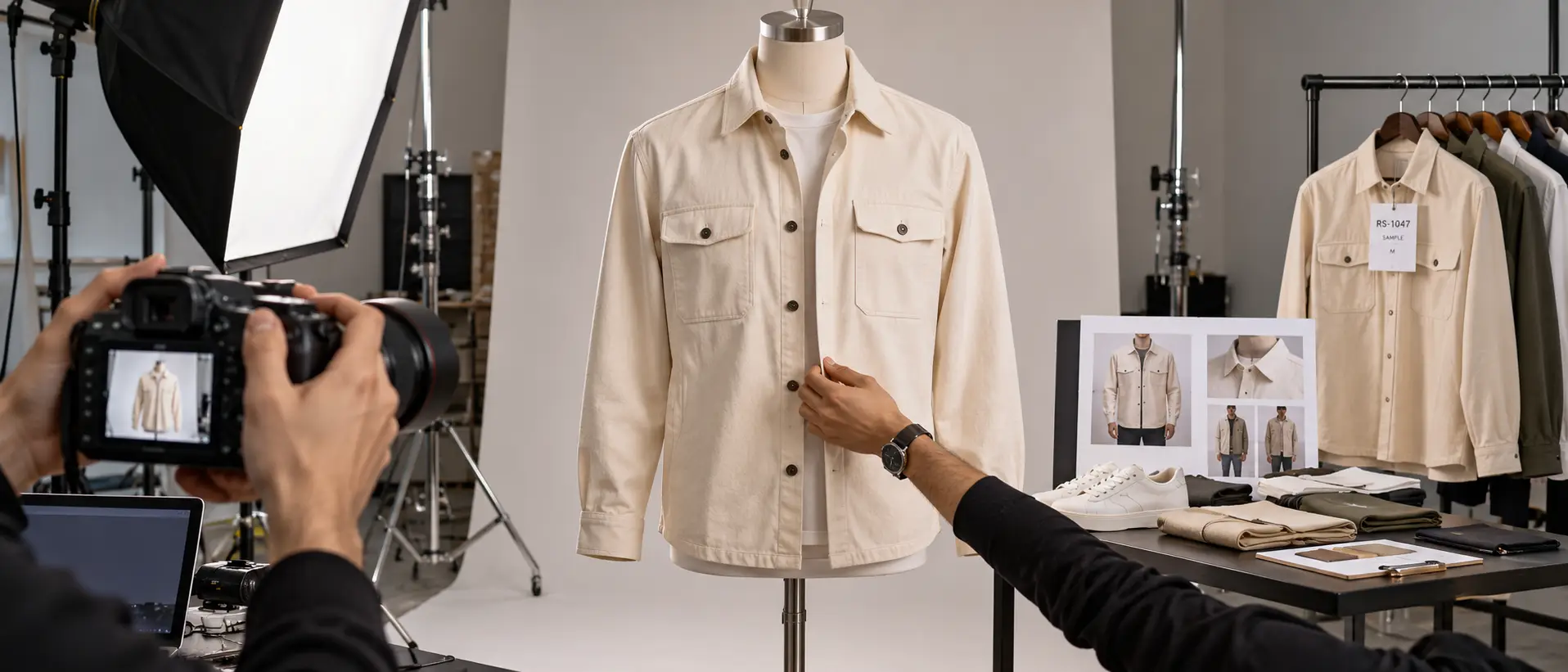
What Is a Salesman Sample (SMS)?
A salesman sample, often abbreviated SMS, is used to present a garment to potential buyers, retail customers, distributors, or internal commercial teams.
Salesman samples may be used for:
- Wholesale presentations
- Retail buying meetings
- Collection reviews
- Trade shows
- Showroom displays
- Early commercial evaluation
Depending on the buyer’s requirements and development timing, salesman samples may use final materials or agreed development alternatives.
They should accurately represent the product’s intended appearance and important features, especially where commercial decisions depend on them.
What Is a Photoshoot or Press Sample?
A photoshoot sample is prepared for photography, campaign development, e-commerce presentation, editorial features, or other marketing activities.
It may be produced in the size required for a particular model or presentation.
The sample’s visual purpose does not automatically establish its suitability as a production reference.
For example, a photoshoot sample may be adjusted for styling or presentation in ways that do not represent the intended production specifications.
Can a Sales Sample Be Used as a PP Reference?
Potentially, but only when it meets the applicable technical requirements and receives the necessary approval.
A salesman sample should not automatically override an approved PP sample simply because its appearance was preferred by the marketing team.
If a commercial presentation reveals that the garment requires a design change, the change should be incorporated into the controlled development process.
That may require updating the technical specifications and reviewing affected approvals.
Pilot Run and TOP Samples: Checking Actual Production Execution
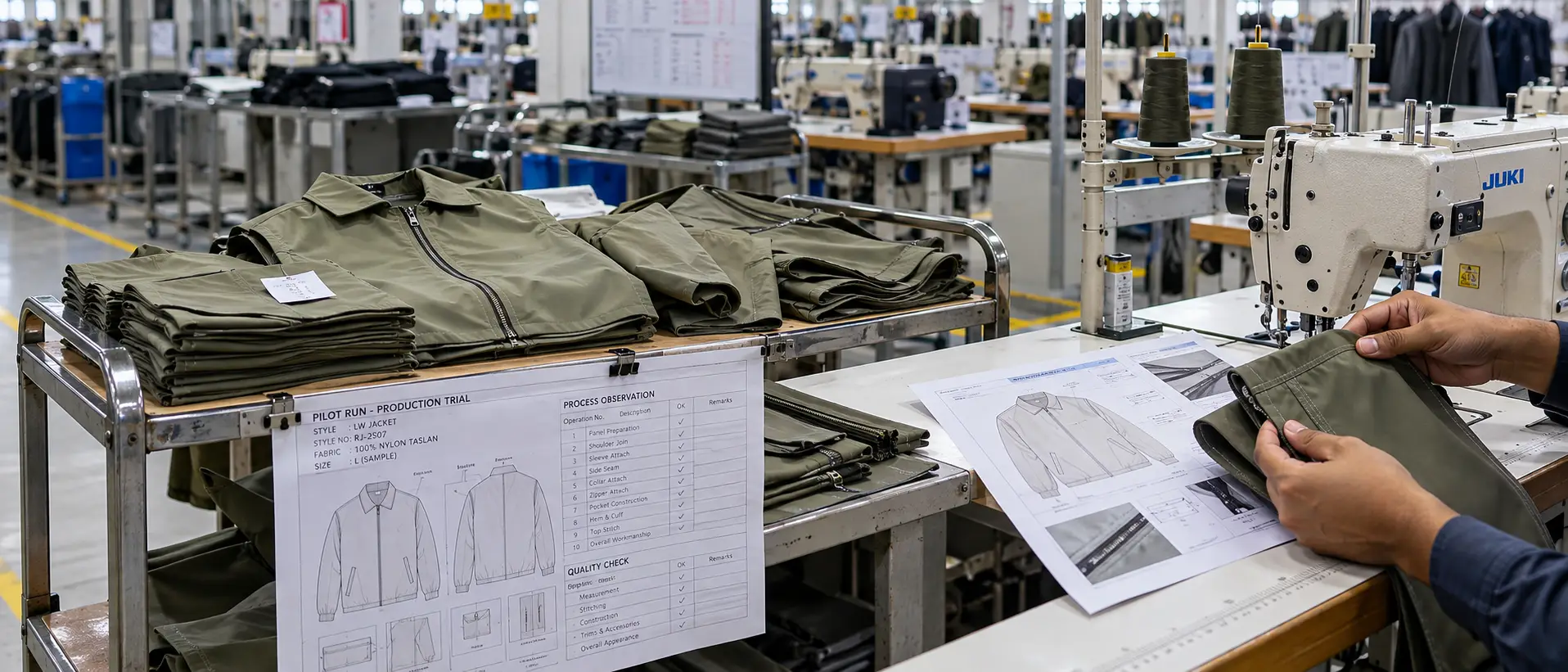
A production-representative sample establishes the intended product standard, but manufacturers must also demonstrate that their production arrangements can execute the required garment consistently.
Pilot runs and TOP samples can support this verification.
They are related activities, but they are not identical.
What Is a Pilot Run Sample?
A pilot run is a limited manufacturing trial conducted under defined production conditions.
Depending on the program, it may use the intended production equipment, operators, materials, processes, and quality-control methods.
The purpose is to identify manufacturing difficulties before committing to a larger volume.
A pilot run may help evaluate:
- Sewing and assembly methods
- Machine setup
- Production workflow
- Garment dimensions
- Workmanship consistency
- Handling and finishing methods
- Process-related quality problems
- Technical feasibility under production conditions
For example, a technically complex jacket may be successfully prepared by a specialist sample maker, yet present operational challenges when manufactured using the intended production arrangement.
A pilot run can help identify those differences.
When Is a Pilot Run Necessary?
Not every apparel order requires a separate formal pilot run.
It may be particularly useful when the program involves:
- A new garment construction method
- An unfamiliar material
- Specialized machinery
- Tight technical requirements
- A new manufacturing process
- A product with significant operational risks
- Buyer-mandated trial production
The scope and quantity should be agreed according to the product and manufacturing program.
A trial does not need an arbitrary minimum quantity to qualify as useful production verification.
What Is a TOP Sample in the Garment Industry?
TOP stands for Top of Production.
A TOP sample is selected from actual early production output and evaluated against the relevant approved specifications and physical references.
TOP reviews may include measurements, construction, appearance, materials, artwork, finishing, and labeling.
The sample provides evidence about what the production process is delivering after manufacturing has begun.
PP Sample vs. Pilot Run vs. TOP Sample
| Comparison | PP Sample | Pilot Run | TOP Sample |
|---|---|---|---|
| Main purpose | Confirm intended product standard | Evaluate manufacturing process | Verify early actual production |
| Typical timing | Before relevant production release | During production preparation | After bulk manufacturing begins |
| Source | Sample facility or production environment, as agreed | Defined production trial | Actual production output |
| Primary focus | Product specifications and appearance | Production execution and process capability | Conformity of production output |
| Approval meaning | Establishes applicable product reference | Supports process-readiness decision | Supports early-production quality evaluation |
These stages should be coordinated with the buyer’s production-release procedures.
Does TOP Approval Happen Before Bulk Production Starts?
No. TOP samples are taken from actual production, so manufacturing must already have begun.
In some programs, TOP findings may influence whether additional production can continue, whether corrective action is required, or whether a process needs adjustment.
However, TOP approval should not be described as a universal prerequisite for the initial authorization to begin bulk cutting.
That initial release depends on the applicable product, material, technical, and manufacturing approvals.
How Early Production Inspection Helps
Early production inspection can evaluate material conformity, initial finished units, manufacturing setup, and product requirements before problems affect larger quantities.
QIMA’s initial production inspection process explains how inspectors can review materials, workmanship, dimensions, product identification, and packing-related requirements at an early manufacturing stage. Such inspections support the identification of production problems but do not guarantee the quality of every subsequent unit.
Other Garment Sample Types: Mock-Up, Sealed, and Shipment Samples
In addition to the main categories, apparel manufacturing uses several other sample terms.
Some describe the garment’s purpose, while others describe how the sample is approved, retained, or evaluated.
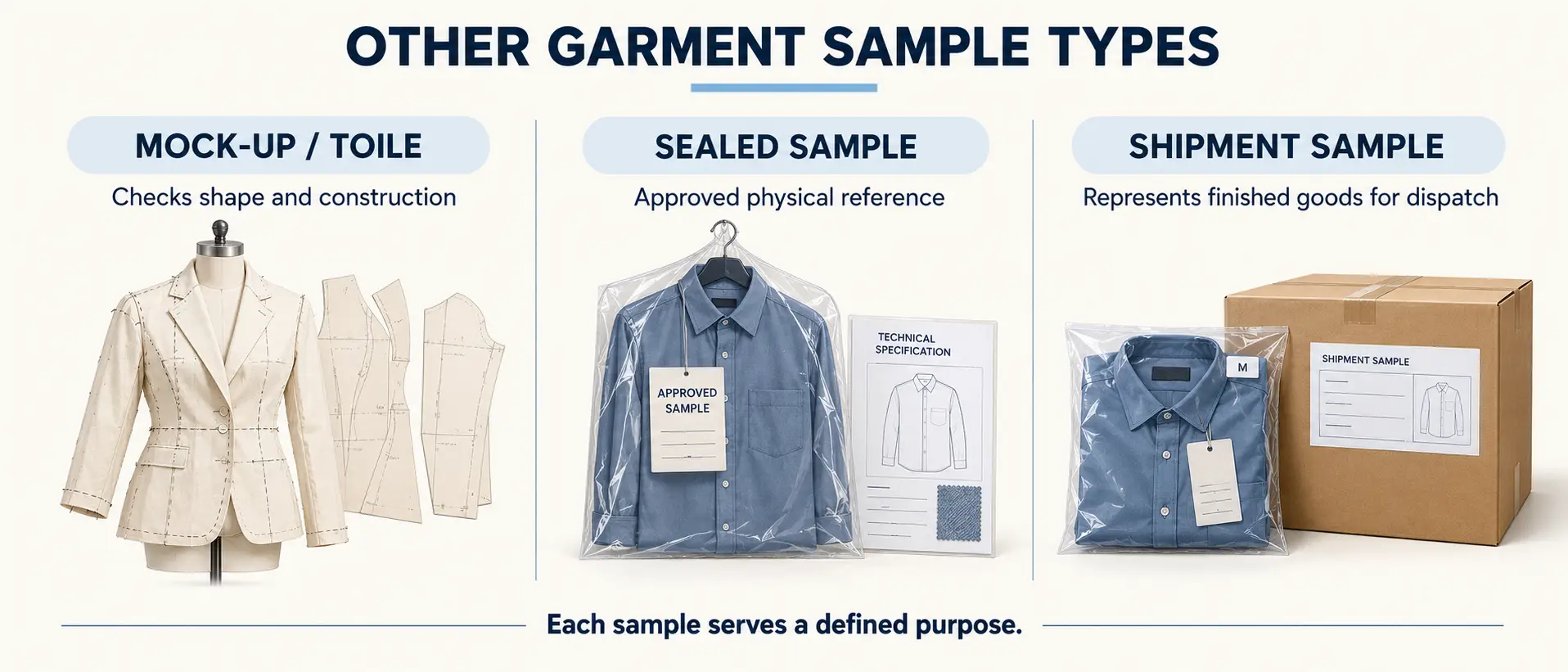
Mock-Up or Toile Sample
A mock-up, often called a toile or muslin in fashion development, is an early representation used to evaluate shape, construction, and pattern ideas.
It may be produced in inexpensive development fabric rather than the intended bulk material.
Mock-ups are particularly useful for investigating complicated pattern shapes, draping, or construction arrangements before developing a more complete sample.
Sealed or Approved Reference Sample
A sealed sample is an identified physical reference accepted for a specified purpose.
It may originate from an approved PP sample or another authorized product reference, depending on the buyer’s procedure.
Its role is to provide a physical benchmark for comparison.
The sample should remain connected to the applicable technical specifications and approval records.
Shipment Sample
A shipment sample is selected or retained to represent garments prepared for shipment.
Depending on the buyer’s requirements, it may help verify final appearance, labeling, folding, packaging, or other characteristics of the goods being delivered.
Shipment samples do not replace a properly defined final inspection process.
Digital Garment Samples
Some brands also use three-dimensional garment simulations during development.
Digital samples may help evaluate design proportions, visualize colorways, communicate construction concepts, or support pattern-development discussions.
They can be useful when combined with suitable fabric data and technical expertise.
However, digital representations do not automatically replace physical fitting, material testing, or production verification where these are required.
How to Choose the Right Sample Sequence for Your Clothing Brand
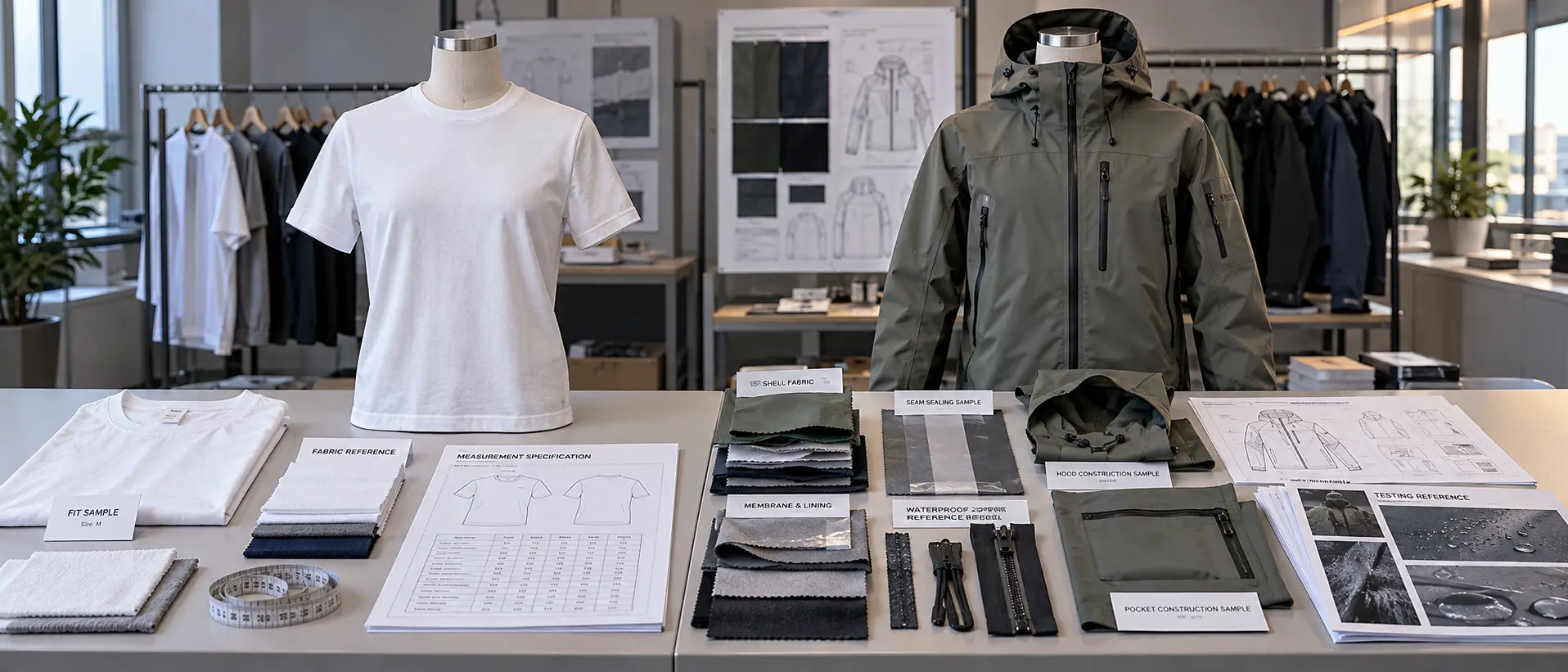
The most effective sampling sequence is not necessarily the one with the greatest number of stages.
It is the sequence that addresses the relevant technical and commercial risks before they affect expensive manufacturing decisions.
A simple repeat garment may require fewer development activities than an unfamiliar product with complex materials, new construction techniques, and demanding performance requirements.
Example Garment Sampling Sequence
| Stage | Main Dependency | Evidence to Review | Next Decision |
|---|---|---|---|
| Development / Proto | Initial technical information | Design interpretation and construction review | Refine design or advance to fit |
| Fit Sample | Suitable pattern and material representation | Fit comments, measurement results | Approve fit direction or revise |
| Size Set | Established base-fit direction and grading | Selected size samples and measurement records | Confirm size specifications |
| PP Sample | Production-representative product requirements | Product review and approval evidence | Authorize applicable manufacturing activities |
| GPT / Testing | Defined test plan and suitable specimens | Test reports and acceptance results | Approve, investigate, or correct affected requirements |
| Pilot Run, if required | Appropriate production setup and approved inputs | Trial production and quality records | Confirm process readiness or revise |
| TOP Sample | Actual early production output | Product measurements and quality findings | Continue production or implement corrective action |
| Shipment Sample, if required | Completed garments and packing | Finished product and packaging records | Complete relevant shipment verification |
The stages may overlap or follow a different order. GPT and other testing activities should be scheduled according to the requirements they are intended to verify, rather than automatically placed after PP approval.
Example 1: Basic Cotton T-Shirt
For a basic T-shirt using established fabric, construction, and sizing, the buyer may be able to use a relatively simple development plan.
This could involve a fit sample, relevant size verification, a production-representative PP sample, and any required testing or production checks.
A separate prototype may be unnecessary when the pattern and construction are already established.
Example 2: Technical Performance Jacket
A technical jacket with multiple layers, special closures, seam-sealing requirements, and functional performance specifications may need a more extensive development approach.
This could involve early mock-ups, prototypes, fit development, size-set checks, material testing, PP approval, and a pilot run.
Testing may need to begin during material development rather than after the PP sample.
Example 3: Repeat Style With a New Fabric
A repeat style may already have an approved pattern and construction method.
However, introducing a new fabric can affect shrinkage, drape, stretch, sewing behavior, and fit.
The buyer should assess whether the new material requires further fitting, testing, or other relevant approvals before proceeding.
The existing sample history is useful, but it does not automatically validate every material change.
How Many Sample Rounds Should You Plan?
There is no universal number of sampling rounds.
Development requirements depend on garment complexity, specification completeness, technical changes, supplier availability, testing, and approval timelines.
Repeated corrections can sometimes be reduced by defining clearer objectives and controlling technical revisions.
However, eliminating an important sample or test solely to reduce the number of rounds may increase risk.
A structured approach to planning garment sample rounds and timelines helps brands estimate development requirements, account for revisions, and coordinate sampling with their intended product launch schedule.
Garment Sample Approval and Bulk Release Checklist
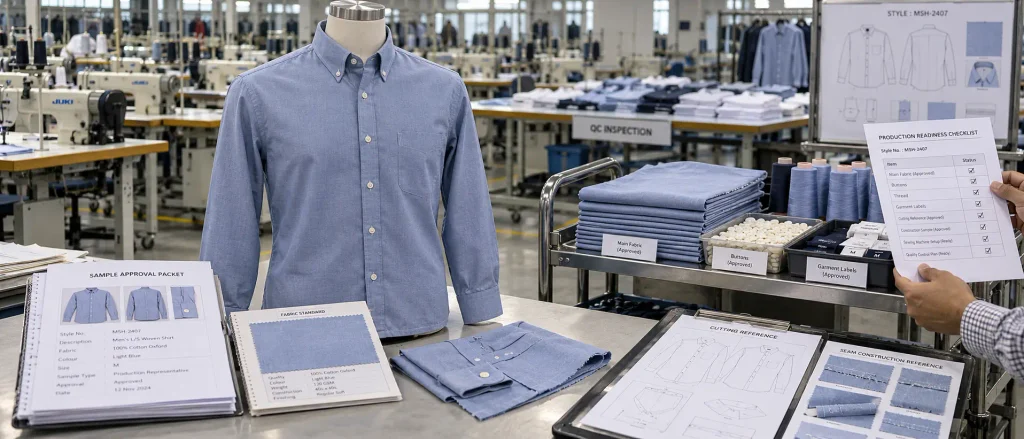
Understanding different garment sample types is only part of the process.
Buyers must also establish which decisions each sample can support and what information is required before production activities are authorized.
Bulk Production Readiness Checklist
| Requirement | Evidence to Review | Typical Responsibility | Risk if Unresolved |
|---|---|---|---|
| Approved Tech Pack | Current technical specifications and revision | Buyer / Technical Team | Incorrect construction or requirements |
| Material Specifications | Approved BOM and relevant sourcing records | Sourcing / Merchandising | Unapproved material substitutions |
| Fit and Measurements | Applicable fit, grading, and tolerance approvals | Buyer / Technical / QA | Fit and size inconsistencies |
| PP Reference | Approved production-representative sample | Authorized Approver | Unclear physical quality benchmark |
| Artwork and Decoration | Approved artwork, placement, and method references | Design / Technical | Incorrect branding or decoration |
| Testing | Required results and dispositions | QA / Compliance | Product performance or compliance failures |
| Production Arrangements | Appropriate machinery, methods, materials, and capacity | Manufacturer / Production Team | Manufacturing difficulties |
| Packaging and Labels | Approved requirements for affected activities | Merchandising / Packaging | Identification or packing errors |
| Production QC | Applicable inspection and monitoring plan | Manufacturer QC / Buyer QA | Inconsistent production evaluation |
| Release Decision | Authorized approval and conditions | Designated Decision-Maker | Activities proceed without required authorization |
A product may receive a conditional approval when an authorized person confirms that certain activities can proceed without affecting unresolved critical requirements.
The approval should identify which activities are allowed, which remain blocked, and what must be completed before the affected work begins.
Sample Approval Checklist for Buyers
Before accepting a sample, confirm:
- The sample type and objective are clearly identified.
- The correct technical specification version was used.
- Relevant physical materials and approved alternatives are documented.
- The required measurements and fit criteria have been reviewed.
- Construction and workmanship have been evaluated at the appropriate stage.
- Necessary test results or testing requirements are addressed.
- Outstanding corrections are recorded.
- The scope of approval is clear.
- The authorized reviewer has documented the decision.
- Relevant changes are reflected in the controlled technical documents.
A dedicated sample approval checklist for fit and workmanship helps reviewers document measurements, construction quality, branding, packaging, and other relevant findings before issuing an approval decision.
Connecting Sample Types With Approval Gates
A sample’s technical purpose should determine the approval requirements applied to it.
For example, a fit sample can establish the accepted fit direction without confirming the final retail packaging.
A PP sample may provide a broader product reference, while TOP checks help verify actual production execution.
Our apparel approval workflow map explains how different technical decisions, evidence requirements, and approval responsibilities can be coordinated before and during garment manufacturing.
Frequently Asked Questions About Types of Samples in Garment Industry
What are the main types of samples in the garment industry?
Common sample types include prototype or development samples, fit samples, size-set samples, salesman samples, pre-production (PP) samples, GPT samples or testing specimens, pilot-run samples, TOP samples, sealed references, and shipment samples. The actual requirements depend on the product and buyer.
What is the difference between a proto sample and a fit sample?
A proto sample primarily evaluates the garment’s design and construction feasibility. A fit sample focuses on how the garment fits, balances, and moves, using sufficiently representative material characteristics for meaningful assessment.
What is a size set sample?
A size set sample is used to evaluate grading, measurements, and fit across selected or all sizes in the intended product range. It helps identify size-specific problems that may not be visible in the base size.
What is PP sample meaning in the garment industry?
PP means Pre-Production. A PP sample is a production-representative garment used to confirm relevant materials, construction, measurements, appearance, and workmanship before applicable manufacturing activities are authorized.
What is GPT in garments?
GPT commonly refers to Garment Performance Testing. Some buyers use related terminology such as garment package testing. It involves evaluating defined garment, material, or construction performance requirements according to an applicable test plan.
Is GPT required for every garment order?
Not every order requires the same testing package. The applicable tests depend on product characteristics, buyer requirements, destination-market regulations, and relevant technical risks. Mandatory testing requirements must be satisfied regardless of garment simplicity.
What is the difference between a PP sample and a TOP sample?
A PP sample helps establish the intended production standard before the applicable bulk release. A TOP sample comes from actual early production output and is reviewed to check whether manufacturing matches the approved references.
Is a sealed sample the same as a PP sample?
Not necessarily. A sealed sample is an approved and identified physical reference. An accepted PP sample may become that reference, but the exact approval and sealing procedures depend on the buyer’s system.
What is the difference between a salesman sample and a production sample?
A salesman sample is primarily used for commercial presentations, wholesale meetings, or product promotion. A production-reference sample is approved for technical comparison during manufacturing. A sales sample does not automatically establish the production standard.
Does every garment need a pilot run?
No. A pilot run may be appropriate for technically complex products, unfamiliar manufacturing processes, new materials, or programs requiring additional production verification. The decision depends on the buyer’s requirements and manufacturing risks.
How many sample rounds are required before bulk production?
There is no fixed number. Some established styles require limited development, while unfamiliar or technically complex products may require several rounds. The number should be guided by the necessary technical evaluations and approval outcomes.
Can a clothing brand skip a sample stage?
Certain sample stages may be combined or omitted when justified by product complexity, previous development evidence, and the agreed approval procedure. However, essential technical, testing, and compliance requirements must still be satisfied.
Final Takeaway: Choose Sample Types Based on What You Need to Prove
Understanding the types of samples in garment industry helps clothing brands establish more effective development plans and avoid confusing one sample’s purpose with another.
A prototype helps evaluate design feasibility. A fit sample supports shape and measurement development. A size set checks grading across the intended size range. A PP sample establishes a production-representative reference, while GPT evaluates specified performance requirements.
Salesman and photoshoot samples support commercial presentation. Pilot runs help evaluate manufacturing under production conditions, and TOP samples provide evidence of actual early bulk output.
These stages are connected, but they are not interchangeable.
The most effective sampling approach is to identify the technical risk, select the appropriate sample or test, define the evaluation criteria, and document the decision before proceeding.
For buyers sourcing clothing from Bangladesh, RYZEAL SOURCING supports apparel manufacturing and product development through a vetted network of specialized independent manufacturing partners. Our role is to help coordinate technical requirements, sample development, sourcing, approvals, and manufacturing follow-up according to the buyer’s product needs.
Ready to Start Your Clothing Samples?
Share your clothing design, tech pack, measurements, fabric requirements, or product references with RYZEAL SOURCING. Our team can review your development needs and help coordinate suitable sample-making and apparel manufacturing capabilities through our partner network in Bangladesh.
Selecting the appropriate sample stages does not guarantee immediate approval or eliminate every manufacturing risk. It does, however, give brands and manufacturers a clearer method for evaluating products, controlling development decisions, and preparing the intended garment for consistent bulk production.
Connect with RYZEAL SOURCING